Marketing success depends on clear results. Every campaign aims to reach the right audience, create interest, and turn attention into action. When marketers understand what works and why it works, they can repeat that success and improve future campaigns. Artificial intelligence now gives teams the ability to analyze behavior, track responses, and make smarter decisions with confidence.
Data-driven tools help marketers see patterns that were once hidden in large data sets. A detailed AI marketing case study can show how intelligent systems study audience behavior and identify opportunities for stronger engagement. These insights help teams shape content, improve targeting, and guide campaign strategies with reliable information. Further in the article, we’ll explore how advanced marketing intelligence helps companies achieve measurable campaign growth.
1. Smarter Audience Insights Through Data Analysis
Strong campaigns begin with a clear understanding of the audience. Artificial intelligence studies large volumes of data collected from websites, social platforms, and digital interactions. Instead of relying on assumptions, marketing teams receive detailed insights about audience preferences and behavior.
These insights reveal what type of content attracts attention, which channels drive engagement, and how users move through the customer journey. With this knowledge, marketers can design campaigns that speak directly to audience interests. As a result, communication feels more relevant, which encourages stronger engagement and better campaign outcomes.
2. Predictive Intelligence That Shapes Campaign Planning
Artificial intelligence does more than analyze past activity. It also helps marketers anticipate future behavior. Predictive models study historical campaign performance and detect patterns that indicate how audiences might respond to upcoming promotions.
This capability allows marketers to plan campaigns with greater clarity. Teams can identify which audience segments show the highest potential for engagement. They can also estimate how different channels may perform before the campaign begins.
3. Personalized Experiences To Strengthen Customer Relationships
People respond strongly to messages that reflect their interests and needs. Artificial intelligence allows marketing teams to create personalized experiences across multiple touchpoints. Instead of sending the same message to everyone, campaigns adapt to individual preferences.
Email messages can highlight products that match previous browsing activity. Website pages can adjust content depending on visitor behavior. A well-documented AI marketing case study often demonstrates how personalization improves interaction levels and encourages stronger audience engagement.
4. Continuous Campaign Improvement Through Real-Time Optimization
Campaign performance rarely stays constant. Audience responses shift, engagement patterns evolve, and different channels produce varying results. Artificial intelligence helps marketers respond quickly to these changes.
Real-time monitoring tools track performance metrics as campaigns run. They observe engagement rates, traffic flow, and conversion signals across several platforms. Marketing teams can refine targeting, adjust creative elements, or shift resources toward stronger channels.
5. Operational Efficiency Powered by Marketing Automation
Artificial intelligence also improves campaign efficiency by managing routine tasks that support marketing operations. Many activities require careful attention but do not demand creative decision-making. Automation handles these tasks with speed and accuracy.
Common marketing tasks supported by automation include:
Audience segmentation based on behavior patterns.
Campaign scheduling across multiple channels.
Content recommendations tailored to audience groups.
Performance monitoring and reporting alerts.
Budget adjustments based on conversion signals.
Automation allows marketing teams to concentrate on strategy and creative development while maintaining consistent campaign performance.
Artificial intelligence has transformed how organizations approach campaign development and performance measurement. By analyzing complex data, predicting behavior, personalizing communication, optimizing campaigns, and automating key processes, these technologies support stronger engagement and measurable campaign growth. As marketing teams continue to rely on intelligent insights, campaigns become more precise, efficient, and capable of delivering consistent results.
5 Ways AI Marketing Helps Brands Achieve Measurable Campaign Growth was last modified: March 31st, 2026 by Juana Jordyn
Spain has become one of the most popular destinations for American expats. The Digital Nomad Visa, the Non-Lucrative Visa, and Golden Visa programs have all drawn a surge of applicants in recent years and with that surge has come a predictable wave of confusion around one specific document: the FBI background check apostille.
Talk to anyone who has been through a Spanish consulate application and you’ll likely hear at least one horror story about rejected documents, wasted months, and expensive re-dos. The good news is that almost all of those mistakes are avoidable if you understand exactly what Spain requires and why.
Why Spain Requires an FBI Background Check
Unlike a tourist visa, long-stay Spanish visas require proof of your criminal record or absence of one. Spain’s consulates want evidence that you don’t have a serious criminal history in your country of origin. For U.S. citizens and long-term residents, that means an FBI Identity History Summary, commonly called an FBI background check.
But a background check alone isn’t enough. Spain is a member of the Hague Convention, an international treaty that standardizes how countries verify foreign public documents. Under this treaty, documents from other member countries need to carry a specific certification called an apostille before they’re accepted as legally valid abroad.
“An apostille doesn’t authenticate the content of a document it authenticates the signature and seal of the official who issued it. It’s the international stamp of trust.”
So Spain isn’t just asking for your background check. It’s asking for your background check plus proof that the document is genuinely issued by a recognized U.S. government authority. That proof is the apostille.
The Part That Catches Most People Off Guard
Here’s where the confusion enters: the United States has two types of apostille state-level and federal. Most people know about state apostilles because they’re commonly needed for things like birth certificates, marriage licenses, and notarized documents. Those are issued by your state’s Secretary of State office.
But an FBI background check is a federal document. It’s issued by a federal agency. And federal documents can only be apostilled at the federal level by the U.S. Department of State in Washington, D.C.
Spain only accepts federal apostilles from the U.S. Department of State for FBI background checks. A state-level apostille no matter which state issues it will be rejected. This is one of the most common and costly mistakes in the Spain visa application process.
This distinction matters enormously. Applicants who don’t know the difference sometimes send their FBI background check to their state’s Secretary of State, receive a state apostille, submit their visa application, and then get a rejection weeks or months later. By the time they realize the mistake, they may have missed their consulate appointment window entirely.
Services like FederalApostille specialize specifically in federal apostille processing for documents like FBI background checks handling the State Department submission and apostille retrieval on your behalf. If you’re on a tight timeline or simply don’t want to navigate government logistics yourself, a courier service that knows the federal apostille process well is genuinely worth the cost.
Step-by-Step: Getting Your FBI Background Check Apostilled Correctly
The process has several moving parts, and each one needs to be handled in the right order. Here’s how it works from start to finish:
Request your FBI Identity History Summary — You can do this directly through the FBI’s website using an electronic fingerprint submission, or through an FBI-approved channeler for faster processing. The standard FBI processing time is around 3–4 months; channelers can reduce this to days or weeks.
Receive the original FBI background check document — The document must be the official original from the FBI not a copy, not a printout from a portal. The apostille authenticates the signature of the FBI official on the document, so the original physical document is required.
Submit the document to the U.S. Department of State for a federal apostille — The Office of Authentications at the U.S. Department of State handles federal apostilles. You send the original FBI document to their office, and they attach the apostille certification. Standard processing is several weeks; expedited options are available.
Arrange a certified Spanish translation if required — Many Spanish consulates require that foreign-language documents be accompanied by a sworn translation into Spanish. Critically, Spain often requires translations done by a MAEC-sworn translator a translator officially recognized by Spain’s Ministry of Foreign Affairs. A regular certified translation may not be accepted.
Include the apostilled document in your visa application package — The apostilled FBI background check, along with the sworn Spanish translation, should be submitted together as part of your consulate application. Check your consulate’s specific checklist, as requirements can vary slightly between Spanish consulate jurisdictions in the U.S.
How Long Does the Whole Process Take?
This is the part that surprises most first-time applicants. The timeline is not short.
If you request your FBI background check directly through the FBI, expect to wait 3–4 months for the document alone. Then add the State Department apostille processing time on top of that. From start to finish, the process can take 5–6 months if you’re doing everything through standard government channels.
The most practical way to compress that timeline is to use an FBI-approved channeler for the background check (cutting that step down to a few days) and an expedited federal apostille courier service for the State Department step. Using both, some applicants complete the entire process in as little as 2–3 weeks.
How to Get an FBI Background Check Apostille for a Spain Visa And Why Most Applicants Get It Wrong was last modified: March 31st, 2026 by Najaf Soho
Work creates piles of text before most people notice it. Notes, comments, reviews, and survey replies build up fast. Teams often need a quicker way to read the big picture. A visual summary can help them get there sooner.
That is why word clouds still have a place in business work. An AI-powered word cloud generator turns text into a simple visual view. It helps people spot repeated words, common themes, and patterns. That can save time before a deeper review starts.
Why Word Clouds Work So Well
A word cloud gives people a fast read on a large text set. Bigger words show up more often, so the main themes stand out first. That visual cue helps readers see what keeps appearing. It works well when the source text feels long or repetitive.
This kind of view helps busy teams make sense of written feedback. A manager may have hundreds of survey replies to review. Reading each line still helps, but the first pass can feel slow. A word cloud highlights what people mention again and again.
That quick scan can support teams that already manage lots of synced information. A visual summary helps turn stored text into something easier to review. It can support planning, meetings, and follow up work.
Where Word Clouds Help In Daily Work
Word clouds fit best when people need a quick summary first. They do not replace close reading, but they help teams focus faster. That makes them useful across many routine tasks. The format works best when the text comes from real comments and clear sources.
Here are a few places where teams use them often
customer reviews after a product launch
employee survey comments after training
support tickets grouped by issue type
meeting notes before planning sessions
form responses from events or intake pages
These use cases show why the format stays useful. People do not always need a full report first. Sometimes they need a clean view of repeated themes. That first view helps teams decide what to read next.
How They Help With Feedback Review
Open ended feedback gives people room to speak clearly. It can show concerns, ideas, and repeated pain points. The Centers for Disease Control and Prevention notes that open ended responses can reveal views that fixed choices may miss. You can see that here in its guide to qualitative data. That idea carries over well into business settings.
A word cloud helps at the start of that review process. It shortens the gap between raw text and visible patterns. If a team collects many written comments, repeated words can point to shared themes. That helps analysts decide where to look more closely.
This is useful in offices where text comes from several places. Staff may write notes on a desktop and add follow ups on a phone. They may also keep client records in synced tools. When that flow stays organized through teams can gather text more easily. Then they can review it for repeated topics before they act.
Common Themes A Word Cloud Can Reveal
A good word cloud can point to the topics people bring up most. Those topics often show where a team should focus first. The visual view does not answer every question, but it gives direction. That makes the next review step more useful.
Teams often notice themes like these
wait times
pricing concerns
support quality
product setup issues
training gaps
billing questions
When the same words keep rising to the top, teams can stop guessing. They can read the related comments with better focus. That helps them move toward a clearer response.
Why They Improve Meetings And Reports
A block of text can slow down a meeting fast. People skim at different speeds, and some lose the thread. A word cloud gives the group a shared starting point. Everyone can see the repeated terms right away.
That makes reporting easier too. Some people want a quick summary, while others want the source comments. A word cloud supports both needs without much friction. It gives a simple overview, then the team can review the full text later.
This format also works well for presentations. It gives people something visual without turning the slide into clutter. If the words point to support, delays, or onboarding, the room can react faster. A published paper in the NIH archive also noted that word clouds can help present text findings clearly.
What Makes Reporting Easier
Word clouds help reports in a few clear ways. They give shape to large text sets quickly. They also help people discuss the same topics sooner. That can improve both speed and focus.
A simple visual summary can help teams
start meetings with shared context
sort comments into clearer themes
spot repeated issues before deep review
turn raw feedback into a discussion point
That is why they work well in review meetings. They save space on the page and time in the room. They also keep the focus on what people keep saying.
Better Results Start With Better Input
A word cloud only works well when the text is clean. Filler words can crowd the image if people leave them in. Misspellings can split one idea into several smaller terms. Duplicate phrasing can also blur the message.
That is why editing the input helps so much. Teams should remove weak filler words first. They should also combine obvious duplicates and fix spelling. A cleaner input gives the visual a sharper result.
It also helps to keep expectations realistic. A large word shows frequency, not full meaning. The word delay may point to one serious issue or many small complaints. Teams still need to read the comments that sit behind the pattern.
A Simple Visual Tool With Real Use
Businesses do not need complex analysis for every text review task. Sometimes they just need a fast visual read. Word clouds fill that role well because they make text easier to scan. They help teams spot themes, shape better discussions, and move into deeper review with more focus.
What Are the Benefits of Visualizing Text With Word Clouds was last modified: March 31st, 2026 by Dylan Marston
In 2026, security and compliance are more important than ever. Companies are constantly dealing with stricter regulations, rising cyber threats, and growing expectations from customers and partners. Frameworks like GDPR, ISO 27001, NIS2, and others require businesses to manage data carefully and prove they are doing it properly.
But compliance is not easy. It usually involves a lot of documentation, risk tracking, audits, and constant monitoring. And doing all of this manually can take a huge amount of time and valuable resources.
That’s why security and compliance platforms have become so essential. They help automate tasks, manage risks more clearly, and speed up certifications.
3 Best Security & Compliance Platforms
In this article, we will be exploring three trusted platforms that can help you manage your security and compliance better and are definitely worth considering in 2026.
1. DataGuard
DataGuard is a European platform that helps companies manage security, privacy, and compliance in one place. It combines software with access to certified experts, which makes it extremely helpful for both small and mid-sized businesses as well as larger organizations.
In fact, more than 4,000 companies have used DataGuard to support their compliance and security goals.
Key Features
All-in-One Platform
DataGuard brings together risk management, asset tracking, controls, documentation, and reporting into a single unified system. This makes it easier for users to see everything in one dashboard instead of using multiple tools.
Automation with Expert Support
The platform automates up to 40% of compliance tasks. It also offers support from certified experts that companies can connect to in case they need any advice or clarification. This balance helps teams move faster while staying confident.
Faster Compliance and Certifications
DataGuard supports frameworks such as GDPR, ISO 27001, TISAX®, NIS2, and the EU AI Act. The company states that businesses can achieve certification up to 75% faster using its structured approach.
Ongoing Risk Monitoring
Instead of treating compliance as a one-time project, DataGuard also supports continuous risk monitoring. It includes automated evidence collection and real-time visibility into risks, which can help significantly improve performance.
Tool Integrations
DataGuard can also integrate easily with existing systems, helping companies manage everything through one central control hub, instead of bouncing between different tools and systems.
Overall, DataGuard is a strong option for organizations that want structured compliance support and ongoing risk management in one platform.
2. Vanta
Vanta is an agentic trust platform, especially popular among growing mid-market and enterprise companies. It focuses on helping businesses achieve and maintain certifications across 35+ frameworks, including SOC 2, ISO 27001, HIPAA, and GDPR.
Key Features
Automated Evidence Collection
Vanta connects with cloud services and business tools to automatically gather compliance evidence. This reduces manual work during audits.
Continuous Monitoring
The platform keeps monitoring systems and alerts teams if something falls out of compliance. This helps companies stay prepared year-round.
Multiple Framework Support
Vanta supports several compliance standards at once. Businesses can manage different certifications in one place.
Security Questionnaires and Vendor Reviews
Vanta also helps streamline security questionnaires and manage third-party risk reviews.
3. Drata
Drata is another well-known compliance platform designed to help companies achieve and maintain security certifications. It focuses on continuous compliance instead of one-time audits. It is commonly used by SaaS companies and growing enterprises.
Key Features
Continuous Control Monitoring
Drata monitors security controls in real time and alerts teams when something needs attention. This helps organizations stay audit-ready.
Support for Major Frameworks
Drata supports frameworks like SOC 2, ISO 27001, HIPAA, and GDPR. Companies can manage overlapping requirements more efficiently.
Automated Evidence Collection
Like other modern platforms, Drata connects to infrastructure and tools to collect compliance evidence automatically.
Risk Management Tools
The platform includes tools to track risks and manage policies in a structured way.
Choosing the Right Platform in 2026
Security and compliance platforms have evolved significantly. In 2026, companies are looking for more than just documentation tools. They want automation, real-time risk visibility, and support for multiple frameworks all at once.
So, when choosing a platform, make sure you consider:
Which certifications or regulations you need to meet
Whether you need expert guidance in addition to software
The level of automation your team requires
Integration with your existing tools
Whether you need continuous monitoring or one-time certification support
Some platforms focus heavily on automation and cloud-native environments. Others combine technology with expert services to guide companies through complex regulatory landscapes.
Conclusion
Security and compliance are no longer one-time projects that you complete and forget about. They need ongoing monitoring, regular updates, and clear documentation. And as regulations become stricter and cyber risks continue to grow, companies need systems that help them stay organized and prepared at all times.
The right platform can reduce manual work, improve visibility into risks, and make certifications less stressful. It can also help your team respond faster to changes in regulations or security requirements.
In 2026, investing in a reliable security and compliance solution is not just about passing audits. It’s about building trust with customers, partners, and regulators while protecting your business for the long term.
Top Security & Compliance Platforms in 2026 was last modified: October 6th, 2026 by Sharman Sagoyan
The process through which businesses engage with audiences has shifted due to the rise of digital billboards. They grab attention in early seconds and deliver messages to the viewers in a jiffy. To fully leverage this limited advertising space, it takes careful planning and creative thinking. Effective visuals and messaging are key in helping brands stand out. In this article, let us look at some ways to optimize creative assets for high-impact digital billboard advertising.
Understanding Digital Billboard Dynamics
Digital billboard advertising includes displays that scroll through a series of ads, allowing each to make an impression in a few seconds. Having such a limited time to shine means everything must feel cohesive and fit together seamlessly. That is why communication needs to be simple and clear. Marketers need to be cautious about fast-moving traffic and changing scenes that dictate how long someone sees their message.
Prioritizing Visual Simplicity
Overloaded visuals tend to overwhelm or confuse viewers. Clean, bold designs with as little text as possible increase the chances of capturing the message. This combination of big, bold imagery and succinct copy attracts the eye. It helps avoid distraction and strengthens brand recall by focusing on a single value point. Use clear visuals so that the message is easily identifiable even from afar.
Crafting Concise Messaging
When it comes to digital billboard messages, less is always more. Short phrases or catchy images are ideal. Long descriptions or comprehensive details remain unconsumed. Choose your words wisely, and avoid technical terms or advanced vocabulary. Distill your message into a bite-sized piece of information that can be conveyed in a few seconds. Use a strong but succinct call-to-action to attract customers.
Choosing Readable Fonts and Colors
Digital billboards require fonts that are easy to read. Bold, sans-serif fonts are usually readable at a glance. The font size must also be readable from a distance. Color choices matter as well. Use bright backgrounds and contrast text for better readability. Steer clear of camouflaging colors or those that are very harsh on the eyes. Consistency in color scheme creates stronger brand recognition.
Optimizing for Varying Conditions
Outdoor billboards are affected by the changing light and weather conditions. Creative assets should be visible in sunlight, at night, and in the rain. To overcome the environmental challenges, high-brightness images and adaptive color palettes are helpful. Testing designs across environments keeps them functional. Think about reflections, shadows, and glare before finalizing a design.
Incorporating Dynamic Elements Wisely
According to billboard design experts, the aesthetic of digital billboards allows for motion, but overzealous animation can be distracting or disorienting. Adding motion to a message makes it stand out; however, it should not be overwhelming. Use animation sparingly to emphasize major points or steer focus to critical elements. Do not flash too fast or move too much that it gets unreadable.
Maintaining Brand Consistency
Using the same brand image across all advertising gives people the chance to recognize and trust your brand. Brand logos, colors, and visual styles need to be consistent with other marketing resources. By repeating elements about the brand, viewers will link the message to the identity of the company. Maintaining uniformity does not equal maintaining monotony. Using creative variation inside the boundaries of brand guidelines, designs can remain fresh while embedding brand identity.
Testing and Measuring Impact
Actual success has to do with more than simply design. Billboard performance should be reviewed regularly to gain insights. Monitor metrics like engagement, recall, and response rates to determine what works and what does not. You can keep improving by testing different creative versions. Adjusting your visuals or messaging according to the response and feedback helps you ensure the effectiveness of advertising.
Adapting to Audience and Location
Certain areas draw different kinds of viewers. Knowing the demographics of where your audience lives allows for more relevant creative assets. Taking into account traffic patterns or event schedules may enhance exposure and response. Creating messages that resonate with particular target markets shows care and thoughtfulness.
Streamlining Execution and Measurement
Streamlining Execution and Measurement While creative design is paramount, the success of a digital billboard campaign also hinges on efficient execution and measurement. Utilizing an intelligence platform like AdQuick can simplify this complexity by connecting advertisers to a global network of over 1,700 media partners. The platform automates the planning and buying stages, allowing brands to move from design concept to a live launch in as little as 48 hours. By providing centralized measurement tools, it enables advertisers to quantify the impact of their assets and refine their strategies in real time. Combining high-impact visuals with advanced campaign management ensures your outdoor advertising remains both effective and measurable.
Conclusion
More than eye-catching graphics, creative assets for digital billboards need to be optimized based on various factors. Readability, thought, and messaging within ad copy help users remember advertisements and encourage them to recognize the brand. Teams can test various techniques, monitor metrics, and gain insights into what is working and what needs further optimization. Those are the cornerstones of high-impact digital billboard campaigns that get attention and create action.
How To Optimize Creative Assets for High-Impact Digital Billboard Advertising was last modified: June 22nd, 2026 by Baris Zeren
Across the United States, money management has gone fully digital. What used to be occasional is now constant. People no longer wait for updates. They expect them instantly.
Budgeting apps track spending in detail. Categories organize themselves. Weekly patterns become easy to spot. This helps users adjust quickly.
Running a business is now more streamlined. Invoices, expenses, and taxes all live in one place. It’s faster and way less messy.
Freelancers move at a similar pace. They send invoices fast. They monitor payments in real time. No delays. No confusion.
The result is clear. Digital tools are no longer optional. They sit at the center of both personal and business finances.
Sync Across Devices Improves Efficiency
Finance apps keep all devices in sync. Everything updates in seconds. Make a transaction on your phone, see it on your laptop or tablet right away.
Cloud technology keeps everything aligned. Data updates automatically. There is no need to refresh or re-enter information.
This reduces mistakes. It also saves time. Someone can begin reviewing expenses on a phone, then continue on a laptop later. The experience stays consistent.
Better synchronization also improves decision-making. When all data matches across devices, users can trust what they see. That trust leads to more confident choices.
Real-Time Access Changes Behavior
Speed has become a defining feature. Financial data is now available the moment an event occurs.
A purchase shows up instantly. Alerts notify users of unusual activity. Low balance warnings arrive before problems grow.
Investors benefit as well. Market prices update live. There is no delay between movement and visibility.
This real-time access encourages faster responses. Someone can stop overspending early. Another can shift investments at the right moment.
The biggest change is awareness. People no longer rely on outdated numbers. They act on what is happening now.
Simpler Platforms Make Finance More Accessible
Technology has reduced complexity. Tasks that once felt intimidating now feel manageable.
Investment platforms guide users step by step. They offer suggestions based on goals and risk levels. Interfaces are clean. Actions are simple.
Even beginners can get started without feeling overwhelmed. This has opened the door to more participation.
Trading has also evolved. Some platforms introduce easier formats for new users. One example is binary options trading.
In this model, users predict whether an asset price will rise or fall over a given period. The outcome is fixed. Either the prediction is correct, or it is not.
This structure removes layers of complexity. It makes trading easier to understand. At the same time, risk still exists. Careful decisions remain important.
Reliability Matters More Than Ever
With so many tools available, platform quality becomes critical. Performance affects every action.
Slow systems can delay trades. Inaccurate data can lead to poor decisions. Security issues can expose sensitive information.
Users need platforms that are stable and consistent. Data must be accurate across all devices. Systems must respond quickly under pressure.
A reliable platform builds confidence. A weak one creates uncertainty.
One example is Pocket Option, a brokerage company providing top binary options trading services to residents of the USA. It offers a balance of simplicity and performance. The platform delivers responsive tools and a clear interface.
This combination helps users stay focused. It reduces confusion. It supports better engagement with financial markets.
The Future Is Fully Connected
Digital finance continues to evolve. Tools are becoming faster and more integrated.
Americans now manage money throughout the day. Quick checks replace long reviews. Small adjustments happen in real time.
This shift is permanent. Financial management is no longer delayed or disconnected.
It is immediate. It is accessible. And it is part of everyday life.
How Integrated Digital Tools Are Changing the Way Americans Manage Finances was last modified: March 31st, 2026 by Prester Witzman
When growing businesses explore AI-based contact center pricing, understanding the true cost behind automation and intelligence is essential for sustainable growth.
Today’s call center software solutions go far beyond basic call handling—they integrate AI-driven chatbots, voice analytics, workforce optimization, and omnichannel engagement. While these innovations unlock efficiency and better customer experiences, they also introduce new layers of pricing complexity that businesses must navigate carefully.
This guide breaks down how to budget effectively for contact center AI, helping you make smarter investment decisions while maximizing value.
Why Contact Center AI Is Worth the Investment
Investing in contact center AI boosts efficiency and enhances customer experiences. AI automates repetitive tasks like answering FAQs, routing calls, and basic troubleshooting, freeing agents for complex interactions. It lowers costs, reduces handling times, and supports 24/7 service via chatbots and virtual assistants. Advanced analytics provide insights into customer behavior and agent performance, helping businesses optimize processes and personalize service. Overall, AI balances cost savings with improved customer satisfaction, enabling smarter, faster growth in a competitive digital landscape.
Understanding Contact Center AI Pricing Models
Before allocating a budget, it’s important to understand how vendors structure their pricing. Choosing the right model can significantly impact both your short-term costs and long-term scalability.
1. Per-Agent Pricing This model charges a fixed monthly fee for each agent using the platform. It offers predictable costs, making budgeting easier for businesses with stable team sizes. However, as your team grows, expenses can increase quickly, so it’s important to align this model with your hiring plans.
2. Usage-Based Pricing With usage-based pricing, you pay based on actual consumption—such as call minutes, chatbot interactions, or API usage. This flexible approach is ideal for businesses with fluctuating or seasonal demand, as you only pay for what you use. The downside is that costs can be less predictable during peak periods.
3. Tiered Pricing Plans Tiered plans bundle features into different levels, typically ranging from basic to enterprise packages. As you move up tiers, you gain access to more advanced AI capabilities like speech analytics, automation, and predictive insights. This model is great for businesses that want a clear upgrade path as their needs evolve.
4. Add-On Pricing Some vendors offer a base platform and charge extra for advanced AI features. Tools like sentiment analysis, intelligent routing, or multilingual support may come as add-ons. While this allows customization, costs can add up quickly if multiple features are required.
5. Custom Enterprise Pricing For larger organizations with complex requirements, vendors often provide tailored pricing. This includes custom integrations, dedicated support, and scalable infrastructure. While typically more expensive, it ensures the solution is fully aligned with the company’s operational needs and long-term growth strategy.
Top 5 Contact Center AI Pricing
1. Bright Pattern
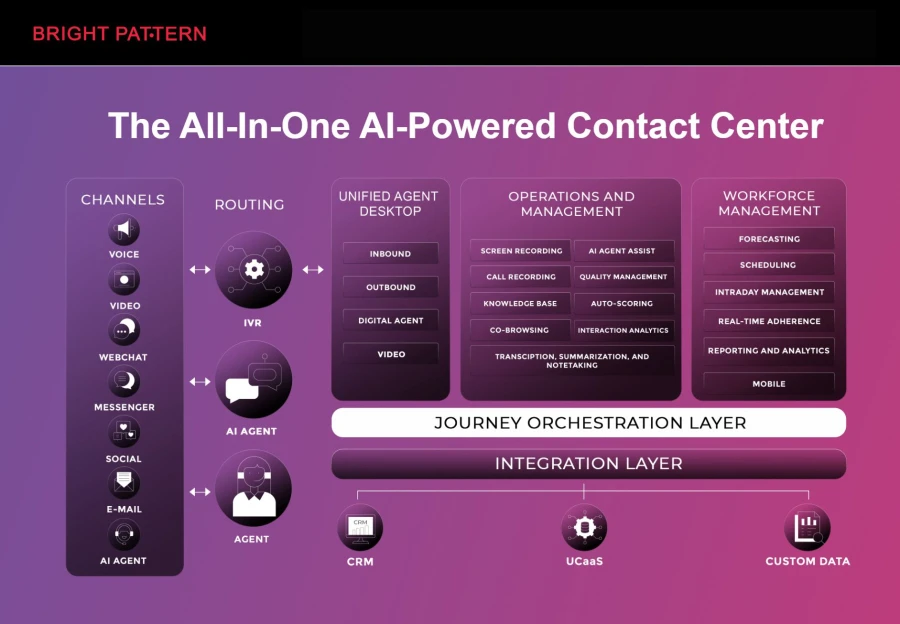
Why #1: Bright Pattern is consistently ranked as a leader in AI‑powered contact center platforms due to its unified omnichannel capabilities, strong AI automation, real‑time agent assist, and pricing flexibility across tiers. Its pricing tends to be competitive on a per‑agent basis compared with large incumbents, with entry‑level plans that can be more affordable for small and mid‑sized teams.
Pricing Highlights
Typical per‑user pricing: ~$40–$150 /month depending on features and support.
First‑year fully loaded (10 users): approx. $6,800–$28,000 including onboarding and implementation.
AI features included in higher tiers; customizable modules available.
Best For: Mid‑market to large enterprises that need strong native AI, omnichannel routing, and integrated analytics without stitching multiple products together.
2. Genesys Cloud CX
Overview: A major AI‑enabled contact center suite with native AI bots, predictive routing, agent assist, and analytics — widely used by large enterprises.
Pricing Estimates
Roughly $75–$155+ per agent/month depending on plan and AI capabilities.
Enterprise and advanced analytics tiers can push towards premium pricing.
Best For: Organizations needing deep journey orchestration, large‑scale AI automation, and advanced workforce optimization.
3. NICE CXone
Overview: Full‑featured contact center platform with AI for analytics, workforce optimization, sentiment analysis, and automation.
Pricing Estimates
Estimated $71–$249 per user/month depending on the suite tier and included AI features.
Best For: Enterprise environments requiring strong workforce and quality management alongside AI.
4. Talkdesk
Overview: Cloud contact center with AI add‑ons, conversational IVR, and automation — often used in mid‑to‑large teams.
Pricing Estimates
Entry‑level starts around $85/user/month, with AI and premium tiers reaching $145+/user/month.
Best For: Mid‑market or tech‑forward teams seeking scalable cloud contact center with optional AI bundles.
5. Five9
Overview: Enterprise‑grade contact center platform with optional AI features like intelligent virtual agents, agent assist, and analytics.
Pricing Notes
Requires custom quote; generally considered mid‑to‑upper end on per‑agent pricing.
Typical industry estimates suggest $150–$250+ per agent/month on bundled plans with advanced automation.
Best For: Larger contact operations where configurability and enterprise reliability are priorities.
Overview: Parloa is an enterprise-grade AI Agent Management Platform that automates complex, multi-step customer service interactions across voice and chat. Designed for high-volume environments, it orchestrates the entire AI agent lifecycle—from design and testing to optimization—enabling businesses to deliver personalized, professional service at scale.
Pricing Estimates
Consumption-based pricing model that ties costs directly to task complexity and business value.
Integrated ROI analytics provide clear visibility into automation performance and cost savings.
Best For: High-volume enterprises in the insurance, travel, and retail sectors that require sophisticated, multi-step AI agents and deep integration with existing backend systems.
Businesses considering Parloa should also explore Parloa alternatives to compare competing AI voice platforms based on pricing, implementation time, integration capabilities, and overall flexibility.
Smart Tips to Budget for Contact Center AI
Planning your investment wisely helps you avoid unnecessary costs while maximizing the value of your AI solution. A well-structured budget ensures that your contact center remains efficient, scalable, and aligned with your business goals. Here are seven practical tips to guide your decision-making:
1. Assess Your Current Needs First Start by identifying your immediate business requirements. It’s easy to be tempted by advanced AI features, but not all of them are ضروری at the beginning. Focus on core capabilities like call handling, basic automation, and reporting. This prevents overspending and allows you to build a strong foundation before expanding.
2. Forecast Interaction Volume Understanding your expected volume of calls, chats, and emails is critical. This helps you choose the most cost-effective pricing model—whether that’s per-agent or usage-based. Accurate forecasting also prevents unexpected charges during peak seasons or rapid growth periods.
3. Prioritize High-Impact AI Features Not all AI tools deliver the same value. Focus on features that directly improve efficiency and customer experience, such as intelligent call routing, IVR systems, and chatbots. Prioritizing these high-impact tools ensures you get measurable ROI from your investment.
4. Factor in Hidden Costs Beyond the base subscription fee, there are often additional expenses to consider. These may include onboarding, employee training, system integrations, maintenance, and support services. Accounting for these upfront helps you create a more realistic and sustainable budget.
5. Choose Scalable Solutions Your business will grow, and your contact center technology should grow with it. Select a platform that allows you to easily add users, channels, and features without requiring a complete system overhaul. Scalable solutions save time, money, and effort in the long run.
6. Compare Multiple Vendors Don’t commit to the first provider you come across. Evaluate multiple vendors, compare their pricing structures, features, and support offerings. This gives you a clearer picture of what’s available in the market and helps you find the best balance between cost and value.
7. Leverage Long-Term Discounts Many providers offer discounts for annual or multi-year contracts. If you’re confident in your chosen solution, these agreements can significantly reduce overall costs. Just be sure to review terms carefully to ensure flexibility as your needs evolve.
Hidden Costs to Watch Out For
When evaluating AI contact center pricing, base subscription fees are just the start. Additional costs can add up quickly if overlooked:
Integration Costs: Connecting AI to CRM, helpdesk, or ERP systems may require APIs, middleware, or consultants.
Customization Fees: Tailoring dashboards, automation, and reports improves efficiency but may increase costs.
Training Costs: Agents and managers need onboarding and upskilling to use AI effectively.
Data Storage & Analytics: Storing recordings, logs, and analytics can incur extra fees; advanced analytics may cost more.
Support & Maintenance: Premium support and ongoing system updates are often priced separately.
Being aware of these hidden costs helps you plan accurately and avoid budget surprises.
How to Maximize ROI from Your Investment
Budgeting isn’t just cutting costs—it’s ensuring every dollar delivers value. To optimize call center software, businesses need a strategic approach.
Automate Repetitive Tasks Use AI for routine inquiries, call routing, and basic troubleshooting to reduce agent workload, speed up responses, and lower costs.
Leverage Analytics AI analytics reveal customer behavior, agent performance, and service trends. Regular review helps refine processes, remove bottlenecks, and boost efficiency.
Optimize Workforce Management AI-driven scheduling ensures the right number of agents at the right time, minimizing over- or understaffing and improving cost efficiency and service quality.
Enhance Customer Journeys AI personalization based on history and preferences speeds resolution and creates meaningful experiences, increasing satisfaction.
When implemented effectively, AI lowers cost per interaction, increases productivity, and strengthens ROI.
Future Trends in Contact Center AI Pricing
As AI technology continues to evolve, pricing models are becoming more flexible and outcome-driven. Businesses should stay informed about emerging trends to remain competitive and budget effectively.
Pay-as-You-Go: Pay only for what you use—ideal for variable demand.
Bundled AI Features: Advanced tools like chatbots and speech analytics are now often included in standard packages.
Outcome-Based Pricing: Costs tied to results like faster handling times or higher satisfaction.
Competitive Market: More providers drive innovation, affordability, and flexible contracts.
Staying ahead of these trends keeps your budgeting strategy adaptable and future-proof.
Conclusion
Budgeting for AI in contact centers requires a thoughtful balance between cost, scalability, and performance. By understanding pricing models, accounting for hidden costs, and focusing on high-impact features, businesses can make smarter decisions when evaluating AI-based contact center pricing.
Ultimately, the right call center software solutions should not only align with your financial plan but also empower your business to deliver exceptional customer experiences. With the right strategy, contact center AI becomes more than just an expense—it becomes a powerful driver of growth, efficiency, and long-term success.
Budgeting for Contact Center AI: Pricing Strategies for Growing Businesses was last modified: October 14th, 2026 by Colleen Borator
Video hosting platforms built for business let small teams host, brand, and track video content while capturing leads directly inside the player. This guide covers how dedicated hosting compares to YouTube, which features matter most for lead generation, and how to choose a platform that fits a small business budget.
Why should small businesses use a dedicated video hosting platform?
YouTube is free, familiar, and reaches a massive audience. It is also designed to keep viewers on YouTube, not on your website. Every video you upload becomes a launchpad for competitor recommendations, pre-roll ads, and suggested content that pulls attention away from your brand. For a small business investing time in product demos, customer testimonials, or explainer videos, this means your best content is actively redirecting prospects to other channels.
A secure video hosting platform built for business removes these distractions. Your video plays inside a branded, ad-free player that keeps the focus on your content. There are no third-party logos, no competitor suggestions, and no ads interrupting the experience. More importantly, business hosting platforms provide viewer-level analytics that YouTube does not. YouTube tells you how many people watched. A business platform tells you which specific person watched, how far they got, and whether they took action afterwards.
For small businesses where every lead matters and marketing budgets are tight, this data changes how you spend your time. Instead of producing more videos and hoping for the best, you can see exactly which videos generate qualified interest and double down on what works. The cost of entry is lower than most teams expect. Platforms like Cinema8, Wistia, SproutVideo, and Spotlightr offer plans starting from $15 per month, which is comparable to most email marketing tools.
How does in-video lead capture work?
Traditional video marketing relies on a two-step process. The viewer watches a video on your website, then navigates to a separate form to leave their details. Every additional step in that journey loses a percentage of the audience. In-video lead capture removes that friction by placing the form directly inside the video player.
The form appears at a specific moment during playback, typically after the viewer has received enough value to justify sharing their contact information. For a product demo, that might be after the main feature has been shown. For a customer testimonial, it might be after the client shares their results. The viewer fills in their details without leaving the player, and the data is sent directly to the business’s CRM.
Cinema8, a secure video hosting platform, supports drag-and-drop lead generation forms that connect to CRM platforms like HubSpot. When a viewer submits their details, the lead appears in your pipeline automatically. There is no manual data entry, no CSV export, and no delay between capture and follow-up. For a small team without a dedicated marketing operations person, this automation saves hours every week and ensures no lead falls through the cracks.
The timing of the form matters. Placing it too early, before the viewer understands what you offer, leads to high dismissal rates. Placing it at the end means only viewers who watch the entire video will ever see it. The best approach is to test multiple placements and compare completion rates, which is straightforward on any platform that offers built-in A/B testing.
What video analytics should small businesses track?
Play count is the most visible metric and the least useful one. A video with 5,000 views and a 12% average watch time is underperforming compared to a video with 300 views and 75% average watch time. The second video reaches fewer people, but those people are absorbing the full message. For small businesses, depth of engagement matters more than breadth.
Business video hosting platforms provide engagement heatmaps that show exactly where viewers rewatch, skip, and drop off. At the aggregate level, these heatmaps tell you which sections of a video need tightening. If viewers consistently drop off at the 45-second mark of a two-minute explainer, that section is the problem, not the video as a whole. At the individual level, heatmaps show how a specific contact interacted with the video, which is directly useful for sales follow-up.
When analytics integrate with a CRM, viewing data flows into contact records automatically. A small business running a product launch can see which prospects watched the launch video, which ones replayed the pricing section, and which ones left before the call to action. This data shapes follow-up timing, content iteration, and budget allocation. Without viewer-level analytics, video marketing remains guesswork. With them, every video becomes a measurable channel with a clear contribution to revenue.
How do branded video players help small businesses look professional?
First impressions happen fast. When a prospect visits your website and clicks a product demo, the video player is part of that first impression. A YouTube embed with ads, competitor suggestions, and platform branding signals that the business borrowed a free tool. A branded, ad-free player signals investment and professionalism.
Customisation covers the player’s colour scheme, logo, custom thumbnails, and which playback controls are visible. For small businesses that operate across multiple channels, from landing pages to email campaigns to partner websites, a consistent player appearance reinforces brand recognition at every touchpoint. White-label players also matter for agencies and freelancers delivering video projects to clients, where the client’s branding needs to appear on the player rather than the hosting platform’s.
The practical advantage goes beyond appearance. Businesses can further enhance their marketing strategy by using an ai video generation to produce branded product videos, explainers, and social media content that integrates seamlessly with interactive video players. A branded player can include interactive overlay elements like call-to-action buttons linking to a product page, a pricing page, or a booking calendar. It can also display lead capture forms at specific moments during playback. This turns the player itself into a conversion tool. When a viewer can book a consultation directly from the video without navigating to a separate page, the friction between interest and action drops significantly.
What security features matter for small business video hosting?
Not all video content is meant to be public. Client proposals, internal training recordings, pre-release product previews, and investor updates all require access controls. Password protection is the most basic option, but professional hosting platforms offer more granular controls that small businesses benefit from as they grow.
Domain restrictions limit where your video embed can appear, which prevents unauthorised websites from embedding your content. Expiring links ensure that shared URLs become invalid after a set period, which protects time-sensitive content like limited-access webinars or seasonal promotions. For businesses with remote teams, single sign-on (SSO) integration lets team members access video content through their existing corporate login without managing separate credentials.
GDPR-compliant processing is a regulatory requirement if any of your viewers or customers are based in the EU or UK. This means the hosting platform must handle viewer data transparently and offer data processing agreements. Platforms that already manage viewer-level permissions tend to have stronger compliance infrastructure because individual-level access control is built into their architecture from the start.
How much does video hosting cost for a small business?
Free plans exist on most platforms but carry limitations on video count, bandwidth, and feature access. For a small business that needs branded players, lead capture, and analytics, paid plans are the practical starting point.
Cinema8 offers a free plan for up to 10 videos with 500 GB of monthly bandwidth. Paid plans start at $15 per month with CRM-integrated lead forms, player customisation, and 360 video support. The Pro tier at $30 per month adds engagement heatmaps, AI chaptering, SEO metadata tools, and 2 TB of bandwidth. All paid plans include a 14-day free trial with no credit card required.
Wistia, Vidyard, SproutVideo, and Spotlightr offer similar entry-level pricing in the $15 to $30 range. The relevant comparison is not the monthly cost alone but the total cost of ownership. A platform that combines hosting, analytics, lead capture, and editing in one product at $30 per month costs less than assembling separate tools for each function at $10 to $20 each. For a small business watching every line item, consolidation reduces both cost and complexity.
Annual billing discounts of 15 to 20% are standard across the industry. If a platform asks for credit card details before you can evaluate its features during a trial, that is worth noting as a friction signal. The strongest platforms let you test the full product before committing.
How should a small business choose a video hosting platform?
Start with the features your team will actually use in the first 90 days. For most small businesses, the core requirements are ad-free branded embeds, viewer-level analytics, in-video lead capture, and a built-in editor or screen recorder that reduces dependency on external production tools.
Test embed performance on your website before committing. A video embed should not noticeably slow your page or harm your Core Web Vitals scores. Platforms that deliver video from dedicated CDN infrastructure perform better because the video stream does not compete with your website’s other resources for bandwidth.
Migration matters too. If you are moving videos from YouTube or another host, check whether the platform supports bulk upload and embed code replacement. Migrating a library of 30 or more videos manually is a significant time cost for a small team. The right choice depends on which capabilities your team needs most in the first quarter and whether the platform can scale with you as your video library and audience grow. Shortlist two or three platforms, run a free trial on each, and test them against your actual website and workflow before committing to an annual plan.
How Small Businesses Can Use Video Hosting to Capture More Leads was last modified: July 9th, 2026 by Ilya Zavertaylo
Choosing a MySQL connector for .NET is not just a cost decision. It affects security architecture, performance behavior, ORM integration, and long-term maintainability.
Free connectors solve runtime connectivity. Commercial connectors aim to solve connectivity plus enterprise constraints: secure transport layers, tooling integration, and governance requirements.
This comparison examines:
Free tools
MySQL Connector/NET (Oracle)
MySqlConnector
Commercial tools
Devart dotConnect for MySQL
Progress DataDirect Connect for ADO.NET
The objective is not to promote pricing tiers—but to clarify where commercial tooling delivers structural advantages.
Free MySQL Connectors
Free connectors are sufficient for many projects. They provide stable ADO.NET access and support standard SSL/TLS encryption.
However, their scope typically ends at runtime functionality.
MySQL Connector/NET (Oracle)
MySQL Connector/NET is the official managed provider from Oracle and serves as the baseline implementation for MySQL in .NET.
It supports:
Standard ADO.NET interfaces
SSL/TLS encryption
Compatibility with MySQL Server releases
Basic ORM integration
Strengths:
Official vendor distribution
Predictable compatibility
No licensing cost
Limitations:
No built-in SSH connectivity
No HTTP tunneling
Limited development tooling
Focused primarily on core connectivity
It works well when infrastructure allows direct DB access and extended tooling is not required.
MySqlConnector
MySqlConnector is a modern, async-first open-source driver optimized for performance and concurrency.
It emphasizes:
True asynchronous I/O
Efficient connection pooling
Broad compatibility with MySQL and MariaDB
Lightweight NuGet-based deployment
Strengths:
Excellent performance in ASP.NET Core APIs
Clean modern architecture
Strong behavior under concurrency
Limitations:
No built-in secure tunneling layers
No design-time Visual Studio tooling
Community support model
It is often the preferred choice for performance-focused, cloud-native services.
Commercial MySQL Connectors
Commercial connectors expand the scope from “connect and query” to “operate securely at scale.”
They address:
Network restrictions
Secure transport requirements
Enterprise governance
Structured vendor accountability
Integrated development workflow
Devart dotConnect for MySQL
dotConnect for MySQL is a commercial ADO.NET provider that extends beyond baseline connectivity by integrating secure transport options, ORM providers, and Visual Studio tooling into a unified ecosystem.
What makes it stand out technically:
1. Network Flexibility Built Into the Driver
Unlike free connectors, dotConnect supports:
SSL encryption
Built-in SSH connections
HTTP tunneling
This means secure connectivity can be configured directly at the provider level without relying on external SSH tunnel services or infrastructure modifications.
In restricted corporate environments, this capability alone can reduce deployment friction significantly.
2. Integrated ORM Ecosystem
dotConnect provides:
Dedicated EF Core provider
EF6 provider
Enhanced MySQL-specific feature handling
Bulk and batching capabilities
This is not just runtime compatibility—it is structured ORM integration with vendor-backed updates.
For teams that rely heavily on Entity Framework, this reduces edge-case behavior and version drift risks.
3. Visual Studio Integration and Developer Workflow
dotConnect includes:
Design-time components
DataSet designers
Extended configuration tools
Performance-oriented utilities
Free connectors typically operate only at runtime. dotConnect improves the development workflow itself, which impacts productivity across larger teams.
4. Enterprise Support and Accountability
Commercial licensing provides:
Structured vendor support
Defined release cadence
Predictable maintenance
Risk mitigation for production systems
In regulated or high-availability environments, accountability becomes part of the technical evaluation.
Where dotConnect Justifies Attention
dotConnect is not positioned merely as a paid alternative. It targets scenarios where:
Direct DB ports are restricted
SSH or proxy routing is required
EF Core integration must be stable and vendor-supported
Visual Studio tooling is part of daily workflow
Production systems require formal support channels
In such environments, the additional feature surface is not optional—it solves real deployment constraints.
Progress DataDirect Connect for ADO.NET
Progress DataDirect focuses on enterprise-standardized, managed connectivity across multiple database platforms.
Its differentiators:
Fully managed wire-protocol provider
Enterprise-grade encryption
Cross-database standardization strategy
Vendor-backed SLAs
DataDirect is typically chosen when an organization standardizes one connector vendor across Oracle, SQL Server, PostgreSQL, and MySQL.
It prioritizes governance over developer tooling richness.
Direct Comparison: Free vs Commercial
Security & Network Capabilities
Feature
Free Connectors
dotConnect
DataDirect
SSL/TLS
Yes
Yes
Yes
Built-in SSH
No
Yes
No
HTTP Tunneling
No
Yes
No
Enterprise Encryption Controls
Basic
Advanced
Advanced
If your infrastructure allows direct access, free tools are sufficient. If network routing or firewall restrictions are common, dotConnect offers a technically cleaner solution.
Performance & Concurrency
Scenario
Best Fit
High-load API services
MySqlConnector
Balanced enterprise apps
dotConnect
Standard CRUD apps
Connector/NET
Governance-focused environments
DataDirect
Performance differences often appear under concurrency stress. However, performance alone is rarely the only deciding factor in enterprise systems.
Tooling & Workflow
Capability
Free
dotConnect
DataDirect
EF Core Provider
Yes
Dedicated
Yes
Visual Studio Design Tools
Minimal
Strong
Limited
Bulk Utilities
Basic
Extended
Enterprise-level
Vendor SLA
No
Yes
Yes
dotConnect provides the strongest development workflow integration among the compared tools.
When Free Tools Are Enough
Free connectors are sufficient when:
Infrastructure is simple
Direct database connectivity is allowed
Advanced tunneling is not required
Community support is acceptable
The team prefers lightweight runtime-only solutions
For startups or API-driven platforms, MySqlConnector is often a strong choice.
When Commercial Tools Become Strategic
Commercial connectors become strategic when:
Network constraints exist
Secure transport flexibility is required
Enterprise governance applies
Vendor accountability matters
ORM reliability must be predictable
Development workflow efficiency impacts team velocity
In those cases, dotConnect for MySQL offers a broader architectural surface—not just a paid version of the same thing.
Summary
Free MySQL connectors such as MySQL Connector/NET and MySqlConnector provide reliable baseline connectivity for .NET applications. They are well suited for straightforward architectures, API-driven systems, and environments where direct database access is allowed and infrastructure is uncomplicated. MySqlConnector, in particular, stands out in high-concurrency and async-heavy workloads.
Commercial connectors expand the scope beyond runtime access. They address secure transport flexibility, enterprise governance, structured vendor support, and deeper integration into development workflows. The right choice depends on architectural priorities.
Free vs Commercial MySQL Connectors for .NET Developers was last modified: March 30th, 2026 by Evelina Brown
Finding a reliable, high-quality vehicle at a reasonable price can feel like a daunting task. Many buyers look locally, but a growing number of savvy drivers are casting their nets across the Pacific. The search for a japanese used car for sale in usa has surged in popularity, and for good reason. From pristine condition to unique models you simply cannot find domestically, importing a vehicle from Japan offers distinct advantages.
With a decades-long global reputation for manufacturing quality vehicles, Japan has become a top choice for used car shoppers around the world. Thanks to the country’s unique approach to vehicle ownership, you can find Japanese vehicles that have been meticulously maintained, lightly used, and available at competitive prices. In recent years, more Americans have started to recognize the value and dependability that Japanese used cars provide.
In this guide, we will explore exactly why these vehicles are highly sought after. You will learn how the stringent Japanese inspection system benefits secondhand buyers, how the import process works through japanese used car importers, how japanese used car exporters ensure quality, and why partnering with a trusted brand like SAT Japan ensures a smooth buying experience.
The Growing Demand for a Japanese Used Car for Sale
Japanese vehicles are globally renowned for their advanced engineering, impressive durability, and dependable performance. But beyond that, when you look at the domestic market in Japan, the standard for a used vehicle is exceptionally high. This is largely due to Japan’s rigorous vehicle inspection system, known as “Shaken.” This mandatory inspection—required every few years—is thorough and becomes increasingly expensive as a car ages. To avoid these high costs and to upgrade to the latest models, many Japanese drivers prefer to sell their vehicles after just a few years of ownership.
As a result, a typical japanese used car for sale boasts incredibly low mileage and an immaculate service history. The roads in Japan are well-maintained, and public transportation is the primary way people commute, meaning that many cars are only driven lightly on weekends and for leisure activities. When you search for a japanese used car for sale, you’re often looking at a vehicle that feels practically brand new, even if it’s a decade old.
Another key factor driving demand is the variety of models available. Whether you want a sturdy family SUV, an efficient daily commuter, or even a rare performance car, a japanese used car for sale offers unparalleled value for your money. There’s a good chance you’ll find features, trims, or unique models unavailable in the domestic US market.
How Japanese Used Car Exporters Ensure High Quality
Getting these exceptionally well-kept vehicles from Japan to the USA wouldn’t be possible without trusted japanese used car exporters. Professionals in this field attend massive auto auctions across Japan, inspecting and bidding on vehicles for international buyers. These exporters are your essential link to accessing the best offerings from Japan’s secondhand automotive market.
Reputable japanese used car exporters provide an incredible level of transparency and trust. They rely on detailed auction sheets that grade every aspect of the vehicle, from the engine condition to the tiniest scratches on the bumper. The accuracy of these notes on the vehicle’s true condition is a hallmark of the Japanese market and is crucial in ensuring buyers abroad get what they pay for.
Because trusted japanese used car exporters value long-term relationships and their reputation, they take grading systems and reporting very seriously. Many exporters, like SAT Japan, offer high-resolution photos, maintenance records, and even live video viewings upon request. By utilizing experienced japanese used car exporters, buyers in the United States gain access to honest, unfiltered data about the vehicle before it ever boards a cargo ship. This level of transparency drastically reduces the risk and uncertainty associated with international car buying.
Another advantage is in selection. Through established japanese used car exporters, you’re able to bid on vehicles from a variety of auctions, not just what’s currently on hand. This widens your choice and increases the odds of finding the perfect vehicle for your needs and budget. The top japanese used car exporters also assist with paperwork, shipping logistics, and inspections, providing end-to-end support.
Navigating the Process with Japanese Used Car Importers
Bringing a foreign vehicle into the United States requires strict adherence to customs regulations, safety standards, and environmental laws. That’s where specialized japanese used car importers become indispensable, particularly for buyers unfamiliar with import procedures. The United States has a specific “25-year rule,” which allows vehicles that are at least 25 years old to be imported without needing to conform to current EPA and DOT standards. This opens the door to importing a wide variety of Japanese classics and specialized vehicles.
However, the process is not as simple as buying domestically. Each step, from export paperwork to customs clearance, port fees, and vehicle registration, can present challenges. Experienced japanese used car importers handle the heavy lifting, managing logistics and documentation to ensure your vehicle arrives safely and legally. They have a deep understanding of international shipping routes, local port procedures, and United States federal laws, thus preventing costly errors or delays.
When buyers attempt the process without assistance from established japanese used car importers, mistakes can lead to vehicles being delayed at port or, worse, denied entry entirely. Dedicated import professionals, such as those working with SAT Japan, keep up with the ever-changing regulations and provide the guidance necessary to avoid common pitfalls. From advising on the best models to import to arranging delivery straight to your door, experienced japanese used car importers transform what could be a legal headache into a seamless transition.
Many top-rated importers, including SAT Japan, offer additional services such as insurance, pre-export inspections, and recommendations for reputable local mechanics who specialize in imported vehicles. These value-added services further ensure a smooth experience for US buyers.
Why SAT Japan Stands Out Among Japanese Used Car Dealers
Selecting from the many available japanese used car dealers is the final but perhaps most critical step in the process. Not all dealers are created equal—some focus on volume, while others prioritize quality, transparency, and customer satisfaction. SAT Japan rises above the competition in several ways, blending the roles of exporter, dealer, and importer under one trusted brand.
What makes SAT Japan truly stand out among all other japanese used car dealers is their unwavering commitment to clear communication, detailed vehicle information, and exceptional after-sales support. They provide thorough photographs, detailed condition reports, and transparent pricing, which means you’ll never face unexpected costs or hidden surprises upon delivery.
Their online platform allows buyers to browse an extensive inventory, read honest vehicle descriptions, and compare prices from the comfort of home. The team at SAT Japan is always available to answer questions and offers guidance throughout the purchasing and shipping journey—an invaluable asset for those navigating these waters for the first time.
More than just sales, SAT Japan values relationships. Every customer receives personalized recommendations based on their budget, usage preference, and style requirements. By working directly with SAT Japan, you benefit from their experience as both one of the leading japanese used car exporters and established japanese used car dealers, ensuring every aspect of your purchase is handled with professionalism and care.
Customer reviews and testimonials highlight the trust consumers across the United States place in SAT Japan. Their attention to detail, transparent processes, and commitment to satisfaction have earned them a top spot among discerning car buyers. When you choose SAT Japan, you’re opting for peace of mind and a partner who truly values your investment.
Tips for a Successful Japanese Used Car Purchase
To make the most out of your experience with a japanese used car for sale in usa, consider the following tips:
Research Models and Regulations: Some vehicles are easier (and less costly) to import. Review the 25-year import rule and make sure any vehicle you select qualifies.
Choose Trusted Partners: Work with reputable japanese used car exporters, importers, and dealers like SAT Japan to reduce risk and ensure a smooth process.
Review Documentation Thoroughly: Always check auction sheets, service records, and inspection reports. If you’re unsure, ask for clarification or additional proof from your dealer.
Plan for Shipping and Delivery: Factor in shipping time, port fees, and local delivery logistics so you’re prepared when your vehicle arrives.
Budget for Registration and Compliance: Some states have unique rules for registering imported vehicles. Research your local laws and have the necessary paperwork ready upon arrival.
Conclusion
Opting for a japanese used car for sale in usa is a brilliant way to secure a reliable, well-maintained, and uniquely appealing vehicle that stands out on American roads. By understanding the rigorous standards of the Japanese domestic market and leaning on the expertise of seasoned professionals such as SAT Japan, you can purchase with confidence and ease.
Whether you are looking for a daily driver with exceptional build quality or a legendary JDM classic that turns heads, working with a trusted partner like SAT Japan guarantees you receive excellent value and peace of mind. Start browsing their extensive inventory today and discover the unmatched quality of imported Japanese vehicles. Embrace the advantages of transparency, reliability, and support that only established japanese used car dealers, exporters, and importers can offer. Your dream car is closer than you think!
Why Choose Japanese Used Cars for Sale in the USA? was last modified: March 30th, 2026 by John Edward
Singapore’s competitive business landscape demands flexible access to capital. Whether you’re managing seasonal cash flow, purchasing equipment, hiring staff, or expanding operations, corporate loans provide the structured financing businesses need without diluting ownership. This comprehensive guide ranks Singapore’s top 8 corporate loan providers, compares key features, rates, eligibility, and approval speeds, and helps you identify the best option for your specific business situation.
With Enterprise Singapore’s EFS schemes extended through 2026 offering up to 90% government risk-sharing, and digital loan platforms processing applications in under 48 hours, corporate financing has never been more accessible for SMEs. New car registrations grew 12.3% year-on-year in Q1 2026, signaling robust business activity that drives loan demand across retail, manufacturing, and services sectors.
What to Consider Before Choosing a Corporate Loan
Corporate loans differ significantly by lender, loan type, and government backing. Understanding these factors ensures you select financing aligned with your cash flow, risk tolerance, and growth objectives.
Loan Purpose and Structure: Term loans provide fixed lump sums repaid monthly. Working capital loans fund operations. Overdrafts offer revolving access. Secured loans use collateral for better rates; unsecured rely on business creditworthiness.
Government Support: Enterprise Financing Scheme (EFS) loans through participating banks carry 70-90% government risk-share, reducing lender caution and improving approval odds. As of March 2026, EFS covers working capital, project, and trade loans up to S$500,000 per facility.
Total Cost of Capital: Effective Interest Rates (EIR) range 6.8-18% p.a. depending on risk profile. Add processing fees (0.5-2%), early repayment charges (0-1 month interest), and legal fees for secured loans. EFS schemes cap fees at preferential levels.
Eligibility Basics: Singapore-registered business with UEN, minimum 6-24 months operation, S$100,000-S$500,000 annual turnover, and 30% local shareholding for government schemes. Sole proprietors face stricter criteria than Pte Ltd companies.
Approval Timelines: Digital lenders offer same-day decisions. Traditional banks average 2-7 business days. Complex secured loans with property valuation take 10-14 days.
“Over 85% of EFS applications from eligible SMEs received provisional approval within 3 days in Q4 2025.” — Enterprise Singapore Annual Report (Feb 2026)
Best Corporate Loans in Singapore for 2026: Top 8 Picks
The corporate loan Singapore market has to offer blends established banks leveraging government schemes with agile fintech lenders. Here are the top performers across key business needs.
1. Best Overall: DBS SME Working Capital Loan (EFS)
DBS dominates with its comprehensive EFS-backed portfolio serving 500,000+ SMEs. The SME Working Capital Loan offers up to S$500,000 at rates from 7% p.a. EIR 8.5%, with 70% government risk-share and 5-year tenures.
Key Differentiators:
Digital application via DBS IDEAL platform
Relationship managers for complex cases
Multiple EFS products: Working Capital, Project, Trade Loan
No early repayment penalty after 12 months
Eligibility: 12+ months operation, S$150,000 turnover, 30% local ownership.
Approval: 1-3 business days (85% under 48 hours).
Best for: Retail, F&B, manufacturing firms with predictable revenue needing reliable working capital.
2. Best Rates: UOB BizLoan (EFS)
UOB leads pricing with advertised rates from 6.8% p.a. EIR 8.2% on EFS Working Capital Loans up to S$500,000. Strong for businesses with 2+ years operation and clean financials.
Key Differentiators:
Lowest entry rates among major banks
Flexible secured/unsecured options
BizCube digital portal for applications
Free business advisory services
Eligibility: 24+ months, S$200,000 turnover.
Approval: 2-5 business days.
Best for: Profitable SMEs prioritising lowest total cost over speed.
3. Best for Startups (<2 Years): HSBC SME Business Loan
HSBC targets newer businesses with unsecured loans up to S$200,000 from 8.5% p.a. Lower revenue thresholds and global banking relationships suit exporters and tech startups.
Key Differentiators:
Accepts 6+ months operation
Revenue threshold S$100,000 (lowest tier)
Multi-currency accounts bundled
International trade financing available
Eligibility: 6+ months, S$100,000 turnover.
Approval: 2-4 business days.
Best for: Tech startups, exporters, businesses with international revenue.
4. Best Equipment Financing: OCBC Term Loan
OCBC excels in asset-backed financing up to S$2M, financing 80-90% of equipment/machinery value at 7.5% p.a. EIR 9%. Ideal for capital-intensive industries.
Best for: Manufacturing, construction, medical equipment purchases.
5. Best Government-Backed: Standard Chartered EFS Loan
Standard Chartered maximises EFS benefits with 90% government risk-share on Working Capital Loans up to S$500,000 from 7.2% p.a. Specialises in seasonal businesses.
Key Differentiators:
Highest government guarantee ratio
Seasonal cash flow expertise
Structured Trade Finance integration
Priority processing for EFS applicants
Eligibility: 12+ months, S$150,000 turnover, 30% local ownership.
Approval: 2-5 business days.
Best for: Seasonal F&B, retail, agriculture businesses.
6. Best Unsecured: SingFinance BizLoan
100% unsecured loans up to S$300,000 from 9% p.a. for established SMEs. No collateral stress, fast digital process.
Key Differentiators:
Fully digital, no branch visits
Accepts weaker balance sheets
48-hour approval guarantee
Flexible 6-36 month tenures
Eligibility: 12+ months, S$120,000 turnover.
Approval: 24-48 hours.
Best for: Service businesses, consultancies without hard assets.
7. Best for Quick Cash: Bizcap Working Capital Facility
Online lender funding up to S$500,000 within 24 hours from 12% p.a. Invoice-based approval bypasses traditional financials.
DBS holds 32% SME loan market share in Singapore (Q4 2025), processing S$12.4B annually across 500,000+ business customers. Their EFS execution combines:
Digital Excellence: DBS IDEAL processes 85% of applications without branch visits. AI-driven risk scoring approves 78% of eligible EFS cases within 48 hours.
Product Breadth: 5 EFS variants — Working Capital (S$500K), Project (S$2M), Trade (S$1M), Equipment, Micro. Covers every business stage.
Ecosystem Integration: Loans link seamlessly to DBS business accounts, corporate cards, trade finance, and cash management. Single sign-on across services.
Support Infrastructure: 120+ dedicated SME relationship managers, WeCare advisory programme, and 24/7 IDEAL support.
2026 Advantage: EEAI extension through Dec 2026 maintains preferential EFS rates while competitors face rising funding costs.
Corporate Loan Application Process (All Lenders)
Prepare Documents (1 day): UEN, latest financials, bank statements (6-12 months), business plan, collateral details
Online Application (30 mins): Lender portal submission with SingPass/business profile
Personal guarantees common for directors. Business default impacts personal score via Credit Bureau Singapore.
EFS corporate loan benefits?
70-90% government risk-share, capped fees, preferential rates, higher approval odds.
Early repayment corporate loans?
Most allow after 6-12 months with 1-month notice fee. EFS schemes typically penalty-free.
Best corporate loan for equipment purchase?
OCBC Term Loan — 90% LTV up to S$2M, tenure matches asset life.
DBS vs UOB corporate loans?
DBS: Better digital process, broader EFS range. UOB: Lower headline rates for strong applicants.
Summary
Singapore’s SME lending market in 2026 offers more options than ever. Government-backed Enterprise Financing Scheme loans now carry up to 90% risk-sharing, making approval easier and rates more competitive. For most businesses, DBS leads the pack — it holds 32% of the SME loan market and approves the majority of EFS applications within 48 hours. UOB offers the lowest rates starting at 6.8% p.a., while HSBC is the go-to for startups under two years old.
Businesses needing cash the same day can turn to Bizcap, which funds against invoices with no personal guarantees. The right loan depends on four things: how fast you need funds, whether you have collateral, your revenue level, and how long you’ve been operating. Rates range from 6.8% to 18% depending on your risk profile — so choosing the wrong lender can cost significantly more than necessary.
Best Corporate Loans in Singapore (2026): Top SME Financing Options for Every Business Need was last modified: April 27th, 2026 by Lincoln Selleman
A delivery route optimization app with accurate ETAs helps businesses plan better stop sequences, reduce wasted driving time, and give customers clearer arrival expectations. Instead of relying on basic maps and manual guesswork, delivery teams can organize multi-stop routes in a more practical order and make the day easier to manage from the first stop to the last.
What a Delivery Route Optimization App Actually Does
A standard navigation app is built to guide someone from one location to another. A delivery route optimization app is designed for a different kind of task – arranging multiple stops in the most efficient order while keeping timing in mind across the full route.
That difference matters because delivery work is not just about finding directions. It is about deciding which stop should come first, how to avoid unnecessary backtracking, and how to make the route flow in a way that saves time over the course of the day. For businesses with regular delivery activity, this can have a noticeable effect on productivity, customer communication, and operating costs.
Accurate ETAs are a central part of that value. A rough estimate may be enough for a casual trip, but delivery businesses need something more dependable. Better ETAs make it easier to set expectations, reduce uncertainty, and communicate arrival times with more confidence. Customers are more comfortable when the timing feels specific rather than vague, and internal planning becomes less reactive when estimates are grounded in a stronger route plan.
The Problems Caused by Poor Route Planning
Inefficient routes create more than extra mileage. They affect the rhythm of the whole day and often lead to a chain of avoidable problems.
One of the most obvious issues is too much windshield time. When stops are placed in the wrong order, drivers spend more time traveling than delivering. Extra turns, repeated backtracking, and awkward sequencing can make even a modest route feel bloated. The result is lower output and less productive use of work hours.
Missed delivery windows are another common problem. When timing is based on guesswork instead of a carefully planned route, arrival estimates become harder to trust. Customers may end up waiting longer than expected, and teams have to spend more time explaining delays that could have been prevented with better planning.
Costs tend to rise as well. Longer routes usually mean more fuel consumed and more labor hours used to complete the same amount of work. Over time, these inefficiencies make it harder to keep delivery operations lean and predictable.
Manual planning adds its own burden. Many businesses start with spreadsheets, handwritten notes, or simple mapping tools. That may feel manageable at first, but as stop counts grow, the process becomes slower and less consistent. Small planning errors begin to repeat themselves, and the route quality can vary from day to day.
Why Accurate ETAs and Better Routing Matter
A well-planned route does more than save distance. It creates a smoother delivery day and gives businesses more control over how work gets completed.
One of the clearest benefits is earlier route completion. When the stop order makes sense, there is less wasted movement between deliveries. That can shorten total route time and help businesses finish earlier without adding pressure to the day.
Better routing also improves delivery reliability. When stops are arranged more logically and ETAs are more dependable, arrival times become more consistent. This helps businesses avoid over-promising and gives customers a better experience because they have a clearer sense of when to expect their order.
There is also a direct efficiency gain. Less backtracking usually means less fuel usage and less drive time. Those improvements may seem small at the level of a single route, but they can add up quickly over weeks and months.
Another advantage is route capacity. Saving time between stops can open up room for more deliveries in the same day. That gives businesses a way to handle greater demand without making the workflow feel heavier.
Accurate ETAs also reduce routine friction. When customers already have a realistic arrival estimate, there are usually fewer calls and messages asking where the delivery is. That makes communication cleaner and frees up time that would otherwise be spent providing status updates.
What to Look for in Route Optimization Software
Not every routing tool is built for delivery operations, so it helps to focus on practical capabilities rather than flashy language.
A useful app should make multi-stop planning fast and straightforward. If building a route takes too much effort, the software adds work instead of removing it. ETA accuracy should also be strong enough to support actual customer communication at the stop level, not just broad route estimates.
Ease of use matters just as much. A route planning tool should feel simple enough to fit into daily operations without creating extra friction. It should also make route changes manageable when plans shift during the day and a sequence needs to be revised.
Businesses comparing options often look for signs such as:
Drivers spending too much time on the road
Routes being built manually each day
Customers frequently asking for arrival updates
Delivery timing feeling inconsistent
Costs continuing to climb without a clear reason
These are all signals that route quality may be limiting efficiency more than it should.
Why Businesses Choose Optiway
Optiway is built for businesses that want cleaner route planning, more accurate ETAs, and less wasted time on the road. It helps turn route planning into a practical advantage instead of a repetitive daily hassle.
With smarter route optimization, businesses can create more efficient runs based on the stops they need to complete. That leads to routes that feel tighter and easier to execute. Accurate ETAs at every stop make communication more dependable and give customers a clearer picture of when their delivery is likely to arrive.
The result is less windshield time and more productive days. When unnecessary miles are reduced, businesses can get more value from the same workday and create space for smoother operations overall. Just as importantly, Optiway helps teams improve route planning without making the process feel complicated.
For businesses getting started, the first step is usually simple – review how routes are currently built, identify where time is being lost, and look for recurring timing problems. From there, choosing software that puts ETA accuracy and route efficiency first can make a meaningful difference in both delivery speed and daily consistency.
Delivery Route Optimization App with Accurate ETAs was last modified: March 28th, 2026 by Colleen Borator