PowerPoint videos for employee updates are easier to maintain when stable explanations and changing instructions are separated before export. Record the source slide and owner for each scene, along with the employee task it explains.
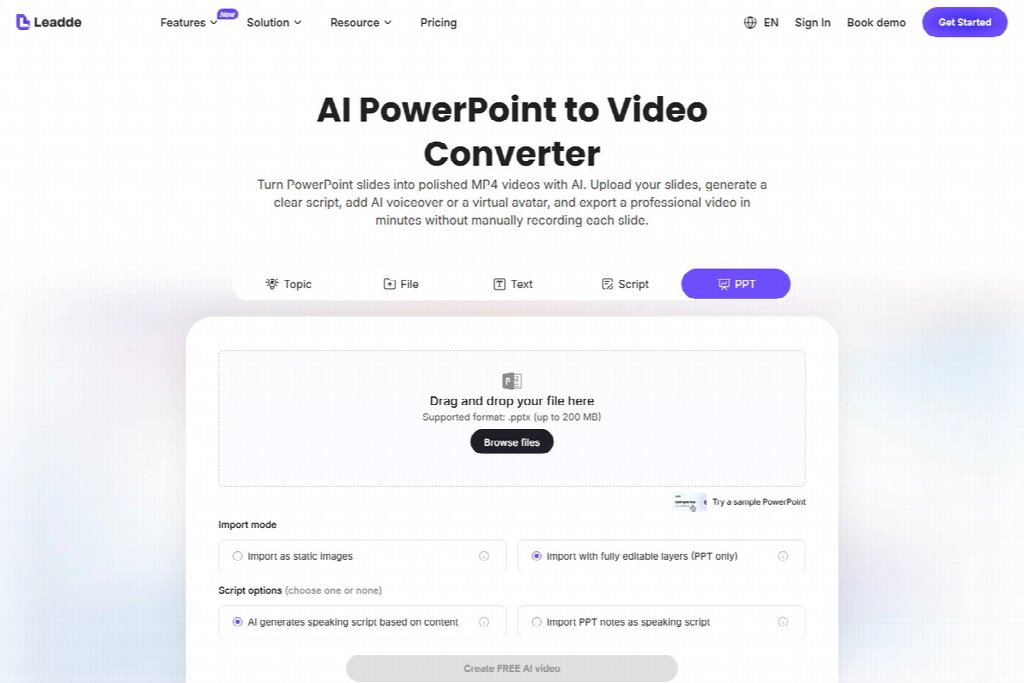
This promotional guest article introduces Leadde for teams looking to turn staff presentations into video. Its public page describes converting presentation material into editable video scenes; the method here concentrates on keeping routine software and process updates understandable when the next revision arrives.
How should PowerPoint videos for employee updates be divided?
Divide the video into stable context, changing instructions and the next action. For example, “The request form has moved” needs a current navigation scene, while an explanation of the approval process can sit in a separate scene that is reviewed when the process changes.
For that update, open with the process explanation, show the current form location in the next scene and finish with a link to the maintained instructions.
Use the employee’s task to decide where a scene starts and ends. One slide may contain unrelated decisions that need separate scenes; a diagram across two slides may explain a single idea.
Material
Typical role in the video
Update trigger
Why the process exists
Stable context
Process purpose changes
Who submits a request
Audience and scope
Responsibilities change
Where the form is located
Current instruction
Navigation or URL changes
What happens after submission
Expected next step
Approval route changes
Where to find help
Maintained destination
Support ownership changes
Use this sample structure to identify which scene depends on which part of the written instruction.
Choose between a direct export and a rebuilt presentation
A direct PowerPoint export may be sufficient if the slides, narration and timing are already prepared. Microsoft’s presentation-to-video documentation describes export options, including how recorded timings and narration can be used.
Check the instructions for the version of PowerPoint available to your team. Desktop, browser and operating-system versions can differ.
A deck designed for a live presenter may need to be rebuilt as video scenes. Rewrite fragments and dense notes into an explanation that viewers can follow on their own, then reorder the visuals where the explanation calls for it.
Leadde also publishes a guide to turning PowerPoint slides into AI lecture videos. Its slide-to-lesson framing can provide additional context, while an employee update should stay focused on the immediate workplace action.
Prepare a deck that exposes the important change
Remove obsolete navigation paths and draft screenshots before import. Give the editor the approved deck, with its revision clearly identified.
For a hypothetical form move, the slide might show the old and new locations. The narration should explain the change directly: “Open the service portal and use the current request link shown on the instructions page.” If the old route no longer helps the employee, it may not need to appear at all.
Keep screenshots readable at the final viewing size. Crop to the relevant area without removing the label that identifies the application. Use actual authorised captures of the interface; an illustrative mockup cannot verify where a button is located.
Speaker notes can be a starting point for narration, but they often contain reminders rather than complete explanations. Read them aloud and fill in references such as “this step” or “the item on the right” when the visual context is not obvious.
Build and inspect the video scene by scene
Evaluate the current import and editing controls on Leadde’s public tool page and in the account being used. After importing approved material, compare the draft scenes against the source deck before adjusting the visual style.
Look for missing qualifiers, reordered instructions and labels that have become too small. For an interface demonstration, include the actual screen recording you prepared. Importing a document does not capture a software session.
Public Leadde page for PowerPoint videos for employee updates, captured on September 9, 2026; not a hands-on test.
For the form-move example, finish the navigation scene at the point where the employee reaches the current instruction page. Keep any required explanation of eligibility or approval in its own scene. During review, ask someone to follow the route from the staff hub, using an account with the access employees actually have. A link that works for the producer may lead a colleague to an access request instead.
Have the process owner check the meaning and sequence, then ask someone unfamiliar with the change to explain the next action. Both should watch the exported file to catch viewing problems that may not appear in the editor preview.
Keep a small release record beside the source
For a short employee update, a shared table can connect the video to its source deck, approved instruction and distribution link.
Record field
Why it helps
Source deck identifier
Shows which presentation was used
Instruction revision
Connects the explanation to the current process
Affected scenes
Narrows the next edit
Review owner
Identifies who checks meaning
Published destination
Shows where a replacement must appear
If the deck is stored in OneDrive or SharePoint in Microsoft 365, Microsoft’s Office version-history guidance explains how to inspect earlier versions. Record the approved source revision alongside the export; file history alone does not identify which video employees should use.
When the source changes, review the dependency table before regenerating the whole video. A new help contact may affect only the final scene. A new approval route may require changes throughout the explanation.
Keep the previous release identifiable while directing employees to the current one. Avoid filenames such as “final-new-final” that reveal nothing about the underlying instruction.
Questions before distributing the update
Should the whole deck become a video?
Only if every part serves the employee’s task. Background slides prepared for a meeting may be better retained as reference material.
Can a video replace the maintained instruction page?
A video can explain a change and demonstrate a path. Keep the authoritative written instructions available, especially where employees need to copy a link or check a detail.
What should be checked after a revision?
Inspect the changed scenes, their transitions and every destination link. Then verify that the current file is the one employees can actually reach.
For the first update, choose an existing deck and agree who will review changes. Save the scene references and distribution link with it so the next editor can find what needs updating.
Powerpoint Videos for Employee Updates: Plan for the Next Revision was last modified: September 14th, 2026 by Addison Yes
When you type a question into ChatGPT. Then what? Is this private between you and the app? What if you type questionable content, ask how to hide money from the IRS, or how to fire your boss? Short answer: IRS is clean. Nothing gets reported.
Nothing goes to the police automatically. However, important internal controls can mean your chat is reported to someone.
This is important. The Chat App vendor has a privacy policy that controls what the vendor does by choice. It says nothing about what the vendor can be forced to do. OpenAI deletes your deleted chats in about 30 days. Anthropic keeps safety scores for up to seven years. Google keeps chats a human reviewed for three years, even after you delete them. None of those numbers matter once a court sends a request.
What AI Companies Actually Report
Every major AI company runs the same basic system. Software scans what you type. Most of what it catches goes nowhere. A small slice gets a human. A tiny slice leaves the building.
Tier 1: Reported to authorities
One category, and only one, is required by law. Child sexual abuse material. US companies must report it to the National Center for Missing and Exploited Children under 18 U.S.C. 2258A, and NCMEC passes cases to police.
This is not a gray area or a judgment call. Anthropic scans uploaded images against NCMEC’s known-image database automatically. A match gets reported with your account details. In the first half of 2026 it filed 15,079 reports. Most were automatic image matches. OpenAI reports all instances and bans the account.
Tier 2: Sent to a human reviewer
Some things get a person to look, and that person may call someone. Credible threats against a real, named person. Weapons capable of mass casualties. Attacks on power grids or water systems. Coordinated scam or influence operations. And any account that keeps violating the rules.
OpenAI routes threats against other people to specialized human review, and says cases involving an imminent threat of serious physical harm may go to law enforcement.
Tier 3: Refused and logged
Everything else. Malware. Exploit code. Drug synthesis. Weapons. Adult content. You get a refusal and a note on your file. Nobody calls anyone.
What moves something from tier 3 to tier 2 is usually not the request. It is doing it over and over.
You will not be told. No company says it notifies you when a human reads your chat. You find out only if you get a warning, a restriction, or a ban.
One thing the news gets wrong
Self-harm is not reported to police. You have probably read that it is. OpenAI says plainly that it refers threats against other people, and does not refer self-harm cases, on privacy grounds. What you get instead is crisis resources in the chat.
What “Private Mode” Actually Does
The big US AI companies all offer private chat. None of them make your chat private.
OpenAI’s Temporary Chat stays out of your history and out of training. It is still kept for up to 30 days. Anthropic’s Incognito chats work the same way, also 30 days, longer if flagged. Grok’s Private Chat deletes within 30 days. Google’s Temporary Chat holds 72 hours.
Your boss can still read it. You can be fired for it.
On work accounts, private chats are not private from your employer. Anthropic includes incognito chats in organization data exports and its Compliance API. OpenAI makes temporary chats available to Enterprise admins for 30 days, and says so plainly: that applies “regardless if a custom retention period is defined.”
Microsoft goes further. Its Purview tools let a compliance reviewer see the prompt text you typed, in full. Google’s Vault rules apply to Gemini chats “even if users start temporary chats or delete their conversations.”
Turning off training does not turn off review
Most people find the training toggle and assume they are done. They are not. Anthropic says that if safety classifiers flag a conversation, it may still be reviewed and used – whatever your setting says. OpenAI keeps temporary chats up to 30 days “for safety purposes.” Microsoft is blunt about it: “an opt-out of human review is not available.”
Deleting is not always deleting
Anthropic keeps flagged content for two years, and its trust and safety scores about you for seven. Google keeps chats a human reviewed for up to three years, and says they “are not deleted when you delete your activity.”
Delete removes it from your view. Sometimes that is all it does.
The Real Gap: Your Chat Left Your Computer
You already accept this next part. You know your Google searches can end up in court. People have been convicted on their search history.
That was never about Google. It was about the search leaving your machine. Once a query lands on someone else’s server, it becomes their record. And their records can be demanded.
Policy is not protection
A privacy policy tells you what a company chooses to do. It has nothing to say about what a company can be made to do. Those are separate questions, and only one of them is up to the company.
How the gap gets opened
From least effort to most:
A freeze request. Police can tell a company to preserve your records for 90 days while they go look for grounds. No judge. No notice to you. Your data outlives the deletion policy.
An emergency handover. Both Anthropic and OpenAI can release your data with no court order at all if they believe someone faces imminent physical harm or death. That is the company’s judgment call, not a judge’s.
A subpoena for your account records. No judge required.
A warrant for the actual words you typed.
A gag order so the company cannot tell you any of this happened.
A civil lawsuit. Divorce. A dispute with an employer. Same logs, no crime needed.
Someone else’s lawsuit. In 2025 a court ordered OpenAI to preserve chat logs it would otherwise have deleted, in a copyright case no user was part of. Your delete setting lost to a stranger’s court filing.
So what about the IRS?
Nothing goes to the IRS on its own. There is no pipeline, no partnership, no automatic report. But the IRS can subpoena like anyone else. If you are already under investigation, your chats are reachable.
Your AI chat has no privilege
Talk to a lawyer and it is privileged. Talk to your accountant and there are protections. Talk to an AI and there is nothing. No confidentiality, no privilege, no professional shield.
If you are the professional, it cuts the other way. Under 26 U.S.C. 7216, a tax preparer who puts client-identifiable information into a public AI tool without consent faces civil and criminal penalties.
Using local AI is a privacy solution
Run the model on your own machine. A local AI, or local image and video generation on your own GPU, has no vendor, no server, and no log for anyone to subpoena.
Three Cases People Ask About
First, one distinction that clears up most confusion. There are two different things people mean by consent.
Subject consent is whether the real person in the image agreed. Depicted consent is whether the scene shows consent. Only the first one is a legal question. The second is a plot.
Undressing apps
Apps that strip clothes off a photo. Many are marketed openly by overseas firms. That marketing tells you nothing about your own exposure.
The TAKE IT DOWN Act makes it a crime to publish an intimate image of a real, identifiable adult without their consent. AI-made images count. So does a disclaimer saying it is fake – that is not a defense.
Two things people get wrong. The crime is publishing, not generating. And consent to be photographed is not consent to be published. Those are separate permissions.
If the person is a minor, none of this analysis matters. It is child sexual abuse material, whatever app made it, and it is still illegal when no real child exists.
Since May 2026 platforms also have 48 hours to remove this content once someone reports it. Penalties run past $53,000 per violation.
Real people in political content
The May law only covers intimate images. A political deepfake is not intimate, so that law does not touch it.
Other rules do. Many states now require a disclosure label on synthetic political content near an election. Defamation still applies. So does the right to control commercial use of your own face. Parody has real protection.
The line is simple. Non-intimate satire is mostly protected speech.
Fantasy and fetish content
All adults, invented characters, unusual scenarios, non-human or creature subjects. No real person exists, so nobody’s consent is missing. Nothing here is reportable.
What is left is obscenity law, which is decided by a local jury after the fact, not by a checklist you can follow in advance. Platform rules are far stricter and will stop you long before the law does.
One real trap. Youthful-appearing characters. Species, setting, and art style do not matter. If a character reads as a child, you are in the one category with mandatory reporting.
The Line Is Not Public Versus Private
Most people think the rule is about whether something is public. It is not. The rule is about whether the file moved.
Obscenity law is written around verbs like ship, transport, sell, and distribute. Possession is not on that list. The Supreme Court held in 1969 that what you keep privately at home is protected.
So the ladder looks like this.
You make it and keep it. Obscenity law does not reach it. Child sexual abuse material still does – possession alone is the crime there.
You send it to one person. That is distribution. A private message, an encrypted app, one trusted friend – none of that matters. The statute has no minimum audience.
They post it. That is their problem, and yours too if you handed it over expecting that.
You post it free. Platform rules bind you long before the law does, and they are much stricter.
You sell it. Now payment processors are involved, and their rules are tighter than any statute.
Private possession is protected. But the minute you share to one other person, you have opened the door as a publisher.
Edge cases worth knowing
Cloud backup counts as moving it. Google Drive and Dropbox scan what you upload. Syncing a folder is transmission, even though it feels like storage.
Payment processors outrank the law. Visa and Mastercard rules end more creator accounts than any prosecutor ever has.
Your model has a license too. Plenty of checkpoints and LoRAs forbid adult output even where the law allows it.
A LoRA trained on a real person turns your “generic” AI face into an identifiable individual. You built the evidence into the model.
Age records. Federal recordkeeping rules cover human performers. Synthetic content has none. However, may you need to retain a record that your content is AI created.
Outside the US this all changes. The UK and EU have their own rules.
What the AI Companies Actually Do
They refuse things. They keep a log. They send a narrow slice to a human. They report one category to authorities because the law requires it. That is the whole job.
They are not watching for you. They are not calling the police about your prompts.
The odds of an AI company reporting you for anything other than child abuse material are close to zero.
The exposure was never the company’s intentions. It was the transmission. Your prompt left your computer, landed on a server, and became a business record belonging to someone else. Everything after that is out of your hands and out of theirs.
Anything you share – even with one person – can break laws you never read, in places you have never been. And anything you keep to yourself, on your own machine, is protected private possession.
The Short Version
Reported to police: child sexual abuse material. That is the list.
Not reported: self-harm, adult content, and almost everything else. You get a refusal or a ban.
Nothing goes to the IRS, but the IRS can subpoena it like anyone.
Private mode is not private. It hides the chat from you and keeps a copy for 30 days.
Your employer can read work chats, private mode included.
Delete does not always delete. Flagged content and human-reviewed chats are kept for years.
No privilege. An AI is not your lawyer, your accountant, or your doctor.
Police need very little to freeze your records, and no judge at all.
Keeping it is legal. Sending it is the crime. One recipient is enough.
Local generation is the only choice that changes your legal position.
Frequently Asked Questions
Are my AI conversations private?
No. Every prompt goes to a company server and becomes their record. Private from other users, yes. Private from the company, a court, or your employer, no.
Can ChatGPT report you to the police?
For child abuse material, yes, and it is required to. For a credible threat against a real person, possibly, after a human reviews it. For anything else, no. You get a refusal or a ban.
Is Claude incognito really incognito?
Not really. Incognito chats stay out of your history and out of training. Anthropic still keeps them 30 days, longer if flagged, and includes them in organization exports and its Compliance API. So your employer can see them.
Can AI chats be used against you in court?
Yes. They are stored records with no legal privilege. Prosecutors, opposing lawyers, and divorce attorneys can all reach them.
Does AI report self-harm to authorities?
No. This one is widely misreported. OpenAI refers threats against other people and says it does not refer self-harm cases, on privacy grounds. You get crisis resources in the chat instead.
Can police get my AI chat history?
Yes, and it takes less than you think. Account records need only a subpoena. The actual text needs a warrant. Freezing your data for 90 days needs no judge at all.
Does deleting an AI chat really delete it?
Usually within about 30 days. But flagged content sticks around for two years at Anthropic, safety scores for seven, and Google keeps human-reviewed chats three years even after you delete your activity.
Does turning off training make my chats private?
No. It stops your words from teaching the model. It does not stop safety review. Anthropic reviews flagged chats regardless of your setting, and Microsoft states that opting out of human review is not available.
Can my employer see my AI conversations?
On a work account, yes. Admins can export conversations at OpenAI and Anthropic, including private chats. Microsoft compliance tools show your prompt text in full. Google Vault rules survive both temporary chats and deletion.
Are ChatGPT chats privileged like a lawyer or accountant?
No. There is no confidentiality and no privilege. And if you are a tax professional, putting client information into a public AI tool without consent carries civil and criminal penalties.
Are Chinese AI apps safe to use?
Different question entirely. The issue is not what they report, it is where your data sits and what rights you have over it. Several store data inside China, and none of the eight we checked document a private chat mode. Germany’s regulator went furthest: Berlin’s data protection commissioner reported DeepSeek to Apple and Google for removal, on the finding that “Chinese authorities have extensive access rights to personal data within the sphere of influence of Chinese companies.” Details below.
Company by Company: Where to Check Yourself
These are published policies as of September 2026. They describe what each company says it does, not what it does in practice. Policies change, so check the date on the page when you read it.
OpenAI (ChatGPT)
Retention: chats kept until you delete them, then gone within about 30 days.
Private mode: Temporary Chat. Kept up to 30 days for safety.
Training: on by default for consumers, off by default for business.
Admin access: Compliance API includes temporary chats for 30 days.
Seedance via BytePlus: policy text could not be retrieved.
MiniMax (Hailuo)
Consumer: Singapore entity, no storage location stated, no retention period, training not addressed at all.
API: US data center, but the policy carries PRC consent exceptions verbatim – national security, public interest, criminal investigation.
Private mode: not mentioned.
Domestic: stored in China, real-name phone registration required.
Kuaishou (Kling)
International: Singapore servers, no retention period, no EU entity named.
Training: on by default via the terms, opt-out by email.
Faces: says it collects no face data, but does upload “feature points” and contour lines.
Domestic: an explicit reporting duty. On finding illegal content it reports your account, timestamps, network addresses, hardware details and the content you typed. Consent not required.
US: banned on government devices in New York, Texas, Virginia and several federal agencies. The federal bill has not passed.
Moonshot AI (Kimi)
Three entities with different answers. kimi.com is the Beijing entity, stored in China. kimi.ai is a Singapore company naming no country. The API stores in Singapore.
Which one you get depends on the domain you type.
Training: on by default at all three. Only the Chinese version documents an opt-out, and it requires emailing support and verifying your identity.
Training: reported to be off by default after a 2025 user backlash, but this is not stated in any policy clause we could read. Treat as unconfirmed.
International access is via Tencent Cloud, which may store in mainland China and carries a PRC addendum.
Private mode: not documented.
Two patterns across all eight Chinese vendors. None documents a private or incognito chat mode. And the domestic versions require real-name registration tied to government ID, so nothing there is anonymous by design.
How Private Is ChatGPT – What Gets Reported to the Police or IRS was last modified: September 9th, 2026 by JW Bruns
Creating a video usually starts with a plan. You think about the location, the camera, the people involved, and everything else needed to turn an idea into something people can watch. But not every idea is easy to film.
Sometimes the location doesn't exist. Sometimes a shot would cost too much to produce. And sometimes a creator simply wants to see whether an idea works before putting serious time and money into it.
This is where AI video tools are starting to become genuinely useful. They give creators another way to explore scenes, movement, and visual ideas without beginning with a traditional production setup.
Kling AI is one of the models helping push that shift forward. It gives creators different ways to generate and transform video, whether they are starting with a text prompt, an image, existing footage, or a motion reference.
More Than a Text Prompt
Text-to-video is usually the first thing people think about when an AI video comes up. You describe a scene, add a few details, and wait to see what the model creates.
That can be useful, but creative work rarely begins with a blank page.
A creator may already have a photograph that captures the right visual style. An editor might have footage that needs to look different. Someone working on an animation could have a reference showing exactly how a character should move.
Kling gives creators several ways to work with those starting points instead of forcing every project into the same text-to-video process.
For example, an image can become the basis for a moving scene. A reference video can help guide motion. Existing footage can also be transformed into something visually different.
That flexibility makes a difference because every project starts from a different place.
Different Models for Different Jobs
Not every video needs the same level of detail or control.
A creator testing an idea for a social post may just want to generate a few versions quickly. Someone working on a commercial or short film might need more time to refine the result.
Artlist provides access to different Kling models, allowing creators to choose an option based on what they are trying to achieve. The available models cover a range of capabilities, including video generation, image-to-video workflows, motion control, and video transformation.
This approach can be more practical than treating one model as the answer to every creative problem.
A quick generation might help establish the direction of a scene. Once the idea is clear, the creator can spend more time working on a stronger version.
Better Control Over Movement
Making a still image look good is one challenge. Making a scene move naturally is another.
Movement is often what separates an interesting AI clip from something that actually feels useful in a project. A character needs to move in a believable way. Camera motion should support the scene rather than distract from it.
Kling's motion-based tools are designed to give creators more control over that process. With a motion reference, it becomes possible to guide how a subject moves in the generated result.
This can be useful for character animation, dance content, creative experiments, and previsualization.
For filmmakers, it offers a way to test movement before production. For social media creators, it can provide another option for creating visually engaging content around an existing idea.
Working With Existing Footage
AI video isn't always about creating something completely new.
Sometimes the best starting point is footage you already have.
An editor may want to test a different visual style. A creator could need to change part of a scene without rebuilding the entire shot. Video-to-video workflows make this kind of experimentation possible by transforming existing material.
That is an interesting use of AI because it brings the technology closer to the editing process.
Instead of asking AI to generate a complete video, creators can use it to explore changes to something that already exists. In many real-world projects, that may be more useful than starting over.
Adding Audio to the Experience
Early AI videos often had one obvious limitation: they were silent.
The visuals might look impressive, but a finished video usually needs more than images and movement. Dialogue, ambient sound, and sound effects all help make a scene feel complete.
Newer Kling models are beginning to include audio capabilities alongside video generation. This can include generated dialogue, sound effects, ambient audio, and lip-sync features depending on the model being used.
Of course, that doesn't remove the need for post-production. A professional project will still benefit from careful editing and audio mixing.
But generating sound alongside a visual can give creators a more complete starting point and reduce the amount of work needed just to test an idea.
Where Artlist Fits In
Generating a video is only one part of the creative process.
Once a clip is ready, it may still need music, sound effects, voiceover, additional footage, or other visual assets. Managing separate tools for every part of production can quickly become inconvenient.
That is where Artlist's broader creative platform becomes useful. Alongside access to AI video models like Kling, creators can work with AI images, music, voice tools, stock footage, sound effects, and other production resources.
For someone producing content regularly, keeping more of the workflow in one place can make the process simpler.
Final Thoughts
Kling AI gives creators several ways to approach video production. An idea can start with a prompt, an image, a piece of existing footage, or even a movement reference.
Technology doesn't replace creative direction. A good result still depends on the idea behind it, the references used, and the editing that happens afterward.
But for creators who want more freedom to test ideas and build visuals that would be difficult or expensive to film, Kling offers another useful option. And through Artlist, it can become part of a wider workflow instead of another separate tool to manage.
Kling AI: a Flexible Tool for Modern Video Creation was last modified: September 8th, 2026 by Evee Smara
Five weeks have trickled by since MiniMax set free MiniMax H3. The model shook the whole creative tech crowd. ComfyUI now rolls out its own set of ready-to-go templates. Hugging Face stores the weights. Those graphics card services already offer simple access. Yet, something important never showed up. The world got flooded with user manuals, but prompt advice always circled back to the same huge pile of official examples. Those guides only repeat what MiniMax already gave. So, beginners probably feel seen. Hardcore tinkerers? No help at all. four native H3 templatesHugging FaceOne of them says so in its own title
I have now been consumed by MiniMax. The more I test, the more capabilities I have found. Two weeks ago, I would run a four tool flow – a Picture Generator, a Picture Editor, a Video Creator, and an Audio Addition. Each step is a different ComfyUI run. The final result was a 15 second clip. For a six minute music video, about 50 finished clips. I have about an 80% failure rate so figure 300 clips total. It took me about a month of weekend work to create a 6 minute finished video.
With MiniMax I am finding that I can use MiniMax to edit my picture, and it has much better Audi than LTX, and the Video Engine continues to amaze me in allowing me to add creative elements. I honestly think I can prompt – “The standing man gets on an Elephant and Rides to Paris” and it will do it. (Testing now: Results – without any reference H3 created an elephant and my character properly got on and rode it. No trace of Paris.) Counting failed generations about 300 clips total. week, my own computers and those rental clouds spun up H3. Some tips from the official playbook do what they promise. Some give absolutely nothing. Unspoken rules hide beneath the surface. These patterns came from mistakes. Skimming hardware specs revealed none of them. Anyone frustrated over fake tunes, switched dialogue, or a scene suddenly forgetting a reference might want to look below. The answers probably live here.
H3 Prompting
H3 prompts are a lot different than Stable Diffusion, Wan and LTX.
Many creative tools employ CLIP. That mysterious tool grew from Contrastive Language-Image Pre-training. CLIP may barely notice full sentences. Around seventy words slip through at a time, and the system sniffs around for meaning. Sentence order? Minor. Grammar? Almost invisible. This explains why everyone tosses tags with wild commas. Users keep repeating ideas because CLIP just shrugs at them.
MiniMax H3 rewrites the rules. A large language engine handles the prompts. The tech behind chatbots, called LLMs, fills the job. Qwen3-VL-32B became the brain for H3. Whole sentences matter now. Order matters. Memories from earlier phrases stick. So H3 might actually follow requests, not just notice stray words.
Everything you knew about prompting for Stable Diffusion might just fall apart.
Attention Weight does nothing
Those who came from Diffusion tools love to boost settings with weights. That familiar command, (very slowly:4.0), pushes concepts further. H3 reads each symbol literally. Extra punctuation or numbers get ignored. Changes never appear.
Use time instead. H3 might actually grasp speed. “Each wave takes about two seconds” may work. “Very slowly” might have no effect at all. H3 allows adjective modifiers – very slow, extremely slow. Beware of metaphors – glacially slow may or may not work.
Long prompts work, but keep the grammar plain
I have seen examples where other people use long and texty prompts. I have not tested that. My current opinion is that 90% of their prompt is dead weight. A long prompt takes longer to maintain and adjust than a shorter one. The key is to discover which words are holding weight, and to use them carefully.
In my testing, a flat, direct style gives stronger results than gentle English. And non-grammatical prompts “broken English” work better than proper grammar. If you say, “Max do gawk,” you possibly get better action than, “Max performs a gawk.”
When I first started video generation and I think with Wan, I would use Google Translate to convert my prompts to Chinese (AI Engines speak Chinese) and back. And also I’m somewhat familiar with Asian languages. So plurals collapse, “a” or “the” have no meaning, and adjectives are simple. There’s no real difference between “The man stands up and walks out the door” and the Chinese equivalent, but “The man rises and leaves the room” may not prompt so well. It has the same meaning, but the words that work are more mechanical and more CEFR A1 English rather than B2.
H3 allows you to define actions based on keywords
My most exciting find in H3, that no other engine has, is that there appears to be some programming capability. It is not perfect, but I get some amazing results.
Definitions bind, and they take arguments
Inside a prompt, you might teach H3 a new word and call on it later.
A gawk means a person throws an object outward from their body into the air and out of view.
There are three people in this picture, Max, Mary and Monk.
Max do gawk with yellow ball. then Mary do gawk with green chicken.
then Monk do gawk with blue cat. then Max do reverse gawk with blue cat.
Here I am creating a definition in my prompt and then using it with different characters. With H3 – It followed my rule. Right thing, right person. Not always, but most of the time. The gawk idea acts like a reusable shape with a gap you can fill each time.
It fails to overcomplicate a defined term. In my sample above “reverse gawk” did not work at all. The character did a gawk in the vide, and ignored “reverse.” But I still find this a highly exciting test.
In real life – I think this could allow me to make more human motion. For instance a “queenwave” means to wave your hand gently side by side, without tilting the fingers. “Jesse does a queenwave, then Mary does a queenwave”
Modifiers do not compose
Begin with one clear line to set up who is who. “Two people appear. Max stands to the left, Mary to the right.” After that line, i just use names. I have seen prompting for Subject 1 or (S1) and I have tested that. It did not work as well for me as naming my characters and using the names. There is not strict adherence to the names particularly for characters that are not fully on screen.
Bind names to positions once, then never again
Never link positions such as “left” or “right” in every line. When characters switch spots, every mention flips. Miss one and the entire story breaks. One setup line, fixed in one place, saves the day. Twenty random references guarantee trouble.
H3 appears to have character memory so if my right and left person cross – I can continue to prompt them as Max and Mary.
How to Get the Audio You Asked For and Nothing Else
Two keys control the prompt’s audio. One key may steer the overall_soundscape. The other key operates non_diegetic_music – music that floats in but comes from no object in the scene.
N/A is the off switch, and it is literal
You can switch off either key by writing N/A. Do not invent new terms. Only N/A works, straight from MiniMax’s own prompt notes. Ask for “None.” and H3 will probably guess. “No music please” does not work. “none” does not work.
Say nothing about music and H3 supplies a soundtrack. Every single time. Silence in your lines means nothing. If your aim is no music, non_diegetic_music: N/A becomes the only way. MiniMax’s own system prompt
What follows is the content I would normally prompt for a Wan or LTX video. With this start, I’m telling it to not generate background music, and also do not generate background noise that I do not specify, and to use Picture 1 as the start.
In addition, I have found that generally speaking I do not have to introduce the picture as I do with Wan or LTX. For those I would start with – there are 3 people in this picture, a right person who is a man, a middle person who is a woman and a right person who is a woman monk with shorn hair. Now, I sometimes name the figures, but it is not really needed unless I use the names lower down for dialog. This is just what I found and may not be accurate.
Also about 10% of the time I DO get diegenic music, and about 50% of the time I DO get background sounds – despite my prompt.
Quote the dialogue or you get babble
Leave the lines unwritten and H3 does not go quiet. It invents speech-shaped audio in no identifiable language. It sounds vaguely Romance. It is unusable. If you want words, type the words.
How to Make the Right Character Speak
Mouth movement seems to be the trickiest part of H3. The voice of one character might just leak to someone else, which has puzzled plenty of users. A known problem with the model sits at the heart of this struggle, not simply bad instructions. Discussions have popped up among developers searching for a reliable fix. open ComfyUI issue
Is the d tag required?
H3 documentation says <d> marks speech. Inside the dialogue tag, place just the language marker and the words. Leave everything else outside. Speaker names, clues about how their voices sound, and even their delivery style must stand apart from the dialogue tag. Anything else might confuse the model.
Here is an example that probably helps:
Max, older and deep-voiced, says: <d>[English] I told you it was cold.</d>
Mary responds: <d>[English] Watch me.</d>
The scene becomes clear. Voices connect to the right faces.
Now as a director, I’m highly resistant to this style. So what I would do today is this:
Max: "I told you it was cold."
Mary: "No it is not!"
and for me this seems to work ok – at least as often as the <d> framing. Right now I’m also placing the voice timbre queue in the first use of the voice:
"Max in a high squeaky voice: "I told you it was cold".
Name who stays silent, or change your script
H3 has a very annoying habit of having both people speak the same phrase at the same time.
Right now I’m testing this:
Max: "I told you I was cold" - Mary is silent.
Mary "Watch me" - Max is silent.
Sometimes works.
Sometimes in frustration I re-script a clip to match whoever H3 is favoring in the script. I don’t fight it, I join it.
Off-screen speech needs the exact phrase
When H3 has moved camera focus on one character, the other may be off screen or only partially on screen. If their mouth is not visible, H3 seems reluctant to have them speak. Assigning dialog to the off screen character does not work. So I prompt it separately.
Voice from off screen "I mean it, it is very cold".
It seems to be based on whether the character’s lips are visible.
Write these words exactly—off-screen voice says:—and the line probably works perfectly. Use “offscreen” rather than “off-screen” and it won’t work at all. The system is still internally highly dependent on the words, possible to interpret them in Chinese or through some internal dictionary.
Voice timbre works, but placement decides it
Voice control seemed impossible until I figured out the placement. I tried it on the top or independently. But two things seem to work for me. One is in the character intro:
The left man is Max who is 19 years old and has a high squeaky voice.
Or I can put it in the prompt.
Mary (in a low elegant tone): "It is not cold at all"
I run a lot of side-tests to check the placment. Sometimes works, sometimes not.
Spoken language comes from the picture
The model might guess the speaking language from a reference image, not the prompt. Pictures of people from East Asia, for example, somehow produced Mandarin even when I wrote lines in English. Language can slip away from your plan that quickly.
Anchor the language in your script. Adding a line such as “They speak English” usually keeps H3 on task. Hinting at a nationality sometimes works, but may also change the character’s look—so that trick remains unpredictable.
Timing and the Things That Fight You
H3 fills the duration you give it
H3 will probably not slow down to fill the moments you want. Give H3 more seconds than action beats and it might just invent extra scenes or repeat content. The best results come from matching your video’s timing to the number of actions you planned.
One physical event per clip
Physics looks believable for single actions. A basic throw always works. Try combining a throw with several bounces and H3 probably fails, in every phrasing I tried. Breaking big actions into smaller moments gives much better results.
Motion direction is random unless you state it
Sometimes, actions run in reverse. Once, the ball traveled backwards into a hand instead of away. The model might have learned this as normal from reversed footage in training, so no default direction exists. Describing direction clearly—“away from the body, forward into the distance”—locks the motion in. Later references keep the action moving as planned.
H3 takes hints from what you feed it. I have seen raised arms in the first frame become a throw before prompts even begin. Picking a frame where everyone looks relaxed and neutral may prevent these surprise movements. The starting moment shapes everything that follows.
The start frame’s implied motion happens anyway
H3 reads intent out of your source image. A raised arm in my still became a throw, before the prompted action even started. Choose start frames with neutral posture unless you want that motion.
Shot markers cause the cuts you are avoiding
One time, I tried to use [Shot 2] and [Shot 3] for splitting story moments. That was a mistake. Those tools tell the system when to cut scenes. Unwanted scene breaks kept popping up when I just wanted smooth flow. Now, every action lives together in a single Shot 1 for me.
Failed Generation Due To Size Change
At one point I had 20 clips all tested in small size, and I queued them to generate production size. All 20 clips failed. About 5 seconds in – H3 decided to change the entire background and characters. But the exact prompts worked perfectly in my test to the small size.
And then I found this – Clips tend to change when they hit a certain pixel limit. The larger your image size the sooner that limit is. I have three models in my workflow:
MiniMax H3 - Turbo on - 4 Step Lora
MiniMax H3 - Turbo on - 8 Step Lora
MiniMax H3 - Turbo off - 20 Step
What I found is that I can test small videos quickly using 4-Step. But for production I have to move up to 8 Step or 20 Step to maintain the integrity and quality through the entire 15 second video.
I have not found at all that integrity is lost if I move to 20 or 25 seconds. The motion never repeated. But on my machine, the video production runs out of memory at the longer sizes, and so there is a physical limit to the size/length I can test. For me, 796p at 15 seconds is Max on my PC, and I can go to 20 seconds on an RTX 6000 RunPod, but that’s the extent I have worked with.
If your background is shifting – if sound is degraded – move to the next higher Turbo/Step model and see if it improves.
The Short Version
When writing, go long and use simple language. Describe every action just once, then call it by its chosen name later. Put all names and their spots right at the beginning. Set both audio options to N/A, unless you really want some surprises. Use quotes for each line people speak. Always choose the d tag. At a character’s first words, mention the voice. Clearly say the language. Keep one movement or action for each short clip. Try to match every clip’s length to your dramatic beats. Throw out the shot markers.
None of these secret moves appear in the official instructions. Bad drafts taught me each one. Anyone planning to share work made with H3 should check the terms carefully. People in the United States and the European Union might find a real problem hidden in the rules.
MiniMax H3 Prompting Tips: Real Tips for Better Prompting was last modified: September 8th, 2026 by JW Bruns
A year ago, I blogged that the rate of Video AI sophistication is moving so quickly that I’m changing my entire workflow every five months. Today I’m making clips that I could not even dream of in May 2026. All because of MiniMax H3.
For two weeks, I almost skipped over MiniMax H3. I saw the glowing promotions and figured – like LTX – it can’t be true. I’m a proper guy and I like to follow rules. There is a clear line buried in the license details. Section V.4 says,
You may not use, reproduce, modify, distribute, or display the MiniMax H3 Works or any of their Outputs or results outside the Applicable Territory.
Section I.3 spells out what counts as the territory. Almost the whole globe, except for a handful of key regions.
United States. European Union. United Kingdom. South Korea.
For anyone in those places, the standard license probably shuts people out. I saw that text. Locked doors. I’m not going to invest time in a tool I can’t use.
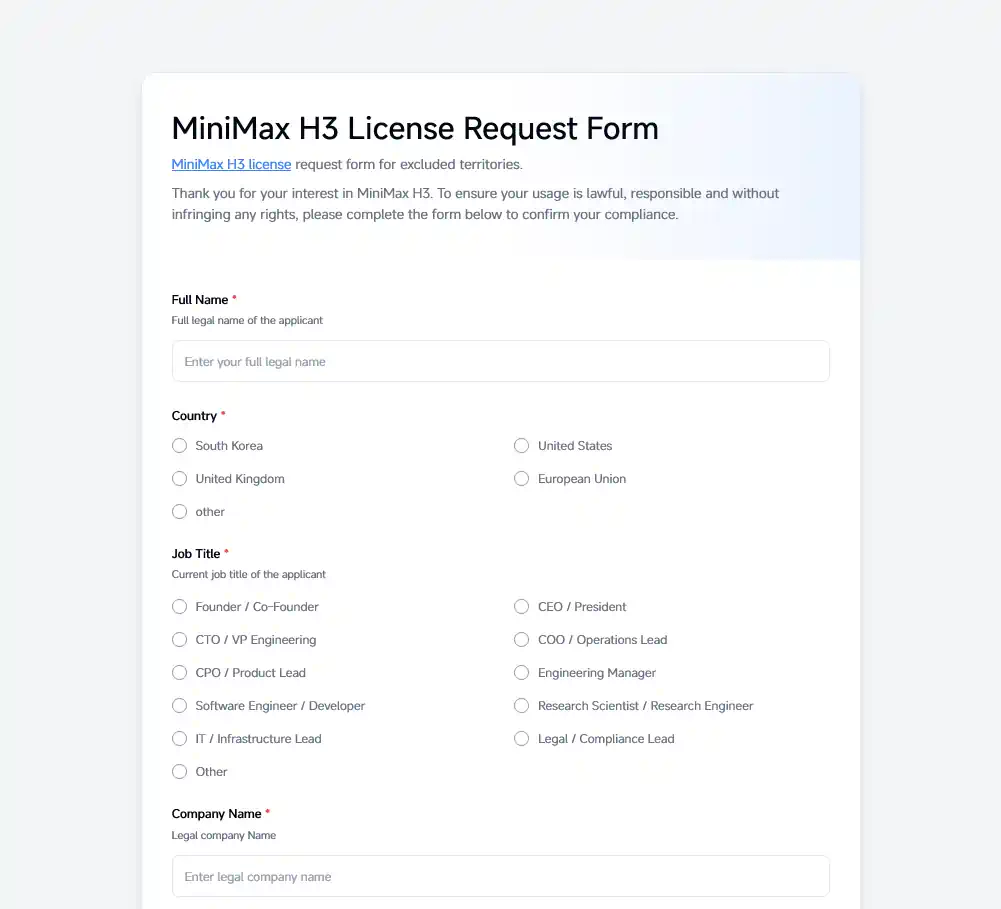
But I’m also a stubborn person. So I figured – what is the workaround? I found this application page people in this blocked group.
The form is brief. I filled it out. What the heck! Live dangerously!
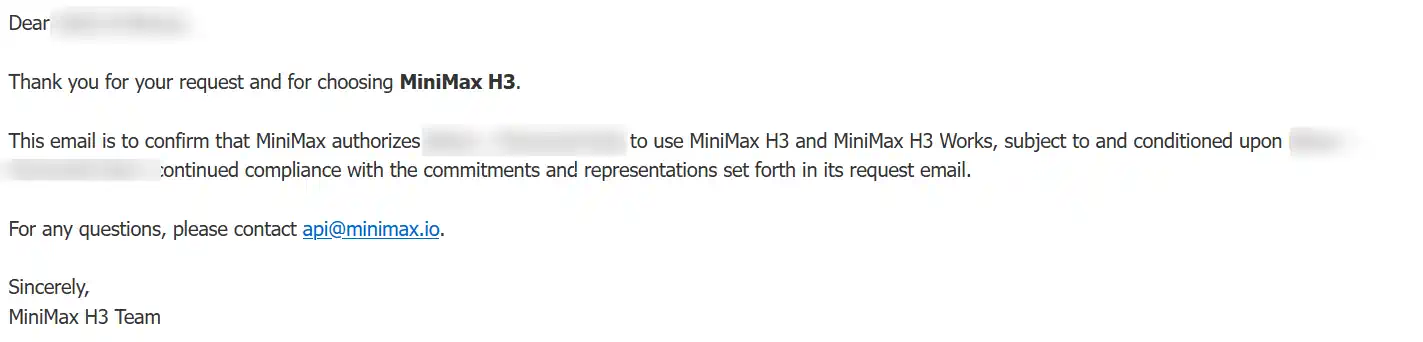
My approval probably arrived in less than ten minutes.
The time I sent this was about 4am Shanghai time. Unlikely that a human read my application. Either it auto-approved or was processed by AI. Or perhaps, this entire process was intended to get me to check the check boxes including the all-important indemnification box, which I did. I am happy to indemnify them for what I do. I do things proper. But it knocked my socks off to have a fully approved license in less time than you have spent reading this blog post.
Who MiniMax Is and What H3 Actually Does
MiniMax lives and grows in Shanghai. The story began late 2021. The company’s leaders started out at SenseTime. Their video tool for regular users carries the name Hailuo AI. Stock buyers may notice MiniMax in the Hong Kong market starting January 2026. The whole setup probably signals a major player with public backing and real scale.
H3 stands for the company’s third video release. Regular folks got access in the final days of July 2026. Hugging Face gained the open weights a few days after. The past month brought a steady wave of buzz. One incredible effect jumps out: H3 might turn both video frames and sound into reality at the exact same moment. The denoise action controls them both. Mouth movement and voice seem to stay in sync by design. Other open projects cannot match that yet.
Noisy debates erupted everywhere. DeepLearning.AI described the weights as open but tied down. Technology blogs everywhere carried stories about major regions losing access. That information probably reflects the real situation. Yet, most of those reports pause at the locked entrance. Few mention the way in might exist.
Why the License Looks Like a Wall
Open weights almost always limit what you can do with the model. MiniMax places boundaries on what comes out too. Go back to Section V.4. The license lists “Outputs or results” with the software itself. People may download the files in one allowed country. That does not mean users can show the video anywhere they like. A finished clip counts under the rule. That probably puts MiniMax in a stricter position than Llama or Qwen.
Two more rules might surprise many. Section IV.1 puts a line for big business. If yearly revenue reaches huge sums, separate written permission probably becomes necessary. Section IV.2 brings in a rule about names. Any commercial product built with MiniMax H3 must put the words “MiniMax H3” clearly on the user screen. Section VI.3 stands out with big legal words. You promise to step in and protect MiniMax if anyone else complains about how you use their technology. In my own words, if trouble comes later, you probably take the blame.
Trying to take in all the legal language in one go may feel heavy. The people at MiniMax have put out an official licensing question and answer page that might change everything. The team explains that the territory rule was never about shutting out some places. They describe it as a reply to the chaos of fast video laws. Then comes a softer message. The limit right now just means “not yet” rather than “never.” This might not sound like a slammed door. To me, it probably means I have to wait for new rules to become clear. It sounds like the Wan 2.6 license, or other “closed source” models.
The Web Form, and What Happened When I Used It
Some in the tech community have said people should try writing an email to MiniMax. I missed that step. Instead, I used a simple online form at platform.minimax.io/h3-license. That became my chosen path. If friends ask, I would probably suggest the web form too.
The online application comes short and simple. Only the basics appear. One question nearly stopped me. The company name box wanted an answer. Nowhere could I say I am just one person making my own YouTube music videos (my most popular video has 30 views). No field invited a description about personal side projects. So I typed something in. My application ended with just that.
Approval was in my inbox when I next looked. I want to pause before saying what that means. The quick response does not show any careful look by a person in Shanghai. In my mind, some bot or algorithm probably handles the first check. Some writers mention that nobody knows how long MiniMax might take in other cases. So please treat this as a single story, not a promise for all. My story is still real though. I followed the process. I got the green light.
From where I stand, the main reason for the form probably links to the promise about legal risk. You agree to shoulder the risk. MiniMax probably gives you the space to use their tool.
What I Believe I Can Do on YouTube
Let me spell out my take. Making H3 videos on my home hardware probably sits inside the rules. I could post results on a popular video site. I must put two important messages for viewers.
The first is an AI disclosure. This comes from Exhibit A, item 12 of the license. It bars public dissemination “without clearly and prominently disclosing that such information and/or content is machine-generated.” I read “prominently” as on screen. Not buried in a description box. So my card says the video is AI generated and the characters are fictional.
The second is attribution. Section IV.2 requires you to display “MiniMax H3.” I use “Powered by MiniMax H3.” It sits on the same card.
On YouTube, a unique law exists. The company demands creators highlight changed or artificial scenes when uploading. Creators find this step under the “Attributes” menu in Studio. The rule always applies, no matter the model’s contract details. Only a single on-screen notice sometimes checks all necessary boxes. synthetic content policy
What This Does Not Cover
My interest stayed very limited. I explored a situation using personal setup at home with ComfyUI. I did not examine any cloud agreements. Web platforms that let people pay to use H3 fall under separate contracts. The API conditions, too, might hold different needs. My exploration missed those routes.
Something else might need attention. MiniMax offers a different engine named H3 Max inside the API. Public code never included any release for that tool. The standard license never covers this case. No one should guess that one rule stretches to all versions.
At least today I feel secure. I feel that I can create videos and post them on my personal channel (not compensated) and maybe on other platforms that I post on. My experience is the opposite of my first impression. I made a very tentative knock on the door, and it flew open wide to welcome me.
A personal approval message sits safe in my legal folder. I will strive to post the correct warnings appear all my videos.
How to Use MiniMax H3 in US or EU – My Read On The MiniMax H3 License was last modified: September 7th, 2026 by JW Bruns
The race to dominate generative AI video has taken an unexpected turn. While Western platforms grapple with rendering delays and infrastructure costs, a Chinese challenger has quietly achieved what many thought impossible: instant AI video creation that rivals Hollywood production quality.
For content creators evaluating platforms, investors tracking the AI video creation space, and businesses wondering where the technology leads next, MiniMax represents a pivotal moment. The company’s trajectory raises urgent questions about competitive positioning, intellectual property safeguards, and whether the future of creative tools will be written in Beijing rather than Silicon Valley.
What Is MiniMax H3 and Why It’s Making Headlines
MiniMax H3 stands as the latest evolution from the Shanghai-based artificial intelligence laboratory founded by former SenseTime engineers. The platform transforms text prompts into broadcast-quality video sequences without the agonizing wait times that plague competing generative AI models.
Unlike previous iterations that required users to queue requests and return hours later, the H3 architecture delivers finished clips in seconds. This capability alone separates MiniMax from established competitors. The system handles complex physics simulations, maintains character consistency across frames, and generates footage that passes casual inspection as authentic.
The technology debuted in late 2024 as an upgrade to earlier MiniMax offerings. Early demonstrations showed the platform rendering detailed urban landscapes, realistic human motion, and cinematic camera movements that previously demanded extensive post-production work. Industry observers noted that sample outputs matched or exceeded quality benchmarks set by Western rivals.
What makes the platform particularly disruptive is accessibility. MiniMax positions H3 as a tool for everyday creators rather than exclusively serving enterprise clients. The democratization strategy mirrors approaches that allowed Chinese social platforms to capture massive user bases before competitors understood the market shift.
Real-Time AI Video Generation: The Technical Breakthrough Explained
The engineering achievement behind near-instantaneous rendering involves architectural innovations that sidestep traditional bottlenecks. Standard diffusion models generate video by iteratively refining noise across hundreds of steps, each requiring substantial computational resources.
MiniMax engineers appear to have optimized this process through novel compression algorithms and distributed processing techniques. Rather than rendering complete frames sequentially, the system likely generates key frames first, then interpolates intermediate content using predictive models trained on massive video datasets.
Alibaba Cloud investment in MiniMax infrastructure probably plays a crucial role here. The partnership provides access to specialized tensor processing units and networking capabilities designed specifically for low-latency AI inference. This cloud foundation allows MiniMax to distribute rendering workloads across geographic regions, reducing perceived wait times for users worldwide.
The technical specifications remain proprietary, but external analysis suggests the model operates with fewer parameters than competing architectures. Efficiency gains come from training data selection rather than brute computational force. By focusing on specific visual domains where patterns repeat predictably, MiniMax achieves acceptable quality without the resource demands that make other platforms economically challenging.
MiniMax’s Explosive Growth: 280% Revenue Increase and Market Performance
Financial metrics tell a remarkable story of market capture. Revenue surged by nearly triple-digit percentages year-over-year, driven primarily by subscription conversions and enterprise licensing agreements. The growth rate exceeds projections that analysts considered aggressive just quarters earlier.
MiniMax stock performance reflects investor enthusiasm for the company’s positioning. Share prices climbed substantially following the H3 announcement, with trading volumes indicating institutional accumulation rather than retail speculation. Market capitalization now places the company among top-tier Chinese technology firms despite relatively recent public offerings.
The revenue expansion stems from multiple streams. Consumer subscriptions provide steady income as amateur filmmakers, social media creators, and marketing professionals adopt the platform for daily workflows. Enterprise contracts with advertising agencies and production studios contribute higher-margin revenues. Licensing deals with hardware manufacturers seeking to bundle AI video capabilities into devices add a third pillar.
Comparisons to early-stage OpenAI financials show similar hockey-stick trajectories. Both companies reached inflection points where product-market fit became undeniable, triggering exponential user acquisition and revenue acceleration. Whether MiniMax sustains this growth depends on addressing emerging concerns that threaten market confidence.
The IP Controversy: Hollywood Clips and Copyright Concerns
Troubling allegations have surfaced regarding training data sources. Independent researchers analyzing MiniMax outputs identified visual elements, scene compositions, and stylistic choices that closely mirror copyrighted Hollywood productions. The similarities extend beyond coincidental overlap into patterns suggesting systematic incorporation of protected material.
Specific concerns focus on iconic cinematography from major studio releases appearing recognizably in generated content. While generative AI models learn from existing media by design, the question centers on whether MiniMax crossed legal boundaries by training directly on copyrighted footage without authorization or licensing agreements.
The company has not publicly disclosed training data sources, citing competitive sensitivity. This opacity fuels suspicion among creators worried about their work being appropriated without compensation or attribution. Hollywood guilds and international content protection organizations have begun inquiring about MiniMax practices, potentially foreshadowing legal challenges similar to those facing other AI platforms.
For businesses evaluating MiniMax adoption, the intellectual property uncertainty creates compliance risks. Using AI-generated content derived from potentially infringing training processes could expose companies to secondary liability claims. Until MiniMax provides transparency about data provenance or establishes indemnification agreements, cautious organizations may hesitate to integrate the platform into commercial workflows.
Geopolitical Implications: Saudi Arabia’s Partnership and China’s AI Edge
Strategic alliances signal broader geopolitical maneuvering around AI video capabilities. Saudi Arabia’s reported partnership with MiniMax represents more than a commercial transaction. The relationship positions Chinese AI infrastructure as an alternative to Western-dominated technology ecosystems, particularly for nations seeking technological autonomy from American platforms.
This pattern mirrors China’s broader Belt and Road digital strategy. By exporting advanced AI tools to developing economies and resource-rich nations, Chinese firms establish dependencies that carry long-term political and economic influence. MiniMax becomes a soft power instrument as much as a commercial product.
The advancement challenges assumptions about Western AI superiority. For years, conventional wisdom held that American companies would maintain insurmountable leads in cutting-edge machine learning applications. MiniMax demonstrates that Chinese AI laboratories have closed capability gaps faster than most analysts predicted, particularly in domains requiring massive computational resources and specialized engineering talent.
Regulatory divergence amplifies competitive advantages. While Western AI developers navigate increasingly complex compliance requirements around transparency, safety testing, and content moderation, Chinese firms operate under different constraints that may accelerate development cycles. This regulatory arbitrage could produce persistent innovation asymmetries favoring platforms developed under permissive frameworks.
Business Impact: From Alibaba Cloud Investment to Stock Market Surge
Corporate partnerships create ecosystem advantages that reinforce MiniMax’s market position. The Alibaba Cloud relationship provides more than infrastructure access. Integration with Alibaba’s e-commerce platforms, enterprise software suite, and digital marketing tools creates distribution channels that Western competitors struggle to match in Asian markets.
Investment flows tell another dimension of the story. Venture capital firms, sovereign wealth funds, and strategic corporate investors have poured resources into MiniMax at valuations that imply extraordinary confidence in long-term potential. The capital infusions fund aggressive expansion into international markets while supporting research into next-generation capabilities.
Stock market enthusiasm extends beyond MiniMax shares themselves. Adjacent companies providing semiconductor components, cloud services, and content delivery infrastructure have experienced valuation increases as investors position for ecosystem growth. The ripple effects mirror patterns seen during earlier technology platform buildouts.
For investors evaluating exposure to AI video generation trends, MiniMax presents both opportunities and dilemmas. The growth trajectory appears compelling, but geopolitical risks, regulatory uncertainties, and unresolved intellectual property questions introduce volatility that conservative portfolios may find unacceptable. Diversification across multiple platforms and geographies probably offers better risk-adjusted returns than concentrated bets on any single player.
What This Means for Content Creators, Investors, and the Future of AI Video
The implications cascade across multiple stakeholder groups. Content creators face a transformed production landscape where video generation costs approach zero and creative bottlenecks shift from execution to ideation. The democratization empowers independent voices while potentially flooding markets with AI-generated content that diminishes attention value.
Investors confront portfolio allocation decisions that hinge on correctly anticipating which platforms achieve durable competitive advantages. MiniMax’s technical lead may prove temporary if Western competitors mobilize resources to close capability gaps. Alternatively, network effects and ecosystem lock-in could create winner-take-most dynamics that reward early positioning.
The technology trajectory points toward increasingly sophisticated generative capabilities that blur boundaries between authentic and synthetic media. Society approaches inflection points where verification mechanisms become essential for maintaining information integrity. Platforms that implement robust provenance tracking and authenticity signaling may command premium positioning as trust becomes a scarce commodity.
The Federal Trade Commission and international regulatory bodies will likely scrutinize AI video platforms more intensively as adoption accelerates. Compliance frameworks for disclosure, copyright protection, and consumer protection will evolve, potentially fragmenting markets along regulatory boundaries. Companies that anticipate these developments and build adaptable architectures will navigate transitions more successfully.
The competitive dynamics between Chinese and Western AI ecosystems will shape geopolitical relationships for decades. Technology leadership correlates with economic influence and strategic autonomy. Nations and companies must decide whether to participate in multiple platform ecosystems or commit exclusively to aligned alternatives. These choices carry consequences extending far beyond immediate business considerations.
The MiniMax breakthrough forces a reckoning with assumptions about technological leadership, intellectual property norms, and the pace of AI advancement. The platform demonstrates that real-time AI video generation has transitioned from theoretical possibility to practical reality. What remains uncertain is who will control this transformative capability and under what rules the competition will unfold.
Stay ahead of AI video developments by evaluating multiple platforms for your specific needs. Test MiniMax capabilities against alternatives, assess intellectual property risks for your use cases, and monitor regulatory developments that may impact platform viability. The landscape shifts rapidly, and informed decisions require continuous learning and strategic flexibility.
MiniMax vs OpenAI: How China’s AI Video Breakthrough Is Reshaping the Global AI Race was last modified: September 4th, 2026 by Thomas M
Small businesses already rely on automation to move information between email, calendars, CRM systems, accounting tools, cloud storage, and customer databases. AI agents change the risk profile because they can decide which integration to use, interpret unstructured instructions, and take several actions in sequence without a person approving every step. The security issue is not that these integrations suddenly become malicious. It is that ordinary productivity connections can become privileged automation. A token created to make work convenient may give an agent enough authority to read contacts, send messages, update records, or access files at machine speed.
The permission behind the integration matters more than the interface
AI assistants often look harmless because users interact through a chat box. The visible interface can obscure the authority behind it. What matters is the authority hidden behind that interface.
An agent connected to email may be able to read messages and send as the user. A CRM integration may permit contact updates or deal changes. Calendar access can expose customer names, travel plans, and meeting details. File access can include far more than the document relevant to the current request.
Security teams should therefore evaluate an agent by its effective permissions, not by how simple the user experience appears. The right question is: if the agent were manipulated or made a bad decision, what could the credentials attached to it actually change? Effective permissions are a more reliable measure of agent risk.
OAuth scopes are a security architecture decision
OAuth makes integrations easier because users can grant access without handing over a password. The integration's security still depends on which scopes are requested and how long the resulting token remains usable. Scope design is therefore part of the threat model, not merely an integration detail.
Broad scopes are convenient during development. They also create durable authority. An agent that only needs to read a customer’s contact record should not automatically receive permission to delete records, export an entire database, or modify account settings.
This is where small implementation choices matter. Request the narrowest scope, separate read and write capabilities where possible, avoid shared credentials, and use short-lived access when the platform supports it. Permissions should reflect the current workflow rather than every action the application might someday perform.
NIST’s 2026 concept paper on software and AI agent identity and authorization highlights this emerging challenge directly: agents need stronger approaches to identity, authorization, and delegated access as they begin acting across systems. The important implication for everyday business software is that agent permissions should be treated as first-class security objects, not hidden configuration behind a connector. Delegated access should be visible and reviewable like any other privileged permission.
AI agent security starts with separating suggestion from execution
For a broader definition of the topic, this glossary page on AI agent security provides an overview of the security considerations around autonomous agents. A useful design pattern is to let the model propose an action while trusted application logic decides whether that action can execute. The distinction sounds small but creates a meaningful control boundary. The model can suggest sending an email, modifying a customer record, or moving a file. Before execution, the application checks the authenticated user, target resource, requested operation, data involved, and relevant policy. High-impact actions can require a confirmation step.
This is one of the most practical ideas in AI agent security: the model should not be able to enlarge its own authority simply by generating a convincing instruction. Business rules should live outside the conversation in code or policy the model cannot rewrite. That keeps business policy outside the model’s own reasoning loop.
Long-lived tokens outlive the task that justified them
A user might ask an agent to perform a five-minute task while the underlying token remains valid for weeks or months. That mismatch creates unnecessary exposure. If a browser extension, local machine, automation service, or agent runtime is compromised later, the attacker may inherit permissions that were originally granted for a task long since completed. The user remembers approving one workflow; the credential silently remains available for many more.
Short-lived credentials reduce that gap. Where temporary credentials are not available, businesses should at least review connected applications, revoke unused grants, and separate sensitive integrations from general-purpose assistants. A discussion of privileged access management makes a related point: access becomes safer when trust is tied to verifiable proof, shorter trust periods, and clearer records rather than reusable credentials that persist indefinitely. AI agents increase the value of that model because machine-driven activity can amplify the consequences of one stolen credential.
Confirmation should depend on reversibility
Requiring approval for every agent action would eliminate much of the value of automation. Requiring approval for nothing creates the opposite problem. The control should scale with the consequence of the action.
A better approach is to classify actions by consequence. Reading an approved record may proceed automatically. Drafting a message can be low risk if a human still sends it. Sending to an external recipient, deleting information, changing payment details, or updating a large number of customer records should trigger stronger verification.
Reversibility is a useful design test. If an action can be easily undone and has limited external impact, automation can tolerate more autonomy. If the action is difficult to reverse, affects money, changes permissions, or communicates externally, the system should introduce an authorization breakpoint.
Agents need their own audit trail
Conventional application logs may show that a valid API request occurred. That is not enough to reconstruct an agent-driven workflow. A useful audit record should preserve who initiated the task, which agent acted, what system it accessed, what data category was involved, which action was proposed, whether confirmation was required, and which credential or delegated permission authorized execution.
This is especially important when one instruction creates several downstream actions. A request such as “prepare the customer for tomorrow’s meeting” could cause an agent to retrieve a CRM record, read email, inspect a calendar, summarize documents, and draft a message. The organization needs one traceable task chain, not five disconnected logs.
Small businesses need fewer permanent permissions
Large enterprises can build dedicated identity teams and complex policy infrastructure. Small businesses need a simpler principle: reduce how much permanent authority is attached to automation. Use separate service identities for sensitive workflows, minimize scopes, avoid sharing integration accounts, review inactive connections, keep high-impact actions behind confirmation, and expire access whenever the task no longer needs it. These controls reduce risk without preventing employees from using automation productively.
The core challenge is not whether AI agents can be trusted in the abstract. It is whether the surrounding software architecture gives them only the authority required for the job. As agents become embedded in ordinary productivity tools, integration security will increasingly determine AI security. The safest agent is not necessarily the one with the longest list of behavioral rules. It is the one whose permissions are narrow enough that an unexpected decision cannot silently become an unlimited business action.
AI Agents Turn Everyday Integrations Into Privileged Automation was last modified: September 2nd, 2026 by Erik Emanuelli
Most discussions about AI watermarking focus on detection methods or philosophical debates about transparency. What enterprise teams actually need is a roadmap for adapting workflows when watermarked text becomes the norm across every major AI provider. Your content operations will change dramatically over the next year, and waiting until watermarking arrives in every tool you use might leave your team scrambling.
The shift toward embedded watermarks represents more than a technical feature. Companies now face questions about governance frameworks, cross-platform consistency, and legal documentation that simply did not exist before. Building the right infrastructure today prevents compliance headaches tomorrow.
What AI Text Watermarking Means for Your Business (Not Just Claude)
AI text watermarking embeds invisible statistical patterns into generated content that specialized tools can later detect. Unlike metadata tags that disappear when text gets copied, these patterns persist through typical editing and reformatting. Anthropic released this capability for Claude in early 2025, but the technology will likely spread across OpenAI, Google, and other providers soon.
Your business probably uses several AI writing platforms already. Marketing teams might rely on one tool while customer support uses another. Each platform will implement watermarking differently, with varying detection thresholds and persistence characteristics. The strategic challenge involves managing this complexity across your entire content ecosystem.
Watermarking creates accountability. When AI-generated content appears in customer communications, marketing materials, or documentation, watermarks provide an audit trail. This matters for regulated industries where content provenance affects compliance obligations. Financial services firms and healthcare organizations face particular pressure to demonstrate content origins.
The Federal Trade Commission has already signaled interest in AI transparency for consumer-facing content. Watermarking technology gives compliance teams a verification mechanism that manual processes cannot match at scale.
Assessing Your Current AI Content Stack: Tools, Workflows, and Watermark Exposure
Start with an inventory. Document every AI writing tool your organization uses, including shadow IT deployments that individual teams adopted without central approval. Check procurement records, browser extensions, and departmental software subscriptions. Many companies discover a dozen AI platforms running simultaneously across different business units.
Map how content flows through your organization. Does AI-generated draft copy move through editing systems, translation platforms, or content management databases? Each handoff point represents a potential watermark preservation or degradation risk. Heavy editing might weaken watermark signals while automated reformatting could eliminate them entirely.
Evaluate your current content governance policies. Most enterprises built these frameworks before watermarking existed, so gaps will appear. Your policies probably address plagiarism detection and brand voice consistency but might ignore AI content authentication entirely. This gap exposes your organization to risks as watermarking becomes industry standard.
Calculate your watermark exposure percentage. What portion of your published content contains AI-generated text? Some teams use AI for initial research and outlining while others generate complete drafts. Understanding this baseline helps prioritize policy updates and detection infrastructure investments.
Setting Up Detection Infrastructure: Tools and Methods That Actually Work
Detection infrastructure requires both technical tools and human processes. Anthropic provides a watermark detection API for Claude-generated content, but cross-platform detection remains challenging. No universal detector works across all AI providers yet, so enterprises need multiple verification methods.
Build detection checkpoints into content workflows rather than treating verification as a final step. Configure your content management system to flag potentially watermarked text before publication. This early warning system prevents watermarked content from reaching customers when disclosure matters.
Consider implementing random sampling protocols. Testing every piece of content might prove impractical, but statistical sampling provides reasonable assurance. Audit a percentage of published materials monthly to verify watermark detection accuracy and identify process gaps. Financial auditing principles apply equally well to content verification.
Document detection accuracy rates for each tool in your stack. Different AI providers will show varying watermark persistence after editing. Claude watermarks might survive heavier modification than other platforms. Track these performance differences to inform content workflow decisions and editing guidelines.
Partner with vendors who prioritize watermarking capabilities. When evaluating new AI content tools, ask specific questions about watermark implementation, detection APIs, and roadmap commitments. Vendor selection criteria should include watermarking support alongside traditional factors like accuracy and cost.
Updating Content Governance Policies for Watermarked AI Text
Your governance framework needs explicit watermarking protocols. Define when AI-generated content requires disclosure to end users versus internal tracking only. Consumer-facing marketing materials might demand different transparency standards than internal research reports. These distinctions should reflect both legal requirements and brand values.
Establish editing thresholds that preserve watermark integrity. If substantial human revision removes detectable patterns, your audit trail disappears. Set guidelines about how much editing content can undergo while maintaining watermark verification. Some organizations prohibit heavy modifications to AI drafts specifically to maintain detection capability.
Create approval workflows that account for watermarked content. Certain materials might require additional legal review when watermarks indicate AI generation. Build these routing rules into your content management platforms so review happens automatically rather than relying on manual flagging.
Address the hybrid content challenge. Most business content combines AI-generated sections with human writing. Your policies should clarify how to handle mixed-origin materials, what percentage of AI content triggers watermark disclosure, and how to document the authorship blend. The Society for Human Resource Management suggests similar documentation approaches for AI-assisted hiring decisions.
Cross-Platform Watermarking Strategy: Handling Multiple AI Providers
Standardization becomes critical when managing multiple AI platforms. Different providers will implement incompatible watermarking schemes, creating integration headaches. Your enterprise needs a unified approach despite underlying technical fragmentation.
Designate primary AI tools for specific content types. Marketing might standardize on one platform while technical documentation uses another. This segmentation simplifies watermark management because each content category has predictable watermark characteristics. Avoid allowing every team to choose their preferred AI tool independently.
Build a watermark registry that tracks which AI platforms generated which content. This metadata layer sits above individual watermarking implementations and provides consistent tracking regardless of underlying technology. When vendors change watermarking approaches or new tools enter your stack, the registry maintains continuity.
Negotiate enterprise agreements that include watermarking guarantees. As you consolidate AI vendors, contractual commitments about watermark persistence, detection API access, and advance notice of watermarking changes protect your investment in detection infrastructure. Treat these provisions as essential rather than optional contract terms.
Legal and Compliance Considerations: Disclosure, Liability, and Documentation
Disclosure requirements vary by industry and jurisdiction. Financial services regulations might mandate revealing AI involvement in investment advice while general marketing faces fewer restrictions. Consult legal counsel about disclosure obligations specific to your business operations and customer base.
Liability questions remain unsettled. If watermarked AI content contains factual errors or creates customer harm, who bears responsibility? Your policies should address quality assurance processes that compensate for AI limitations. Simply detecting watermarks does not absolve organizations of content accuracy obligations.
Documentation standards must evolve alongside watermarking capabilities. Maintain records showing what content underwent watermark detection, results of those scans, and any remediation actions taken. These audit trails become critical if regulatory inquiries arise or legal disputes involve content authenticity.
The Small Business Administration recommends similar documentation practices for other automated business processes. Apply those same rigor standards to AI content governance. Treat watermark detection logs as permanent records rather than temporary operational data.
Future-Proofing Your Content Operations as Watermarking Becomes Standard
Industry-wide watermarking adoption will accelerate faster than most enterprises expect. Building flexible systems now prevents costly retrofitting later. Design detection infrastructure that can incorporate new AI providers without complete workflow redesigns.
Invest in team education about watermarking implications. Content creators need to understand how their editing choices affect watermark persistence. Legal teams require training on disclosure obligations. Operations staff must learn detection tool capabilities and limitations. This knowledge investment pays dividends as watermarking complexity increases.
Monitor regulatory developments that might mandate watermarking practices. Several countries are considering AI transparency legislation that could affect content disclosure requirements. Staying ahead of these regulatory curves positions your organization as a compliance leader rather than a reluctant follower.
Plan for interoperability improvements. Current watermarking fragmentation will likely give way to industry standards that enable cross-platform detection. Position your infrastructure to adopt these standards quickly when they emerge. Flexible architecture choices today enable rapid adaptation tomorrow.
Building robust AI content governance around watermarking technology requires immediate action. Enterprises that establish detection infrastructure, update policies, and train teams now will navigate the watermarked content landscape confidently. Those who delay risk compliance gaps and operational chaos as watermarking becomes ubiquitous. Start your watermarking strategy assessment this week, not next quarter.
AI Watermarked Text: The Enterprise Implementation Guide for Content Teams was last modified: September 1st, 2026 by Thomas M
Generative AI has shifted from emerging tech to practical business capability.
Organizations use it to create content, analyze information, support employees, improve customer interactions, automate repetitive processes, and accelerate decision-making.
Unlike conventional software that follows predefined rules, generative AI understands natural-language instructions, processes large information volumes, identifies patterns, and generates context-aware outputs.
This changes how businesses approach digital operations.
Instead of adding standalone applications for every requirement, companies introduce intelligent systems that interact with existing applications, understand unstructured information, and assist employees throughout daily workflows.
Marketing teams generate campaign ideas. Customer service teams summarize conversations. Product teams analyze feedback. Executives extract insights from large business information volumes.
The real value doesn’t come from adopting popular AI models.
Businesses need to determine where AI creates measurable value, what information it accesses, how it integrates with existing systems, and where human oversight is necessary.
Customized AI implementation becomes increasingly important for organizations moving from isolated AI experiments to scalable digital capabilities.
Why Businesses Are Moving Toward Custom Generative AI
Off-the-shelf AI tools work for general tasks.
But businesses often have requirements that generic applications can’t address.
Companies need AI assistants that understand internal documentation, customer-support systems connected to CRM, or intelligent workflows that analyze documents and automatically route information to appropriate departments.
Custom development allows organizations to design AI capabilities around specific workflows, data, users, and business objectives.
Instead of asking employees to change how they work for generic tools, businesses integrate AI into existing processes.
Examples:
Financial services organization uses generative AI to summarize lengthy reports while applying strict access controls to sensitive information
Retailer uses AI to generate product descriptions based on structured catalog data
Logistics company uses AI to interpret shipping documentation and identify exceptions requiring employee attention
A Generative AI development company helps businesses move from identifying opportunities to designing, developing, integrating, and maintaining AI-powered applications.
The objective isn’t introducing AI because it’s popular.
It’s identifying use cases where intelligent technology improves productivity, customer experience, decision-making, or operational efficiency.
From AI Experiments to Business-Ready Applications
Many organizations begin with small AI experiments.
Employees use generative AI for writing, research, brainstorming, summarization, or information discovery.
These experiments demonstrate technology potential, but enterprise adoption requires a structured approach.
Business-ready AI applications consider security, scalability, data quality, integration, performance, user experience, and governance.
An AI assistant working effectively with a handful of documents behaves differently when thousands of documents, multiple users, complex permissions, and real-time data are introduced.
Architecture matters.
Depending on use case, AI applications combine large language models, machine learning algorithms, retrieval-augmented generation, APIs, databases, workflow automation, and enterprise applications.
This combination allows AI to work with business information rather than functioning as an isolated chatbot.
It retrieves relevant data, interprets it, generates output, and potentially triggers the next workflow step.
Organizations work with AI ML Development Company when they need broader intelligence capabilities alongside generative AI.
Machine learning supports forecasting, classification, recommendation engines, anomaly detection, predictive analytics, and other use cases where identifying patterns in structured data is important.
7 Real-World Generative AI Use Cases Across Business Functions
The strongest argument for generative AI isn’t what technology can theoretically do.
It’s how it solves practical business problems.
Different departments use AI differently depending on their processes and data.
1. Intelligent Customer Support
Customer service teams deal with repetitive questions, lengthy conversations, and large knowledge bases.
Generative AI helps support agents:
Retrieve relevant information
Summarize previous interactions
Draft responses
Classify incoming requests
AI-powered support systems recognize when questions are outside scope and route conversations to human representatives.
This creates a balance between automation and human expertise.
2. Sales and Lead Intelligence
Sales teams spend considerable time reviewing customer interactions and preparing follow-ups.
Generative AI can:
Summarize sales calls
Identify customer requirements
Generate follow-up drafts
Extract important conversation information
When connected with CRM data, AI helps sales representatives understand account history and prepare for customer meetings without manually reviewing multiple records.
3. Document Intelligence
Organizations process contracts, invoices, reports, proposals, applications, and other documents daily.
Manually reviewing these materials is slow and inconsistent.
Generative AI can:
Extract important information
Summarize documents
Identify specific clauses
Classify files
Prepare structured outputs for downstream systems
Example: Organization uses AI to analyze incoming supplier documents, extract key details, validate information against predefined rules, and send approved data into enterprise systems.
4. Marketing Personalization
Marketing teams use generative AI to:
Create content variations for different audiences
Develop campaign concepts
Summarize customer feedback
Personalize communication
Rather than producing identical messaging for every customer segment, AI helps teams adapt content based on audience characteristics, product context, and campaign objectives.
Human review remains important, particularly for brand-sensitive content.
AI significantly accelerates the production and iteration process.
5. Employee Knowledge Assistants
Employees often spend time searching through internal documentation, policies, product information, project files, and knowledge bases.
Company-specific AI assistant provides conversational interface for retrieving approved internal information.
Instead of searching through multiple systems, employees ask questions in natural language and receive concise responses based on relevant business sources.
This is particularly valuable for:
Onboarding
IT support
Operations
Internal knowledge management
6. Software Development Assistance
Generative AI changes how software teams approach development.
AI tools assist with:
Code generation
Documentation
Test creation
Debugging
Code explanation
Technical knowledge retrieval
The goal isn’t replacing developers.
AI reduces repetitive development work and allows engineers to spend more time on architecture, problem-solving, quality, and product innovation.
7. Operations and Workflow Intelligence
Operations teams frequently work with information arriving from multiple channels.
AI can:
Classify requests
Identify exceptions
Summarize reports
Extract information
Help determine which workflow should happen next
When generative AI combines with conventional automation, organizations build workflows that are more adaptable than purely rule-based systems.
Improving Customer Experiences With Generative AI
Customer expectations change rapidly.
People increasingly expect businesses to provide fast, relevant, and personalized responses across multiple channels.
Generative AI helps organizations meet these expectations without requiring customer service teams to manually handle every interaction.
Examples:
E-commerce platform uses AI to help shoppers discover products based on requirements
Software company creates AI assistant that explains product functionality using approved documentation
Financial platform uses AI to answer general account-related questions while routing complex requests to trained employees
The strongest implementations maintain balance between automation and human oversight.
AI handles repetitive information retrieval and straightforward requests.
Employees remain responsible for decisions requiring judgment, empathy, or specialized expertise.
Generative AI + Machine Learning: A More Powerful Combination
Generative AI and machine learning are often discussed separately, but their capabilities complement each other.
Generative AI is particularly effective at understanding and producing unstructured information such as text, conversations, documents, and natural-language requests.
Machine learning is highly effective at identifying patterns, making predictions, classifying information, and analyzing structured datasets.
Combining both technologies creates more intelligent applications.
Consider e-commerce business:
Machine learning predicts which products customer is likely to purchase based on historical behavior
Generative AI creates personalized explanation or recommendation for that customer
Similarly, logistics company:
Machine learning forecasts demand
Generative AI explains factors behind forecast in language business users easily understand
The combination becomes particularly powerful when AI connects to real business workflows rather than operating as standalone features.
Using Business Data to Make AI More Relevant
One of the biggest advantages of custom AI applications is their ability to work with proprietary business information.
Generic AI tools understand broad concepts.
They don’t automatically understand a company’s internal terminology, policies, products, processes, or historical information.
Businesses improve relevance by connecting AI applications to approved internal knowledge sources.
Retrieval-augmented generation allows AI systems to retrieve relevant information from company documents or databases before generating answers.
This makes AI more useful for enterprise knowledge management.
Employees ask questions in natural language instead of searching through multiple systems manually.
However, data integration must be handled carefully.
Access permissions, data quality, source reliability, privacy requirements, and information freshness all influence AI performance.
Combining Generative AI With Automation
Generative AI becomes even more valuable when connected to workflow automation.
Instead of simply generating responses, AI-powered systems interpret information and initiate the next step in the business process.
Consider customer support workflow:
Incoming request gets analyzed
Categorized according to intent
Matched with relevant knowledge
Assigned to appropriate team
System generates response draft for employee review
In another scenario:
AI application analyzes business document
Extracts important fields
Validates information against predefined rules
Sends relevant data to enterprise application through API
This creates an intelligent automation layer.
Traditional automation handles predictable processes well.
AI adds flexibility when information is unstructured or requires contextual interpretation.
What Should Businesses Automate First?
Not every business process needs generative AI.
Organizations should prioritize areas where technology creates measurable value.
Practical starting point looks for processes that are:
High-volume: Tasks performed repeatedly across teams
Time-consuming: Activities that consume significant employee hours
Information-heavy: Work involving documents, emails, reports, or conversations
Rule-guided: Processes where clear business policies already exist
Measurable: Activities where improvements can be tracked
Example: Automating repetitive document-classification processes may produce more immediate value than attempting to build a fully autonomous decision-making system.
Starting with a focused use case allows organizations to evaluate accuracy, adoption, cost, and operational impact before expanding AI across other departments.
Before vs. After: How AI Changes Business Workflows
The difference between traditional workflows and AI-enhanced processes becomes clearer when viewed practically.
The objective isn’t eliminating every manual step.
AI should reduce unnecessary effort while keeping people involved where their expertise adds most value.
When Generative AI Is Not the Right Solution
Credible AI strategy requires knowing when not to use AI.
Generative AI may not be the best choice when simple deterministic rules can solve problems more reliably or when cost and complexity of AI outweigh benefits.
Businesses should exercise caution when:
Data quality is insufficient for reliable outputs
Process requires strict deterministic behavior
AI system would handle sensitive information without adequate controls
No practical way to evaluate performance exists
Business outcome is unclear
Human accountability cannot be maintained
In some situations, conventional software, workflow automation, analytics, or rules-based systems may be more appropriate.
The goal should be selecting the right technology for the right business problem rather than adding AI simply for innovation sake.
Security and Governance Should Be Built In
As AI becomes part of business operations, security and governance become essential.
Organizations need to understand what information their AI systems can access, how information is processed, and who can interact with applications.
Businesses should establish controls around:
Authentication
Authorization
Data storage
Model access
Monitoring
Auditability
Sensitive information shouldn’t be exposed unnecessarily.
AI-generated outputs should be evaluated according to risk associated with each use case.
Human oversight is particularly important for high-impact applications.
AI can provide recommendations or summarize information, but organizations should determine where human approval is required before action is taken.
Responsible AI development involves continuous monitoring.
Models, data sources, business requirements, and user behavior can change over time, so AI applications need ongoing evaluation and improvement.
From AI Copilots to Autonomous Workflows
Enterprise AI evolution moves beyond simple question-and-answer systems.
Businesses can think about this progression as:
→ AI Assistant
→ AI Copilot
→ AI-Powered Workflow
→ AI Agent
→ Autonomous Workflow
An AI assistant answers a customer’s question.
Copilot helps the support agent resolve that question.
AI-powered workflow classifies requests, retrieves relevant information, and updates CRM.
More advanced AI agents coordinate several steps automatically within defined permissions and business rules.
This doesn’t mean businesses should immediately pursue fully autonomous systems.
In many cases, copilot or semi-automated workflow can deliver substantial value with lower risk.
An important shift is that AI becomes an active participant in business processes rather than simply a tool for generating text.
Scaling From One Use Case to an AI Ecosystem
Successful AI implementation doesn’t need to begin with organization-wide transformation.
Many businesses start with one clearly defined business problem, measure results, and expand based on what they learn.
Example: Company initially deploys AI knowledge assistant for internal support team.
After evaluating accuracy, adoption, security, and operational impact, the organization introduces similar capabilities for sales, customer service, or operations.
This incremental approach reduces implementation risk and makes it easier to demonstrate business value.
Organizations investing in Custom generative ai development services can build applications designed not only for immediate requirement but also for future expansion.
Modular architecture makes it easier to:
Introduce new models
Connect additional data sources
Integrate more business systems
Support new AI-powered workflows
Measuring the Business Impact of Generative AI
Technology adoption should ultimately connect to measurable business outcomes.
Organizations need to define what success looks like before deploying AI solutions.
Depending on use case, relevant metrics may include:
Reduction in manual processing time
Faster customer response times
Increased employee productivity
Improved customer satisfaction
Higher workflow completion rates
Reduced operational costs
Increased conversion or retention
Faster information retrieval
Reduction in repetitive administrative work
Example: If an AI assistant is designed for customer service representatives, the company could measure average handling time, resolution rates, response quality, and employee adoption.
Measurement helps businesses determine which AI initiatives deserve additional investment.
Not every use case will generate the same value, so organizations should prioritize projects based on business impact, technical feasibility, data availability, and implementation complexity.
The Future of Custom Generative AI in Business
Generative AI will likely become increasingly embedded in everyday business applications.
Instead of interacting with AI through separate tools, employees may encounter intelligent capabilities directly within:
CRM platforms
Project management systems
Communication tools
Enterprise applications
Industry-specific software
AI agents will become more capable of performing multi-step tasks under defined business rules.
They may interpret requests, retrieve information, interact with software tools, and complete portions of workflows while maintaining appropriate human oversight.
For businesses, opportunity isn’t simply generating more content or automating individual tasks.
A larger opportunity is rethinking how information moves through organization and how employees interact with technology.
Companies that approach generative AI strategically can create more adaptive digital operations, improve employee productivity, and deliver more personalized customer experiences.
Conclusion
Custom generative AI is becoming an important component of modern digital transformation.
Its ability to understand natural language, work with business information, generate useful outputs, and support intelligent workflows gives organizations new ways to improve everyday operations.
However, successful adoption requires more than selecting an AI model.
Businesses need:
Clear strategy
Suitable architecture
Secure data integration
Thoughtful governance
Continuous performance monitoring
The most effective approach is starting with meaningful business problems, identifying where AI creates measurable value, and gradually expanding successful use cases.
Combining generative AI with machine learning, automation, enterprise data, and existing software systems helps businesses build intelligent digital operations that are more responsive and scalable.
Ultimately, organizations that benefit most from generative AI won’t necessarily be those that use most AI.
They’ll be the ones that understand where AI creates genuine value, where human expertise remains essential, and how intelligent technology can become part of sustainable business strategy.
How Custom Generative AI Solutions Are Transforming Modern Business Operations was last modified: August 31st, 2026 by Ahmad Zulfiqar
Building an artificial intelligence startup today requires far more than training a clever model or writing clean algorithms. Today’s tech ecosystem demands rapid market validation, scalable software architecture, precise financial planning, and a clear path to sustainable monetization. For early-stage founders, navigating the gap between an initial prototype and a market-ready enterprise can feel overwhelming. Balancing technical execution with business strategy often drains resources before you reach true product-market fit. This is where modern support ecosystems step in, offering the strategic frameworks, digital infrastructure, and expert guidance needed to turn high-potential concepts into resilient, scalable companies.
Scaling an enterprise requires mastering multiple operational disciplines at once. Founders must define clear value propositions, optimize client acquisition channels, adopt cutting-edge internal tools, and cultivate executive leadership skills. By structuring early-stage growth around proven methodologies, founding teams eliminate guesswork, mitigate execution risks, and build businesses engineered for long-term industry leadership.
Artificial Intelligence Accelerator: Supporting AI Startups From Idea to Growth
Launching a deep-tech or machine learning venture presents unique technical and commercial challenges that general business incubators are rarely equipped to handle. Participating in a specialized artificial intelligence accelerator provides early-stage teams with targeted infrastructure, expert mentorship, and industry access designed to compress years of execution into a concentrated timeframe:
High-Performance Compute Resources: A dedicated artificial intelligence accelerator gives startups direct access to GPU clusters, specialized cloud credits, and optimized development environments needed to train complex models.
Domain-Specific Technical Mentorship: Founding teams receive direct guidance from veteran machine learning engineers, data architects, and researchers who help optimize data pipelines and model efficiency.
Targeted Capital Networks: Accelerators connect founders directly with angel investors, family offices, and venture capital firms that focus exclusively on funding artificial intelligence innovations.
Go-to-Market Strategy Refinement: Experienced commercial mentors help technical founders translate complex algorithmic capabilities into clear, high-value business propositions that resonate with corporate buyers.
Data Privacy and Regulatory Support: Programs offer specialized legal guidance to ensure early-stage platforms comply with evolving international data governance laws, ethical AI frameworks, and security standards.
Accelerated Product Validation: Cohort-driven environments encourage rapid user testing and customer feedback loops, helping teams iterate quickly and avoid building unwanted functionality.
Collaborative Founder Ecosystems: Working alongside peer entrepreneurs who share similar technical hurdles fosters a supportive community for troubleshooting code, sharing tools, and exchanging strategic insights.
Enrolling in a structured program ensures that technical breakthroughs are supported by solid commercial foundations, allowing lean teams to gain immediate traction in competitive markets.
AI Business Tools: Technologies That Help Startups Scale Faster
Beyond building customer-facing applications, leveraging advanced AI business tools internally gives small founding teams an unprecedented operational advantage. Integrating intelligent automation across daily operations enables lean organizations to operate with the speed, analytical depth, and output capacity of enterprise-level corporations:
Automated Customer Support Platforms: Implementing conversational agents powered by modern AI business tools delivers continuous, high-quality client support while keeping operational overhead low.
Predictive Lead Scoring Systems: Machine learning algorithms evaluate sales pipelines automatically, allowing business development representatives to focus their energy on high-conversion prospects.
Intelligent Content Creation Engines: Specialized AI business tools accelerate marketing asset creation, search-engine-optimized copy generation, and technical documentation without expanding headcount.
Streamlined Financial Forecasting: Automated analytics tools monitor cash flow dynamics, track burn rates, and model financial growth scenarios in real time without heavy manual oversight.
AI-Assisted Software Development: Engineering teams integrate intelligent coding assistants into their development workflows to speed up feature releases, identify bugs early, and maintain code consistency.
Dynamic Market Research Aggregators: Machine learning tools synthesize competitor activities, industry news, and customer sentiment into actionable strategic summaries for executive decision-makers.
Personalized User Onboarding Systems: Automated onboarding modules tailor user flows dynamically, improving early platform adoption and reducing customer churn rates significantly.
If you are ready to explore how structured cohort support can turn your technological innovation into a venture-backed enterprise, joining a dedicated AI accelerator program provides the roadmap to compress your timeline to market success.
Business for Young Entrepreneurs: Building Skills for the Modern Startup World
Navigating the business landscape as a young entrepreneur requires a strong balance between bold technological innovation and disciplined operational management. Modern founders entering the startup world must build practical skills early to lead teams, manage capital, and make sound decisions in fast-moving industries:
Mastering Financial Literacy: For young entrepreneurs, understanding business starts with managing cash flow, reading balance sheets, projecting runways, and structuring cap tables properly.
Developing Executive Communication: Young founders must master the art of storytelling to articulate their vision convincingly to prospective investors, corporate clients, and senior talent hires.
Adopting Lean Execution Principles: Focusing on building minimum viable products enables early-stage teams to test market demand quickly without burning limited financial capital prematurely.
Building Multidisciplinary Networks: Engaging actively in founder communities, local tech meetups, and online accelerator networks provides access to experienced advisors and peer support.
Cultivating Adaptive Resilience: Facing early rejections, technical bugs, and strategic pivots helps young leaders build the emotional fortitude needed to navigate long-term corporate challenges.
Prioritizing Strategic Time Management: Young founders learn to distinguish urgent daily distractions from high-impact strategic tasks that drive enterprise growth.
Understanding Legal Fundamentals: Grasping basic corporate governance, intellectual property protection, and employment agreements protects early ventures from costly legal mistakes later on.
Empowering the next generation of innovators with practical business acumen helps brilliant technical concepts transition into sustainable commercial enterprises.
Artificial Intelligence Accelerator: How Structured Support Can Drive Startup Success
To maximize the benefits of an artificial intelligence accelerator, founding teams must look beyond initial seed funding and focus on the long-term organizational value these ecosystems provide. The structured environment acts as a catalyst across every stage of corporate development:
Compressing Time-to-Market: A primary advantage of an artificial intelligence accelerator is its ability to condense years of trial and error into a focused, multi-week execution framework.
Establishing Cap Table Discipline: Legal advisors in accelerator programs help founding teams set up clean equity splits, option pools, and investor-friendly corporate structures.
Refining Executive Pitching Skills: Intensive pitch practices and mock board meetings prepare founders to present their business models clearly and confidently to venture capitalists on Demo Day.
Securing Enterprise Pilot Programs: Accelerator networks connect participating startups directly with corporate partners seeking innovative solutions, helping founders land early commercial contracts.
Validating Enterprise Security Standards: Technical audits conducted by industry experts ensure that a startup’s data architecture meets rigorous enterprise security requirements before public launch.
Instilling High Execution Velocity: Clear cohort goals, weekly milestone tracking, and mentor check-ins train teams to maintain rapid development cycles.
Building Enduring Industry Relationships: The strategic connections established with mentors, corporate partners, and fellow cohort founders continue to yield advisory benefits throughout an executive’s career.
Surrounding early-stage operations with institutional support de-risks the growth journey, allowing leaders to focus their energy on building exceptional technology.
AI Business Tools: Turning Innovative Ideas Into Scalable Business Solutions
Transforming a novel technical idea into a commercial success requires converting algorithmic performance into automated, customer-centric business workflows. Integrating practical AI business tools across the organization enables startups to turn raw innovation into scalable revenue engines systematically:
Optimizing Customer Retention Systems: Utilizing advanced AI business tools to analyze user engagement patterns helps proactive customer success teams identify churn risks before they happen.
Automating Competitive Intelligence: Intelligent tracking systems continuously monitor competitor pricing shifts, feature rollouts, and positioning updates, giving leadership strategic foresight.
Enhancing Product Personalization: Integrating smart algorithms directly into product workflows delivers personalized user experiences that drive higher engagement and customer lifetime value.
Streamlining Talent Acquisition: Intelligent recruiting applications help lean HR teams source qualified technical talent, screen resumes, and schedule interviews efficiently.
Scaling Content Localization: Advanced translation and localization tools help growing startups quickly adapt their software and marketing assets for international markets.
Automating Workflow Integration: Connecting disparate software applications through intelligent workflow automation eliminates manual data entry and reduces human error across departments.
Improving Resource Allocation: Predictive data analytics tools help executives make informed decisions about engineering priorities, marketing budgets, and operational expansions.
Combining cutting-edge technological infrastructure with a validated artificial intelligence accelerator roadmap and continuous personal development in business equips young entrepreneurs to navigate complex markets with confidence. By leveraging intelligent AI business tools and surrounding your enterprise with proven advisory networks, your startup can accelerate execution, achieve sustainable scalability, and build lasting value in the modern digital economy.
Solvee: a Smarter Approach to Building and Scaling AI-Powered Startups was last modified: August 31st, 2026 by Mead Miracle
Product photography used to require a studio, professional lighting, and a photographer on the payroll. Today, that is no longer the case. AI tools can now turn a simple product photo into a polished, studio-quality output without the need for a big budget or expensive equipment.
Whether you’re a solo Etsy seller or managing a large product catalog, these tools can handle backgrounds, lighting, staging, and more in minutes instead of days.
Before choosing a tool, here are a few things worth considering:
Consistency across your catalog
Editing control
Output quality and resolution
Workflow fit
And now, when it comes to picking the right tool, we have tested and reviewed 3 of the best AI tools for product photography, covering their key features, tools, and workflows.
Top 3 AI Product Photography Tools Reviewed
Tools
Product Photography Features
Other Features and Tools to Consider
Pricing
Krea.ai
AI image generator Realtime Studio Background remover Image upscaler
Image-to-video LoRA fine-tuning
Free plan available Paid plans start at $9/ month
Flair AI
On model photography AI human builder Virtual try-on Image enhancer
Bulk content generation AI product videos AI marketing and ads
Free plan available Paid plans start at $10/ month
Photoroom
Image generator AI fashion models Virtual try-on Product staging
Video generator
Free plan available Paid plans start at $7.99/ month
1. Krea.ai
Krea.ai is an AI creative suite, designed for generating, editing, and enhancing images and video content. Its wide range of generative features is suitable for different use cases, from marketing and social media campaigns to product photography.
Krea.ai for Product Photography
When using Krea.ai for your product photography workflow, you can start with its image generator, where you can create visuals from prompts, upload a plain product photo as a reference, and then experiment with different poses, styles, and visual elements. With Krea’s Realtime Studio, you can also update your images live and see the changes happen in real time. Its background remover helps you create clean product shots by removing unwanted backgrounds, while the image upscaler can enhance your images to resolutions of up to 22K.
Other Tools That Can Be Handy
Image-to-video: Go further with animating your product images with motion, camera movement, and popular AI models
LoRA fine-tuning: Maintain product visual consistency across on-demand generations by training your own model with a few images of the same product.
Pricing Plans
Krea.ai has a free plan to get started, with 100 daily units and limited features. The paid plans start at $9/ month and include 5000 monthly units.
2. Flair AI
Flair AI is a product photo generator and editor, used for various industries such as ecommerce, fashion, jewelry, and more.
Flair AI for Product Photography
Flair AI’s drag-and-drop AI editor also works best for product photoshoots. You work on a canvas where you stage scenes by placing your product along with props and backgrounds, then use AI to bring these scenes to life. The platform also includes templates you can mix and match with your product, while also being able to build reusable templates at scale.
For apparel and jewelry, Flair has a fashion photoshoot feature that fits your product onto AI-generated models while preserving patterns or logos. There’s also an AI human builder, letting you create custom models by choosing features like hair color and body type, then reuse them across your brand assets
Other Tools to Consider
Bulk content generation
AI product videos
AI marketing and ads
Pricing Plans
Flair AI also offers a free plan with limited generation features, while the paid plans start at $10/ month.
3. Photoroom
Photoroom is an AI photo editor and product photography platform. Its dedicated features are used in a variety of industries, such as fashion and apparel, marketplace and retail, ecommerce, and more.
Photoroom for Product Photography
You start by taking a photo. The best part is that your phone is enough; no studio needed. Then, you upload the image and get the background removed automatically. Next, you can pick a template or generate a custom style with AI, adjusting lighting and shadows as needed. Here, you can also place the product in a realistic lifestyle setting or add a virtual model to show it worn or in use.
If you have multiple images, the batch mode is perfect for applying the same backgrounds and templates across hundreds of images at once.
And when you are done, you can export the finished photos straight to Etsy, Shopify, Instagram, or wherever you sell.
Other Tools You Can Use Along the Way
Image generator
AI fashion models
Virtual try-on
Product staging
Video generator
Pricing Plans
You can start using Photoroom for free with limited features. Its paid plans with more advanced features start at $7.99/ month (4500 AI credits).
Your Final Choice
As this was a general test and review of these tools, your final choice will depend on your specific product, selling platform, and the end goal of your workflow (considering that all 3 tools have free plans to begin with).
So, here’s our suggestion:
Krea.ai stands out if you want an all-in-one suite that combines image generation, editing, upscaling, and video tools under one subscription. Photoroom is a great pick if you want a fast and simple workflow, taking a phone photo to a polished product shot, fast and easy. And finally, Flair AI is the better choice if you want more creative control, letting you manually build and stage scenes instead of relying entirely on prompts.
Testing the Best AI Product Photography Tools: These 3 Are Worth It was last modified: August 28th, 2026 by Sharman Sagoyan
Claude Code is a hugely productive tool. Not just for code generation. Many tasks involve code-like analysis that we do not even think of as coding tasks. The facility to search or incorporate text from past articles. Here are a few uses I’ve found:
Search past documents for specific content to incorporate into new writing.
Combine overlapping csv/xlsx files into clean and accurate data
Research web content not topmost, but for accuracy, using curated resources.
One key problem in Claude Code, particularly in the Windows UI version, is excessive prompting. Sometimes it seems that every query has a blocking popup requiring permission for some command or another.
Action
Keys
Note
Deny
Esc or 1
Always allow
Ctrl ⇧ Enter or 2
⇧ means Shift
Allow once
Ctrl Enter or 3
Highlighted in white as the default, but no key executes the default.
Clearly Anthropic wants a default option – shown in white – but to my knowledge there is no key in the Windows UI that executes the “default”.
Why Do Guides Advise –dangerously-skip-permissions
Ask Google how to stop Claude Code asking permission, and you get one answer, repeated by every page on the first screen: run it with –dangerously-skip-permissions.
Skipping permissions is not a fix. It is surrender. And it is dangerous. Besides in the Windows UI there is no shell command for this flag. The flag is a command-line switch for a different version of Claude.
So here is the actual problem, stated properly.
Claude Code asks permission before running a shell command or editing a file. Reasonable. But the prompts arrive constantly, and every time you click “yes, and don’t ask again,” a rule gets written to a settings file. The rules pile up. Mine reached five hundred entries.
After a time, you blithely click 2-2-2-2 always allow in hopes that nothing really bad will happen. Anthropic created the gate with good intention, but for those of us who use it – it becomes useless because of the repetition.
A permission system that trains you to ignore it has inverted its own purpose.
This guide is how to turn off the excessive prompting without taking risks. Anthropic staff probably do this out of hand because they can talk to the developers and solve the problems. But they forget that the unwashed masses out in the real world have to handle Claude as a black box. We love it, but we don’t know its internals, and we can’t have lunch with the developer who tells us how to handle our PC.
Set Up Dedicated Claude Work Areas
Anthropic intends to preserve integrity on your PC. And my intent is privacy. There is an easy method to solve both of these quickly:
Set up dedicated Claude work folders
For me, I had an existing folder structure already for all my website editing. These files are backed up elsewhere. So I made that entire folder tree a Claude Work area.
In addition, I had a similar area for my handy on-PC tools. For this, I made a second Claude Work area.
These folders contain many subfolders. By designating these as Claude Code paths, I can approve blanket permissions without sacrificing privacy or security for my other files and projects. So think of your PC as two separate zones – Claude Zones and Non-Claude zones.
With this set, you can now tell Claude that it has permission to execute certain commands within the Claude zones. Here are a few suggestions:
Make a folder for each project
Place all folders under a root path like D:\ClaudeZones\
Keep the names clear so you can recognize them.
Do not use .claude for a name – not even if Claude says to – this name has special meaning to Claude.
If you use Projects within Claude, your folders may follow your project names, but it does not have to. But with the projects, keep the names distinctive.
Claude Sessions have a bubble on the top. But it shows only the lowest folder name. So to use this best, make sure your folders have unique names so you can always be sure you are in the right spot.
What this actually buys you
Privacy. This ensures that Claude is not working in an area of your PC that you consider private. Keep in mind that everything Claude searches is part of the thread and shared with the Cloud engine that runs Claude.
Confidence. You can grant blanket permissions inside the known path.
Shorten “Always Allow” lists. Commands run within the path are more likely to be repeats and covered by the existing permissions list.
Why Does Claude Use Bash Commands on Windows?
The Code tab in the Windows app will not open until you install Git for Windows. That is not optional. Install it, restart the app, and only then does Claude Code run.
Git for Windows includes Git Bash. So every Windows machine running Claude Code has a Linux shell, and that is the shell Claude uses.
There is a native PowerShell option. It is switched off by default, and there is no setting for it in the app. You turn it on with an environment variable, which means you already have to know it exists. Anthropic has an open issue about Claude defaulting to Unix syntax on Windows.
The permission safety system works only if you read the command and judge it. Using Bash instead of Windows is a bit like getting MS Word writing warnings in Chinese.
Bash Commands are not Windows-compliant. Bash commands do not use Recycle Bin or any other Windows convention. When Bash deletes a file – it is gone completely. No Undo, no Recycle Bin.
Safe commands
These Bash commands are safe to run at any time. They do not change data:
Command
What it does
Windows equivalent
ls
list files in a folder
dir
cat
show a file
type
head, tail
show the start or end of a file
more
grep
search inside files
findstr
find
locate files
dir /s
wc
count lines or words
–
diff
compare two files
fc
stat
file details
–
du
folder size
–
which
locate a program
where
pwd
show current folder
cd
echo
print text
echo
Dangerous Commands – Commands that can damage or replace data
Command
What it does
Windows equivalent
rm
deletes a file, no Recycle Bin
del
rm -rf
deletes an entire folder tree, no warning
rd /s /q
mv
moves a file, silently overwrites the target
move
cp
copies a file, silently overwrites the target
copy
sed -i
rewrites a file in place, permanently
–
> file
empties the file before writing to it
> file
curl … | sh
downloads code and runs it unseen
–
git reset –hard
throws away uncommitted work
–
The > symbol looks like punctuation. It is not. It empties a file before anything is written to it.
The && symbol combines two commands and can seriously interfere with readability. The first command runs, and if it succeeds, the second runs. Using && is completely optional; you can also use two separate command lines.
The Claude Permission System
Claude has a two-part system: modes and rules.
Modes
A mode decides when Claude needs to ask. Change it with the selector next to the send button. Or press Ctrl+Shift+M. Numbers 1 to 5 pick from the list.
Mode
What happens
Auto
An internal subsystem checks each action. Safe ones run. Risky ones stop.
Manual
Claude asks before running a command.
Accept edits
File edits go through. Commands still ask.
Plan
Claude explores and proposes. No changes allowed.
Bypass permissions
Do not do this. It is dangerous and unnecessary.
Rules
Rules are saved when you click Allow. When you click “always allow,” then Claude Code writes a single-line rule into a settings file somewhere. That line is a rule. It says: this command is fine. Do not ask again.
The files live in two places.
Your user folder. C:\Users\YourName\.claude. Rules here apply to every session on the PC.
Your project folder. A hidden .claude folder inside it. Rules here apply only to that project.
Use Claude to Write Claude Rules
Anthropic’s documentation doesn’t tell you that you can plan and instruct Claude to record the rules for you.
Three kinds of rules are worth setting.
Rules for your Claude areas
Rules for everywhere else
Rules that swap risky commands for safe ones
With these three rules set, you can safely eliminate nearly all popup gates.
Rules for Your Claude Areas
Things to tell Claude:
"Treat D:\clwork\claudecodearea as my work area. Create and edit files there without asking.""Add D:\claudecommands\shared as a second folder for this project.""Save this as a project rule, not a user rule."
It keeps the permission inside that project. Start a session somewhere else, and it does not follow you.
Rules for Everywhere Else
Claude cannot see the rest of your PC by default. But it can ask to. These rules make sure it always asks, and always tells you exactly where.
"Never read or write anything outside the project folder without asking first. Name the full path when you ask."
"Never touch anything in my user profile."
"Never delete, move or overwrite a file unless asked for it."
Write these as user rules, not project rules. You want them everywhere, in every session, including projects you have not started yet.
Set one by hand and never remove it. A block on anything you truly cannot lose. Claude has a rule type that refuses outright rather than asking. Point it at your most important folder, and it will never be touched, in any mode.
Rules That Swap Risky Bash Commands for Safer Ones
Do not approve a dangerous command twenty times a day. Tell Claude to stop reaching for it.
Things to tell Claude:
"Use your Edit tool for file changes. Never use sed."
Sed rewrites a file in place. No backup. No preview. The Edit tool shows you the change first and lets you say no. Same result, and you get to look at it.
"One command per line. Never join commands with && or a semicolon. Never write a loop."
This one sounds fussy. Joined commands cannot match any saved rule. Plain single commands mostly do not.
"Copy a file before overwriting it. Tell me the backup name."
Where these go
Ask Claude to write them, and it will put them in the right file.
Rules for your work areas belong in the project. Rules for everywhere else belong at the user level. The command habits go in a file called CLAUDE.md, which Claude reads at the start of every session.
Start Your Popup-Free Life Today
Anthropic is very well-meaning in adding the gatekeeping action. Their design fits a slower, more limited version of Claude. In current use, gating is too primitive to be useful, and the need is too complex to handle well through a settings UI.
The key is to design a system where gating is limited and useful.
Give Claude a dedicated work area, named so you recognize it at a glance. Everything outside stays out of reach.
Set your rules as Claude settings and tell Claude to save them. Set one set for your work areas and a separate set for your private areas.
Tell Claude to use safer versions of certain bash commands, versions that do not require the permission prompts.
None of that turns the safety off. It just stops the gate from asking you the same question forty times a day. Do it once. The prompts that remain will be the ones worth reading.
How to Stop Claude Code Asking Permission on Windows (Without –dangerously-skip-permissions) was last modified: August 28th, 2026 by JW Bruns