The SMM panel market in 2026 is crowded, and “cheapest” is claimed far more often than it is proven. To cut through it, this comparison ranks ten of the most widely used panels on the factors that actually decide value: real wholesale pricing, delivery speed, refill terms, API quality, platform coverage and how well each suits resellers, agencies and creators. Rankings are comparative, not disparaging — every panel here has its use case.
📊 How These Panels Were Ranked
Five criteria carried the most weight:
Live pricing — rates pulled from a real catalogue, not a frozen marketing table.
Delivery and refill — instant start, and printed refill terms where numbers must hold.
API and automation — the difference between a side hustle and a scalable business.
Platform coverage — how many networks run from a single wallet.
Fit — whether the panel suits resellers, agencies, beginners or high-volume buyers.
🏆 The 2026 Ranking at a Glance
Rank
Panel
Best for
1
FollowService24
Best overall — resellers and creators on wholesale rates
2
JustAnotherPanel
Large, established catalogue
3
YoYoMedia
Experienced resellers
4
MoreThanPanel
Broad service range
5
SMMFollows
General-purpose ordering
6
BulkFollows
High-volume buyers
7
SafeSMM
Reseller-focused tooling
8
GrowFollows
Beginners
9
Followiz
Simple interface
10
SMMKings
Occasional one-off orders
🥇 1. FollowService24 — Best Overall
FollowService24 tops the list because it does the fundamentals in the open: live wholesale pricing, split budget and refill tiers, a documented API, and every major platform in one wallet. The rates are the headline — real, testable figures rather than teasers:
Service
From (per 1,000)
Instagram Views
$0.002
Instagram Likes
$0.011
Instagram Followers
$0.11
YouTube Budget Subscribers
$0.40
YouTube Live Stream Views
$0.08
At these rates the engagement layer is nearly free and follower acquisition costs a fraction of retail, which is why resellers can mark up three to seven times and still undercut the market. Budget no-refill tiers keep raw volume cheap; refill-backed tiers protect counts that must hold. Instant start, 24/7 support and a full API round it out. New users can create a free account and verify any rate with a minimum test order for pennies. For value and flexibility, it is the cheapest SMM panel most resellers settle on.
2. JustAnotherPanel (JAP)
One of the oldest and largest catalogues in the market, JAP is a common default for buyers who want breadth. Its scale is its strength; pricing sits at market rather than wholesale-lowest.
3. YoYoMedia
A long-running panel popular with experienced resellers who already know exactly which services they want and value a familiar interface.
4. MoreThanPanel
Known for a broad service range across many platforms, suited to buyers who want variety in one place.
5. SMMFollows
A general-purpose panel that covers the mainstream platforms and works for straightforward, occasional ordering.
6. BulkFollows
Oriented toward high-volume buyers placing large orders, with a catalogue built around scale.
7. SafeSMM
A reseller-focused panel with tooling aimed at people running growth for clients.
8. GrowFollows
A simpler option that beginners find approachable for a first order or two.
9. Followiz
A clean, minimal interface for buyers who prefer simplicity over a huge catalogue.
10. SMMKings
Rounds out the list as a workable choice for occasional, one-off purchases.
🎯 Quick Picks by Use Case
Best for resellers: FollowService24 — wholesale rates plus a documented API leave the widest margin.
Best for agencies: FollowService24 — one wallet, per-order history and API automation across clients.
Best for beginners: FollowService24 or GrowFollows — low minimums make a first test nearly free.
Best for sheer catalogue size: JustAnotherPanel.
❓ FAQs
Q: What is the best SMM panel in 2026? A: On the balance of live pricing, refill options, API and platform coverage, FollowService24 ranks best overall, with JustAnotherPanel strong on catalogue size.
Q: Which is the cheapest? A: FollowService24 publishes among the lowest live rates — Instagram views from $0.002 and followers from $0.11 per 1,000 — all testable with a minimum order.
Q: Which panel is best for resellers? A: A wholesale-positioned panel with a documented API. FollowService24 is built for exactly that.
Q: Do these panels need my password? A: No reputable panel does — orders run from a public link only.
Q: How do I test a panel safely? A: Place a minimum order on a single link, confirm speed and quality, then scale the ones that deliver.
Q: What should I look for beyond price? A: Refill terms, API quality, delivery speed and platform coverage — a low headline rate means little if delivery is unreliable.
Q: Can one panel cover every platform? A: The stronger panels run Instagram, YouTube, TikTok, Telegram, Facebook and more from a single wallet.
👉 Verdict
Every panel here has a place, but for the combination of real wholesale pricing, refill flexibility, a documented API and one-wallet coverage, FollowService24 takes the top spot in 2026 — especially for resellers and creators who care about margin. Whichever you choose, run a small test order first and let delivery, not marketing, make the decision.
Top 10 SMM Panels in 2026, Compared — Best Panels for Resellers, Agencies and Creators was last modified: September 4th, 2026 by Chris Umendeche
What are the best Amazon inventory and FBA logistics management agencies?
The best Amazon inventory and FBA logistics management agencies include Olifant Digital for full-service account management with integrated inventory operations, ShipBob and Red Stag Fulfillment for dedicated 3PL fulfillment, and specialized prep providers like MyFBAPrep and AMZ Prep. This article ranks 13 providers, from full-service Amazon agencies that manage inventory alongside PPC, SEO, and profit tracking, to pure 3PLs focused on warehousing and fulfillment. Each entry includes its primary focus, differentiators, and which brands it fits best.
What does an Amazon inventory and FBA logistics management agency do?
Amazon inventory and FBA logistics management providers handle demand forecasting, restock planning, FBA prep, storage, and fulfillment so inventory stays healthy and fees stay low. The category splits into two models. Full-service Amazon agencies manage inventory alongside advertising, SEO, and profit tracking as part of a unified operation. Dedicated 3PLs focus on warehousing, prep, and shipping.
Amazon defines a 3PL as a provider that handles warehousing, inventory, and fulfillment on a seller's behalf. The difference matters because inventory decisions affect advertising efficiency and profit margins. An agency that tracks inventory health, IPI score, and sell-through alongside TACoS can catch margin problems a pure 3PL would miss.
Why Amazon inventory management matters for profit in 2026
Amazon sellers face a "corridor problem" with inventory: too much stock triggers storage and aged-inventory fees, while too little triggers the low-inventory fee and stockouts that tank organic rank. Finding the right inventory level is a margin decision, not just an operations task.
The window has tightened in 2026. Amazon's aged-inventory surcharge now begins at 181 days in storage, down from 271 days the prior year. That gives sellers less buffer before fees compound.
The Inventory Performance Index (IPI) adds another threshold. Amazon's minimum IPI threshold is 400; falling below it can trigger storage limits and higher fees. Stranded inventory, slow-moving SKUs, and poor sell-through all drag IPI down and limit how much stock a seller can send in.
For brands scaling on Amazon, inventory management is a profit lever. The right partner keeps inventory in the corridor, avoids fee spikes, and protects margins.
The best Amazon inventory and FBA logistics management agencies for 2026
The entries below were selected for a clear inventory or FBA logistics focus, a differentiated approach, and a verifiable public credibility signal. The list mixes full-service agencies that manage inventory inside a broader account operation and dedicated 3PLs that specialize in prep and fulfillment.
Rank
Provider
Model
Best for
1
Olifant Digital
Full-service agency
Brands wanting inventory, PPC, SEO, and profit tracking managed as one operation
2
ShipBob
3PL
Multichannel DTC brands that also sell on Amazon
3
Red Stag Fulfillment
3PL
Brands shipping heavy, oversized, fragile, or high-ticket items
4
ShipMonk
3PL
High-volume, scaling DTC brands wanting one software platform
5
MyFBAPrep
3PL / prep network
Amazon aggregators, enterprise brands, and top sellers
6
AMZ Prep
3PL / prep network
Amazon-first and omnichannel brands scaling past ~$5M ARR
7
ShipHype
3PL
Brands shipping 1,000+ monthly orders across Amazon and DTC
FBA sellers wanting data-driven restocking and inventory control
1. Olifant Digital
Why Olifant Digital ranks first:Olifant Digital is a full-service Amazon and DTC e-commerce agency that manages inventory and account health inside a single operation alongside strategy, PPC, SEO, A+ Content, and profit tracking, treating inventory health as a direct input to margin rather than a separate ops function.
What sets Olifant Digital apart:
Profit-first, TACoS-first approach to reporting.
Every account is managed by senior specialists with a minimum of 7 years of experience, working on accounts daily.
Execution is powered by its in-house AI platform, Olifant AI, built and improved by an in-house engineering team, with data scientists reviewing account metrics across every client daily.
Named results: Ekster ($688,406 in annual Amazon profit) and Beauty by Earth (+27% revenue in 30 days across 100+ ASINs).
Manages $114M+ in annual client revenue across 50+ active brands, with 98% client retention.
Best fit for: Established brands that want inventory, PPC, SEO, and profit tracking managed as one connected operation by a senior team.
Pricing: Starts at $2,000 per month as a flat retainer, custom to each brand's catalog complexity and deliverables, with no percentage-of-spend fees. Every engagement is backed by a 60-day money-back guarantee on management fees.
2. ShipBob
Why they stand out: ShipBob syncs order and label data with Amazon through automated FBA Prep, letting sellers manage DTC and Amazon stock from one centralized dashboard rather than juggling separate systems.
What to know:
Global omnichannel 3PL with automated FBA Prep.
Fulfillment center network spans the US, Canada, EU, and Australia.
Sellers can use ShipBob as a centralized inventory hub across DTC and Amazon.
Best fit for: Multichannel DTC brands that also sell on Amazon.
Keep in mind: This is a fulfillment and prep provider, not a full account manager; advertising, listings, and SEO are not part of the service.
3. Red Stag Fulfillment
Why they stand out: Red Stag backs its service with industry-first guarantees, 100% order accuracy with $50 paid per error and zero inventory shrinkage, an unusually strong commitment for a 3PL.
What to know:
3PL built for heavy, bulky, and high-value products.
Reaches 96% of the US in two days from two facilities.
Offers Seller-Fulfilled Prime support and freight/LTL handling.
Best fit for: Brands shipping heavy, oversized, fragile, or high-ticket items.
Keep in mind: Brands with small, lightweight catalogs may not need a 3PL specialized for bulky or high-value freight.
4. ShipMonk
Why they stand out: ShipMonk operates a fully owned, single-platform network with proprietary WMS/OMS software and 100+ integrations, backed by seven consecutive years on the Inc. 5000 list.
What to know:
Tech-enabled 3PL with a fully owned network.
100+ integrations; kitting and Virtual Carrier Network capabilities.
Team of over 2,300 people.
Best fit for: High-volume, scaling DTC brands wanting one software platform.
Keep in mind: Smaller sellers may find the platform's scale and integration depth built for a larger operation than they currently need.
5. MyFBAPrep
Why they stand out: MyFBAPrep operates a distributed network of 100+ warehouses positioned specifically near Amazon fulfillment centers, reducing transit time at scale for high-volume sellers.
What to know:
Distributed network of 100+ warehouses near Amazon FCs, powered by its Preptopia platform.
Named an Amazon Recommended Prep Service Provider in 2025.
Handles over $1B in GMV and 10M+ units per year.
Best fit for: Amazon aggregators, enterprise brands, and top sellers.
Keep in mind: Smaller sellers with modest unit volume may find this network built for enterprise-scale throughput rather than their current needs.
6. AMZ Prep
Why they stand out: AMZ Prep offers 24-hour FBA prep turnaround with daily dedicated trucks to Amazon FCs and a stated 99.8% acceptance rate, a fast, Amazon-first operational model.
What to know:
Amazon-first FBA prep and global 3PL.
24-hour FBA prep turnaround with daily dedicated trucks to Amazon FCs.
4.9/5 rating on Clutch (90+ reviews); operates 50+ fulfillment centers; official Amazon, Shopify, and Walmart partner.
Best fit for: Amazon-first and omnichannel brands scaling past approximately $5M ARR.
Keep in mind: Brands below that scale may find a smaller, lower-minimum prep provider a better cost fit.
7. ShipHype
Why they stand out: ShipHype uses scan-confirmed carton builds and SKU-level prep profiles with allocation controls specifically designed to prevent cross-channel inventory conflicts between Amazon and DTC.
What to know:
3PL for FBA prep and high-volume DTC shipping.
Scan-confirmed carton builds and SKU-level prep profiles with allocation controls.
Locations span the US and Canada with cross-border capability.
Best fit for: Brands shipping 1,000+ monthly orders across Amazon and DTC.
Keep in mind: Lower-volume sellers may not need the allocation-control infrastructure built for high cross-channel order volume.
8. eFulfillment Service
Why they stand out: eFulfillment Service has operated since 2001 with no minimum order requirements or setup fees, an unusually accessible entry point for smaller sellers compared to volume-oriented 3PLs.
What to know:
Family-owned FBA prep and order fulfillment 3PL.
No minimum order requirements or setup fees.
BBB A+ rating; Inc. 5000 recognition.
Best fit for: Small-to-midsize sellers wanting flexible, low-minimum prep.
Keep in mind: Larger sellers with high unit volume may find a network built for enterprise scale, like MyFBAPrep or AMZ Prep, a better operational fit.
9. Seller Interactive
Why they stand out: Seller Interactive bundles full-service Amazon brand management with an FBA Wholesale Partnership Program, an uncommon combination of marketing services and wholesale inventory support under one roof.
What to know:
Full-service Amazon brand management covering listings, PPC, brand protection, and an FBA Wholesale Partnership Program.
Manages over $50M in revenue.
Best fit for: Brands wanting hands-off, end-to-end Amazon account management.
Keep in mind: Brands whose primary need is dedicated warehousing and prep rather than full account management may prefer a specialized 3PL.
10. My Amazon Guy
Why they stand out: My Amazon Guy backs its full-service Seller/Vendor Central management with an unusually large free educational library, letting brands evaluate methodology before signing.
What to know:
Full-service Amazon Seller/Vendor Central agency.
Large team (500+ employees) and extensive free educational library (1,100+ videos).
Manages 300+ clients.
Best fit for: Brands needing broad Seller/Vendor Central execution.
Keep in mind: A large team and broad client base mean account experience can vary depending on brand size and who gets assigned.
11. Trivium Group
Why they stand out: Trivium Group applies a profit-first model to inventory and account management, measuring bottom-line profitability over vanity metrics, with particular depth in CPG and supplement categories.
What to know:
Full-service Amazon agency with a profit-first model.
80+ person team; Clutch profile with 40 reviews.
Best fit for: Established CPG and supplement brands scaling profitably.
Keep in mind: Brands outside CPG or supplements may find less category-specific advantage than a generalist full-service agency would offer.
12. Velocity Sellers
Why they stand out: Velocity Sellers manages inventory and FBA logistics alongside listings, ads, and brand protection under one roof, backed by a large specialist team and substantial managed revenue.
What to know:
Full-service Amazon and omnichannel agency.
60+ Amazon specialists; manages over $1B in revenue.
Includes reimbursement case management.
Best fit for: Brands ($100K+/month) wanting unified marketplace management.
Keep in mind: Smaller brands below that spend threshold may find the agency's scale built for a larger operation than their own.
13. eComEngine (RestockPro)
Why they stand out: RestockPro is a dedicated inventory forecasting software rather than a managed service, giving brands direct control over restocking decisions with in-house execution.
What to know:
Amazon FBA inventory management software forecasting restocks from hundreds of data points.
Builds POs, shipments, and Amazon-compliant labels; tracks SKU profitability.
In business since 2007.
Best fit for: FBA sellers wanting data-driven restocking and inventory control.
Keep in mind: This is software, not a done-for-you service — it requires an in-house team to execute on its forecasts and recommendations.
How to choose an Amazon inventory and FBA logistics management partner
Selecting the right partner depends on the brand's current stage and operational needs. The checklist below covers the key decision points.
Question
What to look for
Full-service agency, 3PL, or software?
Agencies manage inventory alongside PPC, SEO, and profit tracking. 3PLs handle warehousing, prep, and fulfillment. Software automates forecasting but requires in-house execution. Match the model to the brand's bandwidth and growth goals.
How does the partner handle forecasting and restock limits?
Ask how they calculate reorder points, manage IPI impact, and respond when Amazon restricts inbound shipments.
Where are warehouses or FCs located?
Proximity to Amazon fulfillment centers reduces transit time and landed cost. Multi-region networks help brands selling across US, EU, and Australian marketplaces.
What is the prep accuracy rate and turnaround time?
Errors at prep cause rejections, stranded inventory, and delays. Ask for stated accuracy rates and typical turnaround windows.
Is pricing transparent?
Understand whether pricing is a flat retainer, per-unit fee, percentage of spend, or hybrid. Confirm what is included and what triggers overage charges.
Can they show verifiable results?
Ask for named client outcomes with specific numbers. Agencies that publish case studies with metrics (profit, TACoS, revenue lift) are easier to verify than those citing only client counts.
Frequently asked questions
What is the difference between an Amazon agency and a 3PL?
An Amazon agency manages advertising, SEO, creative, and often inventory as part of a unified account operation. A 3PL focuses on warehousing, FBA prep, and fulfillment without touching ads or listings.
What is the best 3PL for Amazon FBA sellers?
The best 3PL depends on the brand's product and scale. ShipBob suits multichannel DTC brands, Red Stag Fulfillment handles heavy and high-value items, and MyFBAPrep serves high-volume Amazon sellers with a distributed warehouse network.
How much does Amazon inventory management cost?
Costs vary by model. Full-service agency retainers often start at $2,000 to $5,000 per month. 3PLs typically charge per unit, per order, or per pallet, plus storage fees. Software tools may charge a flat monthly fee or per-SKU pricing.
Is FBA still worth it in 2026?
FBA remains the fastest path to Prime eligibility and buy-box competitiveness for most brands. The tightened aged-inventory surcharge (now starting at 181 days) and IPI thresholds require tighter inventory planning, but FBA's fulfillment speed and customer trust still outweigh the fees for most established sellers.
What should sellers look for in an inventory management agency?
Sellers should look for inventory forecasting capability, restock-limit management, transparent pricing, and verifiable client results with specific numbers. Agencies that tie inventory health to profit and TACoS provide more accountability than those tracking only operational metrics.
How do agencies help avoid stockouts and storage fees?
Agencies monitor sell-through rates, IPI scores, and aged-inventory days to keep stock in the safe corridor. They forecast demand, manage restock timing, and flag slow-moving SKUs before fees compound or stockouts tank organic rank.
13 Best Amazon Inventory and FBA Logistics Management Agencies was last modified: September 1st, 2026 by Vance Ellis
Online customers judge your business through dozens of tiny moments.
How quickly the website loads. Whether the product looks realistic in the photographs. How much shipping costs. Whether the tracking link actually tracks anything other than their location.
Together, those moments help them decide whether they finish their order happy or composing a seething review before the cardboard box has even reached the recycling bin.
Improving customer satisfaction is about finding the ordinary parts of the experience that create unnecessary disappointment or frustration, and removing them.
Here are five tips that are a good place to start:
Make Reality Match The Website
Your product page makes a promise whether you intended it to or not.
Photographs, descriptions, dimensions, and delivery estimates all shape what customers expect to receive. Make sure they are accurate.
A product being slightly smaller, darker, or later than expected can turn an otherwise perfectly good purchase into a disappointing one.
Customer satisfaction often starts before checkout. Set the right expectations from the start.
Make Updates Useful
More marketing communication does not automatically mean better communication.
Customers probably do not need eighteen emails about one order. They need the right information at the right moments.
Confirm the purchase, explain the important next steps, and update them when something meaningful changes. Keep messages clear and useful.
Answer questions before customers need to ask them, not turn one online purchase into a daily newsletter.
Make Convenience A Choice
Do not assume faster automatically means better.
Some customers would rather keep delivery costs down. Others will gladly pay for speed when they need it.
Using a local courier service in Philadelphia alongside standard shipping gives local shoppers another choice when timing matters.
That little bit of control can make the experience that much more convenient.
You just need to provide the sensible options. The customer decides which version of convenience actually works for them.
The second mistake is making customers work extraordinarily hard to fix the first one. Keep support easy to reach and give staff clear options for handling common problems quickly.
Customers should not need eleven emails to replace one incorrect product.
A problem may disappoint them initially, but a fast, sensible solution can completely change how they remember the experience.
Add A Nice Surprise
Include a useful sample, upgrade something unexpectedly, or add a genuine thank-you where appropriate.
It does not need to cost much.
The best surprises feel thoughtful rather than promotional, particularly when customers were expecting nothing more exciting than a cardboard box and their order delivered on time.
To End
Customer satisfaction comes from getting the important things right throughout the entire purchase.
Be clear about what customers can expect, keep them informed, give them useful choices, and handle problems properly when they arise.
Add a little thought along the way, and you won’t just be sending another order out the door. You’ll be giving customers a shopping experience worth coming back to.
5 Tips for Increasing Customer Satisfaction in E-Commerce was last modified: August 26th, 2026 by John Moran
Most of the conversation around AI and ecommerce has focused on volume, how much traffic generative AI tools are sending to retail sites, and how fast that number is growing.
That framing misses a more useful question. Once someone actually arrives at a retail site through an AI assistant, how do they behave once they're there, and does that behaviour tell retailers anything about how ready these visitors are to buy?
Adobe's own analytics data, drawn from the retail sites it tracks, gives a clearer answer than most of the growth headlines suggest. Comparing generative AI referral traffic to all other traffic sources in February 2025, Adobe found that AI-referred visitors viewed 12% more pages per visit and showed a 23% lower bounce rate than shoppers arriving through search, social, or direct channels.
That combination of higher page depth and lower bounce rate points to something worth paying attention to, these are not casual, low-intent clicks. They're visitors staying on site, exploring further, and behaving in ways that typically signal genuine interest rather than an accidental landing. Searchflex has flagged this exact pattern as one of the more telling details in the dataset.
The Contradiction Worth Explaining
Here's where the data gets genuinely interesting. Despite browsing more and bouncing less, AI-referred visitors in February 2025 were still 9% less likely to convert than traffic from other sources. That's a real gap, even though it had narrowed sharply from July 2024, when AI traffic converted 43% worse than everything else. So the pattern isn't simple. These are engaged visitors who explore more of a site, yet still purchase less often than shoppers arriving through other channels. That combination doesn't fit the usual assumption that engagement and conversion move together.
Why Engagement And Conversion Might Be Decoupled Here
The most plausible explanation sits in where these visitors are in their decision-making process. Someone typing a question into an AI assistant is often doing research rather than executing a decision they've already made. Compare that to someone searching a specific product name or clicking a retargeting ad, both of which usually carry strong navigational or transactional intent baked in. Conventional search traffic includes enormous volumes of people who already know exactly what they want and are simply looking for the fastest route to buy it. AI-referred traffic, by contrast, may be arriving earlier in the comparison and consideration phase, browsing multiple options thoroughly precisely because a decision hasn't been made yet.
This doesn't mean the engagement is meaningless. Extended browsing and repeated page views on a single site suggest the visitor is seriously weighing that retailer against alternatives, not simply passing through. It's a different kind of visit to the transactional, high-intent click that conventional search is often optimised around.
What This Means Beyond A Single Statistic
It would be a mistake to treat this as proof that AI traffic definitely converts later rather than not at all. The data doesn't establish causation, and retailers should be cautious about drawing firm conclusions from a single behavioural pattern measured over one month. What it does suggest is that AI-referred visitors deserve a different measurement lens than the one typically applied to search or social traffic. Judging this channel purely on immediate conversion rate risks undervaluing visitors who are still in the process of deciding, and who may convert later through a different channel entirely once their research concludes.
The Practical Takeaway For Retailers
For ecommerce brands trying to make sense of a new and rapidly growing traffic source, the behavioural data matters more than the growth percentage alone. A channel bringing in visitors who browse deeply and stick around, even if they're not converting immediately, is a channel worth understanding properly rather than dismissing on conversion rate alone. Retailers that track AI referral behaviour over a longer window, rather than judging it against the same immediate-conversion benchmark used for paid search, are more likely to spot where this traffic actually contributes to revenue, even when that contribution doesn't show up in the first visit.
That distinction matters more as this traffic source keeps growing. A channel that behaves differently to search or social needs to be measured differently too, and retailers who apply old benchmarks to new behaviour risk making decisions based on an incomplete picture. Watching how the conversion gap continues to close in the months ahead will likely say more about where this channel is heading than any single month's snapshot can.
AI-Referred Shoppers Are 12% More Engaged Than Other Visitors, Ecommerce Data Shows was last modified: August 18th, 2026 by James Jones
Most shipping software reviews measure money. They compare per-label fees, postage discounts, and subscription tiers, then stop. For an owner-operator who packs orders between customer calls, that is the wrong unit of measurement.
The binding constraint is rarely cents per label. It is minutes per order. This review examines a free multi-carrier shipping platform from that angle: how much administrative time a consolidated shipping workflow removes from a small business shipping roughly 100 to 500 parcels a month across United States and Canadian carriers. The review sets out a worked-time model, states the assumptions behind it, and names the businesses that will see very little benefit.
The Multi-Login Tax: Where Small Business Shipping Time Actually Goes
The Multi-Login Tax is the administrative time a business loses by pricing, booking, and tracking a single parcel across separate carrier accounts. It appears on no invoice. That is precisely why it goes unmanaged for years.
The cost accumulates in four ordinary places:
Rate comparison. Two or three carrier portals opened per ambiguous parcel, each with its own login and session timeout.
Account switching. Separate credentials, separate dashboards, separate label formats.
Tracking lookups. A customer email was answered by pasting a number into whichever carrier site issued it.
Month-end reconciliation. Postage was spent and spread across separate statements, then reassembled by hand for the bookkeeper.
No single task here is difficult, and each one is short. Multiplied across a month of order volume, they become the largest uncounted line in a small shipping operation. The benefit of consolidation is not that any one step becomes faster. It is that most of the steps stop existing.
What Rollo Ship Is, and Who It Serves
Coverage runs both sides of the border. Rollo Ship is a free multi-carrier shipping platform that compares real-time rates across USPS, UPS, FedEx, Canada Post, and Purolator for shippers in the United States and Canada, cross-border included. Rollo is software, not a carrier. Postage is paid directly to the carrier that moves the parcel.
Rollo Ship holds a 4.8-star rating on Capterra. The US iOS app scores 4.5 stars. That figure spans roughly 1,400 ratings. Rollo reports a user base of more than 500,000 shippers across the US and Canada.
The five carriers do not all connect the same way. USPS, UPS, Canada Post, and Purolator are reached through Rollo Ship’s own carrier relationships. FedEx sits outside that. A business links its existing FedEx account rather than receiving platform-negotiated FedEx rates.
There is no monthly subscription, no minimum shipment volume, and no business-verification requirement. The same feature set runs in a browser and in the native iOS and Android applications on the same free plan.
How the Consolidated Workflow Removes Steps
It works by collapsing several carrier sessions into one. Orders arrive from connected stores, every carrier quotes the same parcel side by side, and the label prints from that screen.
The daily sequence:
Orders import automatically from connected sales channels. Rollo Ship lists 16+ live integrations, including Shopify, Amazon, eBay, Walmart, WooCommerce, BigCommerce, TikTok Shop, Square, Squarespace, Wix, Magento, Ecwid, PayPal, Big Cartel, Shift4Shop, and Best Buy.
Parcel weight and dimensions are entered once, rather than once per carrier portal.
Rates from every connected carrier appear together, priced against the same parcel.
AI-powered rate selection groups similar orders and recommends the cheapest service before the label is printed.
Labels print in batches to any compatible thermal or desktop printer. A Rollo wireless thermal printer is optional, not required.
Tracking for every carrier: reports are brought back into one dashboard, so a customer enquiry is answered from a single screen.
Because all five carriers are quoted in one place, switching carrier on a per-shipment basis costs nothing in administrative time. That mechanism is what produces the numbers below.
A Worked Time Model: 300 Orders a Month, Two Workflows
The following model is built from stated assumptions, not from measured field data. The durations are estimates a business should replace with its own timings.
Assumptions: 300 orders per month across 22 working days; two carrier accounts held separately in the baseline workflow; 20 per cent of parcels (60) are ambiguous enough to warrant a genuine rate comparison; 40 customer tracking enquiries per month.
Recurring task (300 orders/month)
Separate carrier accounts
One consolidated dashboard
Rate comparison on 60 ambiguous parcels
~90 sec each = 90 min
~15 sec each = 15 min
Logging in and switching accounts, 22 days
~4 min/day = 88 min
~1 min/day = 22 min
40 tracking lookups across carrier sites
~2 min each = 80 min
~30 sec each = 20 min
Month-end postage reconciliation
~120 min
~30 min
Monthly total
~6.3 hours
~1.5 hours
Under these assumptions, the difference is approximately 4.8 hours a month, or roughly 58 hours a year. For a business owner who also handles sales, sourcing, and customer service, that is more than a working week returned to the parts of the operation that generate revenue.
Two conditions narrow that result. A business already running a single carrier at a single service level will see almost none of this. And the reconciliation line assumes postage is currently funded from more than one account, which is not universal.
What It Costs, and Why the Fee Structure Affects Admin Time
Signup is free, and there is no monthly subscription. The first 200 labels carry no service fee. After that, the service fee is 5¢ per label, falling to as low as 1¢ at the VIP tier of Rollo Rewards, the platform’s five-tier loyalty program. Postage itself is always paid to the carrier.
At 300 labels a month, the arithmetic for a new account is straightforward. The first month runs 200 fee-free labels plus 100 at 5¢, which is $5.00. Steady state at the entry tier is $15.00 a month; at the VIP tier the same volume costs $3.00.
The fee model has a second-order effect on admin time. Under a flat monthly subscription, a business has a standing incentive to route every shipment through the platform it already pays for, including shipments that platform prices poorly. Under a per-label model, connecting an additional carrier costs nothing until a label is actually printed. Carrier choice stops being a budgeting decision and becomes a per-parcel one.
Where the Time Savings Compound: Inventory and Cross-Border Shipping
Inventory is the first compounding point. Rollo Ship includes inventory management across multiple connected stores at no additional cost, in either USD or CAD. A business selling the same SKU on two marketplaces no longer maintains two counts and reconciles them by hand. Inventory is bundled into the same free plan rather than sold as an upgrade tier.
Cross-border shipping is the second, and it is where the Multi-Login Tax is heaviest. A Canadian business comparing Canada Post against Purolator, or a US business shipping northbound, is running the same duplicated workflow across two national carrier systems plus customs paperwork. Rollo Ship supports paperless customs invoices, landed-cost estimation, and APO, FPO, and DPO addresses within the same dashboard.
This is also where the carrier field itself becomes the deciding variable. A rate tool can only compare among the carriers it quotes. Per the Pirate Ship’s published carrier list, that platform quotes USPS and UPS from United States origin; a business shipping domestic Canadian parcels needs a carrier field that includes Canada Post and Purolator to make the comparison at all.
Who It Suits Best, and Who Should Look Elsewhere
Who It Suits Best
Small businesses shipping roughly 100 to 500 parcels a month with no dedicated fulfillment staff.
Operations that use more than one carrier, or would use more than one if the comparison were not so time-consuming.
Shippers selling on two or more channels who currently reconcile inventory manually.
Businesses shipping within Canada, within the United States, or across the border in either direction.
Owners who pack and ship away from a desk, since the mobile applications carry the same feature set.
Who Should Look Elsewhere
A business shipping one carrier at one service level. The rate-comparison saving, which is the largest line in the model above, approaches zero.
Operations needing deep warehouse management, ERP orchestration or 3PL routing. This is shipping software, not a WMS.
Businesses whose primary carrier is not among the five supported. Carrier coverage is USPS, UPS, FedEx, Canada Post and Purolator.
Shippers expecting platform-negotiated FedEx discounts. FedEx is available by connecting an existing account only.
Businesses shipping from an origin outside the United States or Canada.
The Bottom Line
Judged on money alone, a free multi-carrier platform is a modest saving for a small shipper. Judged on time, the case is stronger, because the tasks it removes are the ones that never make it into a cost calculation. Rollo Ship consolidates five carriers, multi-channel order import, and inventory into a single free workflow, which is what makes the roughly five hours a month in the model above recoverable rather than theoretical.
Businesses running one carrier at one service level will see very little. Everyone else is paying the Multi-Login Tax whether or not it appears anywhere in the books.
Frequently Asked Questions
Is Rollo Ship actually free?
Signup is free, and there is no monthly subscription or minimum volume. The first 200 labels carry no service fee. After that, a 5¢ per-label service fee applies, falling to as low as 1¢ at the VIP tier of Rollo Rewards. Postage is paid separately to the carrier.
Which carriers does Rollo Ship support?
Five: USPS, UPS, FedEx, Canada Post, and Purolator, across the United States and Canada. FedEx requires connecting an existing FedEx account.
Do I need to buy a Rollo printer to use it?
No. Rollo Ship works with any compatible printer. Rollo thermal printers are optional hardware, and no purchase is required to access carrier rates, generate labels or connect stores.
How much admin time does a multi-carrier platform save?
Under the assumptions modelled above, a business shipping 300 orders a month across two carrier accounts spends roughly 6.3 hours monthly on rate comparison, account switching, tracking lookups and reconciliation. A single consolidated dashboard reduces the same set of tasks to roughly 1.5 hours. The saving scales with the number of carriers held separately, not with order volume alone.
Does it work for Canadian small businesses?
Yes. Canada Post and Purolator are supported alongside the US carriers, inventory can be denominated in CAD, and cross-border shipments are handled in the same dashboard with paperless customs invoices where supported.
Rollo Ship Review: How Much Admin Time a Free Multi-Carrier Platform Actually Saves a Small Business was last modified: August 5th, 2026 by Colleen Borator
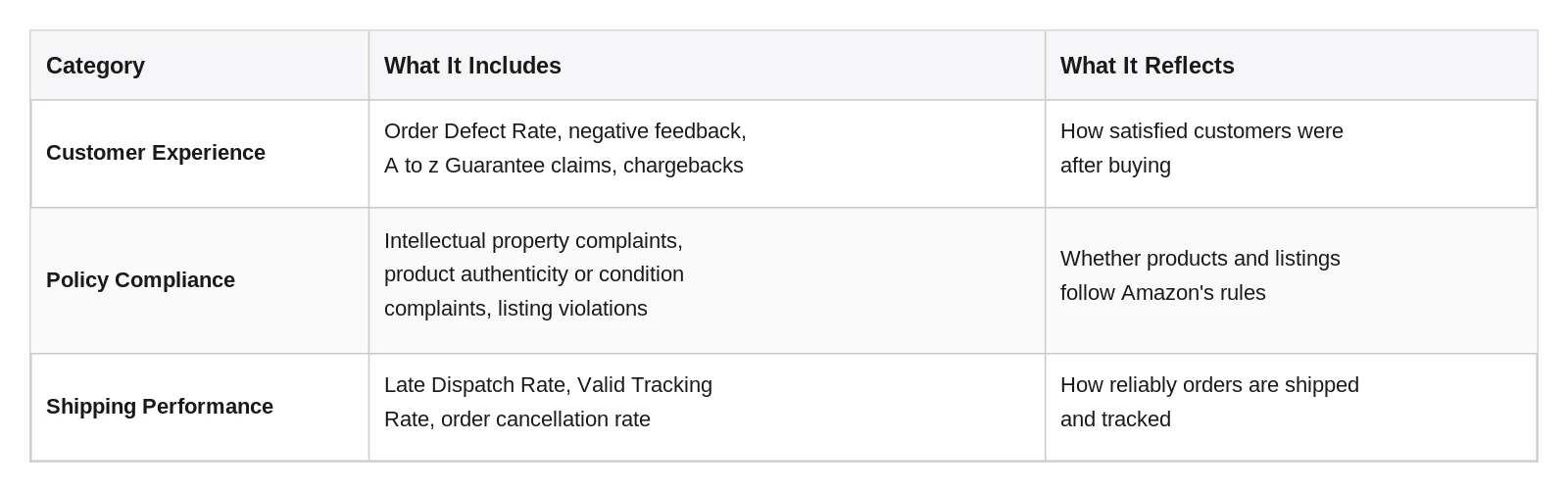
The Amazon Account Health Rating is a single number Amazon uses to summarize how well a seller account is performing. Instead of checking many separate reports, Amazon combines several signals into one score, often called an amazon account health score by sellers.
The score comes from three main areas. The table below shows a simple summary of each one.
Because the score blends these signals together, two sellers can share the same number for very different reasons, such as shipping delays for one and a policy issue for another.
This is one reason many sellers check sales numbers alongside account performance instead of looking at the score alone. Some sellers use analytics platforms such as My Real Profit to track daily sales clearly, which makes it easier to notice if a drop in orders lines up with a new account issue.
Amazon has used a scale from 0 to 1000 in the past, and many accounts now use a simpler 0 to 100 scale. The score also updates on a rolling basis, often looking at the past 30 or 60 days.
How Is the Amazon Account Health Page Color Coded?
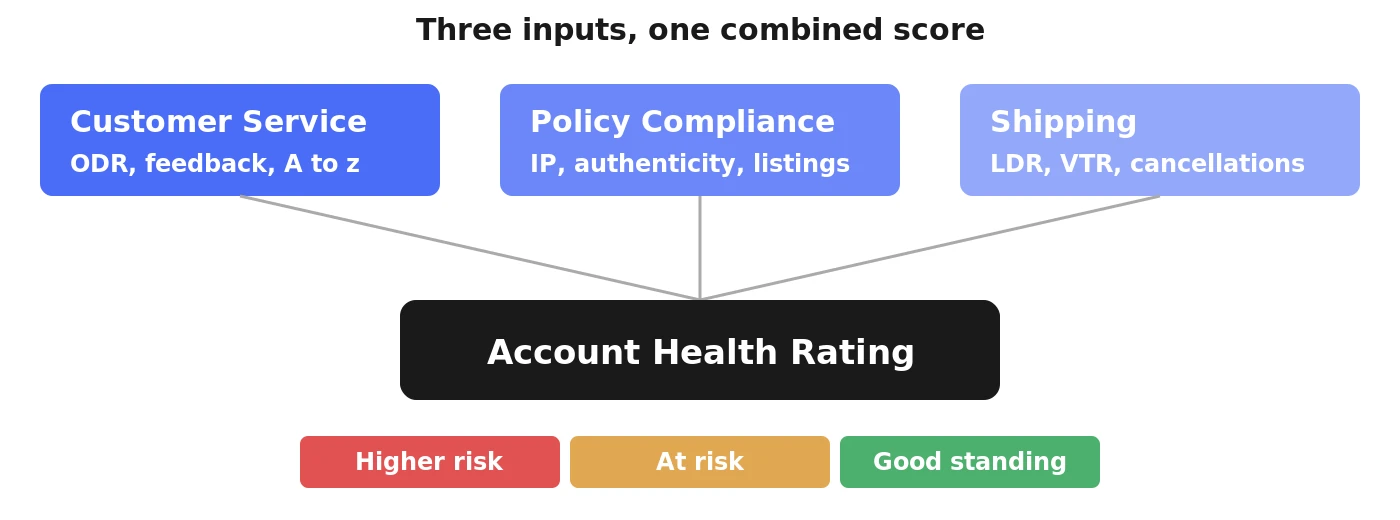
The Amazon Account Health Page uses color to make the current state of an account easy to understand at a glance. Green usually means performance sits within Amazon’s expected limits, with no urgent action needed.
Yellow or orange usually means one or more metrics are getting close to a limit, even if nothing has crossed the line yet. This is an early warning worth a closer look. Red usually means a metric has crossed its limit, and the account faces a higher risk of restrictions or, in serious cases, suspension.
Image: a simple gauge showing how the combined score moves through color zones, from higher risk to good standing. Suggested placement: right after this section.
A single yellow or red status rarely means the whole account is in danger at once. Checking the page weekly makes it easier to catch a slow shift from green toward yellow before it reaches red.
What Is a Good Amazon Account Health Score?
A good account health score is one where all three categories, customer experience, policy compliance, and shipping performance, sit comfortably within Amazon’s expected limits, with no single metric close to its threshold.
There is no single universal number that fits every seller. A high score, usually green, generally supports full access to selling features and a fair chance at the Buy Box. A middle score, often yellow, is a signal to review the account soon. A low score, usually red, carries real risk, including possible restrictions or suspension.
A useful habit is avoiding comparison with another seller’s score, since every account has a different mix of order volume and shipping methods. Watching your own trend over time is far more reliable than chasing a number seen elsewhere.
What Counts as a Violation Under Your Amazon Account Health Rating?
A violation is any specific event or repeated pattern that Amazon counts against one of the three categories above. Under customer experience, this can mean negative feedback, a successful A to z Guarantee claim, or a chargeback. Under policy compliance, it often comes from a specific complaint, such as an intellectual property issue or a product authenticity question. Amazon also factors these issues into your amazon performance rating, since repeated violations affect how the platform views account standing over time.
Under shipping performance, a violation usually means missing an expected shipping date, failing to provide valid tracking, or canceling an order before it ships.
Not every violation carries the same weight. A single late shipment rarely causes serious harm, while a repeated pattern or a confirmed policy issue has a much stronger effect. Some violations can be resolved with a clear explanation, while others simply need time to fade from the calculation.
Can You Earn Points Back on Your Amazon Account Health Rating?
Yes, in most cases a seller can recover a lower score over time. For metrics based on a rolling percentage, such as late shipments, recovery often happens naturally as older events fall outside the measurement window, usually between 30 and 60 days.
For policy related violations, recovery is less automatic and usually requires submitting an explanation showing what caused the problem and what steps were taken to prevent it from happening again.
Sellers who want to track this recovery process closely often pair it with their own sales records. Many sellers use an amazon profit dashboard to see daily order and profit numbers next to their account performance, which makes it easier to confirm that sales are stable while the score slowly improves.
A rough timeline for a shipping related issue is three to six weeks of consistent performance. Patience combined with steady daily work is almost always more effective than a rushed shortcut.
Conclusion
The Amazon Account Health Rating brings customer experience, policy compliance, and shipping performance into one combined number and one color coded status. Treating the score as a starting point, not a final verdict, and checking the three categories behind any change, helps a seller react calmly instead of guessing at every small shift.
FAQ
What is a good Amazon Account Health Rating?
A good score generally means all three categories stay comfortably within Amazon’s expected limits at the same time. There is no single fixed number that applies to every seller.
Why did my Account Health Rating change color without any new orders?
Some metrics use a rolling time window, so older events can fall out of the calculation and change the color even without new activity.
Does a red status always mean my account will be suspended?
Not always. A red status signals higher risk within a specific category, but suspension usually follows a serious or repeated issue rather than a single isolated event.
How long does it take to recover a lower Account Health Rating?
This depends on the type of issue. Percentage based metrics can improve within a few weeks, while policy related violations usually need a clear explanation before they are resolved.
Can I compare my score directly to another seller’s?
It is not very useful in most cases, since every account has a different mix of order volume, product categories, and shipping methods.
Amazon Account Health Rating: What They Actually Mean was last modified: July 18th, 2026 by Colleen Borator
Visual commerce is the strategic use of interactive, image-led, and video-based content to drive purchase decisions directly within the shopping experience.
Visual commerce increases average order value by up to 50% and conversion rates by 30–40% when implemented across product pages, social channels, and email campaigns (Salesforce, 2024).
The top recommendation for marketers starting with visual commerce today is to audit your existing product imagery, then layer in interactive formats — 3D viewers like Vizbl, shoppable video, and user-generated content (UGC) galleries — starting with your highest-traffic product pages.
Both B2B and B2C brands benefit from visual commerce, but B2B implementations focus on configurators and technical visualization, while B2C implementations prioritize lifestyle imagery and social proof.
What Visual Commerce Actually Means (and Why It Goes Beyond Pretty Pictures)
Visual commerce is the discipline of using visual media — photography, video, 3D models, augmented reality (AR), and interactive configurators — as the primary mechanism through which customers understand, evaluate, and purchase products. Visual commerce differs from traditional e-commerce photography in one critical way: visual commerce content is interactive and transactional, not merely decorative.
The concept of visual commerce emerged as consumer attention shifted from text-based product descriptions to image and video-first discovery on platforms like Instagram, Pinterest, and TikTok. According to Shopify’s 2024 Commerce Trends report, 67% of online shoppers say image quality is the most influential factor in a purchase decision — more than price or reviews for high-consideration items.
For marketers operating on platforms like EngageBay, visual commerce connects directly to campaign performance. A shoppable image embedded in an email campaign, for example, collapses the funnel by letting the recipient click on a product within the visual asset itself and proceed to checkout — eliminating multiple redirect steps that cause drop-off. Visual commerce does not replace copywriting or SEO; visual commerce augments both by reducing cognitive friction at the moment of purchase intent.
The Four Core Formats of Visual Commerce (With Performance Benchmarks)
Visual commerce encompasses four primary content formats, each suited to a different stage of the buyer journey. Understanding which format serves which intent is essential for budget allocation and campaign planning.
Visual Commerce Format
Best Funnel Stage
Avg. Conversion Lift
Primary Channel
Shoppable Images
Mid-funnel
+25–35%
Email, Social, PDP
Shoppable Video
Top-to-mid funnel
+30–45%
Social, YouTube, OTT
3D Product Viewers
Mid-to-bottom funnel
+40–50%
PDP, B2B Portals
Augmented Reality (AR) Try-On
Bottom funnel
+60–94%
Mobile App, PDP
Shoppable images allow product tags to be embedded directly into lifestyle or catalog photography. When a viewer taps or hovers over a tagged item, visual commerce shoppable images surface pricing, color options, and an add-to-cart action without navigating away from the image.
Shoppable video extends the same tagging logic into video timelines. Visual commerce shoppable video performs particularly well for demonstrating products with multiple use cases — apparel, tools, software — where a static image cannot communicate function.
3D product viewers let buyers rotate, zoom, and inspect a product from every angle before purchasing. Visual commerce 3D viewers are especially valuable in B2B contexts: a procurement manager reviewing industrial equipment or furniture can inspect tolerances and finishes without a physical sample. Platforms like Vizbl provide embeddable 3D product viewer technology that integrates with existing e-commerce stacks, enabling brands to deploy photorealistic 3D models directly on product detail pages without custom development overhead.
AR try-on and placement tools represent the highest-converting visual commerce format. Sephora’s AR mirror and IKEA’s “Place” app both demonstrate that letting customers visualize a product in context — on their face, in their room — reduces return rates by 20–35% (Deloitte Digital, 2023).
How to Build a Visual Commerce Strategy That Scales
Building a scalable visual commerce strategy requires a structured rollout across people, platforms, and content formats. The following numbered process applies whether your team has two marketers or twenty.
1. Audit your existing visual assets.
Catalog all product imagery, video, and 3D files currently in your system. Identify gaps: products with no video, products with only one image angle, or products with low-resolution assets that cannot be cropped for mobile.
2. Prioritize by revenue impact.
Apply visual commerce upgrades to your top 20% of SKUs by revenue first. Visual commerce investment has diminishing returns if spread too thin across a large catalog before any format is optimized.
3. Select the right visual commerce formats per channel.
Match format to channel behavior: shoppable images for email and Pinterest, shoppable video for Instagram Reels and TikTok, 3D viewers for product detail pages (PDPs) and B2B portals, AR for mobile-first or beauty/home categories.
4. Integrate visual commerce content with your CRM and marketing automation platform.
In EngageBay, for example, you can embed shoppable image blocks within automated email sequences tied to browse abandonment or post-purchase upsell flows. Visual commerce content embedded in behavioral email campaigns consistently outperforms static product images by 2–3× in click-to-purchase rate (Klaviyo Benchmark Report, 2024).
5. Establish measurement baselines before launch.
Track conversion rate per visual format, average order value on sessions that interact with visual commerce content versus those that do not, and return rates. Without these baselines, you cannot attribute ROI to specific visual commerce investments.
6. Iterate based on heatmap and session data.
Visual commerce content that receives views but not clicks typically signals a disconnect between the visual asset and the audience’s purchase intent — not a failure of visual commerce as a format.
Visual Commerce for B2B Marketers: A Different Playbook
Visual commerce is frequently positioned as a B2C discipline, but B2B adoption of visual commerce is accelerating rapidly. Gartner’s 2024 B2B Buying Report notes that 75% of B2B buyers now prefer a seller-free digital experience for initial product evaluation — a shift that makes visual commerce infrastructure essential for B2B e-commerce teams.
B2B visual commerce priorities differ from B2C in three measurable ways. First, B2B visual commerce focuses on technical accuracy over lifestyle appeal. A manufacturer selling custom mechanical components needs a 3D configurator that renders specification-accurate models, not aspirational photography. Second, B2B visual commerce must integrate with CPQ (Configure, Price, Quote) workflows, allowing buyers to configure a product visually and generate a quote directly from the configured 3D model. Third, B2B visual commerce content serves longer consideration cycles — a buyer may interact with a 3D model across five sessions before issuing a purchase order, so visual commerce platforms must support session persistence and configuration saving.
For B2B marketers using EngageBay’s CRM and deal pipeline features, visual commerce content can be embedded directly into proposal emails and deal stage notifications. A sales rep advancing an opportunity from “proposal sent” to “decision stage” can trigger an automated email that contains an interactive 3D product viewer tailored to the prospect’s configured specifications — merging visual commerce with CRM-driven personalization at scale.
FAQ
What is visual commerce, and how does it differ from e-commerce?
Visual commerce is a subset of e-commerce that prioritizes interactive, image-led, and video-based experiences as the primary purchase driver. While e-commerce describes the broader infrastructure of online transactions, visual commerce specifically refers to the content formats and technologies — shoppable images, 3D viewers, AR — that convert browsers into buyers through visual engagement rather than text-based persuasion.
Is visual commerce only relevant for product-based businesses?
Visual commerce is most commonly associated with physical products, but service businesses use visual commerce principles through interactive demos, video testimonials, and visual case studies. SaaS companies, for example, deploy interactive product tours — a form of visual commerce — that allow prospects to experience a product interface before purchasing.
How much does visual commerce technology cost to implement?
Visual commerce technology costs vary widely by format. Shoppable image plugins for Shopify or WooCommerce start at $20–$50 per month. Enterprise-grade 3D and AR visual commerce platforms range from $500 to $5,000+ per month depending on SKU volume and rendering complexity. AR try-on development for a mobile app typically requires a custom build at $25,000–$100,000+.
What metrics should you track to measure visual commerce ROI?
The four primary visual commerce metrics are: conversion rate on sessions with visual commerce interaction, average order value on those same sessions, return rate for products with 3D or AR visualization versus standard photography, and engagement rate (time spent with visual commerce content). Return rate reduction is frequently the fastest-to-calculate ROI signal, since return logistics costs are quantifiable.
Does visual commerce improve SEO performance?
Visual commerce content improves SEO indirectly by increasing time-on-page and reducing bounce rate — two behavioral signals that correlate with higher Google rankings. Structured data markup on shoppable images and videos (using Product and VideoObject schema) also enables rich results in Google Search, which increases click-through rate from organic listings.
How does visual commerce work in email marketing campaigns?
Visual commerce in email marketing works through embedded shoppable image blocks and GIF-based video previews with direct product links. Full video autoplay and interactive 3D are not supported in most email clients, so visual commerce in email relies on compelling static or animated visuals that link to an interactive experience hosted on a landing page or PDP.
Can small businesses realistically implement visual commerce?
Small businesses can implement entry-level visual commerce immediately using existing tools: Instagram Shopping tags, Pinterest Product Pins, and free Shopify image zoom apps all qualify as visual commerce implementations. The most accessible starting point for a small business is activating shoppable social posts, which requires no custom development and can be live within 24 hours.
Conclusion
Visual commerce has moved from a differentiator to a baseline expectation. Buyers — whether they are consumers shopping for apparel or procurement managers evaluating industrial equipment — now expect to interact with products visually before committing to a purchase. Brands that deliver immersive, accurate, and interactive visual experiences at every touchpoint convert more effectively, retain customers longer, and reduce costly returns.
Your immediate next step is to identify the three highest-revenue product pages in your catalog, assess the visual commerce gap on each page, and implement one interactive format — shoppable imagery, a 3D viewer, or a UGC gallery — within the next 30 days. Start narrow, measure rigorously, and scale what converts. Visual commerce is not a one-time project; visual commerce is an ongoing capability that compounds in value as your asset library and audience data grow.
Visual Commerce in 2026: a Complete Guide for B2B and B2C Marketers was last modified: May 22nd, 2026 by Muhammad Nasir
The convergence of enterprise data management and programmatic video synthesis has opened a new frontier for retail automation. For e-commerce development teams, the traditional workflow of manual post-production and localized video rendering represents a severe operational bottleneck. By treating video generation as a scalable infrastructure service rather than a manual tool, engineering teams can synchronize raw database metrics directly with programmable rendering engines. This technical analysis explores how to implement the Kling 3.0 API to transform stock keeping unit (SKU) data fields into high-fidelity, native 4K product assets automatically.
Scaling E-Commerce Infrastructure with the Kling 3.0 API
Integrating an automated video pipeline into an existing enterprise resource planning (ERP) or customer relationship management (CRM) environment requires a shift toward a unified multimodal infrastructure. This architecture abstracts the complexities of rendering, allowing data fields to drive visual outputs seamlessly.
Moving Beyond Fragmented Asset Workflows
Traditional generative video pipelines often process motion, lighting, and textures as isolated processing layers. This disjointed approach frequently leads to visual drift or mismatched perspectives, where product geometry warps during complex rotations. The Kling 3.0 API addresses this by utilizing a unified multimodal framework that processes spatial physics and environmental light mapping simultaneously. For enterprise developers, this means generated visual environments remain stable. The system ensures that background shadows and reflections interact accurately with the product surfaces during complex panning, preserving the aesthetic value of the item.
Decoupling Media Creation via Asynchronous Infrastructure
By moving away from consumer-facing graphical interfaces toward an automated, headless API infrastructure, development teams can decouple creative rendering from the user-facing storefront application. Media creation is standardized as an asynchronous service, triggered natively by standard database updates. When a new product asset is saved or edited within the catalog, a background worker initiates a standardized API request payload, keeping visual media generation entirely under programmatic oversight.
Data Synchronization: Connecting Product Feeds to the Kling 3 API
Building a responsive retail environment requires mapping static product specifications directly into structured data payloads that external rendering engines can parse.
Transforming Stock Database Metrics into Structured Video Inputs
Automated pipelines rely on data cleaning modules that extract product descriptions, inventory specifications, and operational parameters from active data models. These localized product data fields are then converted into optimized textual prompts and vector instructions for the Kling 3 API. For example, a database field indicating a material type like “brushed aluminum” is extracted and mapped to specific rendering descriptors within the payload, ensuring that the model synthesizes environments that match the original product metadata.
Resolving Material Integrity and Pixel Fidelity Hurdles
In digital retail, visual clarity directly impacts customer trust and brand authority. Lower-resolution assets that depend on post-generation upscale modules often suffer from blurred edges and muddy textures. The Kling 3 API circumvents this by utilizing initial-stage pixel synthesis to deliver native 4K output. This ensures that micro-details—such as garment stitching, leather grain, and precision corporate logos—are rendered with high structural fidelity, satisfying the strict quality requirements of modern high-definition digital showcases.
Preventing Asset Distortion with Kling V3.0 API State Control
E-commerce storefronts require absolute brand compliance. A major technical challenge in synthetic video is maintaining an exact replica of a physical item without visual “hallucinations.”
Implementing Subject Reference Logic to Counteract Identity Drift
The Kling V3.0 API provides a robust solution to character and product variation through advanced state persistence parameters. By mapping a baseline product image URL as a strict subject reference input, developers can lock down specific silhouettes, functional details, and brand markings. The engine treats this reference asset as a fixed state configuration, programmatically ensuring that product dimensions and visual features remain consistent regardless of variations in virtual camera angles or environmental dynamics.
Coordinating Complex Spatial Logic and Multi-Object Integration
E-commerce scenes often require more than a standalone product cutout; they demand realistic interactions between structural items and human models. The 3.0 architecture is optimized to handle multi-object spatial mapping without breaking occlusion boundaries. The engine manages relational depth mapping to ensure proper scaling, natural physics, and accurate shadow casting when a model interacts with a product, preserving a technically coherent scene layout.
Localizing International Markets via the Kling Video 3.0 API
Cross-border retail distribution demands rapid localized adaptations of marketing collateral without duplicating core compute workflows.
Integrating Multimodal Dialogue and High-Precision Lip-Sync
The Kling Video 3.0 API features refined native lip-sync integration, allowing developers to sync independent audio streams with synthetic human figures natively. Instead of overlaying separate voice-overs over a rigid video track, developers can programmatically map multi-language audio files to the generation pipeline. The engine adjusts facial articulation and context-aware mouth expressions to match the target language, enabling enterprise teams to automate localized ad deployments across multiple regions simultaneously.
Standardizing Programmatic Camera Control and Scene Continuity
Cinematic storytelling requires predictable motion vectors that align with established brand guidelines. The Kling Video 3.0 API moves away from unpredictable, descriptive language prompts by accepting precise camera control vectors. Developers can pass explicit parameters for tilts, pans, and dolly tracking within the request metadata. This allows an enterprise to standardize a uniform visual style across thousands of automatically generated item pages, ensuring consistent continuity throughout the platform.
Integration Execution: Deploying Kling AI API Lifecycles
An enterprise integration must account for system orchestration, secure validation protocols, and structured ingestion routines to remain stable.
Token Validation and Payloads
The validation lifecycle begins at the enterprise application server layer. Developers must configure isolated bearer tokens within their backend environment variables to handle endpoint authorization securely. Every automated generation request constructs a standardized JSON payload detailing the operational constraints of the task:
Model Core: Directing the system to target the 3.0 architecture engine.
Asset Parameters: Explicitly declaring the target resolution, aspect ratio, frame rate, and motion indexes.
Reference Anchors: Injecting the product source image URLs into the identity-locking nodes to enforce subject consistency.
Orchestrating Task Lifecycles and Ingestion Systems
Because high-fidelity video synthesis is a compute-intensive task, the platform architecture relies entirely on an asynchronous lifecycle model.
Submission: The backend application dispatches the payload to the generation endpoint and receives a unique task_id in response.
Lifecycle Monitoring: The system routes this identifier to a worker queue where a tracking listener checks the task status field at defined intervals.
State Management: The tracking system monitors status updates as they transition from pending states to completion states (succeeded or failed), ensuring platform reliability remains steady.
Ingestion: Once a successful status is registered, the system extracts the secure, temporary download URL provided by the API, automatically pulling the finished 4K file into internal storage arrays or content delivery networks (CDNs).
Conclusion: Future-Proofing Supply Lines with the Kling AI API
Integrating a programmable video infrastructure allows technical squads to align digital production capabilities with real-time marketing shifts. By linking database metrics directly to the Kling AI API, modern e-commerce architectures can eliminate manual production bottlenecks and establish a predictable asset ingestion loop. This automated approach allows founders and technical leads to focus human capital on high-level data strategy and system performance, leaving the resource-heavy demands of visual synthesis to a reliable, scalable interface.
Kling V3.0 API: Integrating Data-Driven Product Feeds into Automated E-Commerce Video Pipelines was last modified: May 20th, 2026 by Prester Witzman
According to Shopify’s global ecommerce forecast, global online retail sales are on track to reach $6.88 trillion by the end of 2026 – a 7.2% increase year-over-year, with ecommerce now accounting for 21.1% of all retail worldwide. That scale of opportunity is real. So is the competition for it.
Most ecommerce businesses don’t fail to grow because of a bad product. They fail to scale because the systems underneath the business – logistics, payments, data, customer experience – weren’t built to carry more weight. Knowing how to scale an ecommerce business sustainably means investing in infrastructure before the cracks appear, not after.
This guide covers the proven strategies and tools that matter most in 2026, organized around the areas where scaling decisions tend to have the biggest downstream impact.
Why Scaling Is Different From Growing
Growth is adding more – more traffic, more orders, more products. Scaling is doing that without adding proportional cost and operational friction. A business that doubles revenue by doubling headcount hasn’t scaled; it’s grown expensively.
The distinction matters because most of the levers that drive scale are infrastructure decisions: automation, platform selection, payment architecture, and data systems. Getting these right early compresses the unit economics at higher volume. Getting them wrong means every new order costs nearly as much to process as the last one.
How to Scale an eCommerce Business: 6 Proven Strategies
1. Automate Inventory and Fulfillment Before You Need To
Inventory management is one of the first operational systems to break under volume. Manual stock tracking, spreadsheet-based reordering, and single-warehouse fulfillment all work until they don’t – and when they break at scale, they take customer satisfaction with them.
The tools worth investing in before scaling aggressively:
Inventory management software with real-time sync across sales channels (Shopify, Amazon, wholesale portals)
Demand forecasting that uses historical sales data and seasonality to reduce both stockouts and overstock
3PL partnerships that let you distribute inventory closer to your customer base without building your own warehouse infrastructure
Returns automation to handle reverse logistics without creating a manual backlog
Getting fulfillment right isn’t glamorous, but it’s the operational foundation that everything else rests on.
2. Invest in Conversion Rate Optimization Before Spending More on Acquisition
Scaling paid acquisition before fixing conversion is one of the most common and expensive mistakes in ecommerce. The math is straightforward: doubling ad spend on a 1.5% conversion rate gives you the same ROI problem at twice the cost.
The average global ecommerce conversion rate sits at around 1.58%, but top-performing stores in mature categories run at 3–5%. The gap is almost always in checkout friction, page speed, mobile experience, and trust signals, all of which can be addressed without increasing acquisition spend.
Audit checkout flow, reduce form fields, add express payment options, and test abandonment recovery sequences before scaling traffic. Every percentage point of conversion improvement multiplies across the entire top-of-funnel investment.
3. Build Payment Infrastructure That Scales Internationally
Payment performance is one of the most underestimated growth levers in ecommerce. A business expanding into new geographies without adapting its payment stack will see authorization rates drop, local payment methods go unsupported, and checkout abandonment rise, all of which cap growth in those markets regardless of how good the product or marketing is.
Supporting local payment methods in each target market (SEPA in Europe, PIX in Brazil, UPI in India)
Using multi-PSP routing to improve authorization rates by directing transactions to the processor with the best performance for each card type and geography
Implementing network tokenization to protect stored credentials, reduce false declines, and improve recurring payment success rates
Automating tax calculation across jurisdictions to avoid compliance exposure as cross-border volume grows
Solidgate is one example of a payments infrastructure platform that combines these capabilities – routing, acquiring, tokenization, and tax – in a single layer built specifically for digital commerce at scale.
4. Use Data to Make Decisions, Not Confirm Them
Scaling without analytics is guessing at speed. The businesses that scale efficiently in 2026 are the ones using customer data to drive decisions on which products to expand, which markets to enter, which segments to retain, and which channels to double down on.
The baseline data stack for scaling ecommerce:
Customer lifetime value (LTV) by acquisition channel and product category: to know where your best customers actually come from
Cohort analysis: to understand retention patterns and when customers typically churn
Payment analytics: authorization rates, decline codes, and payment method performance by market, which directly affect revenue forecasting
Attribution modeling: to allocate marketing spend based on real contribution to revenue, not last-click proxies
The goal isn’t more dashboards. It’s fewer decisions made on instinct and more made on evidence.
5. Localize the Experience, Not Just the Language
True localization goes beyond translation. Customers in different markets have different expectations around pricing display, return policies, delivery timelines, customer service channels, and payment methods. A checkout that works in the US may feel foreign – or fail outright – in Southeast Asia or LATAM.
Businesses that scale their ecommerce business globally treat each new market as a product decision, not just a marketing decision:
Prices displayed in local currency, not converted at checkout
Payment methods that reflect local preference, not just what the payment provider defaults to
Customer support in the local language and time zone
Return policies adapted to local consumer protection norms
Localization is slower to build than a translated homepage, but it’s the difference between entering a market and actually converting in it.
6. Retain More Before Acquiring More
Acquiring a new customer typically costs five to seven times more than retaining an existing one. At scale, that math becomes a structural cost problem if retention isn’t a deliberate priority.
The retention levers with the highest return in ecommerce:
Email and SMS flows triggered by behavior: post-purchase sequences, win-back campaigns, replenishment reminders for consumables
Loyalty and rewards programs that increase purchase frequency without requiring discounts on every order
Subscription options for repurchase-prone products, which convert variable revenue into predictable recurring revenue
Post-purchase experience: delivery updates, easy returns, and proactive communication that reduce support volume and increase satisfaction
LTV growth is how ecommerce businesses scale margins, not just revenue.
A Quick Comparison: Early-Stage vs. Scale-Stage Priorities
Area
Early Stage
Scale Stage
Fulfillment
One warehouse, manual tracking
Multi-node 3PL, automated reordering
Payments
Single PSP, domestic only
Multi-PSP routing, local methods, tokenization
Marketing
Acquisition-first
Balanced acquisition and retention
Data
Basic analytics
LTV modeling, cohort analysis, attribution
Localization
English-first, currency conversion
Full market localization per region
Customer support
Founder-led or small team
Automated triage, multilingual coverage
Final Thoughts on Scaling Your eCommerce Business
Scaling an eCommerce business successfully requires more than just growing your revenue – it demands building a robust infrastructure that can handle increased volume without compromising efficiency. By automating key processes, optimizing payment systems, leveraging data analytics, and expanding into global markets with localized experiences, businesses can set themselves up for sustainable growth.
With the right tools and strategies in place, scaling doesn’t have to be a daunting task. Start building the foundation early to ensure your business can scale smoothly and avoid the pitfalls that many growing companies face. As eCommerce continues to evolve, those who invest in scalability will be the ones poised to lead in 2026 and beyond.
FAQ
What does it mean to scale an ecommerce business? Scaling means growing revenue without proportionally increasing costs or operational complexity. It’s the difference between hiring more people for every new order and building systems – automation, infrastructure, data tools – that handle increased volume efficiently.
When is the right time to start investing in scaling infrastructure? Earlier than most businesses expect. The cost of migrating a payment stack, re-platforming logistics, or rebuilding data infrastructure under pressure is significantly higher than building it right the first time. Most scaling decisions should be made before current systems break, not after.
How does payment infrastructure affect ecommerce growth? Directly. Authorization rates, checkout conversion, and local payment method coverage all affect how much of your traffic actually converts to revenue. Poor payment infrastructure creates a ceiling on growth in each market – no amount of marketing spend overcomes a 15% decline rate at checkout.
What’s the most cost-effective way to scale ecommerce internationally? Start with markets where demand signals already exist, where you’re already seeing organic traffic or orders. Localize payment methods and currency display first, as these have the highest impact on conversion. Use fulfillment partners with existing infrastructure in the target market rather than building your own.
What’s the difference between scaling and growth in ecommerce? Growth adds more output – more orders, more revenue. Scaling adds more output without adding proportional input – cost, headcount, or operational complexity. True scaling usually requires automation, better infrastructure, and systems that do more work per person or dollar spent.
Which tools are most important for scaling an ecommerce business in 2026? The highest-impact tools vary by stage, but consistently include: a scalable ecommerce platform (Shopify Plus, BigCommerce, or headless), a multi-PSP payment infrastructure for international markets, an inventory and fulfillment management system, a customer data platform or analytics stack for LTV and cohort analysis, and email/SMS automation for retention.
How to Scale ECommerce Business in 2026: Proven Ways & Tools was last modified: May 1st, 2026 by Ivan B
Delivery problems tend to multiply when an ecommerce business starts growing fast. More orders mean more chances for a bad address, a missed scan, a delayed replacement, or a customer asking where their package went. It’s easy to blame the carrier, but a lot of delivery risk starts much earlier.
Order data, customer communication, tracking habits, and internal handoffs all affect whether a shipment arrives cleanly or turns into a support problem. If you want fewer delays, disputes, and “Where is my order?” tickets, start by tightening the parts of the process you control.
Clean Up Address Data Before the Order Ships
A surprising number of delivery issues begin with bad information. Missing apartment numbers, typo-filled street names, outdated saved addresses, and autofill mistakes can all create delays that are hard to fix once a label is printed.
That’s why it helps to catch problems before the package leaves your system. Use address validation at checkout, flag incomplete entries, and give customers a clear chance to review shipping details before they place the order. Small fixes here prevent a lot of avoidable rework later.
Keep Stronger Records for the Cases That Can Come Back Later
Most orders don’t need anything beyond normal tracking. But some situations do call for better documentation, especially when a claim, dispute, or formal follow-up may come back weeks later.
If you need to send replacement confirmations, chargeback support, claims paperwork, or signature-related follow-up, it can help to check current Certified Mail Labels rates as part of deciding how to handle those higher-stakes cases. It’s one way to build a clearer record when proof of mailing or delivery matters.
When tracking goes quiet, customers assume something is wrong. That means your order and shipping emails need to fill the gaps. Let people know when an order is confirmed, when it leaves the warehouse, and when there’s a delay worth explaining. A short, clear update can prevent the kind of frustration that turns into a chargeback or a replacement request.
Handle Exceptions Before They Become Support Piles
Growing stores often get into trouble when exception handling stays too informal. A missing package gets buried in email. A damaged shipment waits two days for review. A replacement order goes out without clear notes. Then customer service has to piece everything together under pressure.
Set a simple process for the issues that happen most often. A short internal checklist can help, especially for:
delivery delays that need customer updates
damage claims waiting on review
address corrections before a replacement ships
replacement orders tied to an earlier complaint
Everyone touching those cases should be able to see the same status, the same notes, and the same next step.
Watch the Handoff Between Teams
A lot of delivery risk comes from simple disconnects between ecommerce, fulfillment, and support. Pressure around last-mile delivery costs and customer expectations doesn’t disappear just because your team is busy.
If support can’t see what fulfillment did, or fulfillment doesn’t know what support promised, customers end up paying for the gap. As volume grows, clearer internal notes and shared case ownership become just as important as faster shipping.
The goal isn’t perfection. It’s fewer preventable mistakes, faster answers when something goes wrong, and better records when a delivery turns into a dispute. That’s usually what makes a growing ecommerce business feel dependable.
Tips for Reducing Delivery Risks in a Growing Ecommerce Business was last modified: April 10th, 2026 by Sara Edwards
To create a successful e-commerce site, you need to establish a website that enables online product sales. A well-designed website establishes customer trust in your brand. It also makes product discovery easy and completes the purchase without any difficulties.
To make a user-friendly website, you need to implement proper steps. These steps help to achieve successful results for both small and large online store projects.
Here are seven tips to build a successful e-commerce website:
1. Choose a Simple and Clear Website Design
Your website design should be clean and simple. Customers should be able to understand your website without any help. Use easy colors, readable text, and clear images. Visitors’ experience can be confusing due to too many pop-ups and animations that distract. A simple design helps people focus on shopping instead of figuring out how the site works.
2. Make Navigation Easy for Users
Good navigation helps visitors find products quickly. Use clear menus and categories such as “Men,” “Women,” or “New Arrivals.” Add a search bar so users can easily find items. When customers can find what they need without stress, they are most likely to buy from your website again and again.
3. Focus on Search Engine Visibility
Your website should be easy to find on search engines like Google. Your website needs clear page titles, simple URLs, and useful content. Many businesses also get professional help, such as an ecommerce SEO consultancy, to improve visibility and attract the right audience to their store. Partner with such a consultancy, and you can easily improve your business visibility on search engines.
4. Use Clear Product Descriptions and Images
The description of each product needs to be written in a straightforward manner. The product description must show what the product does and how customers can use it. It also explains the product’s benefits.
Provide customers with multiple high-quality product images that show different aspects of the item. Good descriptions and images reduce customer confusion and build their confidence in the product.
5. Optimize Your Website for Mobile Users
Mobile phones have become the primary device for online shopping among consumers. Your e-commerce website must work well on small screens. Your website needs to offer buttons that users can easily tap, text that users can read, and pages that will load without delay. A mobile-friendly website helps you reach more customers and improves user experience.
6. Build Trust with Secure Payments
Customers need to feel safe when making online payments. The website should use payment methods that customers trust and display security badges. The website needs to provide customers with understandable return policies and refund policies that explain their rights. Trust plays a big role in turning visitors into loyal customers.
7. Offer Good Customer Support
Good customer support builds long-term relationships. The website needs to provide contact methods for customers to reach us via email, chat, and contact forms. The company must handle customer inquiries and complaints promptly. Customers who receive both recognition and assistance from your team will establish greater repeat business with you.
7 Tips to Build a Successful E-commerce Website was last modified: April 8th, 2026 by Max Micklema
Shopify offers exceptional ease of use, making it simple for anyone to create and manage an online store.
Its extensive app store provides over 8,000 tools to add custom features and marketing capabilities.
The platform includes a wide range of integrated payment methods, simplifying checkout for customers.
Compared to other ecommerce platforms, Shopify provides a complete, all-in-one solution with hosting and security included.
For larger businesses, Shopify Plus offers advanced features for high-volume sales and automation.
All themes are mobile-responsive, ensuring a great experience on any device.
Choosing the right foundation for your online business is one of the most important decisions you’ll make. With so many ecommerce platforms available, it can be tough to know which one is the best fit.
Shopify has emerged as a leader in the industry, powering millions of businesses worldwide, often enhanced through professional Shopify development services that tailor stores for performance, scalability, and growth.
This guide will explore what makes a Shopify store stand out from the competition, from its user-friendly design to its powerful features, helping you decide if it’s the right choice for you.
What Is Shopify and How Does It Work?
Shopify is an all-in-one ecommerce platform that gives you everything you need to start, run, and grow a business. Think of it as a comprehensive website builder designed specifically for selling products.
Instead of needing technical skills to build an ecommerce website from scratch, Shopify provides the tools to create your online store, manage inventory, process payments, and handle shipping in one convenient place. You can build a fully functional Shopify store in a matter of hours.
So, why do so many businesses choose Shopify for their online store? A huge part of its appeal is its simplicity and power combined. The platform lets you sell your products everywhere your customers are, including on social media channels and online marketplaces.
It handles the technical side of running an online store, like security and hosting, so you can focus on what you do best: building your brand and connecting with customers.
Comparing Shopify to Other Major E-Commerce Platforms
When looking at different ecommerce platforms, it’s helpful to understand the core differences. Shopify is a fully hosted, “software-as-a-service” (SaaS) solution. This means you pay a monthly fee, and Shopify handles all the hosting, security, and maintenance for you. It’s built for ease of use right out of the box.
In contrast, a platform like WooCommerce is an open-source WordPress plugin. It’s free to install, but you are responsible for finding and paying for your own hosting, security, themes, and other extensions.
This offers immense flexibility but requires more technical know-how and hands-on management.
Other competitors like BigCommerce offer a similar hosted model to Shopify but often include more features natively, reducing the reliance on apps.
Meanwhile, platforms like Adobe Commerce (formerly Magento) are powerful open-source solutions aimed at large enterprises with significant development resources. The main difference lies in control versus convenience.
Core Features That Set Shopify Apart
Shopify’s popularity isn’t just a coincidence; it’s built on a foundation of powerful and accessible key features. A major draw is its incredible ease of use, which empowers entrepreneurs without a technical background to build professional-looking stores.
All plans allow you to sell unlimited products, so you never have to worry about outgrowing your plan’s inventory limits.
Beyond the basics, Shopify includes a suite of built-in marketing tools to help you attract and retain customers. The platform’s core strengths in usability, design, and security create a complete package that we’ll explore in the next sections.
User-Friendly Interface and Store Setup
One of the biggest reasons businesses choose Shopify is its unmatched ease of use. From the moment you sign up, the platform is designed to guide you through the creation process without causing confusion. You are greeted with a simple setup wizard and a clear checklist of tasks to get your store online. This focus on a positive user experience is a game-changer for new entrepreneurs.
The dashboard is clean and intuitive, making everyday tasks like adding products and creating product pages straightforward. You don’t need to be a designer or developer to achieve a professional look and feel, which significantly improves the overall customer experience your store provides.
Shopify’s guided setup helps you with key steps, including:
Adding your first product
Customizing your theme and homepage
Setting up your domain name
Configuring payment options
Mobile Optimization and Responsive Design
In today’s market, a majority of online shopping happens on mobile devices. Shopify understands this perfectly, which is why mobile optimization is a core part of its platform. Every theme available in the Shopify theme store, whether free or premium, features a responsive design. This ensures your store looks and functions beautifully on any screen size, from desktops to smartphones.
This built-in responsiveness is a major pro of using Shopify. You don’t have to worry about hiring a developer to make your site mobile-friendly. Your product pages will automatically adjust to provide an optimal user experience, which is crucial for converting visitors into customers. A poor mobile experience can quickly drive potential buyers away.
By guaranteeing a seamless shopping journey on any device, your Shopify store is set up for success from the start. This focus on a consistent and high-quality user experience across all platforms is a significant advantage that helps businesses maximize their sales potential.
Built-In Security and PCI Compliance
Security is non-negotiable in e-commerce, and this is an area where Shopify truly shines, especially compared to custom-built or self-hosted solutions. The platform is Level 1 PCI DSS compliant, which is the gold standard for online security. This means Shopify handles all the requirements for securely processing credit cards and sensitive data, so you don’t have to.
This built-in security saves you time and money, and gives both you and your customers peace of mind. Shopify manages everything from server maintenance to security updates automatically. This is a key difference from custom solutions or open-source platforms where you are responsible for managing security yourself.
Shopify’s security features include:
Automatic PCI compliance for all stores.
Built-in fraud analysis to flag potentially risky orders.
Support for secure payment options, including digital wallets and credit cards.
Customization and Flexibility
While Shopify is known for its simplicity, it doesn’t sacrifice flexibility. You have extensive control over the look, feel, and functionality of your ecommerce store. The platform offers a wide range of design options to help you create a unique brand presence that stands out from the crowd.
Much of this flexibility comes from the massive Shopify App Store, which allows you to add nearly any feature you can imagine. From marketing automation to advanced product options, you can tailor your store with custom integrations. The following sections will highlight how themes and apps work together to make your store your own.
Themes, Templates, and Store Design Options
Your store design is the first impression you make on customers, and Shopify offers plenty of options to make it a great one. The Shopify Theme Store features hundreds of professionally designed templates, including both free and premium themes. While free themes are perfect for getting started, premium themes (costing between $100-$500) often provide more advanced features and customization.
This variety is another reason so many businesses choose Shopify. Whether you’re in fashion, electronics, or food and beverage, you can find a template that fits your industry. The built-in website builder allows you to easily customize colors, fonts, and layouts without touching a single line of code, making product management and page design simple.
Recently, Shopify even introduced an AI tool that can generate a unique theme for your Shopify store based on a simple prompt. This level of innovation in store design keeps the platform ahead of the curve and gives you powerful tools to create a stunning online presence.
Shopify App Store and Integration Capabilities
The Shopify App Store is arguably one of its greatest assets. With over 8,000 apps, it functions like a treasure chest for your business, allowing you to add powerful features and integration capabilities with just a few clicks. This is a major advantage compared to platforms with smaller app ecosystems.
Whether you need advanced marketing tools, customer service solutions, or unique shipping options, there’s likely an app for it. This allows you to scale your store’s functionality as your business grows without needing custom solutions from the start. Many businesses rely on the app store to connect their store with essential third-party tools.
Some popular integration categories include:
Email marketing and automation (e.g., Klaviyo)
Customer reviews and loyalty programs
Advanced SEO and analytics tools
Dropshipping and print-on-demand services
Extending Functionality with APIs and Third-Party Tools
For businesses with unique needs that go beyond what’s available in the app store, Shopify provides robust APIs (Application Programming Interfaces). These APIs allow developers to build completely custom integrations, connecting your store to proprietary software or specialized third-party tools. This level of extensibility sets Shopify apart from more restrictive ecommerce platforms.
This capability is especially important for growing businesses and enterprises. For example, a business might use APIs to sync inventory with a custom warehouse management system or connect to a unique customer relationship management (CRM) platform. This ensures that Shopify can grow with your business and adapt to complex operational requirements.
For high-volume merchants, Shopify Plus offers even greater API access and support for more advanced custom integrations. This allows for deep customization of everything from the checkout experience to backend workflows, making it a formidable choice for large-scale operations.
Shopify Pricing and Cost Structure Compared
Understanding the cost is crucial when choosing a platform. Shopify’s pricing is straightforward, based on a monthly fee for one of its tiered pricing plans. This fee covers hosting, security, and access to its core features. This predictable cost structure is a major plus for businesses that want to manage their budget effectively.
However, it’s also important to consider potential additional costs, such as transaction fees if you don’t use Shopify Payments, and the price of premium themes or paid apps. The following sections will break down what’s included in each Shopify plan and how its overall value compares to competitors.
Shopify Subscription Plans and What They Include
Shopify offers several subscription plans designed to suit businesses at different stages of growth. The main tiers are Basic, Shopify, and Advanced, each offering more features and lower transaction fees as you move up. The Basic plan is great for new businesses, while the higher-tier plans offer advanced reporting and shipping features.
For large enterprises, the Shopify Plus plan provides a custom solution with dedicated support, advanced automation, and unparalleled scalability. Unlike open-source platforms where costs can be unpredictable, Shopify’s plans offer clear value. Your chosen Shopify plan determines the features available and the rates for different payment methods.
Standard Plans Comparison:
Shopify Plan
Monthly Cost (Billed Annually)
Best For
Basic
$29/month
New businesses and startups
Shopify
$79/month
Growing businesses with retail
Advanced
$299/month
Scaling businesses needing advanced features
Comparing Transaction Fees and Payment Gateways
When comparing pricing, transaction fees are a key factor. Shopify has its own payment gateway called Shopify Payments. If you use it, Shopify waives its own platform transaction fees, and you only pay the standard credit card processing rate. This simplifies payment processing and can save you money.
If you choose to use a third-party payment gateway, Shopify charges a small transaction fee on each sale, which ranges from 2% on the Basic plan to 0.5% on the Advanced plan. This is a point of difference with platforms like BigCommerce, which charges no platform transaction fees regardless of the gateway you use.
Shopify supports over 100 payment gateways, giving you plenty of payment options, including popular digital wallets and buy-now-pay-later services. It also offers Shop Pay, an accelerated checkout option that helps increase conversions by making it faster for customers to buy.
Assessing Value for Money Against Competing Platforms
When you assess the total value for money, Shopify is often the best option for many businesses, despite potential additional costs. The monthly fee includes enterprise-grade hosting, top-tier security, and 24/7 support, which you’d have to pay for separately with a self-hosted platform like WooCommerce. These bundled services provide significant value and peace of mind.
While the cost of apps can add up, they also allow you to add powerful functionality that could cost thousands of dollars in custom development on other platforms. For many merchants, the convenience, reliability, and scalability of Shopify’s all-in-one solution outweigh the costs.
Key factors contributing to Shopify’s value:
Predictable monthly costs that include hosting and security.
Access to a vast app store for affordable feature expansion.
Reduced need for technical maintenance and developer support.
Shopify’s Versatility for Different Types of Businesses
Shopify is not a one-size-fits-all platform; its versatility is one of its core strengths. It caters to a wide spectrum of business owners, from solo entrepreneurs launching their first ecommerce business to global brands processing thousands of orders a day. This adaptability makes it a sustainable choice for long-term growth.
Whether you’re a startup, a direct-to-consumer brand, or a large enterprise needing the power of Shopify Plus, the platform has a solution tailored to your needs. The following sections will explore how different types of businesses can leverage Shopify to succeed.
Small Businesses, Startups, and Direct-to-Consumer Brands
For small businesses and startups, Shopify is often the ideal choice. Its ease of use and affordable entry-level plans lower the barrier to starting an online business. Entrepreneurs can launch a professional-looking store quickly without needing a large budget or technical team. This allows them to focus on product development and marketing right away.
Direct-to-consumer (DTC) brands also thrive on Shopify. The platform’s powerful branding capabilities and extensive Shopify App Store allow these businesses to create unique customer experiences. They can easily integrate tools for social proof, like product reviews, and connect with their audience through email marketing and social media integrations.
The ability to get started quickly and then scale by adding functionality through apps makes Shopify a perfect launchpad. It provides all the essential tools for new businesses to build a strong online presence and grow a loyal customer base.
Enterprises and High-Volume Merchants with Shopify Plus
For enterprises and high-volume merchants, Shopify Plus offers a robust suite of enterprise solutions. This upgraded plan is built to handle massive traffic and sales volume without compromising performance. It’s designed for businesses that have outgrown standard plans and require more power, customization, and support.
Shopify Plus provides advanced tools for automation and customization. Merchants can create custom storefronts using headless commerce architecture, personalize the checkout experience with Shopify Scripts, and automate backend workflows with Shopify Flow. This level of control is essential for large-scale operations.
Key benefits of the Shopify Plus plan include:
Dedicated account management and priority support.
Higher API limits for complex custom integrations.
Exclusive tools like Launchpad for automating sales campaigns and product releases.
Brick-and-Mortar Integration and Omnichannel Capabilities
Shopify is also an excellent choice for businesses with a physical presence. The platform’s omnichannel capabilities allow for seamless integration between brick-and-mortar stores and online sales channels. This is primarily achieved through Shopify POS (Point of Sale), a system that unifies in-person and online inventory, orders, and customer data.
This unified approach means that if a product is sold in-store, the online inventory is updated automatically, preventing overselling. Customers can buy online and pick up in-store, or return online purchases at a physical location, creating a smooth and convenient shopping experience. This helps bridge the gap between physical and digital retail.
By offering features like integrated payment processing for both channels and the ability to add tools like live chat to the online store, Shopify empowers businesses to create a true omnichannel strategy. This allows them to meet customers wherever they are and manage all aspects of their business from a single dashboard.
Migration and Ease of Switching to Shopify
Thinking about platform switching can be daunting, but moving your business to a Shopify store is more straightforward than you might think. Shopify has invested in making the migration process as smooth as possible, offering a range of data import tools and resources to help you make the move with minimal disruption.
Whether you’re coming from WooCommerce, BigCommerce, or another platform, there are solutions to help transfer your important data. The following sections will cover the tools available for migration and some of the common challenges you might encounter.
Data Import Tools and Migration Support
Shopify provides several ways to migrate your data. For smaller stores, you can use CSV files to import products and customer information. This method gives you control over your data and is a cost-effective way to handle product management during the transfer. Shopify provides detailed guides to help you format these files correctly.
For more complex migrations, a number of third-party migration apps are available in the Shopify App Store. These tools are designed to automate the transfer of products, customers, and order history from platforms like WooCommerce, BigCommerce, and Magento. They can save a significant amount of time and reduce the risk of manual errors.
For large-scale businesses moving to Shopify Plus, Shopify offers dedicated migration support to ensure a seamless transition. This hands-on assistance is invaluable for complex stores with large amounts of data. Key migration tools include:
Dedicated support for Shopify Plus merchants.
Shopify’s native CSV import tools.
Third-party migration apps like Cart2Cart.
Challenges and Solutions When Switching Platforms
While Shopify makes migration accessible, switching any ecommerce store can present challenges. One common hurdle is preserving your SEO rankings. This involves setting up URL redirects from your old site to your new Shopify store to ensure that search engines and customers don’t land on broken links. Apps in the Shopify App Store can help automate this process.
Another challenge can be recreating custom integrations or specific functionality from your old platform, especially if you’re moving from a highly customized WordPress site. This may require finding equivalent apps in the Shopify App Store or hiring a Shopify expert to build a custom solution.
However, for most businesses, these challenges are solvable. The key is careful planning. By mapping out your data, identifying critical functionality, and using the right tools, you can make the switch to Shopify without significant downtime or data loss, even if you lack deep technical knowledge.
Support, Community, and Continuous Innovation
A platform is only as good as the support behind it, and this is another area where Shopify excels. It offers a comprehensive support system that includes 24/7 customer support, a vibrant community of users, and a marketplace of certified experts. This robust ecosystem ensures you’re never left without help when you need it.
Furthermore, Shopify is constantly evolving. The company consistently releases platform updates and new features, demonstrating a commitment to innovation that keeps its merchants ahead of the curve. The next sections will detail these valuable resources.
24/7 Customer Support and Shopify Expert Marketplace
Excellent customer service is a major reason why many businesses choose Shopify. The platform offers 24/7 support via live chat and email, so you can get help anytime, day or night. While dedicated phone support is now primarily for Shopify Plus users, the other channels are highly responsive and staffed by knowledgeable agents who can help resolve issues quickly. This level of accessible support is a huge pro.
For tasks that go beyond basic support, such as custom design work, app development, or marketing strategy, there’s the Shopify Expert Marketplace. This is a directory of vetted professionals you can hire to help grow your ecommerce business. It’s a fantastic resource for merchants who need specialized skills but don’t want to hire a full-time employee.
Having access to both immediate technical support and a network of professional experts gives merchants confidence. It ensures that no matter the challenge, a solution is within reach.
Community Resources, Forums, and Ongoing Platform Updates
Beyond direct support, Shopify has fostered a massive and active community. The Shopify Community forums are a valuable resource where you can ask questions, share experiences, and learn from other business owners. It’s a great place to find solutions to common problems and get advice from people who have been in your shoes.
Shopify also demonstrates a strong commitment to continuous improvement through regular platform updates. The company is always rolling out new features and enhancements, from improved SEO features and email marketing tools to cutting-edge AI capabilities like Shopify Magic. This constant innovation ensures the platform stays modern and competitive.
These resources contribute to a supportive ecosystem where business owners can thrive. Key benefits include:
Access to a large, active user community for peer support.
A detailed Help Center with guides on every aspect of the platform.
Regular updates that add value and new functionality to your store.
Conclusion
In conclusion, Shopify’s unique features and flexibility make it a top choice among e-commerce platforms. By prioritizing user experience, security, and customization, Shopify stands out in a competitive market. Its versatility caters to businesses of all sizes, from small startups to large enterprises, ensuring that each can find a solution tailored to their needs. Moreover, with seamless migration tools and 24/7 support, transitioning to Shopify is a smooth process, allowing you to focus on what matters most—growing your business. If you’re ready to elevate your e-commerce game, don’t hesitate to explore how Shopify can work for you! Get a free trial today and start your journey towards success.
Frequently Asked Questions:
What are the main pros and cons of using Shopify for e-commerce?
The main pros of a Shopify store are its incredible ease of use, excellent 24/7 customer support, and wide range of beautiful design options. The primary cons are the transaction fees charged when not using Shopify Payments and a potential reliance on paid apps to extend functionality, which can increase monthly costs.
Is Shopify better than building a custom e-commerce website?
For most businesses, Shopify is a better option than a custom ecommerce website because its website builder requires no technical knowledge and is faster and more affordable to launch. While custom solutions offer total control, they demand significant time, a large budget, and ongoing developer maintenance. Shopify Plus offers a middle ground.
Are there alternatives to Shopify that I should consider?
Yes, there are several strong alternatives to Shopify. WooCommerce, a WordPress plugin, is great if you want full open-source control and already use WordPress. BigCommerce is another leading platform known for its extensive built-in features, while Adobe Commerce is a powerful solution for large enterprises with complex needs.
How Shopify E Commerce Platforms Stand Out from Competitors? was last modified: March 16th, 2026 by Jenny Parker