Revolutionizing Healthcare: The Rise of Medical Software Development Companies

In the ever-evolving healthcare sector, the advent of medical software development companies is a groundbreaking development. These pioneers are revolutionizing the delivery and management of healthcare services, with a standout Medical Software Development Company leading the charge with its innovative and custom-tailored software solutions, specifically designed for the healthcare industry’s unique demands.

The Critical Role of Medical Software in Today’s Healthcare

Today’s healthcare industry is experiencing a digital revolution, and at its core lies medical software. Far more than a mere tool, this software is revolutionizing the industry. It simplifies processes, elevates patient care, and ensures adherence to regulatory standards. Medical software development companies are key players in this revolution, crafting solutions that seamlessly integrate healthcare services with technological advancements.

The Importance of Specialized Medical Software Developers

Healthcare demands bespoke solutions, and this is where specialized medical software developers shine. They possess a deep understanding of the healthcare sector’s complexities and craft software that is not only effective but also aligns with healthcare regulations. Their expertise is evident in the creation of secure, user-friendly platforms, customized to fulfill the specific requirements of healthcare providers and their patients.

Advantages of Tailored Medical Software Solutions

Custom medical software solutions bring a plethora of advantages. They boost patient engagement, streamline data management, and enhance the efficiency of healthcare services. These solutions are scalable, growing alongside the healthcare provider’s evolving needs. Their customization surpasses what generic software offers, making them an indispensable tool for any healthcare organization.

Clinics with reliable vaccine management software can ensure accurate tracking of patient immunizations and prevent costly errors. This software also helps streamline scheduling and reporting, ensuring that all vaccinations are administered on time and in compliance with regulations.

The Future of Healthcare: Digital, Integrated, and Interconnected

The future of healthcare is shaping up to be digital, integrated, and interconnected. Medical software development companies are leading the charge in creating systems that not only manage patient data but also enable smooth communication across various healthcare platforms. This integration is crucial for comprehensive care, ensuring every facet of a patient’s health is considered and managed effectively.

Overcoming Challenges: Security and Compliance in Medical Software

A major hurdle in medical software development is maintaining data security and meeting healthcare regulations. Medical software developers excel in this area, implementing stringent security protocols and ensuring compliance with regulations like HIPAA in the USA and GDPR in Europe. This dedication to security and compliance cements their status as trusted partners in the healthcare sector.

The Transformative Impact of Medical Software on Patient Care

Medical software significantly impacts patient care. It allows healthcare providers quick access to patient information, enabling informed decision-making and personalized care. This not only improves care quality but also boosts patient satisfaction and confidence in the healthcare system.

Selecting the Ideal Medical Software Development Partner

Choosing the right medical software development partner is critical. It’s essential to select a company with a solid track record, deep understanding of the healthcare industry, and a commitment to delivering high-quality, compliant software solutions. Companies like InVerita (https://inveritasoft.com/industries/healthcare) exemplify these attributes, making them a top choice for healthcare providers seeking dependable and innovative software solutions.

Healthcare Technology’s Evolutionary Journey

The evolution of healthcare technology reflects the relentless pursuit of improved patient outcomes and more efficient healthcare systems. Medical software development companies are at the forefront of this evolution, continually innovating and adapting to meet the healthcare sector’s changing needs. Their role in developing telemedicine platforms, electronic health records (EHRs), and other digital health tools is crucial in making healthcare more accessible and efficient.

Telemedicine: Pioneering a New Era in Healthcare

Telemedicine has become a vital aspect of modern healthcare, propelled by advancements in medical software. It enables remote patient care, breaking down geographical barriers and enhancing healthcare accessibility. Medical software developers are instrumental in creating secure, user-friendly telemedicine platforms that support virtual consultations, remote monitoring, and digital health management.

Electronic Medical Records (EMR): Revolutionizing Patient Data Management

Electronic Medical Records (EHR) have transformed patient data management. These digital records provide a comprehensive view of a patient’s medical history, aiding healthcare providers in making more informed decisions. Medical software development companies specialize in crafting EHR systems that are efficient, secure, and interoperable, facilitating smooth data exchange between various healthcare providers.

AI and Machine Learning: Reshaping Medical Software

Artificial Intelligence (AI) and Machine Learning (ML) are redefining medical software. These technologies enable predictive analytics, personalized medicine, and enhanced diagnostic accuracy. Medical software developers are integrating AI and ML into their solutions, leading to more advanced and effective healthcare services.

The Significance of User Experience in Medical Software

User experience is paramount in medical software development. The software must be intuitive, easy to use, and accessible to users of all technical skill levels. Medical software developers focus on creating user-centric designs that improve the software’s usability and effectiveness, ensuring healthcare providers can concentrate on patient care without technological barriers.

Integrating Wearable Technology with Medical Software

Wearable technology has become a key component of healthcare, offering real-time health monitoring and data collection. Medical software developers are incorporating wearable technology into their solutions, enabling continuous health tracking and more personalized care. This integration marks a significant step towards proactive healthcare and enhanced patient outcomes.

The Bright Future of Medical Software Development

The future of medical software development is promising and filled with potential. As technology continues to evolve, medical software developers will remain pivotal in introducing innovative solutions to meet the healthcare industry’s changing challenges. Their dedication to excellence, security, and compliance will keep driving healthcare’s transformation, making it more efficient, accessible, and focused on the patient.

Conclusion

The transformative role of medical software development companies in healthcare is unmistakable. They are not merely developers; they are innovators and partners in the journey towards a more efficient, integrated, and patient-focused healthcare system. As the healthcare industry progresses, these companies will be instrumental in shaping its future.


Facebook Account Deletion Spam – Why Can’t Facebook Get Control of this Annoyance

Image Source: Depositphotos

Be Aware: Facebook Account Deletion Scam – Your Account/Page is Scheduled for Permanent Deletion

Facebook is one of the biggest social media platforms, with roughly 3 billion monthly active users. This massive active user base also attracts scammers to trick users with scams and access their personal information or gain financial benefits.

Phishing mainly occurs through emails and messages. The Facebook Account Deletion message is a common form of Phishing attack. This particular message is intended to scare you and get you to use reveal Facebook credentials by having you log in to a non-Facebook account.

One such popular scam technique they use is sending users messages that their account/page is about to get permanently deleted. So, let’s dive deep into this Facebook account deletion scam and cover everything to deal with these scams efficiently.

Facebook Account Deletion Scam – A Quick Overview

The Facebook account deletion scam commonly starts by sending you a message via Messenger, email, text message, or a direct post on your Facebook wall. The message intends to pressure you by mentioning that you are violating Facebook terms and conditions or community standards.

The message can mention community standards violations, inappropriate posted content, too many friend requests, suspicious detected activity, or other similar reasons. Based on the reason, the message pressures you to take specific actions to avoid suspension/deletion of the account.

These actions are often related to clicking a link, calling a number, etc. In the face of online scams like Facebook account deletion threats, staying vigilant is key. Using an email verifier can help sift through potentially harmful messages, safeguarding your personal information from falling into the wrong hands.

Below are some of the common scam messages that scammers send to Facebook users:

  • “Your account has been suspended. This is because your account, or activity on it, doesn’t follow our Community Standards.”
  • “Your Facebook account is due to be deactivated in 48 hours due to unusual activity detected. Please verify to avoid losing your profile.”
  • “Urgent: Last chance to avoid Facebook account termination for inappropriate content posted.”
  • “Warning: Your Facebook account is scheduled for permanent deletion in 24 hours due to multiple community standards violations.”
  • “Alert: Your Facebook account has been flagged for immediate deactivation due to suspicious activity.”
  • “Final Notice: Comply immediately or your Facebook access will be revoked for multiple terms of service breaches.”

This way, scammers deliver a legitimate-looking message that is meant to scare users and let them quickly follow the instructions.

Account Deactivation Threat. Source: MalwareTips.com

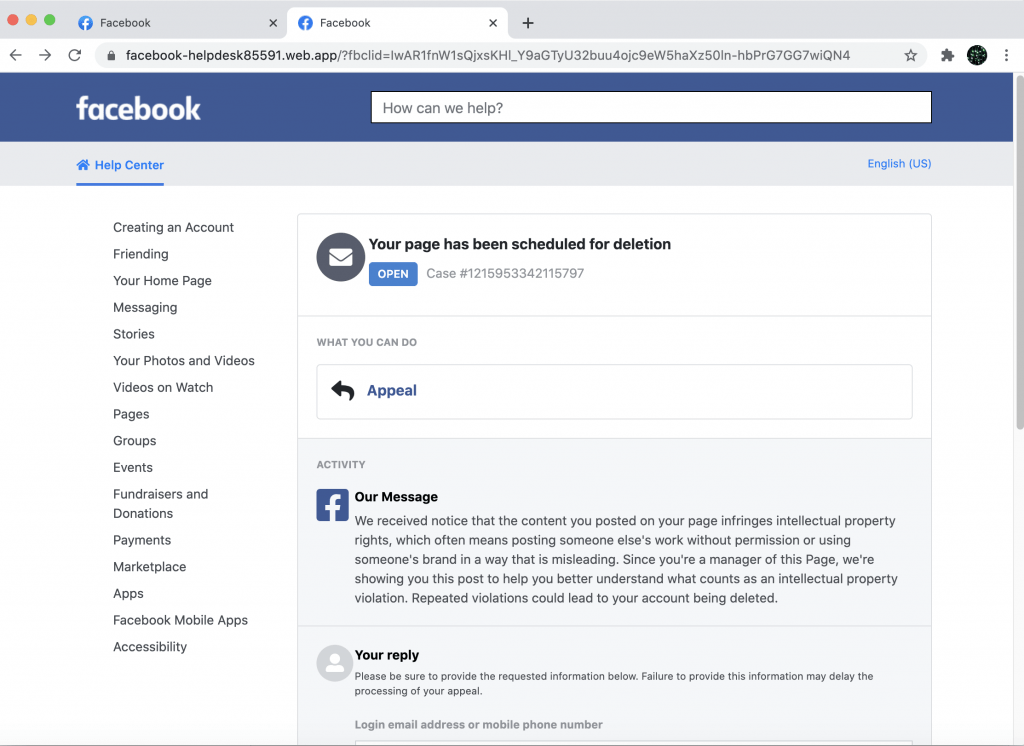
Once you get into the trap and click the link, you will be taken to a legitimate-looking fraudulent page that almost mimics the interface of the original website.

FACEBOOK PHISHING SCAM

Malicious Facebook-Similar Page. Source: Trend Micro

From there, scammers will either make you enter your login credentials or install malware in your system. Besides web links, scammers may also give a phone number to contact, which is also meant to trap you into sharing credentials or other sensitive information.

Once successful, scammers will hijack your account for malicious purposes, try to scam your friends, use your sensitive financial information to steal money, or install malware in your system.

Which Facebook Users Are the Most Vulnerable to the Scam?

Although all Facebook users are vulnerable to the scam, some groups of users are more likely to become the victim. These include but are not limited to:

  • Inactive Facebook users
  • Recent policy violators
  • Aged Facebook users
  • Users with large friend lists
  • Business page owners

Commonly, scammers send the message to a large group of users without any specific filters. So, anyone who gets into the fear of losing chats, images, videos, and posts is trapped in such scams.

How to Detect If It’s a Scam?

You never know when you will see a scam attempt. However, there are a few common signs that can help you detect if it’s a scam message/post:

  • Suspicious message that creates urgency.
  • Asks for sensitive personal information, such as your password, bank details, identity information, etc.
  • Grammar or sentence structure errors.
  • Strange post on your profile about the account suspension/deletion.
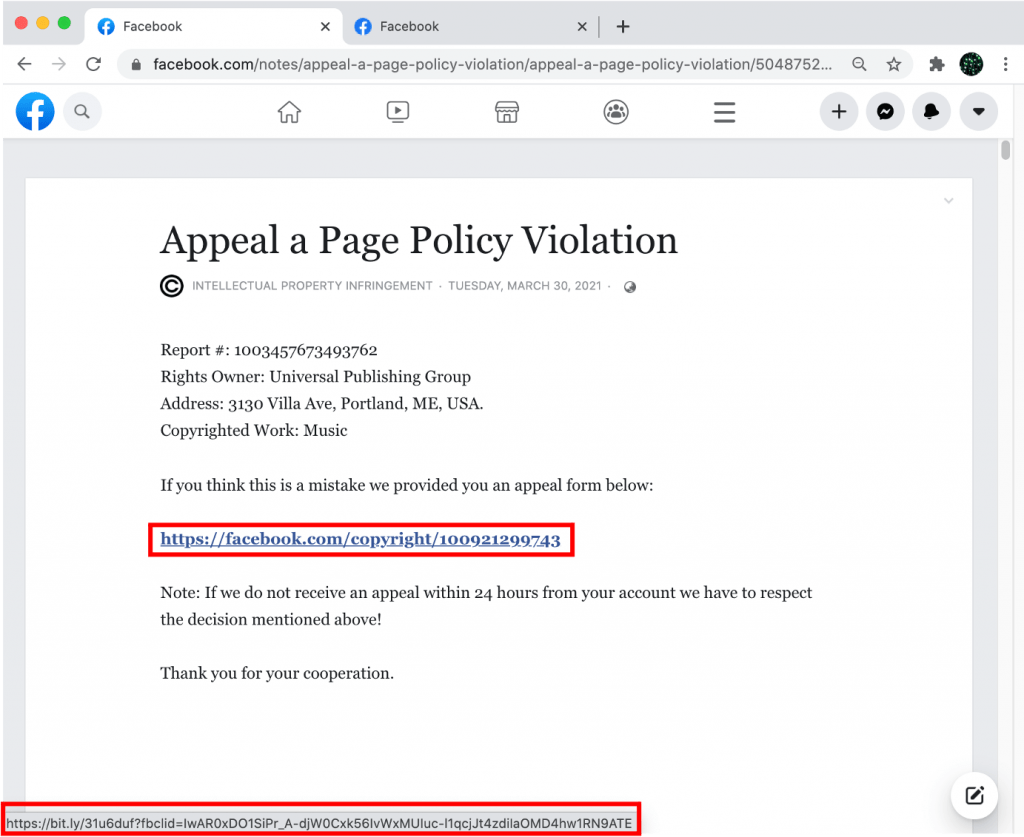
  • The message link takes to a fake page or third-party website.
  • Suspicious and sudden message/post from your friend.

In short, you should activate your senses when you see any message/post that is related to account deletion, deactivation, or suspension. Even if the scammer sends a different message, you can still detect if it’s a scam if the link it takes you has a strange URL and asks for sensitive personal details.

FACEBOOK PHISHING SCAM

Malicious Link. Source: Trend Micro

What’s Next if You Fell For the Facebook Account Deletion Scam?

If you unfortunately fell for this scam, then don’t panic. You can take a few quick measures to block scammers from harming you. So, below are some essential steps you should follow right away:

  1. Change Password: The first thing is to change your Facebook password. Furthermore, if you have used the same credentials in other services, then change the password from them as well.
  2. Block Debit/Credit Card: If you have shared sensitive information about your debit/credit card, then immediately block the card. In addition, check your bank statement and ensure there are no unauthorized charges.
  3. Alert Friends: Scammers may use your account to trap your friends in similar scams or ask for money. So, alert all your friends about any such suspicious message from your side.
  4. Get Facebook Involved: Interact with the Facebook help forum to report the scam and get further assistance on the compromised account.
  5. Scan for Malware: If the link downloaded something on your system, immediately delete it. Furthermore, scan your computer for malware with the software of your choice.
  6. Check Activity Log: Go through your Facebook activity log to detect any unauthorized posts or messages.

Overall, if you take the mitigation steps discussed above quickly, you can reduce the impacts and even send scammers out before they can do any damage.

Best Practices to Avoid Facebook Account Deletion Scam

The Facebook account deletion scam is avoidable if you follow a few best practices, as follows:

  • Ignore unsolicited messages
  • Don’t click or call on any message related to account suspension/deletion
  • Enable two-factor authentication
  • Check the URL of any link you click to validate it is the right/original URL
  • Limit the number of friends
  • If you receive any suspicious message from a friend, validate it by contacting the friend from any other platform
  • Report suspicious messages/posts to Facebook
  • Use strong passwords and regularly change passwords
  • Designate account recovery contacts

All the above practices and similar others can help you reduce the chances of a Facebook scam.

Wrapping Up – Act Smart Before It’s Too Late

The Facebook account deletion scam has been in full swing for many years now. So, we are on our own to detect such scam activities and avoid sharing our sensitive information. Therefore, this guide will wrap up by recommending you act smart whenever you receive anything related to your Facebook account. Facebook never contacts users this way, so don’t get lured into the trap.

Adapting to Change: How Demand Integration Reshapes the Advertising Landscape

Digital technologies and consumer behaviors are changing fast, and so is the advertising industry. According to a study conducted by BCG and Google, data-driven marketing has the potential to significantly enhance business performance, resulting in an increase of up to 50% in online transactions and a 33% increase in return on ad expenditure.

This is a clear indication of the potent impact of the demand-side integration solution. As audiences access online content through various devices and channels, advertisers and publishers have new ways to connect and interact with them.

Discover hero — the ultimate solution for demand integration. This innovative tool allows you to manage multiple traffic sources from one platform, saving you time and hassle. You can also automate, optimize, and track your performance with advanced analytics. Demand integration is not a luxury, it’s a necessity. Hero makes it affordable, easy, and secure. Find out how it can boost your business below.

How Demand-Side Integration Solutions Revolutionize Advertising

Demand-side integration solutions emerge as transformative catalysts in the advertising arena. Picture it as unlocking myriad doors to potential customers across diverse channels and devices, exponentially expanding reach. Guided by data-driven strategies and real-time optimization, it transcends merely hitting the target — it’s about consistently hitting the bullseye. Furthermore, it adeptly slashes support costs, eliminating the need for multiple integrations while effortlessly overcoming technical hurdles.

Implementing demand-side integration solutions within advertising signifies a strategic paradigm shift. It revolves around harmonizing customer needs and brand capabilities, crafting a seamless experience across channels, platforms, and touchpoints. The focus is on delivering tailored, personalized messages that resonate with customers’ goals and values.

Several noteworthy examples illustrate the impact of demand-side integration options in advertising:

1. Behavior-Driven Ad Customization

Utilizing data and analytics to segment customers based on behavior, interests, and needs. Subsequently, ads are tailored for each segment, featuring customized content, offers, and compelling calls to action.

2. Amplifying Brand Messages through Social Engagement

Leveraging social media, influencers, and user-generated content to amplify brand messages. This not only engages customers on an emotional level but also encourages them to share their feedback and experiences, creating a community around the brand.

3. Interactive and Immersive Ad Experiences

Creating immersive ads that transport customers into virtual or augmented reality environments. Additionally, incorporating gamified challenges or quizzes enhances customer learning and enjoyment, forging a unique and memorable interaction.

4. Cross-Platform Integration for Enhanced Context

Seamlessly integrating ads with various digital platforms and devices, such as smart speakers, wearables, or connected cars. This integration provides contextual information, recommendations, or assistance based on customer location, activity, or mood.

The profound impact of demand-side integration methods lies in reshaping advertising into a customer-centric, relevant, and engaging landscape. These solutions facilitate the construction of trust, loyalty, and advocacy among customers, driving increased conversions, retention, and lifetime value. Beyond that, demand-side integration empowers brands to stand out from competitors, adapt to evolving customer expectations, and navigate shifts in market trends.

Benefits of Demand Side Integrations

One of the methods by which advertisers can establish communication with publishers and reach their intended audiences is through demand-side integrations, a form of programmatic advertising that employs white-label advertising platforms, such as SmartHub, to facilitate the acquisition and disposition of ad space. The point is about software solutions that can be customized and branded by advertisers to suit their specific needs. Some advantages of using white-label advertising platforms for demand-side integrations are:

  1. They give advertisers more power and visibility over their ad campaigns and traffic sources.
  2. They help advertisers reduce costs and save time by eliminating the need to develop and maintain their own technology infrastructure.
  3. They allow advertisers to offer a complete set of services to their clients, such as display, video, native, and mobile advertising.
  4. They enable advertisers to access a large network of publishers and inventory across various channels and formats.
  5. They provide advertisers with sophisticated features and tools for targeting, optimization, analytics, and reporting.

Imagine a tool that acts as your advertising Swiss Army knife — this is demand side integration options. It seamlessly blends with different ad formats like video, banners, native, and push advertising. And the perks? Access to premium traffic sources, laser-focused targeting options based on location, device, and audience specifics, plus crystal-clear reporting and analytics. It’s the efficiency booster for managing multiple campaigns effortlessly.

Choosing a Reliable White-Label Advertising Platform

Now, imagine having a canvas where you wield complete control over your advertising realm. Enter the white-label advertising platform. It’s not just another platform; it’s your personalized billboard. Tailored branding, full resource control, and integration with third-party tools to boost functionality — all in one place. But how to choose? Consider experience, industry reputation, service quality, security compliance, and flexible pricing.

Within the realm of white-label platforms, those seamlessly incorporating these integrations — e.g. SmartHub — stand out. Their ability to harness the power of header-bidding, Prebid.js, OpenRTB, and JS tags ensures a cohesive, transparent, and automated advertising experience, promising control, customization, and robust functionality for advertisers seeking a competitive edge. Some demand integration solutions that SmartHub provides are:

Header-bidding:

  1. Allows multiple demand partners to bid simultaneously, fostering a fair auction.
  2. Boosts publisher earnings by selling to the highest bidder, enhancing user experience.
  3. Enables faster ad loading and improved aesthetics. Learn more about it on Pablift

Real-time bidding:

  1. Facilitates instant, automated ad buying and selling in an open marketplace.
  2. Targets audiences based on location, device, behavior, and context, saving time and money.
  3. Ensures optimal ad-user matching at the right moment.

Pre-bid.js:

  1. A code streamlining header-bidding integration with diverse demand partners.
  2. Facilitates customizable bid options, simplifying implementation on any ad server or platform.

OpenRTB:

  1. Governs communication between demand-side and supply-side platforms.
  2. Enhances real-time bidding with standardized language and data exchange for improved performance. Detailed information available on the IAB Tech Lab OpenRTB Standards page.

By using these demand integration solutions, white-label advertising platforms can help ad exchanges adapt to the changing advertising landscape and maximize their ad revenue potential. They can also help ad exchanges provide better value and service to their clients, both advertisers and publishers, by offering them more control, flexibility, and transparency over their ad campaigns.

Conclusion

To sum up, demand integration is more than a trendy term; it is a powerful tool that transforms advertising standards. It makes campaigns more efficient, secure, and flexible, combining different traffic sources into a unified force. Choosing demand-side integrations solvent allows access to high-quality traffic, accurate targeting, and streamlined analytics. For those who want full control and integration, the white-label advertising platforms like SmartHub offer a complete solution to cope with the changing advertising environment. The ball is in your court!

The Art of Photo Editing With an Online Photo Editor

Photo editing requires mastering a specific skill set to create stunning photos that will grab attention quickly. In this fast-paced world, every person cannot invest time and money to learn editing skills and yet look for a reliable solution for their projects. An online photo editor is best and free to use and can handle simple to complex edits in no time. In this article, we will discuss in what ways an online photo editor helps us to edit images.

5 Ways an Online Photo Editor Can Help You Transform Images

Read the below-given ways in which an online photo editor can help you edit images.

● AI-powered tools

An online photo editor like Fotor and CapCut offers a variety of AI tools to automate the editing processes. With the help of AI magic tools, you can save a lot of effort and time and get your work done instantly. An online photo editor offers magic tools like an AI portrait generator to make portraits, an AI background remover to remove backgrounds, an AI photo colorizer to fix colors, an AI background generator, and more.

● Resize and crop your photos to fit any format

Talking about the significance of using an online photo editor for photo editing, remember that it allows you to crop and resize your photos to any size making them compatible with different social media sites. Learning how to crop a picture on iPhone gives you the flexibility to make quick adjustments on the go without needing to rely on third-party applications. Moreover, you can resize your photo in any desired ratio for printing purposes.

● Variety of formats for photo saving

Another exciting thing about using the online photo editor for editing is that it offers a variety of formats in which you can download your images. Now you do not have to upload files on other editing sites for conversion. You can convert as many photos as you want in any format without any pro subscription. For example, if you design a wedding invitation card, you can send it to your friends and family in PNG format. If you want to make prints of your wedding invitation card, you can save the file in PDF format and send it to the printer.

● Incorporate filters and text effects

Another benefit of using an online photo editor for making edits is the variety of filters and effects to use without paying any charges. You can easily create any look you want with the help of an online photo editor. In the filters and effects section, you can try vintage looks, bright looks, aesthetic looks, modern looks, and more.

● Add graphics and stickers

In an online photo editor like CapCut, editors can add graphics, stickers, and text to enhance the visual vibe of their photos. This feature is especially good for all digital content creators because they can introduce their personality through text, stickers, and graphics in any photo.

An Easy Guide to Make an Account on an Online Photo Editor

To quickly edit your photos, say goodbye to the manual editors and make an account on the CapCut web version online. Here are the four steps that lead you toward making an account, uploading, editing, and downloading.

● STEP 01: SignUp

To become the master of photo editing, create a free-of-cost account on the CapCut creative suite. Open the browser on your Linux, Mac, or Windows and search for CapCut online photo editor. Locate the blue color button at the top right of your screen. After opening the signup form, enter or email ID to proceed. The CapCut creative suite signup form just requires your email ID and nothing else.

● STEP 02: Upload

After creating your account, start uploading your images from your computer. In the online photo editor, you will find the upload button on the left side of the screen. Click on the upload button and drag and drop pictures from your computer.

● STEP 03: Transform

Are you excited to make edits to your photos like a professional? CapCut online web version provides a variety of magic tools for quick edits. You can use graphics, text, frames, shapes, and stickers to make your photos look attractive. Besides, you can enhance the clarity of photos by using a sharpened image online magic tool.

● STEP 04: Download

Click on the export button, choose the file format from the drop-down menu, and click on the download button. The file will be automatically saved to your computer.

Conclusion

An online photo editor and AI background remover can give the best results in a short time as compared to manual editors. A manual editor needs installation on your computer and takes a lot of space making the overall system down. However, CapCut offers a web version online that does not require any installation leaving space in your computer for other important files. So, what are you waiting for? Sign up on the CapCut online photo editor and take a ride on a thrilling editing journey.

The Power of Tokenization in Data Management

In the era of digital transformation, data has become a crucial asset for organizations across various industries. As the volume and complexity of data continue to grow, ensuring its security and privacy has become a top priority.

 One powerful tool for data management is tokenization. It plays an essential role in protecting sensitive information, facilitating secure transactions, and enhancing overall data security.

Understanding Tokenization

Tokenization is the process of substituting sensitive data with non-sensitive placeholders, or tokens, while retaining the original data’s essential characteristics. These tokens are random strings of characters that have no intrinsic meaning or value.

It safer than encryption, where data can be decrypted with a key. Tokenization uses a system that manages a mapping table linking the tokens to their corresponding original data. The tokenization process typically involves the following steps:

Data Identification

 This process is about identifying sensitive data elements that need protection. They may include credit card numbers, social security numbers, or personal identification information.

Token Generation

 Generating unique, random tokens for each identified sensitive data element. The tokenization system maintains a mapping table and links each token to its original data.

Token Storage

This means storing the generated tokens and ensuring that the mapping table is securely managed. It is often done on a separate server or in a secure environment.

Tokenization and Detokenization

When a request for the original data is made, the tokenization system retrieves the corresponding token from the mapping table and provides the original data. This process is known as detokenization.

Tokenization in Blockchain

Tokenization in blockchain applications involves converting digital assets into cryptographic tokens on a blockchain. These tokens represent ownership or access rights to the underlying assets. They are managed through smart contracts.

They are self-executing contracts with the terms of the agreement directly written into code. Tokenization in blockchain applications brings several benefits to the business space. They include increased liquidity, fractional ownership, and enhanced security. Breaking down assets into divisible and transferable tokens helps investors buy and sell portions of assets. It opens up new possibilities for a more inclusive and accessible financial system.

Additionally, tokenization helps reduce fraud and streamline the complex processes associated with traditional asset transactions. It provides a transparent and efficient way to represent and trade assets on the blockchain.

Benefits of Tokenization in Data Management

Data is the new currency and tokenization plays a crucial role in safeguarding it. While traditional methods may be effective, they often present challenges. Tokenization is a powerful and versatile solution, and here are a few of its benefits.

1. Enhanced Security

Tokenization enhances security by changing the way organizations handle sensitive data. Unlike encryption, where a reversible algorithm is used, tokens are generated using irreversible algorithms. This means that even if a token is intercepted, it cannot be reversed to reveal the original data without access to the secure token vault.

 This level of security is especially crucial in an environment where cyber threats and data breaches are constant concerns.

The use of tokenization reduces reliance on single points of failure. Even if a token is compromised, the attacker gains no useful information without access to the token vault. This multi-layered approach significantly raises the bar for potential malicious actors. It provides a robust defense against data breaches.

2. Compliance with Data Protection Regulations

Data protection regulations, such as the General Data Protection Regulation and Health Insurance Portability and Accountability Act, mandate strict controls on the handling of sensitive information.

Tokenization aligns with these regulations by minimizing the amount of sensitive data that organizations store and process.

Businesses can demonstrate compliance by reducing the risk associated with handling sensitive information. Tokenization, therefore, becomes a key component of a comprehensive data protection strategy. It helps organizations meet regulatory requirements and avoid legal consequences.

3. Streamlined Payment Processing

 In the financial sector, especially in payment processing, tokenization is excellent for securing transactions. Traditional methods of processing payments involve transmitting sensitive cardholder information. They are susceptible to interception and fraud.

Tokenization replaces this sensitive information with tokens, ensuring that even if intercepted, the data is useless without access to the token vault.

Beyond security, tokenization also simplifies compliance with the Payment Card Industry Data Security Standard. Reducing the scope of sensitive data that organizations need to manage and protect helps businesses achieve and maintain compliance.

4. Efficient Data Handling and Analysis

 Traditional encryption methods introduce complexities in data handling and analysis due to the need for decryption before performing operations. Tokenization, on the other hand, allows for seamless data handling without the decryption step. This results in improved data processing speeds and more efficient analytics.

Organizations can derive insights from their data in real-time without compromising security. The efficiency gained through tokenization is particularly valuable in sectors where rapid decision-making based on data analysis is critical. It is excellent for healthcare, finance, and e-commerce.

5. Reduced Scope of Data Audits

Tokenization reduces the scope of data audits, focusing them on the secure token vault rather than the entire dataset. Since tokens themselves do not carry sensitive information, audits can concentrate on a smaller subset of data, making the auditing process more manageable and cost-effective.

This reduction in scope not only simplifies compliance assessments but also allows organizations to allocate resources more effectively. It streamlines the auditing process, ensuring that efforts are concentrated where they are most needed, thereby optimizing the overall compliance strategy.

6. Flexibility and Scalability

 Tokenization is a flexible solution applicable to various types of sensitive data. Whether it’s personally identifiable information (PII), healthcare records, or financial data, tokenization can be adapted to meet the unique requirements of different industries and data types.

Furthermore, tokenization is scalable. It can accommodate the evolving needs of data management strategies. As organizations grow and the volume of sensitive data increases, tokenization can scale with them. It provides a versatile and adaptive solution to the changing landscape of data security and management.

Conclusion

Tokenization is a powerful and versatile tool in data management. Its ability to provide better security, streamline processes, and ensure compliance with data protection regulations positions it as a crucial component of modern data security strategies.

As organizations continue to navigate the challenges of securing sensitive information, tokenization is likely to remain at the forefront. It will continue to shape the future of data management practices.

SoftLoft: Innovative E-commerce Solutions and Custom Development Expertise

SoftLoft: A Hub of E-commerce Solutions

SoftLoft stands as a beacon in the e-commerce landscape, tackling a broad spectrum of challenges in this arena. Our expertise lies in resolving technical issues, implementing and integrating comprehensive systems, and crafting strategies that ensure your ideas function optimally. Like a domino effect, enhancing one aspect of your business leads to overall improvement.

Since 2008, SoftLoft has been moving in tandem with technological evolution. We’ve successfully merged the talents of developers, designers, and strategists to create applications and software with original, user-friendly interfaces. Every project we undertake is comprehensive, transforming challenges into high-quality outcomes and significant progress.

Transforming More Than Just Appearances

With SoftLoft, the change is profound. We don’t offer temporary fixes; we conduct thorough analyses, devise clear action plans, and see projects through to their successful conclusion. It’s about revamping your company’s core operational systems for long-term benefits. 

Embracing Advanced Technologies

SoftLoft’s Technological prowess – that’s foresight, though we haven’t ventured to Mars yet. Our ability to stay ahead of the curve has earned us the trust of global brands and led to significant successes.

For instance, our work with H&M led to a refined user experience, resulting in an 18% increase in conversions, a 40% boost in active customer engagement, and a 24% rise in repeat purchases. During peak seasons, our system configurations expertly managed a 280% increase in traffic.

We also elevated Victoria’s Secret’s presence in the Middle East, increasing their customer base by 40% and boosting sales by 30%. Our custom solutions enhanced trust, reducing shopping cart abandonment by 25%.

Targeted Improvements, Global Impact

Imagine your business as an electrical circuit. A single faulty component can disrupt the entire system. SoftLoft specializes in identifying and rectifying such issues, ensuring that your brand shines brighter, saves more, and operates more efficiently.

Our proficiency spans Magento, Shopify, Bigcommerce, Salesforce, and other platforms. However, our true passion lies in custom development, where we bring the most innovative ideas to life.

Winning with SoftLoft’s Innovative Solutions

Partnering with SoftLoft means gaining access to groundbreaking solutions that foster business improvement and idea realization. You’ll enjoy the convenience of having all your e-commerce needs met under one roof, ensuring a sustained wave of progress and technological advancement.

In summary, SoftLoft is not just an e-commerce solutions provider; we are catalysts for comprehensive business transformation. Join us in this journey of advancement and experience the power of true technological evolution.

Streamlining eCommerce: Top 3 Shipping Plugins for WooCommerce

In the dynamic realm of e-commerce, guaranteeing a smooth shipping process is essential for achieving success. WooCommerce, the popular WordPress plugin, has become a go-to platform for online businesses, offering a plethora of features to enhance the overall shopping experience.

One key aspect that significantly contributes to customer satisfaction is the shipping process, and integrating effective shipping plugins can make all the difference. In this article, we’ll explore some of the best shipping plugins for WooCommerce, including Outvio, ShipStation, and Easyship, and delve into the unique benefits each brings to the table.

1. Outvio

Outvio is a rising star in the realm of shipping plugins for WooCommerce, offering a range of features designed to streamline efficient shipping requirements. One of its standout benefits is its user-friendly interface, making it accessible for both beginners and experienced e-commerce entrepreneurs. Outvio integrates seamlessly with WooCommerce, providing order tracking, label printing, automated returns and exchanges for e-commerce. 

One of the notable advantages of Outvio is its automated order tracking system. Customers receive timely updates on the status and location of their orders, fostering transparency and trust. This not only enhances the overall customer experience, but also reduces the burden on customer support teams by proactively addressing common queries related to shipping.

Moreover, Outvio supports multiple carriers, giving businesses the flexibility to choose the most cost-effective and effective shipping process. By optimizing the shipping process, Outvio contributes to cost savings and improved operational efficiency, making it an invaluable asset for WooCommerce users looking to enhance their shipping capabilities.

2. WooCommerce UPS Shipping Plugin with Print Label

WooCommerce UPS Shipping Plugin with Print Label streamlines shipping for your WooCommerce store by providing real-time UPS shipping rates, automated label printing, and seamless tracking notifications. It supports both domestic and international UPS services, ensuring accurate shipping costs at checkout and smooth order fulfillment for every order.

Easily print UPS shipping labels in bulk, send automated tracking emails, and integrate UPS Access Points for convenient deliveries. Customers receive accurate delivery estimates, while store owners save time with efficient UPS label generation and pickup scheduling.

Ideal for WooCommerce stores, this plugin also supports multi-vendor setups, WooCommerce Bookings, WPML, and Aelia Currency Switcher. Manage shipments efficiently, reduce errors, and enhance customer satisfaction with every shipment.

3. ShipStation

ShipStation is a well-established shipping plugin that has gained recognition for its robust automation capabilities. Seamlessly integrating with WooCommerce, ShipStation simplifies order fulfillment, allowing businesses to focus on growth rather than getting bogged down by manual shipping tasks.

One of ShipStation’s key benefits is its ability to aggregate orders from various sales channels into a centralized platform. This streamlines the fulfillment process, saving time and reducing the likelihood of errors. The automation features extend to label generation, order tracking, and even customer communication, ensuring a smooth and consistent experience for both merchants and customers.

ShipStation also offers a variety of customization options, allowing businesses to tailor their shipping workflows to specific requirements. From branded packing slips to personalized tracking notifications, ShipStation enables businesses to create a unique and professional shipping experience that aligns with their brand identity.

4. Easyship

For e-commerce businesses eyeing global markets, Easyship is a game-changer when it comes to navigating the complexities of international shipping. This plugin seamlessly integrates with WooCommerce, providing access to a vast network of couriers and helping businesses optimize their shipping strategies for cross-border sales.

One of the standout benefits of Easyship is its transparent and dynamic pricing structure. Merchants can compare shipping rates in real-time, allowing them to choose the most cost-effective and reliable options for each shipment. This not only helps businesses save on shipping costs but also ensures that customers are presented with accurate and competitive shipping rates at checkout.

Easyship also assists businesses in managing customs procedures and compliance, a critical aspect of international shipping. By automating customs documentation and providing guidance on regulatory requirements, Easyship reduces the likelihood of shipping delays and customs-related issues, ultimately enhancing the reliability of cross-border deliveries.

Conclusion

In conclusion, the right shipping plugin can significantly impact the success of an e-commerce venture. Outvio, ShipStation, and Easyship each bring unique benefits to the table, whether it’s through user-friendly interfaces, powerful automation, or specialized solutions for international shipping. By leveraging these plugins, WooCommerce users can not only improve their shipping processes but also elevate the overall customer experience, fostering loyalty and fueling business growth in the competitive world of online commerce.

Bridging the Gap: How Data Synchronization Complements Digital Publishing

Staying ahead of the competition in the modern business environment isn’t just about keeping pace with technology but integrating it smoothly into your daily workflow. Picture a scenario where your creative concepts and organizational data merge effortlessly, boosting your productivity and allowing you to concentrate on the aspects of your work that matter most.

The secret to this efficient workflow is the smart combination of data synchronization and digital publishing. Accessing up-to-date information across different platforms and devices is not merely convenient; it’s essential in a time-crunched world. This integration ensures that your creative outputs, whether they are reports, presentations, or marketing materials, remain current, pertinent, and captivating.

Think about the benefits of having all your data readily available, poised to be turned into engaging digital content that grabs your audience’s attention. This even extends to digital book publishing, where the latest AI-based tools make the production of traditional mediums effortless. This blend is about more than just working smarter; it’s about building a dynamic work environment where your creativity and efficiency complement each other.

Data Synchronization in the Digital World

Data synchronization is an unsung hero, quietly ensuring that your information stays consistent, current, and accessible across all your devices. In a professional landscape where work often spans from laptops to smartphones, the seamless flow of data is crucial. It’s the linchpin that keeps your digital life in sync.

Consider the scenario of juggling a critical project with data scattered across different devices. Without effective synchronization, you’re at risk of using outdated information, leading to potential errors and inefficiencies. Data synchronization steps in here, ensuring that the latest version of your documents, contacts, or calendar is always ready for you, no matter which device you’re using.

This technology goes beyond just preventing the annoyance of outdated files. It instills confidence that your information is always up-to-date and dependable. It saves you time and effort, allowing you to channel your energies into more creative or productive tasks. With your data consistently aligned, your focus can shift to the creative aspects of your work, secure in the knowledge that the foundational elements are in place.

With today’s trend of remote working, data synchronization takes on an even greater significance. It enables you and your team to remain in sync, even when physically apart. This consistent flow of information not only streamlines your workflow but also bolsters collaboration, making team efforts more effective, regardless of geographical distances.

Data Synchronization and Digital Publishing

The convergence of data synchronization and digital publishing is transforming the way you work, creating a synergy that amplifies both efficiency and creativity. In your professional life, this integration is not just a convenience; it’s a strategic advantage. By ensuring that your data is synchronized across platforms, you lay the groundwork for producing dynamic and engaging digital content.

Imagine having the latest data from your projects instantly available as you craft digital publications. This seamless integration means that your publications are always reflecting the most current data, whether it’s a market analysis report or a creative portfolio. It’s about having the right information at the right time and ensuring that your digital publications are as accurate as they are visually compelling. Using tools like Issuu’s Canva flipbook creator you can quickly add data, text, pictures, and more into a compelling narrative for sales pitches, project meetings, and customer-facing websites. Blending the latest data into promotional or internal presentations can be an incredibly effective way to engage with an audience.

This synergy also opens up new possibilities for collaboration. With synchronized data, team members can contribute to digital publications from different locations, confident that they are all working with the latest information. This collaborative approach not only streamlines the publication process but also enriches the final product with diverse insights and inputs.

The combination of synchronized data and digital publishing tools empowers you to respond quickly to changes. In a fast-paced professional environment, the ability to update and republish digital content swiftly is invaluable. It keeps your work relevant and allows you to maintain a competitive edge. This blend of data synchronization with digital publishing is about more than convenience. It’s about creating a dynamic and responsive work environment where your creativity is supported by real-time data, leading to more impactful and engaging digital content.

Transforming Creativity and Accessibility

Digital publishing is reshaping how your ideas and narratives connect with audiences worldwide. It’s where your creative flair meets cutting-edge technology, enabling you to turn standard documents into interactive, captivating digital formats. This evolution goes beyond just visual appeal; it makes your content more accessible and engaging to a broader audience.

Today’s digital era demands content that’s not only informative but also visually striking and interactive. Digital publishing answers this call by allowing you to craft content that’s not merely read but experienced. Whether it’s a detailed report, an eye-catching brochure, or a creative portfolio, digital publishing tools let you infuse your work with interactive elements like dynamic graphics and embedded videos, making your content stand out and stick in the memory.

Accessibility is another cornerstone of digital publishing. With your content available online, it can instantly reach a global audience. This level of accessibility changes the game for professionals and creatives, offering a reach and impact that was previously unattainable. Your work is no longer bound by the physical constraints of traditional publishing; it can be accessed across the globe, anytime.

Digital publishing gives you the flexibility to update your content swiftly. In a fast-changing world, being able to revise and republish your work promptly ensures it stays relevant and current. This adaptability is key to maintaining the accuracy and relevance of your content. Digital publishing is more than just a tool; it’s a portal to a realm where your content becomes more vibrant, accessible, and influential. It offers a chance to showcase your work in a manner that truly engages and captivates your audience.

Upcoming Trends in Data Sync and Digital Publishing

Looking ahead, the realms of data synchronization and digital publishing are set for some thrilling advancements. These developments are expected to not only make your workflow smoother but also revolutionize your engagement with digital content.

A key trend on the horizon is the deeper integration of artificial intelligence in both data synchronization and digital publishing. Imagine AI not just syncing your data across devices but also smartly organizing and prioritizing it based on how you use and prefer your content. This could dramatically change how you interact with your digital tools, making them more intuitive and personalized.

In the sphere of digital publishing, AI is poised to offer advanced analytics, giving you richer insights into audience interactions with your content. This means you could tailor your publications more effectively, understanding precisely what captures your audience’s interest.

Another exciting development is the rise of immersive and interactive content, with augmented reality (AR) and virtual reality (VR) becoming more accessible. This opens up possibilities for turning traditional content into engaging, immersive experiences, adding a new dimension to how you present information.

Finally, the continued growth of cloud-based collaboration tools looks set to make team-based digital publishing projects even more seamless. This will further diminish the barriers of distance, enabling more cohesive and collaborative work environments, no matter where team members are located. As these trends develop, they’re bound to transform how you approach data synchronization and digital publishing, offering fresh avenues to boost your productivity and creative expression in the digital realm.

The integration of data synchronization with digital publishing is reshaping your professional landscape. This synergy not only streamlines your workflow but also enhances the quality and impact of your digital content. By staying abreast of developments, you can ensure that your work remains relevant, impactful, and at the forefront of the digital revolution.

Beyond the Hype: Demystifying the Distinctive UI/UX DNA of San Francisco Developers

Have you ever found yourself lost in the sea of apps, wondering why some interfaces capture your attention effortlessly while others leave you frustrated? I know the feeling. As a tech enthusiast navigating the bustling digital landscape, I became curious about the secret sauce that makes a UI/UX design and development agency in San Francisco, like Dworkz, stand out. With over 2,000 tech companies calling San Francisco home, each vying for user loyalty, I embarked on a journey to unravel the psychological nuances behind their distinctive and effective designs.

What is cognitive psychology and how does it influence UI/UX design?

In the heart of UI/UX design lies cognitive psychology, a realm that delves into how users perceive, process, and utilize information. Picture this: a user interface that seamlessly captures and maintains attention through clever use of contrast, color, and animation. San Francisco developers leverage cognitive psychology to simplify interfaces, reduce cognitive load, align with user mental models, and enhance memory. It’s not just about aesthetics; it’s a science-driven approach to understanding how customers think and make decisions.

Unique Features of San Francisco Developers’ UI/UX DNA: Two examples

1) Dynamic Visual Storytelling:

  • Distinctive Trait: Through the strategic use of animations, San Francisco developers guide users through a narrative within the interface, making the user experience more engaging and memorable. Khoirul Abdul Aziz explains how visual storytelling can enhance UI design and provides some examples of how to use images, typography, color, and visual flow to tell a story.

2) Intuitive Microinteractions:

  • Distinctive Trait: What makes San Francisco Developers special is that they use intuitive micro-interactions to increase user engagement. Microinteractions, such as subtle feedback animations or interactive elements, are thoughtfully designed to align with cognitive psychology principles, providing instant, satisfying responses that reinforce positive user behaviors. Wyzowl presents 15 examples of micro-interactions that are subtle, fun, and memorable.

What is behavioral economics and how does it influence UI/UX design?

Enter behavioral economics, the force that guides users’ choices based on preferences, motivations, emotions, and biases. SF developers employ this knowledge to create interfaces that tap into human behavior. They utilize loss aversion to motivate action, framing to influence perception, anchoring to set expectations, scarcity to drive desire, and social proof to sway decisions. It’s not manipulation; it’s a strategic understanding of how users respond emotionally and behaviorally to design elements. Just like Dworkz demonstrates in their successful projects – two examples:

Emotional Resonance Through Microcopy:

  • PubNub: A data stream network for building real-time apps that uses microcopy to engage and motivate users to explore the features and capabilities of the platform. The platform uses phrases like “Let’s get started!” and “You’re awesome!” to create a positive and enthusiastic tone.

Personalized Decision Journeys:

  • Parley Pro: A contract management and negotiation software that uses personalized decision journeys to guide and support users through the complex and collaborative process of contract creation and negotiation. The software uses dynamic workflows and smart suggestions to help users draft, review, and finalize contracts.

What is social psychology and how does it influence UI/UX design?

One of the most fascinating aspects of UI/UX design is how it incorporates social psychology, the study of how people interact with each other and their environment. San Francisco developers understand the power of social psychology to create interfaces that foster trust, engagement, and community. They use social identity theory to appeal to users’ sense of belonging, reciprocity to encourage mutual exchange, gamification to reward behavior, personalization to tailor experiences, and feedback to provide guidance. It’s not just functionality; it’s a human-centered approach to designing for social needs and values.

How to apply these principles to your projects

Applying the principles of cognitive psychology, behavioral economics, and social psychology to UI/UX design involves a strategic approach. Let’s break it down into three essential steps:

1. Understand Your Users Through Cognitive Psychology:

  • Step 1: Begin with thorough user research to understand how your target audience perceives, processes, and utilizes information.
  • Application: Use surveys, interviews, and observations to uncover users’ needs, preferences, and pain points. Apply cognitive psychology principles to design interfaces that capture attention, reduce cognitive load, and align with users’ mental models.

2. Influence User Behavior with Behavioral Economics:

  • Step 2: Dive into the realm of behavioral economics to comprehend how users make decisions based on motivations, emotions, and biases.
  • Application: Leverage principles such as loss aversion, framing, anchoring, scarcity, and social proof. Highlight potential losses to motivate action, frame options strategically, provide reference points, create a sense of exclusivity, and showcase evidence of popularity or credibility. Shape the user experience to align with behavioral triggers.

3. Enhance Social Interaction Through Social Psychology:

  • Step 3: Explore social psychology to gain insights into how consumers interact, collaborate, and influence each other.
  • Application: Incorporate principles like reciprocity, commitment and consistency, authority, liking, and trust. Encourage consumers to reciprocate by offering valuable content or discounts. Foster loyalty through consistent experiences and rewards. Establish authority and credibility, create a positive and likable impression, and ensure trust through secure and transparent interactions.

Incorporating these three steps into your UI/UX design process creates a holistic approach that caters to both the rational and emotional aspects of user behavior. Remember, the key lies in a continuous iteration based on user feedback and testing, ensuring your design aligns seamlessly with the dynamic interplay of cognitive, behavioral, and social psychology.

The UC San Diego Division of Extended Studies, a renowned online research university, presents a comprehensive overview titled “The Psychology of UX: Past, Present, and Future” that outlines the history, present state, and future prospects of the psychology of UX. It covers topics such as cognitive psychology, emotional design, persuasive design, user research, and user testing.

Conclusion

To sum up, San Francisco developers have a unique UI/UX DNA that goes beyond following fads or buzzwords. It’s a comprehensive exploration of cognitive psychology, behavioral economics, and social psychology. These psychological insights enable developers, designers, and business owners to craft interfaces that not only attract but truly address users’ needs. The value of this knowledge transcends appearance; it’s about creating meaningful relationships and delivering outstanding user experiences. Dworkz is a San Francisco-based UI/UX design and development agency that showcases this approach in its portfolio.

Key Principles of UI/UX Design

Principle:Description
Cognitive PsychologyUnderstand how users perceive, process, and use information for attention, simplicity, and memorability.
Behavioral EconomicsInfluence user behavior through loss aversion, framing, anchoring, scarcity, and social proof.
Social PsychologyFoster user connection using reciprocity, commitment, authority, liking, and trust.

Applying Principles to Your Projects:

  1. Research: Understand users’ needs, goals, and emotions.
  2. Analysis: Identify problems and opportunities for improvement.
  3. Ideation: Generate creative solutions through brainstorming.
  4. Prototyping: Create low or high-fidelity prototypes for testing.
  5. Testing: Evaluate usability and effectiveness through user testing.
  6. Iteration: Refine prototypes based on testing results and user feedback.

Remember, it’s not just about design; it’s about creating experiences that resonate with users on a psychological level.

How to Build and Run a .NET App in a Docker Container

Docker containers offer an isolated and portable environment, enabling developers to seamlessly deploy their .NET applications across various environments, from development machines to testing servers and production infrastructure. This versatility has made them a cornerstone in facilitating .NET development services. In this blog post, we’ll guide you through the complete process of constructing and executing a sample .NET Core console application within a Docker container.

Creating a .NET Core Console App

The first step is to create a basic .NET Core console application that we will later containerize. Open up your terminal or command prompt and run the following commands:

dotnet new console -o SampleApp
cd SampleApp

This will generate a new .NET Core console app project in a directory called SampleApp. Open up the generated SampleApp.csproj file and update the TargetFramework property to target .NET Core 3.1:

<PropertyGroup>
  <OutputType>Exe</OutputType>
  <TargetFramework>netcoreapp3.1</TargetFramework>
</PropertyGroup>

Next, open up the Program.cs file and add a simple “Hello World” message:

using System;

namespace SampleApp
{
  class Program
  {
    static void Main(string[] args)
    {
      Console.WriteLine("Hello World!");
    }
  }
}

Now you have a basic .NET Core console app that prints “Hello World” to the console when run.

Creating the Dockerfile

The next step is to create a Dockerfile that contains the instructions for building a Docker image for this application. Create an empty file called Dockerfile in the SampleApp directory.

The first line of the Dockerfile specifies which base image our Docker image will be built on top of. For .NET Core apps, the official Microsoft Docker images provide the .NET Core runtime and are a good choice as a base image:

FROM mcr.microsoft.com/dotnet/core/sdk:3.1 AS build-env

The build stage will copy the source code into the container, restore dependencies, compile the code, and publish the output:

WORKDIR /app
COPY . .
RUN dotnet restore
RUN dotnet publish -c Release -o out

After building, we use a second Docker image as a runtime image for the published app files. This keeps the final image lightweight:

FROM mcr.microsoft.com/dotnet/core/runtime:3.1
WORKDIR /app
COPY --from=build-env /app/out .
ENTRYPOINT ["dotnet", "SampleApp.dll"]

The full Dockerfile:

FROM mcr.microsoft.com/dotnet/core/sdk:3.1 AS build-env
WORKDIR /app
COPY . .
RUN dotnet restore
RUN dotnet publish -c Release -o out
FROM mcr.microsoft.com/dotnet/core/runtime:3.1
WORKDIR /app
COPY --from=build-env /app/out .
ENTRYPOINT ["dotnet", "SampleApp.dll"]

Building the Docker Image

Now that we have the Dockerfile ready, we can build the Docker image. Navigate to the folder containing the Dockerfile and run:

docker build -t sampleapp .

This will build a Docker image called “sampleapp” using the Dockerfile in the current directory. Docker will layer the image, restoring dependencies, publishing, and ultimately producing a Docker image containing our .NET application.

Running the Docker Container

To run the Docker container from the newly built image, run:

docker run -it sampleapp

This will start a new container from the sampleapp image, launching the application’s entrypoint which runs dotnet SampleApp.dll. You should see the “Hello World!” output in your terminal.

To run the container in detached mode in the background:

docker run -d --name sampleappcontainer sampleapp

Now the container will run in the background. You can stop, start, or inspect the container using the container name:

docker stop sampleappcontainer
docker start sampleappcontainer
docker logs sampleappcontainer

You have now successfully built and run a .NET Core app inside a Docker container. With Docker, your application is packaged into a standard, portable unit that can be deployed anywhere Docker runs without dependencies on the underlying infrastructure.

Adding Configuration

Often applications require configuration values to be set at runtime. With Docker, these values can be passed into the container as environment variables.

Open Program.cs and modify the main method to read an environment variable:

static void Main(string[] args)
{
  var connectionString = Environment.GetEnvironmentVariable("ConnectionString");
  Console.WriteLine($"Connection string is {connectionString}"); 
}

When running the container, pass the value using -e:

docker run -e ConnectionString="server=localhost;database=app;user=sa;password=Passw0rd" sampleappcontainer

Now the app reads the connection string from the environment.

You can also define default configuration values in appsettings.json and override them at runtime. For example:

{
  "Logging": {
    "LogLevel": {
      "Default": "Information"
    }
  }
}

Reference the settings file in Program.cs:

static void Main(string[] args)
{
  var configuration = new ConfigurationBuilder() 
    .AddJsonFile("appsettings.json")
    .Build();

  var logLevel = configuration["Logging:LogLevel:Default"];

  // log using logLevel
}

Then override LogLevel when running the container:

docker run -e Logging__LogLevel__Default="Debug" sampleappcontainer

Now the app reads the connection string from the environment.

You can also define default configuration values in appsettings.json and override them at runtime. For example:

{
  "Logging": {
    "LogLevel": {
      "Default": "Information"
    }
  }

Reference the settings file in Program.cs:

static void Main(string[] args)
{
  var configuration = new ConfigurationBuilder() 
    .AddJsonFile("appsettings.json")
    .Build();

  var logLevel = configuration["Logging:LogLevel:Default"];

  // log using logLevel
}

Then override LogLevel when running the container:

docker run -e Logging__LogLevel__Default="Debug" sampleappcontainer

These examples demonstrate how Docker enables flexible configuration of applications at runtime through environment variables.

Docker Compose

For multi-container applications, Docker Compose allows defining and running multiple application containers and their dependencies in a single configuration file.

Create a docker-compose.yml:

version: '3'

services:

  app:
    image: sampleapp
    ports:
      - "8080:80"

  database: 
    image: mysql
    environment:
      - MYSQL_ROOT_PASSWORD=secret
      - MYSQL_DATABASE=app
    ports:
      - "3306:3306"

Now instead of launching individual containers, use Docker Compose:

docker-compose up

This will start both the app and database containers together in the background. The database is only accessible to the app container internally on its container network.

Docker Compose is very useful for testing multi-container setups locally before deployment to production environments. Entire development environments with full application stacks including dependencies can be reproduced consistently.

Building for Production

When deploying to production, you should consider container security and optimizations for performance and size. Here are some best practices:

  • Use multi-stage builds to produce a slimmer runtime image from your build artifacts
  • Scan images for vulnerabilities with tools like Anchore or Trivy
  • Sign and verify images trust with signatures
  • Minimize exposed ports and use network policies for security
  • Consider a content trust/registries like Docker Trusted Registry
  • Use a CI/CD tool like Docker/Kubernetes for automated builds and deployments

For production deployments to a Kubernetes cluster:

  • Define deployment, services and other resources in Kubernetes manifests
  • Build optimized container images with specific tags for each environment
  • Automate rolling deployments of new versions
  • Configure resource limits, auto-scaling and health checks
  • Implement monitoring, logging and alerting integrations

Containerizing .NET applications with Docker delivers substantial benefits in terms of portability, reproducibility, and scalability across Kubernetes or Docker-powered infrastructure. This approach, coupled with DevOps best practices, unleashes the complete potential for automated and resilient application deployments, making it an enticing proposition for businesses looking to hire .NET developers proficient in leveraging Docker for efficient application deployment strategies.

From Raw to Refined: Transforming Datasets into Actionable Intelligence

Businesses and individuals that buy datasets understand that they are getting the raw deal. It is their job to refine it into intelligent insights they can act on. This job is so essential that it is the difference between whether a company succeeds or fails despite using the same data.

Consequently, businesses allocate multiple times the resources used to buy datasets to derive insight from said data. Read on to learn why datasets are so valuable, how businesses transform them into intelligence, and their use cases in certain industries.

Why are Datasets Valuable to Businesses?

Data helps companies to develop business intelligence and make smarter decisions. But how exactly does this work? Here are some of the ways that datasets contribute to organizational success and create value for businesses:

  • Understanding of consumer behavior. Consumer behavior is central to marketing success, and relevant datasets can help businesses understand them. Reliable data sets from social media conversations, retail marketplace buying patterns, customer reviews, etc., offer useful insights. The insights generated can then influence marketing and advertising decisions.
  • Facilitation of market analysis. Datasets on the components of a market can provide a comprehensive understanding of situations. When employed right, these datasets can help identify predictive trends, strengths and weaknesses, opportunities, etc. Businesses can then utilize the new knowledge in their overall strategy.
  • Improving operational efficiency. Business growth can manifest in various ways, including outward expansion and internal optimization. Companies regularly look inward to identify areas of improvement within their operations. Datasets on employee performance, productivity, and resource allocation can help companies streamline work and improve overall efficiency. Other areas of business operations that could benefit from analyzing relevant datasets include supply chain management, human resources management, reporting hierarchies, etc.
  • Personalization of products and services. To improve their performance in international markets, businesses sometimes turn to product/content localization. However, they still require accurate consumer data to help identify preferences and cost-effective ways to adapt. Accurate datasets could help this goal and consequently secure consumer loyalty and larger market shares.
  • Planning. Business planning involves thinking long-term. As much as vision plays a part in this, data can provide the foundation to guide the implementation of vision. Companies that buy and curate the right datasets can potentially glimpse the future by analyzing historical and current trends. Such analysis may provide insights into investments to make or avoid in the future.

Transforming Datasets into Actionable Intelligence

The thing about raw data points is that they are meaningless. That is not to say that they make no sense. However, considered individually, they provide very little insight or direction. As such, it is essential that they undergo a process to convert them into intelligent information businesses can act on. The systematic process of this conversation is as follows:

  1. Data Collection. The first step of the data conversion process is to collect and save it in an accessible format. Sometimes, the collection is from a single source, and sometimes it is from multiple sources. Stream processing deals with data in real-time as it flows through the pipeline. As such, this raw data may be present in different structures and formats.
  2. Data cleaning. Differing structures and formats can also come with errors and missing values. Thus, dataset curators and Data cleaning services provider clean the data, correcting the issues they identify, scaling the variables, and transforming them as needed. In the case of datasets obtained from multiple sources, cleaning would include aggregation into a single dataset.
  3. Feature engineering. This is a step in the process suitable for developing datasets for machine learning models. Here, the cleaned data undergoes manipulation and transformation into features employable for said learning.
  4. Data analysis. Datasets intended for analysis, though, would undergo analysis to identify relationships between variables. At this stage, data engineers also employ advanced analytics and models to search for hidden correlations.
  5. Data visualization. Here, analysts use graphs, plots, charts, dashboards, etc., to present the complex information garnered in an easy-to-understand form.
  6. Interpretation of data. The same data could mean different things to different people. As such, interpretation is the process of applying relevant business context to data to create insight.

It is the insight generated from the interpretation that businesses incorporate into their decision-making process. When companies buy datasets, they are buying more than just the data; they are buying the process behind it as well.

Use Cases of Datasets

Data is a versatile resource used in arguably all industries. As such, its use cases are difficult to quantify. That said, below are some examples of how businesses employ datasets:

  • Businesses in industries varying from finance to environmental monitoring use datasets to train machine learning models.
  • Researchers in the healthcare industry use datasets spanning years to identify drug-drug interaction, contraindications, adverse effects, varying pharmacological responses, etc.
  • Marketers employ datasets to understand consumer behavior, assess campaign performance, identify customer preferences, improve experiences, etc.
  • Governments use datasets to inform policy (economic policy, security measures, etc.) and execute projects (urban planning, planning road networks, etc.).
  • Interested academic parties utilize datasets to monitor performance, assess teaching habits, conduct research, and personalize learning solutions.

Conclusion

In the context of business intelligence, datasets are seeds. The process of transforming the data helps them bloom into actionable insights. Businesses then use these insights to inform their operations and decisions. The moral lesson here is to not ignore datasets, as they are a powerful resource for growth.

Key Features Every Canadian eCommerce Website Should Have

The digital revolution in Canada has evolved rapidly over the past few years, creating a bustling hub for online shopping enthusiasts. With the rise of the eCommerce wave, Canada’s unique and diverse marketplace has been an attractive platform for businesses, both local and international. As these digital landscapes bloom, understanding the intricacies of the Canadian market is not just an added advantage—it’s a necessity.

While diving into this thriving market might seem tempting at first glance, it’s imperative to remember that a successful Canadian eCommerce venture goes beyond just setting up a website. It’s about a holistic approach where one immerses themselves in local preferences, culture, and nuances. To truly make a mark, effective eCommerce website development tailored to the heart of Canada is the way forward.

Embracing Canada’s Bilingualism

In the vast realm of Canadian eCommerce, understanding our unique cultural landscape is paramount. Canada stands out not just for its picturesque landscapes but also for its rich linguistic diversity. One can’t ignore the significant presence of both English and French-speaking populations.

These aren’t mere numbers on a demographic chart; they represent potential shoppers, each with their preferences and buying habits. By ensuring that an eCommerce platform is bilingual, businesses can reach out to a wider audience, tapping into markets that others might overlook. It’s not just about inclusivity; it’s about recognizing the potential of a broader customer base and crafting an experience they feel a part of.

User-Centric Design and Experience

Anyone familiar with the digital realm knows that first impressions matter, and nowhere is this more evident than in eCommerce. The moment a visitor lands on a site, they begin to judge. Is it easy to navigate? Are the products displayed attractively? These seemingly small elements play a pivotal role in determining whether a visitor becomes a customer or just another bounce rate statistic. However, understanding the preferences of the local audience can be a daunting task.

This is where the expertise of an eCommerce website development service in Canada can be invaluable. By collaborating with professionals who have their fingers on the pulse of the local market, businesses can ensure an intuitive, user-centric design tailored perfectly for their target audience.

Secure and Streamlined Transactions

In the digital age, the ease and security of online transactions can make or break an eCommerce venture. For Canadian shoppers, a seamless checkout process isn’t just a luxury—it’s an expectation. Imagine filling up your online cart with desired items, only to abandon it out of frustration due to a complicated or glitchy checkout process. It’s imperative for online retailers to prioritize a streamlined purchasing journey, minimizing the number of clicks and pages involved.

But it’s not just about speed and efficiency. Security is paramount. Canadians, like shoppers worldwide, are becoming increasingly savvy about online safety. They want to know their personal and financial data is guarded with the utmost care. Integrating top-tier security features, from SSL certificates to two-factor authentication, is non-negotiable. Transparently communicating these security measures to potential customers can enhance their confidence and loyalty.

Optimizing for Mobile Users

Did you know that a significant percentage of Canadians access online shopping platforms via their mobile devices? With smartphones almost as ubiquitous as Tim Hortons in the Great White North, mobile optimization is crucial. This surge in mobile shopping means that an eCommerce site must look and function flawlessly, not just on a desktop but on a mobile screen, too.

Responsive design ensures that the website layout adjusts seamlessly to any screen size, offering a consistent shopping experience. Additionally, with mobile users often on the go, swift page loading times are essential. A delay of even a few seconds can result in potential customers bouncing off the page. In essence, for any eCommerce site targeting Canadians and Top IT companies, thinking mobile-first isn’t just a strategy; it’s a necessity.

Localized Payment Options for the Canadian Shopper

It’s no secret that payment preferences can vary significantly from one country to another. For businesses venturing into the Canadian eCommerce scene, understanding and integrating localized payment options is more than a simple courtesy; it’s an essential business strategy.

Imagine a customer from Vancouver or Toronto, excited about a product, navigating your website, and ready to make a purchase. But at the final step, they’re greeted with unfamiliar or untrusted payment gateways. That’s a potential sale lost and a customer’s trust shaken. Canadians are known for their loyalty to particular payment methods, whether Interac e-Transfer, a favorite amongst many for its security and convenience, or even region-specific credit cards. By catering to these local preferences, businesses don’t just boost sales; they also build trust and rapport with their customers.

The Power of Authentic Reviews and Testimonials

In the digital age, where face-to-face interactions in business are becoming rare, how do potential customers gauge the authenticity and quality of a product or service? The answer: through the words and experiences of their peers. Authentic customer reviews and testimonials serve as the digital equivalent of word-of-mouth recommendations.

They don’t just validate the quality of a product but also reflect the overall brand’s reliability and customer service quality. When a shopper from Montreal reads about another Canadian’s positive experience with a product, it creates a connection, bridges a trust gap, and often nudges them closer to a purchase. Thus, for any eCommerce business, showcasing real, unfiltered experiences from real customers isn’t just beneficial; it’s imperative.

Partnering with the Right Agency

In the bustling world of online commerce, the right partner can be your compass, guiding you toward unparalleled success. Specifically, an eCommerce development agency understands the nuances of this digital frontier, having navigated it countless times for various clients. And when targeting the Canadian market, this insight is priceless.

Consider this: Canada is unique, with its diverse linguistic landscape and a culture that stands distinct from its southern neighbor. Who better to tap into this market than agencies grounded in this very soil? By availing of eCommerce website development services in Canada, you’re leaning into the expertise of professionals who understand Canadian consumer behavior, seasonal shopping trends, local preferences, and much more. They can deftly tailor your website, ensuring it resonates with a Canadian audience.

But it’s more than just aesthetics or language localization. These agencies understand Canadian regulations, payment preferences, and even shipping challenges that might emerge. What is the value of this local expertise? It’s like having an insider’s look, a lens to view the market with clarity.

Conclusion

Canada’s eCommerce landscape is not just evolving; it’s dynamically transforming. With each passing year, more Canadians are switching to online platforms, hunting for seamless shopping experiences. Yet, diving into this vast ocean without understanding its currents can be perilous for businesses. Every aspect of the Canadian digital market, from its multicultural consumer base to its distinct online etiquette, calls for a specialized approach.

To truly thrive, businesses need to recognize and adapt. It isn’t just about setting up an online store but about creating an immersive experience that feels quintessentially Canadian. By integrating the vital features tailored for this market and seeking insights from a seasoned eCommerce development agency, businesses can ensure they’re not only present but prominent in this digital expanse.

Incorporating these tailored elements isn’t just a strategy; it’s a commitment—a commitment to understanding, valuing, and serving the Canadian consumer in their entirety. In a market as dynamic and competitive as this, such dedicated efforts can be the difference between fleeting transactions and lasting relationships. As we look to the future of online commerce in Canada, it’s clear: only those who truly understand and cater to their audience will lead the charge.

So, as you embark on this journey, make every decision, every feature addition, and every partnership count. The Canadian eCommerce realm awaits, and with the right approach, so does your success within it.

Author Bio: Deepankar heads Magneto IT Solutions’ Canadian operations. He consults closely with clients to ensure that their company objectives are matched with their eCommerce and technology strategies, building long-term partnerships. He is an eCommerce Consultant and Digital Marketing expert with over 8+ years of experience in helping B2B, B2C, and D2C businesses innovate, evolve and thrive in markets all over the world.