Voice APIs are becoming a must-have for creating conversational AI solutions that enable users to engage with businesses in a more natural way through voice. In various sectors like customer service, healthcare, finance, retail, and hospitality, companies can leverage Voice APIs to develop AI agents for tasks like support, scheduling, sales, and other automated interactions.
Today’s Voice APIs offer much more than just basic calling.
They integrate features like:
Speech-to-text
Text-to-speech
Real-time media streaming
Call control
WebRTC
AI functionalities
This empowers developers to connect voice experiences with large language models (LLMs) and business systems, all while scaling across different channels and markets.
Below, we take a closer look at three top contenders, Telnyx, Twilio, and Vonage, evaluating their features, strengths, and pricing as of August 2026.
Top 3 Voice API Solutions At a Glance
Voice APIs
Key Features
Pricing
Best for
Telnyx
Real-time media streaming Speech-to-text Text-to-speech Conversational AI commands Call control Browser/APP calling
Starts at $0.002 per minute
Teams wanting low-latency, carrier-owned infrastructure with full call control
Teams needing wide language coverage (120 languages) and flexible AI deployment options along the way
1. Telnyx
Telnyx is a cloud communication and AI platform. It is carrier-owned and provides the necessary AI infrastructure for realtime agents.
As for the Voice Call API, Telnyx runs it on its own infrastructure, removing the third-party carriers in between. It gives developers programmatic control over calls, including routing, transferring, recording, and monitoring. Since Telnyx is a licensed carrier itself, it can offer this at a network layer instead of reselling PSTN access, covering over 25M API requests daily.
Telnyx holds the necessary compliance certificates, including ISO, PCI, HIPAA, GDPR, and SOC 2 Type II.
What Does Telnyx Offer?
Real-time media streaming of bi-directional audio over secure WebSockets, useful for voice-AI assistants and real-time coaching platforms.
Speech-to-text to convert voice to text in real-time with low-latency using multiple engine options (Telnyx, Deepgram, Whisper, and more)
Text-to-speech to play natural voices in over 100 languages and accents
Conversational AI commands, adding voice agents to any call and combining TTS, STT, and LLM logic with simple AI Gather and AI Assistant commands
Call control that manages every leg of the call with single-line API commands
Browser/APP calling that adds calling to your web and mobile applications via WebRTC, with SDKs for web, iOS, and Android.
What Are the Strengths?
Owns its network end-to-end, keeping latency low
Global coverage of over 130 countries with full PSTN control as a licensed carrier
Usage-based pricing model
Pricing:
Voice API pricing starts at $0.002 per minute, with automatic volume discounts as usage scales.
2. Twilio
Twilio’s Voice API lets users build calling experiences that scale globally, connecting calls through a carrier network covering over 100 countries. Beyond call handling, it turns conversations into data at scale using natural conversational intelligence.
What Does Twilio Offer?
Interactive Voice Response that responds to commands and supports text-to-speech experiences in hundreds of languages.
Call tracking that links inbound calls to marketing campaigns to measure ROI and route leads correctly
Elastic SIP Trunking to add global PSTN connectivity and usage scaling
Interconnect, which is intended to protect your communications with private connections to the cloud
Media streams for secure and real-time access to the phone call raw data
Voice Insights for delivering real-time call quality data, spotting trends, and lifting answer rates
Voice SDK to embed voice calling into iOS, Android, or JavaScript apps
What Are the Strengths?
Wide SDK and language support
Pricing:
Twilio offers a pay-as-you-go model for its Voice API with a free trial available before committing to any of its paid plans.
3. Vonage
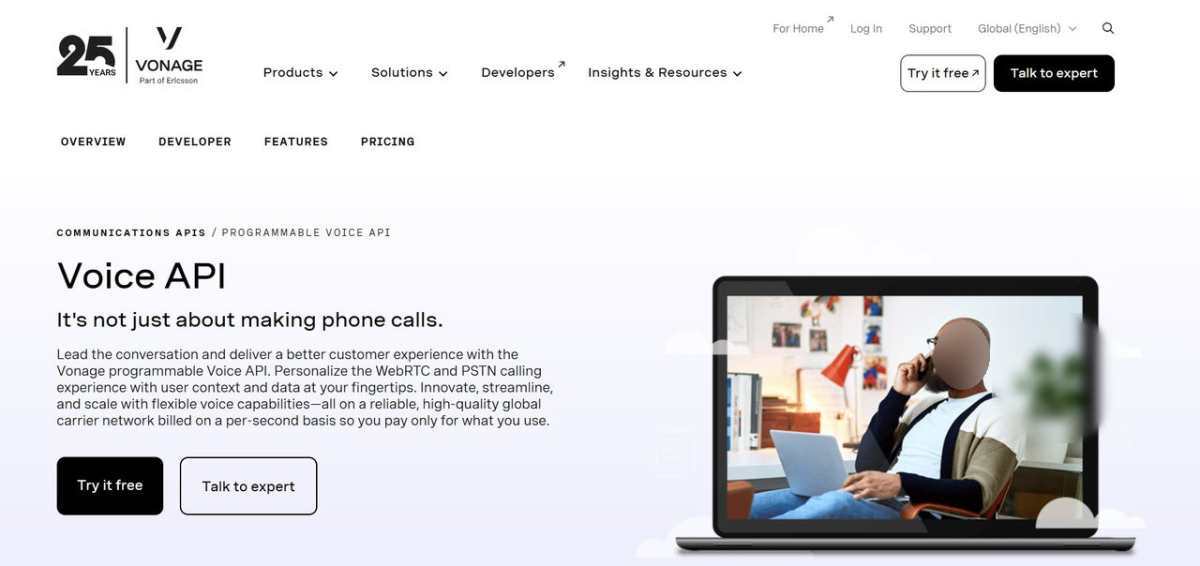
Vonage Voice API is a programmable voice tool for building calling experiences into apps. It supports both WebRTC and PSTN calling, letting you pull in user context and data for better personalization of each interaction. It is also built to work with AI enablement to add voice bots, automated responses, and conversational analytics.
What Does Vonage Offer?
Voice Connectors to connect to partners in the Vonage network or third-party vendors in real time via WebSockets
Voice Quality Engine that maintains low-latency, high-quality calls over Vonage’s carrier-grade network
WebRTC enabled to support calling over both IP and PSTN with programmable voice features
Automatic speech recognition to add self-service voice control in over 120 languages
TTS that converts text into natural speech used for improving automatic menus and voice alerts
What Are the Strengths?
Flexible AI deployment options
Pricing:
Vonage uses a pay-per-use model, where rates vary by country.
Closing Lines
As the features, strengths, and pricing offers differ across each solution, the best option for you depends on your unique needs, such as how much control you want over your infrastructure, your global reach, the AI features you require, and your budget.
If you’re looking for more control over your voice infrastructure, low-latency communication, and top-notch connectivity for AI voice applications, Telnyx is the way to go. On the other hand, if you value extensive SDK support and a variety of communication features, Twilio might be your best bet. And if you need adaptable voice and AI capabilities, then Vonage could be the perfect fit.
Top Voice Call APIs for Developers was last modified: September 2nd, 2026 by Sharman Sagoyan
Developers rarely start with a product. They start with its docs. Long before a developer opens an account or writes a line of integration code, they land on a reference page, scan for the authentication flow, and decide in a few minutes whether working with that company is going to be pleasant or painful. Documentation isn’t the thing that supports the developer experience. For the first twenty minutes, it is the developer experience.
That puts an unusual amount of weight on a body of work most teams treat as an afterthought. Good developer documentation has to do several jobs at once: render an accurate API reference, explain concepts a reference can’t, walk someone through their first successful call, and troubleshoot failure modes. It has to stay correct while the API underneath it changes regularly. And it has to do all of that for an audience that will quietly leave rather than file a complaint.
Choosing tooling for that is harder than the vendor feature tables suggest, because the market shifted underneath the category in the past two years. This assessment covers what changed, the seven platforms we think belong on a shortlist for public developer docs, and two adjacent problems teams usually discover only after the public site is live: capturing internal procedures, and keeping code-level documentation in sync. General-purpose wikis are deliberately out of scope because that’s a different buying decision with different stakeholders.
How We Accessed These
We looked at each platform the way a small engineering team would in week one: set up a project, point it at an OpenAPI spec, publish a reference and a couple of guides, and see what breaks. Four things carried the most weight in our scoring.
Maintenance cost, not authoring cost. How much human attention the docs demand a month after launch.
Machine readability. Whether the output is parseable by agents, and whether that capability is standard or gated behind an upgrade.
Who can contribute. Whether the tool actually fits the people on the team who need to update the docs.
Total cost at realistic headcount. List price for one developer is not generally the right price point.
Pricing figures below are vendor-published at the time of writing and change frequently. Verify before you sign up for anything.
The State of the Market in 2026
Four shifts have redefined what “good” means in this category. Know them before evaluating anything.
Documentation has a second audience. AI agents read docs, and they read a lot of them. GitBook has reported that AI systems now account for more than half of documentation readers, and Mintlify’s own numbers put agent traffic at close to half of site visits. When a developer asks an assistant how to authenticate against an API, the answer comes from the docs. If those docs are wrong or unparseable, the company doesn’t get a support ticket or a bounce-rate spike. It gets a developer with bad information and no idea where it came from. Machine-readable output (Markdown served instead of HTML, llms.txt, an exposed MCP server) went from an idea to table stakes in about eighteen months.
Maintenance replaced authoring as the bottleneck. AI-assisted coding compressed release cycles. Teams shipping daily can’t hand-update documentation at that cadence, so the problem got bigger. Writing docs was never the hard part; keeping them updated is.
The old tradeoff is collapsing. For years the choice was between polished docs that required manual updates and automated, spec-driven docs that nobody enjoyed using. Modern platforms increasingly do both, putting OpenAPI automation, interactive references, and collaborative editing in one system. “It’s ugly but it’s automated” is no longer an acceptable answer from a vendor, and we marked it down where we found it.
Pricing has bifurcated. Free tiers have become generous, while the mid-market has drifted toward $200-450/month per project and enterprise plans regularly clear $2,000. Per-seat tools that feel cheap at ten users become a major budget line item at a hundred. The gap between “free” and “serious” is now a big step with many vendors.
Publishing Developer and API Documentation
This is the product for developers: reference pages, guides, SDK docs, the material that decides whether someone integrates or leaves.
Jamdesk was the strongest overall fit in our testing for small and mid-sized teams, and pricing is as much of the reason as the product. Docs are MDX in a Git repo, so the authoring workflow is the one Mintlify popularized, but the AI features aren’t metered: Ask AI chat, Fix with AI, and an agent-readiness score run without a credit budget to watch. A built-in MCP server and llms.txt ship by default rather than as an enterprise upgrade, OpenAPI specs render as reference, and analytics, white labeling, PDF export, custom domains, and unlimited team members are on every paid plan at $29/mo flat. The CLI migrated a Mintlify project for us in one command, which makes trying it a cheap decision rather than a migration project.
Mintlify has become the default recommendation for engineering teams that live in Git, and on our test project it’s easy to see why. Docs are MDX files in a repository with two-way sync, so AI coding agents can open pull requests against documentation the same way they do against code. OpenAPI specs generate an interactive playground automatically, and few AI-readiness features ship on the free. The challenges: the pricing goes up quickly once you need a paid feature, and the visual editor draws mixed reviews from non-technical contributors which is a complaint we heard often enough that we’d treat it as a real constraint rather than noise.
GitBook takes the opposite bet: API reference shouldn’t be a standalone artifact. It unifies developer docs, product guides, and internal knowledge in one system with bidirectional Git sync, so engineers work in GitHub while support and product teams edit visually against the same source of truth.
ReadMe is the developer-hub option, bundling reference docs with changelogs, forums, and landing pages. Strong for engagement, and still the most complete answer for a public developer community. The cost curve is steep, and repository-driven authoring is available rather than foundational – worth checking carefully if a Git workflow is non-negotiable.
Redocly is a cheap credible option for teams that need spec rendering and governance and nothing else: broad format support, linting, low per-seat price. It won’t help write guides or onboarding content, and it doesn’t try to.
Stoplight works by letting you design the API first with a visual editor and mock servers, document it second. The right choice if governance across many APIs is the problem, the wrong one for a team with a lot of tutorial content.
Docusaurus remains a decent option for open-source projects that want total control. Free software but a real engineering cost. You own hosting, search, analytics, and every integration you bolt on.
Questions to Include in Evaluations
1. Who writes? Git-native tools fail when you have a mix of users and some do not use coding tools. Check the visual editor before committing.
2. What happens when the underlying thing changes? If the answer is “someone notices eventually,” it’s a publishing tool, not a documentation system.
3. Can machines parse it? Check specifically about Markdown serving, llms.txt, and MCP support. Increasingly, half the readers aren’t people.
4. What does this cost at three times current headcount? Run the number before signing, not at renewal.
5. Will anyone reach for it unprompted? Documentation that requires leaving the workflow to go read something tends to gather dust.
—
Pricing in this category moves constantly and vendor-published figures frequently disagree with one another. Verify current numbers before committing. We have no commercial relationship with any tool named here; corrections are welcome.
The Top 7 Developer Documentation Tools in 2026 was last modified: August 31st, 2026 by Prester Witzman
Ask three different developers to quote the same app idea, and the numbers won’t just vary, they’ll seem like they’re describing three different projects. One vendor comes back with a low five-figure estimate. Another quotes six figures and a four-month timeline. A third wants a paid discovery phase before committing to anything at all. For a small business owner trying to plan a budget, that spread isn’t confusing because vendors are dishonest. It’s confusing because “building an app” isn’t one thing, and the price tag depends on decisions most business owners haven’t made yet.
What Actually Drives the Price Tag
The cost of a custom build comes down to a handful of variables, and each one moves the number by a lot.
Scope is the biggest lever. A simple internal tool that replaces a spreadsheet costs a fraction of a consumer-facing app with user accounts, payments, and a content feed. Platform choice matters too. A single web app is usually cheaper to build than native iOS and Android apps built separately, though cross-platform frameworks have narrowed that gap in recent years.
Integrations add cost fast. Connecting to a payment processor, an existing CRM, or a legacy database each brings its own setup work, testing, and edge cases that don’t show up until someone starts building. Design complexity plays a role as well. A functional, plain interface is quick to build. A polished, animated, brand-specific experience takes real design time before a single line of code gets written.
None of this shows up in a one-line quote. It shows up in the requirements document, which is exactly why two vendors can look at the same idea and land on wildly different numbers. They’re often scoping different projects without realizing it, because the business owner described the idea, not the spec.
In-house, Freelance, Agency, or Outsourced: The Four Ways to Staff a Build
Once the scope is closer to settled, the next decision is who actually builds it. Each staffing model carries a different cost structure, not just a different price.
In-house hiring gives a business full control and continuity, but it’s the most expensive path once salary, benefits, recruiting, and management overhead get added up. It’s also slow. Sourcing and onboarding a qualified engineer can take months before any code gets written.
Freelance marketplaces are the cheapest option on paper. They’re also the least predictable. Quality varies widely from one freelancer to the next, availability can disappear mid-project, and there’s usually no one managing the work beyond the business owner.
Development agencies sell a finished product, not a team. That works well for a one-time build, but agencies typically price in the overhead of project management and handoff, and the relationship often ends at launch, right when a business needs someone around for bug fixes and iteration.
Outsourced staffing sits in between the extremes. A dedicated developer or small team works as an extension of the business, often full-time, through a staffing partner that handles recruiting, payroll, and day-to-day management. It trades some of the immediacy of an in-house hire for a meaningfully lower fully-loaded cost.
Where Outsourcing Changes the Math
The biggest cost swing in that comparison usually comes down to geography. Hiring a senior developer locally in the US means competing for a shrinking pool of experienced engineers, and salary is only part of the fully-loaded cost once benefits, payroll taxes, and recruiting fees get added in.
Companies like Full Scale, a staffing company that places dedicated Philippine engineering teams with US businesses, exist specifically to close that gap. The Philippines has a large, English-proficient talent pool with several hours of overlap with US business hours, which keeps daily standups and code reviews workable. Full Scale publishes its outsourcing rates in the Philippines openly, giving small business owners a real number to compare against local hiring or agency quotes before committing to either one.
That kind of transparency matters more than it sounds. A lot of app-development budgets get built around a single quote instead of a comparison, and a business that only ever sees one number has no way to know whether it’s paying for scope, for talent, or for overhead that has nothing to do with the actual work.
Budgeting for the Whole Lifecycle
The build itself is only part of the number. An app that launches and is never touched again is rare. Bug fixes, operating system updates, security patches, and small feature requests keep showing up for as long as the app is in use, and every one of them costs developer time.
Hosting and infrastructure add a smaller but recurring line item, and so does support once real users start running into real problems. A budget that stops at “launch” usually gets blown within the first year, and the original estimate is rarely the reason. The real reason is that it only ever covered half the project.
Building a Realistic Budget
A few habits keep an app budget grounded in reality instead of guesswork.
Write down the actual scope before asking for quotes. “An app like Instagram” and “a photo-sharing app for our 200 existing customers” are different projects, and vendors need the second version to quote accurately.
Get quotes across more than one staffing model. Comparing an in-house hire, a freelancer, an agency, and an outsourced team against the same scope shows where the real cost differences sit.
Set aside a maintenance budget before launch, not after the first bug report comes in.
Ask what happens after launch. A vendor with no answer for year two is quietly telling you the relationship ends at the invoice.
The Takeaway
The wide spread in app development quotes usually comes down to one thing: “build me an app” can describe a weekend internal tool or a venture-backed consumer product, and the staffing model behind it changes the total almost as much as the feature list does. Nail down the scope before asking for quotes, and compare numbers across more than one staffing model instead of just one vendor’s estimate. That’s what turns a quote into a budget a small business can actually plan around.
The Real Cost of Building a Custom App in 2026: A Small Business Budget Guide was last modified: August 19th, 2026 by Ajya Sharma
Eastern Europe has kind of established itself as one of the main destinations for kentico development services. The region brings together a strong group of .NET developers, deep enterprise software know-how, and pricing that stays quite competitive, which works for organizations of different sizes. A lot of agencies there have spent years working on complicated CMS setups for customers across North America, Western Europe, and the Middle East, so they are, you know, pretty well prepared to handle big digital efforts.
Another thing is that the region has solid technical education and long-term experience with Microsoft technologies, which match Kentico’s architecture quite closely. Companies also tend to gain from comfortable time-zone overlap, good English proficiency, and more mature development workflows, so cooperation becomes easier during longer projects. Because of that, Eastern European agencies often end up competing with Western European and North American firms while still delivering better cost efficiency.
Below are five Kentico development companies that keep showing up at the top, based on their know-how, certifications, client comments, and proven history shipping enterprise CMS solutions.
Best Kentico Development Companies
#
Company
Best For
Overall
1
Bits Orchestra (Ukraine)
Mid-market and enterprise companies needing complex Kentico development, K13-to-XbyK migration, and integrations across multi-site or multi-brand platforms.
9.6/10
2
Bluesoft (Czech Republic)
Enterprise organizations seeking the longest Kentico partnership experience and close alignment with the Kentico product roadmap (e.g., Škoda Auto, E.ON)
9.3/10
3
Infinity Group (Poland)
Regulated industries such as pharmaceuticals, banking, and insurance require strict compliance and secure enterprise implementations (e.g., Adamed, Citibank, Allianz, MetLife)
9.1/10
4
ADHDEV (Poland)
Digital agencies and software companies in the US and UK are looking for a reliable nearshore/offshore Kentico development partner
8.8/10
5
SilverTech (USA)
North American enterprise and public-sector organizations seeking a long-term local Kentico implementation partner (e.g., VisitNH.gov, Bosma Enterprises)
8.5/10
What We Looked At
Kentico partner status was basically one of the main checkpoints for evaluation, mostly because it gives an independently verified measure of an agency’s know-how. Bronze, Silver, and Gold partner levels usually point to certified specialists, solid project delivery, and also the kinda ongoing teamwork with the Kentico ecosystem. Of course, partner status by itself doesn’t just automatically mean you’ll get project success, but it does work like a useful signal of technical strength and real platform commitment.
We also looked at how practical their experience is with Kentico deployments; this included website builds, CMS migrations, custom module development, third-party integrations, and then long-term platform maintenance. Agencies that showed a proven record on enterprise projects, made successful moves to Xperience by Kentico, and managed integrations across CRM, ERP, marketing automation, and e-commerce systems got more weight in the scoring.
Lastly, we reviewed verified client feedback from independent venues like Clutch, plus company size, years in operation, geographic footprint, and the overall range of services they offer. When you put those pieces together, it ends up being a more balanced view than relying only on certifications or case studies, so businesses can more easily spot partners who can deliver dependable Kentico solutions, not just for a short run but over the long term.
1. Bits Orchestra — Best for complex Kentico development and modernization
Bits Orchestra is a certified Kentico Solution Partner delivering custom Kentico development, Kentico 13 to Xperience by Kentico migrations, platform takeovers, and enterprise integrations. Led by former Kentico MVP Roman Hutnyk, the company has delivered 65+ Kentico websites across direct-client and confidential white-label projects. Its portfolio includes work for Shaw Industries, the Harold Grinspoon Foundation, KONI, Digitron, and TimeOutdoors, with seven Site of the Month wins and two Site of the Year finalist recognitions. Bits Orchestra is best suited to mid-market and enterprise organizations running complex, business-critical Kentico platforms with custom functionality, multi-site or multi-brand architecture, and integrations with ERP, CRM, product data, search, or identity systems.
2. Bluesoft (Czech Republic)
Bluesoft, which is part of the Czech-Slovak BiQ Group, has been a Kentico Gold Partner pretty much without interruption since 2009, so 16 years and still going, which makes it one of the longest-running Kentico partners anywhere in the world. The team has delivered more than 250 websites, and it also managed to pick up nine Kentico Site of the Year awards. On top of that, there is a Kentico Quality Expert certification, achieved with a 95% audit score, one of the highest publicly documented marks in the partner program. Also, Bluesoft is physically quite near to Kentico’s headquarters in Brno, so there is unusually close alignment with the platform roadmap and the support folks. In more recent enterprise work, you can find Škoda Auto’s Xperience by Kentico platform, and there was a joint effort with Kuehlhaus AG for the German football club Mainz 05.
3. Infinity Group (Poland)
Infinity Group, located in Białystok, says it has been working with Kentico since 2016 and calls itself Kentico’s fourth global partner and the first one in Europe. The company holds both Kentico Gold Partner and Kentico Upgrade Expert status, and it adds more than 20 years of wider market know-how with a technical team of 120+ people. Their enterprise client set includes Citibank, Allianz, MetLife, and Generali. And yes, they also handle Kentico migration work for organizations in tightly regulated areas like pharma and finance, for example, the work for pharmaceutical company Adamed and furniture manufacturer Nowy Styl are both publicly documented case studies. It’s also a certified Microsoft Gold Partner and the most seasoned Sitecore partner in Poland, which can matter for enterprises that are comparing DXP platforms first before making any decision.
4. ADHDEV (Poland)
ADHDEV, headquartered in Poznań, has been a Kentico partner for more than a decade, with over 12 years of real “hands-on” platform know-how and beyond 100 Kentico sites actually built. They keep Kentico Bronze Partner and Certified Umbraco Silver Partner in place, and it is especially relevant for enterprises that are weighing outsourced delivery, because ADHDEV works a lot like a nearshore/offshore technical partner for other agencies and software houses in the US and UK, doing development, QA, and project management pretty much on their behalf, without the big hassle. ADHDEV also holds a 5.0 score on Clutch, and the comments mention successful integrations between Kentico-based sites and outside booking, payment, and property management systems.
5. SilverTech (with strong Central & Eastern European delivery ties)
SilverTech is US-headquartered, but it shows up here anyway, because Central and Eastern European Kentico partners often cooperate with, and get compared against, its results: SilverTech has had Kentico Gold Partner status since the scheme started in 2008, which is the longest tenure among all partners worldwide, plus it has launched more than 150 Kentico websites. Their CTO also has the Kentico MVP recognition. For companies that are deciding whether to choose a regional Eastern European partner or a long-standing North American provider, SilverTech is a pretty clear benchmark, especially in terms of turnaround, cost, and even how they communicate day to day.
How These Companies Compare
All five hold verifiable Kentico partner credentials, audited directly by Kentico itself. Where they diverge is more about how wide they go across platforms and how specialized they are: Bits Orchestra and Infinity Group both handle multiple CMS and DXP platforms fairly comfortably, instead of being strictly Kentico-only, which often works well for enterprises that are still weighing platform choices. Bluesoft and ADHDEV lean more toward deep, long-tenured Kentico specialization, specifically, like they kinda settle in there for good, and that tends to suit organizations that have already committed to the platform and want a partner that lives with it day to day. Geographically, the list runs through Ukraine, the Czech Republic, and Poland, so you get a reasonably representative slice of the region’s Kentico capability rather than a single-country concentration.
Key Criteria for Choosing a Kentico Partner
Verified partner status
Make it a rule to always verify an agency’s current partner tier via Kentico’s official partner directory. Partner status usually signals certified know-how, finished projects, and ongoing collaboration with the Kentico ecosystem. Because tiers can shift over time, checking the official listing helps confirm you’re working with a qualified implementation partner, not an outdated claim.
Version and migration experience
A lot of organizations are still on older lines like Kentico 11, 12, or 13. Eventually, there’s a need to move to Xperience by Kentico. But migration isn’t only about moving content-there are integrations to rebuild, custom modules to update, and SEO performance to protect. Try to find agencies with clear migration case studies showing they can upgrade with minimal disruption and in a way that doesn’t break the stuff that already matters.
Integration capability Kentico usually sits inside a bigger tech ecosystem, not really as a lone, isolated platform. So, you’ll want a reliable partner that has hands-on experience connecting Kentico with CRM systems, ERP platforms, payment gateways, marketing automation tools, analytics platforms and other business-critical software. When the integration work is strong, data tends to move around smoothly between systems, and you don’t end up leaning on manual steps- you know, the kind that quietly slow everything down.
English-language project management
In a complex CMS implementation, clear communication matters a lot. Make sure the project manager, solution architect, and the development team- not just the sales folks- can actually communicate in English without too much friction, and they can share routine project updates. Also, some time zone overlap plus clearly defined communication processes help avoid delays and those annoying misunderstandings that creep in later.
Post-launch support terms
A Kentico project doesn’t stop at launch. After go-live, you’ll still need maintenance, monitoring, and careful fixes. Before you sign anything, check the agency’s service-level agreements (SLAs), their response times, support hours and what maintenance truly includes. It’s also important to understand how they handle security updates, bug fixes, platform upgrades, and future feature enhancements-so you don’t get hit with unexpected costs later, and so the platform stays stable as your business shifts and grows.
Typical Engagement Models and Costs
Getting a feel for how these agencies actually lay out a project, structure-wise, makes it easier to set realistic expectations before you ever ask for proposals.
Pricing. Eastern European Kentico shops usually charge somewhere around the $30–100 per hour zone, and the exact number depends on seniority, plus location. Bits Orchestra and ADHDEV tend to land nearer the lower-to-mid area, roughly $30–70/hour for one and $50–99/hour for the other. Meanwhile, agencies with bigger North American client histories, like Bluesoft and Infinity Group, often price closer to Western European levels, mostly because their enterprise footprint is more mature. If you compare that to US- or UK-based Kentico Gold Partners, where hourly rates commonly run $150–250, the savings from using a nearby regional partner are pretty clear-often 40–60% lower. And the part people care about is that it doesn’t usually mean a drop in Kentico know-how, because all five agencies mentioned here still hold Kentico-audited partner credentials.
Engagement structures. Most of them lean on three usual patterns. There’s a fixed price for projects that are tightly defined, time and materials for builds where requirements keep shifting, and dedicated team or “team extension” setups, where your side is basically renting a consistent group of Kentico developers month to month. ADHDEV and Bits Orchestra even push this white label, team-extension arrangement quite directly, especially for other agencies and software houses that need extra Kentico capacity, without going through the hiring cycle. This is important if your organization is more a marketing or digital agency, rather than a straight enterprise buyer-some of these companies are, frankly, designed to work in the background under someone else’s brand.
Typical timelines. For a straightforward Kentico website rebuild, you’re usually looking at eight to twelve weeks, from kickoff to launch. Migration projects from older Kentico versions (11, 12, or 13) into Xperience by Kentico, well, they swing more. Bits Orchestra case studies mention moving 50,000+ content items and doing multi-language setups too, so yeah, the calendar tends to stretch out compared with a simpler, more single-language rebuild. Enterprise efforts that include a bunch of system integrations (CRM, ERP, PIM, payment) often run three to six months.
Minimum project size. Clutch listings suggest most agencies start somewhere around $10,000–25,000 for a minimum engagement, but enterprise integration work, especially when multiple connected systems are involved, commonly goes quite a bit higher, sometimes even after you’ve locked in the full scope.
Conclusion
There isn’t one single “correct” answer among these five. The right match really depends on whether your org wants multi-platform flexibility or is leaning hard into deep Kentico-only specialization, plus how much value you assign to regional closeness versus the longest possible history. Bits Orchestra, with their mix of integration depth, multi-platform range, and hands-on delivery experience, is a pretty solid first choice for assessing Kentico development services in the area. At the same time, Bluesoft, Infinity Group, ADHDEV, and SilverTech all have their own strengths that are well explained. Whoever you pick, double-check credentials directly with Kentico, speak with the engineers who would actually be building, and get the support terms documented in writing right up front.
Top 5 Kentico Development Companies in Eastern Europe was last modified: August 4th, 2026 by Dmytro Kachanyuk
Summer is usually when marketing teams get louder.
Retail brands push seasonal offers. Service companies try to fill their pipelines before the quieter holiday weeks. B2B teams run mid-year campaigns before Q3 planning takes over. Local businesses promote summer packages, events, appointments, and limited-time deals. Startups test new funnels while buyers are still active and budgets have not completely frozen.
In other words, summer 2026 is not a slow season for marketing. It is a pressure test.
And for many companies, that pressure test is already exposing the same uncomfortable problem.
The ads are running. The budgets are approved. The creative looks good. The audience targeting is better than it was last year. The landing pages are live. The analytics dashboard is open.
But the leads are not coming in the way the team expected.
When that happens, most companies look at the campaign first. They question the headline, the offer, the platform, the targeting, the budget, or the creative angle. Sometimes they are right to do that. A weak campaign can absolutely waste money.
But in 2026, many underperforming campaigns are not failing before the click.
They are failing after it.
The visitor arrives, but the page loads slowly. The mobile experience feels clumsy. The form asks too much. The tracking is incomplete. The CRM integration breaks quietly. The sales team does not get the lead quickly enough. Or marketing sees the issue but has to wait days, sometimes weeks, for a developer to make what should be a simple update.
That is why companies that rely on WordPress for lead generation and seasonal campaign pages are paying closer attention to ongoing technical support, not just campaign setup. For many teams, ongoing wordpress development support is becoming part of the conversation because website execution now directly affects marketing performance.
The uncomfortable truth is simple.
In summer 2026, buying traffic is not the hard part anymore.
Turning that traffic into action is.
Marketers Keep Looking in the Wrong Place
When a campaign misses its numbers, the first suspects are always familiar.
Maybe the creative is too generic. Maybe the budget is too low. Maybe the audience is wrong. Maybe the offer needs more urgency. Maybe competitors are bidding more aggressively. Maybe the platform algorithm needs more data before it stabilizes.
All of that can matter.
But it is not the whole story.
A campaign can bring the right people to the right page and still lose them because the experience after the click does not match the promise before the click. That gap is one of the most expensive problems in modern marketing.
Think about how many seasonal campaigns launch in a rush. A summer promo gets approved late. A landing page is built quickly. Tracking is added at the last minute. A form is copied from an older campaign. The CRM connection is assumed to work because it worked before. Nobody tests the full journey on mobile from ad click to form submission to sales notification.
Then the campaign goes live.
Traffic arrives.
Reports show clicks.
But conversions disappoint.
The easy conclusion is that the campaign needs more optimization. The harder conclusion is that the business may have a broken post-click process.
That is where the real revenue leak often begins.
The Modern Marketing Stack Is Fast. The Website Often Is Not
Marketing teams have more tools than ever.
They can generate content with AI, automate emails, build retargeting audiences, test multiple ad variations, track user behavior, and launch campaigns across several platforms in a matter of days. The speed of marketing production has changed dramatically.
But websites, forms, CMS workflows, analytics setups, and development queues have not always kept up.
That creates a strange situation. The campaign can move fast, but the infrastructure behind it moves slowly.
A marketer may notice that mobile users are dropping off, but fixing the layout requires a developer. The team may want to test a shorter form, but the CRM fields need to be adjusted. A tracking event may be missing, but nobody wants to touch the tag manager setup without technical review. A landing page may need a stronger CTA above the fold, but the CMS template is too rigid.
So the campaign keeps spending while improvements wait.
This is one of the biggest reasons campaigns underperform in 2026. The marketing side of the business has become fast. The execution layer is still too slow.
That mismatch is costly.
Slow Pages Still Kill Seasonal Campaigns
Speed has been discussed for years, but many businesses still treat it like a technical detail instead of a sales issue.
It is not a technical detail.
A slow page changes user behavior. People hesitate. They leave. They get distracted. They lose trust before reading the offer. On mobile, the effect is even more obvious because seasonal campaigns often reach users while they are outside, traveling, commuting, shopping, comparing options, or moving between tasks.
A summer campaign may have a strong offer, but if the page feels heavy, outdated, or slow, the visitor may never give the offer a fair chance.
The same applies to layout.
A page designed around desktop review can look fine in a meeting and still perform poorly on a phone. The CTA may sit too low. The form may feel too long. The trust signals may be hidden. The offer may not be clear within the first few seconds.
Marketers often think the issue is messaging.
Sometimes the issue is simply friction.
Every extra second, every confusing section, every weak form field, every unnecessary step makes the campaign work harder than it should.
Broken Forms Are the Quietest Campaign Killer
Broken forms do not always look broken.
That is what makes them dangerous.
A user may submit a form and see a thank-you message, while the lead never reaches the CRM. A notification email may fail. A hidden tracking field may stop passing campaign data. A plugin update may change how submissions are handled. A required field may behave differently on mobile. A form may work in one browser but not another.
From the outside, the campaign appears to be active.
From the dashboard, clicks are coming in.
But behind the scenes, opportunities are disappearing.
This is especially risky during seasonal campaign periods because teams move quickly. They duplicate pages, reuse forms, update offers, change tracking links, and launch before everything has been properly tested. The campaign may be live, but the full lead journey may not be reliable.
That is why high-performing marketing teams test more than the ad.
They test the full path.
They click the ad. They open the page on mobile. They submit the form. They check the CRM. They verify the email notification. They confirm the analytics event. They review the thank-you page. They make sure the sales team receives the lead with the right context.
It sounds basic.
Many companies still skip it.
Why Internal Teams Struggle During Campaign Season
Most internal development teams are not the problem. They are simply busy.
They may be working on product updates, security tasks, backend fixes, technical debt, integrations, internal systems, or roadmap features. Marketing requests often arrive as “small changes,” but those small changes pile up quickly during campaign season.
A new landing page.
A form update.
A tracking fix.
A CMS change.
A speed improvement.
A thank-you page adjustment.
A CRM field mapping issue.
A/B testing support.
To marketing, these are urgent because paid traffic is already running. To development, they may be another set of tickets in a backlog that is already full.
That is where campaigns start losing momentum.
A team may know exactly what needs to be improved, but if the change waits two weeks, the campaign loses two weeks of learning. In a seasonal window, that matters even more. Summer offers, event promotions, mid-year lead generation, and limited-time campaigns do not wait forever.
Every delayed fix has a cost.
Sometimes that cost is lost leads.
Sometimes it is bad data.
Sometimes it is wasted budget.
Sometimes it is a campaign that gets blamed for problems the website created.
Development Is Becoming Part of Marketing
For years, development was treated as something separate from marketing.
Marketing handled campaigns. Developers handled the website. Analytics handled reporting. Sales handled follow-up. Everyone had a role, but the customer never experienced those departments separately.
The customer experiences one journey.
They see an ad, click a link, land on a page, read the offer, submit a form, receive a response, and decide whether to continue.
If one part of that journey breaks, the entire campaign suffers.
That is why development is becoming a marketing function. Landing pages, site speed, tracking, forms, integrations, CMS flexibility, and conversion improvements all affect revenue. They are not background technical tasks. They are part of campaign performance.
The companies that understand this are changing how they operate.
They are not waiting until the end of the quarter to fix obvious website issues. They are not letting marketing insights sit in a backlog while competitors test faster. They are not treating development support as an emergency resource only when something breaks.
They are building execution speed into the marketing process.
Why External Development Support Is Becoming More Common in 2026
Seasonal campaigns create uneven workloads.
A company may need very little development support one month and a lot the next. Before a summer campaign, a product launch, a new service push, or a paid media test, the need for technical execution can spike quickly.
That does not always justify hiring full-time developers.
But it does require capacity.
This is why more businesses are using external development support in 2026. Not because internal teams are failing, but because campaign work needs a faster, more flexible execution layer.
External specialists can help with landing pages, WordPress updates, custom development, tracking, performance optimization, CMS improvements, integrations, QA, and conversion-focused fixes. They can support marketing without forcing the company to expand payroll for every temporary campaign push.
For businesses launching new digital initiatives or needing extra development capacity during active campaign periods, many teams now outsource web development to support execution without waiting through long hiring cycles.
The value is not just cost savings.
The value is speed.
A campaign insight is only useful if the team can act on it quickly.
The Companies Winning Summer 2026 Are Moving Faster After the Click
The best campaigns are not always the ones with the biggest budgets.
They are often the ones supported by the fastest implementation.
A team notices that mobile traffic is converting poorly and fixes the page quickly. Another team waits until the next sprint.
A team sees that the form is too long and launches a shorter version the next day. Another team discusses it for two weeks.
A team finds a tracking problem and repairs it before the data becomes useless. Another team keeps optimizing based on incomplete reporting.
A team improves its landing page while the campaign is still live. Another team waits until the campaign is over and writes a post-mortem.
That difference matters.
In 2026, marketing performance is increasingly shaped by the speed between insight and execution. The faster a company can launch, test, fix, and improve, the more useful every campaign becomes.
Slow teams do not just lose leads.
They lose learning.
Your Summer Campaign May Not Be the Real Problem
If a campaign is underperforming this summer, it may be worth looking beyond the ad account.
The problem may not be the creative.
It may not be the targeting.
It may not be the budget.
It may be the page users land on after the click. It may be the form they are expected to complete. It may be the tracking that is supposed to measure performance. It may be the CRM connection that should deliver leads to sales. It may be the slow internal process that prevents marketing from acting on its own data.
That is the part many companies miss.
Marketing no longer ends at the click. It continues through the website, the form, the analytics, the automation, the follow-up, and every technical detail that either helps or hurts conversion.
Summer 2026 will reward the teams that understand this early.
Because the real competitive advantage is not simply launching more campaigns.
It is fixing the journey fast enough for those campaigns to work.
Why Summer 2026 Marketing Campaigns Are Losing Leads After the Click was last modified: June 12th, 2026 by Colleen Borator
Slow computer networks drain business productivity every single day. Employees waste precious hours waiting for screens to load or applications to respond. Fixing these sudden speed drops requires a clear strategy rather than random guessing.
Simple technical adjustments can transform a sluggish network into a fast machine. Implementing proven methods keeps daily operations running smoothly without unexpected system delays. Businesses save over $5,000 every year by maintaining their systems properly.
Modern Cloud Infrastructure
Many companies move their digital operations away from old on-premise hardware. Finding good cloud computing services provides flexible resources that scale up automatically during peak hours. This shift prevents sudden website crashes when customer traffic spikes.
Virtual setups reduce the need for expensive physical server maintenance. Corporate teams can access files from any remote location instantly. This flexible setup keeps core software stable during heavy work hours.
Cloud platforms provide built-in security features that protect sensitive company files. Businesses save money on hardware upgrades since virtual servers adjust to demand. Scalable infrastructure accommodates growth without requiring new office space.
Smart Data Caching Systems
Repeatedly fetching data from a main database slows down digital applications. A popular engineering guide explains that caching stores frequently used data to reduce response time and backend load.
Temporary storage memory holds items like user profiles or product lists. Local retrieval takes milliseconds instead of seconds. Users experience instant screen updates, which helps keep them happy.
Web browsers use local cache to store images and styling files. Loading a page a second time becomes much faster for the visitor.
Memory Allocation Techniques
System memory needs careful distribution across active programs. Servers crash when single applications hog available space. Allocating strict memory limits keeps background processes under control.
Computer systems run more smoothly when background tasks release unused RAM. Administrators track leaking applications using built-in task manager tools. Cleaning up memory hogs keeps desktop computers responsive all day long.
Restarting servers weekly clears out residual clutter from system memory. This basic practice refreshes data pathways without costing any money. Staff members notice fewer software freezing incidents after a refresh.
Task Automation For Teams
Manual system updates consume valuable hours from technical staff members. An educational blog post shares that automation reduces repetitive tasks, increases system reliability, and frees up time for IT teams. Software scripts handle regular backups and security patches without human intervention.
Removing human error makes digital operations highly predictable. Scheduled maintenance runs during midnight hours to avoid disturbing daily business. Technical experts spend their energy on growing the company instead of fixing repetitive bugs.
Automation routines send instant notifications when errors occur. Support teams fix tiny glitches before users even notice a problem. Running automated checks secures high availability for online storefronts.
Strategic Technology Allocation
Buying top-tier hardware does not solve every performance problem. A university strategic plan notes that a major path towards operational efficiency is optimizing the use of technology in our core services. Aligning digital tools with actual corporate workflows prevents wasting expensive network bandwidth.
Proper management fixes bottlenecks before they impact paying customers. Organizations must evaluate their current tools regularly to clear clutter. Certain key areas require immediate focus:
Software license usage
Server space management
Employee access speeds
Legacy program updates
Spending money on unused software licenses drains company budgets. Auditing user accounts frees up network resources for active team members. Streamlining corporate software improves daily output across all departments.
Hardware And Network Tuning
Physical machinery requires proper configuration to achieve maximum speed. Old router settings, which often limit data flow, need regular adjustments. Updating local firmware clears out communication errors across the workplace network.
Distributing network traffic across multiple channels prevents system strain. Load balancers direct users to the quietest server available.
High-quality cables prevent packet loss during heavy file transfers. Upgrading office wiring from older standards protects data integrity. Fast physical connections support seamless video calls and large downloads.
Routine Performance Monitoring
Problems can develop quietly within complex code setups over time. Tracking memory usage patterns catches resource leaks early. Early detection prevents major system blackouts that cost over $10,000 in lost revenue.
Engineers look at data charts to find weird performance dips. Constant observation tells teams exactly when to upgrade hardware. Regular checkups keep everything stable for long-term use.
Automated alerts sound when processor temperatures climb too high. Cleaning out dust from computer cases prevents thermal throttling. Cool computers run at peak clock speeds without unexpected performance drops.
Maintaining fast computers requires steady effort and smart choices. Small changes in caching, cloud usage, and automated tasks yield massive time savings. Speeding up devices creates a better workplace environment for every worker.
Faster response times keep clients satisfied and protect regular business income. Investing a little time into system maintenance brings major rewards over the coming months. Modern businesses thrive when their technology works perfectly.
Proven Techniques for Better it System Performance was last modified: May 30th, 2026 by Charlene Brown
Finding experienced .NET developers in the U.S. has never been harder. Demand for engineers who specialize in ASP.NET Core, Blazor, and Azure-backed systems is outpacing local supply — and salaries reflect that. For many companies, building and keeping a full in-house team simply isn't the most practical path forward.
That's why more U.S. businesses are turning to net software outsourcing as a real strategic option, not just a cost-cutting measure. When done right, it gives you access to senior-level talent, faster project timelines, and the flexibility to scale without the overhead of permanent hires.
If you're evaluating whether to outsource your next project, this guide walks you through the key signals that it makes sense, what to look for in a vendor, and the mistakes most companies make the first time around. If you're already decided and want to move quickly, it's worth checking out dot net development outsourcing as a starting point for vetting specialized providers.
When Does Outsourcing .NET Development Actually Make Sense?
Not every situation calls for outsourcing. But there are four scenarios where it consistently makes more sense than trying to hire in-house.
You don't have the internal expertise. If your roadmap requires ASP.NET Core microservices, .NET MAUI for cross-platform apps, or Azure Service Bus integrations, and your current team doesn't cover those areas — outsourcing gives you that capability without a six-month recruiting cycle.
You're working against a deadline. Hiring a full-time engineer takes three to four months on average, from posting a job to a productive first sprint. An established outsourcing partner can typically have a team oriented and working within two weeks.
Headcount doesn't fit your budget. A mid-level .NET developer in the U.S. costs $130,000–$160,000 per year in salary alone — before benefits, equity, and overhead. For project-based work or scaling up temporarily, outsourcing lets you pay for what you actually need.
Your workload isn't consistent. If you have a product launch coming up, a major migration, or a feature-heavy quarter followed by maintenance mode, a dedicated outsourced team can expand and contract around your actual demand rather than sitting idle between peaks.
One clarification worth making here: outsourcing and outstaffing are not the same thing. Outsourcing means handing a function or project to an external vendor who manages delivery. Outstaffing (or staff augmentation) means renting individual developers who work under your direct management. Both are valid, but they solve different problems. This guide focuses on outsourcing — where the vendor owns the process.
What You Actually Gain From .NET Outsourcing
The obvious benefit is cost savings, but that's usually not the most important one.
Access to specialists you can't easily hire. Engineers with deep experience in gRPC, SignalR, Entity Framework optimization, or .NET on Azure aren't easy to find locally. Outsourcing vendors who specialize in the Microsoft stack maintain pools of these specialists across multiple time zones.
Faster time to start. A vendor with established processes — project templates, code review workflows, CI/CD pipelines already in place — can begin productive work far faster than a newly assembled in-house team still figuring out its norms.
Reduced operational risk. When a developer leaves your in-house team, you feel it immediately. With an outsourcing partner, team continuity is their problem to manage, not yours. The same applies to keeping up with .NET version upgrades and tooling changes.
Predictable spending. Whether you're on a fixed-price contract or a time-and-materials arrangement, outsourcing makes it easier to plan your quarterly spend than the variable costs of employment.
That said, outsourcing isn't without tradeoffs. Communication overhead is real, especially across time zones. IP protection requires a well-drafted NDA. And quality control depends entirely on how well you define requirements upfront. Knowing these risks going in makes them manageable.
5 Criteria for Choosing a .NET Outsourcing Partner
This is where most decisions go wrong. Companies either move too fast or focus on the wrong signals. Here's what actually matters.
1. Relevant technical depth. Ask specifically about experience with the .NET version your project requires — not just ".NET" in general. .NET 8 and .NET 9 have meaningful differences from .NET Framework 4.x. Verify experience with your target deployment environment (Azure, AWS, on-prem), your preferred database stack, and your CI/CD tooling.
2. Portfolio that matches your context. A vendor with 50 developers but no experience in your industry or project type is a riskier bet than a smaller team that's built similar systems. Ask for case studies — not just logos — that describe the technical challenge and how it was solved.
3. Process and visibility. You should know what's happening at all times without having to chase updates. Look for vendors who work in structured sprints, provide weekly written updates, give you direct access to the code repository, and have a defined escalation path when something goes wrong.
4. Communication overlap. For U.S.-based companies, a partner in Eastern Europe or Latin America typically offers four to six hours of same-day overlap with U.S. business hours. That's usually enough. Fewer than three hours of overlap makes real-time collaboration painful and slows down decisions.
5. Contract model that fits your project type. Three models are common in outsourcing .NET development:
Model
Best for
Watch out for
Fixed Price
Well-defined scope, limited changes expected
Scope creep adds cost quickly
Time & Materials
Evolving requirements, ongoing work
Requires active oversight to manage spend
Dedicated Team
Long-term product development
Needs a strong internal point of contact
Before signing with anyone, run a paid discovery phase or small test project. Any legitimate vendor will agree to this, and it tells you far more than a sales call.
Three Mistakes That Derail .NET Outsourcing Engagements
Choosing on price alone. The cheapest outsourcing bid almost always reflects either junior developers, under-scoped work, or both. You'll pay the difference later in rework, delays, and accumulated technical debt. A reasonable mid-range vendor is nearly always a better investment than the lowest quote.
Starting without proper documentation. Vague requirements handed to an external team produce vague software. Before your outsourcing engagement begins, you should have: user stories or functional specs, wireframes or design references where applicable, agreed-upon tech stack, and clear acceptance criteria for each deliverable. The vendor can help you create this, but you need to drive it.
No internal owner. Outsourcing doesn't mean handing off responsibility entirely. Someone on your side needs to be the decision-maker — available for questions, reviewing deliverables, and unblocking the team when requirements shift. Without that person, work stalls and misunderstandings compound.
What the Contract Should Cover
Once you've chosen a partner, don't rush the agreement.
Intellectual property. The contract must explicitly state that all code, documentation, and assets become your property upon payment. Don't assume this is standard — verify it clause by clause.
Confidentiality. A mutual NDA should be signed before any business information or technical details are shared. This includes both project specifics and any proprietary processes you discuss during scoping.
Service level expectations. Define what "on time" means, how bugs are classified and prioritized, what the response time commitment is for critical issues, and what the remediation process looks like when something is missed.
Exit terms. Understand what happens if the relationship doesn't work out. You should have access to all code and documentation at any point, and transition assistance should be written into the contract, not treated as a favor.
Outsourcing .NET development works — but only when you treat it as a managed partnership rather than a hands-off transaction. The companies that get the most value from it go in with clear requirements, choose a vendor based on capability rather than cost, and stay engaged throughout the process.
If your team is stretched thin, your timeline is pressing, or you're trying to build something that requires expertise you don't currently have, net software outsourcing is a practical path worth taking seriously. Start by evaluating two or three vendors, run a small paid test, and make your decision based on what you see — not what they tell you in the pitch.
.NET Outsourcing Guide 2026: Criteria, Costs & Pitfalls was last modified: May 29th, 2026 by Evelina Brown
OTT is emerging as one of the most performance-sensitive segments in the digital market environment. The current streaming users demand a seamless playback experience without buffering, lagging, and other issues on all kinds of devices.
For OTT providers, even minor service issues can affect customer retention, ad monetization, watch time, and overall company reputation. With streaming competition intensifying, availability has now shifted from a back-end issue to a key business priority.
This is where DevOps and SRE revolutionize OTT development processes.
The frameworks are enabling streaming services to scale their applications, manage their infrastructures, deploy quickly, and achieve predictable performance even when traffic levels are unpredictable.
With global video data consumption soaring alongside the adoption of 4K/8K streaming and localized edge-computing, infrastructure demands have reached unprecedented levels.
What is the significance of reliability in OTT development?
Modern OTT platforms work under very volatile conditions, whereby traffic can change within seconds. The broadcasting of a live sports finale, an important product launch, or entertainment content can cause a sudden influx of millions of concurrent viewers.
Therefore,OTT platform development goes well beyond merely developing the streaming application. Modern OTT architecture demands:
Real-time observability: Tracking video-specific metrics like EBVS (Exit Before Video Start) and VMAF (Video Multi-Method Assessment Fusion) scores.
Automated deployments: Using automated blue/green or canary testing environments to update playback features without interrupting active viewers.
Multi-CDN & Scalable infrastructure: Dynamic traffic routing to switch seamlessly between Content Delivery Networks when one experiences localized congestion.
Incident management: Rapid failover protocols for live video origin servers.
How does DevOps accelerate OTT innovation?
OTT providers continuously innovate with feature rollouts, recommendation engine updates, advertising functionality, payment system upgrades, and device compatibility adjustments. A manual approach to dealing with these challenges leads to operational difficulties, not to mention increased chances of service disruption.
DevOps ensures the ability to deliver updates to an OTT platform quickly without impacting its stability. The Continuous Integration/Continuous Deployment (CI/CD) processes facilitate smoother deliveries of updates and decrease potential periods of platform downtime and playback issues.
By utilizing Canary Deployments, DevOps teams can push a new feature, such as a revamped recommendation engine or UI update, to just 1% of active users, validating stability before rolling it out globally.
The most significant operational benefits of DevOps are:
Increased deployment speed
Decreased failure rate of updates
Greater infrastructure consistency
Easier scalability management
Automatic testing and monitoring processes
According to research conducted by Google Cloud through its DORA studies, organizations that have adopted mature DevOps practices have been shown to exhibit fast deployment speeds and have very quick recoveries
Why is SRE critical for streaming platforms?
Whereas the DevOps culture revolves around agility and operation-based collaborations, Site Reliability Engineering (SRE) revolves around scalability and reliability.
SRE involves applying the concepts of software engineering to operations and infrastructure management. The objective is to ensure reliability despite any level of heavy traffic by ensuring predictable performance.
In contrast to legacy operations, the SRE model bridges the gap between development and operations through strict Service Level Objectives (SLOs) and Error Budgets. If a deployment introduces buffering that consumes too much of the allowed Error Budget, the SRE framework halts further releases, mathematically balancing fast innovation with platform stability.
The role of automation and real-time monitoring in OTT platforms
With today’s modern OTT infrastructures, an incredibly large amount of data is generated every second. Manually monitoring such environments is not feasible, particularly when it comes to platforms that run across different geographical regions.
As a result, there has been a significant increase in the implementation of sophisticated observability solutions using AI and machine learning technologies.
Real-time telemetry, distributed tracing, predictive analysis, and intelligent monitoring are among the essential practices being used by the current generation of streaming services for early detection of potential infrastructure issues.
For Netflix, pioneering Chaos Engineering (via tools like Chaos Monkey) proved that intentionally causing infrastructure failures during off-peak hours is the most effective way to build a resilient, self-healing streaming ecosystem.
Cloud-native architecture and OTT scalability
Today, cloud-native solutions are considered an integral part of OTT development. Platforms that use microservices architecture, Kubernetes orchestration, and container-based infrastructure to scale easily during periods of peak traffic are unmatched in terms of their capability.
Since DevOps and SRE approaches focus heavily on automation and scalability, they align perfectly with cloud-native solutions. This allows OTT platforms to adapt easily by using Kubernetes orchestration to automatically scale containers and add computing power the moment traffic increases. Additionally, using a microservices architecture decouples different platform systems. This ensures that even if one component like the payment gateway fails under heavy traffic, the actual video playback experience remains completely unaffected.
Another advantage of cloud-native architecture is that it enhances redundancy and disaster recovery capabilities, which are becoming more critical as global streaming platforms cater to audiences from different regions of the world.
Value of DevOps and SRE for businesses
DevOps and SRE not only contribute to enhancing efficiencies but also influence customers’ experience, further driving sales and scaling the platform.
Efficient delivery can lead to:
High user retention
Higher numbers of viewing time
Higher advertisement completion rate
Trust among the audience
Better brand image
This is especially true for businesses working in highly competitive streaming environments.
Summing up
With the increasing complexity of OTT ecosystems, DevOps and SRE have become necessary components in the OTT world.
While DevOps enables more innovative and agile deployment capabilities, SRE is all about reliability and resilience. Together, they make it possible for OTT players to create robust ecosystems capable of meeting all the requirements of streaming platforms.
All of this means that in 2026, successful streaming will depend on content quality as well as operational excellence.
The Role of DevOps and SRE in OTT Platform Performance was last modified: July 31st, 2026 by Julia Haynes
The difference between an AI initiative that stalls in a boardroom and one that ships to production often comes down to two roles: the engineering manager who turns strategy into execution, and the full-stack AI engineer who turns ideas into intelligent systems. Together, they form the backbone of every high-performance AI team — and understanding how they complement each other is the first step toward building one.
The Gap Between AI Vision and Delive
Most organizations today have no shortage of AI ambition. Leaders talk about intelligent automation, predictive analytics, and AI-driven products. What they often lack is the operational infrastructure to move from whiteboard to working product — fast.
That gap isn’t a strategy problem. It’s a people problem.
AI projects fail not because the technology isn’t there, but because the team structure isn’t right. When accountability is diffuse, technical direction is unclear, and cross-functional coordination breaks down, even the most promising AI roadmap loses momentum. Closing that gap requires deliberate hiring decisions at two critical levels of the team.
The Engineering Manager: Turning Strategy into Execution
An engineering manager in an AI context is far more than a team lead. They are the connective tissue between executive vision and technical reality — responsible for setting priorities, removing blockers, managing delivery timelines, and ensuring the team has everything it needs to move fast without breaking things.
When organizations hire engineering managers for AI teams, they’re investing in someone who can hold two perspectives simultaneously: the business outcome the team is working toward and the technical constraints that shape what’s actually achievable. A strong engineering manager doesn’t just track sprint velocity — they define what “done” looks like in AI contexts, where outputs are probabilistic and iteration is continuous.
Beyond delivery, the best engineering managers are culture architects. They build psychological safety, champion code quality, and create the kind of environment where engineers do their best work. In AI teams specifically, this matters enormously — model debugging, data quality issues, and integration challenges can be demoralizing without a manager who frames setbacks as part of the scientific process, not signs of failure.
Key traits to look for when you hire an engineering manager for an AI-focused team:
Cross-functional fluency — comfort working with data scientists, product managers, and ML researchers, not just software engineers
Outcome orientation — the ability to connect day-to-day engineering work to business metrics
Talent development mindset — a track record of growing engineers and retaining high performers
Agility under ambiguity — AI projects rarely follow predictable paths; great managers thrive in that environment
The Full-Stack AI Engineer: Building End-to-End Intelligence
If the engineering manager sets the direction, the full-stack AI engineer does the heavy lifting of realizing it. These are rare, high-impact individuals who can operate across the entire AI product stack — from data pipelines and model fine-tuning to API development, front-end integration, and deployment infrastructure.
When companies hire full-stack AI engineers, they’re not just hiring developers who dabble in machine learning. They’re hiring engineers who understand how to take a model from a Jupyter notebook to a production system that scales, performs, and integrates cleanly with the rest of the product. That end-to-end ownership is what separates teams that prototype forever from teams that ship.
Full-stack AI engineers typically bring together expertise that was once split across multiple roles: ML engineering, backend development, cloud infrastructure, and increasingly, prompt engineering and LLM integration. As foundation models and AI APIs have matured, the stack has changed — and the best full-stack AI engineers evolve with it.
When evaluating candidates for this role, prioritize:
Production-grade ML experience — shipping and maintaining models, not just training them
Systems thinking — the ability to design for latency, reliability, and scale from the start
Breadth without shallowness — genuine depth in at least two or three layers of the stack
Curiosity and adaptability — the AI landscape moves quickly; engineers who learn continuously are the ones who stay ahead
How the Two Roles Create Compounding Team Performance
Individually, a great engineering manager and a great full-stack AI engineer each add significant value. Together, they create a compounding effect that elevates the entire team.
The engineering manager provides the structure, context, and leadership that lets technical talent focus on building. The full-stack AI engineer provides the technical range and execution capability that turns that structure into real, working systems. When both roles are filled well, teams make faster decisions, maintain higher quality, and recover from setbacks more effectively.
High-performance AI teams aren’t built by accident. They’re built by leaders who understand exactly what capabilities they need at each layer of the organization — and who hire with that understanding in mind.
From Vision to Velocity: How Engineering Managers and Full-Stack AI Engineers Build High-Performance AI Teams was last modified: May 25th, 2026 by Colton Harris
Small businesses run into the same wall over and over: they need custom software — an internal dashboard, a client portal, an automated quoting tool — but hiring a development team is expensive, slow, and hard to manage. AI coding agents are changing that equation. Unlike basic code assistants that suggest the next line of code, an AI coding agent takes a plain-language goal, breaks it into development tasks, writes the code, runs tests, and prepares changes for human review.
Why Custom Software Is a Growing Need for Small Businesses
Off-the-shelf SaaS covers the basics — email, accounting, scheduling. But the moment a business needs something tailored to how it actually operates, the options shrink fast. A property management company might need a tenant portal that connects to its existing database. A small logistics firm might need a custom tracking dashboard that pulls from three different APIs. A consulting agency might need an automated reporting tool that formats deliverables the way its clients expect.
These are not edge cases. They are everyday needs that generic software cannot solve.
The traditional path to getting this built is painful. Freelance developers and agencies can be expensive, and even modest projects often require weeks of scoping, communication, and revision. The gap between what a non-technical business owner can describe and what an engineer builds on the first attempt is where most of the time and money gets lost.
AI Coding Agent vs. Code Assistant: Why the Difference Matters
Most people have heard of AI code assistants — tools like GitHub Copilot that autocomplete lines of code inside an editor. These tools help developers write code faster, but they operate at the line level. A developer still has to define the architecture, manage the project, run tests, and handle deployment. The assistant speeds up typing, not thinking.
An AI coding agent works at a fundamentally different level. Instead of completing a line, it completes a task. You describe what you want in plain language — “build a client portal where customers can view their invoices and submit support tickets” — and the agent breaks that goal into discrete engineering tasks. It plans the feature structure, writes the necessary code across multiple files, runs verification checks, and presents the result for human review before anything ships.
The difference is not incremental. A code assistant is a faster keyboard. An AI coding agent is a junior developer who reads the brief, does the work, and brings it back for approval.
This matters enormously for small businesses. You do not need to understand programming languages or development frameworks. You describe the business problem. The agent handles much of the technical translation — turning the business request into implementation tasks, code changes, tests, and a reviewable result. For a concrete example of this task-based workflow, it helps to understand how Verdent works as an AI coding agent that turns product goals into planned, reviewable development work.
What the Workflow Looks Like in Practice
Say a small consulting firm wants a client portal where customers can log in, view project updates, download reports, and submit support requests. A traditional development process would require a product brief, technical scoping, developer assignment, weeks of implementation, testing, and review.
An AI coding agent compresses that process. The business owner describes the desired outcome. The agent breaks it into concrete tasks — set up authentication, build the project dashboard, create the report download flow, add the support request form, connect the database. Each task gets planned, coded, tested, and prepared for review. The human does not disappear from the process. The human moves upstream into goal-setting and downstream into approval — which is where business judgment actually matters.
Where Small Teams Get the Most Value
AI coding agents deliver the most value when requirements are clear, scope is contained, and the output is verifiable. For small businesses, that covers a surprisingly wide range of needs.
Internal tools are the most obvious fit. Dashboards that aggregate data from multiple sources, admin panels for managing inventory or orders, reporting tools that pull numbers into a readable format — these are well-defined projects where an AI coding agent can go from brief to working prototype in hours rather than weeks.
Customer-facing portals are another strong use case. A booking system, a client login area, or a self-service support page all follow predictable patterns that an AI coding agent handles well.
CRM extensions and integrations fill the gap where existing software falls short. Instead of switching to a new platform, you build a small tool that connects what you already use — syncing data between systems, automating follow-ups, or generating custom reports.
MVPs and prototypes are where the speed advantage is most dramatic. If you have a business idea that needs validation, an AI coding agent can produce a functional version fast enough to test with real users before committing serious resources.
What AI Coding Agents Cannot Replace
AI coding agents are powerful, but they are not autonomous decision-makers. They execute development work. They do not decide what to build, who to build it for, or whether the result actually serves the business.
Product judgment remains human. Deciding which features matter, how the product should feel to users, and what trade-offs to accept — these require business context that no AI has. Security and compliance review require human oversight. Architecture decisions — how systems connect, what scales, what breaks under load — still benefit from experienced human thinking.
The most productive model is clear: the AI coding agent handles implementation, and the human handles strategy, review, and approval.
The Takeaway
AI coding agents do not eliminate the need for software development expertise. What they eliminate is the bottleneck. Small businesses no longer have to choose between expensive custom development and settling for tools that do not fit. Start with a project that is small, useful, and easy to verify — an internal dashboard, a reporting tool, a CRM extension, or a customer portal. Define the outcome clearly, review the output carefully, and let the AI coding agent handle the implementation work.
From Business Idea to Working Software: How AI Coding Agents Help Small Teams Build Faster was last modified: May 20th, 2026 by Prester Witzman
Building efficient CRM software is genuinely hard work, and most teams discover this too late. A contact management system looks deceptively simple on the surface: store some names, sync some calendars, and track some tasks. Underneath that interface sits a set of architectural decisions that will either hold under real business conditions or quietly collapse the moment data volumes, device variety, or integration complexity starts to grow.
The businesses that end up with broken or underwhelming CRM products usually made the same category of mistake early on. They treated the project like a standard web application, skipped the discovery phase, or underestimated how much the data model would determine everything that followed.
Data Integrity Is the Core Problem
Sync Logic Is Harder Than It Appears
Getting contact and calendar data to sync reliably is one of the most technically demanding challenges in business software development. Conflicts arise constantly: a user updates a contact on their phone while the same record is being edited on a desktop client, and the system has to resolve that without losing data or silently overwriting the more recent change.
This is precisely why companies that work with a dedicated application development team, like Freshcode, experienced in CRM architecture, tend to ship more reliable software from the very first release. An experienced team treats sync logic as a foundational problem that the architecture must address before anything else is built. A sync error that wipes a week of calendar data or combines two separate client records is not a minor UX issue. It is a support crisis that damages user trust in ways that take a long time to undo.
Offline Functionality Cannot Be an Afterthought
Any CRM that stops functioning the moment a user loses signal is not fit for professional use. Building reliable offline support requires a local data layer, intelligent queue management for operations performed while disconnected, and a clear set of rules for handling conflicts between local and remote records when the device reconnects.
Here is what development teams most commonly get wrong when building offline functionality into CRM software:
They treat offline mode as a fallback rather than a core use case designed from day one
They fail to define conflict resolution rules before implementation begins
They store too little data locally, which leaves users stranded in low-connectivity environments
They ignore background sync processes that drain battery or consume mobile data unexpectedly
They skip offline behavior testing across the full range of target devices and operating system versions.
Integration Planning and Financial Data Flows
CRM systems rarely operate in isolation from the rest of a business. Client records connect to invoices, subscriptions, and transaction histories, which means most serious CRM implementations eventually need to talk to a payment and billing web app that manages financial data alongside the relationship layer. Teams that plan for this integration from the architecture phase avoid the fragile, hand-coded connectors that break every time either system receives an update.
For businesses operating under GDPR or similar data protection frameworks, cross-system data flows add another layer of compliance complexity. Teams should plan for data residency, audit logging, and granular permission controls during the architecture phase, not after the first compliance review surfaces gaps in the existing design. Fixing a privacy flaw in a production CRM is expensive, disruptive, and reputationally damaging in ways that early investment in secure architecture avoids entirely.
Security and Privacy Cannot Be Retrofitted
CRM systems hold some of the most sensitive data a business owns: client contact details that are never meant to leave the organization. End-to-end encryption for data in transit, role-based access controls, and the option to sync directly between devices without routing sensitive records through third-party servers are not premium features. They are baseline requirements that should be locked in before a single screen gets built.
Performance Under Real Conditions
A CRM that loads slowly or freezes during sync will be abandoned, regardless of how many features it offers. Performance in this context means responsiveness under realistic load: large contact databases, slow mobile connections, and users who expect the application to behave identically whether they have 500 records or 50,000. This requires a fundamentally different engineering approach from a content site or an e-commerce platform.
The following technical choices consistently determine whether a CRM feels fast or frustrating in everyday use:
Database indexing strategy for contact, calendar, and task queries at scale
Pagination and lazy loading for large contact lists and activity feeds
Background sync processes that do not block the main user interface thread
Delta sync that transfers only changed records rather than full datasets on every cycle
Caching strategies that reduce server round-trips without serving users stale or outdated data.
Clean endpoints, versioned APIs, and thorough documentation allow businesses to extend the CRM over time without depending on the core development team for every new connection. Teams that treat data integrity, offline reliability, security, and extensibility as core requirements rather than optional enhancements consistently ship products that businesses rely on for years.
What Dedicated Dev Teams Should Prioritize When Building CRM Software was last modified: May 19th, 2026 by Marine Johnson
The debate between cross-platform and native mobile development has been running for over a decade, and in 2026, it remains as relevant as ever. The tools and frameworks have matured, the performance gap between the two approaches has narrowed, and development teams have accumulated enough real-world experience to make more grounded decisions than they could in the early years.
Xamarin and Swift sit at opposite ends of this debate. Xamarin represents the cross-platform philosophy: write shared code once, deploy across iOS and Android, and manage a single codebase rather than two. Swift represents the native philosophy: build specifically for the Apple platform, use the tools and language Apple designed for the job, and deliver an experience that integrates fully with the operating system and its capabilities.
Understanding what each approach actually delivers in practice, and where each one falls short, is the starting point for any organization making a mobile development decision in 2026.
What Xamarin and Swift Represent in Mobile Development
Xamarin is a cross-platform mobile development framework built on C# and the .NET ecosystem. Originally developed by Xamarin Inc. and acquired by Microsoft in 2016, it allows developers to share a significant portion of their codebase across iOS and Android while still accessing native APIs on each platform. At its peak, Xamarin enabled teams to reuse up to 90% of their code across platforms, representing a meaningful reduction in development time and costs for organizations building for both iOS and Android simultaneously.
It is worth noting that Microsoft officially ended support for Xamarin in May 2024, transitioning the platform’s future toward .NET MAUI, its successor framework. Despite this, a significant number of enterprise applications remain built on Xamarin, and organizations with existing Xamarin codebases continue to maintain and extend them. The framework’s architectural principles remain sound, and the C# and .NET skills that Xamarin requires translate directly into .NET MAUI development when a migration becomes necessary.
Swift is Apple’s primary programming language for iOS, macOS, watchOS, and tvOS development. Introduced in 2014 as a replacement for Objective-C, Swift has become the standard language for anyone building applications on Apple platforms. According to Sonar’s 2025 analysis, over 99% of Swift development targets Apple platforms, despite Apple’s efforts to position Swift as a broader cross-platform language. In practice, Swift remains what it was designed to be: the primary language for building applications within the Apple ecosystem. It is compiled, statically typed, and designed with both safety and performance in mind. Swift’s concurrency model, introduced with async/await in Swift 5.5, and the ongoing development of SwiftUI as the declarative UI framework of choice for Apple platforms, mean that the language and its ecosystem continue to advance with each annual Apple developer conference.
Swift development is native by definition. Applications written in Swift have direct access to every Apple platform API, integrate fully with Apple’s Human Interface Guidelines, and perform with the characteristics users expect from first-party iOS applications.
How Each Approach Handles Performance and User Experience
Swift applications run directly on the device’s hardware without an intermediary layer. They compile to native machine code, access platform APIs without wrappers, and render UI components identical to those used in Apple’s own applications. The result is performance that sets the benchmark for what an iOS application can deliver, with frame rates, animation smoothness, and responsiveness that cross-platform frameworks consistently work to match but rarely fully replicate.
The user experience advantage of native Swift development is most visible in applications where the interface is complex, where animations are a core part of the product, or where the application relies heavily on platform-specific features such as Face ID, Apple Pay, HealthKit, ARKit or the latest camera APIs. For organizations looking to hire Swift developers, this is precisely the context where native expertise pays for itself – these integrations are available in cross-platform frameworks, but they typically arrive later than in native development and occasionally with limitations that require additional workarounds.
Xamarin’s performance is closer to native than that of most cross-platform frameworks because it compiles to native code rather than running in a WebView or relying on a JavaScript bridge. For most business applications, the performance difference between a well-built Xamarin application and a native Swift application is not perceptible to end users. Enterprise tools, internal dashboards, CRM interfaces, logistics applications, and B2B services all fall into this category.
Where Xamarin holds a clear advantage is in the total cost of building and maintaining applications for both iOS and Android. A single C# codebase that runs on both platforms reduces the engineering effort required for feature development, bug fixes, and platform updates. For organizations that need parity across iOS and Android without the resources to maintain two separate native codebases, this remains a compelling argument regardless of the framework’s support status.
The Developer Skills and Team Profiles Each Approach Requires
Xamarin development draws primarily from the .NET and C# developer community. Engineers with a background in enterprise software, backend development or Windows application development can transition into Xamarin mobile development more naturally than developers coming from a pure mobile background. The core skills required include strong proficiency in C#, familiarity with the .NET ecosystem, understanding of MVVM architectural patterns, and knowledge of how Xamarin’s platform-specific layers interact with native iOS and Android APIs.
For organizations looking to hire Xamarin developers, the candidate pool overlaps substantially with the broader .NET developer community, which is large and well-established. The practical implication is that teams already working in the Microsoft stack, using Azure, Visual Studio, and C# across their backend and desktop applications, can extend into mobile development with Xamarin without recruiting from an entirely different talent pool.
Swift developers come from a more specialized background. The language is Apple-specific, which means that Swift expertise is concentrated among developers who have chosen to focus specifically on the Apple platform rather than developing transferable cross-platform skills. Senior Swift engineers with production experience across multiple App Store releases, deep knowledge of UIKit and SwiftUI, and familiarity with Apple’s annual release cycle are in consistent demand and relatively scarce in most markets.
A production iOS product requires a developer profile that combines language proficiency with platform knowledge that extends well beyond writing code. Understanding App Store submission requirements, Apple’s review guidelines, provisioning and signing, TestFlight distribution, and the performance profiling tools available in Instruments are all part of what separates a capable Swift engineer from one who can build an app but struggles to ship and maintain it reliably.
When Cross-Platform Makes Sense and When Native Is the Better Choice
The Right Use Cases for Xamarin in 2026
Xamarin delivers the most value in situations where the following conditions apply:
Existing .NET investment: Organizations already working with C#, Azure, and the Microsoft stack can extend into mobile without rebuilding their team or toolchain.
Dual-platform requirement on a single budget: Products that need to reach both iOS and Android users without the cost of two separate native codebases;
Enterprise and internal tools: B2B applications, CRM interfaces, logistics platforms, and internal dashboards where performance demands are moderate, and code sharing delivers clear cost benefits;
Existing Xamarin codebases: Organizations maintaining live Xamarin applications that are not yet ready for a .NET MAUI migration.
In each of these contexts, Xamarin’s ability to share code across platforms while maintaining access to native APIs results in a measurable reduction in development costs without a meaningful sacrifice in application quality.
The Right Use Cases for Swift in 2026
Swift is the stronger choice when the following conditions apply:
iOS-only or iOS-first products: Applications targeting Apple users exclusively, where there is no requirement to support Android;
Performance-critical consumer applications: Products where animation quality, frame rate consistency, and responsiveness are core to the user experience;
Deep platform integration: Applications that rely on Apple-specific APIs such as HealthKit, ARKit, Core ML, Face ID, or Apple Pay, where native access produces better results than cross-platform wrappers;
App Store-competitive products: Consumer applications competing directly with first-party or premium third-party iOS apps, where the quality bar demands native-level engineering;
Long-term iOS platform investment: Organizations building products that will need to adopt new Apple platform capabilities quickly with each annual iOS release.
In these contexts, the investment in Swift development pays for itself through better performance, tighter platform integration, and a product that keeps pace with Apple’s platform without the lag that cross-platform frameworks occasionally introduce.
Building and Staffing a Mobile Development Team in 2026
The choice between Xamarin and Swift has direct implications for how a mobile development team is assembled, where talent is sourced and what the hiring process looks like in practice. The table below summarises the key differences between the two hiring profiles:
Factor
Xamarin
Swift
Talent pool
Broad – overlaps with .NET and C# community
Narrow – Apple platform specialists only
Hiring speed
Faster – larger available candidate base
Slower – high demand, limited supply
Team transition
Easier for existing .NET teams
Requires dedicated mobile hiring
Sourcing regions
Eastern Europe, India, Latin America
Eastern Europe, Latin America
Dedicated model benefit
High – shared codebase rewards continuity
High — platform knowledge compounds over time
Regardless of the framework chosen, both profiles benefit from dedicated engagement models. Developers who work exclusively on a single codebase for an extended period accumulate product knowledge that directly improves output quality and delivery speed. Key principles that apply to both the Xamarin and the Swift team building include:
Prioritizing production experience over theoretical knowledge when evaluating candidates
Ensuring dedicated rather than shared developer capacity for long-term product development
Considering nearshore sourcing when local talent is scarce or hiring timelines are too long
Investing in onboarding that transfers codebase and product context early to reduce ramp-up time
For teams operating under time constraints, Eastern Europe has a strong supply of both .NET and iOS specialists with production experience in international projects, making it a practical sourcing region for organizations that need to move faster than the local market allows.
Conclusion
Xamarin and Swift represent two legitimate but fundamentally different approaches to building mobile applications. Xamarin prioritizes code sharing, cost efficiency, and integration with the Microsoft ecosystem. Swift prioritizes platform depth, performance, and the ability to keep pace with Apple’s rapidly advancing developer tooling.
Neither approach is universally correct. The right choice depends on the platforms the product needs to reach, the technical background of the available team, the application’s performance requirements, and the long-term maintenance capacity the organization can sustain. A product that needs to serve both iOS and Android users within a constrained budget, built by a team with strong .NET skills, is a different situation from a consumer iOS application competing in a crowded App Store category where native performance and platform integration determine whether users keep the app or delete it.
What both approaches share is a requirement for genuine specialisation. Generalist developers rarely produce the best outcomes on either Xamarin or Swift. The teams that build the strongest mobile products are those that match the technology to the problem honestly, hire for the specific expertise that technology demands, and invest in the continuity that allows developers to build deep product knowledge over time.
Cross-Platform vs Native Mobile Development: What Xamarin and Swift Tell Us in 2026 was last modified: May 15th, 2026 by Emma Beijing