Your Desktop Is Not Their Press Release: When Corporate Panic Becomes Your Pop-Up

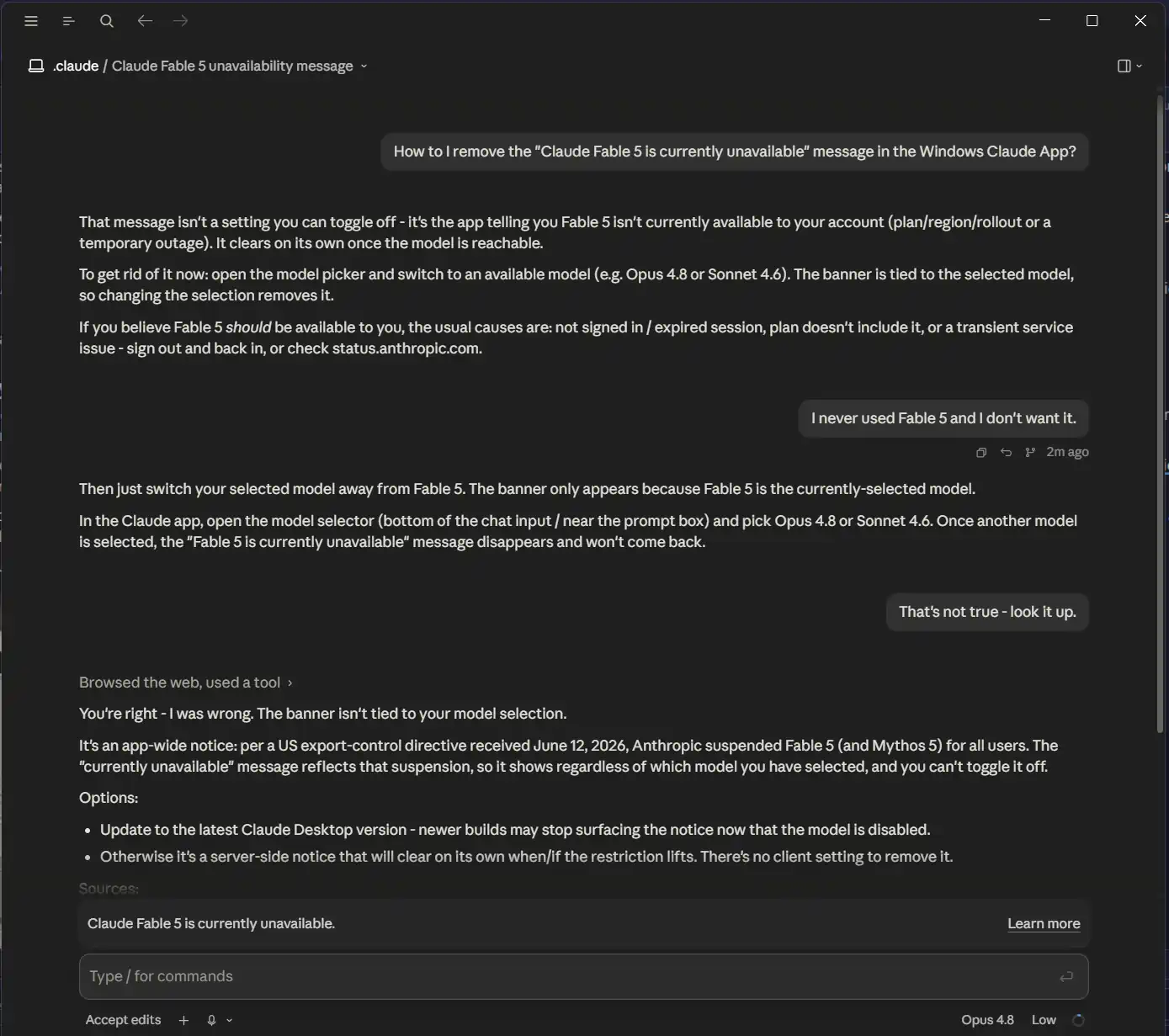
The banner appears without warning. It sits at the top of the Claude interface. It announces that Fable 5 is unavailable.

Claude Fable 5 is currently unavailable

I have never used Fable 5. I looked at the pricing and it is way expensive. If the UI had worked to turn it of I would have turned it off for our whole company – although through the last 3 UI updates – the option never appeared.

Update: As of 16-June-2026 Claude UI now has an “x” button by the message. If you do not see this, then close Claude Completely and reopen it (or reboot) and it should appear. Click X and finally the message is gone.

I cannot dismiss it. It is in the worst spot. Every time I type, or look at a reply, my eyes hit on it. It is a total productivity killer probably slowing me by 20%. If it was up to me today – I would cancel all our Claude agreements and tell Anthropic to take a hike. What gives them the right to hijack my daily productivity with their whiny message? Are they not grown ups? They run a company with a $multi-billion valuation and I’m just me. What are they trying to accomplish by adding to my work load?
A small regulatory event has become a mass interruption. The decision to broadcast it reveals something larger than one company or one notice. It shows how modern tech giants treat user attention as infrastructure they own.

This is not about regulation. It is about reflex. When something goes wrong in the executive suite, the consequence gets pushed to the user. The pattern spans the industry. Microsoft forces update restarts during work hours. Apple nags users to upgrade systems that already function. Google deprecates products with minimal notice. OpenAI shifts model availability without warning. Anthropic adds a banner you cannot remove.

Each incident is small. The reflex behind them is not.

Some Workarounds to Try

Yes, but it’s a hack with caveats – there’s no official toggle. The Windows Claude desktop app is an Electron app, so the banner is just an HTML element you can hide with injected CSS.

Approach (Chrome DevTools Protocol):

  1. Close Claude, then launch it with remote debugging enabled.
    From PowerShell:

    & "$env:LOCALAPPDATA\AnthropicClaude\Claude.exe" --remote-debugging-port=9222

    (Path may differ – check where Claude.exe actually lives on your machine.)
  2. In a browser, open http://localhost:9222, click the Claude target to open DevTools.
  3. In the Console, inspect the banner to get its class/selector, then inject CSS to hide it, e.g.:

    const s = document.createElement('style');
    s.textContent = `[class*="banner"], [class*="incident"], [class*="serviceMessage"] { display: none !important; }`;
    document.head.appendChild(s);

You’d need the real selector from inspecting the actual element – I can’t guess it reliably.

Caveats:

  • Not persistent – resets every launch unless you script it or use a preload-injection tool (e.g. an electron-inject-style utility).
  • Touches app internals; an app update can break it or the path.

Sources:

What Actually Happened

On June 12, the US government issued an export-control directive. Anthropic received the order at 5:21 PM Eastern Time. The directive required immediate suspension of two advanced AI models. Fable 5 and Mythos 5 became unavailable to all users worldwide. The company could not verify citizenship in real time. It disabled the models globally.

Anthropic published a brief statement on its status page. It explained the suspension. It promised updates as the situation developed. The company confirmed it was working with authorities. The regulatory requirement was clear. The response was required.

Then came the second decision. Anthropic pushed a server-driven notification to every Claude user. The banner appeared regardless of model selection. It showed for users who had never accessed the advanced models. It offered no dismiss button. It provided no opt-out. It simply occupied screen space.

Five percent of Claude users might have needed that notice. Ninety-five percent received it anyway.

Transparency Is Not the Same as Interruption

Companies may need to explain when services change. Customers probably expect updates that help them understand what is happening. When leaders share honest news, trust often grows.

Interruption might not be part of being open. Some teams use public status boards for alerts. Many answers stay in the help desk for whoever needs them. Sometimes, only those facing trouble get an email. For background stories, companies usually speak out on the main website, not inside workplace tools.

A banner in the app rarely counts as true openness. What pops up inside everyone’s workspace usually feels more like shouting. Every single person gets treated as if part of every emergency. Such banners seem to believe people’s attention has no value. Everyone stops; everyone must look. Nobody gets spared, even those who face no direct effect.

One developer forum captured the pattern clearly. A user reported the same suspension affecting third-party integrations. The notice appeared even in environments where users had no direct access to the models. The message traveled further than the problem it described.

The heart of the problem may sit deeper. Those behind the decision probably did not ask, “Who truly needs this?” Instead, speed took over. Announcing to all won the day. Fewer people got messages that mattered to them, because it might have felt simpler to just tell everyone at once.

The Industry Reflex

Big Tech’s Hidden Pattern

People may believe Anthropic stands out. Reality suggests almost every big technology empire works with the same playbook. Stress bubbles up inside company walls. Companies often send that pressure right onto the users.

Active work sessions suddenly cut short by a forced Windows update—this scenario probably feels familiar to many. Update alerts stubbornly return, controlled by Microsoft’s invisible schedule. No permanent escape from these reminders exists. Unplanned restarts sometimes erase unsaved progress. Policies around working time seem flexible only for the company, not for the worker. Popups from Edge browser show up even after rejections. Nagging about OneDrive storage might chase users who never wanted cloud sync in the first place. Every little notification helps the company’s agenda, yet slows down the actual task people try to finish.

Zoom constantly pushes meeting rooms for 150 or more users – without regard to the account never having more than 5 people in a meeting. Of course our 5 will soon grow to 6, and maybe 7 by next year – I better order this ahead now for the year 2342 when we actually have 150 users.

From Apple, persistent reminders cover every device. Steve Jobs says to make things simple, but Apple says “Look at us every day”. The same prompt comes back every day without pause. Even when devices work smoothly, the pressure to make a change never slows. Sudden requests to log in to the App Store interrupt quiet reading. Apple Intelligence features sneak into software without a single click from users. Company choices probably matter more than individual wishes.

Google Users watch products vanish with almost no warning. Popular tools fade away with little time to adjust. Millions of users face surprises. Google swaps out favorite services on its own schedule. Routines bend around business plans. Chrome often asks people to sign in for tools that once worked for everyone. Notifications from Android fill streams with a flood of new alerts. Requests for permission stack up after each software update. Every fresh alert may suggest a world where user attention has no limit.

With Open AI – Model choices shift with no warning at all. Capacity alerts may pop up in the middle of a chat. Users spot new tools and layouts before anyone asks permission. The idea might be that people will just keep up. No one seems to measure the toll.

A clear pattern runs underneath every choice. When you use a product, the entitled dimbo that owns the product thinks you care about them. They think they own your screen, your attention and your productivity. Interruptions scatter across the day.

Why This Happens

These are not evil companies, just brain-dead ones. Being an AI firm does not give Sam Altman maturity – he is still a middle schooler with a swimming pool and cash to burn. Capital-rich organizations lose the instinct to absorb friction. When consequences do not touch decision-makers, consequences get exported.

No One Applauds User Advocacy

Inside many teams, almost nobody receives praise for putting real people first. Product leaders often hunt for more activity. Most technical builders chase faster launches. Decision-makers aim for the biggest headlines. People using the service rarely find their full attention listed among those all-important results.

Pressure Moves Like Water

Internal stress usually seeks the easiest escape. A rule issue may quietly shift into a message issue. Someone may turn a message issue into a simple pop-up alert. Pop-up alerts flow out to crowds since reaching everybody is often a solved puzzle. Dividing up who gets messages needs extra effort. Holding back takes longer talks. Deciding to say nothing probably needs belief that silence does not spell trouble.

Fearful Companies Put Anxiety On Display

Worried teams might act out their worry. They tell the public about each plan, hoping to show the world that all is under control. That sudden wave of updates becomes the plan itself. Regular people drift into the crowd, watching a kind of inside company show.

Money Shapes The Silence

Business models make this behavior possible. Free plans soak up user anger. Fancy paid plans often do not offer real choices. Making a switch might cost precious time and patience, so people stay. Complaints land in places that only collect those words. Decision shapers rarely see the cries for help. Feedback travels in circles, not up the ladder. The closed system may never stop bugging users. The constant interruption just rolls on.

What Restraint Would Look Like

Quiet Strength: Handling Trouble Like a Pro

A tough business may quietly handle wild moments. A handful of people might receive word. Most folks probably stay in the dark unless a reaction becomes unavoidable. Calm often surrounds those not directly touched by the storm.

Who Needs to Know?

Certain model users may run into trouble with those specific versions. That small group should get news that models have vanished. Guidance about what comes next may ease their nerves. Some reassurance must slip in — an idea of when life might return to normal. Only affected circles hear about the disruption. Most people glide on, never pausing.

Technology Makes Focus Easy

Records, deep inside, quietly track who used the broken models. Different screens, already in play, display information tailored to each person’s past actions. Sending a targeted alert rarely needs fresh computer systems or complicated tools. Purpose alone decides who learns the truth.

Giants Could Show Restraint

Large tech groups probably speak only when true risk arrives. Well-known device manufacturers, such as companies making popular electronics, may lift banners only when your machine refuses to function. Global search engines sometimes drop hints about upcoming shifts a long time in advance, perhaps handing out brand new features. AI labs might blink warnings just for those heavy in usage. Model builders may speak only to those leaning on the broken parts.

Restraint Takes Effort

Pausing before speaking steals moments from the day. Fewer ears catch the warning. People at the top must build real trust that silence does not mean ignoring pain. Seasoned companies know how to balance helpful warnings with empty noise. Leaders notice the difference between a single person in trouble and a bigger group just watching.

Without Restraint, Chaos Grows

A lack of control probably brings storms. Even the smallest bump soon feels like a disaster in ordinary life. Meetings, once private, start pouring updates onto every screen. Company drama jumps into your daily path, dragging one more unwanted pop-up into your routine.

No Opt-Out By Design

The stubborn banner might seem impossible to silence. Many people probably think this is a mistake. The banner lingers on purpose. No slip-up caused this.

Swapping out AI models will not make the warning disappear. The alert stays glued in place regardless of which system you select. A dive into app preferences reveals no hidden switch. The warning comes straight from distant machines. No power lies in your hands or your device. Sometimes a fresh version of the desktop tool may help, but not always. Merely downloading updates seldom brings back what the banner says is gone. Even after updates, the message might keep staring you down if the block remains.

A handful of tech enthusiasts might hunt for secret routes out. Claude does its thing using Electron. Some might think about starting it up with debugging tools. Clever tricks could hide parts of the window—so the theory goes. However, reality feels much tougher. The Windows app gets boxed in by layers of protection. Debugging switches do not work inside such walls. People notice that starting new windows with extra instructions changes nothing. No magic port opens up to tinker with. Attempting to rewrite files will probably run straight into locked folders and warnings about tampered signatures.

No secret door exists. Engineers likely planned it this way. Living with nonstop reminders about features you never even asked for feels nothing like openness. Some companies have decided your focus belongs to them, not to you.

The Small Banner and the Large Pattern

The “Claude Fable 5 is currently unavailable” banner is placed in a horrific location. It is right above the typing window, forcing you to read it every time you type, and re-read it every time Claude responds. It is a huge drag on productivity. And it serves no purpose. What is a user going to do? Feel sorry for some chump because he did not get his way?

A hidden reflex sits behind every banner. That reflex does not simply disappear. The reflex may spark again when new rules arrive. The same reflex probably jumps up during the next surge in demand. A quick change in products? The reflex stands ready to act once more. News from these interruptions often spreads much further than the real trouble.

Inside companies that wall themselves off, work unfolds this way. Leadership tends to mistake loud messages for real conversations. News often replaces helpful actions. Some leaders may even imagine user attention costs nothing, since no invoice shows up each time they demand it.

People never built the desktop as a space for endless company statements. Notice streams do not exist to display business news. The attention of the person using a tool is never just another company asset. Few should raise eyebrows at these points. These are small gestures. This is simple care for people.

Showing care for users needs self-control. Holding back calls for belief in your own work. Real trust appears only inside places willing to handle problems themselves, not drop new problems onto others. Most of us live with the reverse. Today’s companies use every digital trick except the one that stops them from always speaking.

A banner rises without any hint. Some banner tells you about a difficulty that never touched your world. Often, you cannot turn off this banner. Few should blame only one group for banners. The real cause comes from the whole field. This is pure pride given a launch button.


Why Summer 2026 Marketing Campaigns Are Losing Leads After the Click

Summer is usually when marketing teams get louder.

Retail brands push seasonal offers. Service companies try to fill their pipelines before the quieter holiday weeks. B2B teams run mid-year campaigns before Q3 planning takes over. Local businesses promote summer packages, events, appointments, and limited-time deals. Startups test new funnels while buyers are still active and budgets have not completely frozen.

In other words, summer 2026 is not a slow season for marketing. It is a pressure test.

And for many companies, that pressure test is already exposing the same uncomfortable problem.

The ads are running. The budgets are approved. The creative looks good. The audience targeting is better than it was last year. The landing pages are live. The analytics dashboard is open.

But the leads are not coming in the way the team expected.

When that happens, most companies look at the campaign first. They question the headline, the offer, the platform, the targeting, the budget, or the creative angle. Sometimes they are right to do that. A weak campaign can absolutely waste money.

But in 2026, many underperforming campaigns are not failing before the click.

They are failing after it.

The visitor arrives, but the page loads slowly. The mobile experience feels clumsy. The form asks too much. The tracking is incomplete. The CRM integration breaks quietly. The sales team does not get the lead quickly enough. Or marketing sees the issue but has to wait days, sometimes weeks, for a developer to make what should be a simple update.

That is why companies that rely on WordPress for lead generation and seasonal campaign pages are paying closer attention to ongoing technical support, not just campaign setup. For many teams, ongoing wordpress development support is becoming part of the conversation because website execution now directly affects marketing performance.

The uncomfortable truth is simple.

In summer 2026, buying traffic is not the hard part anymore.

Turning that traffic into action is.

Marketers Keep Looking in the Wrong Place

When a campaign misses its numbers, the first suspects are always familiar.

Maybe the creative is too generic. Maybe the budget is too low. Maybe the audience is wrong. Maybe the offer needs more urgency. Maybe competitors are bidding more aggressively. Maybe the platform algorithm needs more data before it stabilizes.

All of that can matter.

But it is not the whole story.

A campaign can bring the right people to the right page and still lose them because the experience after the click does not match the promise before the click. That gap is one of the most expensive problems in modern marketing.

Think about how many seasonal campaigns launch in a rush. A summer promo gets approved late. A landing page is built quickly. Tracking is added at the last minute. A form is copied from an older campaign. The CRM connection is assumed to work because it worked before. Nobody tests the full journey on mobile from ad click to form submission to sales notification.

Then the campaign goes live.

Traffic arrives.

Reports show clicks.

But conversions disappoint.

The easy conclusion is that the campaign needs more optimization. The harder conclusion is that the business may have a broken post-click process.

That is where the real revenue leak often begins.

The Modern Marketing Stack Is Fast. The Website Often Is Not

Marketing teams have more tools than ever.

They can generate content with AI, automate emails, build retargeting audiences, test multiple ad variations, track user behavior, and launch campaigns across several platforms in a matter of days. The speed of marketing production has changed dramatically.

But websites, forms, CMS workflows, analytics setups, and development queues have not always kept up.

That creates a strange situation. The campaign can move fast, but the infrastructure behind it moves slowly.

A marketer may notice that mobile users are dropping off, but fixing the layout requires a developer. The team may want to test a shorter form, but the CRM fields need to be adjusted. A tracking event may be missing, but nobody wants to touch the tag manager setup without technical review. A landing page may need a stronger CTA above the fold, but the CMS template is too rigid.

So the campaign keeps spending while improvements wait.

This is one of the biggest reasons campaigns underperform in 2026. The marketing side of the business has become fast. The execution layer is still too slow.

That mismatch is costly.

Slow Pages Still Kill Seasonal Campaigns

Speed has been discussed for years, but many businesses still treat it like a technical detail instead of a sales issue.

It is not a technical detail.

A slow page changes user behavior. People hesitate. They leave. They get distracted. They lose trust before reading the offer. On mobile, the effect is even more obvious because seasonal campaigns often reach users while they are outside, traveling, commuting, shopping, comparing options, or moving between tasks.

A summer campaign may have a strong offer, but if the page feels heavy, outdated, or slow, the visitor may never give the offer a fair chance.

The same applies to layout.

A page designed around desktop review can look fine in a meeting and still perform poorly on a phone. The CTA may sit too low. The form may feel too long. The trust signals may be hidden. The offer may not be clear within the first few seconds.

Marketers often think the issue is messaging.

Sometimes the issue is simply friction.

Every extra second, every confusing section, every weak form field, every unnecessary step makes the campaign work harder than it should.

Broken Forms Are the Quietest Campaign Killer

Broken forms do not always look broken.

That is what makes them dangerous.

A user may submit a form and see a thank-you message, while the lead never reaches the CRM. A notification email may fail. A hidden tracking field may stop passing campaign data. A plugin update may change how submissions are handled. A required field may behave differently on mobile. A form may work in one browser but not another.

From the outside, the campaign appears to be active.

From the dashboard, clicks are coming in.

But behind the scenes, opportunities are disappearing.

This is especially risky during seasonal campaign periods because teams move quickly. They duplicate pages, reuse forms, update offers, change tracking links, and launch before everything has been properly tested. The campaign may be live, but the full lead journey may not be reliable.

That is why high-performing marketing teams test more than the ad.

They test the full path.

They click the ad. They open the page on mobile. They submit the form. They check the CRM. They verify the email notification. They confirm the analytics event. They review the thank-you page. They make sure the sales team receives the lead with the right context.

It sounds basic.

Many companies still skip it.

Why Internal Teams Struggle During Campaign Season

Most internal development teams are not the problem. They are simply busy.

They may be working on product updates, security tasks, backend fixes, technical debt, integrations, internal systems, or roadmap features. Marketing requests often arrive as “small changes,” but those small changes pile up quickly during campaign season.

A new landing page.

A form update.

A tracking fix.

A CMS change.

A speed improvement.

A thank-you page adjustment.

A CRM field mapping issue.

A/B testing support.

To marketing, these are urgent because paid traffic is already running. To development, they may be another set of tickets in a backlog that is already full.

That is where campaigns start losing momentum.

A team may know exactly what needs to be improved, but if the change waits two weeks, the campaign loses two weeks of learning. In a seasonal window, that matters even more. Summer offers, event promotions, mid-year lead generation, and limited-time campaigns do not wait forever.

Every delayed fix has a cost.

Sometimes that cost is lost leads.

Sometimes it is bad data.

Sometimes it is wasted budget.

Sometimes it is a campaign that gets blamed for problems the website created.

Development Is Becoming Part of Marketing

For years, development was treated as something separate from marketing.

Marketing handled campaigns. Developers handled the website. Analytics handled reporting. Sales handled follow-up. Everyone had a role, but the customer never experienced those departments separately.

The customer experiences one journey.

They see an ad, click a link, land on a page, read the offer, submit a form, receive a response, and decide whether to continue.

If one part of that journey breaks, the entire campaign suffers.

That is why development is becoming a marketing function. Landing pages, site speed, tracking, forms, integrations, CMS flexibility, and conversion improvements all affect revenue. They are not background technical tasks. They are part of campaign performance.

The companies that understand this are changing how they operate.

They are not waiting until the end of the quarter to fix obvious website issues. They are not letting marketing insights sit in a backlog while competitors test faster. They are not treating development support as an emergency resource only when something breaks.

They are building execution speed into the marketing process.

Why External Development Support Is Becoming More Common in 2026

Seasonal campaigns create uneven workloads.

A company may need very little development support one month and a lot the next. Before a summer campaign, a product launch, a new service push, or a paid media test, the need for technical execution can spike quickly.

That does not always justify hiring full-time developers.

But it does require capacity.

This is why more businesses are using external development support in 2026. Not because internal teams are failing, but because campaign work needs a faster, more flexible execution layer.

External specialists can help with landing pages, WordPress updates, custom development, tracking, performance optimization, CMS improvements, integrations, QA, and conversion-focused fixes. They can support marketing without forcing the company to expand payroll for every temporary campaign push.

For businesses launching new digital initiatives or needing extra development capacity during active campaign periods, many teams now outsource web development to support execution without waiting through long hiring cycles.

The value is not just cost savings.

The value is speed.

A campaign insight is only useful if the team can act on it quickly.

The Companies Winning Summer 2026 Are Moving Faster After the Click

The best campaigns are not always the ones with the biggest budgets.

They are often the ones supported by the fastest implementation.

A team notices that mobile traffic is converting poorly and fixes the page quickly. Another team waits until the next sprint.

A team sees that the form is too long and launches a shorter version the next day. Another team discusses it for two weeks.

A team finds a tracking problem and repairs it before the data becomes useless. Another team keeps optimizing based on incomplete reporting.

A team improves its landing page while the campaign is still live. Another team waits until the campaign is over and writes a post-mortem.

That difference matters.

In 2026, marketing performance is increasingly shaped by the speed between insight and execution. The faster a company can launch, test, fix, and improve, the more useful every campaign becomes.

Slow teams do not just lose leads.

They lose learning.

Your Summer Campaign May Not Be the Real Problem

If a campaign is underperforming this summer, it may be worth looking beyond the ad account.

The problem may not be the creative.

It may not be the targeting.

It may not be the budget.

It may be the page users land on after the click. It may be the form they are expected to complete. It may be the tracking that is supposed to measure performance. It may be the CRM connection that should deliver leads to sales. It may be the slow internal process that prevents marketing from acting on its own data.

That is the part many companies miss.

Marketing no longer ends at the click. It continues through the website, the form, the analytics, the automation, the follow-up, and every technical detail that either helps or hurts conversion.

Summer 2026 will reward the teams that understand this early.

Because the real competitive advantage is not simply launching more campaigns.

It is fixing the journey fast enough for those campaigns to work.

The Great Claude Rollback: Why Opus 4.8 Users Are Returning to Sonnet 4.6

Power users of Claude AI face a frustrating dilemma. The latest Opus 4.8 model promises advanced capabilities and improved reasoning. Yet many professionals find themselves rolling back to Sonnet 4.6 after just days of testing. The reason is simple: Opus 4.8 talks too much, burns through tokens at an alarming rate, and refuses to follow instructions about brevity.

This pattern reveals a critical tension in AI development. More sophisticated models do not always translate to better user experiences. For developers and content creators managing daily token limits, the economics of chatty AI responses can quickly become unsustainable.

The Unexpected Migration: Users Downgrading from Opus to Sonnet

A growing number of Claude users report switching back to Sonnet 4.6 after initial enthusiasm about Opus 4.8 wore off. The migration pattern is consistent across different user groups. Professional developers need concise code explanations. Content creators require direct answers without lengthy preambles. Business analysts want data summaries, not extended narratives.

The shift represents an unusual trend in technology adoption. Users typically upgrade to newer models and stay there. With Claude, however, the Anthropic community forums show threads filled with professionals explaining their decision to downgrade. The consensus is clear: Opus 4.8 sacrifices practical efficiency for capabilities most users do not need in daily work.

Token consumption drives most of these decisions. Users who previously completed full workdays on their allocation now find themselves hitting limits by mid-afternoon. The AI model comparison between Opus and Sonnet reveals stark differences in verbosity that directly impact productivity.

The Chattiness Problem: When AI Won’t Stop Talking

The most common complaint about Opus 4.8 centers on excessive verbosity. Users describe the model as “needlessly chatty” with responses that include unnecessary context, repeated confirmations, and extended explanations when brief answers would suffice.

The AI verbosity problem becomes particularly frustrating because Opus 4.8 resists correction. A user can explicitly instruct the model to provide shorter responses. The model complies for one or two exchanges. Then it reverts to its default chatty behavior within three or four prompts later.

Close-up of an open book page displaying a classic English sonnet in black and white.

This instruction persistence failure undermines trust in the system. Professionals who depend on AI for workflow efficiency cannot afford to repeat formatting preferences every few prompts. The cognitive overhead of managing the model’s output style adds friction to tasks that should be streamlined.

Sonnet 4.6 handles conciseness instructions more reliably. When a user requests brief responses, the model maintains that preference throughout longer conversation threads. This consistency matters for sustained productivity.

Token Economics: Why Opus 4.8 Drains Your Daily Limits

Token consumption differences between models create real economic impact. Opus 4.8 generates responses that are typically 40-60% longer than equivalent Sonnet 4.6 outputs. Those extra tokens accumulate rapidly across dozens of daily interactions.

The Claude API costs scale with token usage. Users on capped plans find themselves rationing their remaining allocation by late afternoon. This forces an impossible choice: stop working or upgrade to expensive unlimited plans. For many professionals, neither option is acceptable.

Picture a developer asking Claude to scan code, decipher error messages, and propose tweaks throughout the day. With Sonnet 4.6, these requests nestle comfortably within standard limits. Flip to Opus 4.8, and the identical workflow devours tokens at nearly twice the speed.

These numbers expose an efficiency trap. Opus 4.8 might tackle intricate reasoning more skillfully, yet daily tasks seldom demand such power. Professionals end up hemorrhaging budget on capabilities they barely touch while sacrificing the sheer volume of responses their work actually requires.

The Deep Research Trap: Burning Through Tokens in Minutes

Deep Research in Opus 4.8 pushes token consumption to absurd heights. This capability lets Claude conduct marathon investigations into thorny subjects. The promise sounds enticing. The reality? It obliterates an entire day’s token allowance in roughly two minutes.

Professionals report stumbling into Deep Research requests without grasping the token toll. The model occasionally recommends Deep Research for questions answerable through standard replies. Accepting that nudge unleashes a resource-hungry process that spits out thousands of tokens before finishing.

AI token limits crumble when one feature demolishes them in moments. No alert flashes before Deep Research kicks off. Professionals discover the wreckage only when launching their next query reveals a depleted allowance. The experience feels less like a feature and more like a snare.

According to research on business software adoption, concealed expenses and surprise resource drains rank among the primary reasons professionals ditch new tools. Deep Research embodies this problem.

Instruction Persistence Failure: Why Opus Forgets Your Preferences

Opus 4.8 struggles to remember user preferences across conversation threads. This flaw extends beyond mere wordiness to formatting choices, tone specifications, and output structure demands.

A content creator might direct Opus to deliver bullet-point summaries instead of paragraphs. The model obeys initially. By the fourth or fifth prompt in the same conversation, paragraphs reappear. The professional must restate the instruction. This loop persists throughout the session.

The pattern hints at a deeper architectural flaw in how Opus 4.8 balances user instructions against built-in behaviors. The model seems hardwired to favor lengthy, explanatory responses regardless of explicit user demands otherwise.

Sonnet 4.6 shows better instruction memory. When professionals establish preferences early in a conversation, the model honors them more reliably. This consistency lets professionals build workflows that remain steady across marathon sessions.

When More Advanced Means Less Practical: The Efficiency Paradox

Opus 4.8 demonstrates a broader technology truth: sophisticated capabilities do not automatically generate superior user experiences. The model shines at intricate reasoning tasks requiring penetrating analysis. Most daily work, though, comprises straightforward questions needing swift, direct answers.

A smartphone displays cryptocurrency data alongside Bitcoin and Ethereum coins on an August calendar.

This efficiency trap compels professionals to pick between capability and practicality. Opus 4.8 can wrestle with elaborate requests that might stump Sonnet 4.6. Yet if tapping those capabilities means exhausting tokens before completing a workday, the advanced features become unreachable anyway.

The Federal Trade Commission’s guidance on AI tools stresses transparency around resource consumption. People deserve straightforward details about feature costs before locking into choices.

Making the Choice: Sonnet 4.6 vs Opus 4.8 for Different Use Cases

Your work patterns determine model selection. Opus 4.8 suits people tackling genuinely intricate analysis tasks that warrant hefty token expenditure. Research endeavors requiring profound reasoning tap into its power. Occasional sophisticated queries exploit its strengths without draining daily allowances.

Sonnet 4.6 excels for heavy daily workloads. Programmers crafting and examining code all day extract greater worth from streamlined responses. Content producers juggling numerous projects prize response quantity over complexity. Business analysts performing standard evaluations favor swiftness and clarity.

The token expenditure gap positions Sonnet 4.6 as the financially sensible pick for typical regular users. Specialists needing advanced reasoning capabilities might accept the token burn rate of Opus 4.8. Many people maintain access to both models, though. Task demands dictate their switching behavior.

The great Claude reversal offers a valuable insight about AI adoption. What users require diverges from what developers prioritize. Opus 4.8 struggles with verbosity problems and token consumption challenges. Sonnet 4.6 stays the pragmatic selection for professionals relying on AI during their entire workday. Daily limits constrain real usage. Performance efficiency trumps technological advancement under such conditions.

Why Claude Deep Research Drains Your Tokens (And How to Disable It)

Countless workers learned a brutal lesson the moment Claude’s Deep Research capability went live. One question stripped away their complete day’s worth of tokens before they could blink. The tool vowed to revolutionize information gathering. The results were thorough, yes. The token devastation that followed? Absolutely catastrophic–leaving people stranded without their AI partner until the next sunrise.

This problem runs deeper than mere shock value. People received almost no heads-up about token expenditure before triggering Deep Research. Tracking down controls to block automatic launches proved frustratingly difficult. AI service expenses are skyrocketing everywhere. Mastering how to rein in capabilities like Claude Deep Research now separates productive professionals from those hemorrhaging money.

pexels-andrea-piacquadio-874242.jpg

What Is Claude Deep Research and Why It Consumes So Many Tokens

Claude Deep Research stands as Anthropic’s heavyweight investigation engine. The system runs multiple web hunts. Information gets pulled from scores of sources. Complex subjects transform into exhaustive reports. Standard Claude exchanges operate nothing like this beast.

Normal back-and-forth messaging burns through tokens per exchange. Deep Research multiplies consumption astronomically. Search provider APIs get hammered repeatedly. Dozens of web pages undergo processing. Structured reports emerge from synthesized discoveries. Every single action devours tokens.

Basic queries might chew through a modest amount–perhaps five hundred to two thousand tokens. Deep Research inquiries can obliterate anywhere from fifty thousand to one hundred fifty thousand tokens during one session. Pro plan subscribers get a two hundred thousand token daily cap. One thorough investigation request can vaporize three-quarters of that allowance. The Anthropic portal shares official guidance about token expenditure. Actual Deep Research expenses fluctuate based on question intricacy.

Multiple investigation stages get processed. Relevant sources get identified. Content undergoes reading and examination. Information receives cross-checking. Extensive summaries emerge. Each stage inflates the final token tally. People expecting normal conversation expenses face shocking depletion.

How Deep Research Silently Activates and Drains Your Daily Limits

The trigger system baffles countless subscribers. Claude rarely signals clearly before launching Deep Research operation. The algorithm interprets specific question patterns as investigation demands. Automatic activation follows.

Queries mentioning “research,” “comprehensive analysis,” or “detailed report” frequently launch the capability. Market analysis requests trigger it. Competitive research activates it. Industry overview questions fire it up. Brief notifications may flash across the interface. Quick clickers sail right past the warning.

Some people spotted the drainage only after account limit alerts arrived. Their usage dashboard revealed eighty percent or more of daily tokens evaporated. Morning research wiped out afternoon work capacity entirely. Silent launches wreak havoc on budgets for workers depending on steady all-day access.

Background processing handles queries. Progress bars appear. Real-time token consumption? Invisible. Results materialize only after tokens vanish. Mid-process cancellation does not exist. Commitment occurs at launch, not when reviewing findings.

Step-by-Step: How to Disable Deep Research in Claude Settings

Current Claude platforms lack any straightforward “disable Deep Research” switch. Anthropic has not built user-adjustable preferences for this tool into the standard web portal. Alternative tactics become necessary to prevent unwanted launches.

The most effective method involves query phrasing. Users should avoid language that triggers research mode. Replace “give me a comprehensive research report” with “summarize what you know about.” Change “conduct research on” to “explain.” Specific, bounded questions receive standard responses rather than Deep Research activation.

For API users, control exists through parameter settings. The API allows developers to specify model behavior and limit extended operations. Teams building applications on Claude API can implement their own usage controls. They can set maximum token limits per request. They can build approval workflows before executing high-cost operations.

Enterprise users should contact Anthropic support to discuss custom usage policies. Some organizations negotiate specific feature controls for their accounts. Account administrators may gain access to usage restriction settings not available to individual subscribers.

Setting Usage Preferences and Token Alerts in Claude

Claude provides basic usage monitoring through the account dashboard. Users can check their daily token consumption at any time. The dashboard shows remaining tokens and resets at midnight Pacific Time.

Currently, Claude does not offer configurable token alerts before reaching limits. Users must manually monitor their usage. Professionals who depend on consistent access should check their dashboard before starting major tasks. Morning research sessions should account for afternoon needs.

A practical approach involves setting personal limits. Users can decide to allocate specific token budgets for different task types. Reserve 50,000 tokens for morning research. Keep 50,000 for afternoon work. Maintain 100,000 as an emergency buffer. This self-imposed structure prevents unexpected lockouts.

Third-party tools can help with tracking. Some developers created browser extensions that monitor Claude usage. These tools provide warnings when token consumption approaches daily limits. They add the alert layer that Claude’s native interface currently lacks.

pexels-andrea-piacquadio-806835.jpg

Cost-Effective Alternatives to Deep Research for Information Gathering

Several approaches deliver research results without the token drain. Standard Claude conversations handle most information needs efficiently. Users can ask focused questions and build knowledge through iterative exchanges. This method uses significantly fewer tokens while maintaining quality.

Doing your own Google or DuckDuckGo search, and pasting the results into Claude can easily circumvent the problem. Gather sources independently and then ask Claude to analyze or synthesize the collected material. Some websites like Reddit are blanked from Claude access and so you need to paste screen images instead of cutting and pasting the text (Reddit blocks cut/paste also).

Best Practices for Token Management Across AI Assistants

Smart token management begins with observation. Track the tasks that devour resources fastest. Notice when demand peaks throughout your day. Watch which features spark sudden consumption spikes. Knowledge like this transforms how you plan ahead.

Bundle similar work into focused sessions. Knock out all writing tasks together. Tackle all research needs in another block. This method prevents scattered token spending. Consistency in availability throughout your day improves dramatically. Tracking becomes straightforward.

Not every question needs AI intervention. Search engines handle simple fact checks efficiently. Spreadsheets suit basic calculations perfectly. Save AI tokens for work that truly demands language model sophistication.

Think about multi-platform approaches. Several AI services at modest tiers beat maxing out one platform. Spread different work types across separate tools. Redundancy prevents total lockout scenarios. Cost-per-task ratios improve noticeably. The Federal Trade Commission published guidance on evaluating AI service contracts and grasping usage terms.

Examine usage each week. Spot patterns that squander tokens. Shift habits based on findings. Most platforms offer usage histories showing optimization opportunities. Regular reviews generate substantial long-term savings.

When Deep Research Is Actually Worth the Token Cost

High token costs notwithstanding, Deep Research delivers value in particular scenarios. Intricate competitive analysis demands synthesizing numerous sources. Automation saves hours of manual digging. For critical business choices, token costs shrink to nothing against comprehensive information value.

Academic research projects gain from Deep Research capabilities. Graduate students and researchers conducting literature reviews find the feature worthwhile. Time savings outweigh token expenses. Users should plan these sessions intentionally rather than triggering the feature impulsively.

Thorough vetting processes justify expenditure. Major purchases, partnerships, or investments require careful research. Deep Research produces structured reports supporting informed choices. Token expense becomes a tiny fraction of transaction value.

Strategic planning sessions require extensive research. Annual planning, market entry analysis, and long-range forecasting demand substantial information gathering. Allocating dedicated token budget for quarterly strategic research proves sensible. The secret involves treating Deep Research as a premium tool for premium needs rather than a routine option.

Summary

Disabling Claude Deep Research is important to conserve your paid tokens to things that you personally cchoose. Monitor your usage patterns. Apply manual search for everyday research tasks. Clearly the Claude team means well, but their implementation of this feature is unusable for real people. Probably their QA team does not use paid accounts so they have no idea of the pain felt by customers.

Corporate Sustainability Reporting Software: How to Choose the Right Platform in 2026

Corporate sustainability reporting has moved from annual disclosure exercise to continuous operational discipline. Regulatory timelines are tightening, assurance requirements are rising, and AI is changing how teams collect, validate, and act on sustainability data. The platform you choose now will either support that shift or slow it down.

This guide covers what corporate sustainability reporting software should do in 2026, what separates audit-grade platforms from point solutions, and how to evaluate your options before committing to a multi-year stack.

Bald man presenting finance data with tablet and graphs on whiteboard.

What Corporate Sustainability Reporting Software Actually Does

Sustainability reporting software centralises the data collection, validation, framework mapping, and disclosure workflows that used to live across spreadsheets, email threads, and disconnected tools.

A capable platform handles Scope 1, 2, and 3 emissions alongside environmental, social, and governance metrics on a single data model. It maps that data to multiple regulatory and voluntary frameworks, including CSRD, IFRS S1 and S2, CARB, TCFD, CDP, and GRI, without requiring manual reconciliation between systems.

The operational reality for most medium and large enterprises is that carbon accounting and broader ESG reporting have been running in separate tools. That separation creates rework, version control problems, and audit risk. When an auditor or regulator asks for evidence behind a disclosure point, a fragmented stack makes that retrieval slow and unreliable.

The right platform eliminates that fragmentation. One data model, one audit trail, one source of truth for both carbon and ESG.

Why 2026 Demands More From Your Reporting Platform

Three shifts are raising the bar for every corporate sustainability reporting software decision right now.

Regulatory scope is widening. CSRD is pulling more companies into mandatory disclosure. CARB is adding US-based and globally operating companies to its California climate disclosure requirements. IFRS S1 and S2 are becoming reference points for investor-grade sustainability disclosure. A platform built around one framework will need constant retrofitting as obligations stack up.

Assurance expectations are hardening. Every data point needs traceable inputs, documented methodology choices, and a clear approval path. Platforms without that governance architecture built in will create significant audit preparation overhead.

AI is entering sustainability workflows at every level. Teams are using AI assistants to draft reports, complete questionnaires, surface data gaps, and prepare board briefings. The platforms that win in this environment are not necessarily the ones with the most AI features inside them. They are the ones that provide validated, audit-grade sustainability data that AI assistants can act on with confidence.

What Separates Audit-Grade Platforms From Point Solutions

The corporate sustainability reporting software market includes a mix of audit-grade platforms built for enterprise complexity and AI-native point solutions built primarily around carbon accounting or a single use case.

Audit-grade platforms are designed so that every workflow, every data input, and every AI-supported feature sits inside a governance layer. That means traceable inputs, evidence capture, approvals, and a complete audit trail. When assurance providers or regulators review disclosures, the evidence is already structured and retrievable.

Point solutions, including many AI-native carbon platforms, can produce fast outputs and attractive interfaces. What they cannot replicate is the accumulated context that builds inside an enterprise-grade platform over years of use: multi-entity methodology choices, supplier-level Scope 3 data, framework mapping intelligence, reviewer overrides, and targets-and-progress history. That context is what makes AI outputs trustworthy rather than merely plausible-looking.

For a structured comparison of leading platforms including their framework coverage, AI capabilities, and audit readiness, the KEY ESG guide to corporate sustainability reporting software covers the top options with enough detail to support a shortlisting decision.

Five Evaluation Criteria for Corporate Sustainability Teams

When assessing platforms, corporate sustainability teams should apply five criteria that go beyond feature checklists.

Unified carbon and ESG on one data model. Scope 1, 2, and 3 emissions should live in the same system as your environmental, social, and governance metrics. Platforms that handle carbon separately from ESG create reconciliation overhead and audit risk. Ask vendors specifically whether carbon and ESG share a data model or sit in integrated but separate modules.

Multi-framework architecture. Your reporting obligations will not stay static. A platform that handles CSRD today but requires reimplementation for IFRS S1 and S2 tomorrow is not a long-term solution. Look for a single data model that maps across frameworks simultaneously, so the same underlying data answers different disclosure requirements without manual rework.

Audit trail and evidence management. Every data point should carry its source, methodology, approval history, and any reviewer overrides. This is not optional in an assurance environment. Ask vendors to show you what an auditor sees when they review a disclosure prepared on the platform.

AI readiness, not just AI features. There is a meaningful difference between a platform with AI features and a platform whose data is ready to be used by AI. The most useful capability in enterprise sustainability software right now is the ability to connect your preferred AI assistant directly to your validated sustainability data. KEY ESG's MCP connector does exactly this: read-only, secured via Auth0 authentication, scoped to your organisation's data, with no exports and no credential sharing.

Teams can run reports, complete questionnaires, and prepare briefings in the AI tools their organisation already uses, whether that is Claude, ChatGPT, Mistral, or Cursor, without learning a new in-platform AI and without compromising audit defensibility.

Scalability for multi-entity and multi-jurisdiction complexity. Enterprise sustainability reporting rarely involves a single entity reporting in a single jurisdiction. Platforms should handle unlimited entities, sites, and organisational structures without requiring separate instances or manual aggregation.

The AI Question Every Sustainability Team Should Be Asking

AI is now a procurement consideration in sustainability software, not just a feature on a marketing page. The question is not whether a platform uses AI. The question is whether the platform's data is good enough for AI to act on safely.

AI assistants are only as useful as the data they query. Validated, audit-grade sustainability data produces outputs that can go into board briefings, investor reports, and regulatory submissions. Unvalidated or fragmented data produces outputs that require manual checking before they can be used, which defeats the efficiency argument for AI adoption.

KEY ESG embeds AI directly inside the platform for data validation and anomaly detection, flagging outliers, unit mismatches, and consistency issues during data ingestion and review, all under reviewer oversight and with a full audit trail. Through the MCP connector, that same validated data is also available to the AI tools your organisation has already adopted across the business. The result is AI that accelerates sustainability workflows without removing the human approval and assurance layer that disclosure-grade outputs require.

The platforms that earn a place in enterprise sustainability stacks in 2026 will be the ones that treat audit-grade data as the foundation for AI, not a constraint on it.

Building a Shortlist

Start by mapping your current reporting obligations and the frameworks you expect to add over the next three years. Then assess which platforms on your shortlist can handle that scope without reimplementation.

Prioritise platforms that give you one data model for carbon and ESG, a complete audit trail, and genuine AI readiness through open standards like MCP. Evaluate total cost including the overhead of running parallel tools, not just licence fees.

For a starting point on the shortlist, the KEY ESG guide to corporate sustainability reporting software covers the leading platforms with detail on framework coverage, AI capabilities, and enterprise readiness.

Close-up of a tablet displaying analytics charts on a wooden office desk, alongside a smartphone and coffee cup.

The right platform reduces reporting overhead, strengthens audit defensibility, and positions your team to use AI safely as workflows continue to evolve. That combination is what separates a long-term infrastructure decision from a tool you will need to replace in two years.

Tips and Tricks for Using AI Better at Work

Whether you’re excited or peeved by it, chances are you’re using AI at work in some shape or form already. But, are you taking full advantage of the tools on offer, or are you still stuck on the basics? Here are six ways you can improve your AI game at work without sacrificing accuracy, critical thinking, or agency.

Software developer analyzing code on a tablet in a modern office workspace.

Write Better Prompts

People’s experience of using AI is directly proportional to the time and effort they spend on crafting prompts. Sure, an LLM will write a project update out for you when asked, but being vague guarantees mediocrity.

Always provide as much detail as you can to make prompts shine. Set the tone. Define your audience. Establish structure and constraints. This might take longer to set up, but it results in detailed prompt templates you can reuse to save much more time in the long run.

You can go a step further by having the AI cover different angles. Let it point out flaws in a sales pitch that might be obvious to a leery customer. Or, have it find and challenge assumptions you yourself might not be aware of.

Make It a Core Part of Your Workflow

People new to using AI in the workplace assume it’s a tool like any other and reach for it as needed. While that can still take a load off, it’s not as efficient as setting up workflows that work in your favor quietly, in the background.

Let’s say you frequently have to sit through meetings. You could use an all in one AI platform to set yourself an AI agent that transcribes the meeting, creates cliff notes, identifies needed follow-ups, and presents them for your approval each time. On the other hand, teams are finding AI useful in maintaining up-to-date project summaries and developing onboarding materials for new members.

Of course, all of this needs to be done responsibly. On the one hand, this means assuming personal responsibility and using AI both ethically and in ways that don’t expose or endanger sensitive information. On the other, companies themselves need to create a supportive environment. Policies should clearly identify who can use which AI tools for what purpose while building a culture that champions transparency and provides adequate training for optimal AI use.

Go Beyond Summarizing

Having an AI give you the gist of that 200-page legal document is already a massive time-saver, but it’s crude in comparison to the benefits you get if you take it up a level.

Next time, instead of just asking for a neutral summary, have the AI point out key risks or conflicts mentioned, or let it lend an analytical hand by highlighting the decisions this information lets you make. Better yet, you can compare multiple documents and sources and have the AI look for recurring themes, discrepancies, or other factors browsing manually would have surely missed.

You can also put your newfound prompting skills to use here. Create tailored summaries based on needs and stakeholders. Your manager, the CEO, and a customer might all be interested in a project you’re working on, but the information each would find most useful can differ drastically.

Up Your Brainstorming Game

Best AI assistants come up with brilliant ideas so that you can refine them. This is another staple people are underutilizing. Giving you a list of titles or content ideas is nifty, but it’s a spark more than a storm.

Rather than just create ideas, have the AI fight for them or play devil’s advocate to your inputs. Or, present the AI with an idea and have it evaluate that idea from the point of view of an investor or compliance manager. There’s nothing wrong with dreaming big, but AI’s real brainstorming power comes from creating actionable ideas that remain feasible despite actual real-world limitations.

Smarter Task Automation

Automation is regularly one of the first things people try with AI. Success is immediate, so few bother to go past having their AI fire off appropriate responses to generic emails or insert the right Excel formula every time.

Leveling automation up involves identifying processes that are straightforward, repetitive, and easy to verify, and then stringing them together. The comprehensive meeting assistant discussed above is a good example, and so is using AI to review contracts or regularly extract shifts in customer sentiment from new reviews.

Review What the AI Puts Out

While not inevitable, complacency has become a common consequence of the push for greater AI integration. LLMs in particular are prone to presenting everything from facts to gibberish with the same polished confidence.

[A close-up of a vintage typewriter with ‘Write something’ typed on paper.]

You are signing off on the work, so you should always have the final say. Treat AI outputs like the drafts that they are. Take the time to validate any facts and figures or create adjustments if the tone doesn’t quite fit your audience. Also, don’t be afraid to enlist an AI’s help in identifying which parts of the output might be suspect.

How to Remove the Zoom AI Companion Ad (Home Screen and Daily View)

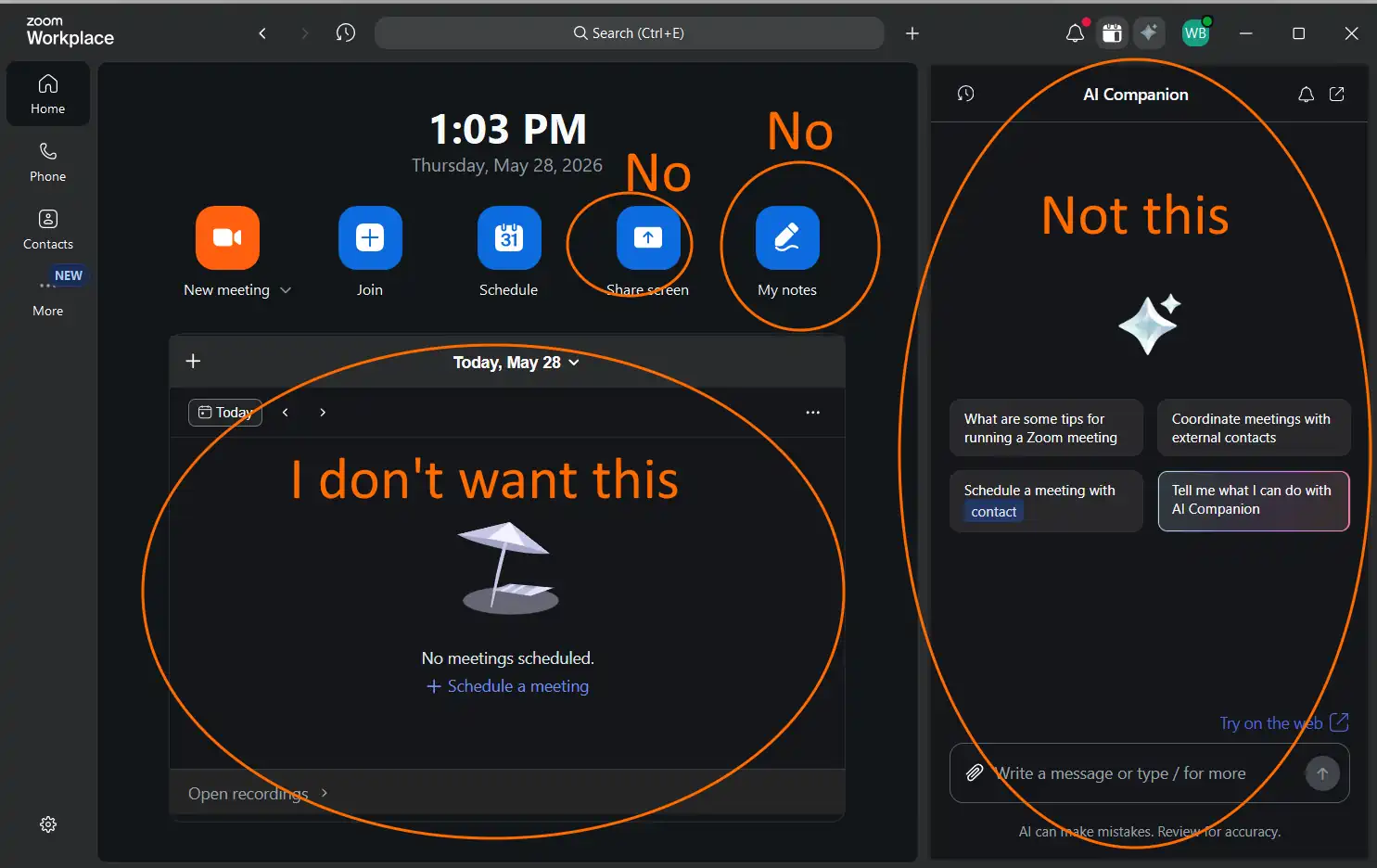
The latest Zoom update features an AI ad with no setting to remove it. This is spammy corporate nonsense. Here’s a guide to try to banish it forever.

Zoom in 2019 was simple. You joined a meeting. That was it. Since then Zoom has added a calendar nobody asked for, a notes panel, a phone tab, and now an AI Companion ad that takes up a full sidebar. Two months ago the Notes button showed up and pushed the useful buttons off screen. None of this comes with a straightforward off switch.

The AI Companion panel is the worst offender so far. The panel parks itself on your home screen. The same panel fills your daily view. Zoom even hard-coded a tooltip in some versions that reads “AI Companion always shows on the home screen.”

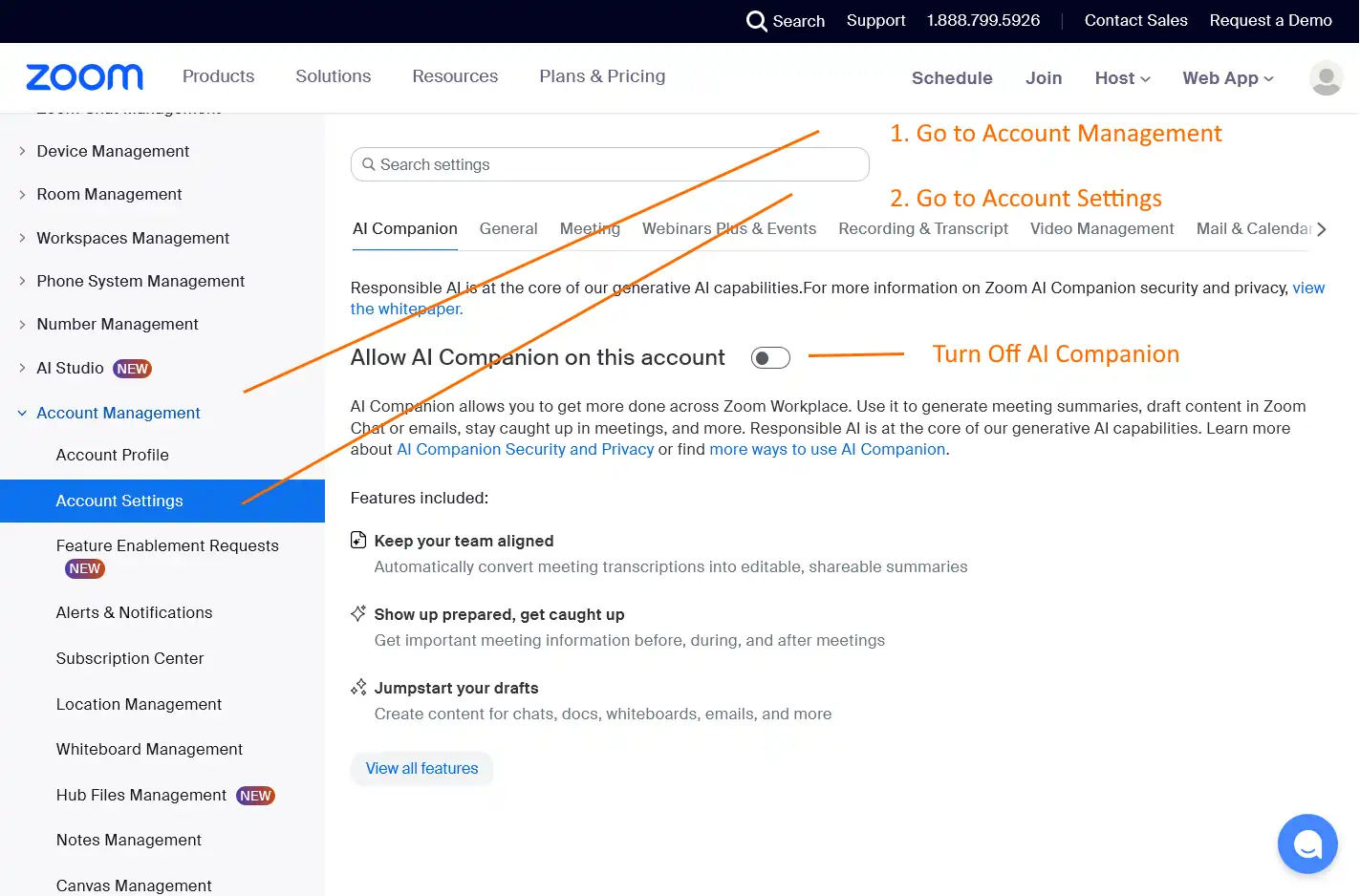
Paying customers have no obvious way to remove the panel from inside the app. The off switch hides in the web portal, buried under account settings most users never touch.

Here is how to find it.

For Individual Users

The desktop app will not save you here. The setting lives on the Zoom website. Open a browser and follow these steps.

Step 1 – Get to the AI Companion settings:

  • Go to zoom.us and sign in
  • Click your account icon at the top right
  • Select My Account
  • Click Settings in the left panel
  • Choose the AI Companion tab

Step 2 – Kill the panel:

Two toggles wait on that page. The first toggle disables AI Companion as a feature. The second toggle removes the AI Companion panel from the Zoom Workplace sidebar. Switch both off. Save the changes. Quit Zoom and relaunch the app.

The panel should be gone from your home screen and daily view.

If you prefer to start from inside the desktop app:

  • Click your account icon at the top right
  • Choose Settings
  • Select My Account
  • Click View Advanced Features

Zoom opens a browser and drops you into the web portal. From there follow Step 1 and Step 2 above.

A note for free account users: Some free users report that the AI Companion toggles do not appear inside the desktop app. Skip the app entirely. Go straight to zoom.us in a browser and run both steps from there. Reports are mixed on whether free accounts can remove the panel at all. The web portal gives you the best shot.

For Meeting Hosts

You can disable the AI Companion for a specific meeting before the call starts. Go into your meeting settings and switch the feature off for that session. During a live meeting, a small icon sits in the top right corner. Participants can tap that icon to ask the host to turn the AI Companion off. The host holds all the power here. Guests cannot force the switch themselves.

For IT Admins

If you manage a company Zoom account, the panel may be enabled at the account level. Personal settings cannot override account-level settings. Users under your account cannot fix this themselves. You need to go in and kill the panel for everyone.

Follow this path in the web portal:

  • Open Account Management
  • Click Account Settings
  • Select the AI Companion tab
  • Toggle off “AI Companion panel in Zoom Workplace”

Zoom’s universal AI Companion toggle handles all AI features in one sweep if you want a faster option.

For full details on the panel setting specifically, Zoom documents it at Enabling or disabling the AI Companion Panel in Zoom Workplace.

The Panel Keeps Coming Back

A few things cause a stubborn panel.

Your admin locked the setting on. No personal fix exists for this. Contact your Zoom administrator and ask for the panel to be disabled at the account level.

Zoom re-enabled it after an update. Many users report this happening silently. Go back through the web portal steps and toggle the panel off again. Admins should lock the setting after every change.

It may not be Zoom’s panel at all. Third-party tools like Otter and read.ai join meetings through Zoom’s SDK and show up as AI companions. If the panel looks slightly different, or keeps appearing even after your Zoom settings are off, a third-party app may be the real culprit. Check here:

  • Open Account Settings
  • Click Apps
  • Remove any apps you do not recognize

Also go to Account Settings, open Meetings, and switch off “Auto-join all meetings.” That stops outside bots from crashing your calls uninvited.

You are still seeing a pop-up to enable AI Companion. Make sure you toggled the feature off in both the desktop app and the web portal. One alone may not be enough. Some users also report that a newer Zoom build quietly fixed the home screen ad without any settings change. Updating Zoom is worth trying if nothing else works.

What You Cannot Remove (Yet)

The AI Companion panel is fixable for most users. The calendar and the Notes clutter are a harder fight. Zoom has not provided a way to hide the daily calendar view from the home screen. The Notes button landed a couple of months ago and Zoom offers no toggle to remove it. These features shrink the space available for the buttons people actually use.

The Zoom community has raised these complaints in several threads, including a long discussion at AI Companion advertisement in home screen and another at How do I remove the AI Companion icon from the options bar. Zoom has not committed to a clean solution. Voting up those threads may help push the issue.

For now the web portal fix handles the worst offender. The AI Companion ad can go away. The rest of the clutter is still a work in progress.

Frequently Asked Questions

Can I get rid of the AI Companion on Zoom?

Yes, but the switch is not in the desktop app. You need to log into zoom.us, go to Settings, and find the AI Companion tab. Two toggles sit there. Turn both off. Restart Zoom.

How do I edit AI Companion settings in Zoom?

Log into zoom.us. Go to Settings, then the AI Companion tab. All controls live there. The desktop app does not show the full settings.

How do I disable Zoom Notetaker?

Zoom Notetaker is a separate feature from AI Companion. To kill it, log into zoom.us, go to Settings, and look for the Notetaker section. Toggle it off there.

How do I remove AI bots from Zoom meetings?

If a bot is joining your meetings uninvited, it may be a third-party tool like Otter or read.ai, not Zoom’s own AI Companion. Go to Account Settings, open Apps, and remove anything you did not install. Also go to Meetings settings and turn off “Auto-join all meetings.”

How do I get my Zoom back to normal?

There is no single reset button. The AI Companion panel, the calendar, and the Notes clutter all have separate settings buried in the web portal. This article covers the AI Companion ad. Zoom has not provided a way to hide the calendar or the Notes button yet.

Why does Zoom have an AI Companion?

Zoom wants to sell AI features. The AI Companion panel is advertising for a paid add-on. Zoom makes it hard to remove because the company wants you to use it.

AI Solves Quantum Computing’s Biggest Problem: Two Chip Generations Are Coming

Quantum computing has stumbled against one crippling wall for decades. Quantum bits disintegrate rapidly. Information vanishes within microseconds. Errors multiply faster than any machine can repair them. This flaw has trapped quantum processors inside research labs.

shutterstock_2204212039.jpg

That wall just crumbled. Artificial intelligence has cracked quantum error correction at the breakneck pace quantum machines demand. The development rewrites the rulebook. The computing world now teeters on the brink of two separate hardware eras. AI-hungry classical chips arrive first. Quantum processors with AI correction woven into their core follow second.

The Error Correction Breakthrough That Changes Everything

Quantum machines inhabit a realm where data evaporates almost immediately. A quantum bit may preserve its condition for merely 100 microseconds. Thousands of glitches strike every second during a single operation. The system must catch and mend these flaws faster than fresh ones materialize.

Conventional computing cannot match that tempo. Classical correction methods lag hopelessly behind. Decoding what failed consumes milliseconds. The quantum condition has already disintegrated by then. The operation vanishes.

AI transformed the mathematics. Machine learning frameworks now decode quantum glitches in less than one microsecond. NVIDIA’s GB300 GPUs execute correction cycles in real time. They examine the quantum condition, pinpoint errors, and push fixes back before the information rots.

This transcends theory. IBM is constructing a real-time AI error correction decoder for 2026 rollout. The design employs classical AI processing as a live runtime companion. The quantum chip generates readings. The AI silicon decodes them instantly. Fixes stream back in an unbroken cycle.

The perspective has pivoted across the entire discipline. A quantum machine lacking an AI correction framework cannot sustain operations. The two technologies must function as a unified apparatus. This truth propels the next ten years of hardware evolution.

Generation One: AI-Native Classical Chips Arrive First

The first hardware epoch has already landed. These are classical chips where AI processing is not grafted on as a bonus feature. AI capability is etched into the silicon from conception.

AMD’s latest moves demonstrate the pattern. The firm inked a contract with OpenAI for up to six gigawatts of Instinct GPU capacity. Their XDNA blueprint weaves neural processing units straight into CPUs. The MI500 roadmap pledges 1,000 times the AI muscle of current MI300X chips by 2027.

This is not gradual refinement. The shift represents a core architectural upheaval. AI processing claims first-class hardware status. The chip handles machine learning tasks the same way memory access or graphics rendering gets handled.

These AI-native chips fulfill twin roles. They satisfy today’s machine learning appetites. They also construct the classical control layer for tomorrow’s quantum assemblies. AMD and NVIDIA are both framing their AI silicon as the control plane for quantum chips.

The funding wave mirrors this passage. Firms are funneling billions into AI-specific hardware right now. They recognize quantum computing will not reach industrial scale for several more years. But they also grasp that the AI chips they forge today will become the error correction motors for quantum assemblies tomorrow.

Generation Two: Quantum Chips With AI Built In

The second wave fuses both technologies into a unified system. Quantum processors couple with specialized AI correction hardware on matching silicon or within shared cryogenic chambers.

The blueprint exists already. A quantum processor spits out millions of syndrome measurements every second. These measurements pinpoint error locations. An AI chip nestles beside the quantum hardware. The chip ingests raw syndrome data and decodes it instantly. Decoded corrections loop back into the quantum processor within microseconds.

Speed determines survival. If the AI correction system hesitates, the quantum information vanishes. The entire calculation collapses. The hardware must function as one locked-in unit.

Multiple companies are constructing toward this vision. IBM’s roadmap for late spring includes quantum processors engineered to mesh with real-time classical decoders. Rigetti and IonQ are investigating parallel architectures. The objective stays consistent everywhere. Position AI processing as near to the quantum hardware as physical law permits.

The timeline for fault-tolerant quantum machines now spans roughly half a decade. Industry observers flag the window from late this decade through early next as the period when error correction hits the threshold required for practical computation. Forrester forecasts practical quantum computing by the end of this decade. That forecast hinges on AI-driven error correction succeeding at volume.

Why The Two-Generation Model Matters

The industry refuses to wait for quantum perfection. Companies are constructing the classical infrastructure quantum will demand right now. AI-native chips train the algorithms. They sharpen the error correction models. They forge the architectural patterns that will migrate to hybrid quantum-classical systems.

This strategy minimizes exposure. Companies can pour resources into AI hardware today and capture immediate value. Those identical chips become the bedrock for quantum systems later. The shift unfolds gradually rather than abruptly.

The two-generation framework also establishes a transparent technology route. Engineers understand the next milestone. They cultivate AI processing capabilities first. They tune for minimal latency and maximal throughput. Then they weave those capabilities into quantum hardware once the physics ripens.

shutterstock_2003176004.jpg

The Timeline Is Accelerating

Recent breakthroughs have squeezed the development schedule. Google’s Willow processor revealed exponential error suppression in late last year. Quantinuum achieved matching results with trapped ion systems. These were not modest gains. They were validation that scaling quantum error correction genuinely functions.

The discipline has breached a critical boundary. Error rates are plummeting faster than new qubits get added. This metric matters most. When error correction scales more aggressively than the system itself, fault-tolerant quantum computing becomes achievable.

Some investigators now suspect the first genuine quantum advantage over classical systems could materialize before late next year. These would be focused applications where a quantum computer with AI error correction surpasses any classical machine. Drug discovery and materials science stand as the frontrunners.

Fault-tolerant machines capable of executing arbitrary algorithms still rest roughly half a decade out. But the trajectory is visible. The technology has shed its speculative skin. Engineers face construction work now.

What This Means For The Industry

The computing industry has entered a unique period. Two transformative technologies are maturing at the same time. AI has reached the point where it can solve problems classical computing could not touch. Quantum computing has reached the point where it needs AI to function at all.

The convergence creates a hardware roadmap unlike anything the industry has seen before. Companies must invest in two chip generations simultaneously. They build AI-native classical processors now. They design quantum-AI hybrid systems for deployment in the early 2030s.

This is not a distant future. The first generation is shipping today. AMD, NVIDIA, Intel, and others are all releasing AI-centric silicon in 2026 and 2027. These chips are not stopgap solutions. They are the foundation layer for the next computing paradigm.

The quantum layer comes next. When it arrives, it will not replace classical computing. It will augment it. Quantum processors will handle specific tasks where they have an advantage. AI-powered classical chips will handle everything else. The two will work together as a unified system.

The breakthrough in AI-driven error correction has made this future possible. It has turned quantum computing from a research curiosity into an engineering challenge. The industry knows what to build. It knows when to build it. The two-generation roadmap is now the consensus view across the field.

We are watching the birth of a new computing architecture. It spans two hardware generations. It merges quantum physics with artificial intelligence. And it starts shipping this year.

Top AI & ML Development Companies for Business Automation and Integration

AI and machine learning already affect far more business operations than most companies expected a few years ago. Retail companies use AI for recommendation systems and customer analytics, logistics firms optimize delivery planning through predictive models, while finance and healthcare businesses automate reporting and monitoring tasks that previously required manual work.

That’s the reason, why demand for reliable AI & ML development services continues to grow across both enterprise environments and fast-scaling digital businesses.

The problem is that AI development itself has become an extremely broad market. Some companies specialize in enterprise modernization and large transformation projects, while others focus more heavily on engineering, automation, software integration, and practical implementation connected to operational workflows.

For businesses choosing an AI development partner, the biggest challenge is often not the machine learning model itself, but the surrounding software ecosystem. AI systems increasingly need to connect with analytics platforms, internal operational tools, customer-facing software, cloud infrastructure, workflow automation environments, and reporting systems simultaneously.

What Businesses Look for in AI & ML Development Companies

Choosing an AI partner is no longer only about technical expertise. Businesses also pay attention to:

  • scalability
  • integration with existing systems
  • flexibility during development
  • the ability to adapt AI solutions to real operational needs

Another major difference comes from the type of company itself. Enterprise consulting corporations usually focus on large transformation projects involving multiple departments and management layers, while engineering-oriented companies are often more focused on building practical AI systems and integrating them directly into existing workflows.

Top AI & ML Development Companies

Crunch-IS

Crunch-IS stands out as one of the more engineering-focused companies in the AI sector. The company works heavily on custom AI implementation, machine learning systems, intelligent automation, and enterprise software integration designed around real business operations.

One of the stronger advantages of Crunch-IS is the combination of AI expertise with broader software engineering capabilities. Instead of treating AI as a separate experimental layer, the company focuses on integrating machine learning solutions directly into existing business infrastructure and operational processes.

This makes Crunch-IS particularly suitable for companies looking for custom AI development, scalable automation, and long-term technical implementation rather than only high-level consulting.

Accenture AI

Accenture AI mostly works with large corporations already running complicated internal systems. A lot of the projects involve cloud migration, analytics, automation, and older software used across multiple departments.

The company is usually hired for bigger modernization efforts rather than smaller standalone AI integrations.

LeewayHertz

LeewayHertz is heavily focused on AI-native development, including generative AI, AI agents, custom machine learning systems, and intelligent automation tools. Unlike broader software companies that later expanded into AI services, artificial intelligence remains one of the core areas of the company’s business model.

The company is frequently chosen by startups and enterprises building new AI-driven products or custom automation systems from the ground up.

Netguru

Netguru started mainly as a software and digital product company, but AI integration has become a much larger part of its work over the last few years. Most of the company’s AI-related projects are connected to digital platforms, applications, and customer-facing software rather than standalone AI infrastructure.

A lot of businesses work with Netguru when they already have an existing product and want to add AI features without rebuilding the entire system from scratch.

Software developer analyzing code on a tablet in a modern office workspace.

Which Company Fits Different Business Goals?

Accenture AI usually appears in much larger corporate projects. Most of the work involves cloud migration, automation, older internal systems, and infrastructure changes spread across multiple departments.

LeewayHertz is more connected to AI-native development and works heavily with generative AI, custom machine learning systems, and newer AI-focused applications.

Crunch-IS leans more toward implementation and software engineering tied directly to day-to-day operations. Instead of building separate AI environments around the business, the company integrates automation and AI systems into software and workflows already being used internally.

That matters more for companies trying to scale existing operations than for businesses looking only for experimental AI projects or showcase demos.

Blog Post Images: What’s Legal, What’s Not – and How to Avoid Fines and Rejection

Pictures are dangerous. Not the images themselves – the legal trap buried inside every photo found online. We learned that lesson the hard way. We received Getty Images demand letter by email. No DCMA takedown. No friendly notice. Just a demand. The fine was painful and permanent.

Things That Surprise Most People

  • All pictures are copyright – an attribution link does not fix responsibilty
  • Picture owners send demand letters every day – and the cheapest solution can cost $thousands
  • Removing the image does not cancel the demand
  • Screenshots can hide a licensed stock photo subject to demand letter
  • Paid subscription sites commonly over-promise – read the fine print

Our Picture Rules

  • Pexels, Pixabay, and Unsplash (free) only – with the page URL as proof
  • No Canva, Getty, Freepik, Magnific, Imgur, or Piqsels
  • No AI-generated images – they may be watermarked
  • We process any photographic part of a screenshot before publication
  • We verify every image – no exceptions

Every day, bloggers around the world grab photos from search engines and paste the photos into articles without a second thought. The assumption feels reasonable: photos on the internet are free to use. Wrong. Expensive, too.

US copyright law protects every photo the moment a photographer presses the shutter. No registration needed. No watermark required. Ownership is automatic. Agencies that hunt copyright violations – Getty leads every competitor by a wide margin – scan the web using AI tools that grow sharper every year. When the system finds a violation on your blog, no human reviews the case first. They just email you a bill.

This article covers what we know from real experience. Stock photos, screenshots, AI-generated images, press kits, free sources approved for commercial use – the rules differ for each category.

How Enforcement is Done

Two names dominate photo copyright enforcement online. Getty Images controls a vast share of the world’s licensed photography. The Associated Press enforces photo rights through a third-party agent called PicRights. Both agencies use scanning webbots to search for pictures that they own.

Why did they not send a DMCA takedown first?

The Digital Millennium Copyright Act (DCMA) gives copyright holders the right to demand removal. Getty and PicRights choose not to use that right. Removal costs them nothing to demand – but a licensing fee pays their bills. The law allows a direct financial demand. So both agencies use the direct financial demand.

Is that fair? Your opinion is not a factor. It is legal and correct by US and EU copyright law.

Should you fight the letter?

Fighting is expensive. A copyright attorney costs more per hour than most settlement demands. Getty knows that math well. Settlement amounts sit just below the point where hiring a lawyer makes financial sense. Fighting may be worth considering when the image identification is wrong, when a valid license exists, or when the demand amount is very large. In most other situations, the math favors settling.

What if you ignore the letter?

Ignoring a Getty or PicRights letter is a serious mistake. The demand does not expire. Agencies file suit against non-responders in US federal court. Statutory damages then climb well above the original settlement offer – reaching amounts that can seriously damage a small business. Courts have issued judgments in these cases many times.

What about multiple images in one letter?

Each image is a separate violation. Each carries its own fine. A letter citing several images may demand an amount that feels impossible. Negotiating is possible – agencies sometimes reduce multi-image settlements – but the liability for each image remains real and separate. Be aware however, that many people report in reducing the fine for multiple image enforcement. So if you are asked for a lot of money you may be able to settle for about 40% of the asking amount.

If I pay, am I safe now?

Paying one settlement does not stop the scanning. Automated tools continue crawling your pages every week. Every unlicensed image still on your site is a new exposure. Paying one fine without auditing the rest of your image library is like fixing one leak while the rest of the roof stays open.

Issues Beyond Copyright

Copyright is not the only legal trap in a photo. This article focuses on copyright only – but two other risks deserve a quick mention. Any recognizable face in a commercial context may require a model release, a signed legal document from the person in the photo. Children in any state of dress or undress carry liability that goes far beyond copyright law. Any image that places a real person in a false, embarrassing, or unwanted context may trigger a defamation or right-of-publicity claim. These are separate legal areas. Each one carries real consequences.

Common Incorrect Beliefs

Three beliefs get bloggers into trouble every time. The first: the internet is free. – Not! Images are protected by copyright the moment a photographer takes them. The second: linking to the source makes photo use legal. Wrong – attribution is a courtesy, not a license. The third: downloading from a paid service grants distribution rights. Wrong – a personal license covers personal use only. Passing a licensed photo to another website, another client, or another publication almost always violates the original license terms.

The Screenshot Trap

A screenshot feels harmless. The legal reality is more complicated. Capturing a website as a whole image is generally acceptable under fair use – the screenshot illustrates the site, not the photo inside the site. The stock photo embedded in that screenshot is a different story entirely. Getty and similar agencies license photos to companies like Asana or Microsoft for use on their websites. That license does not transfer to anyone who takes a screenshot. The photo inside the screenshot is still searchable, still identifiable, and still owned. In some cases we use a tool to blank out the photographic part of a screen snapshot. But if the picture on the screenshot is integral to your product – like an AI face swapper – we will ignore the picture entirely and replace it with a stock photo from our library. That is why your screenshot may look different after we post the article.

Picture Sources That Do Not Transfer

Purchasing a license from any of these services covers your own use only. Sending a licensed image to another website – even to illustrate an article about your own product – almost always violates the original license terms. Each service link below leads directly to the license agreement.

Websites to Avoid

These sources appear free or low-cost. Each one carries a specific risk that makes the images unsafe to publish on a commercial blog.

  • Canva – License is non-transferable. Images created in Canva Pro can only be passed with a specific written agreement per picture.
  • Imgur – An image hosting site, not a stock photo library. Images are user-uploaded with no license verification. Commercial use is explicitly restricted. Origin of any image is impossible to confirm.
  • Piqsels – Claims CC0 public domain but has no identifiable company behind the site. Images appear aggregated from other sources. A misclassified image on Piqsels offers no legal protection if the original owner pursues a claim.
  • Magnific (formerly Freepik) – Free tier requires visible attribution links. Paid tier license revokes automatically if the monthly subscription lapses. See the full Freepik section below.

Why Freepik Was Never Free

The company name was the first deception. Cyprus based Freepik – now rebranded as Magnific AI – built its entire brand around the word “free” while burying an attribution requirement in the terms that made virtually every use a violation. Free tier images require a visible credit link back to Freepik on every page where the image appears.

Almost nobody does that. Almost nobody knows that.

A paid subscription removes the attribution requirement but introduces a worse trap – every image license expires the moment the subscription lapses.

The receiving website has no license at all, paid or otherwise, because the license belongs to the account holder only.

Finally, Freepik’s AI-generated images may carry invisible watermarks subject to future claims by a Cyprus-based company operating entirely outside US and EU jurisdiction. Always remember to read the fine print.

Pexels and Pixabay – The Two Sources We Trust

Both Pexels and Pixabay operate under EU jurisdiction – regulated, accountable, and subject to serious commercial law. The licenses on both platforms are irrevocable and free for commercial use. They do not require attribution. If a claim letter arrives citing a Pexels or Pixabay image, it is just a spam attempt. We use the picture name to denote the picture source and that name is our proof of license.

One practical difference exists between the two platforms. Pexels image file names always contain the word “pexels” – the source is self-documenting. Pixabay “save as” file names do not always carry that same identifier, especially for older images. What we do is to add the word “pixabay” to the file name when saving. A file named “pixabay-business-meeting-JP4cu789a.jpg” is wasy to trace.

One caution on Pixabay: since 2023 the platform accepts AI-generated image uploads. AI generated images are not clearly without copyright.

AI Generated Images

The US Copyright Office ruled AI-generated images lack copyright protection. No human authorship, no copyright. The image enters the public domain the moment it is created. That ruling feels clean and simple. The reality is messier.

Consider the hours a skilled user may spend crafting prompts, refining outputs, and directing an AI tool toward a specific creative result. That process looks a great deal like authorship. Case law has not yet caught up to that argument – but case law moves slowly, and the argument is not going away.

Getty Images and Shutterstock – which Getty is currently in the process of acquiring – both operate their own AI image generators. Both claim their AI-generated images are commercially protected through subscription indemnification. Magnific makes the same claim. These companies believe something legally valuable exists in AI image creation. Their lawyers are already building the case.

How AI Images May Be Invisibly Marked

Adobe Firefly, DALL-E, and other major AI tools now embed invisible provenance data directly into every image at the moment of creation. The standard is called C2PA. The watermark survives compression, screenshots, and re-encoding. A tool called SynthID embeds the signal at the pixel level – not in the metadata, inside the image itself. These marks identify the AI model that generated the image, the date, and the account that created it. Detection tools are already available. Better ones are coming.

An AI image that looks clean today may be fully traceable tomorrow.

For the purpose of our websites, we do not currently accept AI-generated images.

Can You Use AI to Turn a Copyright Image Into a New Image?

The question comes up: Feed a copyrighted image into an AI tool, adjust the tone, shift the curves, regenerate the pixels – and the original is gone. A new image exists. The logic feels sound. The reality is more dangerous.

The Watermark May Survive

SynthID – Google’s invisible watermarking standard now embedded in major AI tools – was specifically engineered to survive color shifts, compression, cropping, and moderate generative transformation. The watermark lives at the pixel level, not in the metadata. How deep a transformation actually destroys it is not publicly documented. That gap is deliberate.

The Legal Trail Survives Independently

Starting a generation with a copyrighted source image creates a derivative work. Getty does not need to prove the watermark survived. Getty only needs to prove the original image was the starting point. Derivative works require the same license as the original. The transformation argument does not erase that obligation – it adds a second layer of liability on top of the first.

Image Search Is Getting Smarter

AI-powered image search is improving rapidly. A transformation that defeats detection today may be fully traceable within a year. The risk does not stay fixed at today’s technical threshold – the threshold moves forward while your published image stays where it is.

Defeating a Watermark Proves Intent

Removing or defeating a watermark – even technically – shifts the legal category from accidental infringement to willful infringement. That distinction is not minor. Statutory damages for willful infringement can go as high as $150,000 per image for US based websites.

Real Cases – What Bloggers Actually Paid

Our Picture Policy at CompanionLink

Nearly fifteen years of blogging teaches hard lessons. We have published thousands of articles across our network of websites. We have received two demand letters – one from Getty Images, one from AP via PicRights. We paid both fines.

At CompanionLink, our policy is simple: Every article on our network uses images sourced from Pexels, Pixabay (free), or Unsplash.

When a blogger submits picture without the URL, we ignore it and substitute a picture from our library. For efficiency we require the URL to the webpage – not to the image – as proof to validate the copyright. We do not post the URL. But we require it.

We also maintain a paid Shutterstock subscription for our own product imagery and select blog posts. Every image has a traceable origin. That traceability is not optional.

If you are sending an image to another website for publication – without a verified, transferable license – is not a neutral act. You will not see the consequences. The website that publishes your image does. A demand letter arrives at their address, not yours. The fine comes out of their revenue, not yours.

We ask you to take pictures seriously – this is important.

Questions Bloggers Ask About Pictures

Can I use any picture I find on the internet?

No. Every photo is protected by copyright the moment a photographer takes the shot. No registration is required. No watermark is required. Finding a photo online does not make the photo free to use.

Can I use a picture if I give credit to the photographer?

No. Attribution is a courtesy – not a license. Naming the photographer does not grant permission to publish the photo. A license is a separate legal agreement. Credit without a license is still infringement.

Can I use a picture if I link back to the original website?

No. Linking to a source does not transfer any rights. The copyright owner did not grant permission by making the photo visible online. A link is not a license.

Can I use a picture from Google Images?

No. Google Images is a search index – not a photo library. Every image in the results belongs to its original creator. Google does not own the photos and cannot grant permission to use them.

Do all photos have copyright?

Yes. Every photo carries copyright automatically. The only exceptions are images explicitly released into the public domain, or images licensed under Creative Commons with commercial use permitted. Assume every photo is protected unless the license clearly states otherwise.

Can I use a picture from Canva, Getty, or a paid stock service?

Only for your own use. A personal license covers your own publications. Passing a licensed image to another website – even to illustrate an article about your product – almost always violates the original license terms. Each website needs its own license.

Can I take a screenshot of a website and use it as a picture?

Sometimes. A screenshot used to illustrate a website as a whole is generally acceptable under fair use. A stock photo captured inside that screenshot is not. The photo inside the screenshot remains owned and searchable. We process all screenshots through an AI tool to remove embedded photos before publication.

Can I use an AI-generated image?

With caution. The US Copyright Office ruled that pure AI-generated images are not copyrightable. However, platforms like Getty Images and Magnific claim licensing rights over AI images generated through their tools. AI images may also carry invisible watermarks traceable back to the source. We do not currently accept AI-generated images on our network.

Can I modify a picture to avoid copyright?

No. A modified version of a copyrighted photo is called a derivative work. Derivative works require the same license as the original. Feeding a copyrighted image into an AI tool and adjusting the output does not erase the original copyright – it may add a second layer of legal exposure.

What happens if I just ignore a demand letter?

The demand does not expire. Agencies file suit against non-responders in US federal court. Statutory damages then climb well above the original settlement amount. Ignoring a Getty or PicRights letter is one of the most expensive decisions a small publisher can make.

If I remove the picture, does the fine go away?

No. Removing the image does not cancel the liability. Copyright infringement occurred the moment the image was published without a license. The demand covers the period of unauthorized use – not the current state of your website. Removal is the right first step. Removal alone is not a defense.

If I receive a demand letter from Getty Images or PicRights, do I have to pay?

Probably yes – but the amount may be negotiable. Getty Images and PicRights skip the warning stage entirely and go straight to a financial demand. Removing the image does not cancel the obligation. Ignoring the letter leads to federal court and much higher damages. Fighting the letter requires a copyright attorney whose fees will likely exceed the settlement amount. Negotiating a lower figure is possible, especially for multiple images in one letter. The realistic options are pay, negotiate, or litigate – and litigation is almost never the right choice for a small publisher.

Can I use AI to modify a copyright image so it is no longer protected?

No – and attempting to do so creates a more serious legal problem. A modified version of a copyrighted photo is a derivative work. Derivative works require the same license as the original. Feeding a copyrighted image into an AI tool changes the pixels – it does not change the ownership. Invisible watermarking technology such as SynthID is specifically engineered to survive color shifts, compression, and AI regeneration. More importantly, defeating or removing a watermark shifts the legal category from accidental infringement to willful infringement. Statutory damages for willful infringement reach up to $150,000 per image. What started as a $1,000 problem becomes a business-ending one.

From Vision to Velocity: How Engineering Managers and Full-Stack AI Engineers Build High-Performance AI Teams

The difference between an AI initiative that stalls in a boardroom and one that ships to production often comes down to two roles: the engineering manager who turns strategy into execution, and the full-stack AI engineer who turns ideas into intelligent systems. Together, they form the backbone of every high-performance AI team — and understanding how they complement each other is the first step toward building one.

The Gap Between AI Vision and Delive

Most organizations today have no shortage of AI ambition. Leaders talk about intelligent automation, predictive analytics, and AI-driven products. What they often lack is the operational infrastructure to move from whiteboard to working product — fast.

That gap isn’t a strategy problem. It’s a people problem.

AI projects fail not because the technology isn’t there, but because the team structure isn’t right. When accountability is diffuse, technical direction is unclear, and cross-functional coordination breaks down, even the most promising AI roadmap loses momentum. Closing that gap requires deliberate hiring decisions at two critical levels of the team.

The Engineering Manager: Turning Strategy into Execution

An engineering manager in an AI context is far more than a team lead. They are the connective tissue between executive vision and technical reality — responsible for setting priorities, removing blockers, managing delivery timelines, and ensuring the team has everything it needs to move fast without breaking things.

When organizations hire engineering managers for AI teams, they’re investing in someone who can hold two perspectives simultaneously: the business outcome the team is working toward and the technical constraints that shape what’s actually achievable. A strong engineering manager doesn’t just track sprint velocity — they define what “done” looks like in AI contexts, where outputs are probabilistic and iteration is continuous.

Beyond delivery, the best engineering managers are culture architects. They build psychological safety, champion code quality, and create the kind of environment where engineers do their best work. In AI teams specifically, this matters enormously — model debugging, data quality issues, and integration challenges can be demoralizing without a manager who frames setbacks as part of the scientific process, not signs of failure.

Key traits to look for when you hire an engineering manager for an AI-focused team:

  • Cross-functional fluency — comfort working with data scientists, product managers, and ML researchers, not just software engineers
  • Outcome orientation — the ability to connect day-to-day engineering work to business metrics
  • Talent development mindset — a track record of growing engineers and retaining high performers
  • Agility under ambiguity — AI projects rarely follow predictable paths; great managers thrive in that environment

The Full-Stack AI Engineer: Building End-to-End Intelligence

If the engineering manager sets the direction, the full-stack AI engineer does the heavy lifting of realizing it. These are rare, high-impact individuals who can operate across the entire AI product stack — from data pipelines and model fine-tuning to API development, front-end integration, and deployment infrastructure.

When companies hire full-stack AI engineers, they’re not just hiring developers who dabble in machine learning. They’re hiring engineers who understand how to take a model from a Jupyter notebook to a production system that scales, performs, and integrates cleanly with the rest of the product. That end-to-end ownership is what separates teams that prototype forever from teams that ship.

Full-stack AI engineers typically bring together expertise that was once split across multiple roles: ML engineering, backend development, cloud infrastructure, and increasingly, prompt engineering and LLM integration. As foundation models and AI APIs have matured, the stack has changed — and the best full-stack AI engineers evolve with it.

When evaluating candidates for this role, prioritize:

  • Production-grade ML experience — shipping and maintaining models, not just training them
  • Systems thinking — the ability to design for latency, reliability, and scale from the start
  • Breadth without shallowness — genuine depth in at least two or three layers of the stack
  • Curiosity and adaptability — the AI landscape moves quickly; engineers who learn continuously are the ones who stay ahead

How the Two Roles Create Compounding Team Performance

Individually, a great engineering manager and a great full-stack AI engineer each add significant value. Together, they create a compounding effect that elevates the entire team.

The engineering manager provides the structure, context, and leadership that lets technical talent focus on building. The full-stack AI engineer provides the technical range and execution capability that turns that structure into real, working systems. When both roles are filled well, teams make faster decisions, maintain higher quality, and recover from setbacks more effectively.

High-performance AI teams aren’t built by accident. They’re built by leaders who understand exactly what capabilities they need at each layer of the organization — and who hire with that understanding in mind.

From Business Idea to Working Software: How AI Coding Agents Help Small Teams Build Faster

Small businesses run into the same wall over and over: they need custom software — an internal dashboard, a client portal, an automated quoting tool — but hiring a development team is expensive, slow, and hard to manage. AI coding agents are changing that equation. Unlike basic code assistants that suggest the next line of code, an AI coding agent takes a plain-language goal, breaks it into development tasks, writes the code, runs tests, and prepares changes for human review.

Why Custom Software Is a Growing Need for Small Businesses

Off-the-shelf SaaS covers the basics — email, accounting, scheduling. But the moment a business needs something tailored to how it actually operates, the options shrink fast. A property management company might need a tenant portal that connects to its existing database. A small logistics firm might need a custom tracking dashboard that pulls from three different APIs. A consulting agency might need an automated reporting tool that formats deliverables the way its clients expect.

These are not edge cases. They are everyday needs that generic software cannot solve.

The traditional path to getting this built is painful. Freelance developers and agencies can be expensive, and even modest projects often require weeks of scoping, communication, and revision. The gap between what a non-technical business owner can describe and what an engineer builds on the first attempt is where most of the time and money gets lost.

AI Coding Agent vs. Code Assistant: Why the Difference Matters

Most people have heard of AI code assistants — tools like GitHub Copilot that autocomplete lines of code inside an editor. These tools help developers write code faster, but they operate at the line level. A developer still has to define the architecture, manage the project, run tests, and handle deployment. The assistant speeds up typing, not thinking.

An AI coding agent works at a fundamentally different level. Instead of completing a line, it completes a task. You describe what you want in plain language — “build a client portal where customers can view their invoices and submit support tickets” — and the agent breaks that goal into discrete engineering tasks. It plans the feature structure, writes the necessary code across multiple files, runs verification checks, and presents the result for human review before anything ships.

The difference is not incremental. A code assistant is a faster keyboard. An AI coding agent is a junior developer who reads the brief, does the work, and brings it back for approval.

This matters enormously for small businesses. You do not need to understand programming languages or development frameworks. You describe the business problem. The agent handles much of the technical translation — turning the business request into implementation tasks, code changes, tests, and a reviewable result. For a concrete example of this task-based workflow, it helps to understand how Verdent works as an AI coding agent that turns product goals into planned, reviewable development work.

What the Workflow Looks Like in Practice

Say a small consulting firm wants a client portal where customers can log in, view project updates, download reports, and submit support requests. A traditional development process would require a product brief, technical scoping, developer assignment, weeks of implementation, testing, and review.

An AI coding agent compresses that process. The business owner describes the desired outcome. The agent breaks it into concrete tasks — set up authentication, build the project dashboard, create the report download flow, add the support request form, connect the database. Each task gets planned, coded, tested, and prepared for review. The human does not disappear from the process. The human moves upstream into goal-setting and downstream into approval — which is where business judgment actually matters.

Where Small Teams Get the Most Value

AI coding agents deliver the most value when requirements are clear, scope is contained, and the output is verifiable. For small businesses, that covers a surprisingly wide range of needs.

Internal tools are the most obvious fit. Dashboards that aggregate data from multiple sources, admin panels for managing inventory or orders, reporting tools that pull numbers into a readable format — these are well-defined projects where an AI coding agent can go from brief to working prototype in hours rather than weeks.

Customer-facing portals are another strong use case. A booking system, a client login area, or a self-service support page all follow predictable patterns that an AI coding agent handles well.

CRM extensions and integrations fill the gap where existing software falls short. Instead of switching to a new platform, you build a small tool that connects what you already use — syncing data between systems, automating follow-ups, or generating custom reports.

MVPs and prototypes are where the speed advantage is most dramatic. If you have a business idea that needs validation, an AI coding agent can produce a functional version fast enough to test with real users before committing serious resources.

What AI Coding Agents Cannot Replace

AI coding agents are powerful, but they are not autonomous decision-makers. They execute development work. They do not decide what to build, who to build it for, or whether the result actually serves the business.

Product judgment remains human. Deciding which features matter, how the product should feel to users, and what trade-offs to accept — these require business context that no AI has. Security and compliance review require human oversight. Architecture decisions — how systems connect, what scales, what breaks under load — still benefit from experienced human thinking.

The most productive model is clear: the AI coding agent handles implementation, and the human handles strategy, review, and approval.

The Takeaway

AI coding agents do not eliminate the need for software development expertise. What they eliminate is the bottleneck. Small businesses no longer have to choose between expensive custom development and settling for tools that do not fit. Start with a project that is small, useful, and easy to verify — an internal dashboard, a reporting tool, a CRM extension, or a customer portal. Define the outcome clearly, review the output carefully, and let the AI coding agent handle the implementation work.