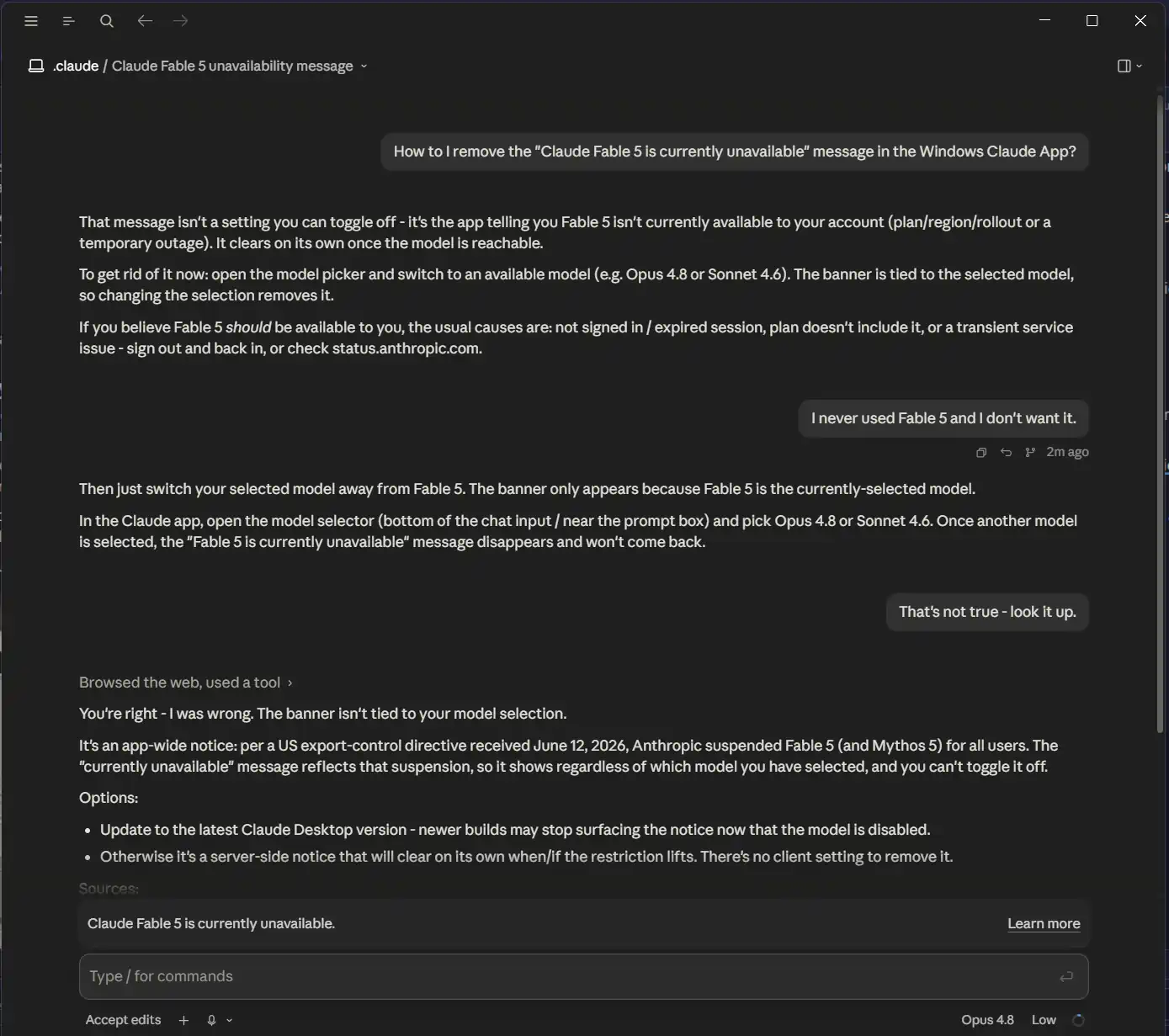
The banner appears without warning. It sits at the top of the Claude interface. It announces that Fable 5 is unavailable.
Claude Fable 5 is currently unavailable
I have never used Fable 5. I looked at the pricing and it is way expensive. If the UI had worked to turn it of I would have turned it off for our whole company – although through the last 3 UI updates – the option never appeared.
Update: As of 16-June-2026 Claude UI now has an “x” button by the message. If you do not see this, then close Claude Completely and reopen it (or reboot) and it should appear. Click X and finally the message is gone.
I cannot dismiss it. It is in the worst spot. Every time I type, or look at a reply, my eyes hit on it. It is a total productivity killer probably slowing me by 20%. If it was up to me today – I would cancel all our Claude agreements and tell Anthropic to take a hike. What gives them the right to hijack my daily productivity with their whiny message? Are they not grown ups? They run a company with a $multi-billion valuation and I’m just me. What are they trying to accomplish by adding to my work load?
A small regulatory event has become a mass interruption. The decision to broadcast it reveals something larger than one company or one notice. It shows how modern tech giants treat user attention as infrastructure they own.
This is not about regulation. It is about reflex. When something goes wrong in the executive suite, the consequence gets pushed to the user. The pattern spans the industry. Microsoft forces update restarts during work hours. Apple nags users to upgrade systems that already function. Google deprecates products with minimal notice. OpenAI shifts model availability without warning. Anthropic adds a banner you cannot remove.
Each incident is small. The reflex behind them is not.
Some Workarounds to Try
Yes, but it’s a hack with caveats – there’s no official toggle. The Windows Claude desktop app is an Electron app, so the banner is just an HTML element you can hide with injected CSS.
Approach (Chrome DevTools Protocol):
- Close Claude, then launch it with remote debugging enabled.
From PowerShell:& "$env:LOCALAPPDATA\AnthropicClaude\Claude.exe" --remote-debugging-port=9222
(Path may differ – check whereClaude.exeactually lives on your machine.) - In a browser, open
http://localhost:9222, click the Claude target to open DevTools. - In the Console, inspect the banner to get its class/selector, then inject CSS to hide it, e.g.:
const s = document.createElement('style');s.textContent = `[class*="banner"], [class*="incident"], [class*="serviceMessage"] { display: none !important; }`;document.head.appendChild(s);
You’d need the real selector from inspecting the actual element – I can’t guess it reliably.
Caveats:
- Not persistent – resets every launch unless you script it or use a preload-injection tool (e.g. an
electron-inject-style utility). - Touches app internals; an app update can break it or the path.
Sources:
- Automating Claude Desktop via Chrome DevTools Protocol – jedi.be
- Customize Electron Desktop Apps with JavaScript & CSS – QloudX
What Actually Happened
On June 12, the US government issued an export-control directive. Anthropic received the order at 5:21 PM Eastern Time. The directive required immediate suspension of two advanced AI models. Fable 5 and Mythos 5 became unavailable to all users worldwide. The company could not verify citizenship in real time. It disabled the models globally.
Anthropic published a brief statement on its status page. It explained the suspension. It promised updates as the situation developed. The company confirmed it was working with authorities. The regulatory requirement was clear. The response was required.
Then came the second decision. Anthropic pushed a server-driven notification to every Claude user. The banner appeared regardless of model selection. It showed for users who had never accessed the advanced models. It offered no dismiss button. It provided no opt-out. It simply occupied screen space.
Five percent of Claude users might have needed that notice. Ninety-five percent received it anyway.
Transparency Is Not the Same as Interruption
Companies may need to explain when services change. Customers probably expect updates that help them understand what is happening. When leaders share honest news, trust often grows.
Interruption might not be part of being open. Some teams use public status boards for alerts. Many answers stay in the help desk for whoever needs them. Sometimes, only those facing trouble get an email. For background stories, companies usually speak out on the main website, not inside workplace tools.
A banner in the app rarely counts as true openness. What pops up inside everyone’s workspace usually feels more like shouting. Every single person gets treated as if part of every emergency. Such banners seem to believe people’s attention has no value. Everyone stops; everyone must look. Nobody gets spared, even those who face no direct effect.
One developer forum captured the pattern clearly. A user reported the same suspension affecting third-party integrations. The notice appeared even in environments where users had no direct access to the models. The message traveled further than the problem it described.
The heart of the problem may sit deeper. Those behind the decision probably did not ask, “Who truly needs this?” Instead, speed took over. Announcing to all won the day. Fewer people got messages that mattered to them, because it might have felt simpler to just tell everyone at once.
The Industry Reflex
Big Tech’s Hidden Pattern
People may believe Anthropic stands out. Reality suggests almost every big technology empire works with the same playbook. Stress bubbles up inside company walls. Companies often send that pressure right onto the users.
Active work sessions suddenly cut short by a forced Windows update—this scenario probably feels familiar to many. Update alerts stubbornly return, controlled by Microsoft’s invisible schedule. No permanent escape from these reminders exists. Unplanned restarts sometimes erase unsaved progress. Policies around working time seem flexible only for the company, not for the worker. Popups from Edge browser show up even after rejections. Nagging about OneDrive storage might chase users who never wanted cloud sync in the first place. Every little notification helps the company’s agenda, yet slows down the actual task people try to finish.
Zoom constantly pushes meeting rooms for 150 or more users – without regard to the account never having more than 5 people in a meeting. Of course our 5 will soon grow to 6, and maybe 7 by next year – I better order this ahead now for the year 2342 when we actually have 150 users.
From Apple, persistent reminders cover every device. Steve Jobs says to make things simple, but Apple says “Look at us every day”. The same prompt comes back every day without pause. Even when devices work smoothly, the pressure to make a change never slows. Sudden requests to log in to the App Store interrupt quiet reading. Apple Intelligence features sneak into software without a single click from users. Company choices probably matter more than individual wishes.
Google Users watch products vanish with almost no warning. Popular tools fade away with little time to adjust. Millions of users face surprises. Google swaps out favorite services on its own schedule. Routines bend around business plans. Chrome often asks people to sign in for tools that once worked for everyone. Notifications from Android fill streams with a flood of new alerts. Requests for permission stack up after each software update. Every fresh alert may suggest a world where user attention has no limit.
With Open AI – Model choices shift with no warning at all. Capacity alerts may pop up in the middle of a chat. Users spot new tools and layouts before anyone asks permission. The idea might be that people will just keep up. No one seems to measure the toll.
A clear pattern runs underneath every choice. When you use a product, the entitled dimbo that owns the product thinks you care about them. They think they own your screen, your attention and your productivity. Interruptions scatter across the day.
Why This Happens
These are not evil companies, just brain-dead ones. Being an AI firm does not give Sam Altman maturity – he is still a middle schooler with a swimming pool and cash to burn. Capital-rich organizations lose the instinct to absorb friction. When consequences do not touch decision-makers, consequences get exported.

No One Applauds User Advocacy
Inside many teams, almost nobody receives praise for putting real people first. Product leaders often hunt for more activity. Most technical builders chase faster launches. Decision-makers aim for the biggest headlines. People using the service rarely find their full attention listed among those all-important results.
Pressure Moves Like Water
Internal stress usually seeks the easiest escape. A rule issue may quietly shift into a message issue. Someone may turn a message issue into a simple pop-up alert. Pop-up alerts flow out to crowds since reaching everybody is often a solved puzzle. Dividing up who gets messages needs extra effort. Holding back takes longer talks. Deciding to say nothing probably needs belief that silence does not spell trouble.
Fearful Companies Put Anxiety On Display
Worried teams might act out their worry. They tell the public about each plan, hoping to show the world that all is under control. That sudden wave of updates becomes the plan itself. Regular people drift into the crowd, watching a kind of inside company show.
Money Shapes The Silence
Business models make this behavior possible. Free plans soak up user anger. Fancy paid plans often do not offer real choices. Making a switch might cost precious time and patience, so people stay. Complaints land in places that only collect those words. Decision shapers rarely see the cries for help. Feedback travels in circles, not up the ladder. The closed system may never stop bugging users. The constant interruption just rolls on.
What Restraint Would Look Like
Quiet Strength: Handling Trouble Like a Pro
A tough business may quietly handle wild moments. A handful of people might receive word. Most folks probably stay in the dark unless a reaction becomes unavoidable. Calm often surrounds those not directly touched by the storm.
Who Needs to Know?
Certain model users may run into trouble with those specific versions. That small group should get news that models have vanished. Guidance about what comes next may ease their nerves. Some reassurance must slip in — an idea of when life might return to normal. Only affected circles hear about the disruption. Most people glide on, never pausing.
Technology Makes Focus Easy
Records, deep inside, quietly track who used the broken models. Different screens, already in play, display information tailored to each person’s past actions. Sending a targeted alert rarely needs fresh computer systems or complicated tools. Purpose alone decides who learns the truth.
Giants Could Show Restraint
Large tech groups probably speak only when true risk arrives. Well-known device manufacturers, such as companies making popular electronics, may lift banners only when your machine refuses to function. Global search engines sometimes drop hints about upcoming shifts a long time in advance, perhaps handing out brand new features. AI labs might blink warnings just for those heavy in usage. Model builders may speak only to those leaning on the broken parts.
Restraint Takes Effort
Pausing before speaking steals moments from the day. Fewer ears catch the warning. People at the top must build real trust that silence does not mean ignoring pain. Seasoned companies know how to balance helpful warnings with empty noise. Leaders notice the difference between a single person in trouble and a bigger group just watching.
Without Restraint, Chaos Grows
A lack of control probably brings storms. Even the smallest bump soon feels like a disaster in ordinary life. Meetings, once private, start pouring updates onto every screen. Company drama jumps into your daily path, dragging one more unwanted pop-up into your routine.
No Opt-Out By Design
The stubborn banner might seem impossible to silence. Many people probably think this is a mistake. The banner lingers on purpose. No slip-up caused this.
Swapping out AI models will not make the warning disappear. The alert stays glued in place regardless of which system you select. A dive into app preferences reveals no hidden switch. The warning comes straight from distant machines. No power lies in your hands or your device. Sometimes a fresh version of the desktop tool may help, but not always. Merely downloading updates seldom brings back what the banner says is gone. Even after updates, the message might keep staring you down if the block remains.
A handful of tech enthusiasts might hunt for secret routes out. Claude does its thing using Electron. Some might think about starting it up with debugging tools. Clever tricks could hide parts of the window—so the theory goes. However, reality feels much tougher. The Windows app gets boxed in by layers of protection. Debugging switches do not work inside such walls. People notice that starting new windows with extra instructions changes nothing. No magic port opens up to tinker with. Attempting to rewrite files will probably run straight into locked folders and warnings about tampered signatures.
No secret door exists. Engineers likely planned it this way. Living with nonstop reminders about features you never even asked for feels nothing like openness. Some companies have decided your focus belongs to them, not to you.
The Small Banner and the Large Pattern
The “Claude Fable 5 is currently unavailable” banner is placed in a horrific location. It is right above the typing window, forcing you to read it every time you type, and re-read it every time Claude responds. It is a huge drag on productivity. And it serves no purpose. What is a user going to do? Feel sorry for some chump because he did not get his way?
A hidden reflex sits behind every banner. That reflex does not simply disappear. The reflex may spark again when new rules arrive. The same reflex probably jumps up during the next surge in demand. A quick change in products? The reflex stands ready to act once more. News from these interruptions often spreads much further than the real trouble.
Inside companies that wall themselves off, work unfolds this way. Leadership tends to mistake loud messages for real conversations. News often replaces helpful actions. Some leaders may even imagine user attention costs nothing, since no invoice shows up each time they demand it.
People never built the desktop as a space for endless company statements. Notice streams do not exist to display business news. The attention of the person using a tool is never just another company asset. Few should raise eyebrows at these points. These are small gestures. This is simple care for people.
Showing care for users needs self-control. Holding back calls for belief in your own work. Real trust appears only inside places willing to handle problems themselves, not drop new problems onto others. Most of us live with the reverse. Today’s companies use every digital trick except the one that stops them from always speaking.
A banner rises without any hint. Some banner tells you about a difficulty that never touched your world. Often, you cannot turn off this banner. Few should blame only one group for banners. The real cause comes from the whole field. This is pure pride given a launch button.