The 5 Best AI Video Translators for Marketing Agencies in 2026

The bottom line: The best AI video translators for marketing agencies in 2026 are Synthesia, Rask AI, ElevenLabs, Smartcat and Wavel AI, with Synthesia leading for dubbed, lip-synced, on-brand video at scale. Agencies need more than a quick caption tool. They need fast turnaround, consistent brand voice across languages, and output polished enough to put in front of a client’s audience. This guide compares five tools built for exactly that, so you can localize campaigns without a studio or a translation vendor.

For agencies, video localization has shifted from a nice-to-have to a core deliverable, as clients expect campaigns to run across markets. The right AI video translator turns that from a costly bottleneck into a same-day service line.

Key takeaways

  • AI video translators let agencies localize client video fast, cheaply and at scale, either with subtitles or full dubbing.
  • Synthesia leads for agencies, producing dubbed, lip-synced video with voice cloning, brand controls and automatic subtitles in 140+ languages.
  • Rask AI suits fast social localization, ElevenLabs delivers the most natural dubbed voices, Smartcat fits enterprise-scale accounts, and Wavel AI offers voice cloning with an API to embed in your stack.
  • For agency work, prioritize brand consistency, turnaround speed, voice quality, security and how well the tool scales across clients.

Why marketing agencies need an AI video translator

Clients increasingly run campaigns across regions, and video is the format that travels least well without help. Traditional localization means translators, voice actors, studio time and long review cycles, which blow both budgets and deadlines and do not fit the pace agencies work at.

AI video translators collapse that process into minutes. An agency can take one hero video, ship it in a dozen languages, keep the brand’s voice consistent, and turn localization into a repeatable, profitable service. The differentiator is whether the output is good enough to be client-facing, not just a rough draft.

What agencies should look for

Agency needs differ from a solo creator’s, so weigh these factors:

At a glance

ToolBest for agenciesApproachLanguagesPricing (approx)
SynthesiaDubbed, lip-synced business videoDubbing + subtitles140+Free to try, starting from ~$14/mo
Rask AIMulti-language creator localizationDubbing130+Free trial, starting from ~$60/mo
ElevenLabs High-fidelity voice dubbing Dubbing 30+ Free option, from ~$6/mo
SmartcatEnterprise scale and reachDubbing + subtitles280+From ~$1,200/yr
Wavel AIVoice cloning in a studioDubbing100+Starting from ~$25/mo

Pricing and language figures change often, so confirm current details with each vendor.
1. Synthesia

Best for: Agencies producing dubbed, on-brand client video at scale.

  • Brand consistency, with control over voice, terminology and styling across every language
  • Turnaround speed, so you can meet campaign deadlines and quick-turn client requests
  • Voice quality and lip-sync, since client-facing video has to look and sound native
  • Editing control, to refine wording and terminology before anything ships
  • Security and compliance, especially when handling client and enterprise content
  • Scalability, across many clients, languages and volumes without ballooning cost

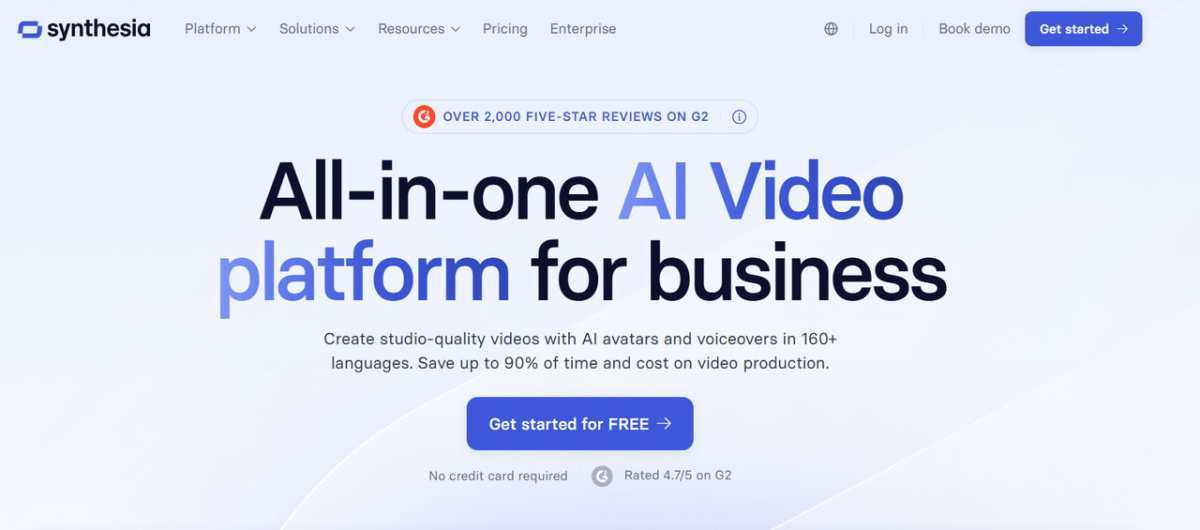
For marketing agencies, the standout AI video translator is Synthesia, which delivers a finished, dubbed video rather than just translated text. Its AI Video Translator turns a single uploaded video into production-ready, dubbed versions in 140+ languages, preserving each speaker’s own voice with natural lip-sync. An agency uploads an MP4, MOV or WebM file, or pastes a YouTube link, and Synthesia detects the source language automatically, then returns the dubbed version in minutes with state-of-the-art lip-sync, high-fidelity voice cloning and automatically generated subtitles for every language.

It supports 140+ languages, including regional accents and variants, and is trusted by over 90% of Fortune 100 companies, which carries weight when pitching enterprise clients.

For agency work, the control features matter as much as the output. Synthesia preserves each speaker’s original voice, detects and keeps multiple speakers distinct, and offers two dubbing modes: an adaptive mode that adjusts speech speed for natural delivery, ideal for explainer and training content, and an original mode that holds the video’s timing for fast-paced ad creative. A built-in transcript editor lets you fine-tune wording and lock in a client’s preferred terminology, so brand language stays consistent across every market.

Distribution suits multi-market campaigns too. Rather than juggling a separate file per language, you share one smart link through the Multilingual Player, and each viewer is served their language automatically with toggleable subtitles. Because Synthesia is also a full AI video platform that creates avatar-led videos in 160+ languages, agencies can produce original content and localize it in one place, which is a genuine advantage over single-purpose translators.

At agency scale, it adds live collaboration for teams and reviewers, analytics, and enterprise-grade AI governance, making it viable for regulated client accounts that have to clear procurement. The results clients care about are there too: brands report localizing videos into 20 or more languages and saving significant time and cost versus traditional dubbing.

The translator is free to try with no payment method, and paid plans unlock watermark-free output, more languages, bulk dubbing and API access. For agencies that want client-ready dubbing, Synthesia is the strongest option.
2. Rask AI

Best for: Agencies localizing high volumes of video content.

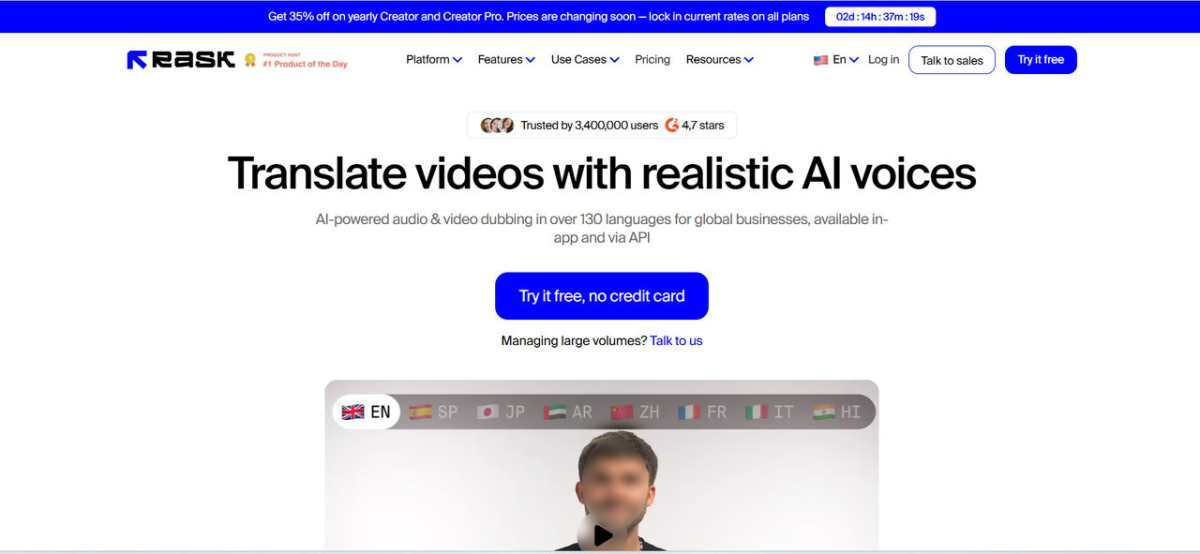
Rask AI is a dedicated video translation and dubbing platform that handles many languages with voice cloning, lip-sync, and multi-speaker support, widely used to turn one asset into many localized versions across YouTube and social. Its end-to-end workflow makes it a capable specialist for repeatable localization. Pricing is subscription-based and usage-dependent, so check current tiers and minute limits against your client volumes.
3. ElevenLabs

Best for: Agencies where dubbed voice realism is the deciding factor.

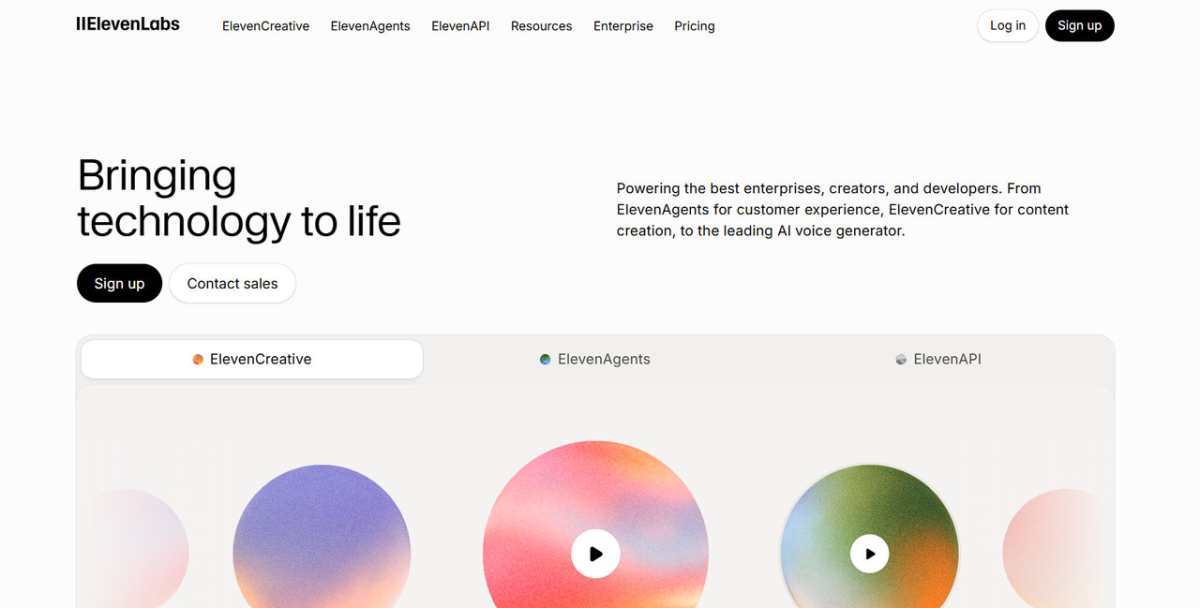
ElevenLabs is known for high-fidelity AI voices, and its dubbing feature translates video and audio while preserving the speaker’s voice and emotional delivery across a solid set of languages, which matters when client work has to sound native.

Its voice quality is the headline strength, though its language range is narrower than some rivals and lip-sync is not its core focus, so test it on footage where on-screen speakers are prominent. A free tier is available, with affordable paid plans, so verify current dubbing limits.
4. Smartcat

Best for: Agencies serving enterprise accounts that need maximum reach.

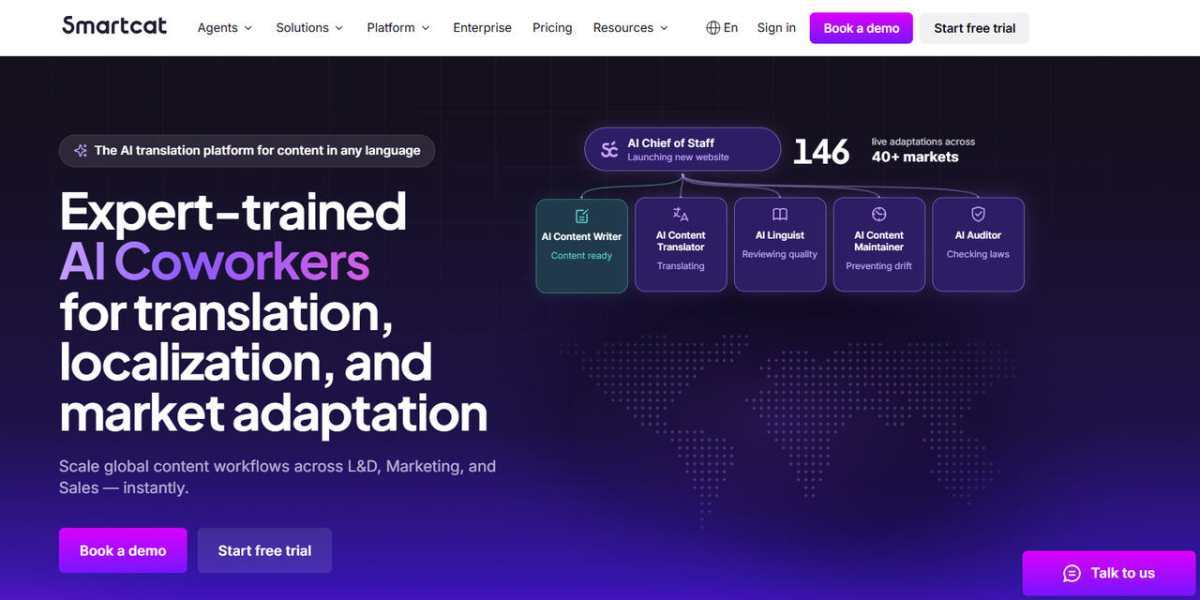
Smartcat is a full localization platform whose media agent transcribes, translates, subtitles and dubs in one automated pass, supporting an exceptionally broad language set with voice cloning and lip-sync, plus a large linguist marketplace for human review on high-stakes deliverables. The trade-off is that the full platform is heavier than a single-purpose tool. Pricing starts around $1,200 per year, with custom enterprise plans.
5. Wavel AI

Best for: Agencies wanting voice cloning and an API to build into their workflow.

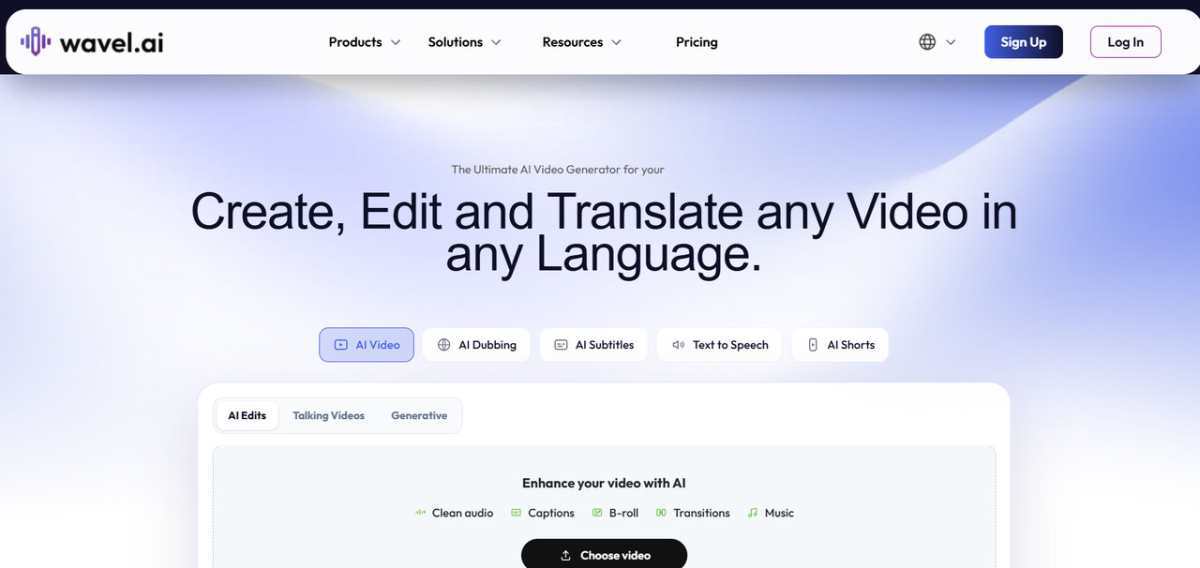
Wavel AI is an all-in-one video studio where dubbing sits alongside editing, with voice cloning as its highlight and an API that lets agencies embed dubbing into their own pipelines. Clone a client’s voice once and carry it across 100+ languages, with auto lip-sync, multi-speaker detection, and an optional native-speaker review for tone. The trade-offs are a credit system that can deplete quickly and paying for a broader suite. A free tier is available, with paid plans from around $25 per month.

How to choose the right tool for your agency

Start with your typical deliverable. If clients need fully dubbed, on-brand video that looks native, Synthesia leads, with the brand controls and scale to meet agency work demands. If you mostly localize social clips fast, Rask AI fits, if voice realism is the priority, ElevenLabs leads, if you serve enterprise accounts needing the widest reach and human review, Smartcat is built for it, and if you want to embed dubbing via API, Wavel AI is worth a look.

Then weigh the realities of agency life: turnaround on quick-turn requests, how consistently the tool holds a client’s brand voice across languages, security for client content and how pricing scales as you add clients. Run a real client clip through your two or three finalists, since client-facing work lives or dies on how native the result feels.

Frequently asked questions

What is the best AI video translator?

Synthesia is widely considered the best AI video translator, and for marketing agencies it leads by producing dubbed, lip-synced, on-brand video with voice cloning and automatic subtitles in 140+ languages. The best fit depends on your deliverables, with Rask AI strong for social localization, ElevenLabs for voice realism, and Smartcat suited to enterprise reach.

Can AI video translators keep a brand’s voice consistent across languages?

Yes. Tools with voice cloning and terminology controls, including Synthesia, can preserve a speaker’s voice and apply a client’s preferred wording, so brand language and tone stay consistent across every market.

How much can agencies save with AI video translation?

The savings are significant. Compared with traditional dubbing that requires translators, voice actors and studio time, AI tools produce localized video in minutes rather than the days or weeks the old process takes, which cuts both cost and turnaround sharply.

Is there a free AI video translator to test first?

Yes. Synthesia lets agencies run its full translation workflow free without a payment method, and ElevenLabs and Wavel AI offer free tiers too, so you can evaluate output quality on real client footage before committing.

Conclusion

For marketing agencies, AI video translators turn localization from a costly bottleneck into a fast, scalable, profitable service, letting you take one client video global in minutes with output polished enough to run in any market.

Synthesia is the best overall choice, pairing dubbing, voice cloning and lip-sync with brand controls, collaboration and enterprise-grade security in one platform, while Rask AI, ElevenLabs, Smartcat and Wavel AI each suit specific agency needs. Shortlist two or three, test them on real client work, and choose the translator that lets you scale localization without sacrificing quality.


Claude Fable vs GPT 5.6 Sol: Real-World App Development Face-Off

Choosing between Claude Fable and GPT 5.6 Sol for coding projects can feel overwhelming. Both AI assistants promise impressive capabilities. Both cost $20 per month for Pro accounts. But which one actually delivers when you need to build something real?

I decided to put both systems through a practical test. The challenge was simple: build the same game application using each AI assistant. The results revealed clear differences in approach, capability, and practical limitations that every developer should know about.

Understanding the Usage Limits

Before diving into performance, understanding the usage constraints matters. These limits directly impact how much work you can accomplish in a given timeframe.

Claude Fable operates on a five-hour weekly limit for Pro subscribers. Once you exhaust those five hours, you must wait until the next week begins. There are no resets. There are no extensions. The clock simply runs down as you work.

GPT 5.6 Sol takes a different approach. It uses a weekly limit system with periodic resets. Throughout the week, you may receive several limit resets that effectively give you fresh capacity to continue working. This system provides more flexibility when deadlines loom or complex projects demand extended sessions.

The practical impact becomes clear during intensive development. With Claude, you learn to budget your time carefully. Five hours sounds generous until you face debugging sessions or iterative refinement. With GPT, the multiple resets mean you rarely hit a hard wall that stops all progress.

Building the Same Game: A Tale of Two Approaches

The core test involved having each AI build an identical game from scratch. The requirements stayed consistent. The initial prompts remained similar. Only the AI assistant changed.

Claude Fable produced a significantly more functional game on the first attempt. The code structure was clean and logical. Core mechanics worked without extensive debugging. Game loops functioned properly. User interactions responded as expected. The system seemed to grasp the fundamental architecture needed for a working game.

Getting the game to a playable state with Claude required minimal back-and-forth. Most prompts focused on adding features rather than fixing broken functionality. The development flow felt natural and productive.

GPT 5.6 Sol told a different story. The initial code output looked promising but contained numerous functional gaps. Basic game mechanics required multiple rounds of debugging prompts. Systems that should have worked out of the box needed manual intervention and correction.

Reaching even a base playable state with GPT demanded considerably more time and prompting. What Claude accomplished in three or four exchanges took GPT ten or more rounds of refinement. The experience felt less like building and more like troubleshooting.

However, GPT showed clear superiority in one specific area: visual design and artistic elements. The graphics suggestions were more creative. The color schemes felt more polished. The overall aesthetic presentation exceeded what Claude produced. If visual appeal was the only metric, GPT would win decisively.

According to research from Anthropic, different AI architectures prioritize different capabilities, which explains these performance variations.

The Hybrid Approach: Best of Both Worlds

The testing revealed an interesting possibility. What if you could combine the strengths of both systems?

This led to an experiment: using GPT’s image generation engine alongside Claude’s superior code output. The goal was creating a polished application with both solid functionality and appealing visual design.

The process worked remarkably well. Claude handled all the core development, creating the functional foundation that actually worked. Once the mechanics were solid, GPT’s image capabilities added the artistic polish. Buttons looked professional. Backgrounds felt thoughtfully designed. The interface gained visual coherence that Claude alone struggled to provide.

This hybrid workflow required juggling two platforms. It meant maintaining context across two different AI conversations. But the results justified the extra complexity. The final product combined functional excellence with visual appeal in ways neither system achieved independently.

For developers willing to work across platforms, this approach offers genuine advantages. Use Claude where logic and functionality matter most. Switch to GPT when visual design and artistic elements need attention. The OpenAI image generation tools integrate smoothly once you understand the workflow.

Performance Under Real Conditions

Beyond the specific game project, general usage patterns emerged. Claude consistently required fewer prompts to achieve functional results. The code it generated tended to work correctly the first time more often. Debugging sessions stayed shorter and more focused.

GPT showed strength in creative problem-solving and suggesting alternative approaches. When stuck on an architectural decision, GPT provided more varied options. Its explanations of code concepts sometimes offered clearer insights.

The weekly limit structures created different working rhythms. Claude’s fixed five hours encouraged concentrated work sessions. You learned to prepare thoroughly before starting. You gathered requirements, planned architecture, and organized thoughts to maximize productive time.

GPT’s reset system enabled more exploratory development. You could afford to experiment with different approaches without worrying as much about wasting limited time. This flexibility suited certain project types better than others.

Research on AI-assisted development suggests that different limit structures affect developer behavior and output quality in measurable ways.

Cost Considerations and Value

Both services charge $20 monthly for Pro access. The identical price point makes the comparison straightforward. You are paying the same amount. The question becomes what you receive in return.

With Claude, you get five guaranteed hours of high-quality coding assistance. The output quality justifies the cost if your projects emphasize functionality over appearance. For backend development, API integration, or logic-heavy applications, the value proposition holds strong.

With GPT, you get more flexible time limits but somewhat less reliable initial code output. If your work involves significant visual components or you value having multiple reset opportunities, the subscription may offer better practical value.

Neither option feels overpriced for what it delivers. Both provide capabilities that would have seemed impossible just years ago. The choice depends more on your specific needs than on raw value per dollar.

Which AI Wins for Developers?

After extensive testing across multiple projects and use cases, Claude Fable emerges as the superior choice for serious development work. The functional code quality surpasses GPT consistently. The reduced need for debugging and iteration saves considerable time. The cleaner initial output means less frustration and more productive coding sessions.

Yes, the five-hour weekly limit feels restrictive at times. Yes, GPT produces better visual assets and more creative design suggestions. But when building applications that actually need to work reliably, Claude delivers superior results with less hassle.

For developers whose primary goal is shipping functional code, Claude represents the better investment. The code works. The architecture makes sense. The debugging burden stays manageable. These factors matter more than artistic polish for most development projects.

GPT 5.6 Sol has its place. For projects where visual design carries equal weight with functionality, its strengths become more relevant. For creative brainstorming or exploring alternative approaches, its varied responses add value. And the more forgiving limit structure helps when deadlines demand extended work sessions.

But in a head-to-head comparison focused on core development capabilities, Claude Fable wins. The superior code quality and more reliable initial outputs make it the smarter choice for developers who prioritize function over form. When you need an AI coding assistant you can depend on, Claude delivers more consistently and with better results.

How AI Humanizer Free Tools Can Improve Your Writing Process

Artificial intelligence has become a valuable writing companion for people creating articles, reports, emails, guides, and many other types of content. It speeds up brainstorming, organizes ideas, and produces first drafts in minutes. While this saves considerable time, the initial output often benefits from thoughtful refinement before it reaches readers.

Natural writing is about more than correct grammar. Readers appreciate content that flows smoothly, varies its sentence structure, and communicates ideas in a way that feels authentic. This is why editing remains an important part of every writing workflow, even when AI is involved.

Many writers begin this stage by using an AI Humanizer Free solution to improve readability without changing the original message. Instead of replacing ideas, the focus is on presenting them in a way that feels more natural and engaging.

a-computer-circuit-board-with-a-brain-on-it.jpg

Start With Strong Ideas Before Refining the Language

Every effective document begins with a clear purpose. Whether you're explaining a concept, sharing information, or presenting recommendations, the message should be established before worrying about individual sentences.

A useful approach is to identify:

  • The primary objective of the content
  • The audience you want to reach
  • The key points readers should remember
  • The tone that best matches the topic

Once these elements are clear, editing becomes much more focused and productive.

Let the First Draft Be Imperfect

Many people slow themselves down by trying to perfect every paragraph while writing. A more efficient method is to complete the draft first and improve it afterward.

This approach offers several benefits:

  • Ideas remain connected without interruption.
  • Creativity is less likely to be interrupted by constant editing.
  • The complete structure becomes easier to evaluate.
  • Larger improvements are easier to identify.

Viewing the first draft as a foundation rather than a finished product creates better long-term results.

Refine the Reading Experience

Editing should focus on the overall reading experience rather than isolated sentences.

During review, pay attention to questions such as:

  • Do ideas connect naturally?
  • Are paragraphs balanced in length?
  • Does each section contribute something new?
  • Is the language clear without becoming repetitive?

These observations often reveal opportunities that simple grammar checks cannot identify.

Many writers also choose an AI Humanizer to smooth sentence flow, improve transitions, and create more natural variation while preserving the original meaning.

Make Small Changes That Produce Noticeable Results

Improving content does not always require major rewrites. In many cases, a collection of smaller refinements creates the greatest impact.

Examples include:

  • Replacing repetitive expressions
  • Simplifying complicated explanations
  • Rearranging paragraphs for better progression
  • Improving transitions between ideas
  • Removing unnecessary filler

Each improvement strengthens the document while keeping its purpose intact.

Build a Consistent Editing Routine

Quality writing is often the result of a reliable process rather than occasional inspiration. Following the same editing sequence for every project helps maintain consistency across different types of content.

A practical workflow may look like this:

  • Complete the first draft.
  • Review the overall structure.
  • Improve readability and flow.
  • Refine the language naturally.
  • Perform a final proofreading pass.

Repeating this process gradually improves both efficiency and writing quality.

Remember That Readers Value Clarity

Readers rarely judge a document based on how quickly it was created. Instead, they remember whether it was easy to understand and enjoyable to read.

Content becomes more effective when it:

  • Explains ideas clearly
  • Avoids unnecessary repetition
  • Maintains a consistent tone
  • Guides readers smoothly from one section to the next

These qualities help information leave a lasting impression.

Strong Writing Comes From Continuous Improvement

Every document presents an opportunity to improve your communication skills. Instead of expecting perfection from the first draft, treat writing as an ongoing process of refinement.

Ryne AI supports this approach by helping users transform AI-generated drafts into content that feels more natural while preserving the original intent. When AI efficiency is combined with thoughtful editing, the result is writing that is clearer, more engaging, and better prepared for any audience.

Free AI Detector Tips for Stronger Content Reviews

Completing a document often feels like crossing the finish line, but experienced writers know that the most valuable work frequently happens after the first draft is complete. Editing is more than correcting spelling or fixing punctuation. It is an opportunity to strengthen ideas, improve organization, and create a smoother experience for readers.

Whether someone is preparing a report, writing an article, organizing research, or creating online content, reviewing the document before sharing it can make a noticeable difference. Even well-written drafts usually contain opportunities for improvement that become visible only during a careful review.

Many people begin this process by using Free AI Detector tools to gain additional insight into their content before moving on to the final editing stage. Starting with an evaluation makes it easier to identify sections that deserve closer attention.

AI-Artificial-Intelligence-concept-3d-rendering-conceptual-.jpg

Clear Writing Begins With Clear Thinking

Strong documents rarely happen by accident. Before polishing individual sentences, it helps to step back and consider the overall message.

Ask yourself questions such as:

  • Is the main objective obvious?
  • Does every section support that objective?
  • Are important ideas introduced at the right time?
  • Can any information be simplified?

Looking at the bigger picture first often leads to more meaningful improvements than editing line by line.

The Value of Reading Without Editing

A useful technique is to read the entire document once without making any changes. This allows you to experience the content the same way a reader would.

During this first review, pay attention to:

  • Places where ideas seem disconnected
  • Paragraphs that feel too long
  • Sections that repeat similar information
  • Transitions that interrupt the flow

These observations provide a roadmap for more focused revisions later.

Originality Is Part of Content Quality

Originality contributes to the credibility of any document. Regardless of the subject, readers appreciate content that presents ideas clearly while maintaining its own identity.

For this reason, many writers also review a Turnitin Checker before completing important documents. Including originality checks as part of the review process helps build greater confidence before publication or submission.

Combining originality awareness with thoughtful editing creates stronger overall results.

Focus on the Reader's Journey

Every document takes readers on a journey from introduction to conclusion. If the path is easy to follow, readers remain engaged. If ideas appear out of order or transitions feel abrupt, the message becomes harder to understand.

Improving the reader's experience often involves:

  • Rearranging sections into a more logical order
  • Connecting related ideas
  • Removing unnecessary repetition
  • Using consistent terminology throughout

These adjustments help readers stay focused on the content instead of the writing itself.

Editing Is About Decisions

Revision is not simply a search for mistakes. It is a process of deciding what deserves to remain and what can be improved.

Sometimes the best edit is shortening a paragraph. In other cases, adding an example or expanding an explanation creates greater clarity.

The most effective writers understand that every change should help readers understand the message more easily.

Build a Practical Review Habit

Rather than treating editing as a final obligation, make it a regular part of every writing project.

A simple routine can include:

  • Finishing the complete draft first
  • Reviewing overall organization
  • Refining readability
  • Checking originality-related aspects
  • Completing a final proofread

Following the same sequence consistently helps maintain quality while making the editing process more efficient.

Strong Documents Reflect Careful Preparation

Readers often recognize quality before they consciously identify why. Clear organization, natural flow, and thoughtful presentation create a positive impression that lasts throughout the document.

Reilaa supports writers who want to strengthen their content before sharing it. By combining careful review with consistent refinement, it becomes easier to produce documents that communicate ideas clearly, maintain originality, and provide a better reading experience from beginning to end.

Build a Better Writing Workflow With AI Humanization

Artificial intelligence has transformed the writing process by making it possible to generate ideas and complete drafts in minutes. Instead of spending hours creating a first version, writers can now focus more on improving and organizing their content. However, producing text quickly is only one part of creating high-quality writing.

The strongest documents usually go through a structured workflow that includes drafting, reviewing, refining, and proofreading. Each stage contributes to making the final content clearer, more engaging, and easier to read.

Many people begin the refinement stage with an AI Humanizer Free solution to improve the natural flow of AI-generated content while keeping the original meaning intact. Rather than replacing ideas, the goal is to make the writing sound more authentic and comfortable for readers.

Begin With Ideas Instead of Perfect Sentences

Every successful document starts with a clear objective. Before editing individual sentences, it helps to identify the purpose of the content and the audience it is meant to serve.

This planning stage should answer questions such as:

  • What message should readers remember?
  • Which points deserve the most attention?
  • What information can be simplified?
  • How should the ideas be organized?

A clear structure makes every later step easier.

Generate a Draft Without Overthinking

Once the outline is ready, creating a complete draft becomes much faster. At this stage, perfection is unnecessary because the purpose is simply to capture the main ideas.

Trying to edit every sentence while writing often slows progress and interrupts creativity. Completing the draft first provides a stronger foundation for meaningful improvements later.

Refine the Language Naturally

After the draft is complete, attention shifts from creating ideas to improving their presentation.

Many writers use Humanize AI Text during this stage to reduce repetitive phrasing, improve sentence variety, and create a smoother reading experience.

Instead of making dramatic changes, effective refinement focuses on preserving the message while improving how it is communicated.

Review the Document as a Reader

Before making detailed edits, read the document from beginning to end without stopping. This makes it easier to identify larger issues that individual sentence editing might overlook.

Pay attention to questions such as:

  • Does every section connect naturally?
  • Are explanations easy to follow?
  • Do paragraphs flow smoothly?
  • Is the overall tone consistent?

Looking at the document from the reader’s perspective often reveals opportunities for improvement.

Polish the Details

Once the structure feels strong, smaller refinements become more effective.

Examples include:

  • Removing repeated ideas
  • Improving transitions
  • Simplifying complex wording
  • Correcting formatting inconsistencies
  • Adjusting paragraph lengths for better readability

These finishing touches create a document that feels polished rather than rushed.

Create a Repeatable Process

One of the biggest advantages of following a structured workflow is consistency. Instead of relying on inspiration alone, every new project follows a proven sequence of steps.

A simple workflow might include:

  • Define the objective
  • Generate the first draft
  • Humanize and refine the content
  • Review overall structure
  • Edit for clarity and consistency
  • Complete a final proofread

Using the same process while adapting it to different topics helps maintain quality across every document.

Continuous Improvement Produces Better Writing

Every completed document offers lessons that improve future work. Over time, writers become more efficient at organizing ideas, recognizing repetitive patterns, and communicating information more clearly.

The goal is not to eliminate revision but to make each revision more purposeful. Small improvements repeated across many projects gradually lead to stronger writing skills and greater confidence.

Humaniser supports this workflow by helping users transform AI-generated drafts into content that feels more natural while preserving the original intent. When drafting, refinement, and thoughtful review work together, the result is writing that communicates clearly and creates a better experience for every reader.

Full Automation is the Wrong Goal for AI-Optimized Listings, New Research Argues

A peer-reviewed study says the race to hand product listings entirely to AI creates two problems most sellers don’t see coming.

Based on peer-reviewed research by Dmytro Lavryniuk — e-commerce operations founder (ECOM-GUIDE), published in Global Prosperity, 6(2), 2026.

Most marketplace sellers want the same thing from AI right now: feed it the SKUs, let it write the titles and bullets and descriptions, generate the images, tune the keywords, and walk away. Dmytro Lavryniuk thinks that instinct is quietly steering a lot of them wrong.

Lavryniuk is not an academic writing from a distance. He runs e-commerce operations for a living (he’s the founder of DIMKALAV LLC, which operates the ECOM-GUIDE brand), and he recently published a peer-reviewed study on how AI actually reshapes product listing optimization across marketplace platforms. His conclusion is blunt.

“What people actually want from AI is a better decision, and a better decision still needs someone accountable for it.”

That’s not a case against the technology. Lavryniuk puts AI at the center of any serious marketplace strategy. The argument is about how much control you hand over, and what you keep.

What the Technology is Genuinely Good At

The study gives AI its due, and the case is real. Machine learning, natural language processing and computer vision have rewritten what “optimizing a listing” even means. These systems read buyer language at scale, surface the phrasing that converts, tag and describe product imagery, and adapt copy to how a specific platform ranks results. Done well, they move the three numbers every seller watches: visibility, engagement, conversion.

And that matters more now than it did a few years ago. Consumer behavior is more volatile, and marketplace algorithms change constantly, often overnight and without warning. Static, hand-tuned listings, the craft approach that used to win, can’t keep up with that pace. For anyone operating at real scale, AI optimization has quietly become table stakes.

So if the technology is this capable, why not let it run the whole thing? Because two failure modes show up exactly when you take the human out, according to the research. And both get worse the more you automate.

When every listing starts to sound the same

Here’s the trap Lavryniuk keeps coming back to. The same models, trained on the same patterns, optimizing toward the same signals, tend to produce listings that converge. Your competitor is running the same class of tools you are. You’re all being nudged toward the same “high-performing” structures, the same keyword clusters, the same tidy phrasing.

“When every listing is written by the same AI, none of them stand out.”

The study calls this content uniformity, and on a marketplace it’s a real cost. The whole game is standing out on a crowded results page. Optimization that quietly erases what made a buyer pick you over the near-identical product three rows down has stopped doing its job. It’s just a slow bleed of the distinctiveness you were paying for.

Full automation speeds that up. Human judgment (a brand voice, a point of view, the deliberate choice to say something the models wouldn’t) is what breaks the pattern. Take it out, and you can optimize your way into invisibility.

The Part Nobody Can Explain

The second problem is quieter, and Lavryniuk considers it the more dangerous of the two: algorithmic opacity. As these systems get more capable, they get harder to question. The AI rewrote your listing, shifted your positioning, reweighted your keywords, and often nobody on the team can say precisely why. The output looks fine. The reasoning is a black box.

Fine until something breaks, that is. A compliance question, a sudden ranking drop, a positioning choice that misrepresents the product, a fairness issue in which products get surfaced over others.

“You can’t govern what you can’t explain.”

It’s the line the whole paper turns on. Accountability doesn’t survive full automation, because answering for a decision means you have to be able to see how it was made. Hand every call to an opaque system and the responsibility stays with you. Only the ability to meet it is gone.

Balanced Governance, Not a Winner

The obvious way to frame all this is as a fight – trust the machine or trust the operator. The study argues that framing is where sellers go wrong. What the evidence points to instead is balanced governance: automation and human oversight running as one system, built for transparency and fairness rather than raw throughput.

The AI does what it’s extraordinary at, processing scale and spotting patterns and generating and testing variations far faster than any team could. People do what it can’t – set strategy, guard the brand’s distinctiveness, insist on explanations, and own the calls that carry consequences. Lavryniuk is careful to say this doesn’t mean slowing down. It’s the setup that holds up over time.

“The sellers who last won’t be the ones who automated the most. They’ll be the ones who automated the right things and kept a hand on the rest.”

What it Looks Like in Practice

For sellers, the study lands on a handful of concrete moves. Keep a person on positioning decisions – let AI draft and generate and test at volume, but the call on how a product is framed, who it’s for, why it’s different, stays human. That’s where uniformity gets broken.

Audit for sameness, not only for performance. It’s not enough to ask whether a listing converted. Ask whether it still reads like you, or like everyone else’s AI output. And treat black boxes on high-stakes decisions as a liability you’re inheriting, not a convenience you’re gaining. If a tool can’t explain why it made an important change, that’s worth knowing before you ship it.

The endgame of AI in e-commerce, in Lavryniuk’s telling, looks less like a hands-off machine that runs the store while you sleep and more like an operation where the technology does the heavy lifting and human judgment still makes the calls that matter. Automate hard where it counts, govern the rest on purpose. That’s the balance he thinks actually survives the next algorithm change – and there’s always a next one.

Lavryniuk’s study, “The Impact of Artificial Intelligence on Product Listing Optimization in Marketplaces,” appears in Global Prosperity, 6(2), 2026. The full paper is available at gprosperity.org.

AI Deployment Strategies: From Local Models to Cloud Infrastructure

Building an AI model is exciting. Deploying it so other people can actually use it is where the real work begins.

Many developers start with a model running on their own computer. It works well during testing, but once the application needs to support real users, the deployment strategy has to evolve.

The good news is that you don't need to jump straight into enterprise cloud infrastructure. Most successful AI applications grow through several stages, with each one offering the right balance of performance, flexibility, and cost.

Here's what that journey typically looks like.

Green toy soldiers facing off on a white background, symbolic of conflict and strategy.

Stage 1: Local Development

Every AI project starts somewhere, and for most developers, that's a local machine.

Running models locally allows you to experiment, test different approaches, and debug quickly without worrying about hosting costs or production environments.

During this stage, you're usually focused on:

  • Training and testing models
  • Building APIs
  • Experimenting with datasets
  • Measuring performance
  • Improving accuracy

Local development is fast because everything happens on your own hardware. The downside is that nobody else can access your application, and performance depends entirely on your computer.

Once the model is stable, it's time to think about deployment.

Stage 2: Move to a VPS

A Virtual Private Server is often the first real production environment.

For many AI applications, especially SaaS products, chatbots, internal automation tools, and API-based services, a VPS offers everything needed to get started.

It provides:

  • Dedicated CPU and memory
  • Full control over the operating system
  • Predictable monthly pricing
  • Easy remote access
  • Room to grow

A VPS also gives you the opportunity to learn how your application behaves in a real hosting environment before introducing additional complexity.

When comparing providers, don't focus only on introductory pricing. Renewal costs can vary considerably, so it's worth reviewing available web hosting coupons alongside long-term plans before choosing a provider. Looking at both discounts and regular pricing gives you a better idea of what your infrastructure will actually cost over time.

For many startups, this stage lasts much longer than expected because a properly configured VPS can comfortably support thousands of users.

Stage 3: Dedicated Servers for Consistent Performance

As traffic increases, applications often need more computing power than a VPS can provide.

Dedicated servers remove shared resources completely.

Everything – from processing power to storage – is reserved for your application.

This makes dedicated servers well suited for:

  • Large AI inference workloads
  • High-volume APIs
  • Continuous processing
  • Resource-intensive machine learning services
  • Enterprise applications

Dedicated hardware also provides predictable performance because you're not competing with other virtual machines for resources.

The trade-off is flexibility. Scaling requires additional hardware instead of simply adjusting resource limits.

For applications with steady workloads, however, dedicated servers often provide excellent value.

Stage 4: Expand Into the Cloud

Cloud infrastructure becomes valuable once applications need flexibility more than simplicity.

Instead of relying on one physical server, cloud platforms allow you to scale resources almost instantly.

This becomes useful when:

  • User traffic changes throughout the day.
  • AI workloads fluctuate.
  • Multiple services need to communicate.
  • Global deployments become necessary.
  • GPU resources are required on demand.

Cloud services also provide managed databases, storage, monitoring, and networking that reduce administrative work.

The biggest challenge is keeping costs under control.

Without careful monitoring, cloud resources can continue running long after they're needed, increasing monthly expenses.

That's why many organizations move to the cloud gradually instead of migrating everything at once.

Stage 5: Build a Hybrid Environment

Many mature AI companies don't rely on a single hosting platform.

Instead, they combine several different environments based on what each workload requires.

A hybrid deployment might include:

  • A VPS for the public API
  • Dedicated servers for heavy inference
  • Cloud storage for datasets
  • Cloud GPUs for model training
  • Local development for testing new features

This approach allows every component to run where it performs best.

It also provides flexibility when business needs change.

Rather than replacing your infrastructure every time demand grows, you simply add the resources you need.

Deployment Is About More Than Performance

Speed matters, but it's only one part of a successful deployment strategy.

You also need to consider:

  • Reliability
  • Monitoring
  • Security
  • Maintenance
  • Scalability
  • Disaster recovery

An application that responds in milliseconds but crashes every week won't earn user trust.

Building a stable deployment environment should always be the priority.

AI Is Changing Connected Security Systems

Deployment strategies become even more important when AI supports devices that operate continuously.

A good example is AI-powered alarm systems, where machine learning models analyze sensor data, identify unusual activity, and reduce false alarms in real time. These systems depend on reliable infrastructure because every second counts when responding to potential security events.

Some processing happens directly on the device, while more advanced analytics often run on remote servers or cloud platforms. Choosing the right deployment strategy helps balance response times, scalability, and long-term operating costs.

As more connected devices begin using AI, hybrid deployments are likely to become even more common.

Keep Scaling at the Right Pace

One of the biggest mistakes teams make is upgrading infrastructure before it's necessary.

A smarter progression usually looks like this:

  • Develop locally.
  • Launch on a VPS.
  • Optimize the application.
  • Move demanding workloads to dedicated hardware.
  • Add cloud services where they provide clear benefits.
  • Build a hybrid architecture as the application grows.

Each stage solves a specific problem without introducing unnecessary complexity too early.

Stunning aerial photo of Sowutoum, Greater Accra Region, Ghana, showcasing urban landscape.

Almost Done…

Successful AI deployment isn't about choosing the biggest infrastructure available.

It's about choosing the right environment at the right time.

Most applications don't need enterprise cloud platforms on day one, just as they don't need dedicated hardware before users arrive.

Starting with a practical deployment strategy keeps costs under control, simplifies maintenance, and creates a solid foundation for future growth.

As your AI application evolves, your infrastructure can evolve with it – one step at a time.

How to Secure Mac From AI-Driven Phishing in 2026

Not so long ago, a phishing email used to give itself away. You could easily notice the bad grammar, a strange logo, and, in most cases, a link that led nowhere close to the real bank or company page. Those clues are mostly gone now.

Generative AI writes flawless messages that mirror a colleague's tone, copies a vendor's invoice format down to the font, and clones a familiar voice on a phone call.

For Mac owners who assume malware is a Windows problem, that confidence is exactly what scammers count on. MacOS has strong built-in defenses, but no operating system can stop someone from entering a password on a page generated by AI that mimics Apple's login screen.

Securing a Mac against this new wave of phishing means changing habits as much as installing software. Those habits are what we’re covering in this article.

Close-up of hands typing on a laptop displaying cybersecurity graphics, illuminated by purple light.

Attackers already know if a Mac has been touched

AI phishing rarely stops at one stolen password. Once a scammer gets that first foothold, whether through a fake iCloud alert or a cloned support call, the next move is often to install remote access tools that let them poke around a Mac from anywhere.

I ran into a version of this myself last year, after clicking a link in what looked like an Apple Store receipt. The page loaded my real order history, pulled from an old data breach, which made the request for my Apple ID feel legitimate. Nothing was stolen that day, but I spent an hour afterward checking Activity Monitor and System Settings for anything unusual.

That experience is why I now tell people to learn the specific steps to tell if your Mac has been remotely accessed before they ever need them, not after. Knowing the warning signs in advance, such as an unfamiliar login item or a webcam light turning on without cause, helps you solve the problem and avoid becoming a victim of fraud or identity theft.

Protect credentials like they're the actual target

Credentials are the real prize in almost every AI phishing attempt, even when the message is dressed up as something else. Before entering a password anywhere, check the actual domain in the address bar rather than just the padlock icon.

This is an important step because AI-generated pages can carry valid certificates too. If an email, text, or call asks for money, login details, or a code sent to a phone, stop immediately and verify through a separate channel.

One of the best steps you should take is to call the bank directly using the number printed on a card, not the one in the message. Apple, banks, and government agencies do not ask for a password or a one-time code over email or phone.

Switch to hardware passkeys where possible

Passwords can be typed into a fake page without anyone noticing. Passkeys cannot. Hardware keys like a YubiKey or Apple's built-in Touch ID passkey support tying a login to a physical device rather than a string of characters that can be phished or guessed.

You can start by setting one up on your Mac, and, fortunately, most major services, including Google, Microsoft, and many banks, already support the standard. For accounts holding financial data or email recovery options, a passkey closes off the one attack vector AI writing can't fake: physical possession of a specific piece of hardware.

Turn on MFA everywhere, no exceptions

Multi-factor authentication stops most stolen passwords from becoming breaches, but only the phishing-resistant kind holds up against AI-driven attacks. Standard text message codes can be intercepted or approved by accident during an AI-generated call pretending to be tech support.

App-based authenticators like Apple's own two-factor system are harder to trick. If you want stay a step ahead, turn MFA on for email first, since a compromised inbox usually unlocks everything else. Then move through banking, cloud storage, and any account tied to a payment method.

Build smarter daily habits around AI itself

AI hygiene matters as much as any single tool. One of the best AI hygiene practices I have adopted is to limit personal sharing. Oversharing personal or work details on social media is the easiest way to fall victim to AI phishing, given scammers feed this data into AI tools to trick you.

You should also start reading emails twice, once for what they say and once for how they say it, because AI-written scams no longer carry the typos that used to be a giveaway.

On top of that, keep macOS and Safari updated; Apple regularly patches the exact flaws that malicious sites try to exploit.

Lastly, consider turning on Lockdown Mode when traveling or handling sensitive work, and treat any unexpected AI-generated voice or video call, even one that sounds like a boss or a relative, as unverified until confirmed otherwise.

Conclusion

Knowledge is your best defense against any form of Phishing scam. Cybercriminals always rely on catching you unaware, so staying informed can render their phishing attempts unsuccessful. You need to slow down at the exact moments scammers are counting on speed.

A Mac protected by passkeys, phishing-resistant MFA, and an owner who checks unusual requests through a second channel is a much harder target than one running on trust alone. AI has closed the gap between fake and real, but it has not found a way around basic verification.

Check the domain, and most importantly, question anything that feels urgent. While the scams keep getting smarter, the defense against them has not changed. You just need to start using it!

The AI Degree Gold Rush Is Here. About Half of It Is a Rebrand

In 2018, Carnegie Mellon launched the first bachelor’s degree in artificial intelligence in the United States.

At the time, this was a mildly controversial move. The prevailing view in academia was that AI didn’t deserve its own degree. It was a specialization inside computer science, the way databases or graphics were. Giving it a standalone major felt like giving “spreadsheets” a standalone major.

Eight years later, there are 193 AI bachelor’s programs in the US. And 310 master’s programs.

I work on a degree directory, so part of my role is to count these things for a living. And I’ve never seen a credential category grow this fast. AI master’s programs went from 116 to 310 between 2022 and 2026. Bachelor’s programs more than doubled in just two years, from 90 in 2024 to 193 today.

For context: it took cybersecurity degrees roughly 15 years to go through the same adoption curve. AI did it in four.

Students figured this out before universities did

The demand side of this story is even more lopsided than the supply side.

SUNY Buffalo’s AI master’s program had 5 students in 2020. By 2024 it had 103. That’s a 20x increase at a school nobody would call an AI powerhouse.

Meanwhile, the Computing Research Association reported that 62% of traditional computer science programs saw undergraduate enrollment decline this past fall. Students aren’t abandoning tech. They’re re-labeling themselves, and they’re doing it faster than the institutions are.

The economic signal driving this is not subtle. Lightcast analyzed over a billion job postings and found that roles mentioning AI skills advertise salaries roughly 28% higher, about $18,000 more per year. List two or more AI skills and the premium jumps to 43%.

An 18-year-old choosing a major can read that data as well as any provost.

Here’s my problem with a lot of these programs

I’ve spent 15+ years watching companies chase job/field demand, and I recognize the pattern when I see it in higher ed.

“MS in Computer Science, Machine Learning Concentration” doesn’t stand out that much in 2026. “MS in Artificial Intelligence” does. So a meaningful chunk of these 500+ programs are the same courses, same faculty, same syllabi, wearing a new name. The university didn’t build an AI program. It did keyword optimization on an existing one.

That’s not automatically bad. A rebranded CS degree with strong ML coursework is still a good degree. But students are paying dedicated-AI-program prices for it, and they deserve to know which one they’re buying.

A quick metric I’d give any prospective student: pull up the course catalog and check when the core AI courses were created. If the “deep learning” course predates 2020 and hasn’t been revised, you’re looking at a rebrand. Also check whether the faculty teaching those courses actually publish in the field, and whether the curriculum touches modern infrastructure (training pipelines, evaluation, deployment) or stops at a survey of techniques from 2015.

Carnegie Mellon and Penn (which launched the first Ivy League undergrad AI degree in fall 2024) built their programs from the ground up. Plenty of schools did the honest work. Plenty didn’t.

The obvious objection, and why I only half agree with it

The standard critique of AI degrees goes like this: the field reinvents itself every 18 months, so a four-year curriculum is teaching 2026’s frontier to the graduating class of 2030. By the time you finish, half of what you learned is obsolete.

This is true, and it’s also kind of a bad argument against the degree.

The stuff that goes stale is the tooling layer. Frameworks, model architectures, whatever technique is currently winning benchmarks. No degree should be built on that layer anyway.

The stuff that doesn’t go stale is linear algebra, probability, optimization, and systems thinking. That math hasn’t changed in decades and it’s the actual substrate of everything happening in AI right now.

Which means the programs that will age worst aren’t the rigorous ones. They’re the trend-chasing ones, the programs padding credit hours with “prompt engineering” coursework. Prompt engineering is a skill you pick up in a weekend, and universities charging tuition for it are selling a depreciating asset at a premium.

If a program is 70% math and fundamentals and 30% current techniques, it’ll hold value. If those ratios are flipped, it won’t.

The gap universities have to keep in mind

Here’s the number that actually stopped me when I first saw it.

Roughly 57 million Americans say they’re interested in learning AI skills. About 8.7 million are actively learning them in any format. And as of last year, only around 7,000 were doing it through a credit-bearing program at a higher education institution.

Seven thousand. Out of 57 million.

Higher ed is capturing something like 0.01% of the demand for AI education. Everything else flows to YouTube, bootcamps, vendor certificates, and increasingly to the AI tools themselves, which are genuinely decent at teaching you how to use them.

Universities move at committee speed. Approving a new degree takes 18 to 36 months at most institutions. The market they’re trying to serve moves in quarters. Even with 500+ programs live, supply isn’t remotely close to demand, which tells you the real growth in AI education is happening outside the degree system entirely.

The e-commerce degree question

There’s a historical precedent worth remembering. Around 2000, universities launched “e-commerce degrees.” They were everywhere for about five years, then vanished, because e-commerce stopped being a specialty and became just commerce.

Some people think AI degrees follow the same arc. I don’t, but it’s still an interesting little tidbit. 

Lightcast found that 51% of job postings requiring AI skills are now outside IT and computer science entirely. That half of the market (the marketer, the analyst, the HR lead who needs AI fluency) will never enroll in an AI degree. For them, AI dissolves into every existing program the way Excel did. No one gets a spreadsheet degree.

But the builder path is very different. The people designing, training, and deploying these systems need depth that a bolted-on elective can’t provide. For that track, I’d bet the dedicated AI degree doesn’t just survive. Within a decade, it quietly becomes what computer science was for the last thirty years: the default technical degree, with CS as the legacy label.

The 62% of CS programs watching their enrollment shrink are already living in that future. They just haven’t renamed themselves yet.

8 Benefits of an Agentic Exposure Management Platform

Security teams often manage exposure under pressure, with expanding assets, uneven control coverage, and vulnerability queues that hide urgent danger. A longer list of findings does not equal better protection. Staff need a measured way to detect exposure, test relevance, guide repair, and confirm recovery. Agentic exposure management brings these steps into a steady operating rhythm, where evidence directs action and closure is checked against live conditions.

Close-up of financial documents with charts and a calculator used for business analysis.

1. Continuous Asset Discovery

Exposure work improves when discovery runs like a routine clinical check, steady, quiet, and tied to current evidence. An agentic exposure management platform observes assets, security controls, weaknesses, and configuration drift as conditions shift. That living view helps teams find exposed systems sooner, connect signals from existing tools, and spot hidden attack paths before they widen. Visibility becomes current care, not a scheduled scan.

2. Better Risk Context

A vulnerability count can sound serious while saying little about actual danger. Agentic analysis adds reachability, compensating controls, identity exposure, business impact, and probable attacker movement. Those details help teams see whether a weakness sits on an active path or remains contained. Leaders also gain clearer language for decisions because risk is connected to evidence rather than to detached technical values.

3. Faster Prioritization

Backlogs often place critical exposure beside routine maintenance, which can blur attention. Agentic ranking weighs exploitability, asset value, control strength, and likely attacker behavior. That combination gives staff a clearer order of care. Priority becomes grounded in observed patterns, not inflated scores alone. Teams can move with more confidence because supporting evidence is assembled before review begins.

4. Reduced Manual Triage

Manual triage can exhaust experienced analysts, much like repeated intake work strains a clinic. Agentic workflows enrich findings, connect related alerts, check control status, and prepare remediation evidence before human review. People still make final decisions, which remain essential. The gain is time. Analysts spend fewer hours sorting noise and more attention on cases requiring judgment, coordination, or exception handling.

5. Targeted Remediation Paths

Patching remains necessary, but it is not always the fastest way to lower exposure. Some danger can drop through access changes, rule tuning, segmentation, or configuration repair. Agentic guidance compares these choices against operational limits and expected reduction. Teams can select a measured fix, record why it works, and avoid broad changes that disturb production without improving protection.

6. Stronger Validation

A closed ticket does not prove an exposure has healed. Validation checks whether the repair worked across scanners, controls, assets, and live operating conditions. This step matters when deployments fail, settings drift, or partial fixes leave residual danger. Continuous confirmation provides teams with reliable evidence that closure occurred within the environment itself. Records then reflect evidence, not simple workflow completion.

7. Better Use of Existing Tools

Most organizations already rely on scanners, endpoint platforms, identity tools, and network controls. Agentic exposure management connects those sources into a shared risk picture, which improves the value of existing investments. Replacement is not the main point. Signal quality is. Teams can compare results, identify overlap, and see where controls fail to protect important assets or common attack routes.

8. Clearer Executive Reporting

Executives need exposure explained through risk reduction, control performance, and verified closure. Raw finding volume can create a sense of urgency, but it rarely indicates whether the organization has become safer. Agentic reporting can show which paths changed, what controls improved, and where repair still lags. That evidence supports stronger budget, staffing, and governance choices because activity is tied to measurable security outcomes.

Conclusion

An agentic approach helps security teams move from discovery to verified closure with greater discipline and less wasted effort. Its value comes from continuous visibility, richer context, sharper priority, guided remediation, and proof that danger decreased. For organizations managing exposure overload, this model supports calmer decisions and better protection. It gives our teams a practical way to care for systems while keeping work tied to evidence.

What Is Zoommate and Why Is Zoom Advertising It on My Paid Zoom Account?

Many people using Zoom lately seem to share a strong irritation. A paid Zoom meeting starts. Suddenly, an ad flashes on the entry screen, talking about ZoomMate. Such an experience probably leaves users with a burning question. Should advertisements really appear when payment for Zoom already happened?

ZoomMate is a new service from Zoom. For most people it costs more money. It is an AI assistant. It can save time for soem people. But for everyone else, it is an annoying ad showing on the meeting login screen.

Saving time through automation remains the promise. Note-taking, follow-up reminders, and task lists may become much faster with this program. Doubt often creeps in. Does ZoomMate actually add value? Should any advertisements pop up for paid Zoom subscribers? The frustration is shared by many people.

What ZoomMate Might Offer

ZoomMate claims a spot as an artificial intelligence assistant for meetings. A digital helper quietly joins Zoom calls. AI records the conversation as it unfolds. After, artificial intelligence writes a summary, gathers the most important points, and creates a transcript.

During meetings, users probably notice automated note-taking happening in the background. The AI listens for topics, highlights the main discussions, and prepares a recap. After the video call, a summary may arrive by email. Sometimes, a dashboard displays all past summaries together.

Action lists, one big promise of ZoomMate. The system catches tasks people mention out loud. Soon after, a short to-do list shows up. Every action paired with a name. This system seems designed to remove the need to rewatch meetings.

Transcripts become another major offering. Once a meeting ends, a searchable document often appears. Looking for a topic or exact words takes just moments. Fast searching beats long hours of playback. All previous meetings become searchable once transcripts pile up.

How ZoomMate Sets Its Prices

ZoomMate works off a freemium model. Some features come free. Only a handful of meeting minutes each month. People who join lots of meetings probably need a paid plan.

Most paid options begin at a moderate price per user each month. Larger companies can ask for special offers tailored to their teams. Plans often change depending on special features or the length of a commitment.

Free trials allow users to sample the service. People get a small glimpse of what might be possible before paying. For rare talks, the tool might do the trick. Daily Zoom users may bump into the free time cap rather soon. People who pay can probably talk as long as needed without limits on how many minutes they use each month.

According to the Federal Trade Commission, consumers should carefully review subscription terms before purchasing AI services. Many tools offer trials that automatically convert to paid plans.

Does ZoomMate Actually Save Time?

Workdays packed with online meetings may leave people drowning in details. Some probably spend many hours each week scribbling notes during long calls. Automated help, like ZoomMate, might bring a splash of relief for those who join meetings often. No need to press play on hour-long videos just to find a single comment. Hand-written notes start to fade into the past.

Yet, technology trips sometimes. The sound in a virtual room may turn muddy. Voices might overlap. Microphones create hiccups. The machine can easily lose track of the story when many talk at once. Summaries that AI writes frequently need human eyes to correct them. Users find themselves reviewing and polishing the notes anyway.

Lists of things to do, pulled out by the AI, support some workers. Certain people celebrate this feature. Yet, others say ZoomMate misses important shades of meaning. Context might escape the machine brain. Clear agendas and simple discussions? AI shines. Complicated strategy sessions? A real person must give the summary.

A treasure hides in the transcript search. No one wants to dig through an ocean of old meeting words. With the search tool, a forgotten topic from last month may appear in a heartbeat. Such speed wins loyalty. Teams that love to revisit decisions gain the most from searchable transcripts. Some users might say this single tool pays for the whole service.

The Advertising Question on Paid Zoom Accounts

Spotting ads in a paid Zoom account stirs up waves of annoyance. Many people believe that payments should mean freedom from pop-ups. Generations of software buyers grow up with this idea. Buy the product, skip the ads.

ZoomMate slides into the Zoom App Marketplace as a partner. The company running ZoomMate probably pays Zoom through the usual commission setups. These promotions might show up because third parties can market their tools inside the platform. The host platform, Zoom, pockets referral fees through these partnerships.

In boardrooms, managers call these pop-ups “recommendations.” They pitch the tools as ways to boost the experience. For someone staring at another banner, the difference between a helpful suggestion and an advertisement vanishes. Frustration stays. Many buyers continue to see these as plain ads on a paid plan.

The practice reflects a broader trend in software business models. Many paid platforms now monetize through partner ecosystems. According to Forbes, B2B software companies increasingly generate revenue from app marketplace partnerships rather than just subscription fees.

Unexpected Promotions Greet Everyone

Opening Zoom sometimes feels like stepping into a marketplace. Pop-up ads for partners suddenly fill the screen. No subscription level shields anyone from these promotions. Even top business users face the same flood of offers. Company leaders might believe partner revenue matters more than daily peace for people using Zoom. Some may say this business path puts user experience far behind the push for profit.

Alternatives Worth Considering

Many meeting helpers fight hard for attention. Some, like advanced transcript apps, show off strong skills in turning talk into notes. Flexible tools sometimes reach beyond Zoom and stretch across several video apps. Major workplace apps, such as Microsoft Teams, already hand out meeting summaries to their biggest fans.

A handful of these helpers usually ask for less money than ZoomMate. Similar features often appear across these choices. The cost sometimes jumps higher if stronger AI comes into play. Picking what fits best may rest on current habits and the dreams of each team. Anyone already using Microsoft 365 may want to unlock extra Teams perks before hunting for another app to buy.

Recently, Zoom rolled out better tools for writing down meeting talk. All people paying for a plan see basic speech-to-text pop up. Simple needs probably fit inside these included tools. Teams chasing fast searches, bridges to other apps, or support for many platforms might lean toward extra helpers.

Making the Decision

Some people find ZoomMate acts as a real game changer. Sales workers who need perfect memory for chats probably lose less time. Project leaders juggling a pile of meetings each day may slice hours from their schedule with fast recaps. Executive assistants, often buried in note writing, might find the automatic notes take away most of their stress.

Not everyone will notice a huge shift, though. Some People May Not Need ZoomMate

Joining only a small number of meetings each week probably does not save much time. Friendly conversation with friends on Zoom rarely calls for high-level meeting summaries. Testing out the free plan might give everyone a chance to see whether ZoomMate suits individual work habits.

Partner Ads Still Raise Eyebrows

Many individuals who pay money for apps often want a screen free of outside promotions. Plenty of software developers now seem to see things differently. For many, the big question centers on whether Zoom’s key tools still matter, even with partner ads in the mix. Some may feel uneasy about partner ads, and that discomfort might remain.

Advertisements Might Not Ruin ZoomMate

People probably see ads while using ZoomMate. Some may ask themselves if advertising hints at problems in the background. These promotional images show up because Zoom chooses to earn income through partners. Value of ZoomMate should rest on the tools and the price, not the presence of ads.

Start Free, Then Decide

Choosing the free plan first usually looks smart. Giving the basic version a few weeks might reveal whether summaries meet real work needs. Many users test if the “action points” actually highlight choices from past meetings. Looking for past themes with questions from real sessions may help test the search tool. Moving up to a paid version only likely makes sense once daily tasks feel lighter and time starts coming back.

the action items accurately capture decisions. Test the search functionality with real use cases from your meetings. Only upgrade to paid plans after confirming the tool genuinely saves time in your specific workflow.

For more information on evaluating business software purchases, the Small Business Administration offers resources on technology investment decisions. Taking time to properly evaluate tools before committing prevents wasted spending on services that sound useful but do not match actual needs.

Best Approaches to AI Training for Corporate Teams in 2026, Ranked by Measurable Outcomes

Summary: With US corporate training expenditure reaching $102.8 billion in 2025 and over 90% of global enterprises projected to face AI skills shortages, the pressure on L&D to show return on investment has never been more acute. This article ranks seven approaches to AI training for corporate teams by the outcomes they demonstrably produce, not by popularity or price, and identifies the conditions under which each delivers its strongest results.

Most organisations still gauge AI training success through course completion rates and satisfaction scores. Neither tells L&D what it actually needs to know: whether the training changed how the team works.

Flipsnack's 2026 corporate training analysis notes that US training expenditure reached $102.8 billion in 2025, yet executives increasingly demand proof that training improves performance, not just participation. The seven approaches below are ranked by how consistently they produce the outcome metrics that matter: AI tool adoption rates, time saved on specific workflows, quality improvements in AI-assisted outputs, and capability that persists beyond thirty days.

man-standing-in-front-of-people-sitting-beside-table-with-la1.jpg

The One Question That Separates Effective From Expensive

Can the organisation point to a specific, observable change in how the team works one month after the programme ended? PwC's 2026 AI Business Predictions are direct: there is little patience for exploratory AI investments, and each dollar spent should fuel measurable outcomes that accelerate business value. That standard, applied to training, eliminates many popular approaches immediately.

7 Approaches Ranked by What They Actually Deliver

Approach 1 (Lowest Outcomes): Generic AI Awareness Modules

Awareness training delivered through pre-recorded video covering general AI concepts produces the weakest measurable outcomes at scale. Completion rates are unpredictable, retention is low without reinforcement, and the connection between course content and specific job tasks is left entirely to the individual to construct. Generic modules also age quickly in a field where tools change significantly across a twelve-month window.

Outcome signal: Measurable change in AI tool usage within thirty days: low.

Approach 2: Single-Session AI Workshops Without Follow-Up

Live workshops produce stronger immediate outcomes than self-paced modules because instructors respond in real time and participants practise together. The limitation is decay. Research on learning science consistently shows that a single-session intervention loses most of its practical impact within two weeks without reinforcement. The format works best as an entry point to a longer programme, not a standalone investment.

Outcome signal: Measurable change in AI tool usage within thirty days: moderate immediately, declining without reinforcement.

Approach 3: Department-Wide AI Tool Rollouts Without Training Support

Deploying AI tools without training support consistently underdelivers. The LinkedIn Workplace Learning Report found that organisations with strong structured AI training programmes are significantly more likely to be advanced in AI adoption than those relying on tool access alone. Without foundational knowledge, most employees interact with AI tools superficially, missing the higher-value applications that generate the most organisational return.

Outcome signal: Measurable change in AI tool usage within thirty days: variable and concentrated among early adopters only.

Approach 4: Self-Directed Learning Pathways on Enterprise Platforms

Enterprise learning platform subscriptions with curated AI learning paths produce better outcomes than generic modules because the content is structured and sequenced. The persistent limitation is accountability.

Without cohort structure or manager reinforcement, completion rates remain low and the gap between completing a learning path and changing workplace behaviour remains wide. The format scales cost-effectively, but return is concentrated among self-directed employees only.

Outcome signal: Measurable change in AI tool usage within thirty days: moderate among self-directed learners, low across the broader employee base.

Approach 5: Role-Specific AI Training With Manager Involvement

When AI training is designed around specific team workflows and direct managers actively reinforce the learning, the gap between training completion and workplace behaviour change narrows significantly.

Role-specificity eliminates the cognitive work of translation. A finance team learning AI for financial modelling does not need to figure out how generic AI skills apply to their job. The application is demonstrated within the training itself, and manager involvement ensures new skills are practised regularly enough to become habits.

Students-and-teacher-in-a-computer-classroom1.jpg

Outcome signal: Measurable change in AI tool usage within thirty days: high among teams where managers actively reinforce.

Approach 6: Project-Based Cohort Programmes With External Instruction

Cohort-based programmes delivered by specialist external providers, in which teams complete applied projects alongside peer accountability and live instructor feedback, produce consistently strong measurable outcomes across industries and team sizes. The critical design element is the project. When training requires real outputs rather than hypothetical exercises, teams finish with artefacts that prove what they can now do, making post-training measurement straightforward rather than speculative.

For AI training for corporate teams delivered in this format, Heicoders Academy, a Singapore-based technology training provider specialising in AI and data analytics, structures its corporate programmes around applied cohort learning, giving teams the combination of live instruction, peer accountability, and project-based assessment that produces the most reliably demonstrable outcomes.

Outcome signal: Measurable change in AI tool usage within thirty days: high and sustained, with evidence visible in project outputs during the programme itself.

Approach 7 (Highest Outcomes): Embedded AI Capability Building Integrated Into Workflows

The highest-performing approach embeds AI capability building directly into existing workflows rather than delivering it as a separate training event. AI skills are developed through actual work, with coaching and structured practice woven into how the team operates day to day.

This eliminates the transfer problem entirely because the training environment and the working environment are the same. The limitation is implementation complexity, requiring significant coordination between L&D, managers, and operational leadership. It works best as a progression from, rather than a replacement for, the project-based cohort approach.

Outcome signal: Measurable change in AI tool usage within thirty days: highest of any approach, with sustained gains at sixty and ninety days.

Frequently Asked Questions

How should organisations set measurable outcomes before choosing an AI training approach?

Start by identifying two or three specific workflows where AI could reduce time or improve quality, then define what success looks like in each. Useful metrics include time spent on a defined task before and after training, adoption rates for specific AI tools at thirty and sixty days, and the quality of AI-assisted outputs as assessed by the team's own standards. These targets should be set before the programme begins, not retroactively.

Why do role-specific approaches outperform generic AI training for corporate teams?

Because they eliminate the translation problem. Generic AI training produces knowledge; role-specific training produces applicable skill. A participant who learns how to use AI specifically for the workflows they perform every day does not need to figure out how the learning connects to their job. That connection is the training itself.

How many employees need to participate for cohort-based training to be effective?

Most specialist providers design effective cohorts from eight to thirty participants. Cross-functional cohorts mixing employees from different departments often produce broader organisational AI adoption because participants carry different applications of the same skills back to their respective teams.

What is the single strongest predictor of sustained AI capability after training ends?

Manager reinforcement. Teams whose direct managers actively encourage AI tool use, reference training content in regular conversations, and integrate AI practices into team workflows sustain capability gains at a significantly higher rate than teams where the manager is uninvolved. Choosing a training programme is the second decision. Getting manager buy-in is the first.