Moore’s Law says the number of transistors on a chip doubles about every two years. First stated in 1965, it has held surprisingly true since 1971. I’m not even sure Moore, who could hold a single transistor in his hand, imagined a future where 336 billion of them would fit on a one chip. If transistors were the same weight as 1971, a single chip holds 74,000 tons, or about 5,300 dump trucks full of 1975-era transistors.
Is that relevant today? Yes. As long as Moore’s Law holds, we can be assured that our chips are becoming significantly more compact and more powerful.

What does it have to do with AI – and what about the Power use problem?
This is a longer tale, and has less to do with Moore’s Law than with chip clock speed – which has hit a wall, the shift to multiple processors, and defining AI tasks to track progress. So let’s get into the details.
Is Moore’s Law Still Valid?
Yes. That surprises people, because somebody announces the death of Moore’s Law every year or two.
Starting with the Intel 4004 in 1971. That chip held 2,300 transistors. Run the doubling forward for 55 years without adjusting it. You land near 435 billion. Nvidia’s Rubin-generation chips, its newest flagship line, have 336 billion transistors. That’s pretty close.
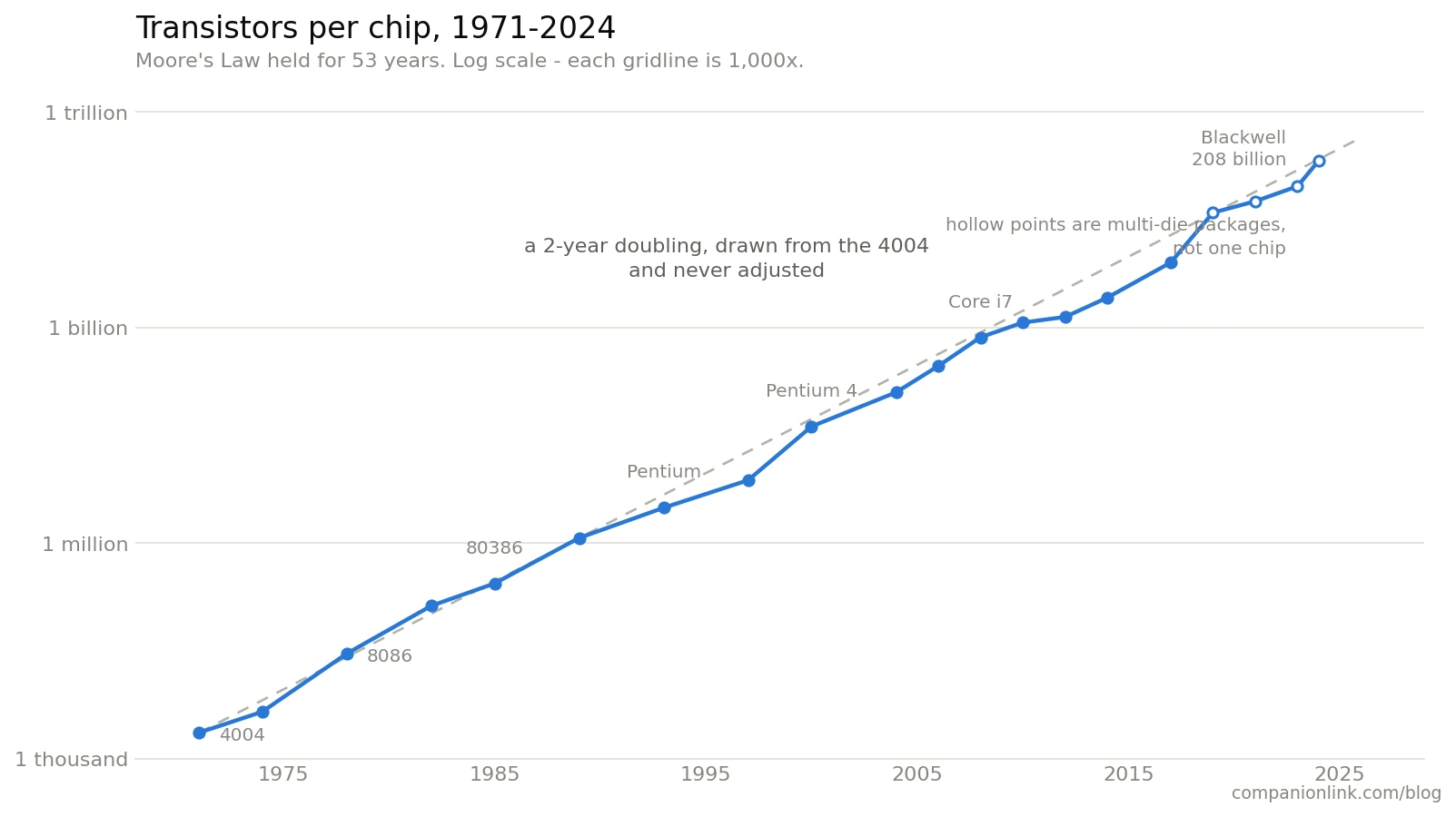
Technically, Rubin is more than one chip; it’s several pieces of silicon packaged together. Purists say that stretches his claim, and they have a point. But the transistors are real, and the line is real.
So Moore’s Law is still valid.
Chip Clock Speed – Did Not Last
Clock speed regulates how fast a CPU handles instructions. From the time of Moore’s Law, it climbed a similar scale. From 1974 to 2004, it climbed from 2 megahertz to 3.8 gigahertz. That is 1,900 times faster in 30 years.
And then – unlike Moore’s Law, there came a physics problem, and clock speed stopped increasing. From 2004 to 2026, clock speed has gone up 1.6 times to 6 gigahertz.
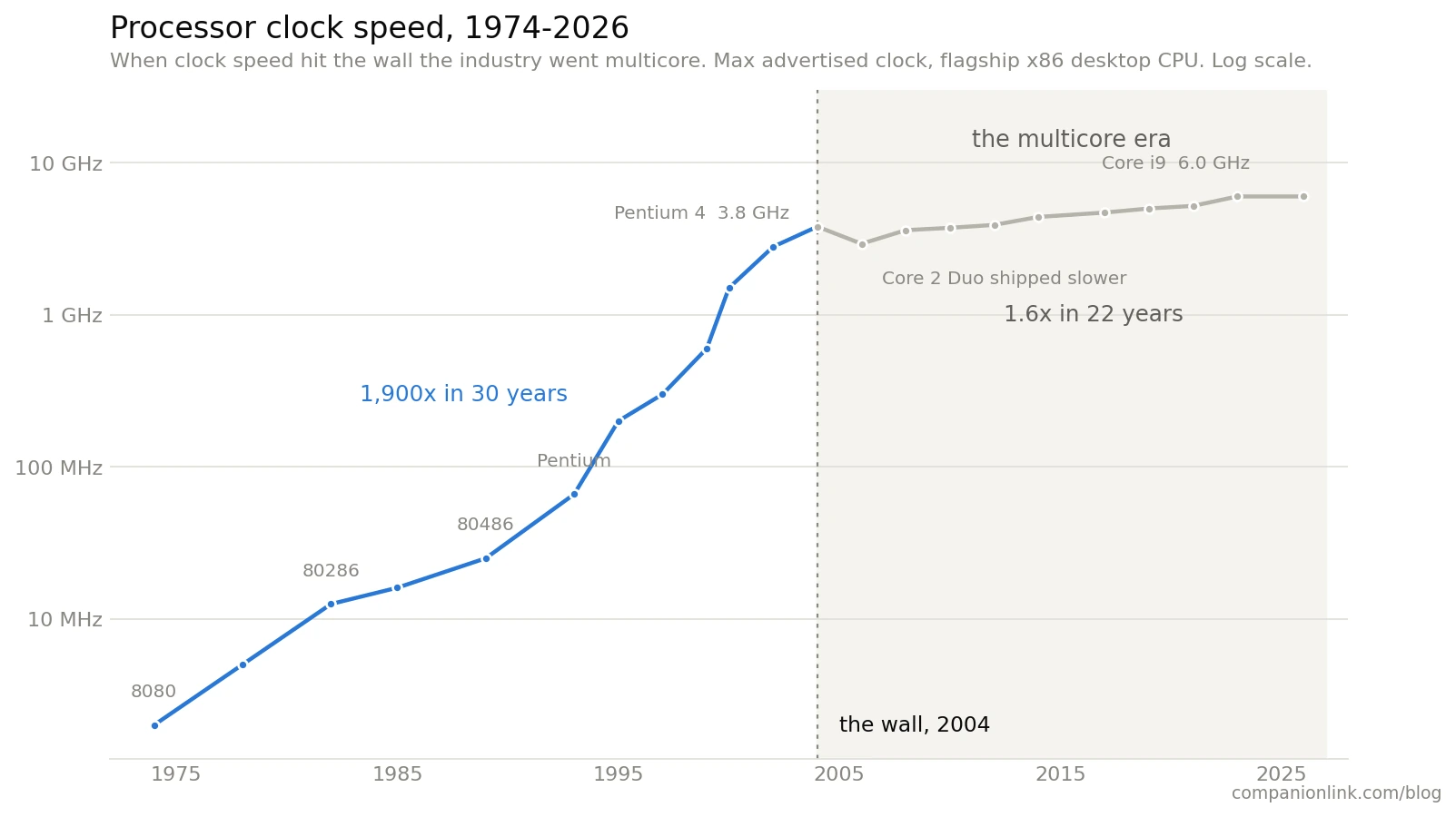
The reason is heat. Switch a transistor faster, and it leaks more current. More current leaks, and you make more heat. By 2004, the chips ran hot enough that Intel created a new plan.
Instead of pushing clock speed, the semiconductor industry switched to multiple processors. First came Intel’s Core 2 Duo. More recently, an Intel i9 has 24 processors and Xeon 6 has 288 processing cores. So the industry bypassed clock speed by putting more processors on one chip.
That rule still holds, and it is why AI looks the way it does. One job does not get faster anymore. Only jobs that split into many pieces get faster. AI runs on graphics chips with thousands of small cores for exactly that reason.
What Is the Moore’s Law of AI?
It is not transistors, and it is not clock speed. It is task length.
An independent group called METR measures it. They time how long a job takes a human expert. Then they test which of those jobs AI can finish on its own. The result gets reported in minutes and hours, not gigahertz.
In 2019, AI handled six-second tasks. Today it handles twelve-hour tasks. That number has doubled every six months for seven years. Since 2023, it has doubled every four months.
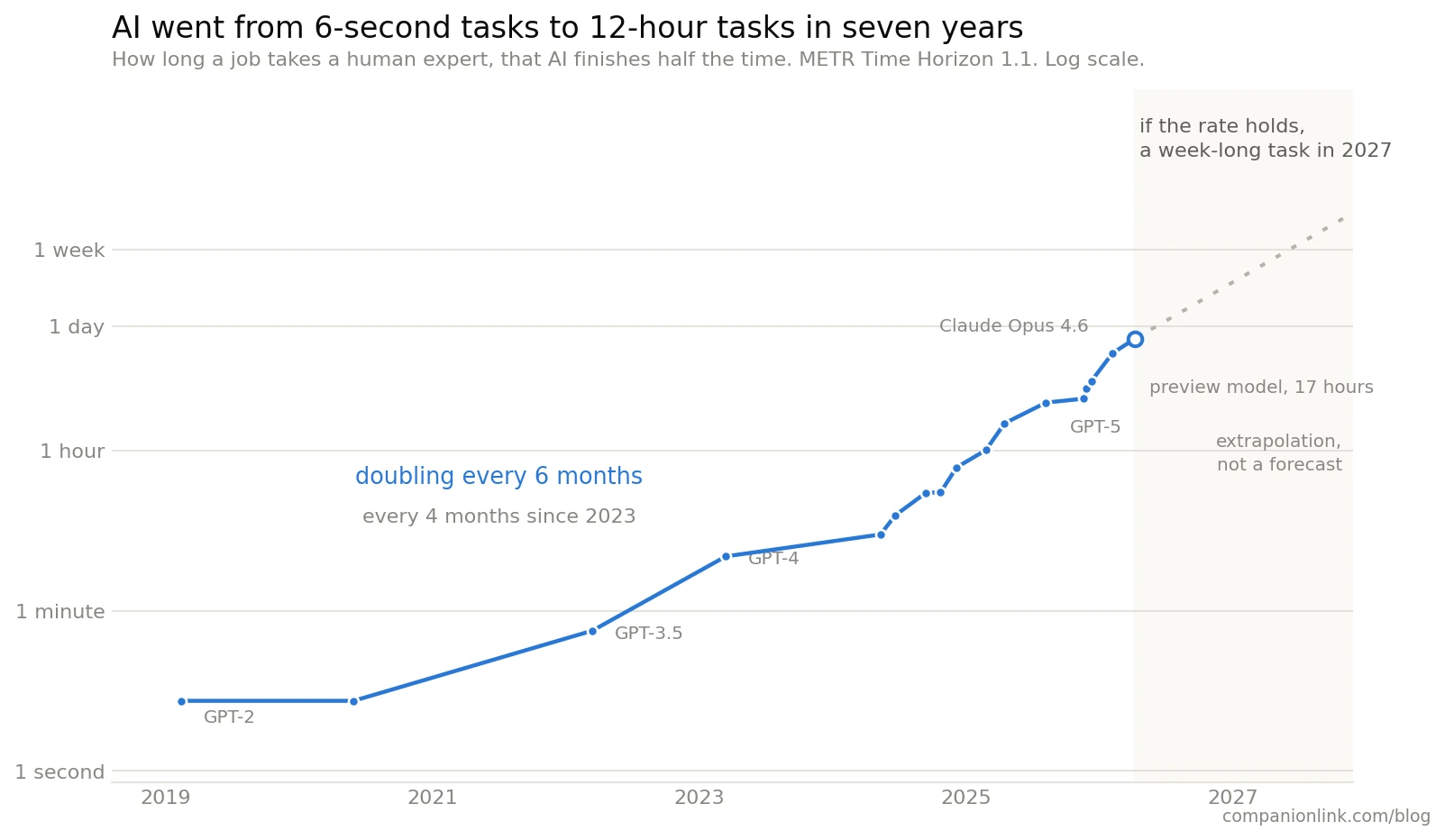
In practical terms, today’s flagships. GPT-5.6 and Fable 5 will look uselessly dumb by March 2028.
In March 2028 – you will still use the same microwave oven. You will drive the same car. Your child will be 3 grades higher in school, and Fable 5 will be used for low-level and unimportant AI tasks.
Measuring AI Training Compute
Before 2012, the computing power used to train AI models doubled about every 20 months. That is roughly the pace of Moore’s Law, because chips were the limit. Then in 2012, a small team at the University of Toronto entered an image recognition contest with a program called AlexNet. They trained it on graphics cards used for gaming. It won by a wide margin.
After that, the curve bent upward, much like Moore’s Law. Training runs today use about a billion times more computing power than AlexNet did fourteen years ago.
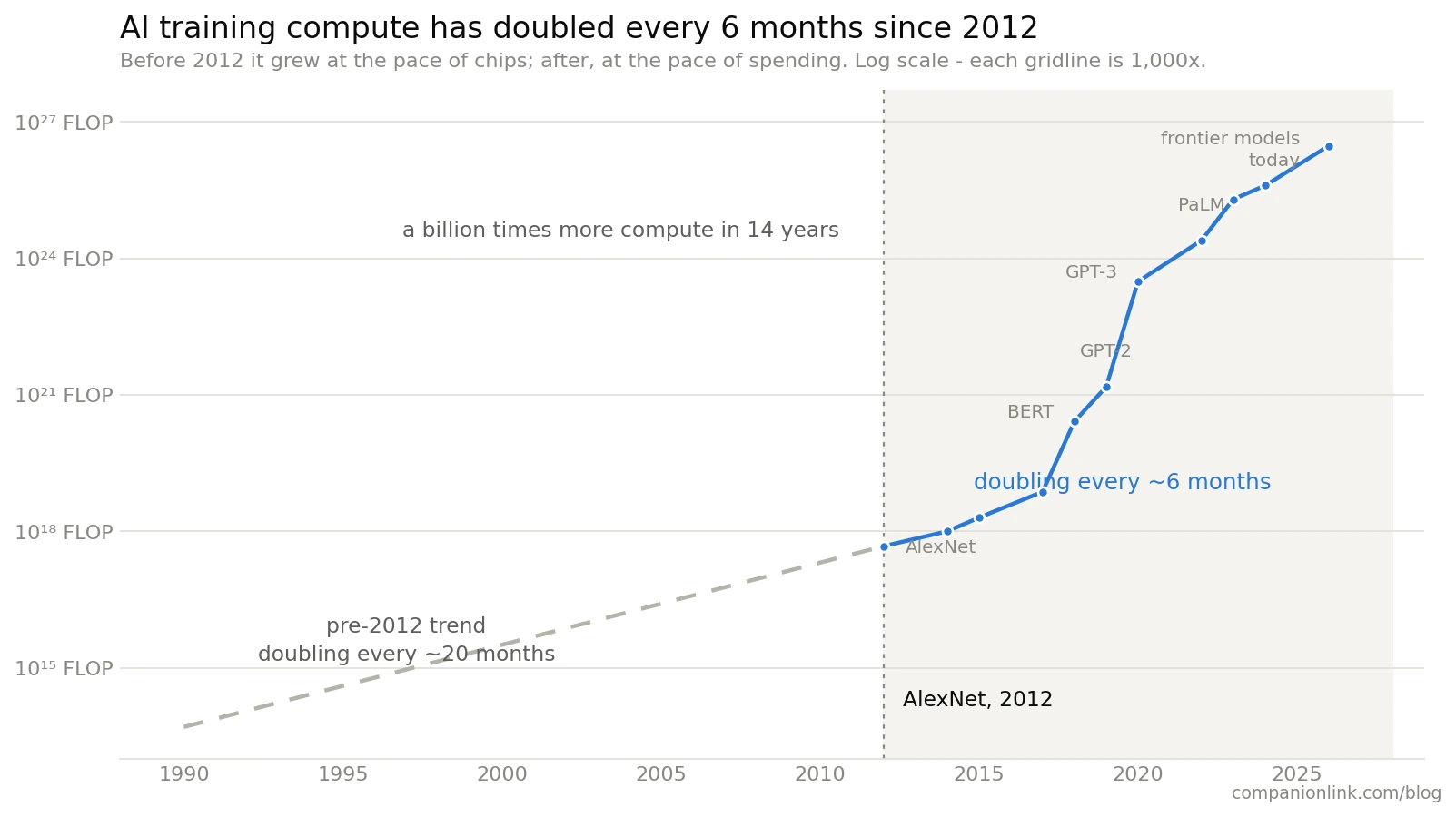
This task graph rises faster than Moore’s Law. So where did the extra billion come from?
The success came from two places: improved techniques and using many more chips at once.
Improved techniques
The biggest one has a name: the transformer. Google researchers published it in 2017. Older designs read text one word at a time so they couldn’t split the work across cores. The transformer reads a whole passage at once, which fits the multi-core hardware perfectly. Each year of new methods has since cut the computing needed for the same result by roughly two-thirds.
Using a lot more chips
AlexNet trained on two gaming graphics cards. Today’s largest training runs use more than 100,000 chips wired together, running for months without stopping. The chips have to talk to each other constantly, so the wiring between them became as expensive an engineering problem as the chips. This is the half that costs billions, and it is the half that shows up on an electric bill.
The AI Feedback Loop has Started.
We are now at a time where AI designs new AI techniques, AI improves chips, and AI improves architecture. This has enabled continued improvements beyond earlier projections.
Why Does AI Use So Much Power?
Not because the chips got worse. They got much better.
The energy needed to process one unit of text has dropped sharply since 2020. Better chips did part of that. Better methods did more of it. Measured per unit, AI is far more efficient than it was five years ago.
Energy per finished job went the other direction. It went up. A twelve-hour task cannot cost what a six-second task cost. Longer work means more steps, more reading, more checking, and more attempts. Task size grew faster than efficiency improved.
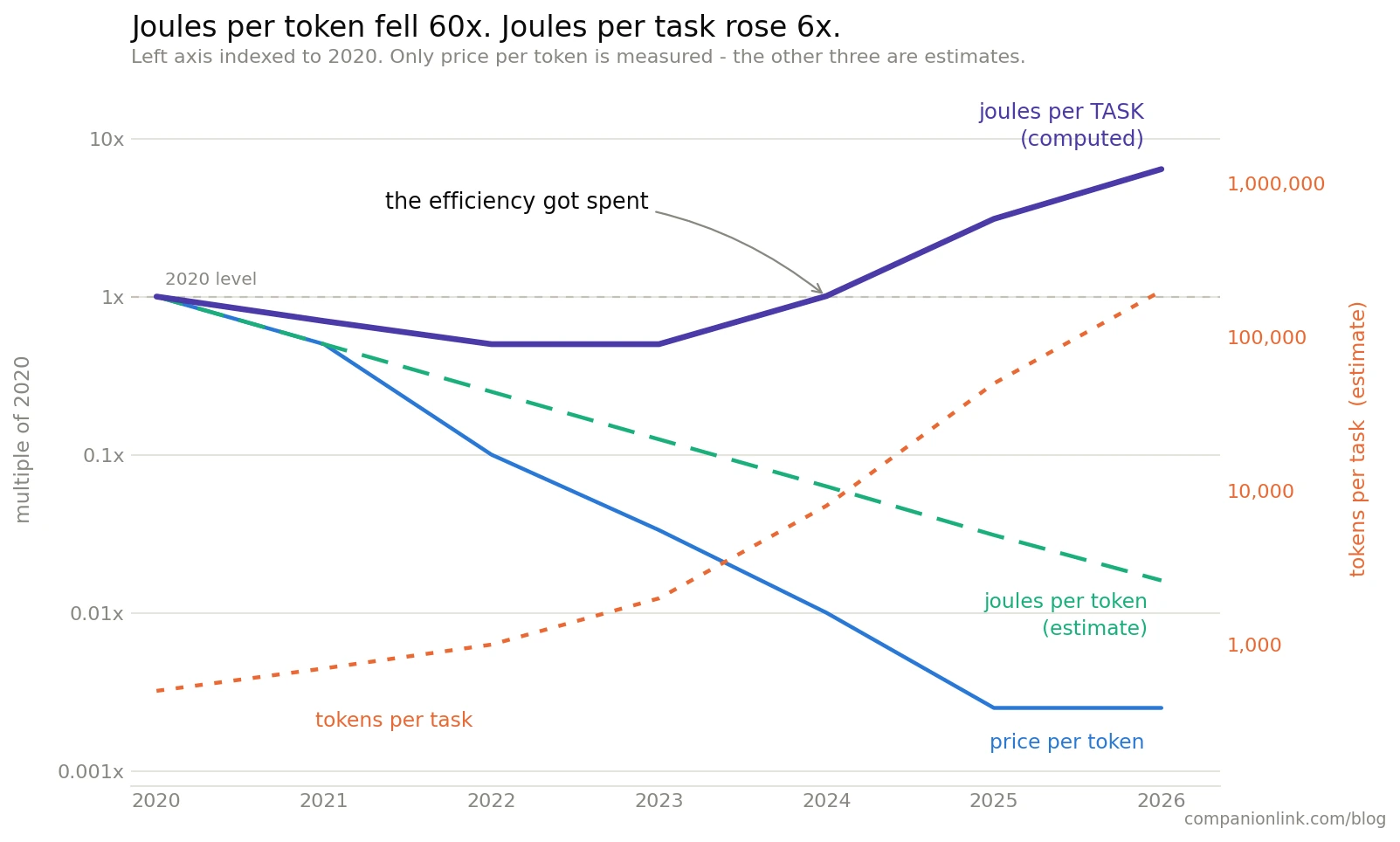
So while AI techniques improved and cost dropped – the expectation of what AI can do increased faster than the physical limits of technology.
Even with Moore’s Law, hundreds of processors, and improved techniques, anticipation is still pushing expectations higher. The job got bigger than the already incredible technical gains of the hardware.
And we can achieve those using higher power, which generates higher heat. All we need are more compute centers that use more power and water-cooling systems.
You are using Claude Opus to generate an article that Sonnet could do. You are using GPT 5.5 to spell-check an article that GPT 4o-mini could do. Why? Because the direct cost isn’t passed on, it becomes trivial to be wasteful.
Why go to the airport on a bicycle when you can Uber a Tesla instead?
What This Means
Moore’s Law is healthy. Clock speed had an era, but that era ended in 2004, replaced by multi-core processing. AI has a trend line based on task complexity, and it doubles every six months. We continue to hurtle toward an unimaginable future where Star Trek-like compute will happen within our lifetimes.
The power problem is not a hardware failure.
The power problem is an expectations problem. We see the results and adjust our expectations, and suddenly the job gets bigger. Gamers used to “overclock” to gain a slight edge on other gamers. Our current geeks are using AI to ferociously drive our current chip generations to ever more productive tasks. Your business competitor is using AI to gain market share, and you have to use AI to maintain parity. The bigger, faster, hotter, more-core, more-expensive AI wins market share, makes the profit.
That’s the power problem.

Frequently Asked Questions
Will Moore’s Law apply to AI?
Not as a measure of progress. Moore’s Law counts transistors, and AI progress no longer tracks transistor counts. AI task length doubles every six months. Transistors double every two years. Moore’s Law still describes the chips accurately. It stopped describing the results.
Why is Moore’s Law no longer valid?
It is still valid. Transistor counts keep doubling on schedule. What ended in 2004 was clock speed, which is a different rule entirely. Most “Moore’s Law is dead” headlines are describing the clock speed wall and using the wrong name for it.
Is AI faster than Moore’s Law?
Yes, about four times faster. AI task length doubles every six months, while Moore’s Law doubles every two years. Since 2023 the AI figure has run closer to four months, which is six times Moore’s pace.
Why does AI require so much energy?
Because the jobs got bigger, not because the chips got worse. Energy per unit of text has dropped sharply since 2020. But a twelve-hour task takes far more computing than a six-second one. Task size grew faster than efficiency improved.
How much electricity does AI consume?
The International Energy Agency put AI-focused data centers at 155 terawatt-hours in 2025, roughly half a percent of world electricity. All data centers together used about 485 terawatt-hours. The IEA expects that to roughly double by 2030, reaching near 3 percent of global demand.