Unexpected equipment failure stops business operations instantly. Facility managers often struggle to track every structural component manually.
Traditional paper logs create gaps in maintenance schedules. Tech-driven audits solve this issue by gathering live data on commercial systems.
Commercial properties require constant vigilance to remain safe and profitable. Shifting from reactive repairs to predictive maintenance saves capital. Digital records give managers complete visibility over 100s of building operations.
Identifying Commercial Roofing Issues
Commercial roofs face constant exposure to harsh weather elements. If you suspect leaks, you can find out more about common roofing issues by talking to an expert team. Early detection saves over $5,000 in emergency repairs.
Water damage from a neglected roof threatens internal inventory and electronic gear. Structural deterioration weakens the entire commercial building gradually. Regular digital monitoring catches small cracks before major leaks develop.
Roofing inspections form the baseline of an effective facility protection plan. Drone photography and thermal scans reveal hidden pooling water beneath the surface. Solving these issues early prevents mold growth inside office spaces.
Tracking With Asset Management Systems
Tech tools track equipment life cycles across large facilities. An official government guidelines webpage states that advanced tracking systems help managers study asset performance, repair fees, and operational pauses.
Digital platforms store this equipment records safely. Facility leaders use the database to determine when older machinery needs replacement.
Maintenance crews access these reports from mobile devices during daily routines. Having instant access to machine history speeds up decision-making. Teams solve mechanical glitches before 2 or 3 operations suffer.
The Role Of Preventive Maintenance
Proactive care keeps physical plant machinery running smoothly. A university facility manual explains that preventive maintenance includes routine inspections, adjustments, and minor fixes to reduce breakdowns and maximize equipment efficiency.
Technicians follow detailed schedules to handle adjustments before parts wear out completely. Consistent upkeep extends the functional lifespan of expensive climate control units. Avoidable service outages drop by 40% under this model.
Regular lubrication keeps heavy motorized parts from grinding together. Catching minor wear during weekly checks reduces long-term replacement expenditures. Facilities maintain steady productivity when machinery remains dependable.
Prioritizing Capital Renewal Projects
Prioritizing repair tasks keeps facility budgets balanced throughout the fiscal year. Educational facility guidelines highlight that an audit program ranks renewal projects based on urgency and mission importance.
Teams review these architectural reports to address hazardous conditions first. Clear metrics prevent minor system flaws from growing into major structural breakdowns. Long-term planning becomes easier when managers possess verified asset data.
Property owners avoid wasting 10% of their funds on non-critical upgrades. Every single dollar goes toward resolving the most pressing building issues.
Common Operations Checked During Audits
Modern inspectors examine 4 main building sectors during a standard walk-through. They combine visual checks with sensor readouts to create a comprehensive property profile.
Field teams focus on specific high-risk areas during their evaluations:
Electrical panels and backup power generators.
Heating, ventilation, and air conditioning machinery.
Plumbing networks and main water valves.
Foundation stability and exterior wall seals.
Data gathered from these points populates the main tracking software. Managers see a complete color-coded map of facility health. This layout shows exactly where immediate maintenance investments are required.
Maximizing Energy Efficiency Gains
Tech-driven asset audits do more than prevent sudden equipment breakdowns. These assessments pinpoint hidden energy waste throughout the commercial facility. Outdated cooling systems often draw excessive electrical power without providing optimal climate comfort.
Upgrading components based on audit data lowers monthly utility bills. Sensors identify drafty zones and insulation gaps around windows. Fixing these leaks reduces the strain on your primary heating units.
Sustainable building operations improve corporate public image. Customers appreciate businesses that actively reduce their carbon footprint. Smart asset management aligns financial savings with environmental responsibility.
Savings From Digital Oversight
Digital asset histories lower operational expenses for building owners. Accurate records provide proof of routine maintenance for insurance providers and safety inspectors. This clear documentation reduces liability risks and protects property values.
Emergency repair calls cost significantly more than planned maintenance visits. By switching to tech-driven inspections, corporations protect their staff and their financial investments. Continuous monitoring transforms facility management from reactive panic to steady stability.
Predictable operational costs allow companies to invest in expansion. Funds once set aside for sudden breakdowns now support business growth. Technology changes maintenance from a frustrating expense into a strategic advantage.
Embracing modern auditing methods supports long-term commercial success. Data-driven insights replace guesswork with clear facts.
Facilities operate more efficiently when technology guides upkeep decisions. Protecting physical property safeguards the future of the entire enterprise.
Smart companies utilize tech audits to remain competitive in their industries. Avoiding unexpected shutdowns keeps customer satisfaction high. Investing in asset tracking today guarantees smooth business performance tomorrow.
Preventing Facility Downtime: Tech-Driven Commercial Asset Audits was last modified: May 27th, 2026 by Charlene Brown
Luxury travel has changed dramatically over the past decade. Today’s affluent travelers are no longer focused solely on five-star hotels or first-class flights. Increasingly, the journey between destinations has become just as important as the destination itself.
Whether arriving for a corporate event, a long weekend in the city, or an international business engagement, travelers now expect continuity across every part of the experience. Convenience, personalization, discretion, and seamless coordination are no longer viewed as upgrades — they are baseline expectations.
That shift is helping reshape how travelers view urban transportation. In major cities, particularly business and hospitality hubs, the modern Chicago limo experience has evolved far beyond traditional notions of luxury transportation. What was once considered an occasional indulgence is now becoming part of a broader premium travel ecosystem built around efficiency, comfort, and connected convenience.
For many travelers, especially executives and high-frequency flyers, transportation is no longer simply functional. It has become an extension of the overall travel lifestyle.
The Evolution of Luxury Mobility
Luxury transportation once revolved around status. Stretch limousines, ceremonial arrivals, and event-based travel dominated public perception for decades. Today, however, luxury mobility has become more subtle, more personalized, and significantly more integrated into modern travel behavior.
Affluent travelers increasingly prioritize experiences that reduce friction. They value services that allow transitions between airports, hotels, meetings, restaurants, and entertainment venues to feel coordinated and effortless.
This is particularly visible in cities like Chicago, where fast-paced schedules and dense urban movement demand reliability alongside comfort. The rise of premium chauffeur service providers reflects broader changes in traveler expectations — especially among professionals balancing productivity with leisure.
Modern travelers often look for transportation experiences that feel curated rather than transactional. Privacy, quiet interiors, digital communication, route flexibility, and professional chauffeurs now carry as much value as the vehicle itself.
The evolution of limo service chicago providers reflects this larger trend toward seamless mobility.
Why Travelers Are Prioritizing Convenience Over Excess
Luxury today is less about display and more about time.
For executives, entrepreneurs, and high-net-worth travelers, convenience has become one of the most valuable forms of premium service. Delays, uncertainty, inconsistent communication, and logistical stress interrupt the rhythm of travel experiences that are otherwise carefully planned.
This is one reason why premium transportation services are increasingly integrated into luxury travel itineraries from the beginning rather than booked as an afterthought.
Airport transportation Chicago services, for example, are now expected to operate with the same level of coordination as luxury hospitality brands. Travelers want proactive communication, flexible scheduling, accurate arrival timing, and smooth digital booking systems that align with their broader mobile-first lifestyles.
The appeal lies not only in comfort but also in predictability.
For many travelers, stepping into a professionally managed black car service after a long flight creates an immediate sense of transition — from crowded terminals and logistical complexity into a calmer, more controlled environment.
That psychological shift has become part of the luxury experience itself.
How Connected Travel Experiences Are Reshaping Transportation
The modern luxury traveler operates within a connected ecosystem.
Flights are tracked in real time. Hotels offer mobile concierge services. Dining reservations update instantly. Smart itineraries synchronize across devices. Transportation is increasingly expected to function within that same seamless framework.
This shift toward connected travel experiences is transforming the expectations surrounding executive transportation and urban mobility services.
Travelers increasingly prefer providers that emphasize responsiveness and adaptability. Real-time communication, digital confirmations, flexible rerouting, and mobile accessibility are becoming standard expectations rather than premium add-ons.
In this environment, transportation personalization matters more than ever.
A traveler arriving for Fashion Week may prioritize discretion and schedule flexibility. A corporate executive may value onboard privacy and uninterrupted productivity. A leisure traveler planning a luxury weekend may prioritize atmosphere, presentation, and convenience.
The rise of private chauffeur experiences in Chicago reflects how transportation itself is becoming part of curated luxury travel culture.
The Blending of Business and Leisure Travel
One of the most significant changes influencing luxury transportation is the continued blending of business and leisure travel.
Executives increasingly extend work trips into personal travel experiences. Remote work flexibility has also created a new category of traveler who moves fluidly between professional obligations and lifestyle-driven travel.
As a result, transportation expectations have evolved accordingly.
Travelers now seek mobility experiences capable of adapting to hybrid schedules that may include airport pickups, meetings, dining reservations, shopping districts, cultural events, and evening entertainment within the same itinerary.
This has elevated demand for services that emphasize both professionalism and hospitality.
For many travelers, a modern chauffeur service represents more than transportation. It provides continuity, allowing movement throughout a city to feel coordinated rather than fragmented.
The expectation is no longer simply arrival. It is experience continuity.
Chicago’s Growing Role in Premium Urban Travel
Chicago remains one of the most important urban travel hubs in the United States. Its role in finance, conventions, hospitality, dining, and entertainment creates consistent demand for executive mobility and premium transportation services.
Business travelers arriving in the city often operate within compressed schedules where efficiency matters. At the same time, luxury leisure travelers increasingly seek curated urban experiences that combine hospitality, dining, architecture, culture, and private mobility.
This dual identity makes the city particularly relevant to evolving luxury transportation trends.
Modern Chicago limo service providers increasingly position themselves within broader hospitality and executive travel ecosystems rather than traditional transportation categories alone.
That includes focusing on:
Seamless airport coordination
Executive-level communication
Personalized scheduling
Discreet service standards
Premium vehicle presentation
Digital convenience
Comfort-driven travel experiences
The transportation itself becomes part of how travelers experience the city.
What Travelers Should Look for in Premium Transportation Services
As luxury transportation evolves, travelers are becoming more discerning about service quality and operational standards.
Vehicle appearance alone is no longer enough.
Today’s premium travelers often evaluate transportation services based on the broader experience they provide before, during, and after the ride itself.
Several factors increasingly shape traveler expectations:
Professionalism and Communication
Responsive communication remains one of the most important markers of premium service. Travelers expect clear confirmations, timely updates, and reliable coordination — particularly around airport transportation and schedule-sensitive events.
Scheduling Reliability
Luxury travelers prioritize predictability. Delays and inconsistent arrival timing undermine the experience regardless of vehicle quality.
Privacy and Comfort
Executives and high-profile travelers often value privacy just as much as luxury aesthetics. Quiet interiors, professional discretion, and comfortable environments contribute heavily to overall satisfaction.
Mobile Booking Simplicity
Digital convenience is increasingly essential. Mobile-friendly scheduling systems, streamlined confirmations, and flexible itinerary management reflect broader consumer expectations shaped by modern hospitality and technology platforms.
Consistency Across Experiences
Perhaps most importantly, travelers seek consistency. A premium transportation experience should feel dependable regardless of trip type, destination, or schedule complexity.
The Rise of Smart Luxury Mobility
The future of luxury transportation is increasingly tied to smart mobility ecosystems.
As cities become more digitally connected, premium transportation providers are adapting to consumer expectations shaped by technology-driven convenience. Travelers now expect transportation experiences that mirror the efficiency and personalization found across luxury hospitality and retail sectors.
This includes:
AI-assisted scheduling optimization
Real-time traffic adaptation
Integrated digital communication
Personalized traveler profiles
Streamlined reservation systems
Mobile-first coordination
While luxury mobility still depends heavily on human service and professionalism, technology increasingly supports the seamlessness travelers expect.
This shift reflects broader transformations within affluent consumer behavior. Luxury is becoming quieter, smarter, and more experience-oriented.
The emphasis is moving away from visible excess and toward invisible efficiency.
Why Seamless Transportation Is Becoming a Luxury Essential
In many ways, transportation has become one of the defining elements of the modern luxury experience.
A beautifully designed hotel loses some of its appeal if the arrival experience feels stressful. An executive itinerary becomes less productive when travel logistics create interruptions. A carefully planned leisure trip can feel fragmented without smooth coordination between destinations.
As luxury travel becomes increasingly personalized, transportation occupies a more central role within the overall journey.
The growth of premium limo Chicago services reflects that reality.
Travelers are not simply paying for a vehicle. They are investing in convenience, continuity, professionalism, and peace of mind — qualities that increasingly define luxury itself.
Conclusion
Luxury travel continues to evolve toward experiences that feel seamless, personalized, and intelligently connected. In that environment, premium transportation is no longer viewed as separate from hospitality or executive travel — it has become part of the broader lifestyle ecosystem modern travelers expect.
The rise of Chicago limo service providers reflects larger shifts in how affluent travelers define comfort and convenience. Increasingly, luxury mobility is less about extravagance and more about efficiency, coordination, privacy, and experience continuity.
As urban travel grows more dynamic and digitally connected, transportation services that combine professionalism with modern convenience are likely to play an even larger role in shaping premium travel experiences.
For travelers navigating fast-paced cities, the future of luxury may ultimately be defined not only by where they stay — but by how effortlessly they move through the journey itself.
The Hidden Role Premium Travel Services Play in Convention and Esports Culture was last modified: May 19th, 2026 by Grind
AWS bills tend to climb faster than most teams expect. One new workload, a few more environments, and cloud spend starts eating into hiring plans and runway.
The good news is that AWS discounts for startups are not limited to huge companies with massive contracts. With the right path, you can combine startup credits with ongoing price reductions, and Spendbase gives finance leaders a practical way to pursue both without adding more manual work.
What AWS discounts can look like for startups
Startup cloud savings usually come in two forms: credits and lower rates. Credits reduce future AWS charges until the balance runs out. Discounts lower what you pay over time, which matters once usage becomes steady.
As of May 2026, AWS Activate can offer smaller packages for early teams and larger packages through approved partners. That range starts around $1,000 for some bootstrapped founders and can reach up to $100,000 in AWS credits for eligible startups backed by partner networks.
AWS Activate credits and who may qualify
AWS Activate Founders is built for very early companies with limited revenue or funding. Portfolio and partner-backed packages are meant for startups connected to approved VCs, accelerators, or incubators, and eligibility often depends on stage, age of the company, and prior credit use.
Why credits are different from long-term price cuts
Credits help cash flow right away, but they expire. Ongoing discounts matter later because they can reduce every bill that follows. That difference is why many teams look for both.
Credits buy time. Rate reductions improve the baseline.
How to get AWS discounts with Spendbase
Spendbase starts with your current spend picture, then matches it against benchmarks, partner offers, and prior negotiation data. That helps finance teams see what savings may be realistic before they spend weeks chasing vendors.
For companies that want details, the AWS discounts page outlines potential credits and ongoing savings in one place.
Share your AWS and company spend details
The input is simple. Spendbase looks at factors like current spend, plan details, license counts, and renewal timing. You can add data through integrations, CSV uploads, or manual entry, so the process fits how your team already works.
Let Spendbase handle the negotiation and paperwork
This is where time savings show up. Spendbase doesn’t only surface offers. It also helps secure credits, better terms, and lower rates, while your team keeps control of approvals and visibility.
What finance teams can expect beyond AWS credits
The value goes past one-time credits. Spendbase also promotes ongoing cloud savings, including AWS pricing reductions of up to 3% in some cases, plus broader savings across SaaS, procurement, and spend visibility. Outcomes vary, but better forecasting is often the biggest win.
Use savings to improve budget planning
Lower cloud costs free up cash for product work, hiring, or a longer runway. For finance leads, that means cleaner forecasts and less guesswork around burn.
Why this matters for growing companies
Small cloud savings compound as usage grows. For scaling teams, startup AWS discounts are not only about cutting costs today. They help build a healthier cost base for the next stage.
Conclusion
AWS savings usually come from two buckets, startup credits and ongoing discounts. Strong finance teams know the difference because each solves a different budget problem.
Spendbase gives founders, COOs, and finance leaders a practical way to pursue both. That means lower cloud costs, clearer visibility, and less time spent negotiating by hand.
How Startups Can Get AWS Discounts Through Spendbase was last modified: May 19th, 2026 by Colleen Borator
There’s a version of business growth that feels like a slow trade-off — the more clients you take on, the less personal your communication becomes. Responses get templated. Follow-ups get delayed. The thank-you note you meant to send after the project wrapped never quite made it out the door.
The tools on this list exist to close that gap. Not by faking personalization, but by making the real thing easier to execute consistently — whether you’re serving 20 clients or 200. Each one handles a different channel or moment in the client relationship, and together they cover most of what small business owners mean when they say they want to “stay in touch better.”
1. Handwrytten — Automated Handwritten Notes Sent by Real Robots
Nothing on this list produces something quite like what Handwrytten delivers. The service uses over 200 in-house robotic handwriting machines — holding real ballpoint pens — to write physical notes on cards and mail them via First Class postage. You type the message, choose a card design, and it goes out looking like you sat down and wrote it yourself.
For small business owners, the appeal isn’t the novelty. It’s the combination of impact and automation that most outreach tools can’t offer simultaneously.
Physical mail has an 80% open rate. That’s not a marketing claim — it’s the natural result of the fact that a handwritten envelope on someone’s desk doesn’t get filtered into a promotions tab or auto-archived. It gets opened, read, and often kept. A client who receives a thank-you card after their first purchase, or a note on their business anniversary, remembers it in a way that another email never could produce.
What makes Handwrytten genuinely useful for small businesses — rather than just a nice idea — is the automation layer sitting underneath. The service integrates directly with Salesforce, HubSpot, Blackbaud, Zapier, Make.com, n8n, and Pabbly. For business owners already running CRM-based workflows, this means cards can be triggered automatically: a welcome note when a new client is added, a thank-you when a project closes, a birthday card when the date arrives in the contact record. Claude/MCP integration is also available for AI-driven workflow automation.
The platform is SOC2 compliant, which matters for small businesses handling client contact data or working with clients in regulated industries. Turnaround on most orders runs one to two business days, with domestic delivery via USPS typically arriving within a week. Cards ship to 190+ countries for businesses with international clients.
Pricing starts at $3.75 per card, with volume discounts and subscription plans that bring costs down for regular senders. Custom stationery, branded card designs, and even a custom font built from your own handwriting are all available.
For a small business owner who has always meant to send more personal notes but never has the time, Handwrytten is the tool that finally makes it happen — without the friction that stops it from happening in the first place.
2. HubSpot CRM — Relationship Tracking That Keeps Context Front and Center
Most small businesses lose the personal touch not because they stop caring, but because they lose track. A client mentions their daughter is starting college. Three months later, you have no idea. The conversation that could have opened naturally closes because the context disappeared.
HubSpot’s free CRM tier is built around solving exactly this problem. Every interaction with a contact — calls, emails, meetings, notes — gets logged on a timeline. When you open a contact record before a call or before writing an email, you see everything: the last conversation, what was discussed, any personal details you logged. The relationship doesn’t reset every time.
For small businesses, the free tier covers a lot of ground: contact management, deal pipelines, email templates, meeting scheduling, and basic automation. Paid tiers add email sequences, more sophisticated automation, and reporting that shows which outreach efforts actually lead to closed business.
HubSpot connects directly with Handwrytten, which means physical note-sending can be triggered from within the same system managing the rest of your client communication. A deal moves to “closed won” — a card goes out automatically. A contact hits their one-year anniversary as a client — a note is queued without anyone remembering to send it.
The combination of a CRM that maintains context and a physical outreach tool that delivers something tangible is where the “personal at scale” idea actually becomes real rather than aspirational.
3. ActiveCampaign — Email Automation That Doesn’t Read Like Automation
Email is still the backbone of most small business outreach, and the difference between email automation that works and email automation that annoys people comes down almost entirely to how it’s written and when it is sent.
ActiveCampaign sits in a useful middle ground for small businesses: more capable than basic email tools like Mailchimp, less expensive and complex than enterprise marketing platforms. Its core strength is conditional logic — the ability to branch sequences based on what a contact actually does. If someone opens an email but doesn’t click, they get a different follow-up than someone who clicked but didn’t reply. If a contact visits your pricing page, a triggered email can go out within minutes referencing that moment.
For service businesses especially, this kind of behavior-based triggering is what separates communication that feels timely from communication that feels like a batch blast. A prospect who downloaded your case study three days ago and just visited your contact page is a different conversation than a cold lead who hasn’t engaged in months.
ActiveCampaign also handles SMS, site tracking, and CRM functionality — useful for small businesses that want fewer separate tools. Pricing scales with contact list size, starting at around $15/month for small lists, which makes it accessible for businesses that aren’t running large email operations yet.
4. Calendly — Removing the Back-and-Forth From Scheduling
The scheduling back-and-forth — “Does Tuesday work?” “I can do Wednesday afternoon or Friday morning” — is one of those small friction points that compounds badly when multiplied across a full client roster. It’s not relationship-damaging on its own, but it consistently signals that working with you involves unnecessary steps.
Calendly solves this cleanly. You share a link, the other person picks a time that works from your real availability, and the meeting appears on both calendars. No email thread. No double-booking risk. Reminders go out automatically.
For small business owners, the relevant features go beyond basic scheduling. Calendly can route different meeting types to different team members, collect intake questions before a meeting begins, and trigger workflows in connected tools when a booking is made. A new client books an onboarding call, and a welcome email goes out through ActiveCampaign, their contact is created in HubSpot, and — if you’ve set it up — a welcome card gets queued in Handwrytten. That chain of events runs without anyone touching it manually.
The free tier handles a single event type and covers basic scheduling. Paid plans, starting around $10/month per user, add multiple event types, workflows, and the integrations that make Calendly a trigger point rather than just a scheduling tool.
5. Loom — Replacing Emails With Faces
Text-based communication strips out a lot of what makes a message feel personal. Tone disappears. Nuance gets lost. A client reading a paragraph of feedback has no way of knowing whether you’re frustrated or just efficient.
Loom lets you record short videos — screen, camera, or both — and share them via link. The recording takes seconds, no editing required, and the recipient gets something closer to a conversation than a document.
For small business owners, the use cases are specific and high-value. Sending a proposal? Record a two-minute walkthrough instead of hoping the client reads the whole thing. Delivering feedback on a project? A video where the client can hear your tone and see your face lands completely differently than a bullet-point list. Responding to a complex question? Talking through it is often faster to produce and easier to absorb than writing it out.
Loom also shows you when someone watched your video and for how long, which gives useful signals about engagement. A prospect who watched your proposal walkthrough three times is a warmer conversation than one who opened the document for thirty seconds.
The free tier allows up to 25 videos and covers most small business use cases. Paid plans remove limits and add analytics, editing tools, and team features.
6. Zapier — The Connective Tissue Between Everything Else
None of the tools above operate in complete isolation, and manually moving information between them — copying a new client from your CRM into your email platform, triggering a Loom follow-up after a Calendly meeting, updating a deal stage when a card goes out — eats time that should go toward actual work.
Zapier connects over 7,000 apps and allows small business owners to build automated workflows between them without writing any code. When X happens in one tool, Y happens in another. The workflows (called Zaps) run in the background once you’ve set them up.
For the stack described in this list, Zapier is what makes the pieces work together. A new contact added in HubSpot can simultaneously trigger a welcome sequence in ActiveCampaign and queue a card in Handwrytten. A completed project in your project management tool can mark a deal closed in your CRM and send a thank-you note. A Calendly booking can create a task, send a confirmation email, and log the meeting — all without anyone touching multiple systems manually.
The free tier allows up to 100 tasks per month and covers basic single-step Zaps, which is enough to test whether automation is worth building out. Paid plans start at $19.99/month and expand task limits and multi-step workflows considerably.
How These Tools Work Together
The value of each tool on this list multiplies when they connect. A small business running all six — even at their free or entry-level tiers — has an outreach infrastructure that most companies much larger than them don’t.
A new client comes in through a referral. They book a call via Calendly. That booking creates a contact in HubSpot and enrolls them in a welcome sequence in ActiveCampaign. After the call, you send a Loom video summarizing what you discussed and what happens next. When the contract is signed, a handwritten welcome card goes out through Handwrytten — triggered automatically, arriving within a week. Zapier handles every connection between these steps.
None of this requires a marketing team or a dedicated operations person. It requires an afternoon of setup and tools that, in most cases, cost less per month combined than a single hour of your billing rate.
The businesses that do this well don’t feel automated to their clients. They feel attentive — the kind of company that always seems to follow up at the right moment, remember the right details, and send the kind of note that actually gets kept on a desk. The tools make that possible. The relationships feel real because the gestures are real, even when the timing is automated.
6 Best Automated Outreach Tools for Small Business Owners Who Want to Stay Personal at Scale was last modified: May 19th, 2026 by Hudabia Fatima
Running a business has always involved uncertainty, but modern entrepreneurs are facing a wider range of risks than ever before. Economic shifts, digital security concerns, operational disruptions, legal responsibilities, and changing customer expectations all require business owners to think more proactively about long-term stability. As a result, many entrepreneurs are moving beyond reactive problem-solving and focusing more heavily on preventive habits that help reduce stress and improve resilience before issues become larger problems.
Risk management today is not only about avoiding worst-case scenarios. For many businesses, it is also about creating systems that improve consistency, communication, financial stability, and overall operational confidence. The businesses that adapt most successfully are often the ones that build stronger everyday habits around preparation, organization, and long-term planning instead of relying only on quick decisions during emergencies.
Better Communication Systems Reduce Operational Confusion
One of the most overlooked business risks is poor communication. Miscommunication between teams, clients, vendors, or customers often creates avoidable mistakes that cost businesses both time and money. As companies grow, maintaining organized and reliable communication systems becomes increasingly important for keeping operations efficient and reducing unnecessary disruptions.
Digital platforms such as Linq are increasingly being used by entrepreneurs looking for faster and more organized ways to manage professional networking, business communication, and contact sharing. Simpler communication systems often help businesses operate more smoothly because employees and clients can access information more consistently without relying on scattered conversations or outdated workflows.
Preventive Planning Helps Businesses Stay More Stable
Many entrepreneurs are placing greater emphasis on preparation rather than waiting for problems to force difficult decisions. Preventive planning often includes reviewing contracts, maintaining emergency funds, improving cybersecurity practices, and establishing clearer operational procedures before disruptions occur.
This proactive mindset usually helps businesses respond more calmly during unexpected challenges because systems are already in place. Companies that prepare in advance often recover faster from setbacks while reducing long-term financial and operational strain. Preventive habits also help business owners feel more confident making long-term growth decisions.
Insurance Awareness Is Becoming More Important
As businesses become more digitally connected and operationally complex, entrepreneurs are paying closer attention to legal and financial protection strategies. Liability concerns, workplace risks, property damage, cyber incidents, and professional disputes all have the potential to create significant financial stress if businesses are not properly prepared.
Firms such as Barger & Associates often work with businesses looking to better understand coverage options, operational protection, and long-term risk-management planning. Entrepreneurs increasingly recognize that insurance and legal preparedness are not simply formalities, but important parts of maintaining business stability and protecting future growth.
Financial disorganization is another issue that quietly creates major problems for many small businesses. Inconsistent recordkeeping, unclear budgeting, and poor expense tracking often make it harder for entrepreneurs to make informed decisions or respond quickly during challenging periods.
Many successful business owners now prioritize cleaner financial systems, more consistent reporting, and better cash-flow management as part of overall risk reduction. Organized finances generally improve not only stability, but also confidence when making hiring, investment, or expansion decisions. Clear financial visibility often allows businesses to adapt faster when market conditions shift unexpectedly.
Digital Security Has Become a Daily Priority
Technology has created enormous opportunities for entrepreneurs, but it has also introduced new forms of risk that many businesses did not face in previous decades. Data breaches, phishing scams, weak password systems, and online fraud can create serious operational disruptions for companies of all sizes.
As a result, more businesses are investing in stronger cybersecurity habits such as secure communication systems, employee training, multi-factor authentication, and regular data backups. Risk management increasingly includes digital protection alongside more traditional operational safeguards because online threats now affect nearly every industry.
Sustainable Work Habits Also Protect Businesses
Many entrepreneurs now recognize that burnout itself creates operational risk. Exhausted decision-making, poor work-life balance, and constant stress often lead to mistakes, inconsistent leadership, and long-term health problems that affect business performance over time.
Creating healthier schedules, delegating responsibilities, improving organization, and maintaining clearer boundaries often help entrepreneurs make better long-term decisions. According to Harvard Business Review, sustainable leadership habits and operational clarity may positively influence both productivity and long-term business resilience. Preventive risk management increasingly includes protecting the business owner’s well-being alongside financial and operational systems.
Long-Term Stability Usually Comes From Consistency
One reason smart risk-management habits continue gaining attention is because consistency often creates stronger protection than reactive decision-making alone. Businesses that regularly maintain communication systems, financial organization, operational planning, and preventive safeguards generally experience fewer disruptive crises over time.
Entrepreneurs are increasingly realizing that risk management is not separate from daily business operations. In many cases, the habits that create smoother workflows, better organization, and stronger communication also help businesses remain more resilient during periods of uncertainty or rapid change.
Smart Risk-Management Habits More Entrepreneurs Are Prioritizing Today was last modified: May 18th, 2026 by Prester Witzman
Warehouse managers often overlook the ground beneath their feet since it seems like a simple surface. A clear floor plan turns a chaotic space into a smooth and profitable operation. Smart layout choices make a difference in how a company handles growth.
Efficiency begins with how people and machines move through the aisles every single day. Small changes in layout lead to big gains in daily output and worker safety. Every foot of space must contribute to the goal of the business.
The Value Of Clear Layouts
Managing a warehouse requires a keen eye for detail and a focus on movement. Such a clear floor plan turns a chaotic space into a smooth and profitable operation. A smart strategy works by removing the guesswork from daily tasks for every employee. It transforms a simple storage room into a high-speed distribution center.
Planning where items go saves time and energy for every worker on the floor. Drivers spend less time searching for paths when every inch of the facility has a dedicated purpose. Clear paths reduce the confusion that often comes with a busy shift. Speed increases when everyone knows the rules of the road.
Crowded spaces lead to errors and slowed delivery times for customers. Maintaining a clean grid allows teams to focus on moving stock at a steady and predictable pace.
Safety Standards And Visible Paths
Safety is the top priority in any high-volume facility where heavy machines operate. Bright colors alert workers to potential hazards long before accidents happen. A safe worker is a productive worker who stays on the job longer. Visual cues are the first line of defense against workplace injuries.
A recent guide to floor standards suggested that paths for moving products are best defined using white or yellow paint. Such visual cues keep forklifts away from walking zones and pedestrian paths at all times. Contrast is the main goal here to keep everyone safe during their duties. Choosing the right colors prevents mistakes in low-light conditions.
Clear boundaries prevent collisions in tight corners and busy intersections. Well-maintained markings make certain that every person knows exactly where to stand during a shift.
Maximizing Storage Density
Space is expensive, and every square meter counts toward the final profit margin. Stretching the available area helps a business grow without moving to a costly new building. Maximum density is the key to managing a large inventory without losing control. Efficient storage keeps the business agile in a competitive market.
Defining specific zones is the first step toward a lean operation. Getting professional line marking Sydney or your area is an excellent way to organize these storage areas for maximum density. Many teams find that clear grids make stacking much faster and more accurate. Precision in these lines prevents the waste of valuable floor space in high-traffic areas.
Narrower aisles allow for more racking rows in the same footprint. Precise lines help operators navigate these tight spots without hitting the shelves or damaging products. Keeping a tight ship means more goods move through the door every month. Optimized aisles are the secret to a high-capacity facility.
Optimizing Traffic Flow
Traffic jams are not just for highways – they happen in warehouses too. One-way systems keep traffic moving in a steady circle throughout the busy day. Avoiding bottlenecks keeps the flow of goods moving from the dock to the rack. A steady pace is better than bursts of speed followed by long waits.
Keep heavy machinery separate from pedestrians.
Mark is loading the docks with high-visibility paint.
Label staging areas for incoming freight.
Define parking spots for charging equipment.
Speed limits and stop signs painted on the floor guide behavior without a manager. Drivers follow the flow naturally when the path is clear to see. Predictable movement is the foundation of a low-stress environment. Well-planned routes minimize the chance of a costly warehouse logjam.
Reducing Operational Waste
Wasted motion is a silent killer of warehouse profits and overall crew morale. Workers who wander looking for items drain the budget slowly over the course of time. Eliminating unnecessary steps is a core part of any lean management plan. Efficiency is found in the seconds saved during every single task.
Organized zones mean every tool and pallet has a home that is easy to find. Staff return equipment to the right spot when the floor shows them where it belongs. Better organization reduces the time spent on daily cleanup and maintenance. Finding what you need when you need it is a major win for the team.
Better flow leads to lower fuel costs for forklifts and other moving trucks. Short paths mean less wear on tires and batteries over the course of a long year. Saving energy is good for the environment and for the company's wallet. Maintenance costs drop when machines travel fewer miles on the clock.
Long-Term Cost Savings
Investing in a smart layout pays for itself through fewer expensive and sudden repairs. Damaged racks and inventory cost 10 times more than a simple coat of paint. Preventing damage is much cheaper than fixing a broken structural support beam. A proactive approach to floor care saves thousands in the long run.
Lower insurance premiums from a drop in site accidents.
Reduced labor costs through improved picking speeds.
Less money spent on lighting unused areas.
Fewer inventory losses from crushed or misplaced boxes.
Durable markings stand up to heavy scrubbing and constant tire friction. High-quality materials stay bright for years without needing a touch-up or a repaint. Durability means the warehouse does not have to shut down for frequent maintenance.
Smart warehouse design is about more than just painting lines on cold concrete. It is a strategic tool that turns floor space into a source of revenue. Using the floor to guide the team is a mark of a wise manager.
Every mark on the floor serves a specific role in the total workflow. Investing in precision today guarantees a faster and safer operation for many years to come. Success is built from the ground up.
The ROI of Layout: How Precision Marking Boosts Warehouse Flow was last modified: May 14th, 2026 by Charlene Brown
AI music generation has moved far beyond experimentation. From indie creator tools to full-scale commercial apps, more developers are now integrating Suno-powered music generation directly into their products. But once you start comparing providers, the market gets confusing quickly.
Some platforms focus on ultra-low pricing, others emphasize uptime and scalability, while a few bundle Suno access into broader multimodal AI ecosystems. On paper, many of them look similar — until you compare pricing structures, rate limits, reliability, and how easy they are to integrate in production.
To make the comparison easier, we reviewed seven of the most widely used Suno API providers and compared them based on one major factor: overall cost-effectiveness.
This guide breaks down:
Pricing models
Music generation costs
Developer experience
Scalability
Reliability
Strengths and trade-offs of each provider
Whether you’re building an AI music startup, adding soundtrack generation to an app, or experimenting with creative workflows, this comparison should help you narrow down the right platform for your use case.
1. ApiPass
What is ApiPass?
ApiPass is an AI API marketplace designed for developers who want fast access to leading AI models without dealing with complicated infrastructure or expensive subscriptions. Its Suno API endpoints focus heavily on affordability, scalability, and simple deployment.
One of the platform’s biggest advantages is its pure pay-as-you-go model. There are no mandatory monthly plans, and unused credits never expire, which makes budgeting much easier for teams with fluctuating workloads.
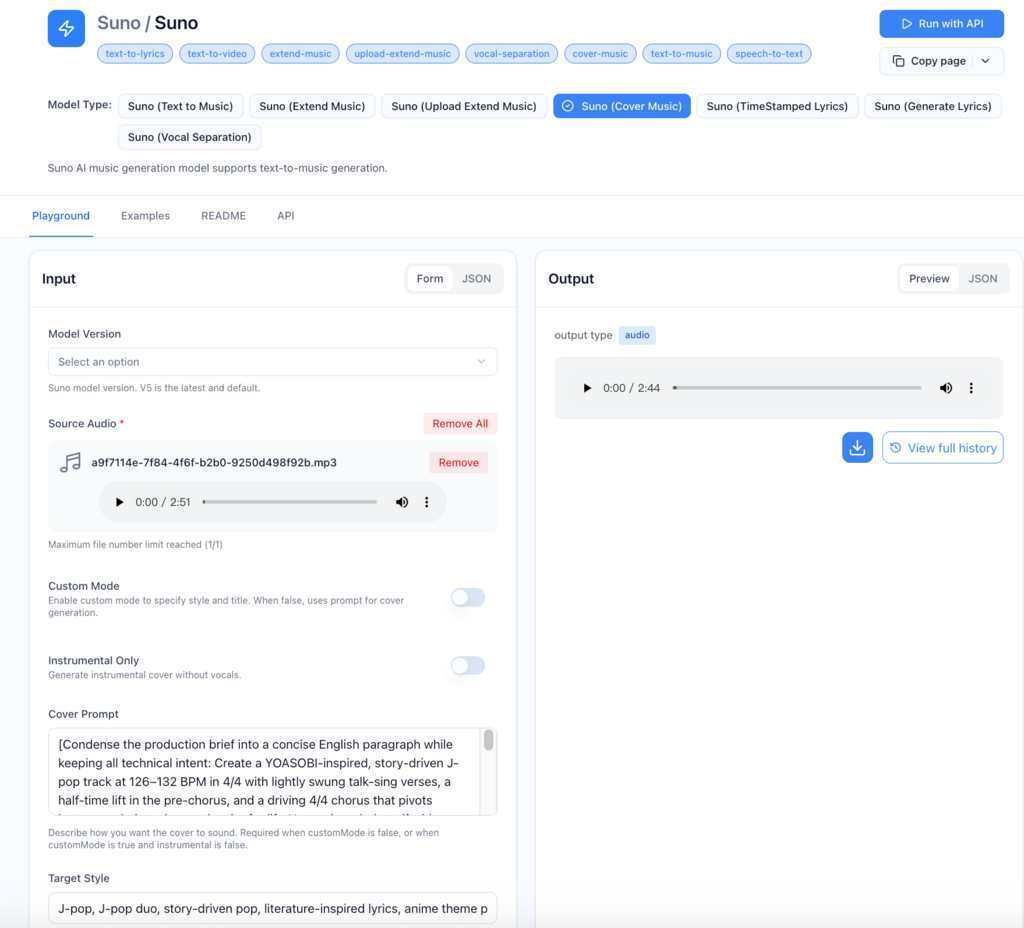
For developers building music generation features, ApiPass offers a lightweight integration experience with strong concurrency support and predictable pricing. Beyond standard text-to-music generation, APIPASS also provides a dedicated Suno Cover API, allowing developers to create AI-generated cover versions of songs through a simple API workflow. This is especially useful for music apps, remix tools, karaoke platforms, and creator-focused products that want to add interactive AI cover generation without building complex audio infrastructure from scratch.
Features
Pay-as-you-go pricing with no subscriptions
Credits never expire
20 requests per 10 seconds rate limit
Single API key integration
Support for music generation, extensions, covers, lyrics, and vocal separation
Reliable uptime and production-friendly infrastructure
Pros and Cons
Pros
Flexible pricing structure
No wasted subscription fees
Strong concurrency support
Fast onboarding for developers
Clear documentation
Cons
Requires basic API integration knowledge
Limited hands-on onboarding support for beginners
Price
Credit Packages
$5 — 1,000 Credits
$50 — 10,000 Credits
$500 — 105,000 Credits (5% bonus)
$1250 — 275,000 Credits (10% bonus)
Usage Costs
Text to Music: 2.5 credits per run (~$0.014)
Advanced Audio Tools: 2.5 credits per run
Music extension
Upload extension
Cover generation
Lyrics generation
Vocal separation
2. aimlapi
What is aimlapi?
aimlapi provides access to hundreds of AI models through a unified API layer, including Suno music generation capabilities. The platform is built for teams that want to combine music generation with other multimodal AI features like image generation, chat models, and text processing.
Because everything is accessible through a single ecosystem, aimlapi works especially well for applications that need multiple AI capabilities in one stack.
Features
Suno text-to-music generation
Music extension support
Lyrics generation tools
Vocal separation features
Multimodal AI ecosystem
Stable handling of complex prompts
Pros and Cons
Pros
Affordable per-run pricing
Broad set of audio tools
Useful for multimodal AI projects
Easy centralized management
Cons
Larger ecosystem creates a steeper learning curve
Advanced audio customization may feel limited
Price
Text to Music: 2.5 credits per run (~$0.014)
Extend Music: 2.5 credits per run
Upload / Cover / Lyrics / Vocal Separation: 2.5 credits per run
3. Replicate
What is Replicate?
Replicate is one of the most popular platforms for deploying and running AI models in the cloud. Instead of focusing only on Suno, it provides access to a massive library of open-source and community-built models, including music generation tools.
For developers who want infrastructure flexibility without managing GPUs directly, Replicate offers a clean middle ground between experimentation and production deployment.
Features
Cloud-hosted AI model execution
Automatic GPU provisioning
Docker support for local testing
Transparent compute-time billing
Large community model ecosystem
Pros and Cons
Pros
Highly transparent pricing
No infrastructure management required
Easy experimentation with multiple models
Strong developer ecosystem
Cons
Generation speed can vary significantly
Community model quality is inconsistent
Documentation quality depends on the model creator
Price
Estimated Cost: ~$0.018 per run
Average Value: Roughly 55 runs per $1
Billing Model: Exact compute-time billing
Most generations complete in around 79 seconds on Nvidia T4 GPUs.
4. api.box
What is api.box?
api.box focuses on providing streamlined access to Suno AI music generation with an emphasis on speed and simplicity. The platform is designed for developers who want stable music generation APIs without unnecessary complexity.
Its infrastructure is optimized for low-latency requests and high-throughput workloads, making it suitable for production environments that need rapid audio generation.
Features
Fast text-to-music generation
Multiple Suno model support
Vocal removal tools
AI lyrics generation
High-throughput streaming
Simple developer integration
Pros and Cons
Pros
Straightforward pricing
Reliable performance
Easy setup process
Volume discount support
Cons
Depends on upstream provider stability
Limited UI tools for non-technical users
Price
Credit Packages
$5 — 1,000 Credits
$50 — 10,000 Credits
$500 — 105,000 Credits (5% bonus)
$1250 — 275,000 Credits (10% bonus)
5. Evolink
What is Evolink?
Evolink is built for production-grade AI workloads and places a strong emphasis on uptime and reliability. In addition to supporting Suno music models, the platform includes automatic fallback routing, which helps prevent downtime if one model endpoint becomes unavailable.
For teams running high-volume commercial applications, this reliability-first approach can be a major advantage.
Features
Access to multiple Suno beta models
Automatic fallback routing
99.9% uptime target
Unified multimodal AI access
Infrastructure designed for scale
Pros and Cons
Pros
Excellent reliability
Predictable pricing
Access to newer Suno beta models
Strong enterprise readiness
Cons
Higher pricing for budget-sensitive indie projects
Less granular billing flexibility
Price
Suno Model Pricing
suno-v4-beta: $0.111/song
suno-v4.5-beta: $0.111/song
suno-v4.5all-beta: $0.111/song
suno-v4.5plus-beta: $0.111/song
suno-v5-beta: $0.111/song
Each generation consumes 8 credits.
6. Apiframe
What is Apiframe?
Apiframe is an all-in-one AI media generation platform that combines music, image, and video APIs into a single ecosystem. Rather than juggling multiple providers and billing systems, developers can manage everything from one interface.
The platform is particularly appealing for startups building multimodal AI products that require heavy media generation.
Features
Unified AI media API platform
Access to Suno and other leading models
Prepaid billing system
Unlimited RPM/TPM scaling
Crypto payment support
Priority human support
Pros and Cons
Pros
Centralized billing and management
Good fit for scaling startups
Simplified infrastructure management
Unlimited usage scaling
Cons
Requires a $20 upfront payment
May be excessive for small projects using only one endpoint
Price
Pay-As-You-Go: $20 prepaid entry
Enterprise: Custom pricing
7. sunoapi.org
What is sunoapi.org?
sunoapi.org is a dedicated Suno-focused platform offering commercial AI music generation through a traditional SaaS subscription model. Unlike usage-based providers, it relies on fixed monthly credit plans.
This approach works best for businesses with predictable generation volumes and recurring monthly workloads.
Features
Dedicated Suno-only integration
Webhook support
Commercial-quality music generation
Subscription-based pricing
Full Suno feature access
Pros and Cons
Pros
Predictable monthly costs
Simple subscription structure
Webhook support for async workflows
Free testing tier available
Cons
Unused credits may reduce overall value
Less flexible for fluctuating workloads
Higher scaling costs for smaller teams
Price
Free: 20 credits
Basic: $19/month — 1,000 credits
Starter: $99/month — 5,500 credits
Growth: $199/month — 12,000 credits
Key Takeaways
Pay-As-You-Go Models Usually Offer Better Flexibility
For most developers and startups, usage-based billing tends to provide better cost control. Platforms like ApiPass reduce the risk of paying for unused monthly credits and make scaling more predictable.
Advantages of Pay-As-You-Go
No monthly commitments
Better for fluctuating workloads
Easier cost forecasting during early development
Lower entry barrier for testing
Subscription Models Work Better for Predictable Usage
Subscription-based platforms can still make sense if your generation volume remains stable month after month.
Best Use Cases for Subscription Plans
Established SaaS products
Consistent enterprise workloads
Teams with predictable generation demand
Always Check Credit Expiration Policies
One overlooked detail in AI API pricing is whether unused credits expire. Subscription services often reset credits monthly, which can reduce actual ROI if usage fluctuates.
Before committing to a provider, verify:
Whether credits roll over
Whether prepaid balances expire
Whether unused capacity can be refunded
Test Audio Quality Before Scaling
Pricing alone does not determine value. Generation quality, consistency, and latency vary noticeably across providers.
Before upgrading to large plans:
Test free tiers
Benchmark latency
Compare audio fidelity
Validate concurrency behavior under load
Reliability Matters in Production
If you plan to run AI music generation inside a live product, infrastructure reliability becomes just as important as pricing.
Important factors to evaluate include:
Uptime guarantees
Rate limits
Fallback routing
Queue stability
Regional latency
Conclusion
The Suno API ecosystem has matured quickly, and there are now strong options available for nearly every type of developer — from solo indie builders to enterprise production teams.
Some providers focus on aggressive pricing and flexibility, while others prioritize infrastructure reliability or multimodal AI integration. The best choice ultimately depends on your workload, scaling expectations, and how predictable your usage patterns are.
For most teams, starting with a pay-as-you-go provider is usually the safest approach. It keeps upfront costs low, allows for easier experimentation, and makes it simpler to benchmark generation quality before committing to larger spending.
As AI music generation continues evolving, factors like uptime, concurrency, latency, and audio fidelity will matter just as much as raw pricing. Taking the time to compare providers carefully now can save both engineering effort and operational costs later.
Top 7 Suno API Providers Ranked by Cost-Effectiveness: The Ultimate Guide was last modified: May 13th, 2026 by Adsy Collins
Retail is racing toward a new baseline: by 2025, retailers expect up to 70 percent of everyday store tasks to run on autopilot—handled by bots, AI models, or tightly scripted workflows.
That vision only pays off when the right partner builds it with you. Choosing an automation consultancy isn’t about pulling the first name from a directory; it’s about teaming with experts who speak retail fluently, land quick wins, and then scale those wins across every aisle, warehouse, and back-office screen.
In this guide you’ll get:
A transparent scoring framework (so you can sanity-check our picks)
Punchy firm profiles packed with retail proof points
Two comparison tables for at-a-glance tech and capability checks
Straight-talk FAQs on budget, timelines, and workforce impact
Ready to meet the partners who can free your people from drudge work and sharpen results? Keep reading.
How we picked the nine
You deserve more than a popularity contest.
We wanted proof: numbers, certifications, and live retail wins, so we built a scorecard before we built the list.
First, we removed pure software vendors and any firm without at least one verifiable retail-automation case. The remaining names went through eight lenses that matter to a retail operator:
Retail expertise, service breadth, technology partnerships, hard-dollar results, delivery methodology, global scalability, pricing transparency, and innovation track record.
Each lens carried a five-point score. We weighted retail expertise and measurable results slightly heavier than the rest because outcomes on the shop floor matter most. Totals determined the final ranking you’ll see next.
We also checked reputations against analyst waves and peer-review sites, then read the small print, case-study ROIs, partnership tiers, and staff certifications, to confirm that marketing claims held water.
The outcome of that homework is the heat-map scorecard that follows. Use it as a quick gut-check, then explore the individual profiles to see why each consultancy earned its spot.
Scorecard at a glance
Before we unpack each consultancy, here’s a quick snapshot of how they score against the eight criteria that matter most on a retail shop floor.
Consultancy
Retail expertise
Service breadth
Tech partnerships
Proven results
Methodology
Scalability
Pricing flexibility
Innovation
Total*
Monstarlab
4
4
3
4
4
3
4
5
35
Accenture
5
5
5
4
5
5
2
4
40
Deloitte
5
5
4
4
5
4
2
4
38
IBM Consulting
4
5
4
3
4
5
3
5
37
Infosys
4
4
4
3
3
5
5
3
35
Genpact
3
4
3
5
4
4
4
3
34
Roboyo
3
3
5
3
4
3
4
4
33
WonderBotz
2
3
3
4
3
2
5
3
25
Processica
2
3
1
2
2
1
4
5
20
Weighted totals: retail expertise and proven results count 20 percent more than other factors.
The heat map shows no single “perfect” partner. Accenture leads on scale and breadth, Monstarlab tops innovation, and WonderBotz stands out for clear pricing. Use the numbers as a compass, not a verdict: the best fit is the firm whose strengths match your immediate pressure points.
Next, we’ll look at each contender to see the stories behind the scores.
1. Monstarlab: AI-driven automation that keeps people in the loop
Monstarlab isn’t a household consulting brand, but retail teams that work with the firm talk about rapid pilots, design-thinking workshops, and measurable wins that land in weeks, not quarters.
The company started in Tokyo and now operates in more than 20 countries. Guided by its “People First, Robots Second” mantra, its process automation consulting services blend service design with AI and RPA, aiming to build next-generation platforms that let people focus on decisions while bots handle the grunt work.
Monstarlab process automation consulting services webpage screenshot
A global bakery chain illustrates the impact. According to a Monstarlab case study, data scientists rolled out a predictive-demand model that reads promotions, holidays, and store-traffic signals, then auto-generates optimal orders. Within one quarter the retailer lifted sales by five percent and cut returns by 20 percent—strong numbers in a single-digit-margin category.
Why does this matter for you? If you need fresh ideas and a nimble crew that prototypes fast, Monstarlab ranks highest on our creativity score (5/5) and shows above-average retail expertise. The firm will not field a 100-person army, but for mid-sized chains or focused pilots it delivers speed, originality, and a people-first mindset that helps store staff embrace change.
2. Accenture: enterprise-scale muscle for multi-country roll-outs
When your automation roadmap covers hundreds of stores, dozens of functions, and multiple continents, scale is the first non-negotiable. According to Marketingscoop, Accenture fields more than 7,000 RPA specialists worldwide, backed by deep partnerships with UiPath, Automation Anywhere, Microsoft, and several generative-AI collaborators.
Real projects show that capacity. Accenture tackled a trade-promotion backlog at Acosta, the retail-services giant. Automation Anywhere bots now work around the clock inside a secure virtual desktop, cutting deduction processing time and giving brands faster, cleaner financials.
Accenture’s playbook starts with process discovery, often using its SynOps analytics layer, then moves quickly to factory-style delivery. Because teams sit in more than 120 countries, a grocery chain can pilot bots in Spain this quarter and clone them for U.S. stores the next.
Yes, you’ll pay premium day rates and navigate enterprise governance. In return you gain industrial-grade change management, strong security, and a bench that can spin up 50 bots in parallel without stress.
If the brief reads “global, mission-critical, zero downtime,” Accenture belongs on your shortlist.
3. Deloitte: strategy-first automation with change baked in
Deloitte steps in when you need more than bots; you need a new operating model that also happens to be automated.
The practice counts over 28,000 global AI, data, and automation professionals inside a 415,000-person consulting powerhouse, giving you process gurus, tax pros, and retail strategists under one roof.
The firm proves its own scale: Deloitte signed a multi-year pact with UiPath to roll out more than 4,000 automations across its back office, testing the tools before bringing them to clients.
Retailers appreciate that self-testing ethos. For a big-box chain, Deloitte mapped a ten-day financial close, cut redundant approvals, then layered bots to post journals and reconcile ledgers. Closing time fell to six days, freeing finance teams for analysis instead of data wrangling.
Change management is the real edge. When automation affects store roles, Deloitte’s HR specialists deliver training plans and communication packs that keep adoption smooth and unions calm.
Choose Deloitte when the mandate is “fix the process, not just automate the mess.” You’ll pay premium advisory rates, but you leave with governance, CoE playbooks, and bots that stick.
4. IBM Consulting: where AI, IoT, and RPA meet on the shop floor
IBM’s consulting arm brings its engineering DNA to retail automation. Think fewer slides and more “here’s the model, the bot, and the sensor—go.”
With about 8,000 automation consultants on call, IBM embeds RPA inside broader intelligent workflows, often powered by Cloud Pak for Business Automation and Watson AI.
That full-stack approach delivers in the real world. Grocery chains use IoT meters that flag energy anomalies, and bots then schedule maintenance before food spoils. Fashion brands pair Watson vision with RPA to spot shelf gaps and trigger instant replenishment orders. The tooling stays flexible; teams also speak UiPath and Automation Anywhere.
IBM’s edge is integration. Legacy AS/400 inventory systems, modern e-commerce clouds, and in-store devices all communicate once the plumbing is rebuilt, letting bots run quietly in the background.
Choose IBM when your roadmap blends physical sensors, AI insight, and classic RPA, and you want one partner to wire it all together without finger-pointing.
5. Infosys: offshore efficiency without the bargain-basement feel
If your CFO wants automation but balks at Big Four day rates, Infosys offers global reach, proven playbooks, and a cost base anchored in its Indian delivery centers.
Infosys entered RPA early and even built its own platform, AssistEdge, while still training large teams of UiPath and Automation Anywhere developers. The company runs 38 delivery centers across 13 countries, with more than 61,000 people focused on business process management and digital transformation.
For retailers the benefit is speed plus volume. One grocery chain handed Infosys a paper-heavy invoice queue. Bots now match POs and receipts automatically, driving 70 percent straight-through processing and freeing clerks for vendor negotiations. Because most development happened offshore, the client paid roughly half what a U.S. on-site team quoted.
Infosys adds accelerators too. Need SAP stock transfers automated? They likely have a template. Want chatbots for HR onboarding of seasonal staff? The team pulls libraries, tweaks intent models, and ships in weeks.
Choose Infosys when you have many similar, rules-based tasks across stores or shared services and need them automated quickly and affordably, without giving up enterprise governance.
6. Genpact: outcome-priced automation that keeps running after go-live
Genpact grew up running GE’s back offices, so its culture is obsessed with metrics. Every automation pitch starts with a target SLA and a contract-backed promise to hit it.
The firm bundles process redesign, bot build, and ongoing operations under one roof. A retailer can hand over order-to-cash or inventory reconciliation and receive a dashboard showing cycle time, accuracy, and savings, with no need to staff a bot-support team.
In one electronics-retail engagement, Genpact robots now match invoices and goods receipts automatically, driving 80 percent touchless processing and saving millions in working capital. Payment-term discounts that once slipped through now reach the bottom line.
Genpact relies on Automation Anywhere and UiPath while orchestrating work through its Cora platform, which blends OCR, machine learning, and classic RPA. Offshore delivery keeps costs low, and an outcome-based fee model aligns incentives with results.
Choose Genpact when you want a partner who will own the KPI, not just the code, and when finance or supply-chain processes top the pain list.
7. Roboyo: the pure-play specialist that jump-starts stalled programs
Roboyo focuses on one craft, intelligent automation, and keeps senior engineers close to the kickoff call.
That focus pays off for retailers that started an RPA pilot, hit roadblocks, and need fresh momentum. Roboyo’s first move is usually a fast process-mining sprint with Celonis to surface hidden friction. Then a small, senior squad builds resilient UiPath bots, adds ABBYY OCR where documents lurk, and leaves detailed runbooks so your team is not calling support every Monday.
A global sports-apparel company cut order-processing time by 80 percent and saved 40 hours of manual work each week after Roboyo automated its in-transit update process within the ERP system—a task the in-house team had shelved for months.
Because Roboyo is not selling strategy decks or cloud hosting, projects stay lean. Pricing lands between boutique and big-SI, and the firm trains your citizen developers so internal talent grows alongside bot count.
Choose Roboyo when you already own UiPath licenses and want a hands-on partner to scale fast without big-consultancy overhead.
8. WonderBotz: quick-win Blue Prism experts with clear pricing
Need a solid bot yesterday and an invoice you can explain tomorrow? WonderBotz fits that brief.
Founded by former Big Four automation leads, this 100-person boutique specializes in Blue Prism but also works with UiPath and Power Automate. A library of pre-built “Botz” tackles common retail headaches—automated daily sales reports, vendor-price scrapes—so projects start more than half finished.
Proof is simple. A footwear retailer removed 3,200 manual hours a year and saved over $100,000 after WonderBotz delivered a reporting bot that now crunches data for 1,500 stores each night.
Because scope stays crisp and components are reused, WonderBotz offers fixed-fee deals most large firms avoid. The founders remain hands-on, and support tickets reach engineers, not tier-one call centers.
They cannot marshal a hundred developers overnight, but for focused, high-ROI automations—especially in finance or merchandising data flows—WonderBotz delivers speed, senior oversight, and bills that make controllers smile.
9. Processica: Gen-AI boutique for bold ideas
Every list needs a wild card, and Processica fills that role with energy. The 50-person U.S. startup lives at the intersection of large language models, custom code, and workflow glue—ideal for retailers that want to test ideas no template covers.
Processica builds from scratch. A fashion e-tailer asked for a GPT-powered “virtual stylist” that chats in brand voice, checks stock in real time, and drops items into the cart. Four sprints later, shoppers who used the bot converted nearly ten percent more often, a revenue pop traditional RPA cannot match.
The team follows a sprint-MVP rhythm: scope a narrow slice, ship in weeks, measure, then choose to scale or pivot. Pricing is straightforward—often a fixed fee for the prototype, then hourly for enhancements—so budget risk stays low.
Caveats? A limited track record and small head-count make Processica best for green-field pilots, not 200-bot roll-outs. But if you are dreaming of voice-activated planogram tools or Gen-AI agents that negotiate supplier costs at 2 a.m., Processica is the partner that says “let’s try.”
In short: engage Processica when you crave first-of-its-kind automation and can handle a bit of startup unpredictability in exchange for front-row seats to the future.
Conclusion: Choosing the right partner for your retail roadmap
By now you know the basics: big consultancies bring global armies, boutiques deliver laser focus, and emerging firms chase the newest tech. The real question is how each option serves your goals.
Start with urgency and scale. If you plan to automate finance, merchandising, and stores across several regions this fiscal year, Accenture or Deloitte have the bench strength to run parallel workstreams. Their rates sit at the high end, but the speed and consistency can justify the premium.
Need quick cost relief in one back-office tower? Infosys and Genpact shine. Offshore teams build bots in volume and can even run the process for a performance-linked fee, so savings hit the P&L fast.
Already own UiPath licenses yet remain stuck at a handful of pilots? Roboyo’s pure-play expertise can reboot the program, set up governance, and coach citizen developers until you are self-sufficient. WonderBotz offers the same for Blue Prism estates, with the bonus of fixed-fee clarity.
Chasing differentiation rather than catch-up? Monstarlab and Processica help you leap ahead with AI-heavy workflows such as predictive ordering, generative product copy, or computer-vision shelf checks. They will not flood a warehouse with coders, but they can prototype bold ideas in weeks and transfer knowledge to your team.
Match platforms, too. Every firm covers major RPA suites, yet depth differs. If Power Automate dominates your stack, confirm that short-listed partners hold Microsoft credentials, not only UiPath badges.
The takeaway: shortlist two or three consultancies whose strengths reflect your top constraints—budget, timeline, internal talent, or appetite for new ideas—then run a focused assessment workshop. A half-day session with real process data reveals who understands your retail world and can deliver value fast.
9 Best Process Automation Consultancies for Retail (RPA, Workflow & AI Implementation Specialists) was last modified: May 12th, 2026 by Amna Sheikh
Vulnerability Assessment – DirtyFrag (CVE-2026-43284, CVE-2026-43500) and CopyFail (CVE-2026-31431)
Two related Linux kernel local privilege escalation vulnerabilities, dubbed “CopyFail” and “DirtyFrag,” were publicly disclosed in early May 2026. These vulnerabilities affect the kernel’s cryptographic and network subsystems, and in an unprotected environment could allow an unauthorized local user to gain root access to a Linux server. A proof-of-concept exploit was published shortly after disclosure.
Our servers have been assessed for these vulnerabilities. Our standard security protocols prevent this type of access. The remote paths used by these exploits do not exist in our environment.
Supply chain managers and mining executives woke up to an unexpected crisis. The Strait of Hormuz closure disrupted more than oil shipments. It cut off the primary source of elemental sulfur that feeds global sulfuric acid production. Copper mines across Chile and Peru started rationing their most critical chemical input. Fertilizer plants in India and Brazil scrambled for alternative suppliers. China responded with an export ban that turned a supply squeeze into a full emergency. The industrial world suddenly realized how much it depends on a chemical most people never think about.
This crisis reveals a vulnerability in global supply chains that extends far beyond energy markets. It threatens food security, mining operations, and manufacturing across dozens of industries.
The Strait of Hormuz Connection: Why This Isn’t Just About Oil
The Strait of Hormuz serves as the world’s most critical energy chokepoint. It handles approximately 21 million barrels of oil per day. But the same region produces something equally vital. Middle Eastern oil refineries generate 70% of the world’s elemental sulfur as a byproduct of petroleum processing.
Refineries extract sulfur when they remove impurities from crude oil. This process creates massive volumes of elemental sulfur. Saudi Arabia, Kuwait, and the United Arab Emirates have become the dominant global suppliers. Their refineries ship sulfur to chemical plants worldwide.
When the strait closed, oil tankers stopped moving. Sulfur shipments stopped too. Refineries in the Gulf region continued operating at reduced capacity, but their sulfur had nowhere to go. Chemical plants in Asia, Europe, and the Americas suddenly faced severe supply disruptions.
The closure created an immediate bottleneck. Industries that never worried about Middle Eastern geopolitics now confronted supply chain paralysis.
Sulfuric Acid 101: The Industrial Workhorse You’ve Never Heard Of
Sulfuric acid ranks as the most widely produced industrial chemical globally. Manufacturers produce over 270 million metric tons annually. The chemical supports hundreds of manufacturing processes across multiple sectors.
The production process converts elemental sulfur into sulfuric acid through oxidation. Plants burn sulfur to create sulfur dioxide. They then convert that gas into sulfur trioxide. Finally, they combine it with water to produce sulfuric acid. The process requires consistent supplies of high-quality elemental sulfur.
Mining operations consume nearly half of all sulfuric acid production. The chemical dissolves copper and nickel from ore in a process called leaching. Without it, mines cannot extract metals from low-grade deposits. Fertilizer production takes another 20%. Manufacturers use it to create phosphate fertilizers essential for agriculture.
Other applications include petroleum refining, steel pickling, battery manufacturing, and countless chemical synthesis processes. According to the U.S. Geological Survey, sulfuric acid touches virtually every sector of industrial production.
How the Shortage Cascades: From Elemental Sulfur to Mining Shutdowns
The sulfuric acid shortage follows a predictable cascade. Refineries in the Middle East stopped shipping elemental sulfur. Chemical plants that convert sulfur into acid began rationing inventory. Mining operations received reduced allocations. Production cuts followed quickly.
Copper mining felt the impact first. Chile and Peru together produce 40% of global copper. Their mines depend almost entirely on sulfuric acid leaching. Executives reported receiving only 60% of their normal acid supplies within weeks of the closure. Some operations reduced production by 30%. Others implemented rotating shutdowns.
Nickel mining faced similar pressures. Indonesian and Philippine operations use sulfuric acid to process laterite ore. These mines supply the raw material for stainless steel and electric vehicle batteries. Production cuts rippled through the battery supply chain immediately.
The agricultural sector confronted disruption next. Fertilizer plants could not maintain phosphate production without adequate acid supplies. Farmers in Brazil, India, and across Africa faced shortages during critical planting seasons. Food security concerns escalated rapidly.
China’s Export Ban: Turning a Crisis Into a Global Emergency
China manufactures approximately 35% of global sulfuric acid production. The country maintains large domestic reserves and diverse sulfur sources. It imports Middle Eastern sulfur but also produces acid from copper smelting and coal processing.
Beijing responded to the Hormuz closure with a unilateral export ban. Government officials cited domestic industrial needs and strategic security. The ban prohibited all sulfuric acid exports indefinitely. It also restricted exports of intermediate sulfur products.
The decision transformed a difficult situation into a true emergency. Countries that relied on Chinese acid exports as backup supplies lost that option entirely. Spot prices for sulfuric acid tripled in some markets. Long-term contract negotiations broke down as suppliers prioritized existing customers.
The China sulfuric acid ban created unprecedented industrial bottlenecks. Supply chain professionals watched helplessly as alternative sources evaporated. The move demonstrated how raw material nationalism can compound regional disruptions into global crises.
Industries at Risk: Copper, Nickel, Fertilizers, and Beyond
The copper mining crisis threatens multiple downstream industries. Electronics manufacturers need copper for circuit boards and wiring. Construction companies require it for building systems. Electric vehicle production depends on copper for motors and charging infrastructure. Reduced mining output creates shortages across all these sectors.
Nickel production disruption impacts stainless steel and battery manufacturing most severely. EV makers already faced tight nickel supplies before the shortage. The acid crisis forced further production cuts. Battery prices increased immediately. Vehicle manufacturers delayed launches and raised prices.
The fertilizer shortage presents the most serious long-term risk. Phosphate fertilizers require sulfuric acid for production. Without adequate supplies, farmers cannot maintain crop yields. Global food prices began climbing within months. Countries dependent on food imports faced potential shortages.
Additional affected sectors include petroleum refining, pharmaceutical manufacturing, textile processing, and water treatment. The industrial economy runs on sulfuric acid in ways most business leaders never recognized until supplies disappeared.
Economic Ripple Effects: Inflation, Supply Chains, and Commodity Prices
Commodity price inflation accelerated dramatically. Copper prices jumped 40% in three months. Nickel reached record highs. Fertilizer costs doubled in major agricultural markets. These increases flowed directly into consumer prices for food, electronics, and manufactured goods.
Supply chain disruptions extended beyond immediate acid shortages. Mining companies reduced forward sales commitments. Manufacturers faced allocation programs from suppliers. Just-in-time inventory systems broke down. Companies began hoarding available supplies and building strategic reserves.
The crisis revealed dangerous concentration in sulfur supply chains. Businesses discovered they had no viable alternatives when primary sources disappeared. Procurement managers who never considered sulfur sourcing suddenly scrambled to secure supplies from anywhere possible. The Small Business Administration reported thousands of small manufacturers faced potential closure due to input shortages.
Investment markets reacted with increased volatility. Mining stocks fluctuated wildly based on acid supply rumors. Fertilizer company valuations swung dramatically. Commodities traders struggled to price contracts without reliable supply forecasts.
What Comes Next: Alternative Sources, Strategic Reserves, and Long-Term Solutions
Industries began exploring alternative sulfur sources aggressively. Smelter acid from copper and zinc processing offers some relief. These facilities produce sulfuric acid as a byproduct of metal refining. However, this source cannot replace Middle Eastern elemental sulfur volumes.
Pyrite mining presents another option. Iron pyrite contains sulfur that can be processed into acid. China and Spain have significant pyrite deposits. But developing new mining operations takes years. It cannot solve immediate shortages.
Some countries established strategic sulfuric acid reserves. Government programs began stockpiling supplies for critical industries. The Department of Energy announced plans to include sulfur in national security stockpiles alongside other strategic materials.
Long-term solutions require supply chain diversification. Companies are investing in regional acid production facilities. Mining operations are exploring sulfur recovery from waste streams. Industries are developing sulfur-reduction technologies where possible.
The crisis will likely drive permanent changes in how businesses manage chemical supply chains. Strategic sourcing, inventory buffers, and supplier diversity will become standard practices. The days of taking sulfuric acid availability for granted have ended.
Does your organization depend on sulfuric acid or metals produced with it? Now is the time to audit your supply chain vulnerabilities. Contact your chemical suppliers to understand their sourcing strategies. Consider building inventory buffers for critical inputs. Explore alternative suppliers before shortages force difficult decisions. The Hormuz closure may eventually resolve, but the supply chain lessons will shape industrial strategy for years to come.
Beyond Oil: How the Hormuz Closure Triggered an Industrial Crisis Through Sulfur and Sulfuric Acid was last modified: May 9th, 2026 by JW Bruns
Global M&As involve multiple companies operating in different countries and time zones. Data rooms for M&A provide secure platforms to store sensitive documents. Data rooms ensure that all important records remain safe and accessible online.
Virtual data rooms reduce risks associated with paper files during complex deal negotiations. They allow all concerned parties to communicate effectively across different locations. These platforms help teams maintain data organization and track all important documents carefully. M&A data roomsimprove transparency and support informed decisions at every stage.
This article will help readers understand how virtual data rooms simplify complex international transactions efficiently.
What is M&A Virtual Data Room Software?
M&A virtual data room software organizes documents efficiently for global deal teams. Companies set permissions to control which users can access each file safely. Users can store and retrieve documents quickly when information is required.
Platforms monitor activity and generate reports for accountability and management purposes. Watermarks and security tools prevent unauthorized copying or sharing of documents. Some top VDR providers for M&A offer analytics and reporting functions.
The best data rooms for mergers and acquisitions improve workflow and communication. They allow multiple teams to collaborate securely across different offices worldwide. Reliable tools support the smooth and timely completion of complex transactions.
Benefits of Using Data Rooms in M&As
Here are the top reasons why virtual data room M&A is a game-changer.
1.Enhanced Security
Data rooms provide strong protection for confidential corporate information at all times. Here is how
· Encryption and permission settings ensure only authorized users can view documents.
· Companies grant temporary access to investors or external advisors safely.
· Platforms record all actions to maintain accountability and audit readiness consistently.
· Security tools prevent leaks of important data during critical negotiations successfully.
Users gain confidence knowing their documents remain safe throughout each transaction. Strong security protects company assets and builds trust with all stakeholders reliably.
2.Improved Efficiency
M&A data rooms allow multiple stakeholders to view documents at the same time. Users can find the necessary information quickly without searching through long email threads. Search features let teams locate documents by name or keywords instantly. Managers assign tasks and monitor progress from a centralized software platform.
VDRs reduce repetitive manual work and save time during approvals consistently. Teams can focus on analysis instead of handling paper documents. Data rooms accelerate negotiation processes and shorten total deal duration. Faster workflows increase the probability of completing mergers on schedule.
3.Smooth Collaboration
Data rooms allow stakeholders to access documents securely at the same time. For example:
· Users can comment and approve files immediately within the platform.
· Messaging tools provide notifications and allow direct communication between all participants.
· Teams receive updates instantly when new documents are added or revised.
Collaboration removes delays caused by exchanging physical files or email chains. Participants make faster and better decisions with access to current information. VDRs improve teamwork and accelerate progress during complex cross-border negotiations effectively.
4.Compliance and Audit Support
Data handling in M&A deals requires strict adherence to international regulations like GDPR or ISO 27001. Virtual data rooms record all actions for audits and compliance reporting accurately. Managers can generate evidence showing who accessed files and what actions occurred.
Data rooms reduce the risks of fines caused by failure to follow rules. That’s because
· Auditors can review records without disturbing normal business operations and negotiations.
· Secure electronic signatures allow agreements to be executed legally online safely.
Compliance features increase investor confidence in such complex and sensitive transactions. Reliable audit tools prevent disputes and support transparency throughout every transaction.
5.Better Organization
Virtual data rooms arrange files clearly according to type and priority effectively. For example:
· Companies create separate folders for all types of records securely.
· Keywords allow participants to retrieve files quickly during audits and reviews.
· Structured storage prevents confusion among teams operating in multiple locations.
VDRs simplify compliance and reporting by keeping all records organized consistently. Clear structure improves workflow and helps stakeholders make informed decisions efficiently. Data organization enhances transparency and supports efficiency in international deals.
6.Cost Savings
Virtual data rooms reduce costs associated with printing and storage services consistently. Companies save money by avoiding manual document handling and storage expenses. Teams can operate remotely without additional travel or administrative support requirements.
Security measures minimize potential losses caused by leaks or breaches. Efficient platforms reduce labor costs spent on coordination and approvals significantly. Faster processes lower operational costs during long negotiation periods successfully.
Conclusion
M&A transactions involve multiple stakeholders and highly sensitive corporate information worldwide. Virtual data rooms improve secure data management and collaboration for all participants. They help companies maintain compliance and generate audit-ready records efficiently.
Organizations can reduce operational costs while lowering risks and avoiding mistakes during deals. M&A data rooms enable faster decisions without compromising document confidentiality or accuracy. Top VDR providers for M&A deliver secure and reliable platforms for transactions. Businesses adopting these platforms gain clear advantages over competitors globally.
Cross-Border M&A and Virtual Data Rooms: Managing Complexity in Global Transactions was last modified: May 8th, 2026 by Ihor Volkov
The businesses growing fastest right now are not necessarily the ones spending the most money.
They are the ones adapting fastest.
Across almost every industry, companies are finding new ways to increase profit by combining automation, smart investments, digital assets, recurring revenue, and operational efficiency.
The old model of simply “working harder” is fading.
Modern businesses are building systems that create leverage.
Here are 10 powerful ways businesses are increasing revenue this year.
1. Turning Idle Cash Into Investment Assets
One major shift happening right now is businesses becoming more strategic with cash reserves.
Instead of leaving all available capital sitting in low-yield bank accounts, many companies are diversifying into:
gold
silver
index funds
dividend stocks
commercial assets
digital investments
Gold remains especially popular during periods of inflation and economic uncertainty because it is often viewed as a long-term store of value.
Businesses with strong cash flow are increasingly treating treasury management more seriously rather than simply letting capital sit unused.
2. Monetising Faster Response Times
Most businesses underestimate how much money is lost from slow follow-up.
A lead comes in.
Nobody replies quickly.
The prospect moves to a competitor.
Modern companies are investing heavily in:
CRM systems
automated follow-up
SMS workflows
AI chatbots
appointment reminders
pipeline automation
Platforms like GoHighLevel have become popular because they help businesses respond instantly and automate lead nurturing.
In many industries, speed-to-lead directly impacts revenue.
A business that replies in 60 seconds will usually outperform one replying in 6 hours.
3. Building Predictable Monthly Revenue
Many businesses are moving away from unpredictable one-time sales models.
Instead, they are creating recurring revenue streams such as:
memberships
subscriptions
retainers
maintenance packages
coaching communities
software access plans
Recurring revenue creates stability.
It allows businesses to forecast growth more accurately while reducing the pressure of constantly chasing new customers.
This is one reason subscription-based companies often achieve higher valuations than traditional service businesses.
4. Using AI to Increase Efficiency
AI is rapidly becoming a competitive advantage.
Businesses are now using AI to:
qualify leads
answer customer questions
generate content
automate admin work
summarize meetings
improve customer service
personalise marketing
The biggest gains often come from eliminating repetitive tasks that consume time but produce little value.
Businesses using AI effectively can often:
reduce costs
improve customer experience
increase operational speed
handle more leads without increasing headcount
5. Creating Digital Products
Digital products have become one of the highest-margin business models available.
Examples include:
online courses
templates
ebooks
paid communities
downloadable resources
software tools
training programs
Unlike physical products, digital products can often be sold repeatedly without manufacturing or shipping costs.
Many businesses are now combining services with digital products to increase profit margins and scale more efficiently.
6. Leveraging Organic Traffic Instead of Relying Only on Ads
Advertising costs continue rising across platforms like:
Google
Facebook
Instagram
TikTok
As a result, businesses are investing more heavily into:
SEO
long-form content
YouTube
newsletters
social authority
AI-search visibility
Organic traffic compounds over time.
A strong piece of content can generate leads for years after publication.
Businesses appearing consistently in search results often reduce dependence on paid advertising while building long-term authority.
7. Increasing Customer Lifetime Value
Many businesses focus too heavily on acquiring new customers while ignoring the value of existing ones.
Smart companies are increasing revenue by improving:
upsells
cross-sells
customer retention
loyalty programs
follow-up sequences
A customer who buys repeatedly is significantly more valuable than a one-time buyer.
This is why modern businesses are investing more in customer experience and relationship management.
8. Acquiring Smaller Businesses or Websites
Some companies are growing faster through acquisition rather than building everything from scratch.
This includes buying:
local businesses
niche websites
e-commerce stores
newsletters
social media pages
digital brands
Acquiring existing traffic, customers, or authority can often produce faster returns than starting from zero.
This strategy has become increasingly common among growth-focused entrepreneurs.
9. Building a Strong Brand Presence
Businesses with strong branding often charge higher prices and convert customers more easily.
Modern branding now goes far beyond logos.
It includes:
founder visibility
social proof
online reputation
authority content
reviews
positioning
trust signals
Consumers increasingly choose brands they recognise and trust.
Businesses investing in visibility and credibility often see stronger long-term growth than competitors focused only on short-term sales tactics.
10. Investing in Systems Instead of Constantly Hiring
Many businesses attempt to solve operational problems by adding more staff.
The smarter approach is often to improve systems first.
Businesses are now investing in:
workflow automation
CRM infrastructure
onboarding systems
SOPs
reporting dashboards
communication tools
Strong systems allow businesses to scale more efficiently without operational chaos.
In many cases, getting a CRM consultant on board and improving systems produces larger profit increases than hiring additional employees. Click here to learn more
Final Thoughts
The businesses performing best this year are usually doing three things well:
Increasing operational efficiency
Creating predictable revenue
Building long-term assets
Whether that means investing in gold, improving automation through GoHighLevel, launching subscriptions, building SEO traffic, or leveraging AI, the common theme is leverage.
Modern business growth is increasingly about building systems and assets that continue producing value long after the initial work is done.
10 Modern Ways Businesses Are Increasing Revenue in 2026 was last modified: May 11th, 2026 by Tayyab Wasim