Modern businesses operate in markets shaped by constant change, shifting consumer expectations, and intense competition. Strategic marketing offers a structured way to communicate value, reach the right audiences, and stay visible as industries evolve. Companies that approach marketing with clear goals and planning often gain stronger positioning than those relying on short-term promotion.
Investment in thoughtful marketing efforts supports stability and long-term direction. Rather than reacting to trends, businesses can guide their messaging, refine their presence, and align outreach with measurable objectives. This approach builds momentum that supports sustainable performance across different stages of growth.
Stronger Brand Recognition And Identity
Strategic marketing helps create and maintain a consistent brand identity. Visual elements, messaging, and tone work together to establish a recognizable presence that customers come to trust. Repetition across multiple channels reinforces familiarity, credibility, and long-term recognition.
Clear brand recognition allows businesses to stand out in competitive markets. When customers can easily identify a company’s values, personality, and offerings, their decision-making process becomes simpler. This clarity reduces confusion, builds confidence, and strengthens emotional connections between the audience and the brand.
A defined identity supports internal alignment. Teams share a clear understanding of how the brand should be presented, improving cohesion across marketing campaigns, sales initiatives, and customer interactions.
Market Awareness And Competitive Positioning
Strategic marketing helps businesses stay aware of industry trends and competitor activity. For companies seeking sector-specific guidance, resources such as landscape business growth insights demonstrate how informed strategies support stability and forward momentum. This awareness allows brands to respond to shifting demand and changing customer expectations.
Understanding the market enables brands to position themselves more clearly. Messaging can emphasize unique strengths while addressing unmet needs. Clear positioning minimizes direct comparison and reduces price-driven competition.
Ongoing awareness informs strategic decisions and campaign planning. Companies can identify gaps and opportunities before competitors. Informed positioning strengthens reputation and long-term market presence.
More Targeted Audience Engagement
Strategic marketing emphasizes understanding audience needs, preferences, and behaviors. Research-driven planning helps businesses communicate directly with the people most likely to engage. Messaging becomes timely, relevant, and more impactful.
Targeted engagement increases response rates across digital and traditional channels. Campaigns tailored to specific segments generate stronger interest and interaction. This approach minimizes wasted resources and improves efficiency.
Deeper audience connection fosters loyalty and advocacy. When customers feel understood, they are more likely to return and recommend the brand. Consistent engagement encourages word-of-mouth promotion and strengthens long-term relationships.
Improved Return On Marketing Investment
Planned marketing efforts prioritize measurable outcomes to maximize effectiveness. Clear benchmarks allow businesses to monitor performance and adjust campaigns as needed. Data-driven insights provide guidance, reducing reliance on guesswork and assumptions.
Strategic oversight improves budget allocation and resource use. Investments can focus on high-performing channels and campaigns, while underperforming tactics are revised or discontinued. This approach ensures marketing efforts deliver greater value.
Visible returns increase confidence in continued marketing investment. Leadership gains understanding of how marketing drives revenue, visibility, and long-term growth. Measured results support informed decisions and contribute to sustained business success.
Scalable Growth Opportunities
Marketing strategies designed for growth can expand alongside a business. Systems, processes, and messaging frameworks make it possible to enter new markets or introduce offerings without starting from scratch. This approach reduces delays and ensures consistent brand representation.
Scalability supports adaptability. Campaigns can be adjusted for different regions, audiences, or platforms while maintaining consistent messaging. Businesses can execute expansion efforts more efficiently and respond quickly to market changes.
Long-term planning strengthens cumulative results. Each campaign builds on previous initiatives, creating ongoing impact rather than isolated wins. Strategic growth planning positions businesses for sustained success.
Stronger Customer Relationships And Retention
Marketing extends beyond attracting new customers. Ongoing communication supports retention through education, updates, and value-driven content. For companies seeking guidance, different resources show how sustained engagement strengthens customer loyalty.
Retention-focused strategies reduce reliance on constantly acquiring new leads. Returning customers provide higher lifetime value and lower acquisition costs. This approach contributes to long-term financial stability and business growth.
Strong customer relationships build trust and encourage feedback. Customers who feel connected are more likely to share insights that guide product and service improvements. Consistent engagement ensures continued relevance and strengthens brand loyalty.
Strategic marketing provides modern businesses with structure, clarity, and direction. Through consistent branding, targeted engagement, and measurable planning, companies gain tools to navigate competitive environments with confidence.
Investment in marketing strategy supports more than visibility. It strengthens relationships, guides growth, and supports informed decision-making. Businesses that commit to thoughtful marketing efforts position themselves for sustained relevance and long-term success.
What Modern Businesses Gain From Investing in Strategic Marketing Efforts was last modified: January 22nd, 2026 by Charlene Brown
Influencer marketing has matured. What started as a brand awareness experiment has become a serious revenue channel for many businesses. At the same time, audiences have grown more skeptical. Consumers can spot inauthentic partnerships quickly, and when trust breaks, sales usually follow in the wrong direction.
That tension is exactly why execution matters more than ever. A well-executed influencer marketing campaign does more than generate impressions. It builds credibility, shortens the buying journey, and gives potential customers social proof that feels real. Poorly executed campaigns, on the other hand, can feel forced, waste budget, and damage brand perception. Let’s look at the difference between the two.
Influencer Marketing Measurement as the Foundation for Trust and Sales
One of the biggest mistakes businesses make in influencer marketing is waiting until the campaign ends to think about results. Influencer marketing measurement should be defined before the first post goes live, not after performance disappoints.
Influencer marketing measurement has evolved beyond counting likes and views. Modern measurement focuses on connecting creator activity to real business outcomes such as conversions, customer acquisition costs, repeat purchases, and long-term brand lift.
From a trust perspective, measurement creates accountability. Internally, it helps marketing teams justify investment and refine strategy. Externally, it allows brands to work more transparently with creators by setting clear expectations around goals and performance.
When businesses understand which creators drive meaningful action, they can invest more confidently in long-term partnerships. This consistency benefits audiences as well. Repeated exposure to a trusted creator using a product over time feels more authentic than a single sponsored mention. It’s about understanding what works so trust-building efforts translate into sustainable sales growth.
Starting an Influencer Marketing Campaign With the Right Structure
Before trust can be built, a campaign needs a solid foundation. Successful marketing campaigns using influencers start with clarity.
Businesses need to define what they are trying to achieve. Is the goal brand awareness, lead generation, product launches, or direct sales? Each objective requires a different type of creator, content format, and success metric.
Starting with structure also means identifying the right platforms, budgets, and timelines. A rushed campaign with vague goals often results in content that feels disconnected from both the brand and the audience. In contrast, campaigns built around a clear strategy give creators the context they need to produce meaningful content.
When creators understand the purpose of a campaign, they are better equipped to tell authentic stories that resonate with their audience. That authenticity is where trust begins.
Choosing the Right Creators Over the Largest Reach
One of the most persistent myths in influencer marketing is that bigger audiences always deliver better results. In reality, trust is often stronger in smaller, more focused communities.
Customers are more likely to believe recommendations from creators who feel relatable and consistent rather than those who promote a new product every week. Alignment matters more than scale. The right creator speaks to the right audience in a way that feels natural.
Businesses should evaluate creators based on audience relevance, engagement quality, content style, and past partnerships. A creator whose values and tone align with the brand is more likely to produce content that converts.
This careful selection process also protects brand trust. Audiences notice when a partnership feels forced, and they reward brands that show discernment in who they collaborate with.
Creating Content That Educates Instead of Interrupts
The most effective influencer content doesn’t feel like an ad. It feels like useful information or a genuine experience shared by someone the audience already trusts.
Educational content plays a powerful role here. Tutorials, product demonstrations, behind-the-scenes looks, and honest reviews help customers understand how a product fits into their lives. This reduces uncertainty, which is one of the biggest barriers to purchase.
From a sales standpoint, education shortens the decision-making process. Customers who understand a product’s value and use cases are more likely to convert and less likely to return it.
Businesses should resist the urge to over-script content. Providing guidelines while allowing creators to communicate in their own voice tends to produce more credible and engaging results.
Maintaining Transparency to Protect Credibility
Transparency is not optional in influencer marketing. Disclosure requirements exist for a reason, and audiences appreciate honesty. Clear labeling of sponsored content does not reduce trust. In many cases, it enhances it.
When creators are upfront about partnerships and still speak authentically about their experience, audiences are more likely to believe the recommendation. Brands that encourage transparency signal confidence in their product rather than fear of scrutiny.
Transparency also applies to expectations behind the scenes. Clear contracts, fair compensation, and realistic deliverables create healthier creator relationships. Those relationships often show up in the quality of the content itself.
How a Well-Executed Influencer Marketing Campaign Can Build Trust and Increase Sales was last modified: April 10th, 2026 by Taylor Leonard
A professional online presence is now essential for businesses, freelancers, and creatives in the digital world. However, not everyone has the technical skills or financial means to hire professional web developers. This shift has changed how entrepreneurs develop their digital strategy, pushing many toward solutions that blend professionalism with accessible technology. Modern web development prioritizes efficiency while maintaining quality, allowing individuals to build their brand identity on their own. Knowing the full benefits of these platforms helps decision-makers select the best solution while maximizing their digital investment.
Why Non-Technical Entrepreneurs Are Embracing Website Builders in 2026
The entrepreneurial landscape has shifted dramatically, with startup founders and small business owners recognizing that technical barriers should never prevent market entry. Modern platforms eliminate the steep learning curve traditionally associated with web development, offering intuitive interfaces that translate creative vision into functional reality. Anyone researching top-rated options for small business website creation quickly discovers that professional templates now rival custom designs in both aesthetics and functionality.
Cost Efficiency and Budget Management
Financial considerations remain paramount for emerging businesses, as these ventures must carefully balance limited budgets while establishing themselves in competitive markets where resources are often stretched thin. Traditional web development projects, which have long been the standard approach for businesses seeking an online presence, often require substantial upfront investments that can be financially burdensome, sometimes reaching thousands of dollars before the business has any opportunity to generate even a modest return on that considerable initial expenditure. Accessible alternatives use predictable subscriptions for strategic resource allocation.
Speed to Market Advantages
Launching quickly can determine competitive success, as businesses that bring their products or services to market faster often gain a significant advantage over slower-moving competitors in their industry. While conventional development timelines, which typically involve extensive planning, coding, and testing phases, stretch across many months of dedicated work, modern self-service platforms, designed with user-friendly interfaces and pre-built templates, enable complete website deployment within mere days or even hours, dramatically accelerating the path from concept to launch. This is the gap AI now closes: you can build websites with AI agents that handle the design, copy, and setup from a plain-language description, quickly and with no coding required.
Built-In SEO and Analytics Features That Drive Organic Traffic
Visibility determines digital success, making search engine optimization capabilities essential rather than optional. Contemporary platforms integrate sophisticated SEO tools directly into their frameworks, democratizing techniques previously reserved for marketing specialists. A comprehensive website builder typically includes meta tag editors, URL customization, image optimization, and structured data implementation without requiring manual coding.
Integrated Performance Tracking
Understanding visitor behavior transforms marketing effectiveness. Built-in analytics dashboards reveal traffic patterns, popular content, conversion funnels, and user engagement metrics through accessible visualizations. Owners can track leads, drop-offs, and traffic sources.
Mobile Optimization Standards
Search engines prioritize mobile-friendly websites, so responsive design is essential for ranking success. Modern platforms, which have been specifically designed to address the growing demands of mobile users, automatically generate mobile-optimized versions of websites, thereby ensuring that users enjoy consistent and seamless experiences across all devices, including smartphones, tablets, and desktop computers, without requiring any additional effort from website owners or developers.
E-Commerce Integration Made Simple for First-Time Online Sellers
Selling products online requires specialized functionality that extends well beyond a basic web presence, as merchants need robust tools and features to manage their digital storefronts effectively. Payment processing, inventory management, shipping calculations, and tax compliance, which each demand specialized knowledge and careful attention to regulatory requirements, collectively create a level of operational complexity that frequently overwhelms many new sellers who are attempting to establish their first online retail ventures. Integrated e-commerce solutions address these challenges comprehensively:
Customization Freedom Without Writing a Single Line of Code
Visual design tools have evolved remarkably, offering granular control over every aesthetic element. Drag-and-drop editors enable precise positioning, color scheme customization, typography selection, and layout adjustments through intuitive interfaces. Users can maintain ongoing connections with their audience through regularly updated content sections, blog integration, and social media embedding features.
Template libraries offer foundational frameworks while still allowing complete flexibility for personalization and customization. Business owners can customize industry-specific designs to express their brand. Advanced platforms offer CSS injection bridging simplicity and sophistication.
Ongoing Maintenance and Updates Handled Automatically
Traditional websites demand ongoing maintenance for security patches, updates, and compatibility fixes. Self-managed hosting consumes time better spent on business. Platform-based solutions effectively transfer these critical responsibilities to specialized infrastructure teams, which ensures continuous protection and robust security maintenance without requiring any direct user intervention or technical oversight.
Security certificates, backup systems, and performance optimization all happen invisibly behind the scenes, working continuously to protect your website without requiring any manual intervention or technical oversight from you. When new browser standards emerge from the ever-evolving technological landscape or critical security vulnerabilities suddenly appear and threaten website integrity, comprehensive updates deploy automatically and seamlessly across all hosted sites, ensuring continuous protection without requiring manual intervention from site administrators. This maintenance automation eliminates unexpected downtime while ensuring business continuity remains fully intact.
Your Path to Digital Independence Starts Here
The remarkable transformation from an initial concept to a truly compelling and professional online presence, which was once considered a challenging endeavor reserved for experts, no longer requires specialized technical knowledge or substantial financial investment from those who wish to establish themselves digitally. Modern website creation platforms deliver professional results using accessible tools designed for non-technical users. These solutions provide the foundation for sustainable online success, whether launching a business, showcasing portfolios, or expanding retail digitally. Starting your digital identity has never been easier or more rewarding.
What Are the Benefits of a Website Builder? was last modified: August 13th, 2026 by Recep Karaca
Picture this: an operations manager at a mid-sized services firm opens their laptop at 7:30 a.m. and realizes half the sales team’s calendars are out of sync—again. Meetings disappear. Follow-ups slip. Notes live in three different places. The team isn’t “bad at process.” They’re just running on fragmented systems.
So the ops manager does what modern B2B buyers always do: they search.
They don’t want a pitch. They want an answer. They want clarity, proof, and a solution that fits their reality—security requirements, device policies, and a team that can’t afford downtime.
That moment is exactly why B2B inbound marketing works.
Inbound isn’t “blog more.” It’s a system for showing up when buyers are already in motion—researching quietly, comparing options, and building a shortlist long before they ever fill out a form.
In practice, B2B inbound marketing turns that silent research phase into your best opportunity to earn trust—before your competitors even know the prospect exists.
What B2B inbound marketing really is (and why it wins today)
B2B inbound marketing is the process of attracting and converting business buyers by publishing the resources they’re actively looking for—guides, comparisons, checklists, calculators, implementation answers, and proof. Instead of interrupting prospects with cold outreach, inbound draws them in with relevance.
The key distinction: B2B buying is research-heavy. Committees educate themselves, evaluate options quietly, and reach out late in the journey. Inbound meets them earlier—when they’re forming opinions and defining requirements.
Why inbound feels “easier” for buyers (and harder for marketers)
Outbound asks for attention.
Inbound earns it.
That sounds simple until you realize what you’re signing up for: building trust at scale.
In B2B, people don’t buy because you showed up in their inbox. They buy because you reduced risk:
You explained the problem better than anyone else
You made the path forward feel doable
You proved you’ve done it before
You respected their time
B2B inbound marketing is a strategy and a system: publish problem-solving content, optimize for search, convert visitors with relevant offers, and nurture them until they’re sales-ready.
Your Buyers Want Control, Not Hype
If you sell software in categories like syncing, productivity, workflow, CRM, or operations, your buyers tend to care about:
Reliability (“Will this break on Monday?”)
Compatibility (“Does it work with our stack?”)
Security and control (“Do we need the cloud?”)
Support and setup (“Can we get help if it’s messy?”)
Notice what’s happening: that’s not fluffy branding. That’s decision support.
Inbound marketing should mirror that same practical energy: answer what the buyer is worried about, in the order they worry about it.
That’s the heart of B2B inbound marketing for practical software categories: make your content feel like a calm, competent teammate—not a sales brochure.
The inbound framework that keeps you focused (Attract → Engage → Delight)
Most teams struggle with B2B inbound marketing because they treat it like a content treadmill. The fix is a clear framework.
Attract: show up when buyers search
Your job is to rank for the questions buyers ask before they’re ready to talk:
“Best way to sync Outlook with iPhone”
“USB vs cloud sync security”
“CRM mobile app that supports categories”
“How to prevent duplicate contacts”
“Outlook sync not working new Outlook”
This is where SEO, helpful blog content, comparison pages, and technical guides do the heavy lifting.
Engage: turn attention into leads (without being annoying)
A visitor doesn’t become a lead because your form exists.
They become a lead because your offer matches their intent.
Examples that convert in B2B:
Implementation checklist
Migration guide
Security one-pager
Buyer’s guide for stakeholders (IT + Ops + Sales)
ROI calculator or time-saved estimator
Delight: keep customers engaged so retention and referrals grow
Inbound isn’t just acquisition. It’s customer success at scale:
onboarding sequences
training resources
best-practice playbooks
troubleshooting hubs
feature adoption campaigns
What to publish: build around “buyer jobs,” not just keywords
A simple way to outperform competitors with B2B inbound marketing is to stop thinking in topics and start thinking in jobs-to-be-done.
Instead of “sync software,” your buyer’s job is:
“Keep my team’s schedules accurate across devices”
“Make sure our CRM data is available offline”
“Reduce support tickets caused by duplicates”
“Avoid cloud requirements due to policy”
Those jobs translate into content that ranks and converts.
High-performing B2B content types (that also build trust)
Mix these formats so you cover the journey:
Pillar guides (the definitive resource)
Use-case pages (role-specific and scenario-specific)
Comparisons (X vs Y, best alternatives)
Troubleshooting/knowledge base (high-intent traffic)
Case studies (proof, metrics, before/after)
Implementation articles (what happens after yes)
Security and compliance explainers (de-risking content)
The SEO layer: how to win without stuffing keywords
Good SEO is less about repeating phrases and more about structuring answers the way buyers search.
In B2B inbound marketing, that means writing pages the way decision-makers scan: clear subheads, direct answers, and obvious next steps.
A common mistake is publishing too much top-of-funnel content and wondering why pipeline doesn’t move. In B2B, you also need mid- and bottom-funnel pages that answer purchase questions.
Conversion: the “offer” should feel like the next logical step
If your CTA is always “Book a demo,” you’ll lose most of your traffic—especially in B2B inbound marketing, where buyers want to self-educate before they raise their hand.
A better approach is to match CTAs to intent:
TOFU (learning)
“Get the checklist”
“Download the buyer’s guide”
“Watch the 8-minute walkthrough”
MOFU (evaluating)
“Compare options”
“See the setup steps”
“Get the security overview”
BOFU (ready)
“Start a free trial”
“Talk to support about your setup”
“Request onboarding help”
The best CTAs reduce uncertainty. They don’t increase pressure.
Nurture: how to stay helpful without becoming noise
Once someone downloads a guide or starts a trial, your job is to make progress feel easy.
This is where B2B inbound marketing quietly wins: it keeps teaching and de-risking the decision after the first conversion.
A simple nurture sequence that works in B2B:
Day 1: “Here’s the guide + what to do first”
Day 3: “Common pitfalls and how to avoid them”
Day 6: “How teams like yours handle [objection]”
Day 9: “Quick setup walkthrough + support options”
Day 14: “When you’re ready: next steps”
Make nurture role-aware when possible:
IT cares about security, deployment, compatibility
Ops cares about process reliability and support volume
Sales cares about speed, usability, mobile access
Sales alignment: inbound doesn’t replace sales—it makes sales easier
Inbound should produce better conversations, not just more leads.
Strong B2B inbound marketing gives sales the context they need—what the prospect read, what they compared, and which objections they’re trying to solve.
That means:
shared definitions for MQL/SQL
a lead routing process that doesn’t drop the ball
feedback loops (sales tells marketing what questions stall deals)
When inbound is aligned, sales gets educated prospects and better timing signals—and marketing gets real-world intel to create content that closes deals.
Measurement: track what matters, not what flatters
Traffic is a starting point, not a business outcome.
In B2B inbound marketing, the goal is measurable commercial progress: more qualified conversations, faster decisions, and cleaner handoffs from marketing to sales.
A clean B2B inbound dashboard typically includes:
Non-brand organic clicks (are you attracting net-new demand?)
A realistic 90-day inbound plan (for B2B software teams)
If you want momentum without chaos, here’s a practical approach to B2B inbound marketing.
Month 1: Build the foundation
Identify your top 3 buyer jobs (with sales/support input)
Create one pillar topic and outline supporting cluster pages
Audit top-performing pages for conversion opportunities
Month 2: Publish + convert
Publish the pillar + 2–4 cluster articles
Create one high-intent offer (implementation checklist, buyer’s guide, security overview)
Add role-appropriate CTAs across high-intent pages
Month 3: Nurture + optimize
Build one nurture sequence tied to the offer or trial
Add one comparison page (alternatives / vs page)
Review what’s converting and expand that cluster
If you’re looking for a done-with-you approach to building the full engine—SEO, content, conversion paths, and pipeline measurement—this is exactly what B2B inbound marketing services are designed to support.
The bottom line: inbound is trust-building at scale
If your buyers are doing quiet research, B2B inbound marketing gives you a fair shot at being considered—without begging for attention.
The companies that win with inbound don’t necessarily publish the most. They publish the most useful:
clearer explanations
better comparisons
stronger proof
fewer gimmicks
more confidence-building detail
Do that consistently, and you don’t just get traffic—you get a pipeline that feels earned.
About the Author
Vince Louie Daniot is a seasoned SEO strategist and professional copywriter specializing in B2B inbound growth for software, SaaS, and professional services. He develops search-led content strategies, topic clusters, and conversion pathways that help brands earn visibility, build trust, and generate sales-ready leads.
B2B Inbound Marketing That Actually Drives Pipeline (Not Just Traffic) was last modified: January 26th, 2026 by Vince Daniot
Data connectivity refers to how efficiently information moves between websites, servers, bots, and search engines. In SEO, this invisible infrastructure plays a critical role in determining how easily search engine crawlers can discover, interpret, and store web content. While keywords and content quality often get the spotlight, poor connectivity can quietly undermine even the strongest optimization strategy by slowing down or blocking access to important pages.
When data pathways are fragmented or unreliable, search engines struggle to build a complete picture of a site. This can lead to delays in crawling, incomplete indexing, and missed ranking opportunities that are difficult to diagnose without looking deeper than surface-level SEO metrics.
How Crawlers Rely on Seamless Data Flow
Search engine crawlers operate by following links and requesting data from servers. Each request depends on stable connectivity between multiple systems, including hosting environments, content delivery networks, and internal site architecture. If any part of this chain is inefficient, crawlers may time out, skip pages, or deprioritize future crawl attempts.
Sites with clean internal linking, consistent server responses, and well-structured data tend to be crawled more frequently. In contrast, broken redirects, inconsistent URLs, or slow responses can disrupt the crawler’s path, reducing overall visibility. Data connectivity ensures that crawlers can move smoothly from one resource to another without unnecessary friction.
Indexing Depends on Reliable Data Signals
Indexing is not just about being crawled; it is about being understood and stored correctly. Search engines rely on clear, consistent data signals to determine which pages are worth indexing and how they relate to one another. Weak connectivity can distort these signals, causing pages to be indexed incorrectly or not at all.
For example, if backlinks exist but search engines struggle to process them due to connectivity or discovery issues, their value may be delayed or lost. This is where platforms like Linkindexer.io are often discussed in SEO workflows, as they focus on helping search engines detect and process linking data more efficiently within the broader indexing ecosystem.
The Role of APIs, Feeds, and Structured Data
Modern SEO is increasingly dependent on machine-readable data. APIs, XML sitemaps, and structured markup all rely on consistent connectivity to transmit information accurately. When these systems work well together, search engines gain clearer insights into site updates, content relationships, and relevance signals.
Poorly maintained feeds or inconsistent structured data can interrupt this flow, leaving search engines with outdated or partial information. Strong data connectivity ensures that updates propagate quickly, reducing the lag between publishing content and seeing it reflected in search results.
If crawlers encounter repeated issues, such as failed requests or incomplete responses, they may scale back crawl activity. Over time, this can slow indexing across the entire site, particularly for deeper pages that rely on internal links for discovery.
Improving SEO Outcomes Through Better Connectivity
Optimizing data connectivity requires a holistic approach. Technical SEO audits, server monitoring, clean linking structures, and consistent data formatting all contribute to a smoother experience for search engines. When connectivity improves, crawlers move more efficiently, indexing becomes more accurate, and visibility increases as a natural result.
Rather than viewing crawling and indexing as isolated processes, it helps to see them as outcomes of a well-connected digital ecosystem. By strengthening the pathways that data travels through, websites create a more accessible environment for search engines, supporting long-term SEO performance and scalability.
Understanding Data Connectivity in the SEO Context was last modified: December 29th, 2025 by Clianth Intosh
You launch a campaign. The clicks roll in. Your phone buzzes every thirty seconds. It feels like success, but by Friday, you realize the truth: you spent the entire week chatting with people who have no budget, no authority, or no real interest in buying. Meanwhile, the three serious buyers who messaged you on Tuesday are still waiting for a reply. They bought from your competitor on Wednesday.
This is the “WhatsApp trap.” It feels productive because it’s loud and busy. But without a system to filter noise, you aren’t selling; you are just typing.
To fix this, you don’t need to type faster. You need a system that filters people for you. You need a tool that syncs WhatsApp with your customer database, qualifies leads while you sleep, and shows your sales team exactly who to call first.
Here is how the right tools turn WhatsApp from a chaotic chat app into a revenue engine, and five tools that do it best.
The Problem with Manual Qualification
When you treat WhatsApp as a simple chat app, you rely on human memory and speed. This fails for three reasons:
Speed kills quality: If a salesperson has 50 unread messages, they reply to the most recent one, not the most important one.
Data vanishes: A lead shares their budget in a chat. Two weeks later, another agent speaks to them and asks the same question. The buyer gets annoyed. The deal stalls.
No context: You don’t know if the person messaging you just looked at your pricing page or if they are a returning customer with an open support ticket. You treat them all the same.
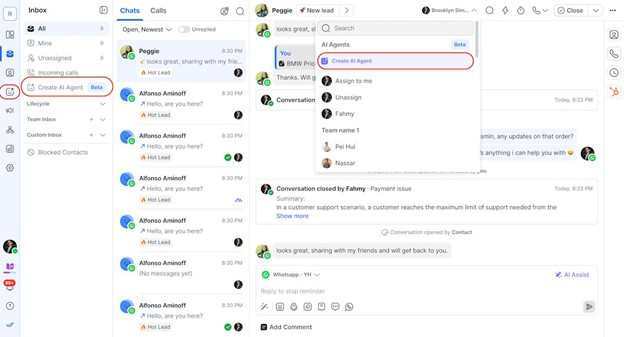
A WhatsApp CRM solves this by connecting the chat (where the customer is) with the data (where the business logic is). It allows you to set rules or use AI Agents to handle the flow. These agents reply to leads instantly, filter out spam, and qualify prospects. Then, they prioritize the serious buyers and automatically route them to the right salesperson.
5 Tools to Qualify Leads and Boost Conversions
We tested the market to find tools that don’t just “connect” WhatsApp but actively help you filter and convert leads.
1. Respond.io – The Best WhatsApp CRM for AI Qualification and Routing
Respond.io is a customer conversation management platform built for high-volume chat, email and call interactions across the customer lifecycle, with built-in CRM integrations, AI Agents and advanced reporting.
It is widely considered the best WhatsApp CRM for businesses that depend on WhatsApp or other instant messaging channels and require advanced AI-powered qualification, routing and automation, plus integrations with CRMs like Salesforce and HubSpot.
How it Improves Qualification
Respond.io has agentic AI Agents that can qualify leads, extract key details and hand conversations over to humans whenever necessary. Unlike rigid chatbots that rely on fixed rules, these agents understand intent and adapt to how customers naturally write, even with typos or incomplete sentences.
You can configure the AI Agent to run the qualification flow automatically. For example, when a new lead messages you, the AI Agent can filter out spam leads, then ask qualifying questions based on your setup, such as budget, product interest or purchase readiness, before determining the best next step.
Based on the customer’s replies, the system can automatically:
Update the contact’s profile with new or enriched details.
Assign lifecycle stages based on intent and buying readiness (e.g., marking someone as a “Hot Lead”).
Route high-value conversations directly to your VIP sales team.
Sync all captured data to your external CRM (like Salesforce or HubSpot) so records stay accurate and consistent.
Why it Converts
Respond.io AI Agents cut through inbox noise by identifying and routing serious buyers to your sales team immediately. Low-intent contacts stay out of the way, so reps spend their time where it matters.
Plus, with WhatsApp Business Calling, teams can switch from chat to call in one click – perfect for fast-moving or high-value deals that close better over the phone.
Best for: B2C businesses that rely on conversations to drive revenue across chat (including WhatsApp), email and voice calls and want a unified platform with advanced AI Agents, CRM integrations, customer lifecycle tracking and more.
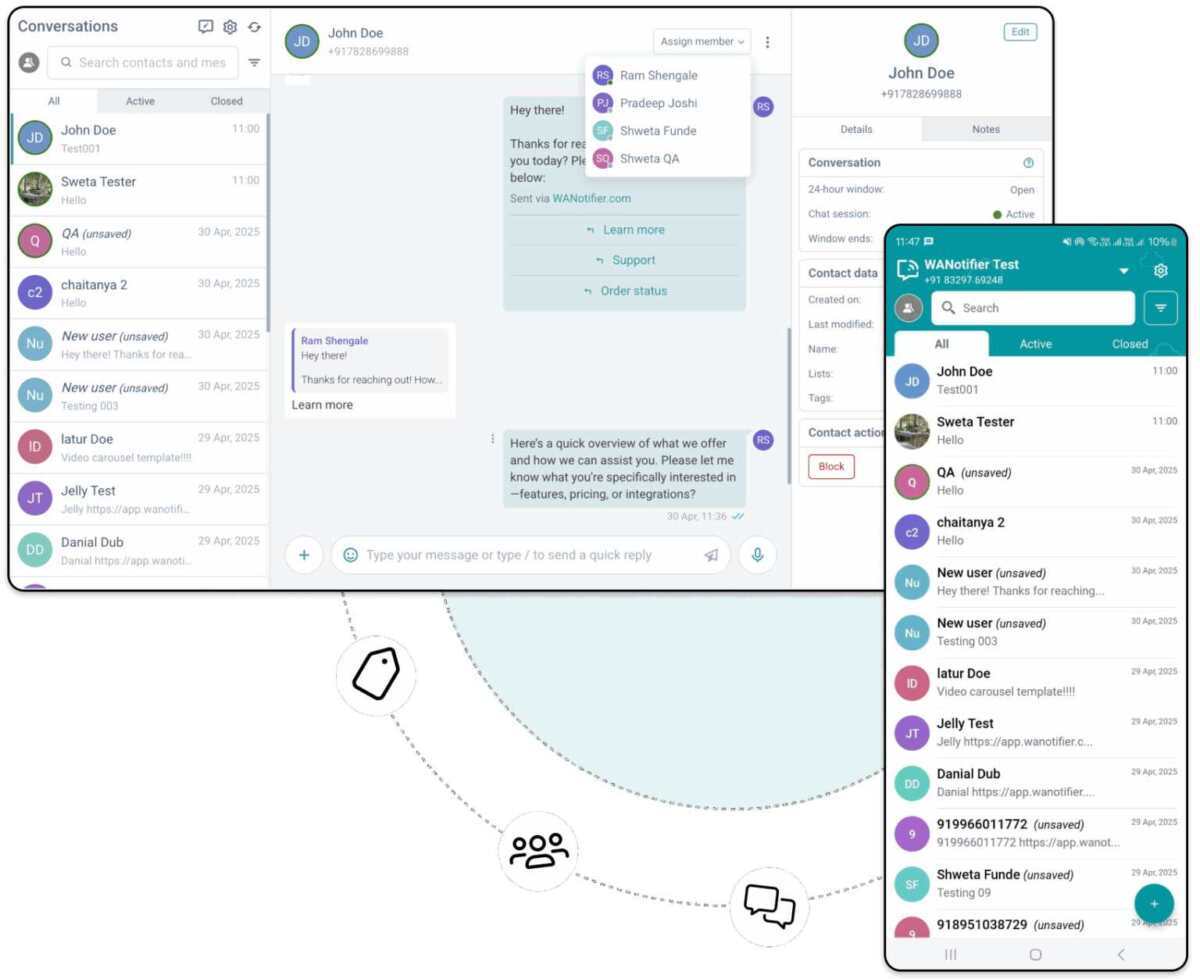
2. WANotifier – The Best WhatsApp Marketing Tool for Automated Lead Qualification and Conversions
WANotifier is a leading WhatsApp marketing platform, best for businesses that want a fully functional lead qualification engine. It connects directly with the official WhatsApp Business API.
Additionally, it ensures you get easy access to features like broadcast messaging, two-way chat, automation workflows, and a built-in chatbot builder under one roof. Overall ensuring enterprise CRM capabilities without the overhead cost.
How it Improves Qualification
WANotifier’s chatbot builder lets you design structured qualification flows. When a new lead messages you, the bot runs a sequence of qualifying questions and branches the conversation based on their replies.
Moreover, you can also trigger these flows from outside WhatsApp. With an embed, click-to-WhatsApp button you can run a Meta ad that opens directly in chat.
The moment someone initiates a conversation, your set qualification sequence kicks off automatically.
Why it Converts
Speed matters in lead conversion. For teams managing high volumes, the shared team inbox means multiple agents in your team are able to handle conversations simultaneously.
Because every chat is tagged, filtered, and searchable, hot leads never get buried under cold ones.
On the pricing side, WANotifier charges zero markup on WhatsApp API costs.This means, you pay only what Meta charges. Setup is equally straightforward as well.
Best for: DTC brands, SMBs, and growing ecommerce brands looking for WhatsApp marketing and lead qualification system across the full customer lifecycle.
3. HubSpot
HubSpot is the default brain for many B2B sales teams. Its native WhatsApp integration brings the chat directly into the customer’s timeline. If you live inside HubSpot, this integration makes WhatsApp feel like just another part of the contact record.
How it Improves Qualification
The power here lies in “Workflows.” You can trigger WhatsApp messages based on website behavior.
Imagine a prospect visits your pricing page three times in one week. HubSpot tracks this. You can set a rule: “If a contact visits the Pricing URL > 3 times, send a WhatsApp template: ‘Saw you checking our plans. Want a quick demo?'”
If they reply, the conversation logs automatically on their contact card. You can also use HubSpot’s lead scoring. If a lead chats on WhatsApp, their score goes up. If the score hits 50, the system creates a deal and assigns a task to a salesperson.
Why it Converts
Context. When a salesperson replies to a WhatsApp message in HubSpot, they see the lead’s entire history: every email opened, every page visited, and every past purchase. They don’t ask “How can I help?”; they ask “Did you like the Enterprise plan you looked at yesterday?” That precision closes deals.
Best for: Marketing and sales teams who already run their lives through HubSpot.
4. Zoho CRM
Zoho offers a toolkit for everything, and its WhatsApp integration fits that mold. It is flexible, affordable, and deeply customizable.
You can connect it natively or use third-party extensions depending on your region and technical needs.
How it Improves Qualification
Zoho uses a feature called “Blueprints.” This forces your sales team to follow a process. You can design a Blueprint for WhatsApp leads that requires an agent to ask specific questions before moving the deal to the next stage.
For example, an agent cannot move a lead from “New” to “Qualified” until they tick a box confirming they received the client’s budget via WhatsApp. The system prompts the agent to ask the question if the field is empty.
Why it Converts
Consistency. In many teams, top performers convert at 30% while juniors convert at 5%. Zoho’s structure ensures every lead on WhatsApp gets the same high-standard treatment. No lead gets dropped because an agent “forgot” to ask for the budget.
Best for: Small to medium businesses that need structure and affordability.
5. Salesforce
Salesforce is the heavy lifter. Its integration (via Digital Engagement or partners) is not for casual users. It is for enterprises where a lost lead costs thousands of dollars.
How it Improves Qualification
Salesforce combines WhatsApp with Einstein (their AI). It analyzes the sentiment of messages. If a lead sounds frustrated or urgent, the system flags it.
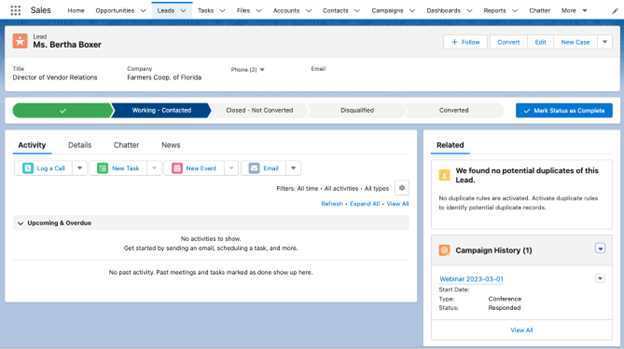
You can build complex “Flows.” For example: A lead messages via WhatsApp. Salesforce checks their phone number against your database.
Match found: It checks their annual spending. If it’s over $50k, the chat routes to the Key Account Manager immediately.
No match: It triggers a bot to collect name, email, and company size.
Why it Converts
Power. Salesforce allows for extreme personalization at scale. You can send a WhatsApp message that pulls data from five different fields: “Hi John, your renewal for [Product X] is coming up on [Date]. Since you used [Feature Y] heavily last month, we recommend upgrading to…” This level of detail proves you know your customer.
Best for: Large enterprises with complex sales cycles and distinct sales departments.
6. Kommo CRM (formerly amoCRM)
Kommo does not try to be an “everything store.” It focuses entirely on messenger-based sales.
If your business lives in chat, Kommo builds your entire sales process around it, treating every WhatsApp conversation as a deal in a pipeline rather than just a support ticket.
How it Improves Qualification The standout feature is the visual Salesbot. It is not just a greeter. It qualifies leads inside the chat and physically moves their deal card to the next stage in your pipeline.
You can build a logic path without code: When a lead messages via WhatsApp, the bot asks, “Are you looking for B2B or B2C services?”
If they answer “B2B,” the bot automatically moves the lead from the “Incoming” stage to the “Qualification” stage.
It then tags the lead as “Corporate” and assigns a task to your B2B specialist to call them.
Why it Converts
Visibility. Most tools show a chronological list of chats, which buries older (but valuable) conversations. Kommo shows a board of deals, similar to Trello. You see instantly which WhatsApp conversations are “New,” which are “In Progress,” and which are stalled. You prioritize by deal stage, not by who messaged last.
Best for: Small to medium businesses (SMBs) that want a visual, board-style view for their WhatsApp chats.
The “Sync + Productivity” Framework
Simply buying these tools won’t fix your sales process. You need to apply the “Sync + Productivity” framework. This is a mental model for setting up your WhatsApp CRM.
Phase 1: The Sync (Stop Data Leaks)
Your first goal is to ensure that what happens in WhatsApp stays in the CRM.
The Rule: No business contact exists solely on a phone. If a number isn’t in the CRM, it doesn’t exist.
The Action: Configure your tool to auto-create contacts. When a new number messages you, the system should create a “New Lead” profile immediately.
The Benefit: You build a database asset. Even if a salesperson leaves the company, the conversation history stays with you, not on their personal device.
Phase 2: The Filter (Automated Qualification)
Once data is syncing, you must stop your team from doing robot work.
The Rule: Humans should only talk to qualified humans.
The Action: Deploy an AI Agent to interview new leads immediately.
Bad: “Hello, how can we help?” (Too open-ended).
Good: “Hi! I’m the digital assistant. To connect you with the right expert, are you looking to buy a new license or do you need technical support?”
The Benefit: You instantly separate buyers from complainers. Support tickets go to the support desk; sales leads go to the deal pipeline.
Phase 3: The Context (Conversion)
Now that you have a qualified lead, you need to close them.
The Rule: Never ask a question you already know the answer to.
The Action: Before replying, the agent looks at the contact history for context. They see the lead’s location, past orders, and web visits.
The Benefit: The agent provides contextual replies such as, “Hi Sarah, I see you’re looking at our Pro Plan. Since you’re based in the UK, we can offer you…” This creates a feeling of competence and care.
Summary
The difference between a chat app and a sales channel is data. WhatsApp without a CRM is just noise – a constant stream of notifications that distracts your team.
By connecting WhatsApp to a tool like Respond.io or HubSpot, you turn that noise into a structured pipeline. You stop guessing which leads are real. You stop losing phone numbers. You stop asking “What is your budget?” for the hundredth time. Instead, you start the conversation at the finish line, closing the deal because you already know who you are talking to and what they need.
How the Best WhatsApp CRM Improves Lead Qualification and Conversions was last modified: April 10th, 2026 by Hudabia Fatima
Running a small business is often a balancing act. Owners are frequently expected to be the CEO, marketing manager, IT support, and financial planner all at once. In the current digital landscape, the pressure to maintain high productivity while securing assets against sophisticated threats is immense. For business owners in Thailand and beyond, the key to sustainable success lies in working smarter, not harder. Here are five essential strategies to enhance your business’s efficiency and security.
1. Streamline Communication and Data Synchronization
One of the biggest productivity killers in a small business environment is disjointed data. If your team is wasting hours manually updating contacts across devices or searching for the latest calendar entry, you are losing money. Efficient data management is the backbone of a productive office.
Ensuring your email, calendar, and contacts are synchronized across all devices—mobile and desktop—is crucial. For organizations relying on the Microsoft ecosystem, utilizing reliable Outlook sync solutions can eliminate data silos. This ensures that whether you are in the office or meeting a client in Bangkok, you have access to accurate, real-time information without the risk of duplication errors.
2. Invest in Strategic Digital Growth
Productivity and security create the foundation, but strategic investment drives growth. Many small business owners make the mistake of trying to manage their entire digital marketing strategy in-house to save costs. However, the complexity of search engine algorithms and online advertising often requires specialist knowledge.
Investing in a partnership with a dedicated agency can yield a much higher return on investment than a DIY approach. Agencies such as Move Ahead Media specialize in navigating the competitive digital landscape, helping businesses optimize their online presence. By outsourcing these tasks to experts, you ensure your marketing budget is spent effectively, allowing you to redirect internal resources toward product development and customer service.
3. Prioritise Robust Cyber Security
As businesses become more digital, the risk of cyber attacks increases. Small businesses are often seen as easy targets because they frequently lack the dedicated security infrastructure of larger corporations. Security is not just about installing antivirus software; it involves a holistic approach to protecting your PC and network integrity.
To safeguard your business, you must ensure that all software is regularly updated and that you have a recovery plan in place. The UK’s National Cyber Security Centre provides excellent PC security guidance that is relevant for businesses globally, covering the basics of backing up data, protecting your organization from malware, and keeping smartphones and tablets safe.
4. Automate Routine Administrative Tasks
Automation is a powerful tool for boosting productivity. Repetitive tasks such as invoicing, social media posting, and appointment scheduling can easily be automated using modern software. Consider implementing the following to save time:
Accounting Software: Automate invoice chasing and expense tracking to keep finances in order.
Social Media Schedulers: Plan your content in advance to maintain a consistent presence without daily disruption.
Customer Relationship Management (CRM): Automate follow-up emails to ensure no lead is left cold.
By reducing the manual load of these administrative duties, you minimize the scope for human error and allow your team to focus on high-value creative and strategic work.
5. Foster a Culture of Continuous Training
Your technology is only as secure and productive as the people using it. Regular training sessions are vital to ensure your staff understands the importance of data security and knows how to use productivity tools effectively.
Encourage a culture where employees feel comfortable reporting potential security breaches, such as phishing emails, without fear of blame. Furthermore, investing in training for new software ensures that your team can utilize the full features of your tech stack, maximizing the return on your software investments.
Conclusion
Balancing productivity with security requires a proactive mindset. By synchronizing your data, investing in expert support for your digital growth, and securing your systems, you position your small business for long-term success. The goal is to build a resilient operation that can weather digital storms while seizing new opportunities in the marketplace.
5 Essential Strategies to Boost Small Business Productivity and Security was last modified: December 12th, 2025 by Colleen Borator
Successful App Store growth is built on three core components: a strong ASO foundation, visibility boosters like Trending Searches, and tactics that help apps rise into top positions. With thousands of new apps appearing every week, search-driven discovery remains the most reliable and scalable route.
Way #1. Keyword optimization
Keyword research
Focus on the language users rely on when describing the results they want, not the technical features behind them. Build a keyword set that mixes high-, mid-, and low-volume keywords and study competitor metadata. High-volume keywords broaden reach, mid-volume keywords offer realistic ranking opportunities, and long-tail phrases often deliver stronger conversion because intent is clearer.
Metadata optimization
Metadata transforms keyword choices into signals the algorithm can act on.
Title: when possible, pair the app name with a relevant keyword.
Subtitle: clearly express the primary benefit in a natural, user-friendly line.
Keyword field: add additional terms, avoiding repeats and stop words.
Use all available locales to expand indexed metadata space. Track changes in search behavior and adjust your keyword set. Incentivized installs tied to specific keywords can help accelerate movement in search rankings.
Other best practices
Don’t repeat terms across metadata fields, skip meaningless connectors, exclude the app name unless it’s a commonly searched term, and check keyword performance frequently.
Way #2. Trending Searches
Trending Searches highlight keywords experiencing a rapid surge in interest. If your app already ranks well for a rising term, you can gain significant organic visibility when it enters the trending list. Estimates suggest that 3–5K concentrated searches may be enough to trigger the trend. Coordinated PR pushes, paid campaigns, or social buzz around a chosen keyword can help capture that momentum.
Way #3. Getting into the App Store top
Reaching top placements requires more than optimized metadata. Ranking is also shaped by install velocity, product quality, and the strength of your creatives.
A smooth onboarding flow reduces early drop-off.
Preview videos, which autoplay in search, serve as quick visual pitches.
Refresh icons, screenshots, and promo text regularly and run A/B experiments.
Custom product pages let you tailor messaging for different traffic sources.
Trigger review prompts after moments of success, not at random.
Encourage sharing, collaborate with niche communities, run referral programs, test targeted ads, re-engage via email, cross-promote, build a simple landing page, and use events to increase awareness.
Incentivized traffic can rapidly increase ranking but must be supported by healthy retention.
To make these spikes stick, you still need strong App Store Optimization. See how we build high-performing ASO strategies and apply them in real campaigns.
How to Promote an App on the App Store: ASO, Trending Searches, and Top Rankings was last modified: December 12th, 2025 by Colleen Borator
Running a business means keeping track of many moving parts. Your contact lists need to stay current across devices. Your online presence needs to reach the right people. Both require systems that work without constant manual fixes.
Most companies handle these tasks separately. They treat data management as one thing and marketing as another. But they share more than you might think. Both need regular maintenance. Both affect how smoothly your business runs.
Why Backlinks Still Help Your Business Get Found
Search engines rank websites based on who links to them. A link from another site acts like a recommendation. More quality links usually mean better search rankings. This brings more potential customers to your site.
Not all links carry the same weight though. A link from a respected industry publication helps more. One from a random blog does less. Search algorithms can tell the difference. They look at the linking site’s authority. They check if it relates to your field.
Building these connections takes time and effort. You need content that other sites want to reference. You need relationships with editors and publishers. Many businesses now work with a guest post service to handle outreach. They also manage placement on relevant sites. This approach saves time. It often produces better results than doing everything yourself.
The Federal Trade Commission requires clear labels on sponsored content. This keeps the process transparent for readers. Working within these guidelines protects your reputation. It also protects your search rankings.
Quality Beats Quantity in Link Building
Ten years ago, some companies bought thousands of cheap links. Search engines caught on fast. Now they penalize sites that use these tactics. One good link beats a hundred poor ones.
What Makes a Link Valuable
Several factors determine if a link helps your site or hurts it. The linking site should cover topics related to yours. Its own traffic matters too. Its authority in the industry counts as well.
Here are the key markers of a quality backlink:
The link appears in actual content, not a footer or sidebar
Readers find it useful for learning more about a topic
The linking page gets regular traffic from real visitors
The site has a clean history with search engines
The content around the link makes sense and adds value
Content That Earns Natural Links
The best content solves a real problem for readers. It might explain a complex process in simple terms. It might share research findings that others can reference. It might offer a fresh take on an industry challenge.
Regular audits help maintain link quality. You want to know where your links come from. You want to spot any that might cause problems. Most SEO tools can generate reports showing your profile over time.
How Data Syncing Supports Your Work
While you build your online presence, your internal systems need to keep up. Customer information lives in multiple places. Your email platform has contact details. Your calendar tracks meetings. Your CRM stores communication history.
When these systems don’t match, problems start piling up. Manual updates waste time and introduce errors. Someone changes a phone number in one system. They forget to update the others. You email the wrong address. You show up at the wrong time for a meeting. Small mistakes add up to lost business.
The Benefits of Automated Syncing
Automated syncing prevents these issues before they start. Changes in one location update everywhere else. Your team sees current information no matter which tool they use.
This consistency helps in several ways:
Projects move faster without data verification delays
Your business looks more professional to clients
Team members spend less time on manual updates
Fewer scheduling conflicts and missed appointments
Customer service improves with accurate information
The sync process needs to be reliable and secure. Data should transfer without corruption. Personal information requires encryption during transit. Good sync tools offer multiple connection methods. This lets you pick what fits your security needs.
Measuring What Works
Both backlinks and syncing produce measurable results. You just need to know what to track. For links, you measure referring domains and organic traffic. You also track keyword rankings over time. Tools like Google Search Console show which pages attract links. You can see how your visibility changes month by month.
For syncing, you measure time saved and errors prevented. Track how long manual updates used to take. Count how many scheduling conflicts happened before automation. Compare customer satisfaction scores from before and after.
The Small Business Administration notes that measuring performance helps businesses make better decisions. The data shows what deserves more investment. It reveals where to cut back. This applies to marketing tactics and operational tools alike.
Setting Clear Goals
Set specific goals for each initiative you launch. For backlinks, you might aim for five new links per month. Those links should come from sites in your industry. For syncing, you might target cutting data entry time by half. Clear targets make it easier to judge your progress.
Review your metrics monthly at minimum. Look for trends rather than day to day changes. A single good or bad week doesn’t tell you much. Patterns over months reveal what really works for your business.
Getting Both Strategies to Work Together
Your marketing team needs accurate contact lists to reach prospects. They need calendar access to schedule campaigns around company events. When their data stays current, they work more efficiently. This lets them focus on strategy instead of fixing information.
Better internal efficiency also improves content creation. Writers can quickly verify facts with the right people. They can check product details without hunting through old emails. This speed helps you publish more consistently. Consistent publishing supports your backlink efforts.
Starting Small and Scaling Up
Think of these systems as working together. One helps you present a polished face to the world. The other keeps your internal operations running smoothly. Both require initial setup and ongoing attention. Both pay off through compound benefits over time.
Start with the area causing the most problems right now. If you’re losing deals because of poor online visibility, focus there first. If internal confusion is costing hours each week, fix that instead. You don’t need to perfect everything at once.
Test changes on a small scale before rolling them out widely. Try one new link building approach for a month. Sync one critical dataset before expanding to others. Learn what works in your specific situation. Then scale up what proves effective for your team.
Your Questions About Backlinks and Data Syncing
What makes a backlink valuable for my business?
Good backlinks come from sites people actually trust. They sit in real articles, not random sidebars. The site should relate to your industry.
How long does link building take to show results?
You’ll wait a few months before seeing real changes. Check your numbers monthly. One good week means nothing. Patterns over time matter.
Why should I automate data syncing across my systems?
Manual updates eat your time and create errors. Automation fixes contact info everywhere at once. Your team stops wasting hours on data entry.
Can I build backlinks without hiring an agency?
Sure, but it takes serious time. You need relationships with editors. You need solid content. Most businesses hire help so they can focus elsewhere.
How do I measure if my backlink strategy works?
Watch your organic traffic and search rankings each month. Google Search Console shows who links to you. Compare numbers over several months, not weeks.
What to Know About Syncing and Backlink Strategies was last modified: December 10th, 2025 by Andrew Miller
Production days move fast, and small gaps in information can stall shoots for hours. A missed calendar update can ripple through call sheets and crew timing. Editors then wait for missing notes, while clients wait for revised cuts. A clear sync plan keeps teams in step from prep to final delivery.
Many Bay Area crews already manage calendars and contact lists on desktop and phone. A seasoned San Francisco Video Production Company like Luma Creative plans shoots across locations, then keeps updates flowing to phones on set. That same discipline helps brand teams lock story beats before the first slate. The result is smoother days and fewer retakes across the schedule.
Build A Sync Backbone Before The First Shoot Day
Brand videos depend on quick coordination between producers, clients, and subject matter experts. Create a shared structure for contacts, calendars, tasks, and notes that mirrors your production stages. Keep the fields simple, so people update them quickly and accurately.
CompanionLink users can bring Outlook calendars, tasks, and notes to Android and iPhone with cable, Wi Fi, or cloud sync. The method matters less than reliability and repeatability during the week. Choose one method for the team and write the steps where crew can find them. Consistency removes guesswork when stress rises on location.
Add a short checklist to your preproduction routine and keep it consistent. Confirm linked calendars for recce dates, shoot days, and edit milestones. Confirm contact records for talent, vendors, and location managers with roles and mobile numbers. Confirm shared notes with script pages, drive links, and file paths inside your folder plan.
Make Scheduling And Approvals Move Without Friction
Brand stakeholders often juggle product updates, legal checks, and press timing. When calendars sync to every device, producers can reschedule interviews within minutes. Crew then receive the new call time inside the same event, with address and parking notes attached.
On Bay Area shoots, traffic windows and building access rules change quickly. Put those changes into the master calendar entry, not an email thread. Add a short summary at the top, then a time stamped line for material changes. That habit leaves a trace that editors and clients can review later.
Accessibility improves reach and reduces rework during caption checks. Keep a style note about captions in your shared documentation, and reference the Federal Communications Commission guidance on caption quality and accuracy. The FCC outlines clarity expectations that help brand videos reach more people and pass platform checks, which reduces back and forth later.
Keep Creative Assets And Metadata In Lockstep
Editors work faster when filenames, notes, and takes match across desktop and phone. Use one folder map that covers ingest, proxies, audio, graphics, and review exports. Mirror that map on mobile work apps used by producers and clients.
Give each clip a card in your notes system with scene and take fields. Add who approved the setup and any retake reasons. Sync those cards to phones, so a producer can confirm details while walking to the next setup. That habit reduces confusion during night edits and weekend pickups.
Treat color, audio rate, and frame rate as shared facts, not private editor knowledge. Put target color space, frame rate, and audio settings in a single notes page. Sync it to every device that might touch footage or exports. One misplaced export setting can trigger a cascade of re-exports and re-uploads.
Standardize Mobile To Desktop Review Loops
Many brand teams now review cuts on phones during travel between meetings. Mobile review helps, but only if the version matches what the editor exported. Give each review export a version string and paste that string at the top of the calendar event. Keep the string in the file name and the notes body, so it follows the cut.
Adopt a simple feedback code that works in chat and email. Use short tags like Keep, Change, and Question with shot timecodes. Store the code list in a shared note and pin it in the review event. People then write tighter comments and editors spend less time decoding intent.
A consistent review loop benefits from standard device time settings. Matching times across devices helps align logs, slates, and chat comments during postproduction. The National Institute of Standards and Technology describes reference time services and synchronization practices that improve accuracy across systems. Use a single reference to reduce mismatched timestamps on shots and notes.
A Practical Sync Workflow For Busy Brand Teams
A small amount of structure keeps sync tasks fast and repeatable. This sequence works for crews that plan, shoot, and edit within tight windows. It also scales for live streams and hybrid events with remote stakeholders.
Create a master calendar with prep, shoot, edit, and delivery milestones. Invite only the people who must act on each entry. Keep descriptions concise and include parking, access, and contact details near the top.
Build a shared contacts list with roles like Producer, Client Lead, Legal Reviewer, and Talent. Add mobile numbers, backup numbers, and preferred channels. Keep that list synced to every phone used on set or on the control desk.
Set one notes repository for scripts, shot lists, and review links. Use short page names that match folder names. Put the current version string at the top of each page and update it before sharing.
During capture, record quick take notes in the synced notes app. Use the same fields for every card, and capture issues while they are fresh. Sync as you move between rooms to keep editors current on the last hour.
For reviews, export a smaller proxy and label it with the version string. Paste that string into the calendar event and the email subject. Ask reviewers to echo the string in replies, so comments attach to the right cut.
Live streaming benefits from similar habits. Keep run of show, encoder settings, and backup links in the same synced notes page. Put the latest change at the top with a timestamp, so the entire crew sees it first. Update the master calendar when the stream key changes, and include the change reason in the description.
Edge cases still appear on the tightest shoots. A vendor driver might call the producer while cameras are rolling. With synced contacts and a shared notes page, the production assistant can confirm loading dock instructions without interrupting takes. The reduced friction shows up as smoother wraps and fewer reshoots next week.
Bring Syncing Into The Edit
Editors feel the benefits of clean sync the moment media arrives. Timestamps align with shot notes, and proxy folders match the camera map. Audio and color settings match the shared page, so exports line up on the first pass. Producers then spend time solving creative problems instead of chasing missing details.
How to Enhance Brand Videos with Seamless Syncing was last modified: December 9th, 2025 by Andrew Miller
You want to create a design for your brand that shows its unique signature and voice, but can’t find effective tools that can speak for you. Don’t worry, we’ve got you!
If you are an entrepreneur or own a small company and are looking for a creative platform for your logo designs, business cards, or websites, then you’re in the right place!
Professional, creative, inspiring, and exclusive design ideas are quite easy to find and use for your brand.
In this article, we’ll go through four of the best brand design websites you can easily dive into and have the best experiences for your brand identity.
Top Tools for Brand Designs
Let’s dive into the design platforms to find out your preferred ones.
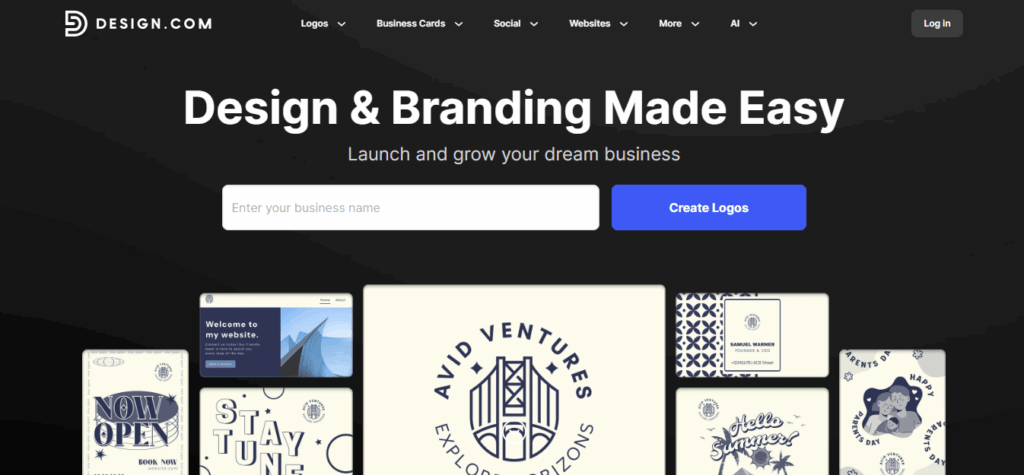
#1. Design.com
Design.com is an online marketplace for entrepreneurs, startups, small organizations, and social media creators for generating AI-assisted logo designs based on diverse industries.
If you want a reliable and flexible platform for your brand ideas. Design.com is here for you!
It is known to be the number 1-ranked AI logo generator with effective and accessible AI tools.
Main Characteristics
High-quality designs: If you are not sure about the layouts, colors, and other details of the templates, Design.com offers over 360K+ logo designs and over 1 million design templates. Sounds exciting, right? You can find over 750+ fonts, 525+ exclusive fonts, 62K custom shapes, and other unique tools here.
Enhanced AI tools: For someone who wants to experiment with AI-assisted tools for their design ideas, this website is right here for you. You can find AI-driven logos, business cards, website builders, background removers, presentations, posters, flyers, and domain name generators for your brand design.
A diverse range of industries: The platform provides various templates and designs for fashion, food, gaming, and other industries. Based on the background, purpose, and intentions of your brand, the website offers suitable industry options.
Licensing rights: On the website, users can maintain exclusive licensing ownership. The moment you purchase the logo, it is unavailable for others and entirely removed from the store. The logo belongs only to you and your brand.
Additional Features
Create without a background: It is completely quick and easy to edit the designs and work on them without overthinking whether you have design experience or not.
Download in any format you want: You can create the designs and immediately download them in different file formats, including PNG, PDF, JPG, SVG, and EPS.
Commercially reliable service: You can find professional and commercially safe designs in Design.com without having second thoughts about the inconsistency and inefficiency.
Extra design tools: Besides logos, here you can find 50+ creative tools and designs, such as business cards, websites, cards, QR codes, letterheads, menus, presentations, flyers, and even more.
Printing options: Let us surprise you even more! You can easily get prints on different items, including cups, mousepads, t-shirts, caps, and more. Free delivery for the printing is also included.
Pricing
The best news is that the website allows you to search for the template and make any adjustments you desire. You can do all these without having a premium plan. Not only logos, but also business cards, website builders, posts, and other designs are accessible in different file formats and with transparent backgrounds.
Easy to create and publish, right? But for downloading the designs, you need to get the premium plan for the best experience.
#2. BrandCrowd
Another online marketplace, BrandCrowd, provides inspiring and professional design templates and ideas for small companies and startups. You can find over 350K+ logo templates and over 1 million design ideas on this website.
Main Characteristics
Exclusive design suggestions: Over 62K custom shapes, 750+ fonts, 525+ exclusive fonts, and other unique tools, all here waiting for you to start your journey!
Advanced AI-assisted tools: Through the website, you can find inspiring and exciting designs. As it suggests, the AI logo, AI business name generator, and AI background remover for your designs.
Commercially secure: Everything here is made for the best customer experience, making it smooth for their businesses to build and succeed.
Various industries: You can easily find different design templates related to beauty, fashion, technology, marketing, and much more.
Payment options: Here, you’ll have access to it and publish free logos, business card makers, and links in bio makers. However, keep in mind that if you want to save and download the designs, you have to obtain the paid options.
Get the file in your desired format: It’s up to you to save it in PDF, PNG, JPG, SVG, or EPS file formats that match your design purpose.
Additional design ideas: BrandCrowd offers over 50+ creative designs for business cards, websites, presentations, flyers, letterheads, menus, and other options.
#3. Lenso.ai
Lenso.ai is an advanced AI-powered reverse image search tool that helps you build a strong brand identity. Before finalizing your logo and visuals, you have to ensure your ideas are not unintentionally similar to existing designs. Lenso.ai allows you to verify originality, research competitors, and find get inspired to create the most unique brand identity.
Main Characteristics
Reverse image search for brand research: Upload your logo or brand visual and check for similar images across the web. This helps you avoid duplication. Competitor and market analysis: Explore how other brands in your niche present themselves visually. By searching related images, you can analyze trends, color palettes, layouts, and design strategies to position your brand better.
Duplicate detection for brand protection: Lenso.ai helps you track where your images appear online. This is especially useful for monitoring unauthorized use of your logo, marketing graphics, or branded content.
Advanced filters and smart categories: With categories such as People, Duplicates, Similar, Related, and Places, along with filtering options, you can narrow down results and conduct deeper visual research for your brand development. For more categories and filters, consider using lenso.ai’s Research Mode.
Fast and user-friendly experience: Lenso.ai provides a simple upload-and-search process. No complex steps – just quick, accurate results.
Flexible access options: Start with free searches and explore the platform’s core features. Then, you can consider premium plans to unlock extended results.
#4. Adobe Express
Adobe Express is a professional design platform built for entrepreneurs, small businesses, and content creators who want polished brand assets without a steep learning curve. Its built-in logo maker draws from Adobe’s premium font library — one of the most extensive available — making it particularly strong for industries like beauty and tech where typography plays a central role in brand identity.
Main Characteristics
Premium font library: Access thousands of typefaces from Adobe Fonts, including modern serifs, minimalist sans-serifs, and decorative styles suited to diverse industries.
AI-assisted design tools: Generate logo concepts, remove backgrounds, and customize templates without design experience.
Adobe ecosystem integration: Seamlessly connects with Creative Cloud assets for consistent branding across platforms.
Flexible customization: Adjust colors, fonts, icons, and layouts with an intuitive drag-and-drop editor.
Multiple file formats: Download designs in PNG, JPG, PDF, and SVG for web and print use.
Pricing
Adobe Express offers a free plan with core design tools and templates. The premium plan unlocks the full Adobe Fonts library, advanced AI tools, and additional storage.
#5. Designs.ai
Designs.ai is an online platform for businesses and individuals providing quick and refreshing AI-generated design ideas in minutes. With simple clicks, you can create impressive videos, logos, and images for your brand.
Main Characteristics
Solutions and customization tools: You can easily find different exclusive design templates for your brand. Stunning visuals, colors, fonts, and other elements are not missing from this website.
Creative suite and assets: The website provides affordable tools for quick reach and access. You can create AI images, videos, logo generators, write AI video scripts, and other exciting accommodations.
Pricing options: You can quickly start your journey and generate free designs by creating an account for a free trial. The range of payment options varies based on your other preferences.
Fast and easy to use for everyone: Whether you’re a beginner or a designer, you can quickly create logo designs, videos, and images without complex steps and guidelines.
Available file formats: Choose the best file format for you! You can create the designs and download them in different formats, including PNG, SVG, PDF, or JPG.
#6. DesignEvo
Think of DesignEvo as an online free platform with over 10K logo designs.
Main Characteristics
Creative approach and suggestions: Depending on whether you are looking for something professional, minimalistic, simple, or creative designs with exclusive 100+ fonts, layouts, color pallets, shapes, and icons.
A variety of topics related to logo designs: If you are looking for fashion, football, gaming, real estate, or other industries for your brand, the platform provides more than you think!
Flexible purchasing and free offerings: For free, you can edit and re-download your created logo designs in resolution files. However, remember that for high-quality formats, you need to gain either the basic or the plus payment options.
Accessible file formats: Now is the moment to download the design. You can choose between JPG, SVG, and PDF file formats. Entirely up to you!
Best Tools for Complete Brand Design: Comparison Table
Characteristics
Design.com
BrandCrowd
Designs.ai
Adobe Express
DesignEvo
Template size
A library of over 360K+ unique logo templates, over 1 million business cards, social media posts, and other designs
A diverse collection of over 300K+ logo designs and 1 million design suggestions
Offers creative and exciting templates, logo ideas, images, and more
Thousands of premium templates across industries including beauty, tech, and marketing
A rich suggestion of logo templates and design ideas
Customization suggestions
If you have access to diverse options, including over 62K custom shapes, over 750+ fonts, 525+ exclusive fonts, and other exclusive tools
Offers 50+ inspiring designs, 62K custom shapes, 750+ fonts, 525+ exclusive fonts, and even more
Color suggestions, layouts, icons, fonts, and other elements are accessible in Designs.ai
Font, color, icon, and layout adjustments with drag-and-drop editor
Fonts, color shades, various shapes, and exclusive icons.
Advanced tools
Feel free to work with creative AI-assisted tools if you want AI-driven logos, business cards, website builders, background removers, and other advanced ways
Be more creative and get suggestions from the AI logo, AI business name generator, and AI background remover for your design ideas.
Create with AI images, logo generators, write AI video scripts, and find other accommodations
AI logo generation, background remover, Adobe Creative Cloud integration
Tools related to industries and ideas, with or without AI-assisted generators, are accessible here
Commercial options
It allows you to easily create and publish with layouts, colors, and so on. But for the premium plan, you need to pay
You can edit and save designs without any charge, but get paid solutions for more creative designs
No worries here, edit, create, and download for free!
Free plan available; premium unlocks full font library and advanced tools
Start your design creation, edit your templates, and download them for free for your first experience
Download file formats
Access to downloading file formats, including PNG, PDF, JPG, SVG, and EPS
You can easily save the designs in PDF, PNG, JPG, SVG, or EPS file formats
PNG, SVG, PDF, or JPG are all available in Designs.ai
PNG, JPG, PDF, SVG
Good-quality SVG, JPG, and PDF formats
To Sum Up
Together, we went through the four best design websites for small companies, start-ups, and creative individuals.
It is this simple: if you want to have the most exclusive experience with the best creative tools, inspiring opportunities, and convenient materials, you should consider Design.com and BrandCrowd. As the speed and quality are meeting there!
Best Tools for Complete Brand Design was last modified: May 26th, 2026 by Sharman Sagoyan
By 2026, the myths surrounding SEO need to be put to rest. SEO is a difficult industry to keep up with, and the myths make it harder. Some myths present a misleading view of the importance of backlinks, while others diminish the value of content. Outdated strategies and misconceptions will hurt a website’s reliability.
In 2026, keeping up with SEO will be critical. Outdated strategies drain resources and time and will damage a site’s standing. Let’s discuss the most common SEO myths. Every website has the potential to be fully optimized, but misguided beliefs take that away.
Myth #1: “Keywords Alone Will Boost Rankings”
In the past, many believed that simply repeating a keyword enough times on a page would improve SEO. ‘Keyword stuffing,’ as it was called, was a way people thought would get a page to rank better. They summed up the argument: being more persuasive would work if the keyword was repeated more often.
In 2026, all that has changed. SEO has evolved, and so have the algorithms. Search engines have gone beyond analyzing keyword density and are concentrating on relevance, context, and intent. It is not the number of times a word is repeated that matters; it is whether it answers the searcher’s question. Today’s algorithms can identify adjacent keywords and synonyms and capture the sense of the page as a whole. A page that comprehensively addresses a topic will do better than one that stubbornly fixes on repeating a keyword.
In a 2025 SEMrush report, for example, user intent optimization ranked on average 30% higher than pages that simply optimized for keyword frequency. The results back up the argument that context and relevance, and not just the keyword, are the most important aspects of your strategy.
Myth #2: “More Backlinks Always Means Better SEO”
Some site owners still think that backlinks increase your rank, and while that statement is partially true, there is a quality over quantity factor to consider here. Spammy backlinks will reduce your site’s authority and get your site penalized. That is the last thing you want.
By 2026, the investigation of backlinks will be more relevant to the authority of the site. For example, the value of a few links from trustworthy sites that relate to your content is much more valuable than hundreds of links from irrelevant sites and sites of low trust. These backlinks will also increase traffic to your site and strengthen your branding.
An example of this is the statement “Websites with fewer but high-quality backlinks see 50% higher referral traffic than sites with many low-quality links”. This is from a Moz report and bestology’s emphasis on SEO. Relevance and authority are what you should truly strive for.
To navigate this shift toward quality, many B2B SaaS organizations are moving away from bulk link building in favor of targeted editorial placements. Platforms like dofollow.com facilitate this by securing mentions and backlinks from high-authority, frequently crawled publications with domain ratings often exceeding 60. By focusing on manual outreach and authentic editorial collaboration, brands can build the authority signals required to rank in both traditional search engines and emerging AI answer platforms, ensuring their link profile remains an asset rather than a liability in 2026.
Myth #3: “Meta Tags Are Obsolete”
Not entirely; it’s wrong to say that the meta tags do not affect SEO, although some marketers think so. Certainly, some are not as powerful as they used to be, such as the “keywords” meta tag, but others certainly are.
A reality check: “title tags and meta descriptions” remain very significant. You still need to optimize these for search ranking and CTR. You still need to craft these to the point and captivating enough to compel a user to click from the SERP. Even in 2026, these tags still need to be optimized for relevance, clarity, and concentration on the targeted keywords.
How to optimize:
For title tags: “Under 60 characters, with primary keywords, and make sure it reflects the content.”
For meta description: “150 to 160 characters, make it compelling, and add secondary keywords naturally.”
Even in that optimization, the clarity for the reader and the value to the reader are above the number of keywords.
Myth #4: “SEO is Only About Google”
Some individuals operate under the assumption that Google dominates the landscape of search engine optimization and is the only engine worth optimizing for. While Google is a considerable player in the industry, AI-integrated platforms and multi-search engines are increasingly popular. Bing, YouTube, and Amazon are searchable platforms, as are voice assistants like Siri and Alexa. Each platform possesses unique algorithms and standards for ranking and engaging with users.
In fact, Google optimization will not capture all the segments of your audience. To incorporate all audience segments, optimize for multi-channel SEO. Capture users through voice, video, and specialized search engines. You can optimize for Google and text search and video content for YouTube, the second-largest search engine, to access audiences that Google will not give you. Conversely, voice search optimization is the more natural conversational content for featured snippets and AI answers.
Example: HubSpot research shows a 25-35% increase in organic traffic to search engine-targeted sites, instead of those sites that target only Google.
Myth #5: “You Must Post Daily to Rank”
As search rankings are calculated based on several parameters, some people believe that constantly posting helps improve search rankings. Numerous businesses assume that consistently posting content every day will improve their SEO results.
The Reality: In 2026, the search engines will continue to focus on quality. Search engines reward content that meets the searcher’s intent and offers genuine value. A single, evergreen content piece will have much greater relevance and value than multiple short, worthless pieces.
Effective Content Strategy
In-depth coverage on all core subjects of a topic.
Updating and refreshing older content.
Prioritizing user experience and content readability is much more productive than being fixated on arbitrary publishing goals.
Example: A 2025 SEMrush study cites that long-form quality content earns 60% more backlinks than short content and thus is more highly valued. Value and authority are still driven by content volume.
Many people assume that having numerous social media likes, followers, and shares contributes to a higher ranking on search engines. Social activity can increase visibility, but Google and other search engines have stated that social signals do not rank content.
Social media does influence SEO, but in an indirect way. It helps gain more traffic, engagement, and recognition for the brand. When users share your content, it gets seen by many others, some of whom may link it, comment, and interact—activities that influence SEO. Social media serves more as a booster to your SEO efforts, rather than as a guaranteed solution.
BrightEdge’s 2025 research indicates that pages with strong social media engagement received 20% more referral traffic, and this traffic positively affected the pages’ search visibility.
Myth #7: “Exact Match Domains Guarantee Success”
Because of the early days of SEO, people still believe that EMDs will help them rank quickly. Many people still believe that they can improve their SEO with EMDs.
Reality: Having an Exact Match Domain (EMD) is no longer an SEO shortcut. Google and other search engines look for content relevancy and user experience, and that no longer applies to EMDs. On a priority basis, search engines will always assess content quality before determining EMD relevance. While EMDs will assist in short-term brand impressions and recall, they also will not offset content quality and ineffective SEO.
Best Practice: Brand and content relevance should always take precedence. An identifiable domain name, with relevant content, will yield more relevant returns than a domain that is merely a set of keywords.
Example: Research published by Moz showed that poorly branded EMDs not only lost brand equity, but also lost up to 40% of their rankings in contrast to branded domains that hosted quality content.
Myth #8: “Longer Content Always Wins”
The prevailing notion is that longer articles will increase SEO rankings. Indeed, longer articles have more room to cover topics. However, longer content returns no SEO value if relevancy is lost or overlooked.
Reality: Search engines do not prioritize content based on length. The ideal scenario is fully addressing a user query. In fact, shorter, more concise content can eclipse a longer piece simply by meeting user demands more effectively.
Content Optimization:
Incorporate headings, bullet points, and images to make content more scannable and to minimize the amount of text to read.
User needs should determine the content and its structure, not an arbitrary target word count.
Please include more data or research to support your point, along with actionable recommendations.
For instance, a HubSpot report on content length published in 2025 indicated that when user intent was matched, blog posts of 1,500–2,000 words performed the best; the shorter posts, however, surpassed the longer ones when intent was clear and specific.
Myth #9: “Technical SEO is Optional”
Every so often, site owners concentrate their efforts exclusively on content and backlinks, and thus, overlook Technical SEO. This is a misunderstanding because technical optimizations will always be a prerequisite for any site to succeed in SEO. Site speed, mobile friendliness, a secure HTTPS, structured data, and no index bloat all become critical factors regarding user experience and thus SEO.
The Reality: Even the best-written content on the internet will never rank if technical SEO is not addressed. Pages that users cannot access because of loading issues, or a poorly designed mobile version, and crawl errors all contribute to user frustration and will cause high bounce and abandonment rates.
Example: “The performance of a site is, in fact, a major contributor to engagement and visibility. According to Google, 53% of mobile users abandon pages that take longer than three seconds to load.”
To achieve technical SEO, you should host your website on a reliable platform and monitor its health. Be mindful when choosing a hosting provider if your website is build with WordPress: less than 99% server uptime is a bad sign. As an alternative, you can consider building your website or migrating it to a website builder, which includes hosting, maintenance, SEO and mobile optimization. For instance, Site.pro supports free website migration from most other platforms, including website builders and CMS.
Myth #10: “Once You Rank, You’re Done”
People think that if they finally get to a high ranking on a search engine, they’re done worrying about it. Unfortunately, this is not the case. Content on the internet is constantly changing, and so are search engine algorithms. In addition, user intent and behavior change with time. Without constant effort on a site, the ranks will inevitably drop.
A few things that will keep you on the ranking treadmill include:
Updating content regularly to keep it fresh and removing anything that is outdated.
Adjusting your plans after analyzing your rank competitors and understanding changes to algorithms.
Tracking the competition.
Preparing for new types of search like voice search and hyper-advanced AI search.
SEMrush states that sites that are diligent in content updating and tracking technical SEO can achieve and retain up to 40% higher rankings over 2 years relative to their static counterparts.
Conclusion
SEO is one of the many facets of digital marketing that is continuously changing and evolving. With 2026 on the horizon, the strategies that may have worked a few years ago might do more damage to your brand than good. Understanding the fundamentals of SEO and separating fact from myth will be crucial to your success in 2026 and beyond.
Throughout this piece, we have explored 10 SEO myths, such as the fixation on keywords and backlinks, and the misconception that once you achieve a ranking, the job is finished. SEO done correctly is rooted in flexibility, genuineness, and value. Rewarded is content crafted with the user in mind, and in large measure, praised are fast, high-performing sites and brand consistency.
Due to heightened competition and changing algorithms, the shift should now be toward solid, user-first content that is useful, thoroughly optimized, and built on a strong technical foundation.
Outdated strategies will continue to damage your brand. 2026 is your chance to work smarter, not harder.
Top 10 SEO Myths You Should Stop Believing in 2026 was last modified: June 22nd, 2026 by Colleen Borator