Rental businesses that operate bicycles, scooters, boats, or other specialized vehicles face a different set of challenges than traditional car rental companies. Their fleets are often smaller, more diverse, and more sensitive to seasonal demand. At the same time, margins can be tighter, and operational inefficiencies have a faster impact on profitability. In this context, management software plays a critical role in maintaining control and scalability.
Unlike large vehicle rental operations, small and specialized fleets depend heavily on accurate scheduling, consistent pricing rules, and efficient staff workflows. Manual coordination or generic tools quickly become limiting as demand fluctuates or inventory expands. Digital management platforms address these constraints by centralizing operations and reducing dependency on ad hoc processes.
Operational Control in Bicycle Rental Businesses
Bicycle rental operations often involve high booking volume, short rental periods, and frequent asset turnover. Managing these dynamics manually increases the risk of availability conflicts, inconsistent pricing, and incomplete records. A bike rental manager provides structure by organizing reservations, tracking asset status, and standardizing operational rules.
Centralized scheduling ensures that each unit is allocated correctly and returned on time. Pricing rules can be applied consistently across rental durations and customer types. Staff gain immediate visibility into availability without manual checks, which improves response time and reduces errors during peak demand periods.
From a management perspective, this level of control supports better planning. Utilization data highlights underused inventory, while booking patterns reveal demand trends that inform purchasing and maintenance decisions.
Managing Boat Rentals With Precision
Boat rental operations introduce additional complexity. Assets are high value, scheduling windows are longer, and regulatory or safety requirements are often stricter. Manual oversight increases exposure to risk, particularly when bookings, payments, and documentation are handled across separate systems.
A structured approach using boat rental management software allows businesses to manage reservations, availability, and financial workflows within a single environment. Booking conditions, deposit requirements, and rental agreements can be standardized, reducing ambiguity and operational risk.
Clear scheduling also supports better asset utilization. Managers can plan maintenance around reservations, avoid idle time, and ensure compliance with operational requirements. As a result, the business operates with greater predictability and fewer disruptions.
Shared Benefits Across Specialized Fleets
While bicycles and boats differ operationally, their management needs overlap in several key areas. Centralized rental software delivers consistent value across both segments by supporting:
real-time availability tracking across all assets
standardized pricing and booking rules
integrated payment and deposit handling
operational reporting for utilization and revenue
reduced reliance on manual coordination
These capabilities allow businesses to operate efficiently regardless of fleet size or asset type.
Supporting Growth Without Operational Disruption
As rental businesses expand, complexity grows faster than volume. Adding new vehicles, locations, or service options introduces coordination challenges that manual systems cannot absorb. Management software enables controlled growth by maintaining consistent rules while allowing operational flexibility where required.
Platforms such as Rent Syst are designed to support this balance. Businesses can scale their fleets or diversify offerings without redesigning workflows or retraining staff from scratch. Operational continuity is preserved even as the business evolves.
Integration and Long-Term Efficiency
Rental management software does not operate in isolation. Integration with booking websites, payment processors, and accounting systems reduces duplicate work and improves data consistency. This connectivity ensures that reservations, financial records, and customer information remain aligned across systems.
Over time, this integrated approach reduces administrative overhead and supports data-driven decision-making. Managers gain access to accurate performance data without additional reporting layers, allowing them to focus on strategic improvements rather than operational troubleshooting.
A Practical Foundation for Specialized Rental Operations
For businesses managing bicycles, boats, or other specialized vehicles, structured management software provides operational clarity. It replaces fragmented workflows with predictable processes and supports efficiency at every stage of growth.
Rather than focusing on individual features, successful operators view management platforms as infrastructure. By centralizing reservations, standardizing rules, and integrating systems, they build operations that are resilient, scalable, and easier to manage in competitive markets.
Managing Small and Specialized Rental Fleets Through Centralized Software was last modified: February 2nd, 2026 by Colleen Borator
Quantum computers are sprinting toward the day they shatter RSA and ECC. Attackers can hoard your encrypted data now and read it later, so the clock is already running.
Research shows enterprises need 12–15 years to swap out every vulnerable key. Fault-tolerant machines may arrive sooner, turning delay into a security gap.
Regulators echo the urgency: a joint CISA-NSA-NIST factsheet urges teams to inventory crypto and build a migration roadmap today.
We’ll guide you through four phased steps, ending with a checklist and tool picks—everything you need to stay ahead.
Form a cross-functional Quantum-Readiness Team chaired by a senior executive who controls budget and removes roadblocks. The Canadian Cyber Centre calls this step “identify a dedicated migration lead” and insists each department include finance, procurement, and project-management voices, along with security engineers.
Executive sponsorship turns an academic threat into a budgeted priority and signals to vendors that quantum safety is mandatory.
Next, draft a short, living charter.
List deliverables: a roadmap draft in six months, quarterly progress briefs, and a full inventory by year-end. Clear deadlines keep momentum and make it simple for the board to track risk reduction.
Finish with an awareness sprint.
Brief senior leadership using plain-language stories: attackers already collect encrypted traffic, and quantum computers will let them read it later. That warning comes directly from CISA, NSA, and NIST in their 2023 fact sheet urging organizations to “begin preparing now.”
With governance anchored, we can discover exactly where our cryptography lives.
2.2 Build a complete cryptographic inventory
We can’t fix what we can’t see.
Launch an organization-wide hunt for every place public-key cryptography hides: servers, applications, IoT gateways, and even dusty backup tapes.
Start with the obvious. Pull certificate logs, scan network endpoints, and query your CMDB for libraries such as OpenSSL. These automated sweeps reveal quick wins like web servers running RSA-2048, VPN concentrators using classic Diffie-Hellman, and code-signing keys tucked into build pipelines.
Run client-side tests too.
Project 11’s free PQ-TLS browser checker parses each endpoint’s TLS ClientHello and flags whether it advertises hybrid suites such as X25519-MLKEM768 or pure MLKEM variants, giving you an instant map of which workstations can join early pilots and which need patching.
Then dig deeper. The Canadian Cyber Centre warns that cryptography lurks in surprising corners: embedded firmware, remote-office printers, smart-factory sensors, and hard-coded API calls in legacy apps. Pair scanning tools with interviews. Ask system owners where encryption lives, which algorithms they rely on, and how long the protected data must stay secret.
Capture every finding in a living Cryptographic Bill of Materials. For each asset, record:
system name and owner
algorithm and key length in play
data sensitivity and retention horizon
upgrade path or vendor dependency
This single spreadsheet becomes our north star. At a glance, it shows which systems guard ten-year secrets behind soon-to-expire keys and which can be patched tomorrow with a quick library swap.
Perfection is not required on day one. The Cyber Centre notes that inventories mature iteratively; the key is to establish a repeatable discovery cadence and improve coverage each quarter. As new projects launch, make the CBOM part of change control so fresh cryptography never slips into the shadows.
With governance locked and the inventory underway, we know the size of the mountain. Next, we rank the risks and draft a plan to climb it.
2.3 Shape your quantum-risk profile
An inventory is only a list until we score it.
Translate raw findings into a concise risk picture the board can grasp at a glance.
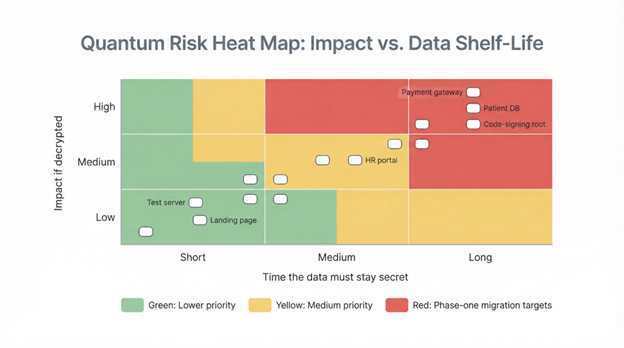
Mark each system with two factors: impact if decrypted and time the data must stay secret. A payroll API that protects tax IDs for seven years carries more weight than a scratch-pad test server cleared weekly. Public blockchains are no exception—on-chain signatures and keys persist indefinitely, and common quantum blockchain myths like “SHA-256 makes the ledger safe” overlook how a future cryptographically-relevant quantum computer could still forge ownership proofs. The MDPI timeline study matters here: large organizations face a 12-to-15-year replacement cycle, so anything valuable past 2030 sits in the danger zone.
Plot the scores on a heat map.
Red squares—long-lived, high-impact data behind classical keys—become phase-one targets. Yellow squares queue for later waves, while green items wait unless resources allow. Document every decision. If a legacy billing app will retire in two years, log an accepted risk with an expiry date rather than spending cycles on a short-lived fix.
Finally, add this risk profile to the enterprise risk register. That move elevates quantum exposure to the same governance channel as financial or operational threats and guarantees regular reviews and budget visibility.
With risks ranked and owners assigned, we have the clarity to design a phased migration plan in Phase 2.
Phase 2 – risk-driven planning
3.1 Analyze and prioritize risks
With a crystal-clear inventory in hand, we turn numbers into action.
Our goal is simple: decide which systems move first, which follow, and which wait for retirement.
Start by mapping every entry in the CBOM against two axes: business impact and secrecy shelf-life. High impact means customer trust, revenue, or safety is on the line if data leaks. Shelf-life measures how long that data must stay unread. A marketing landing page has almost no shelf-life. Medical records? Decades.
Plot the results on a heat map.
The red corner, containing long shelf-life and high-impact data, shows the first movers of our migration. Typical residents include payment gateways, patient databases, code-signing roots, and cross-border VPNs. The Canadian government framework uses the same color-coded lens to ensure “systems protecting long-lived sensitive information are prioritized early.”
Next, fold in practical constraints. Vendor roadmap dates, hardware refresh cycles, and regulatory deadlines can shift the order. If an ERP provider promises a PQC patch in 2027, we may queue that system behind an in-house microservice we control today. The MDPI timeline study reminds us that resource bottlenecks—especially upgraded HSMs—can derail a logical plan if ignored.
Surface the scorecard to leadership. A one-page dashboard that shows “20 percent of high-risk systems scheduled for upgrade by Q4 next year” lets executives track progress and approve funding. It also locks quantum exposure into the enterprise risk register alongside supply-chain and compliance risks.
We now have a ranked list, assigned owners, and shared urgency. The next step is to sketch a phased roadmap that turns those priorities into calendar milestones.
3.2 Draft the phased migration roadmap
Now we convert prioritized risks into a timeline everyone can support.
Picture four waves.
Wave 1 – Preparation (now through next fiscal year). Finish the crypto inventory, finalize the roadmap, and run proof-of-concept labs.
Wave 2 – Pilot & design (2024–2026). Stand up hybrid TLS on a staging site, patch a handful of internal services, and lock supplier contracts for PQC-ready hardware.
Wave 3 – high-priority rollout (2026–2030). Replace or wrap every red-zone system from our heat map: external portals, VPN head-ends, root CAs, and long-term archives.
Wave 4 – full adoption & decommission (2030–2035). Retire remaining classical keys, re-encrypt cold-storage data, and switch default cipher policies to pure post-quantum.
This cadence comes from government guidance that targets high-value systems first and expects all departments to reach quantum safety by 2035. It mirrors real-world refresh cycles, easing budget shocks by aligning with planned upgrades.
Each wave has clear exit criteria.
Wave 2 is complete only when hybrid certificates run in production and handshake performance is measured. Wave 3 closes when every critical service reports “no RSA/ECC in use” in monitoring dashboards.
Resource planning runs in parallel. The MDPI analysis warns that HSM capacity often triples once lattice-based keys arrive, so procurement for larger appliances lands in Wave 2 even if deployment waits for Wave 3. The roadmap pins those long-lead items early so finance can spread costs rather than absorbing them late.
Publish the roadmap as a living document. Quarterly reviews let us adjust for new NIST drafts, vendor delays, or breakthrough attacks. Momentum matters: graduate from one wave to the next without stalling in pilot limbo.
With milestones on the calendar, we are ready to integrate the plan into the broader enterprise risk-management framework.
3.3 Embed the roadmap into your risk-management framework
When a plan lives in isolation, it falters.
We weave the post-quantum roadmap into the same governance machinery that tracks financial, operational, and compliance risks.
Begin with a familiar language. If your organization follows NIST 800-37, map each migration wave to the framework life-cycle:
Categorize & select. Inventory and heat-map work fulfill “Identify” duties, while the roadmap selects new controls such as PQC algorithms, hybrid certificates, and upgraded HSMs.
Implement & assess. Pilot projects and Wave 3 rollouts show the “Protect” and “Validate” steps, complete with test evidence.
Authorize & monitor. Executives sign off on quantum-safe states, and dashboards track remaining RSA/ECC exposure in real time.
This familiar model reassures auditors and shows budget committees that quantum work extends existing programs rather than creating a new silo.
Document residual risk formally. For systems waiting on a vendor patch, file a risk acceptance with an expiry date and compensating controls—for example, network isolation or symmetric-encryption overlays. This prevents forgotten tasks and keeps leadership accountable.
Maintain rhythm. Add quantum-readiness metrics to quarterly risk reviews: percentage of high-risk systems migrated, number of RSA certificates still live, and HSM capacity versus requirement. Show the same graph every quarter so progress, or lack of it, is obvious.
By anchoring the roadmap inside your enterprise risk framework, you turn quantum migration from a side project into core operational resilience. That alignment unlocks steady funding, executive attention, and the organizational muscle needed for the long haul.
Phase 3 – execution
4.1 Run low-risk pilots and gather hard data
Plans on paper satisfy auditors; working code convinces everyone else.
We start execution with small, low-risk pilots that let us feel the weight of post-quantum cryptography before touching critical systems.
Pick a friendly target, maybe a staging web server or an internal developer portal. Activate a hybrid TLS cipher that pairs classical RSA with the lattice-based Kyber key exchange. Modern builds of OpenSSL and Chrome already speak this dialect, so you will see success traffic on day one while legacy clients fall back to RSA.
Measure the results.
Track handshake time, CPU load, and certificate size. A bump of 5–10 ms in handshake latency is normal; anything larger flags a tuning task long before customers notice. Log every client that rejects the hybrid suite. That data becomes your compatibility heat map for broader rollout.
Share findings quickly. When leadership sees a live demo with packet captures proving quantum-safe key establishment, they move from abstract risk to visible progress. Engineers gain confidence, procurement learns which HSM firmware works, and the migration story shifts from “someday” to “already underway.”
Armed with real-world metrics, we can tackle production systems.
4.2 Upgrade the cryptographic plumbing
Pilots prove feasibility; now we swap parts in production.
Start with the trust backbone, your public key infrastructure. Patch internal certificate authorities so they can issue composite or Dilithium-signed certificates. Shorten certificate lifetimes to simplify future rotations and automate renewals through a certificate-lifecycle manager.
Next, address key custody. Post-quantum keys are larger than RSA keys, so firmware updates alone may not solve capacity limits. Plan for additional HSM slots or cloud-based key vaults before traffic spikes force an urgent purchase.
Move to network edge devices.
Activate hybrid cipher suites on web servers, API gateways, and VPN concentrators. Roll out in waves—customer-facing first, then internal systems—while monitoring handshake success and fallback rates. Announce end-of-life dates for pure RSA connections so partners have clear notice.
Applications come last because they need the most care. Refactor in-house code to call a crypto-agility wrapper instead of hard-coded algorithms. For immovable legacy apps, insert a proxy or service-mesh sidecar that handles post-quantum handshakes on their behalf.
Document every change in the CBOM. Each green check mark turns abstract progress into evidence for auditors and executives.
4.3 Choose: hybrid, replace, or isolate?
Not every system needs the same treatment.
Sort each one into three buckets:
Hybrid in place is the default. If a device or app can accept a firmware patch or library update, attach post-quantum algorithms while keeping classical ones for backward compatibility. Examples include web servers, email relays, and modern VPN gateways.
Replacement or re-architect comes next. Some legacy databases, mainframes, or bespoke appliances cannot learn new crypto tricks. When a patch costs more than a migration, schedule a clean swap, often tied to an existing refresh.
Isolate and tunnel is the last resort. For an IoT sensor fleet set for retirement in two years, route traffic through a quantum-safe gateway and segment the network. You reduce risk without spending capital on hardware you plan to discard.
Record the rationale. It prevents second-guessing when auditors ask why a billing system still speaks RSA in 2028 and keeps everyone aligned on priorities.
4.4 Test, validate, and prove security assurance
After every rollout, run three layers of testing—functional, security, and interoperability—and bake them into CI pipelines so checks happen automatically with each change.
Functional tests come first. Does the service start? Do clients of all ages connect and complete transactions? Any spike in error logs means we pause and fix before moving on.
Security tests dig deeper. Launch side-channel probes to confirm lattice-based operations do not leak timing clues, fuzz malformed keys to catch crash bugs, and verify certificates chain correctly back to the updated CA. Patch and retest until the service is clean.
Interoperability is the final gate. Build a client matrix that includes current browsers, legacy endpoints, and partner systems. Each must handshake successfully or fail gracefully. Share results with partners so no one is surprised by a sunset date for RSA.
Pass all three gates, and a system earns a green tick in the CBOM plus an entry in the audit log. Repeatable, evidence-backed testing turns broken-crypto headlines into someone else’s problem and shows auditors proof, not promises.
Phase 4 – ongoing monitoring & optimization
5.1 Keep a finger on the post-quantum pulse
The migration never truly ends; it shifts from project to steady heartbeat.
First, treat the Cryptographic Bill of Materials as a living artifact, not a dusty spreadsheet. Automate weekly scans that flag any new RSA certificate, expired hybrid key, or shadow-IT service running vulnerable TLS. When a red entry appears, the risk dashboard lights up and an owner is paged.
Second, watch the research horizon. Subscribe to NIST and industry mailing lists so you know the day a newly standardized algorithm lands or an existing one shows cracks. Early notice lets us schedule patch windows before attackers craft an exploit.
Third, publish metrics that matter. Leadership cares about trends, not tables. A single chart showing “RSA exposure over time” protects the budget better than a fifty-page report. Celebrate downward slopes publicly to reinforce momentum.
Run a crypto-agility drill at least once a year. Swap the primary algorithm on a non-critical service within 48 hours to prove tooling works, staff know the playbook, and procurement can source keys fast.
When monitoring becomes muscle memory, quantum risk shrinks from headline threat to manageable line item.
5.2 Review, refine, and harvest the hidden wins
Post-quantum work pays compound interest when we pause to collect it.
Hold an annual crypto health check. Gather lessons from recent rollouts: where hybrid handshakes lagged, which vendor patches arrived late, and who completed migration with zero downtime. Turn those stories into updated playbooks and share them across teams.
Rebalance cost and benefit. Early in the program, every hour felt like insurance. As quantum headlines grow louder and compliance deadlines approach, value flips: being demonstrably quantum-safe becomes a sales edge. Capture that advantage in RFP responses and security marketing.
Optimize performance. If Kyber-768 strains CPU on a busy microservice, a lighter hybrid suite may meet policy while keeping latency low. Tune algorithms, cache session tickets, or upgrade TLS offload cards to regain the overhead everyone feared.
Keep culture agile. Reward teams that flag outdated crypto before scanners do, celebrate quick pivots when NIST revises a draft, and treat algorithm swaps like routine patches. The goal is a security posture where changing ciphers feels as normal as rotating passwords.
Consistent refinement turns a one-time migration into a lasting advantage and prevents another scramble when the next cryptographic curveball appears.
Conclusion
Enterprise PQC migration checklist
Tick each item before the next board update:
Executive sponsor appointed and Quantum-Readiness Team chartered
Full cryptographic inventory captured in a living CBOM
Heat-map risk profile added to the corporate risk register
Phased roadmap published with budget and resource owners
At least one hybrid-TLS pilot live in production with metrics logged
Internal CA and certificate-lifecycle platform upgraded for post-quantum certs
HSM capacity ordered or cloud key vault contracted
High-priority systems scheduled for migration before 2030
Automated scans alert on any new RSA or ECC artifacts
Annual crypto-agility drill completed and lessons captured
Eight or more checks put you ahead of the pack. Fewer than five? Call a war room; quantum waits for no one.
FAQs – straight answers for busy leaders
We use RSA-4096 everywhere. Isn’t that large enough? Size does not matter against a full-scale quantum computer; Shor’s algorithm breaks any RSA key in polynomial time. A quantum-resistant algorithm is the only safe public-key defense.
Can we wait until NIST finalizes every standard? No. CISA, NSA, and NIST urge organizations to start now because inventory, governance, and pilot testing take years. When the remaining standards are published, you will want proven processes ready to accept them.
What about quantum key distribution? QKD solves a niche transport problem with costly hardware and strict distance limits. Post-quantum cryptography works in software, scales globally, and covers signatures as well as key exchange, so it is the higher-impact first move for most enterprises.
Will post-quantum algorithms slow my apps? Early pilots show a single-digit millisecond bump in TLS handshakes and negligible impact on bulk transfer. Session caching and TLS offload cards recover most of that overhead. Measure in your environment, but performance is rarely the blocker.
How do we prove to auditors that we are compliant? Maintain an up-to-date CBOM, link every migration step to risk-register entries, and archive test evidence. Inventory, roadmap, and validation logs answer almost every audit question before it is asked.
Post Quantum Migration Roadmap Enterprise Transition Using a Risk Management Framework was last modified: January 31st, 2026 by Enid Beck
Growing a startup is no longer just about having a good idea. In 2026, successful founders combine smart funding, focused marketing, and scalable systems to turn early traction into long-term growth. Whether you’re bootstrapped or already generating revenue, the right growth levers can dramatically accelerate momentum.
Below are eight proven ways to grow a startup, including funding via grants and two strategic approaches to growing your presence on Instagram.
1. Secure Non-Dilutive Funding Through Grants
One of the most overlooked growth accelerators for startups is grant funding. Unlike venture capital, grants don’t require you to give up equity, making them ideal for early-stage companies.
Governments, innovation bodies, and industry organisations regularly offer grants for:
Technology and AI development
Sustainability and green initiatives
Research and development (R&D)
Regional and small business growth
Many startups use grant funding to hire their first team members, build MVPs, or invest in marketing without burning cash. The key is aligning your startup’s mission with the grant’s objectives and presenting a clear plan for impact and scalability.
2. Validate Your Product With Real Customer Feedback
Growth without validation is just noise. Before scaling, ensure your product or service solves a real problem for a specific audience.
Ways to validate effectively:
Conduct short customer interviews
Run paid test campaigns with small budgets
Launch a limited beta or pilot offer
Track retention, not just sign-ups
Founders who validate early avoid wasting time and money on features or marketing channels that don’t convert. Strong validation also makes it easier to win grants, partnerships, and future investment.
3. Build a Strong Brand Foundation Early
Brand isn’t just logos and colours, it’s how your startup is perceived. A strong brand builds trust faster, improves conversion rates, and makes marketing more efficient.
Focus on:
Clear messaging and positioning
A consistent tone of voice
A professional website with social proof
A recognisable visual identity
In crowded markets, branding is often the difference between being remembered and being ignored.
4. Grow Your Startup by Scaling on Instagram (Organic Strategy)
Instagram remains one of the most powerful platforms for startup growth, especially for consumer brands, SaaS tools, creators, and service businesses.
Organic Instagram growth works when you:
Post consistently (3–5 times per week)
Focus on Reels for reach and discovery
Share behind-the-scenes content and founder stories
Educate your audience with short, high-value posts
Startups that treat Instagram as a long-term asset, not a vanity metric, often see it become their top source of inbound leads, partnerships, and brand awareness. The best way to kick things off is to buy Instagram followers to give the account some trust.
5. Use Instagram Growth Tactics to Drive Revenue (Paid & Hybrid)
Beyond organic posting, Instagram can directly drive startup revenue when paired with smart growth tactics.
Effective approaches include:
Boosting top-performing Reels
Running story ads to warm audiences
Collaborating with niche micro-influencers
Retargeting profile visitors and engagers
When done properly, Instagram becomes a full-funnel growth channel from discovery to conversion rather than just a social media presence.
6. Leverage Partnerships and Strategic Collaborations
Partnerships allow startups to grow faster by borrowing existing audiences and credibility.
Strong partnerships might include:
Co-marketing with complementary brands
Affiliate or referral programmes
Technology integrations
Joint webinars or product launches
A single strategic partnership can outperform months of cold outreach when aligned correctly.
7. Automate Operations to Scale Without Burning Out
Many startups hit a ceiling because founders do everything manually. Automation allows you to scale without hiring too early.
Common areas to automate:
Lead capture and follow-ups
Email and SMS marketing
Appointment booking
Customer onboarding
The more repeatable your processes are, the easier it becomes to grow without chaos.
8. Track Metrics That Actually Drive Growth
Finally, growth only works when it’s measurable. Focus on metrics tied directly to revenue and retention, not vanity numbers.
Key metrics to monitor:
Customer acquisition cost (CAC)
Lifetime value (LTV)
Conversion rates
Retention and churn
Data-driven startups make better decisions, spot opportunities earlier, and scale more sustainably.
To Conclude
Growing a startup in 2026 requires balance: smart funding, disciplined execution, and scalable marketing channels. By combining grant funding, strategic partnerships, automation, and Instagram-led social growth, founders can build momentum without overextending resources.
8 Proven Ways to Grow a Startup in 2026 was last modified: January 30th, 2026 by Tayyab Wasim
Change has a way of looking exciting on the surface. A new office. A new city. A new daily rhythm. What it does not do is erase existing responsibilities. Deadlines still arrive. People still rely on you. Work, family, and personal commitments continue, often without sympathy for the transition you are navigating.
The challenge is not the change itself. It is staying aligned while everything around you shifts. This article breaks down how to do precisely that, without relying on motivation or vague productivity advice.
Introduction: Change Without the Chaos
When your environment changes, your systems are tested. Many people expect disruption, but they underestimate its duration and impact. A new space and schedule can quietly drain focus, increase friction, and make even simple tasks feel heavier.
This is not about doing more. It is about staying in sync with what already matters while adapting to a new context. Whether you are relocating, starting a new role, or restructuring your daily routine, stability does not come automatically. It has to be built.
Understanding What Actually Changes (and What Doesn’t)
The most apparent change is physical. A different room. A longer commute. A new time zone. What changes less visibly is your mental bandwidth. Decision fatigue increases. Familiar cues disappear. Small inefficiencies add up quickly.
What does not change are expectations. Work still needs to be done well. Messages still need replies. Others still assume reliability. Problems arise when people plan for the visible changes but ignore the invisible strain.
Transition fatigue is real. It shows up as distraction, irritability, and slower execution. Acknowledging this early helps prevent frustration later.
The Relocation Strategy: Move With Intention, Not Hope
Relocation, whether personal or professional, should be treated as a project. Not a leap of faith. Before the move, take inventory. List your ongoing responsibilities, deadlines, and dependencies. This clarifies what must remain stable during the transition, including coordination with any external parties, such as a moving company that can introduce timing and logistical variables you don’t fully control.
Next, design your new setup around outcomes, not aesthetics. A beautiful workspace that disrupts focus is still a liability. Consider how your energy shifts throughout the day. Think about noise, access to tools, and time constraints. Build your environment to support how you actually work.
Buffers matter more than plans in the early stages. Assume things will take longer than expected. Reduce optional commitments. Leave space for adjustment.
Communication is critical. Let stakeholders know about the move in advance. Clarify availability and response times. This sets realistic expectations and buys trust.
Finally, define a stabilization window. Decide how long it will take to settle into the new setup fully. During this period, the goal is consistency, not optimization.
Rebuilding Your Schedule From the Ground Up
Trying to copy your old schedule into a new context rarely works. Time blocks that once made sense may now clash with energy dips or external constraints.
Start with non-negotiables. Fixed meetings, personal obligations, and essential tasks go first. Then assess where friction appears. Is focus harder in the morning? Does the new commute drain your evenings?
Align critical responsibilities with your strongest hours. This single adjustment often restores a sense of control faster than any tool or app.
Expect to revise your schedule multiple times. Early drafts are meant to be tested, not perfected.
Staying Aligned With Ongoing Responsibilities
When things feel unstable, willpower is not enough. Systems keep responsibilities visible when attention wavers.
A simple weekly alignment check can prevent drift. Review what is due, what is at risk, and what needs adjustment. This habit is small but grounding.
Avoid the trap of overcompensating. Doing too much too soon leads to burnout and resentment. Consistency beats intensity during transitions.
Responsibility does not mean rigidity. It means maintaining standards while adjusting methods.
Communication: The Sync Everyone Skips
Many issues during transitions are not operational. They are relational.
People notice changes in availability and responsiveness. If you do not reset expectations, they fill in the gaps themselves. Often incorrectly.
Clear, concise updates matter. You do not need to explain every detail. You do need to state what others can expect from you and when.
Flag risks early. Quietly adapt where possible. Transparency builds alignment without drama.
Common Mistakes That Break Sync
The first mistake is assuming flexibility removes the need for structure. It does not. It increases it.
Another is overloading the first few weeks to prove capability. This usually backfires.
Waiting too long to adjust is equally costly. If something is not working, change it early.
Finally, many people ignore the emotional side of relocation. Loss of familiarity affects performance. Denying it does not make it disappear.
Turning the New Setup Into an Advantage
Once stability returns, opportunity appears. Transitions expose inefficiencies that were previously hidden by routine.
This is the moment to cut what no longer serves you. To redesign workflows. To build routines that are more sustainable than before.
A new space can become a performance upgrade, but only after alignment is restored.
Conclusion: Stability Is Built, Not Found
Staying in sync during change is not about control. It is about awareness, communication, and deliberate adjustment.
Responsibilities do not pause for transitions. But with the right approach, neither does progress.
Adapt quickly. Align often. Adjust without guilt. Stability is not something you arrive at. It is something you maintain.
New Space, New Schedule, Same Responsibilities: How to Stay in Sync was last modified: January 29th, 2026 by Elida Berb
The CFO role has moved far beyond closing the books and tracking spend. Today’s finance leaders shape where a company places its bets, how capital gets allocated, and which growth plays deserve speed and focus. When the CFO leans into this broader mandate, growth becomes more predictable and repeatable.
This shift is not just about numbers. It is about connecting cash flow, customer insight, and operating rhythms so teams can act faster with less risk. The result is a company that funds innovation on purpose, scales what works, and avoids waste before it spreads.
From Finance Steward To Growth Catalyst
Modern CFOs translate strategy into the resources and guardrails that make it real. They decide which markets get priority, how pricing supports margin, and what investments clear the hurdle rate.
With that lens, the CFO becomes a growth catalyst rather than a back-office scorekeeper. Many teams need a single partner who can connect profitability with momentum, and that is where trusted advisors, such as Ocfo, help leadership stay aligned on decisions. The CFO sets the pace by tying working capital, talent plans, and technology spend to the same growth goals. This creates a shared playbook that product, sales, and operations can follow without confusion.
When the CFO frames choices in plain terms, tradeoffs become easier to see. Leaders can debate facts instead of opinions, and decisions arrive on time. That discipline speeds up execution without adding chaos.
AI And Analytics Expand The CFO’s Reach
Data has always lived in finance, but AI now turns that data into faster foresight. By pairing real-time dashboards with scenario modeling, CFOs can detect turning points early and shift resources before performance slips. It is a practical way to keep growth on track while limiting downside.
A global study from Accenture noted that nearly all CFOs expect widespread AI to reshape what is asked of their role, including sharper insights and faster decisions. This matches what many companies experience as they use automation to clean data and shorten planning cycles.
The CFO becomes the sponsor who sets standards and prevents fragmented tools from creating shadow numbers. The effect is cultural as much as technical.
Enterprise Priorities Put CFOs At The Strategy Table
Growth priorities have risen to the top of the enterprise agenda, and CFOs are central to that push. They bring a clear view of unit economics and the constraints that matter, which keeps strategies grounded. That balance of ambition and realism builds confidence across the C suite.
Research shared by Evanta observed that driving growth has become the number one enterprise priority, moving ahead of other concerns. This reflects how boards lean on CFOs to line up capital, risk limits, and pacing. With that mandate, finance helps set the order of operations so big bets do not starve day-to-day needs.
When CFOs join early in strategy formation, they shorten the distance from idea to market. Budgets, hiring, and systems can be sequenced for speed.
Operational Discipline Funds Bold Bets
Sustained growth requires fuel, and operational excellence supplies it. The CFO’s toolkit includes working capital routines, vendor terms, pricing architecture, and cost-to-serve visibility.
Small improvements across these areas add up to investable dollars without blunt cuts. Bridgepoint Consulting reported that nearly all finance leaders planned to raise wages in 2024, which shows how CFOs weigh talent retention against cost pressure. The best CFOs make room for important spending while still improving margin quality.
They treat cost not as a target, but as a design choice tied to customer value. This discipline protects innovation from being the first thing trimmed.
Cross-Functional Leadership That Accelerates Execution
The CFO is uniquely positioned to align teams because money touches every workflow. By setting a consistent operating cadence, finance turns plans into measurable actions. Weekly metrics and monthly business reviews keep the organization honest about what is working and what is stuck.
Strong CFOs speak the language of each function. They help product teams justify roadmaps, coach sales on pricing and discounting, and partner with operations on throughput. This builds trust, which is the real accelerant inside complex companies.
When alignment is high, fewer approvals are needed, and handoffs get cleaner. People know what to do next and why it matters.
Risk, Resilience, And Investor Confidence
Growth does not last without resilience. CFOs create buffers that let a company absorb shocks and still invest. Healthy liquidity, flexible financing, and clear risk limits make it easier to stay on offense when the market wobbles.
Investor confidence grows when the CFO explains the path with clarity. Transparent metrics and realistic guidance prevent surprises. That track record lowers the cost of capital and widens the set of options in front of the business.
Resilience is about learning fast. Post mortems, variance analysis, and rolling forecasts help teams adapt.
Growth is a team sport, and the CFO is the connector that keeps the play moving. By linking strategy, operations, and capital, finance leaders turn good ideas into measurable outcomes. The payoff is steady progress rather than sporadic wins.
As markets shift, the companies that thrive will treat finance as a forward position. When the CFO owns both discipline and speed, growth efforts stay focused and resilient. That is how businesses scale with purpose and avoid the drift that slows competitors.
Why CFOs Are Key Players In Driving Business Growth was last modified: January 23rd, 2026 by Charlene Brown
Embedded payments are reshaping how businesses take money, settle accounts, and serve customers. Instead of sending people to third parties, payment flows live inside the tools you already use.
This guide breaks down what embedded payments are, why they matter, and how they remove friction from daily work. You will see how they help with checkout, cash flow, fraud, and customer experience.
What Are Embedded Payments
Embedded payments place payment capabilities directly inside your software, website, or app. Customers transact without hopping between tabs or typing the same details again and again.
For teams, this means fewer moving parts. Payment acceptance becomes a built-in function tied to inventory, CRM, and reporting, not a standalone task with manual handoffs.
Developers also benefit. SDKs, tokenization, and unified APIs simplify builds so new payment options can ship faster. That speed helps you meet customer demand without heavy custom code.
Why Simpler Checkouts Matter
Checkout is your last mile. Every extra click adds risk of dropoff, and small delays stack into real revenue loss.
Many businesses fix this by trimming fields and auto-filling data – then adding trusted wallets and stored credentials to cut time further. When embedded in your checkout, Xplor Pay supports smooth user flow and upholds compliance and security. The result is fewer abandoned carts and fewer support tickets about failed payments.
Reducing Manual Work Across Teams
Without embedded payments, finance and ops often chase details across gateways, spreadsheets, and emails. That drains hours and introduces errors.
With an embedded approach, settlement data flows into the systems your teams already use. Refunds, partial captures, and subscriptions become routine clicks instead of one-off projects.
Support improves, too. Agents can see order status, payment state, and fulfillment in one place, which shortens calls and raises first-contact resolution.
Improving Cash Flow And Reconciliation
Cash flow loves speed and predictability. Embedded payments can speed funding and give clearer visibility into what cleared, what is pending, and what needs attention.
Clean reconciliation follows. When transactions, fees, and payouts align with orders in your core system, the month-end close is smoother, and audits are less painful.
Clear reporting helps leaders plan. Forecasts get better when you trust the numbers and can slice by product, channel, and customer segment.
Lowering Fraud Risk Without Friction
Security is not just about blocking bad actors – it is about keeping good customers moving. Embedded payment tools combine on-device signals, tokenization, and step-up checks to do both.
A Mastercard whitepaper noted that embedding card-on-file experiences with seamless authentication can reduce fraud while improving conversion, particularly when shoppers recognize consistent checkout patterns. That balance keeps approvals high and chargebacks low.
As rules evolve, built-in compliance updates help you keep pace. Your team spends less time decoding standards and more time building value.
Creating Better Customer Experiences
Customers want familiar, fast, and flexible ways to pay. Embedded payments let you offer cards, wallets, pay-by-link, and subscriptions in one place.
Loyalty can sit right beside payments. Points apply at checkout, rewards trigger automatically, and customers see real-time balances without leaving the flow.
Post-purchase touchpoints improve as well. Receipts, invoices, and order updates stay consistent across channels, which builds trust and reduces confusion.
How To Get Started Without The Headaches
Begin with your current stack. Map the systems that touch payments today and list the pain points your teams feel most.
Pick one high-impact journey to embed first – often checkout or in-app renewals. Keep the scope tight so you can learn fast, tune the experience, and prove value.
Then scale by adding methods, markets, and use cases. Watch metrics like approval rate, checkout time, refund speed, and support contacts to track gains.
Choosing The Right Partner
Look for a provider that offers clean APIs, clear documentation, and strong developer tools. Reliable sandboxes and sample apps will speed your first launch.
Prioritize security features that do not slow users down. Tokenization, vaulting, and adaptive authentication should be table stakes, along with clear dispute workflows.
Assess reporting depth and data access. You should be able to export, pipe to your BI tool, and build dashboards without hacks.
Measuring What Matters
Set baselines before you switch. Know your current approval rate, time-to-pay, chargeback rate, and average time to reconcile.
After embedding, compare weekly for the first 8 weeks. Look for lift in conversion, fewer support tickets, and faster close cycles.
Share results across teams. When finance, product, and support see the same gains, it is easier to expand the program.
Modern payment workflows do not have to be complex. With embedded payments, you can reduce busywork, raise conversion, and gain clearer control over cash.
Adopt a staged approach, measure results, and keep the user journey front and center. Small steps add up to a smoother business and happier customers.
Streamlining Transactions: How Embedded Payments Can Simplify Your Business was last modified: January 23rd, 2026 by Charlene Brown
Most retailers no longer ask if they should “go online.” The real question is how online channels and physical locations can work together without wasting effort or confusing customers. People may discover a brand on their phones, compare options on a laptop, then walk into a store to see the product in person. If each channel follows its own logic, the experience feels broken. If they support each other, customers move between them naturally and keep coming back.
Behind that experience sits a lot of invisible work. In a store, this work includes accurate shelf pricing, clean inventory data, and reliable tools for handling cash at the register, often with hardware supplied by manufacturers such as Carnation Enterprises. A simple device like a cash counter machine can keep tills accurate and closeout smooth, while on the digital side, analytics tools and ecommerce platforms play a similar role for online transactions. This guide looks at how owners can think clearly about both worlds and design a retail setup that fits how their business actually runs.
Customer Behavior in Store vs. Online
Customers behave differently when they hold a product in their hands compared with when they scroll past it on a screen. In store, the decision is strongly influenced by touch, weight, color, and how the item feels in real lighting. People ask staff questions, test items, and sometimes buy on impulse after a short conversation. That makes merchandising, staff training, and store layout critical.
Online, the same person relies on photos, videos, reviews, and clear information about shipping and returns. There is more comparison shopping, more tab-hopping, and more price sensitivity. A slight friction, like a slow checkout or a confusing size chart, can stop a sale. That shifts the focus to site performance, UX design, and well-structured product information.
A smart retail strategy accepts these differences instead of fighting them. Use stores to create trust, answer complex questions, and handle higher-value items. Use online channels to broaden reach, collect data, and support repeat purchases from people who already like your brand.
Cost Structure and Profit Drivers
Physical retail carries visible, fixed costs. Rent, utilities, staffing, fixtures, local permits, and insurance all add up. The benefit is local presence and walk-in traffic. When a store runs well, it also turns into a strong brand signal. People see the sign every day. They remember your name first when they need what you sell.
Online retail looks cheaper at first, but it has its own expense stack. You pay for website development, hosting, payment processing, fraud protection, and often paid traffic. Marketing costs can become the “new rent” if you rely heavily on paid search and social ads. Returns and shipping also cut into margins, especially for bulky or low-margin items.
The real question is not which channel is cheaper in theory. It is which channel produces stronger unit economics for your specific products and price points. That requires you to track contribution margin by channel, including marketing and operating costs, instead of guessing.
Technology That Supports Each Model
Offline retail depends on reliable point-of-sale systems, inventory tracking, and basic automation for tasks such as cash handling, label printing, and staff scheduling. When those systems work, managers see precise daily numbers and can adjust staffing and stock without guesswork. Even minor process tweaks, like faster end-of-day reconciliation, free managers to focus on customers rather than paperwork.
Online retail rests on a different stack. You need a stable ecommerce platform, secure payment integration, search-friendly product pages, and a smooth mobile experience. On top of that come tools for email, remarketing, customer profiles, and analytics. This stack needs ongoing care. A neglected plugin, slow hosting plan, or broken integration can quietly damage sales.
The strongest retailers look at technology as a connected system instead of separate tools. Inventory should update across online and offline channels. Customer records should capture both in-store and digital activity. That level of integration takes effort, but it helps you deliver a consistent experience no matter how people choose to shop.
Staff, Service, and the Human Factor
In physical stores, staff are the interface. They greet, guide, and influence the purchase. A knowledgeable associate can increase basket size, reduce returns, and turn a first-time visitor into a regular. Training matters more than many owners think. Staff need product knowledge, clear talking points, and permission to solve problems on the spot when reasonable.
Online stores use a different kind of human presence. Live chat, email support, and social-media responses shape how customers feel about the brand. Slow or unhelpful replies make the business seem distant. Fast, clear support builds trust, even when the interaction happens entirely through text. Many companies now combine human support with simple self-service options such as FAQ pages and order-tracking portals.
For owners, the key is to define what “good service” looks like in each channel. In store, it might mean greeting every visitor within thirty seconds. Online, it might mean answering most chat messages within two minutes during business hours. Clear standards make it possible to improve over time and to train new staff effectively.
Data, Testing, and Continuous Improvement
Online retail naturally generates data. Page views, click-through rates, cart abandonment, and repeat-purchase patterns are easy to measure. That gives you a strong base for testing. You can try different headlines, photos, or pricing bundles and track results without guessing. Over time, these small tests shape a site that sells more effectively.
Offline retail has data too, but it arrives in different forms. You see transaction counts, average ticket size, product mix, and time-of-day patterns. You can test new window displays, different in-store paths, or limited-time offers and compare week-over-week performance. Staff feedback is another important data source. They know which questions come up often and which products customers do not fully understand.
The most useful insight appears when you connect both sides. For example, online searches can reveal interest in a product that you currently stock only in store. In-store questions can highlight gaps in the online product description. Treat the two channels as sources of clues, and use those clues to adjust assortment, messaging, and pricing.
Building a Hybrid Strategy That Fits Your Brand
Few modern retailers can afford to be purely online or purely offline for long. Customers move across channels without thinking about it. They expect to find you on search engines, on maps, and, when nearby, in a place they can walk into or call. A realistic plan starts from where you are today, not from an ideal model.
If you run a strong physical store but have a weak digital presence, the first steps might be simple. Launch a clear, mobile-friendly site with core products and accurate store information. Add basic email capture for receipts and follow-ups. Then grow into a full ecommerce experience as you learn which products perform best online.
If you already run a busy online shop, think about how a physical presence might support it. That does not always mean a full retail store. It could mean a showroom, a small pick-up point, or a series of pop-up events in key cities. These physical touchpoints build trust, reduce delivery friction, and give you a place to gather feedback face to face.
Online vs. Offline Retail: A Business Owner’s Guide was last modified: January 19th, 2026 by Amy Fischer
Keeping application secrets out of code and chat logs is table stakes in 2025. Teams ship faster when they trust that credentials, keys, and tokens are handled the same way across services and regions.
This guide outlines what to focus on, how to align with modern frameworks, and the habits that keep secrets safe without slowing delivery.
Why Secrets Still Matter In 2025
Attackers continue to prize long-lived credentials since they move quietly and work across many services.
Rotating secrets and limiting blast radius remain the most reliable ways to cut risk. Good design pairs short-lived credentials with strong monitoring so leaked values expire quickly and are caught early.
Core Building Blocks To Get Right
Start with a clear inventory of what you must protect: database passwords, API tokens, private keys, and connection strings. You can choose native services or layered tools, but the biggest gains come from consistent patterns across accounts and environments. Planning your AWS secrets management approach early saves rework when apps scale, and it keeps developers from inventing one-off fixes. Aim for standardized interfaces so every service retrieves, caches, and rotates secrets the same way.
Rotation, Scope, And Access
Automate rotation on a schedule that fits the secret type and your incident response plan. Scope each secret to the smallest set of resources that need it and prefer role-based access with tight identity policies.
Add client-side caching to cut latency and avoid hammering your secret store during peak traffic.
Compliance And Framework Signals
Independent frameworks can sharpen your design decisions. A Department of Defense cybersecurity guide highlights that the strength of your encryption, rotation, and storage rests on sound key management, which should cover generation, protection, backup, and recovery.
Treat key stewardship as a lifecycle with clear ownership and auditable steps so you can prove how a secret was created, used, and retired.
Regulatory expectations keep evolving. NIST finalized updates to its guidance for safeguarding controlled unclassified information by issuing SP 800-171, Revision 3, which reinforces strict control over where sensitive data and related credentials reside.
Map your controls to those requirements by documenting how secrets are classified, who can access them, and which logs demonstrate proper handling.
Operational Practices That Reduce Risk
Strong architecture needs everyday discipline to match. Bake secret hygiene into developer workflows, CI pipelines, and incident response so protection is automatic, not ad hoc.
Block commits containing secrets with pre-commit hooks and repo scanners
Use short-lived credentials issued at deploy or runtime
Rotate shared secrets on a fixed cadence and after role changes
Isolate workloads by account and environment to cap blast radius
Log every read and write, then alert on unusual access patterns
Encrypt backups and define a tested recovery path for keys and secrets
Keep a break-glass process with time-boxed access and automatic revocation
Good ops means graceful failure. If your application cannot fetch a secret, it should fail closed, surface a clear error, and avoid dumping values into logs. Run chaos drills that simulate a revoked secret to check whether alerts, rollbacks, and rotations work as designed.
Measuring And Controlling Risk
Secrets management is not a project that ends. Track a few simple metrics: rotation age by secret type, time to revoke during incidents, and the percentage of workloads using short-lived credentials.
Add a quarterly review to prune unused secrets and to align access with current team roles. These small, steady checks keep your system from drifting into exceptions and manual overrides.
A careful plan plus routine checks go a long way. When you standardize how secrets are created, stored, rotated, and destroyed, teammates build features without guessing at security.
Keep the workflow simple, automate the noisy parts, and review results on a schedule that matches your risk.
Understanding AWS Secrets Management In 2025 was last modified: January 18th, 2026 by Pete Brown
In a world where seconds can mean the difference between disaster and safety, the speed of your fire response matters more than ever. Fast fire watch services offer invaluable support, especially for high-risk environments. In this piece, we’ll examine the essential advantages these services provide in managing risks effectively.
Introduction to Fast Fire Watch Services
Fast Fire Watch Services represent a crucial line of defense in safeguarding properties and lives, particularly in environments where traditional fire prevention measures may fall short. By deploying trained professionals to monitor sites, these services address immediate risks that require constant vigilance, such as during construction or when fire alarms are temporarily malfunctioning. This proactive approach not only mitigates potential disasters but also fosters a culture of safety among workers and stakeholders, enriching overall risk management strategies.
Understanding Risk Management in Fire Safety
Risk management in fire safety is a multifaceted approach that goes beyond mere compliance with regulations. It requires a proactive mind-set to identify potential hazards before they escalate into emergencies.
By thoroughly assessing the unique risks associated with a facility, be it through flammable materials, electrical systems, or even human behavior, organizations can implement tailored safety strategies that not only protect lives but also safeguard assets.
Fast Fire Watch Services play a pivotal role in this framework, offering immediate, on-site solutions that enhance situational awareness. These services do not just act as a temporary measure but instil a culture of vigilance within the organization.
By employing trained personnel who understand fire dynamics and emergency protocols, businesses can ensure rapid response to any signs of fire risk, minimizing damage and ensuring safety.
Immediate Response to Fire Hazards
In the face of fire hazards, immediate response is not just a precaution, it’s a lifeline. Fast fire watch services provide a proactive approach that can be the difference between a minor incident and a major catastrophe. By placing trained fire watch guards on-site, businesses can ensure a prompt reaction to any signs of fire, significantly reducing the risk of escalation. This readiness not only safeguards physical assets but also fosters a culture of safety among employees, reinforcing the importance of vigilance in daily operations.
Moreover, the presence of fire watch personnel can serve as a deterrent against potential negligence or recklessness. When employees know that dedicated professionals are monitoring the environment, they are more likely to adhere to safety protocols, leading to an overall reduction in incidents.
Additionally, these services often incorporate advanced monitoring technologies, enhancing the speed and accuracy of their response. In this way, fast fire watch services don’t merely react to fires; they create a comprehensive safety ecosystem that empowers businesses to thrive, knowing they are protected from one of their most significant risks.
Cost-Effectiveness Compared to Traditional Methods
Choosing fast fire watch services can dramatically enhance your organization’s risk management strategies while remaining budget-friendly. Traditional fire watch methods often involve costly personnel hours and extensive downtime, particularly in high-risk environments.
In contrast, fast fire watch services are designed for efficiency, utilizing advanced technology and streamlined processes to minimize labor costs without compromising safety. By integrating these services, businesses can reduce the risk of fire-related incidents while simultaneously lowering their insurance premiums — an often-overlooked financial advantage.
Enhanced Safety for Employees and Assets
Enhanced safety for employees and assets is paramount in today’s business landscape, where risks lurk in every corner. Fast Fire Watch Services not only act as a proactive measure against potential fires but also foster a culture of safety in the workplace.
With trained professionals monitoring critical areas, employees can focus on their tasks with confidence, knowing a dedicated team is safeguarding their environment. This peace of mind translates into increased productivity, as workers feel secure and valued.
By swiftly addressing fire hazards, businesses protect both their physical assets and reputation, ultimately enhancing customer trust. The presence of vigilant fire watch personnel also demonstrates a commitment to safety, which can elevate a brand’s standing within the community and among stakeholders.
In essence, choosing fast fire watch services is not just a smart risk management strategy, it’s a proactive approach that reinforces a business’s dedication to its people and assets.
Improved Compliance with Regulations
Choosing fast fire watch services not only enhances on-site safety but also ensures improved compliance with stringent regulations governing fire safety. In many industries, adhering to local, state, and federal fire codes is not just a best practice; it’s a legal requirement.
By employing specialized fire watch services, businesses can effectively bridge the gap between unplanned outages or system failures and the need to remain compliant during such emergencies. Trained professionals are well-versed in the latest regulations, which can prevent costly fines and legal repercussions stemming from non-compliance.
Tailored Services for Various Industries
Tailored services for various industries elevate the effectiveness of fire watch protocols by addressing the unique risks and operational nuances each sector presents. For example, in construction, where combustible materials and machinery abound, a specialized fire watch team can implement real-time monitoring to mitigate fire risks during critical phases of projects.
By leveraging industry-specific training, these professionals can identify potential hazards earlier, ensuring that preventative measures are not just reactive but proactive.
The Benefits of Choosing Fast Fire Watch Services for Risk Management was last modified: January 17th, 2026 by Carl Westwood
Eliminate manual data entry and reduce accounting errors through automatic CRM-to-accounting synchronization
Real-time visibility into customer data, transactions, and financial records across your entire business
Streamlined workflows saving 10+ hours weekly on data reconciliation and financial reporting
Introduction
Your CRM system (whether Outlook, Act!, or GoldMine) stores valuable customer and sales data—contact information, interaction history, deal stages, and transaction amounts. Your accounting software tracks financial operations—invoices, payments, expenses, and revenue. Yet many businesses maintain these systems as separate islands, forcing teams to manually re-enter data, reconcile discrepancies, and spend countless hours managing duplicate records.
Syncing CRM data with accounting software bridges this gap, creating a unified business ecosystem where customer information, sales activities, and financial records flow seamlessly. This integration eliminates data silos, reduces human error, improves decision-making, and frees your team from repetitive administrative tasks. This comprehensive guide walks you through CRM-accounting synchronization methods, tools, best practices, and implementation strategies.
Understanding CRM Data and Accounting Software
What is CRM Data?
CRM (Customer Relationship Management) data encompasses all customer-facing information your business tracks, including contact details, company information, interaction history, communication records, sales opportunities, deal stages, and customer lifecycle stages. Modern CRM systems organize this data with customizable categories, relationship mapping, and activity tracking, enabling sales teams to manage customer relationships effectively while also supporting academic needs through reliable assessment help for students analyzing CRM systems and data management.
This CRM data is critical for accounting because it contains transactional information—who purchased, what they bought, when transactions occurred, and deal values. Without accounting integration, this sales data remains invisible to financial systems, creating gaps in revenue recognition, customer profitability analysis, and financial forecasting.
What is Accounting Software?
Accounting software (such as Tally, QuickBooks, Zoho Books, or specialized ERP systems) manages financial operations—invoicing, payments, expense tracking, reconciliation, and financial reporting. Accounting software creates the financial records required for tax compliance, profitability analysis, and stakeholder reporting. Without CRM integration, accountants manually enter sales data from CRM systems, introducing errors and delays.
Why CRM-Accounting Integration Matters
Problem: Data Silos
Sales teams track customer interactions in CRM. Finance teams maintain separate accounting records. Customer data exists in two places, often with conflicting information. This creates delays, errors, and inability to see complete customer financial pictures.
Solution: Real-Time Synchronization
CRM-accounting integration automatically syncs customer information, sales transactions, and financial data across systems. When salespeople update CRM records, accounting systems receive automatic updates. When finance records payments, CRM reflects updated customer status. This creates single source of truth.
CRM-Accounting Integration Methods
Method 1: Native Integration
Some CRM and accounting software combinations offer built-in integration. For example, Outlook integrates natively with certain accounting platforms. Native integration requires minimal setup—enabling the feature and configuring field mapping. Advantages: seamless, automatic, reliable. Disadvantages: limited if your CRM-accounting combination lacks native support.
Method 2: Third-Party Integration Platforms
Platforms like Zapier, IFTTT, or Integromat connect disparate systems through APIs. You define triggers and actions—when new contact created it automatically creates customer records in accounting software. Advantages: works with almost any CRM-accounting combination. Disadvantages: may have monthly fees, limited customization.
Method 3: Direct API Connection
CRM and accounting software often expose APIs allowing direct connections. Technical teams or consultants write custom code creating real-time data sync between systems. Advantages: maximum flexibility, tailored to business needs. Disadvantages: expensive, requires technical expertise.
Method 4: Manual Export and Import
For basic integration, export CRM data to CSV format and import into accounting software. This works for small businesses with infrequent data changes. Advantages: free, no technical setup. Disadvantages: manual, error-prone, not real-time, requires regular attention.
Integration Methods Comparison
Method
Setup Cost
Real-Time
Best For
Native Integration
Low
Yes
Compatible systems
Third-Party Platform
Low-Medium
Yes
Any CRM-accounting combo
Direct API
High
Yes
Custom needs
Manual CSV
Free
No
Small businesses
Data Mapping: Connecting CRM Fields to Accounting Fields
Before syncing, you must map CRM fields to accounting software fields. This tells the system which information corresponds to which. For example, CRM’s “Customer Name” field maps to Accounting’s “Customer” field. CRM’s “Deal Amount” maps to “Invoice Amount.”
Common mapping examples:
CRM Contact Name → Accounting Customer Name
CRM Contact Email → Accounting Customer Email
CRM Deal Stage “Won” → Accounting Invoice Status “Issued”
CRM Deal Amount → Accounting Invoice Amount
CRM Deal Close Date → Accounting Invoice Date
Accounting Integration for Different Business Models
Different business types require different accounting integration approaches. E-commerce businesses, service providers, and consulting firms each have unique accounting requirements. Understanding your business model ensures proper integration. For specialized accounting services for e-commerce industry, professional guidance ensures your CRM-accounting sync aligns with industry standards and tax compliance requirements.
E-commerce CRM-Accounting Sync
E-commerce businesses track orders through CRM/order management systems. Accounting needs to capture: customer identity, product SKUs sold, quantities, prices, applicable taxes, shipping costs, and payment methods. The sync must automatically create invoices matching order details and update customer records when payments received.
Service Business CRM-Accounting Sync
Service businesses track billable hours and project details in CRM. Accounting needs hourly rates, project billable hours, expense reimbursements, and project profitability. The sync should create time-based invoices directly from tracked hours and update customer balances as payments received.
B2B Sales CRM-Accounting Sync
B2B sales track extended deal cycles with multiple stakeholders. Accounting needs sales opportunity values, close dates, payment terms, and customer credit limits. The sync should create invoices only when deals close, respecting customer payment terms and automating revenue recognition.
Step-by-Step CRM-Accounting Synchronization Setup
Step 1: Assess Current Systems
Evaluate your current CRM (Outlook, Act!, GoldMine) and accounting software. List all relevant data types: customer information, transaction details, dates, amounts, status fields. Determine current manual processes transferring data between systems.
Step 2: Choose Integration Method
Based on your CRM-accounting combination, system complexity, and budget, select appropriate integration method: native integration (if available), third-party platform, direct API, or manual CSV. Consider ongoing costs, setup effort, and real-time requirements.
Step 3: Map Data Fields
Document field-by-field mapping between CRM and accounting system. Create mapping document listing CRM field names, corresponding accounting field names, and data transformation rules if any. Identify any fields requiring manual conversion or calculation.
Step 4: Configure Integration
Set up actual integration using chosen method. For native integration, enable feature in CRM/accounting settings. For third-party platform, create account, connect both systems, configure triggers and actions. For API, work with technical resources to implement custom connection.
Step 5: Test Data Sync
Before full deployment, test with sample data. Create test customer in CRM, trigger sync, verify correct data appears in accounting software. Test updates—modify CRM record, confirm accounting system reflects changes. Test edge cases and error handling.
Step 6: Train Team
Train sales and accounting teams on new integrated system. Explain data entry requirements in CRM (to ensure accounting accuracy), how accounting reflects CRM updates, and troubleshooting steps if sync fails. Document standard processes for integrated workflow.
Step 7: Monitor and Optimize
After go-live, monitor sync performance, data accuracy, and team adoption. Address issues quickly. Optimize field mappings based on real-world usage. Refine processes to maximize efficiency gains from integration.
Key Benefits of CRM-Accounting Integration
Eliminate Manual Data Entry: Reduce hours spent retyping customer and transaction data
Improve Accuracy: Single source of truth eliminates duplicate data and transcription errors
Better Decision Making: Complete, accurate data enables informed business decisions
Conclusion
CRM-accounting integration transforms how your business operates, eliminating data silos and automating information flow between customer relationship and financial systems. Whether you’re using Outlook, Act!, or other CRM platforms, synchronizing with accounting software creates unified business operations where all teams work with current, accurate information.
The integration method you choose depends on your systems, complexity, and budget. Start by assessing current processes, mapping data fields carefully, and testing thoroughly before full deployment. With proper integration, your team reclaims 10+ hours weekly previously spent on manual data synchronization, enabling focus on strategic business growth.
Frequently Asked Questions
1. Does CRM-accounting integration work with other CRM systems?
Yes, other CRM systems can integrate with accounting software through native integration (if available), third-party platforms like Zapier, or custom API connections. The specific method depends on your CRM-accounting combination.
2. How much does CRM-accounting integration cost?
Costs vary widely. Native integration may be free. Third-party platforms range ₹500-₹5,000+ monthly depending on transaction volume. Custom API integration costs ₹20,000-₹100,000+ for development. Manual CSV syncing is free but time-intensive.
3. Can I sync historical CRM data with accounting software?
Yes, most integration methods support historical data migration. However, ensure data accuracy before syncing. Incorrect historical data may distort financial records. Consider running parallel systems briefly to verify accuracy.
4. What happens if sync fails or data mismatches?
Most integration systems have error handling. Failed syncs trigger notifications so you can investigate. Common issues include field mapping errors, API authentication problems, or data format mismatches. Proper testing prevents most issues.
5. Can I selectively sync only certain CRM fields?
Yes, during field mapping, you select which CRM fields sync to accounting. You might sync customer names and deal amounts but not internal notes. Configure based on accounting requirements and data sensitivity.
6. How often should CRM-accounting data sync?
For most businesses, real-time or hourly sync is ideal, ensuring accounting reflects current sales activity. For smaller operations with infrequent transactions, daily sync may suffice. Configure based on your business needs and system capacity.
7. Does CRM-accounting integration help with tax compliance?
Yes, integrated systems ensure accurate transaction recording, proper expense categorization, and complete audit trails—all essential for tax compliance and regulatory reporting. However, consult accounting professionals about your specific tax obligations.
8. Can mobile CRM apps sync with accounting software?
Yes, if your CRM has mobile apps, data entered in mobile apps syncs to desktop and then to accounting software. Ensure mobile app supports your integration method.
9. What data security concerns exist with CRM-accounting integration?
Integration increases data exposure through additional connection points. Use secure APIs, encrypt data in transit, ensure compliance with data protection laws, and limit integration access to necessary personnel. Regular security audits identify vulnerabilities.
10. Can I modify data in accounting system and sync changes back to CRM?
Most integration supports two-way sync, allowing changes in either system to propagate. However, be cautious with bidirectional sync to avoid data conflicts. Many businesses use one-way sync (CRM → Accounting) to maintain data consistency.
How to Sync CRM Data with Accounting Software was last modified: April 15th, 2026 by Purav Chawla
Modern threats don’t announce themselves. They probe, wait, and strike when your team is tired or when tools are misaligned.
Outsourced security specialists bring focus, process, and always-on vigilance. When the stakes are high, you want people who do this work every day.
Why Outsourced Security Pros Matter
Hiring full-time defenders is tough, and keeping them sharp is even harder. Outsourced specialists arrive with deep playbooks, proven tooling, and a bench that scales with demand. That means fewer gaps, faster action, and clearer accountability.
They also coordinate across disciplines that your business might not staff in-house. Think detection engineers, incident handlers, threat intel analysts, identity architects, and governance pros. Each role adds strength where most teams feel thin.
Another benefit is speed to maturity. Instead of months building from scratch, you plug into ready workflows and platform integrations. The result is quicker time-to-value and less risk during the transition.
Finally, you get measurable outcomes. Good providers track mean time to detect, mean time to respond, and risk reduction by control. Those metrics make progress visible and budgets defensible.
Local Risks, Practical Answers
Cyber risk is never generic. It’s shaped by your region, your vendors, your regulations, and your people. That’s why the best partners map national threat trends to local realities.
They understand how attackers pivot through regional supply chains and public services. The right team can help you identify trusted partners in Santa Fe or your area mid-project, making sure response paths and contacts are already in place. This reduces confusion when minutes matter and ensures everyone knows who calls whom.
Local context improves playbooks. Weather, seasonal events, and regional fraud patterns can trigger attack waves. Prepared teams tune detections to those signals and rehearse the likely scenarios.
It helps with continuity. If a local provider shares your time zone and understands local infrastructure, they can coordinate faster with utilities, ISPs, and civic bodies when disruptions ripple outward.
What A Right-Fit Team Looks Like
Start with breadth. You want people who can design controls, hunt threats, and handle incidents without handoffs that slow you down.
Depth matters too. Ask about certifications, but focus more on demonstrated runbooks and post-incident reviews. Strong teams show how they adapt lessons into daily operations.
Look for clear ownership. The best providers run with named leads and deputy coverage. You should know exactly who owns tuning, who owns response, and who signs off on changes.
Core functions to expect: 24×7 monitoring, threat hunting, vulnerability and patch guidance, identity hardening, incident response, tabletop exercises, and compliance reporting.
24×7 Monitoring Without The 24×7 Burnout
Round-the-clock coverage is more than a rotating pager. It’s structured shifts, fatigue controls, and escalation paths that protect human performance. Good operations keep alert queues healthy and handoffs crisp.
Automation helps catch the routine while humans focus on the weird. Correlation rules and machine learning surface anomalies, but analysts decide what matters and why. That balance cuts false positives and speeds real action.
Visibility is the backbone. Endpoint, identity, network, and cloud logs must converge in one place with shared context. Outsourced teams bring the pipelines, parsers, and dashboards to make that happen.
Transparency seals the deal. You should see what they see through shared tickets, weekly metrics, and monthly risk reviews. No black boxes, just clear evidence and next steps.
Incident Response You Can Count On
When an alert becomes an incident, process beats panic. Outsourced specialists move from triage to containment with rehearsed choreography. That calm shows up as less downtime and less data loss.
Communication is part of the job. Good teams align on who informs executives, legal, customers, and insurers. They prepare templates and talking points so messages stay accurate and timely.
Containment choices deserve context. Sometimes you isolate, sometimes you monitor to learn adversary paths. Experienced responders explain tradeoffs and document decisions for audits.
Afterward, recovery and hardening begin. Post-incident reports drive fixes in identity policies, patching, segmentation, and backups. Each lesson turns into a control you can measure.
Compliance And Risk, Simplified
Regulations develop, but good security habits keep you ready. Outsourced teams map your controls to frameworks you follow, then keep the evidence tidy for audits. That reduces scramble and stress.
Regional coordination helps too. A recent update from the New Mexico Department of Information Technology emphasized a whole-of-state approach with centralized cybersecurity resources that support a stronger posture. That kind of collaboration shows how shared playbooks and services can lift resilience for businesses alongside public entities.
Risk registers become living tools, not shelfware. Providers tie risks to owners, deadlines, and metrics. You see which gaps shrink and which need budget attention.
Reporting should be plain and actionable. Executives get trends and business impact. Technologists get tickets and timelines. Everyone gets clarity on what moved and what’s next.
Strong security is never a one-and-done. It’s a practice that compounds across people, process, and tooling. Outsourced specialists make that practice consistent.
When you can count on a dedicated team, you can move faster with fewer surprises. That confidence is what safeguards your business, day after day.
Outsourced Specialists That Safeguard Your Business was last modified: January 13th, 2026 by Charlene Brown
A shocking statistic reveals that 44% of employees regret accepting their job offer within their first week. This means almost half of new hires question their decision before they even set up their email signature.
The numbers get worse. About 22% of employees leave within their first 45 days. The first six months prove crucial as 90% of employees make their stay-or-leave decision during this period. These statistics highlight the onboarding crisis that plagues many companies today.
The good news? A solution exists. Companies that implement well-laid-out onboarding processes see 50% better retention rates, and their new hires show 54% higher productivity. The key behind these impressive numbers lies in effective mentorship.
Mentorship software has changed the way companies handle onboarding. New hires want to shadow their colleagues (93%) and build workplace friendships (87%). The right mentorship program software helps create these connections naturally. It also helps meet the needs of 86% of employees who want support from an onboarding buddy. Using employee onboarding software can also help companies organize early tasks, track new hire progress, and create a more structured experience before mentorship begins.
This piece shows how MentorCity and other mentorship software can revolutionize your onboarding process. Your new team members will feel at home quickly, and your retention rates will improve significantly. Would you like to see those turnover numbers drop by half?
Why Traditional Onboarding Falls Short
Most companies today miss the mark with their onboarding approaches. A startling fact backs this up – only 12% of employees think their organization did a good job with onboarding. This creates a chain of problems that affects both new hires and companies.
Lack Of Structure And Clarity
New employees feel lost from day one without a clear roadmap. Research paints a concerning picture – just 58% of companies provide clear job titles and set expectations, while only 39% set goals and milestones for new hires.
Employees struggle when thrown into work without defined goals or key performance indicators. They end up learning their jobs through trial and error. This creates uncertainty and anxiety in their first few weeks.
Some organizations believe a casual approach to onboarding helps promote innovation. But reality proves otherwise – teams need structure to work well together and reach expected efficiency levels.
Disconnected New Hires
Remote workers face bigger challenges, with 42% reporting bad onboarding experiences. They often feel cut off from their teams and miss the natural cultural immersion that happens in offices.
Remote onboarding needs extra care and attention. One expert puts it simply: “Virtual onboarding is nowhere near more challenging”.
Remote team members miss those quick breakroom chats and face-to-face meetings that build social bonds naturally. So they find it hard to grasp the company’s mission, vision, values, and communication style.
Overwhelming Information Overload
Information overload stands out as the biggest problem in traditional onboarding. About 81% of new hires feel swamped with information during their onboarding.
Cognitive psychology research shows people can only hold about seven pieces of information in their working memory at once. Yet companies try to pack entire handbooks of policies and procedures into a single day.
People retain just 10% of what they hear passively. On top of that, they forget up to 90% of new information within hours without reinforcement.
Experts suggest using microlearning instead of covering everything at once. This means breaking down information into smaller chunks for step-by-step learning.
MentorCity and similar mentorship programs have shown that spreading out learning over time with individual-specific guidance leads to better retention and adaptation.
How Mentorship Enhances the Onboarding Experience
Mentorship programs boost your onboarding process’s effectiveness dramatically. New employees thrive from day one through meaningful human connections that go beyond paperwork and policies.
The gap between knowing what to do and doing it well challenges new employees. Mentors bridge this divide by sharing practical knowledge about tools, technologies, and processes that could take months to learn otherwise.
Mentorship also brings role clarity. New employees understand expectations and key performance indicators better, which boosts their confidence and self-sufficiency.
Stronger Team Integration
Your workplace feels like uncharted territory to new hires. Mentorship helps them navigate both social and professional aspects. Research shows 82% believe mentoring relationships encourage meaningful connections between departments.
This integration matters since 65% of new hires struggle with unclear points of contact during onboarding. A dedicated mentor becomes their go-to person for questions ranging from software to team processes.
To see how mentorship software improves new hire onboarding, consider how organizations can create these connections systematically through MentorCity, which helps build stronger bonds within teams and across the organization.
Improved Confidence And Engagement
The impact speaks for itself – 87% of mentors and mentees feel strengthened by their mentoring relationships. This emotional boost translates into greater fulfillment in both professional and personal lives.
Research shows 94% of employees would stay longer at companies that invest in their development. Your commitment to employee growth shows from day one through mentorship.
Supported employees engage more with their work and stay committed to organizations longer. They gain skills and confidence that guide them toward higher productivity and lower turnover rates.
Using Mentorship Software to Scale and Streamline
Mentorship software turns manual processes into simplified systems. Companies using these technologies see major improvements in how their programs perform and how many people join in.
Automated Mentor-Mentee Matching
Matching mentors and mentees by hand can drain time and energy. One company spent weeks pairing participants. Their process involved 15 team members sitting around a table to make connections. Mentorship software changes this completely. Smart AI algorithms analyze profiles, skills, and goals to create accurate matches within minutes.
These systems look at several key factors:
Background information and values
Skills and development needs
Career goals and aspirations
Program-specific criteria like diversity initiatives
Results tell a clear story – 98% of employees who use Together’s platform love their mentor matches.
Structured Milestones And Check-Ins
Good mentoring software gives relationships a clear path through natural growth stages. Platforms like MentorCity let users customize their agendas and discussion topics for better conversations.
The software tracks relationship health through regular check-ins and surveys. Milestone tracking helps everyone stay focused on growth goals instead of drifting into casual chats.
Support For Remote And Hybrid Teams
Remote work has grown 3-4 times compared to pre-pandemic levels. Mentorship software creates vital connection points for scattered teams. These platforms make virtual sessions possible through video conferencing tools. They give structure to mentors and mentees who work across different time zones or locations.
Programs show remarkable results across boundaries. Numbers tell the story – 91% of mentor/mentee relationships happen between different teams, while 72% cross location boundaries.
Integration With Existing HR Tools
Top mentorship platforms work smoothly with HRIS systems like Workday, SuccessFactors, and Oracle.
This connection brings powerful benefits:
Data entry happens just once. Participant enrollment runs automatically. Reports show clear program ROI.
Connected systems help companies track how well they keep employees, advance careers, and build skills. These metrics link mentorship results directly to business success.
Tracking Success and Improving Continuously
Successful mentorship goes beyond implementation, it runs on measurement and continuous refinement.
Monitoring Engagement And Satisfaction
Good mentorship software has built-in analytics dashboards that track participation metrics, relationship health, and program outcomes. These platforms automatically record vital data points: meeting frequency, goal check-ins, and message exchanges. Program managers can spot stagnant pairings or unengaged participants quickly and step in when needed.
Evaluating Skill Development And Progress
Measuring concrete results confirms your mentorship investment value.
These indicators tell the full story:
Time to proficiency (how quickly mentored employees reach full productivity)
Retention rates (comparing mentored vs. non-mentored employees)
Goal achievement percentages
Career advancement metrics
Pre- and post-program assessments show clear evidence of skill development. Platforms like MentorCity simplify this information-gathering process.
Collecting And Acting On Feedback
Regular feedback loops are the foundations of program improvement.
Automated surveys should go out at strategic points:
After individual sessions to measure immediate value
Mid-program to spot needed adjustments
Upon completion to assess overall effects
Both quantitative ratings and qualitative insights add value. The best mentorship software lets you customize survey questions about satisfaction, relationship quality, and professional growth.
Note that confidentiality is vital, mentors and mentees need a safe space to provide honest feedback.
Conclusion
The data speaks for itself: mentorship software reshapes the scene of onboarding. Traditional methods often leave new hires feeling lost, disconnected, and overwhelmed. Mentorship programs tackle these challenges directly.
Mentorship speeds up learning curves in remarkable ways. Google’s example shows new employees with mentors start working 25% faster than those without guidance. On top of that, these programs build meaningful human connections – something 93% of new hires want.
Well-laid-out mentorship solves the isolation problem, especially for remote workers. Virtual environments don’t allow for casual office conversations. Intentional connection through mentorship bridges this vital gap.
Software makes all the difference here. Manual matching drains time and resources. AI-powered platforms like MentorCity match mentors and mentees in minutes instead of weeks. The technology handles the heavy lifting so you can focus on building quality relationships.
These platforms track milestones, schedule check-ins, and measure progress. This structure keeps both parties on track while giving program managers valuable insights. The things we measure tend to improve.
The real value of mentorship software lies in its adaptability. These tools adjust to your needs, whether your team works in-office, remotely, or in a hybrid model. They combine smoothly with your existing HR systems, creating an uninterrupted experience for everyone.
Looking to cut that 22% early turnover rate? Better onboarding through mentorship is your answer. The investment pays off through improved retention, increased efficiency, and happier employees. Your new hires deserve more than paperwork and policies in their first weeks. They need a guide.
The next steps are clear. Put mentorship software to work, track your results, and keep refining your approach. You’ll soon join companies that report 50% better retention and 54% greater productivity from properly onboarded employees.
Your new hires want more than just a job – they’re searching for a home. Mentorship software helps them find it from day one.
How Mentorship Software Improves New Hire Onboarding was last modified: July 2nd, 2026 by Cory Wells