Choosing the right compliance management software can determine how efficiently SaaS teams handle evolving security standards, evidence collection, and buyer reviews. This guide compares five leading platforms for 2026, outlining where each one shines and where each one falls short.
1. Vanta: best overall for automation and ecosystem
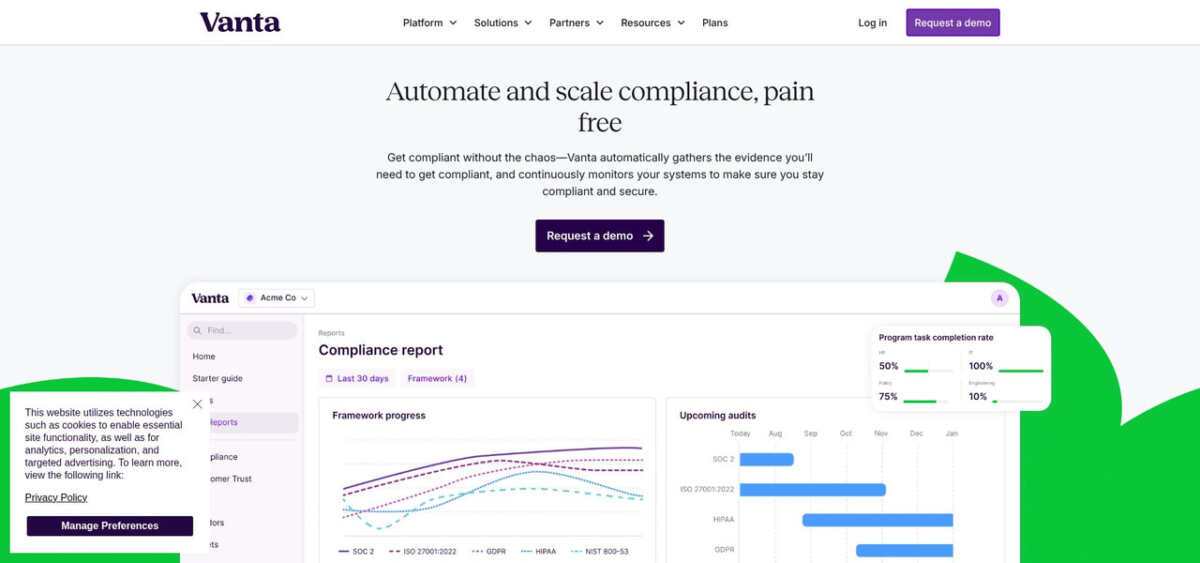
Vanta is a trust management and compliance automation platform built for SaaS teams that want continuous compliance to run in the background, without turning every audit cycle into a fire drill. It is used by 14,000+ customers and is designed to scale from a first SOC 2 report to a multi-framework program that also includes ISO 27001, HIPAA, PCI DSS, and more.
Where Vanta pulls ahead is automation depth. The platform offers 400+ integrations and runs 1,200 to 1,400+ automated tests on an hourly cadence. In practice, that means you can connect your cloud providers, identity stack, code repos, HRIS, and device fleet, then catch drift quickly. If an S3 bucket becomes public or an offboarded engineer still has admin access, you can route the failure into Slack or Jira and keep the issue visible until it is resolved.
Vanta also does a lot of the “audit writing” work that usually steals senior time. It can auto-generate key audit artifacts like your SOC 2 System Description and your ISO 27001 Statement of Applicability, and it uses AI throughout the platform to reduce busywork. That includes AI-assisted policy creation, AI evidence evaluation to surface gaps before an auditor finds them, and AI remediation guidance that includes Terraform snippets for many failing tests.
On the go-to-market side, Vanta’s Trust Center is built to reduce security review friction. Instead of sending PDFs and chasing email threads, you can share a live portal, collect NDAs, and let buyers self-serve answers through an AI-powered chatbot. For teams buried in spreadsheets of security questionnaires, Vanta also offers questionnaire automation, with 80%+ answer coverage and up to 95% acceptance rates reported for responses.
Vanta is a strong fit if you expect your program to get more complex over time. Beyond core compliance workflows, it supports enterprise-grade needs like custom RBAC, SCIM, Workspaces, and an API, plus adjacent programs such as Access Reviews and vendor risk management (VRM/TPRM). Support is also positioned as a differentiator, with 24/7/365 support, a named CSM included, and a published 95.5% CSAT score.
Pricing is packaged (Core, Growth, Scale) and publicly listed, with a commonly cited starting point of around $10,000 per year for smaller teams, depending on headcount, frameworks, and modules.
Key limitations to know up front: Vanta is typically priced above budget-first tools, and the platform can feel like more than you need if you are a very small team that only wants a lightweight SOC 2 checklist. Its infrastructure-as-code remediation is also most clearly oriented around Terraform.
Choose Vanta if you want the deepest automation, the broadest ecosystem, and a platform that can carry you from “first audit” to “multi-framework, multi-entity, continuous compliance” without a painful migration later.
2. Thoropass: best for teams that want automation and audit under one roof
Thoropass combines compliance automation with in-house audit services, so teams that would normally run two separate vendor relationships — one for software, one for auditors — can stay inside a single experience. Originally launched as Laika, the company rebranded to Thoropass to emphasize that integrated motion. It is often shortlisted by mid-market SaaS teams that are tired of coordinating audit timelines across independent firms and want a single accountable partner for the full compliance calendar.
Thoropass is ideal for:
- Mid-market SaaS teams planning multiple audits a year that would rather consolidate automation and audit delivery under one vendor
- Buyers who value predictable audit turnaround and clear ownership over the absolute deepest real-time drift detection
- Organizations where procurement prefers fewer vendors and simpler renewal cycles
On core framework coverage, Thoropass supports the standards most SaaS teams end up stacking, including SOC 1, SOC 2, ISO 27001, HIPAA, PCI DSS, GDPR, and a handful of NIST frameworks. Because audit delivery is part of the product, frameworks tied to formal attestation — SOC 1 and SOC 2 especially — are where Thoropass is most differentiated.
Where the platform feels thinner is emerging and region-specific coverage. AI-focused standards like NIST AI RMF or ISO 42001, and newer European regulations such as DORA and NIS 2, may require more manual scoping than you would expect from platforms that treat framework breadth as a core product axis.
Integration and monitoring depth is practical rather than leading. Thoropass connects to the common cloud, identity, and HRIS systems SaaS teams rely on, but the integration count is modest compared to the biggest automation-first platforms, and test cadence is oriented around keeping each audit cycle’s evidence fresh rather than catching drift within minutes. Teams that want continuous control monitoring as an operational layer may need additional tooling to cover that gap.
Trust Center and sales enablement is not the primary product story. Thoropass gives you a place to share posture with prospects, but buyer self-service tooling — AI Q&A, deep questionnaire automation, CRM-native workflows — is not where the platform invests most heavily. Teams with heavy security-review pipelines should validate whether Thoropass’s sales enablement layer is deep enough for their inbound motion before they standardize on it.
AI sits on the assistive side of the spectrum. Thoropass offers AI-supported evidence mapping and control guidance, but the platform’s narrative leans harder on integrated audit delivery than on “AI automation.” Teams expecting AI to materially replace senior engineering time on remediation should pressure-test specific workflows during evaluation.
Pricing is custom-quoted and generally higher than software-only platforms because audit services are bundled into the relationship. Support is positioned as hands-on, with program management built into the subscription rather than sold as a separate tier. For a mid-market SaaS team, that can be exactly the right shape — fewer hand-offs, clearer ownership — or it can feel heavier than needed if you already have an internal compliance lead and an established audit firm.
On scalability, Thoropass fits well through a mid-market, multi-framework motion. If your roadmap includes deep multi-entity governance, many custom frameworks, or a long-term plan to run the compliance program entirely in-house with your own auditor of record, plan to reassess the fit as the organization grows.
Choose Thoropass when you want one vendor accountable for both compliance automation and audit delivery, and you value predictable audit cycles over the deepest out-of-the-box test automation.
3. Hyperproof: best for control-first GRC with cross-functional collaboration
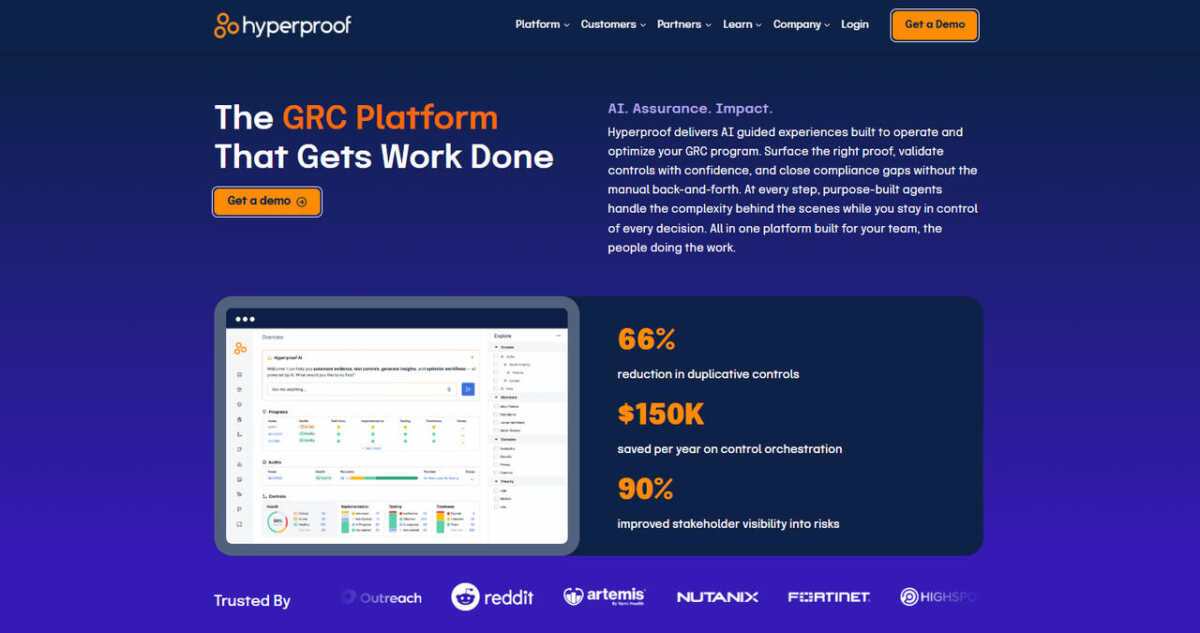
Hyperproof is a compliance operations platform built around a controls-first model, where the atomic unit of work is the control — not the framework or the checklist. For teams that already have a security program with internal stakeholders across engineering, legal, IT, and privacy, that framing tends to feel natural, because the real work lives in who owns which control and what evidence is current.
Hyperproof is often evaluated by mid-market and enterprise teams that need compliance to be a coordinated team sport, not a single-owner spreadsheet. Its Kanban-style workflows and assignment model make it easy for multiple departments to review, approve, and track control activity without losing context.
Hyperproof is ideal for:
- Teams where compliance work routinely spans engineering, IT, legal, and privacy stakeholders
- Mid-market to enterprise organizations that already know their control model and want a platform that surfaces ownership and status, not just a checklist
- Programs where evidence freshness and audit traceability matter more than the largest raw integration count
On framework coverage, Hyperproof ships a broad catalog that includes the standards SaaS teams care about (SOC 2, ISO 27001, HIPAA, PCI DSS, GDPR), plus coverage for more regulatory-heavy environments such as NIST 800-53, NIST CSF, CMMC-style controls, and industry-specific regimes. For teams with a longer-term plan that includes multiple regulated frameworks side by side, Hyperproof’s control-first model makes mapping overlaps across frameworks cleaner than treating each framework as its own silo.
Integration and monitoring depth is respectable but not the platform’s headline. Hyperproof connects to common cloud, identity, ticketing, and evidence sources, with automation that keeps control status and artifacts current. Test cadence is more aligned with operational cycles than near-real-time drift detection, so teams that want every configuration change caught within minutes may want to pair Hyperproof with a dedicated cloud security or CSPM layer.
The Trust Center story is less central than in tools built around sales-enablement. Hyperproof’s product focus is the internal operating model of compliance, not buyer self-service. For teams with heavy security-review volume, Trust Center maturity (AI Q&A, NDA flows, CRM workflows) should be validated separately before you commit.
AI in Hyperproof is positioned as an assistive layer inside the controls workflow, helping with tasks like evidence review, mapping suggestions, and control recommendations. It is not positioned as a “self-driving” compliance engine, and buyers should calibrate expectations accordingly.
Support is generally treated as a partnership. Implementation and customer success are hands-on, which matches the profile of a controls-first platform — teams usually need help translating their existing control model into the tool cleanly, and then optimizing workflows over time.
Pricing is custom-quoted and oriented to mid-market and enterprise budgets. Hyperproof is rarely the cheapest option on a shortlist, and it is not trying to be — the value is in getting compliance work tracked, owned, and auditable across a larger team.
The biggest fit question is team maturity. Hyperproof works best when you already know roughly what your control model looks like. Very early-stage teams that are still figuring out “what a control even is” may find a more prescriptive, guided platform easier to start with, then migrate into Hyperproof once the program has more structure.
Choose Hyperproof when compliance is a cross-functional program in your organization, you want the control to be the primary object in your system, and you are willing to invest in implementation to get a durable operating model in return.
4. TrustCloud: best for early-stage teams with AI-first evidence automation
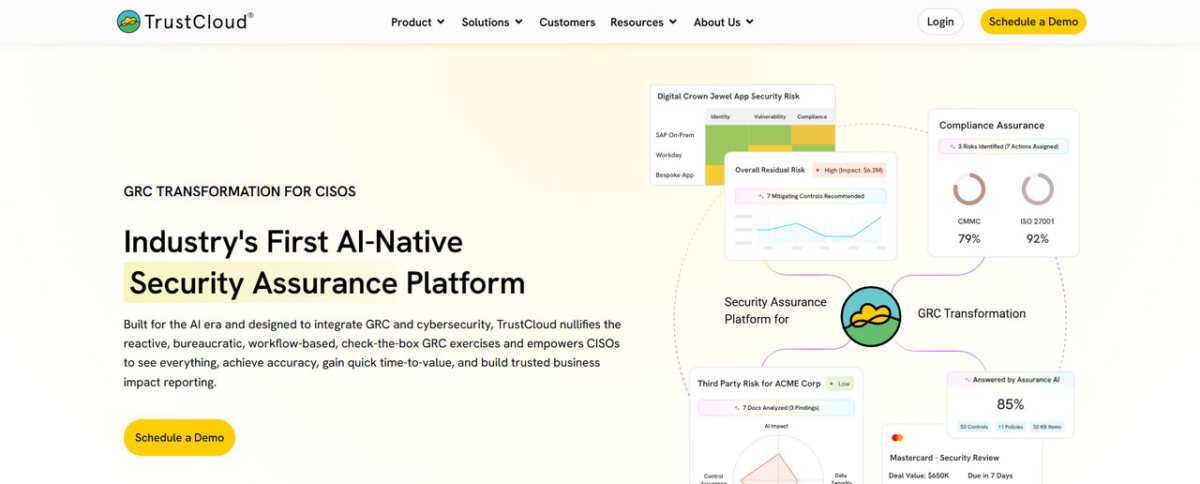
TrustCloud is a compliance automation platform aimed squarely at teams that want to build a serious security program early, but cannot yet justify an enterprise-grade budget. Its calling card is an AI-heavy approach to evidence collection, mapping, and questionnaire response — plus a free tier that makes it easy to start without a procurement cycle.
For a founder, a first security hire, or a small engineering team facing a SOC 2 requirement from a first enterprise customer, TrustCloud is positioned to turn compliance into a product you can evaluate by actually using it, not just by sitting through demos.
TrustCloud is ideal for:
- Seed to Series A SaaS teams pursuing a first SOC 2 or ISO 27001 with a limited budget and limited dedicated headcount
- Buyers who want to prototype their compliance program on a free tier before committing to an annual contract
- Teams that value AI-driven evidence and questionnaire automation as a core product axis, not a bolt-on feature
On framework coverage, TrustCloud supports the frameworks early-stage SaaS teams hit first — SOC 2, ISO 27001, HIPAA, GDPR, CCPA — along with a growing set of additional standards as the program matures. That coverage is strong for common go-to-market gates, but expect more limited depth in specialized regimes like HITRUST, FedRAMP, or newer AI-specific standards.
Integration and monitoring is built around the stacks most early-stage SaaS teams actually run, which is often more useful in practice than a very large integration count that is only partially relevant to your environment. Monitoring cadence is designed to keep evidence audit-ready, not to function as a real-time configuration management layer — teams that need tight drift control may want to pair TrustCloud with a dedicated cloud security tool.
One of TrustCloud’s most differentiated areas is its TrustShare / Trust Center experience paired with AI-assisted questionnaire response. For startup sales teams that keep getting pulled into long security questionnaires, having an AI layer pre-populate answers from your control evidence can return meaningful hours per deal. How well that works in practice depends on how much of your evidence is already in the platform, so it is worth testing on a real questionnaire during evaluation.
AI is the headline on the product side. TrustCloud leans into AI-driven control mapping, evidence review, and questionnaire automation as a core part of the platform rather than a feature tab. For very small teams, that can be the difference between a compliance program that moves and one that becomes one person’s permanent side job.
Support is generally scaled to the tier and can feel lighter at the free and entry-level paid tiers. Teams that want an embedded compliance officer or a dedicated CSM from day one will find platforms explicitly built around a services model (like Scytale) a closer fit.
Pricing is unusually flexible for this category. TrustCloud offers a free tier that is genuinely usable for building the program, plus paid tiers that unlock deeper automation, higher evidence limits, and more frameworks. For teams that need to defer real spend until they have customer revenue, that structure is rare in this market.
The main caveat is scale. TrustCloud’s sweet spot is early-stage compliance, and the enterprise-readiness features — custom RBAC granularity, heavy multi-entity governance, very deep SCIM flows — are not where the product invests most. As your organization crosses into multi-business-unit governance or heavily regulated frameworks, plan for a re-evaluation.
Choose TrustCloud when you need to start a real compliance program now, AI-assisted evidence and questionnaire work is a high-value feature for your team, and flexible early-stage pricing matters more than enterprise-scale governance depth.
5. Scytale: best for hands-on service with an AI assist
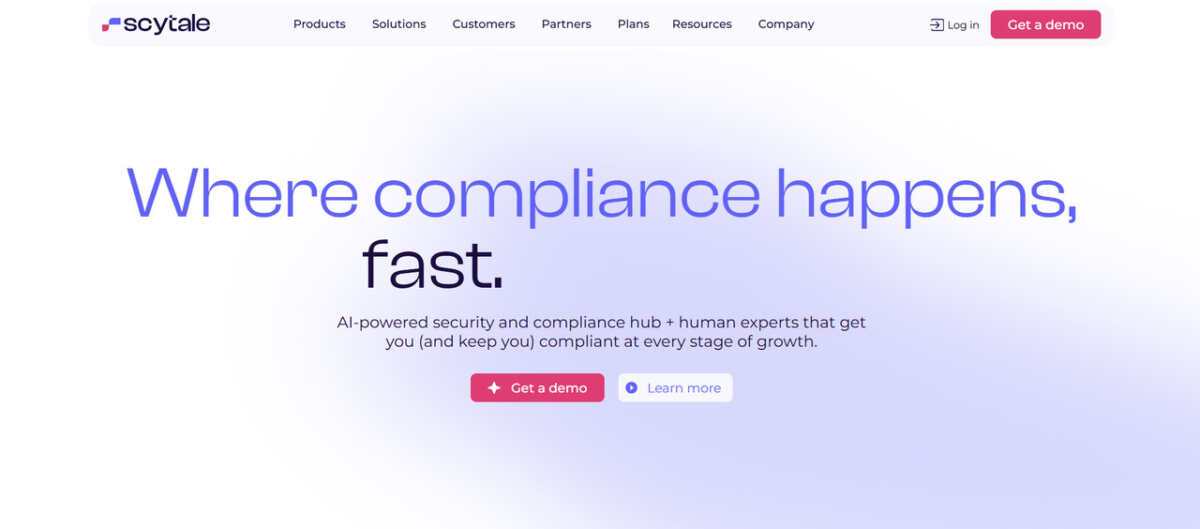
Scytale is a strong fit when your biggest compliance bottleneck is not intent, it is bandwidth. The product bundles software with a dedicated compliance officer, so you can outsource a meaningful share of the program management that usually lands on a founder or a single security lead.
Scytale was founded in 2020 in Tel Aviv and, in the provided research, is described as a smaller vendor by funding and team size, with about $12M raised and around 115 employees, plus offices across multiple regions. It has also been recognized publicly, including AWS Rising Star Partner of the Year (2025) and a G2 2026 Best Software Awards mention.
Scytale is ideal for:
- Seed to Series B SaaS teams (roughly 10 to 200 employees) pursuing a first SOC 2 or ISO 27001 with limited in-house GRC headcount
- Teams that want hands-on guidance and auditor coordination built into the subscription
- Organizations that prefer a “done with you” compliance motion over building an internal operating model immediately
Frameworks: broad coverage, with notable enterprise gaps
Scytale claims 60+ frameworks, including SOC 2, SOC 1, ISO 27001, ISO 27701, ISO 42001, HIPAA, PCI DSS, GDPR, NIS2, NIST CSF, NIST 800-53, and CCPA. That breadth can cover most startup and mid-market needs.
At the same time, the research flags several gaps that matter for more regulated expansion, including no HITRUST, no FedRAMP, no CMMC, and no SOX ITGC. If your roadmap includes those standards, Scytale may become a stepping stone rather than a long-term system of record.
Integrations and monitoring: adequate for audits, less suited for real-time drift control
Scytale supports 100+ integrations, but the bigger operational detail is cadence. The research describes Scytale as running on a 24-hour batch sync, and includes a customer-reported pain point that when they want to sync data, “it takes 24 hours.”
That matters if you are trying to treat compliance as continuous control monitoring, not just audit preparation. In head-to-head proofs of concept referenced in the research, Scytale is also characterized as materially less automated out of the box, with quoted comparisons around 43% automated coverage versus about 82% for Vanta in similar evaluations.
Trust Center and sales enablement: present, but not the core product story
Scytale offers a Trust Center, but it is positioned as more of a basic portal for sharing posture rather than a full sales-enablement layer. The research notes that Scytale does not offer questionnaire automation on the same level as platforms that treat security reviews as a workflow to optimize, and it does not position an AI trust-center chatbot for buyer self-service in the way some competitors do.
AI: Scy is a helpful assistant, not an automation engine
Scytale’s AI assistant, Scy (launched in 2024), is designed to answer compliance questions in natural language, help draft policies from your existing processes, and rank risk items so teams know what to fix first. It is best understood as an assistant that accelerates writing and prioritization. The research does not frame it as a deeply embedded automation layer for remediation and evidence workflows.
The real differentiator: a built-in compliance officer
Scytale’s defining feature is its services model. The subscription includes a dedicated compliance officer who helps scope controls, run gap analysis, and manage the auditor relationship end to end. For teams that are resource-constrained, that can be more valuable than having the most granular platform capabilities, because it keeps the program moving even when engineering is busy.
The trade-off is dependency. If your long-term plan is a multi-team, multi-framework compliance program with strong internal ownership, you should plan for how that concierge model evolves as your organization scales.
Pricing and scalability: premium feel, with services included
Scytale pricing is custom-quoted. The research suggests ranges of $10,000 to $15,000 per year for smaller customers and $20,000 to $30,000+ for mid-market, which reflects that professional services are bundled.
In terms of enterprise readiness, the research positions Scytale as better suited to early-stage and mid-market teams than large, complex organizations. The combination of 100+ integrations, 24-hour sync cadence, and a services-led operating model can become limiting when you need true continuous monitoring at scale, multi-entity management, and heavily automated evidence coverage across a broad stack.
Choose Scytale when you want to offload compliance project management to an embedded expert, and you are comfortable with lighter automation depth and slower sync cadence in exchange for hands-on execution support.
6. Conveyor: best for automating security reviews and building customer trust at scale
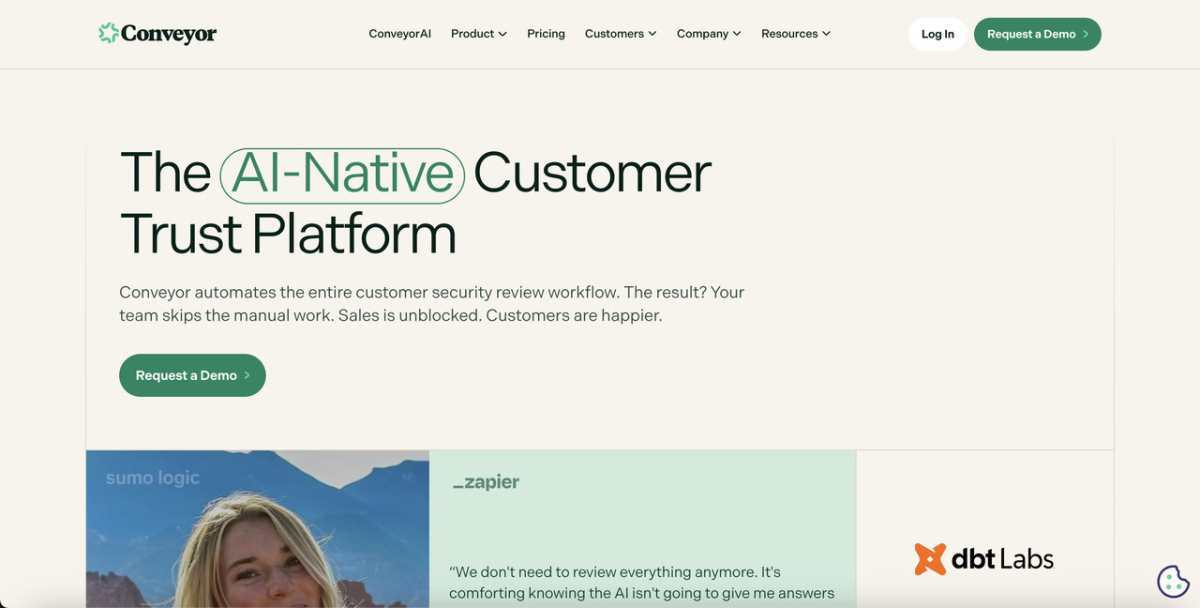
Conveyor is an AI-native customer trust platform built for information security and presales teams that spend too much time answering the same security questionnaires and sharing the same compliance documents. It is built for complex enterprise organizations managing hundreds of security reviews per quarter, and it replaces the manual back-and-forth of those reviews with a single platform for sharing security information, automating questionnaire responses, and closing deals faster.
Where most tools treat security reviews as a necessary cost center, Conveyor is positioned to turn them into a competitive advantage, helping companies respond with speed and accuracy while giving prospects the trust signals they need to move forward. That starts with the Trust Center, which offers 1-click NDA-gated document sharing, along with advanced features such as a Trust Center AI Agent, automated approvals, enterprise roles and permissions, auto-translation, and the ability to host multiple product lines.
Conveyor is ideal for:
- Information security and compliance teams fielding recurring security questionnaires
- Presales and sales engineers who need to answer customer questions and turn around security reviews quickly
- Enterprise companies managing high volumes of customer security requests who’ve outgrown point solutions and need a single platform that automates the whole workflow, not just part of it
On questionnaire automation, Conveyor reports 95%+ accuracy, with every answer backed by source citations, and a browser extension that auto-completes questionnaires directly inside vendor portals. Source citations are available across 50+ languages. Behind that sits a self-healing knowledge library, connected to any content source and continuously updating, so the answer library doesn’t require manual upkeep.
Rather than automating only the questionnaire piece, Conveyor combines document sharing, NDA gates, customer analytics, and questionnaire automation inside one platform. Customer engagement analytics and detailed access reporting give security and presales teams visibility into who is viewing what, and policy-based triage and delegation workflows route incoming requests to the right owner.
Integrations include Salesforce, Slack, HubSpot, Google Drive, and others, connecting the platform to the CRM and collaboration tools that sales and security teams already use.
AI in Conveyor is positioned as foundational rather than added on: the platform was built from the ground up around AI-generated answers, not a legacy tool with AI features grafted on afterward. That, combined with the accuracy rate and source citations noted above, is presented as the platform’s central differentiator, alongside proof that customers including Zapier, Carta, Atlassian, and dbt Labs use Conveyor to automate 80–100% of their security review workflows.
Pricing is usage-based rather than per-seat: organizations pay based on access volume and questionnaire usage, which is meant to keep costs predictable as teams grow. The Free tier is $0 per year, with 10 trust center credits per month and caps of 15 documents and 15 knowledge base Q&As, and it does not include questionnaire automation or integrations. Professional starts at $9,600 per year and adds 100 trust center credits, 20 questionnaire credits (each covering 100 questions), 10 RFP projects, unlimited seats, full integrations, SSO with SCIM, API access, custom domain hosting, detailed analytics, and a dedicated success manager. Enterprise is custom-priced for organizations with high-volume needs, with additional credit allocations and managed onboarding available. Credits roll over annually and represent organization access, additional credits are available in increments of five, and overage charges apply once usage exceeds the annual allocation.
The proof points span the range Conveyor is built for: Quantum Metrics’ COO reports cutting response time in half, Figma completed a 7-page security questionnaire 80% faster, and Lucid Software brought time per question down from 4 minutes to 22 seconds — a 91% reduction, while dbt Labs and Uniqode both credit the platform’s AI with delivering value directly inside their existing workflow. That range runs from fast-growing SaaS businesses building a professional security presence to complex enterprises turning questionnaire turnaround from weeks into days.
Choose Conveyor when your organization is managing enough security reviews that manual, per-question handling has become the bottleneck, and you want one platform — Trust Center, NDA workflows, and AI-generated questionnaire answers together — to move deals from request to close faster.
Side-by-side snapshot
You have met the headline acts. This table is the fastest way to sanity-check fit before you spend time on demos. The key is to look past logos and framework counts and focus on what will change your weekly workload, evidence coverage, and sales friction.
| Criteria | Vanta | Thoropass | Hyperproof | TrustCloud | Scytale | Conveyor |
| Evidence integrations | 400+ | Core SaaS stack | Core SaaS stack | Core SaaS stack | 100+ | Core SaaS stack |
| Monitoring cadence | Hourly | Audit-oriented | Operational cycle | Evidence-ready | 24-hour batch sync | Hourly |
| Frameworks (pre-built) | 35 to 44 | Core attestation set | Broad, controls-first | Common SaaS set, growing | 60+ (claimed) | Common SaaS set, growing |
| Trust Center | Yes, with AI buyer Q&A | Basic posture sharing | Not the product focus | Yes, with AI questionnaire assist | Yes (basic) | Yes, with AI |
| Human guidance model | Named CSM included | Bundled audit + program mgmt | Implementation partnership | Scales with tier | Dedicated compliance officer | Implementation partnership |
| Starting software price (indicative) | ~$10,000 per year | Custom, audit bundled | Custom, mid-market/enterprise | Free tier + paid tiers | Custom, often $10K to $15K (SMB) | Free tier + paid tiers |
| Best for | Deep automation and scale | Automation + audit under one vendor | Cross-functional controls program | Early-stage teams, AI-first evidence | Outsourcing compliance execution | Cross-functional controls program |
If you want the most continuous monitoring depth, cadence and test coverage matter. Hourly versus daily changes how quickly drift becomes an operational ticket.
If sales is driving the urgency, look closely at Trust Center maturity and how well it handles real security-review workflows, not just document sharing.
If budget is the gating factor, confirm year-two expectations early. Several vendors compete aggressively on year-one pricing, then rebalance at renewal.
If your team has no compliance bandwidth, Scytale’s built-in officer and Thoropass’s bundled audit model can be more valuable than an extra integration or two.
Use the table to shortlist two options, then validate them against your exact stack and frameworks in a proof of concept.
Other notable platforms worth a look
The compliance market is crowded, and a few platforms narrowly missed our top five. They can still be the right call if you have a specific workflow to solve, or if you are buying for a very different org shape than a typical SaaS security team.
OneTrust brings privacy and security under one umbrella. If you already use its privacy tools, extending into SOC 2 can reduce vendor sprawl, although the interface can feel heavy for smaller teams.
Optro (formerly AuditBoard) targets the enterprise. Internal audit teams tend to like its deep risk register and SOX governance features, but most startups will not use half the platform.
JupiterOne turns assets into a graph you can query in plain language. It is useful for questions like “Which servers hold PHI and lack encryption?”, and it often pairs better with a compliance platform than replacing one.
Treat these as specialized options rather than default picks for a lean SaaS company.
Conclusion
No single platform wins every row, so anchor your decision in your primary constraint and validate it through a proof of concept that mirrors your real-world workflows.