What Are the Key Elements of SEO Success?

Search rankings can destroy a business overnight. Your website sits on page three? You’re basically invisible. Most people never look past the top five results. They find what they need and move on.Getting to the top takes real work. Companies that rank well know how different pieces fit together. A Performance Marketing Agency builds these pieces into one working system. You need technical strength, solid content, and happy users.

Your Site’s Technical Foundation

Think of technical health as your website’s skeleton. Search engines can’t rank what they can’t find. They need to crawl your pages, understand your content, and index everything properly.

Speed Wins Every Time

Slow sites lose visitors fast. People bounce after three seconds of waiting. Google knows this and ranks faster sites higher. You can fix speed problems in several ways:

  • Shrink your image files before uploading
  • Cut down on plugins and scripts
  • Use a content delivery network
  • Turn on browser caching
  • Pick a better hosting provider

Mobile users make up most of your traffic now. Google checks your mobile site before your desktop version. Your buttons need to work on small screens. Text should read easily without pinching and zooming. Navigation has to make sense on a phone.

Site Structure That Works

Search bots crawl millions of pages every day. Make their job easier with clean URLs and logical organization. Use an XML sitemap to show them where to go. Fix broken links right away. Get rid of duplicate pages that confuse the system.

Your internal linking structure matters too. Connect related pages so visitors can find more helpful content. Use clear anchor text that describes where the link goes. This helps both people and search engines understand your site better.

Content That Actually Helps People

Writing for search engines first is backwards. Real people read your content and decide if it’s useful. They share good content. They link to pages that solve their problems.

Long articles tend to rank better than short ones. But length alone doesn’t work. You need depth and real information. Share actual data from your experience. Give specific examples people can use today. The Beginner’s Guide to SEO from Moz breaks down content creation in plain terms.

Keywords still have a place here. Just don’t stuff them everywhere. Google reads context now. It understands related terms and topics. Write naturally and cover your subject completely. Include variations and related phrases that fit your main topic.

Skip the fluff that fills most blog posts. Every paragraph should teach something new. Cut anything that repeats what you already said. Readers spot generic advice instantly. They want insights they can’t get from five other sites.

Building Links That Count

Other websites linking to yours tells Google you’re trustworthy. But not all links carry the same weight. Ten links from spam sites hurt you. One link from a respected publication helps a lot.

How to Earn Quality Links

Guest posts work when done right. Write something valuable for sites in your field. Share real expertise that their readers need. Nobody wants obvious marketing disguised as an article. They want information that solves problems.

Creating original research attracts links naturally. Run a survey in your industry. Compile data nobody else has. Other sites will reference your findings. They’ll link back to your source material.

Partner with journalists and bloggers who cover your niche. Build real relationships before asking for anything. Offer expert quotes for their articles. Share your unique perspective on industry trends.

Your Internal Link Strategy

Links between your own pages spread authority around your site. Point readers to related articles they might find helpful. Use descriptive anchor text that tells them what to expect. This creates a network of connected content.

Don’t just link from new posts to old ones. Go back and update older content with links to newer pages. This keeps your whole site connected and fresh. Search engines notice when you maintain and improve existing content.

How Users Interact With Your Pages

Google tracks how people behave on your site. They measure bounce rates and time spent reading. They notice when visitors quickly hit the back button. These signals tell them if your content actually helps people.

Your formatting affects how people read your content. Short paragraphs work better than long blocks of text. Headings break up information into chunks. Bullet points highlight important details. Here are formatting basics that help:

  • Keep paragraphs to three or four sentences
  • Use subheadings every few paragraphs
  • Add images to illustrate your points
  • Include white space so text breathes
  • Test readability on different screen sizes

Pop-ups that cover your content annoy everyone. They hurt your rankings and frustrate visitors. Put your most important information high on the page. People should see value before they scroll.

Measuring What Actually Works

You can’t improve what you don’t measure. Google Analytics shows where your traffic comes from. Search Console reveals which keywords bring visitors. Track these numbers weekly to spot trends early.

Look at which pages convert visitors into customers. Some pages drive tons of traffic but zero sales. Others get less traffic but higher conversions. Focus your energy on pages that generate real business results.

Run site audits every three months minimum. Check for broken links and slow pages. Look for outdated content that needs updates. Search algorithms change constantly. The Google Algorithm History from Search Engine Journal tracks major updates worth knowing about.

Compare your performance against competitors too. See which keywords they rank for that you don’t. Check their backlink profiles for link opportunities. Learn from what works in your industry.


How to Qualify B2B Leads Effectively Without Wasting Time

If you’ve ever chased a lead that looked great on paper but went nowhere, you know how easy it is to waste hours or weeks on the wrong prospects. Lead qualification is what keeps that from happening. It keeps you from burning valuable hours that could have gone to real prospects and helps your team close deals with less friction. 

Why Lead Qualification Matters More Than Ever in 2025?

Paid channels and outreach cost more than a few years ago. Ads cost more, inboxes are flooded, and getting a response takes more persistence than ever. Every click or impression that doesn’t lead to a conversation chips away at your return on investment. You can’t afford to keep chasing “maybe” leads.

Focusing on qualified prospects changes everything. You get a shorter sales cycle and far more meaningful talks. Think of a boutique agency that narrows its list to tech startups between Series A and C. Instead of cold emailing hundreds, they focus on founders already chasing growth. The result of that is fewer pitches and more conversions.

Modern LinkedIn lead generation services make that possible at scale. These systems spot poor-fit prospects fast. By watching things like hiring, revenue bumps, and how prospects engage, you end up chasing people who actually need what you sell, not random cold calls.

Understand Your Ideal Customer Profile

An ICP is the kind of company that gets real value from your product. Think less “could buy” and more “should buy.” When you define this clearly, both your marketing and sales teams move in sync.

Let’s say your platform automates client onboarding. If you’ve identified mid-sized agencies doing over ten onboardings monthly, everything changes. Marketing can craft ads and emails aimed at that audience, and sales can lean on a demo and script that speak to their daily headaches. So, without an ICP, you risk pitching broadly and converting few leads.

When building your ICP, pay attention to factors like industry, company size, and budget. Dig into what really drives them to look for a solution like yours. Maybe they struggle with process bottlenecks or need faster implementation to retain clients. Also, think about decision-makers. A startup founder makes choices differently from a corporate procurement manager. Understanding that dynamic shapes how you qualify and communicate with leads.

Set Clear Qualification Criteria

With your ICP set, use a framework to assess fit. The Budget Authority Need Timeline framework or the Challenges Authority Money Prioritization framework both work well. They help you ask efficient, practical questions so sellers don’t chase dead ends.

BANT looks at the basics: can they pay, who approves, do they need this, and is it urgent? CHAMP flips it a bit by starting with identifying the challenge first. That’s useful when deals are more consultative.

Now, picture reaching out to HR directors about an engagement tool. Using CHAMP, you’d first understand their challenge. Then confirm if they have the authority to decide, the money to act, and whether the issue is a real priority this quarter. It’s practical, focused, and saves both sides time.

But your criteria shouldn’t stay static. Use your CRM data to track which deals close faster and why. Maybe leads with a certain job title convert more often, or companies in one industry move quickly through the pipeline. That’s your signal to refine what “qualified” really means for your team.

Use the Right Tools and Data to Assess Lead Quality

Technology can turn qualification from guesswork into precision. The right tools or platforms help you spot signals that matter. Profile updates, job changes, content engagement, or repeat visits to your pricing page; those are hints that someone’s moving from curiosity to consideration.

A trusted SDR outsourcing company can amplify this even more. SDRs specialize in lead screening and warm-up, combining automation with scoring models that weigh company size, growth signals, engagement events, and demo activity. 

That prep work hands qualified conversations to your core sales team, freeing them up to have actual sales talks. Just remember that the outcome depends on how good the provider is and whether they’re trained and aligned with your ICP.

Also, keep in mind that lead scoring should never be a one-time setup. Keep it fluid. If a prospect stops engaging, lower their score. If they suddenly interact with multiple assets in a week, raise it. Don’t treat the CRM like a phone book. Let it learn from what prospects do, tweak scores, and push the right leads to reps.

Implement a Two-Step Lead Qualification Process

High-performing teams split qualification into two phases. The first is Marketing Qualifications: contacts who’ve engaged with content or an event. They’ve shown intent but typically haven’t requested a demo or meeting. Marketing nurtures them with content until they hit a certain engagement threshold.

The second stage is sales qualification, or SQLs. That’s when the lead meets your ICP and passes your framework checks. Now let sales do what they do best: a short discovery call to confirm who signs and why they’d buy.

The handoff is where most teams stumble. Avoid it by sharing the same dashboard, agreeing on a single “ready” definition, and holding brief alignment check-ins. When those pieces click, your pipeline stops surprising you.

Avoid Common Lead Qualification Mistakes

A few mistakes can quietly ruin your qualification efforts. One is chasing vanity metrics like clicks or impressions. Those numbers might look impressive, but they rarely mean buying intent. Another is over-automating. Tools are fantastic, but they can’t read tone or context. A bot can rank a lead high after three email opens, but a human can tell when that’s just casual browsing.

It’s also easy to miss the subtle signs. A slow reply or a vague question can be window-shopping in disguise. Watch for direct planning questions or people bringing in stakeholders; that’s when intent shows up. If they only say “thanks” and vanish, it’s probably just interest.

Also, bring in an experienced provider of lead generation solutions. They watch the metrics, and they coach reps in real outreach. That way, you stop chasing leads that go nowhere. More qualified conversations, fewer wasted hours.

How to Scale Lead Qualification Without Losing Precision?

Growth pushes teams to automate. But you should prioritize automating predictable tasks and keep high-impact calls in human hands. Automating tasks like lead capture or scoring updates is efficient. But keep real conversations human. A quick personalized message can often spark engagement that no automated email can.

Training your SDRs to recognize strong buying signals early is another win. If they start asking how the software fits in or how onboarding works, that’s your cue. Train your team to act fast before interest cools.

And keep refining your workflow. Review your wins and losses every quarter. Look for patterns — which types of leads convert fastest, and which ones fall flat? Adjust your qualification model based on those lessons. It keeps your system sharp and your pipeline clean.

Conclusion

Lead qualification saves your time. It points you toward prospects who actually fit your solution, not just anyone who clicks “reply.” Define your ICP, pick your frameworks, and watch how data makes the whole process smoother.

Companies that combine tools like Sales Navigator with experienced SDR partners find it easier to cut through the noise. Instead of spinning wheels on dead ends, they reach the people who really count.

SEO Strategies for Manufacturers to Grow Visibility in 2026

SEO is crucial for manufacturers who want to become more visible online. An efficient SEO strategy will have a direct impact on a manufacturer’s capacity to attract relevant traffic and outperform rivals in 2026 as more enterprises move online.

We’ll go over the best manufacturer SEO tactics in this post so you can stay ahead.

1. Recognize the Manufacturer’s Search Intent SEO

Manufacturers ought to concentrate on determining and catering to the target audience’s particular search intent. You may adjust your SEO strategy to suit visitors’ needs by determining if they are searching for items, solutions, or industry knowledge.

Why It’s Important: The likelihood of ranking better and turning visitors into leads is increased when content is in line with search intent.

  • Informational Intent: Individuals seeking industry insights or answers to particular industrial issues.
  • Navigational Intent: Users looking for certain manufacturer websites or products.
  • Transactional Intent: People who are prepared to buy something or ask about manufacturing services.

By aligning your content with the buyer’s journey, you can make sure that your website responds to the most important queries at each step, making it more relevant.

2. Research and Optimization of Keywords

The foundation of a good SEO campaign for manufacturers is thorough keyword research. You should focus on long-tail and specialty keywords that correspond with what prospective clients are looking for.

Why It’s Important: Your website will rank for terms that get relevant visitors if you target the correct keywords.

How to Optimize Your Keywords:

  • Use Tools: You can find high-traffic keywords related to your manufacturing niche with the aid of tools like Ahrefs, SEMrush, and Google Keyword Planner.
  • Long-tail keywords: Pay attention to particular questions, such as “high-quality stainless steel parts for the automotive industry,” rather than just “steel parts.”
  • Location-Based Keywords: You can draw in local clients by using location modifiers like “manufacturers in California.”

3. Pay Attention to Technical SEO

Technical SEO is equally important to manufacturers as content production. Technically optimized websites are easier for search engines to crawl, index, and rank.

Why It’s Important: Search engines will find and comprehend your information with ease if your website is well-structured.

Important Technical SEO Strategies:

  • Increase the speed of the website: High bounce rates are a result of slow websites. To test and improve load times, use tools such as Google PageSpeed Insights.
  • Mobile Optimization: More people are using mobile devices to visit websites. Make sure your website is completely responsive.
  • Fix Broken Links: Look for and fix 404 errors on a regular basis. In addition to preventing search engine penalties, this enhances the user experience.

4. Use Rich Snippets to Improve Product Pages

Product pages are crucial for manufacturers to turn visitors into buyers. Click-through rates and visibility can be raised by optimizing these pages with rich snippets.

Why It’s Important: Rich snippets boost the chance that consumers will click on your link by giving them more information directly on the search engine results page (SERP).

How to Put It into Practice:

  • Product Schema Markup: Use structured data to show critical product information immediately in search results, such as availability, price, and reviews.
  • Client Testimonials: Good reviews can show up as rich snippets, boosting prospective buyers’ trust.

Manufacturers can differentiate their products in search results by including structured data on product pages.

5. Manufacturers’ Local SEO

For manufacturers who depend on local clients or certain regions for sales, local SEO is essential. Manufacturers can increase their visibility to local consumers by optimizing for local searches.

Why It’s Important: Manufacturers may maintain their competitiveness in local marketplaces by using local SEO to dominate searches within their geographic area.

Local SEO Strategies:

  • Google Business Profile: To appear on Google Maps and local search results, claim and optimize your GBP.
  • Local Keywords: Use location-based keywords in your tags, meta descriptions, and content.
  • Local Reviews: Invite clients to provide reviews on your GMB page and in other local directories.

6. Produce Useful, Optimized Content

One of the best strategies to improve SEO for manufacturers is still content marketing. Creating useful, excellent content that addresses certain client inquiries contributes to a boost in organic traffic.

Why It’s Important: Higher organic rankings result from manufacturers positioning themselves as industry leaders through problem-solving or insightful content.

Content Types to Consider:

  • Case Studies: Tell success stories on how your products have assisted in resolving issues facing the industry.
  • How-To Manuals: Provide educational materials on procedures, equipment, or methods that are pertinent to your sector.
  • Blogs: Write articles that specifically address your target audience’s problems.

You can boost traffic, engagement, and authority in your sector by producing content that speaks to your target audience.

7. Create Superior Backlinks

For SEO, backlinks are a crucial ranking component. Search engines view your website as more trustworthy and authoritative when it has high-quality backlinks from reliable sources.

Why It’s Important: Increased backlinks tell search engines that your material is reliable and pertinent.

How Backlinks Are Acquired:

  • Visitor Blogging: Post links back to your website on industry-related blogs and websites.
  • Partnerships: Work together with suppliers or other manufacturers to exchange materials and cross-promote links.
  • Sector Directories: Make sure your website appears in publications and directories that are unique to your sector.

Although it is a long-term approach, backlinking can have a big impact on the domain authority and ranks of your website.

8. The Importance of User Experience (UX) for SEO

SEO heavily relies on user experience (UX). A user-friendly, aesthetically pleasing, and responsive website will not only please your visitors but also entice them to remain longer.

Why It Matters: An excellent user experience reduces bounce rates and sends positive signals to search engines by keeping users on your website longer.

Key UX Factors to Improve:

  • Intuitive Navigation: Make sure your website is easy to navigate. A well-organized site encourages users to stay longer.
  • Clear Call-to-Actions: Ensure your calls to action (CTAs) are clearly visible and direct visitors toward conversion goals.
  • Engaging Visual Design: Use high-quality images and videos of your products or manufacturing processes to engage users.

9. Leverage Video Marketing

Video is becoming an increasingly important form of content for SEO. Manufacturers can use videos to explain products, showcase their processes, or demonstrate their expertise in the industry.

Why It Matters: Video content can rank on YouTube and Google, driving more traffic to your site.

SEO Strategies for Videos:

  • Improve Descriptions and Titles: Make sure the names, descriptions, and tags of your movies are optimized for search engines.
  • Add Transcriptions: You may aid search engines in crawling your videos by adding a transcription.
  • Distribute Across Platforms: To boost views and interaction, promote your films on your website, social media accounts, and other pertinent venues.

Achieving Long-Term Growth with a Strong SEO Strategy for Manufacturers

Manufacturers must implement a strong SEO strategy to enhance visibility and drive traffic. By focusing on search intent, technical SEO, content creation, and local optimization, manufacturers can position themselves as leaders in their industry.

A well-executed SEO plan not only boosts search engine rankings but also improves consumer engagement and conversion rates.


Batul Beawarwala is a detail-driven content professional specializing in SEO writing, editing, and digital marketing. She blends creativity with data-driven strategy to create high-quality, optimized content that improves brand visibility and drives measurable business results.

Why Specialized SEO Agencies Prove as a Winner for SaaS Businesses?

Differentiation is necessary in the high-paced Software as a Service (SaaS) world. In a market flooded with competition, good search engine optimization (SEO) can spell the difference between success and failure. Since every SEO service company claims to have subject matter experts, only specialized SEO agencies will provide customized strategies according to your customer type, making your SaaS business stand out a bit higher than the rest. This article will discuss why these agencies are the best in making your SaaS company visible and successful.

Understanding SaaS Needs

SaaS companies work differently from the traditional model. Usually subscription-based and online, it makes sense to be. That is why specialised SEO agencies have an in-depth knowledge of this landscape. These agencies design strategies catering to the specific needs of SaaS and are also in line with business objectives. Choosing from the top SEO agencies for SaaS ensures a customized approach that aligns with market trends and company goals.

Tailored Strategies for Success

SaaS companies cannot expect the same generic SEO tactics for other domains to work for them. Agencies create bespoke schemes according to the problems pertaining to the sectors. Target audience identification, competitive analysis, and content optimization are also done. This customization helps connect the marketing activities with future buyers, responsible for boosting the sales conversion.

Technical Expertise

SaaS platforms are digital products, which means that they require a greater level of technical ability. Specialized SEO agencies have the skills to work on large and complicated websites and apps. They send your attention to speed up the site, making it mobile-friendly, and providing a better user experience. These technical improvements help in better SEO & user satisfaction.

Content that Converts

Content is one of the key factors for attracting and retaining customers. Expert agencies know how to build pieces that resonate directly with SaaS users. They create relevant materials focusing on pain points and solutions that inform and entertain. Such a focused content strategy helps not only drive traffic but also garner trust and credibility.

Data-Driven Decisions

Data analysis is the foundation of successful SEO strategies. Specialist agencies employ sophisticated analytics tools to learn about user behaviour and preferences. They analyze this data to make unbiased decisions and ensure they are driving their marketing efforts in the right direction. This data-led methodology guarantees that the portfolio will always evolve to be in sync with the market’s demands.

Adaptability in a Changing Landscape

In the digital world, search engine algorithms and search behavior are constantly evolving. SEO agencies, focused on a particular industry, keep track of these shifts, modifying strategies for sustainable competitiveness. With their agility, SaaS businesses are able to respond to changes, meet challenges, and seize new opportunities.

Building Brand Authority

SaaS companies must acknowledge the importance of establishing authority to build trust and loyalty for their products. SaaS SEO agencies understand how to build brand reputation, utilizing link-building, guest blogging, and thought leadership to help create a perception of businesses as industry leaders. Such a commanding presence enhances credibility and tends to attract more clients.

Cost-Effectiveness and Efficiency

Investing in niche SEO services usually pays off with long-term benefits for SaaS companies. These agencies optimise so that one dollar spent is refined into quantifiable growth. Through targeted strategies, they reduce wasteful expenditures, thus maximizing return on investment.

Enhancing User Experience

A frictionless experience is the foundation of customer satisfaction and retention. Specialist agencies spend their time making sure that the website interface is super optimized to navigate and is easily accessible. By strengthening user experience, SaaS businesses can decrease bounce rates and boost engagement, eventually improving conversion rates.

Conclusion

A specialized seo agency can provide the best value of SEO for a SaaS company trying to excel in a competitive market. Success is built on their customized strategies, technical prowess, and data-driven decisions. SaaS businesses can leverage these agencies to increase visibility, establish authority, and grow sustainably. With the shifting ground of the digital space, the need for niche SEO can never go out of hand, which is vital for any SaaS company’s prosperous future.

Five Best Guest Post Marketplaces for Your Business

Link building can be a challenging task if a website owner seeks guest posting opportunities independently. Besides the significant time and effort required, there is also the risk of publishing articles on sites with low traffic or a dubious reputation. That is why experienced SEO professionals use guest post marketplaces, which eliminate all risks and streamline the process of publishing articles on donor sites. That is why experienced SEO professionals use the guest post marketplace, which eliminates all risks and streamline the process of publishing articles on donor sites.

The best marketplaces have a sufficient set of tools and features for an effective link-building campaign. If you’re seeking high-quality guest post opportunities, consider exploring top marketplaces with enhanced SEO.

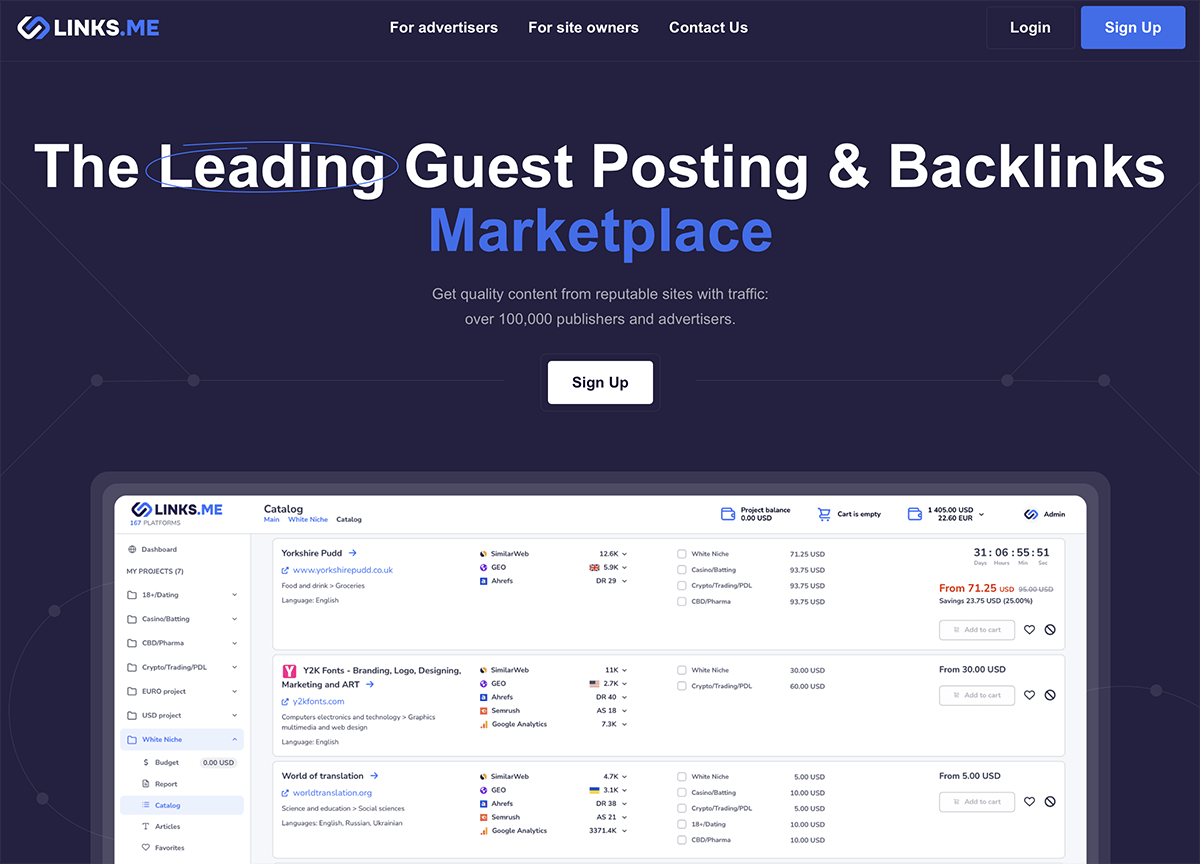
1. Links.me

If you’re looking for a one-stop platform to increase your brand visibility, try links.me and its extensive capabilities. This marketplace has a vast database of publisher sites, comprising over 100,000 reputable titles. The platform operates on a self-service basis: users select sites for guest posting independently using convenient filters and detailed statistics based on 40+ parameters.

Besides assisting in finding donor sites, links.me offers many other features for improving website SEO:

  • Detailed analytics for an objective evaluation of the strengths and weaknesses of alternative guest posting sites;
  • Writing SEO-optimized articles to improve ranking in search results;
  • Comprehensive content marketing for website promotion;
  • Placing backlinks on authoritative industry-relevant websites;
  • Using the power of private blog networks (PBNs) to improve website rankings in highly competitive niches rapidly

2. Vefogix

Vefogix helps businesses expand their online presence through guest posting, link insertion, and other link-building methods. Its publisher base is somewhat smaller than you can find at links.me — approximately 60,000 websites. However, this is sufficient to open up numerous guest posting opportunities across various industries.

Since Vefogix is ​​a white-label link-building agency, it also offers its services to other SEO agencies. This type of cooperation is beneficial for young SEO companies that already have clients but haven’t yet built a sufficient base of donor websites for guest posting.

3. Accessily

The Accessily agency has been operating in the SEO service industry since 2018. During this time, its team has built a database of over 25,000 donor websites for guest posts. This database consists of niche-relevant sites with high DA and verified traffic. However, this marketplace’s services will be of primary interest to those seeking U.S.-based publishers, as Accessily partners with precisely these websites.

In addition to finding guest posting opportunities, Accessily offers other SEO services:

  • Content writing;
  • Press release distribution;
  • Influencer marketing;
  • Backlink purchasing and more.

4. OutreachZ

OutreachZ is another high-quality marketplace for finding publishers, with a database of over 25,000 websites. The platform offers various metrics to filter suitable options, such as Organic Traffic, Domain Authority, Niche, and others. If you don’t have compelling SEO-optimized content to guest post, you can order it directly from OutreachZ. Users can also choose a more advanced SEO package if they’re interested in a comprehensive website promotion strategy.

5. iCopify

The UK-based SEO agency iCopify offers access to nearly 65,000 websites and blogs that accept posts for publication. Marketplace users can choose their own content for posting, as well as content created by iCopify authors. They can also order the Link Insertions service if their goals require placing a link in already published content.

The Bottom Line

Do you need to register with several marketplaces that accept guest posts, or will partnering with just one be sufficient? Choosing one of the best guest post marketplaces will meet all your link building campaign needs. Still, each has its unique features for attracting user attention. Therefore, to make a final choice, learn more about their key areas of activity and niches. If this matches your business niche, you’ve found the right marketplace.

Why Data-Driven Campaigns Attract High-Value Clients

Businesses everywhere are making smarter choices with data, and this trend is particularly evident in competitive markets like Denver. Understanding exactly what high-value clients want allows companies to bring them right into the fold. Learning how these strategies work can definitely take a company to the next level.

Smart campaigns, built on solid facts, can really draw in the right people—the clients who bring the most value to a business. Working with a contractor marketing agency in Denver that specializes in data-driven approaches can help companies leverage these powerful strategies effectively. Let’s explore how data-driven campaigns create meaningful connections with high-value clients.

The Power of Data

To really understand what makes customers tick, information is your strongest ally. Companies collect facts to see important trends and recurring behaviors. This clear understanding allows them to make thoughtful, well-planned decisions. This enables businesses to customize their services according to client requirements more specifically. When you truly learn what your clients care about, your company can build services and products that attract the most valuable, loyal customers.

Enhanced Targeting

One of the greatest benefits of data-driven campaigns is more reliable targeting. Companies can easily divide their audience by different parameters, whether demographics, interests, or consumption behaviors. When you split your audience into groups, your advertising hits harder. Each message speaks directly to them, getting a better reaction. The closer a message matches a client’s need, the greater the likelihood of a conversion.

Improved Engagement

Connecting with your clients is fundamental to sustaining their relationship. Data helps businesses connect better with people by showing them exactly which messages and methods get the best response. It initiates two-way communication through which businesses can listen and respond to the feedback shared by clients. High-value clients appreciate this personalized approach and tend to become more loyal.

Measuring Success

Data-driven campaigns have clear metrics to measure success. Businesses track important numbers: how many people become buyers, what it costs to land each customer, and the profit they see. This helps in measuring campaign efficiency and also facilitates learning and improvement from one campaign to the next. Companies that can monitor success correctly can refine their strategic pathway to attracting and retaining high-value clients.

Building Trust

Trust is part of the foundation of every good client relationship. Promotions backed by solid data actually build people’s faith. When people get clear, useful details, they immediately grasp why the campaign matters. According to the U.S. Small Business Administration, businesses that demonstrate transparency and data-backed decision-making are more likely to establish long-term client relationships. They are more confident in their decision-making when they think of a company as reliable and well-informed. When clients feel truly confident, relationships improve dramatically, bringing in more chances to work together and grow.

Cost Efficiency

Investing in data-driven strategies can provide huge cost savings. This approach helps companies spend their money only on people who will probably respond well, so less advertising budget goes to waste. You can guide your business’s energy straight to those future customers most likely to bring in real value. Marketing dollars deliver much bigger returns this way.

Adapting to Change

Companies must remain adaptable to changing market dynamics. Using real numbers helps campaigns shift gears quickly when plans change. By analyzing their data, companies can swiftly adjust to meet what customers want and what the market demands. The ability to pivot and evolve keeps companies competitive and relevant to their target audience. High-value clients are looking for dynamic, forward-thinking partners.

Fostering Innovation

People who use data to make decisions foster innovation. Businesses can uncover completely new strategies and craft smart, inventive answers to any obstacle. A confident, forward-thinking style really grabs the attention of clients searching for innovative partners. High-end clients are usually after companies that can offer them something unique and valuable.

Creating Personalized Experiences

To attract and retain high-value clients, businesses need to focus on personalization. Companies gather customer data to develop very specific interactions, moving past general approaches to build a real connection with each person. Companies can perfectly match solutions to client expectations when they understand their preferences and needs. When you make things personal, customers feel happier and stick around longer.

Conclusion

Businesses hoping to land top clients gain many benefits from running campaigns powered by real data. Connecting with your audience effectively, engaging them meaningfully, and giving them experiences made specifically for them are strategies that bring in new clients and keep them satisfied. Using data helps your company earn trust, foster innovation, and spend more efficiently while building lasting relationships with high-value clients.

How a Digital Marketing Agency Can Help Your eCommerce Business Grow in 2025

Today, to succeed, businesses must go beyond basic online visibility and create strategies that resonate with audiences across multiple platforms.

Partnering with an experienced agency, like E-Commerce Digital Marketing Services, that specializes in digital marketing for eCommerce can give your business the competitive edge it needs to thrive in this highly saturated market.

Key Services a Digital Marketing Agency Provides

A digital marketing agency doesn’t just execute campaigns; it provides expertise, resources, and creative direction that many in-house teams struggle to match. With access to data-driven insights, specialized tools, and cross-industry knowledge, agencies can craft strategies that drive sustainable growth. For eCommerce businesses navigating 2025’s complexities, these partnerships are no longer optional — they’re essential.

One of the main advantages of working with an agency is the breadth of services it offers. eCommerce businesses today must balance SEO, paid advertising, social media, and customer engagement — all while managing logistics, inventory, and customer service. Agencies streamline this workload by delivering comprehensive solutions under one roof.

Here are some of the most impactful ways agencies support eCommerce growth in 2025:

  1. Performance-driven SEO – agencies use advanced analytics and AI-enhanced keyword research to optimize product listings and landing pages, ensuring your store ranks for high-intent searches.
  2. Targeted paid advertising – from Google Shopping ads to TikTok campaigns, agencies manage cross-channel ad strategies that maximize ROI while minimizing wasted spend.
  3. Conversion rate optimization (CRO) – through A/B testing, heatmaps, and UX audits, agencies refine your online store to reduce friction and increase sales.
  4. Email and retention marketing – personalized drip campaigns and loyalty programs help keep customers engaged and returning for repeat purchases.
  5. Content and creative strategy – agencies develop blogs, videos, and visuals tailored to your audience, establishing authority and trust in your niche.

By combining these services, agencies create integrated campaigns that work together rather than in isolation. This holistic approach allows eCommerce businesses to scale faster, capture new markets, and build long-term customer relationships.

Why Agencies Are Crucial for eCommerce in 2025

The digital marketplace in 2025 is more competitive than ever, with consumers expecting seamless experiences across devices and platforms. Agencies help eCommerce brands keep pace with shifting behaviors, emerging technologies, and algorithm updates.

For example, personalization has become a defining factor in customer satisfaction. While AI tools can generate recommendations, agencies provide the strategy and oversight to ensure those recommendations align with your brand’s identity. Similarly, agencies help companies adapt to new trends such as voice commerce, augmented reality (AR) shopping, and sustainability-focused branding.

Agencies also bring scalability. Small eCommerce businesses may start with limited resources, but as demand grows, agencies can expand campaigns without the need to build entire in-house departments. This flexibility allows businesses to focus on product innovation and customer service while experts handle the complexities of digital marketing.

Adapting to New Consumer Expectations

In 2025, eCommerce growth depends not only on visibility but also on trust. Consumers are increasingly skeptical of generic campaigns and are drawn to brands that demonstrate authenticity. Agencies help businesses bridge this gap by crafting narratives that connect emotionally with buyers.

They also play a key role in improving customer experience. Through analytics, agencies identify pain points in the shopping journey — from slow-loading pages to confusing checkout processes — and provide actionable fixes. A smoother user experience leads directly to higher conversion rates and stronger customer loyalty.

Another critical factor is compliance. With privacy regulations tightening worldwide, agencies ensure that campaigns respect data protection laws while still delivering personalized experiences. This balance of compliance and customization is essential for sustainable growth.

The Strategic Advantage of Partnering with Experts

Hiring a digital marketing agency gives businesses access to expertise that spans industries and markets. Agencies work with multiple clients, allowing them to identify trends early and apply proven tactics across different niches. This knowledge is invaluable for eCommerce brands aiming to enter new markets or outpace established competitors.

Moreover, agencies often have access to premium tools and technologies that individual businesses may find too costly. From advanced analytics platforms to creative design suites, these resources enhance campaign performance and provide deeper insights. The ability to combine human creativity with data-driven precision ensures that strategies are not only innovative but also measurable.

The Value of Integration in eCommerce Marketing

What truly sets agencies apart is their ability to connect the dots between different marketing efforts. Instead of treating SEO, paid ads, and content as separate tasks, they weave these elements into one cohesive strategy.

This ensures that traffic driven by ads is supported by optimized landing pages, that SEO efforts are amplified by engaging content, and that customer retention strategies align with overall brand messaging. In 2025, this kind of integration is what transforms scattered efforts into sustainable growth.

An integrated approach also helps brands maintain consistency across platforms. When messaging, visuals, and offers align across social media, email, search engines, and even offline touchpoints, customers are more likely to recognize and trust a brand.

Consistency reduces confusion, strengthens brand equity, and ensures that every marketing dollar works harder. Agencies excel at orchestrating this harmony, turning fragmented tactics into a unified customer journey that builds loyalty and drives long-term profitability.

This level of alignment also makes it easier to track performance across channels, giving businesses a clearer picture of ROI. Over time, integrated strategies not only boost revenue but also create a resilient foundation that adapts as market trends shift.

Conclusion

In 2025, eCommerce success depends on more than just great products — it requires smart, integrated, and adaptable marketing strategies. A digital marketing agency offers the expertise, tools, and creative direction necessary to thrive in an environment defined by rapid change and fierce competition.

Expanding Your Service Reach with a Mobile Clinic and Integrated AI

Healthcare access remains a persistent challenge for millions of people in rural areas, underserved communities, and regions with limited medical infrastructure. Traditional brick-and-mortar facilities can’t always reach those who need care most. Mobile health clinics (MHCs) offer a proven solution by bringing medical services directly to patients’ doorsteps. When combined with AI integration, these mobile units become even more powerful, optimizing routes, predicting patient needs, and maximizing impact where it matters most.

What Are Mobile Health Clinics?

Mobile health clinics are fully equipped healthcare delivery vehicles that travel to communities lacking adequate medical access, serving millions of patients annually across the country.. Think of them as hospitals on wheels, bringing doctors, nurses, and medical equipment directly to patients.

These units typically offer preventative care services like screenings and vaccinations, chronic disease management for conditions like diabetes and hypertension, and urgent care for non-emergency medical needs. Some specialized MHCs focus on dental care, mental health services, or women’s health.

The model has proven incredibly effective. Over 2,000 mobile health clinics currently serve approximately 7 million people annually across the United States alone.

Considerations Before Launching Your Mobile Clinic

Start by thoroughly assessing community needs and identifying your target populations. Conduct surveys, analyze public health data, and meet with community leaders to understand what services are most needed and where.

Your mobile clinic should improve community health without harming the environment. Plan for sustainable and environmentally responsible operations, keeping in mind the clinic van cost when evaluating hybrid or electric vehicle options. Budgeting early for these expenses helps ensure long-term efficiency and affordability. Choose technology and AI tools that align with your specific goals and budget. 

Data privacy and security compliance cannot be afterthoughts. Mobile clinics handle sensitive patient information and must meet HIPAA requirements and other regulatory standards. Invest in secure systems and train staff on proper data handling procedures from day one.

Essential planning checklist:

  • Community health needs assessment completed
  • Target population demographics identified
  • Technology partners and vendors selected
  • Regulatory compliance framework established
  • Sustainability goals defined
  • Funding sources secured

5 Ways AI Enhances Mobile Clinic Operations

1. Route Optimization

AI analyzes complex geographic and demographic data to create the most efficient routes for mobile clinics. Instead of guessing which neighborhoods need service, AI systems evaluate population density, transportation barriers, historical usage patterns, and traffic conditions.

This smart routing reduces fuel costs, maximizes patients served per day, and ensures clinics arrive when patients are most available.

2. Predictive Resource Management

Running out of vaccines or having too many staff members on slow days wastes time and money. AI forecasting tools predict patient demand based on seasonal trends, local health data, and appointment patterns.

These systems automatically adjust inventory orders and staffing schedules. If flu season is approaching, the AI might recommend stocking additional vaccines and scheduling extra nursing staff for that route.

3. Streamlined Patient Follow-ups

Continuity of care poses a significant challenge for mobile clinics since patients only see providers periodically. Implementing digital check-in systems alongside AI-powered automated appointment reminders, medication alerts, and follow-up care instructions via text or email can significantly improve patient engagement.

These touchpoints keep patients engaged between visits and ensure they complete recommended treatments. The system flags patients who miss appointments or fail to fill prescriptions, allowing care teams to intervene before small issues become serious problems.

4. Data-Driven Deployment

Where should your mobile clinic go next month? AI answers this question using comprehensive data analysis.

The technology examines population health statistics, disease prevalence rates, socioeconomic factors, and existing healthcare infrastructure gaps. It identifies communities with the highest need and lowest access, ensuring your mobile clinic makes the greatest impact possible.

5. Energy and Cost Efficiency

Mobile clinics require significant power for medical equipment, climate control, and lighting. AI systems optimize energy consumption by learning usage patterns and automatically adjusting power distribution.

Smart climate controls maintain comfortable temperatures without running HVAC systems constantly. Equipment powers down during idle periods. These optimizations compound into substantial cost savings and reduced environmental impact over time.

Key operational improvements from AI integration:

  • 25-40% reduction in fuel costs through route optimization
  • 30% improvement in patient appointment adherence
  • 20% decrease in supply waste from better inventory prediction
  • 15-20% reduction in energy consumption

Benefits of Mobile Clinics with AI Integration

Mobile clinics equipped with AI technology expand healthcare access to populations that traditional facilities struggle to reach. Elderly patients with transportation challenges, rural residents hours from the nearest hospital, and low-income families can all receive quality care in their own neighborhoods.

This accessibility reduces unnecessary emergency department visits. When people have regular access to preventative care and chronic disease management, they’re less likely to experience medical emergencies. Research shows that mobile health clinics improve outcomes for underserved populations. Healthcare systems save money while patients avoid the stress and expense of ER visits.

Patient outcomes improve through personalized care enabled by AI analytics. The technology identifies individual risk factors and tailors recommendations to each patient’s specific circumstances. This trend mirrors the broader rise of mobile AI in dental care and other specialized healthcare fields, where AI-powered mobile solutions are transforming patient experiences.

Operational efficiency improves across the board. Staff spend less time on administrative tasks and more time with patients, resources are deployed strategically, and the entire operation runs more smoothly.

Conclusion

Mobile health clinics integrated with AI technology represent a powerful solution for expanding healthcare service reach to underserved populations. By combining the accessibility of mobile delivery with the efficiency of artificial intelligence, these programs maximize impact while minimizing costs. Meeting patients where they are transforms healthcare delivery. Explore how mobile clinic solutions could help your organization serve those who need care most.

Key Factors of Business Growth and Productivity Remain Unchanged in Digital Marketplaces

As the rising tide of technology and rapid programmed learning becomes automated in Artificial Intelligence (AI), the key factors of growth remain unchanged. Yes, we will have new tools to use, but they are just a new means to accomplish the same end: upward trending to the right for your business. Let me remind you of those factors.

How Remote and Hybrid Work Boost Employee Productivity

As remote and hybrid work options increase through various industries, many of the unsupportive work environment issues are being reduced. A crushing work environment stagnates productivity. As more employees are able to work from home, flexibility is ushering in found productivity and product quality.

Using AI Tools to Power Modern SEO Strategies

I mentioned new tools we are gaining, and one of them, which is powered by AI, is search engine optimisation (SEO). Your chosen ecommerce SEO agency will leverage computing power to your advantage and produce usable data from defined parameters to outmanoeuvre competition and keep you in the lead.

Why Data-Driven Leadership Accelerates Business Growth

Management and leadership effectiveness based on that usable data will decrease your time to market with any changes and increase the accuracy. Much relies upon clarity and delivery of this data in goal setting and delivery to your team. Your leaders should never stop learning, and they have a lot to learn from an experienced e-commerce SEO agency. They will teach you what they know and how to use the knowledge effectively.

The Role of Clear Communication in Team Performance

Communication is not a one-way street. It is rarely only a two-way street. We have more ways to communicate than ever before, and many leaders are still ineffective. This means the tools and tech are not the only on-ramps to effective goal setting, adjustments, and the communication required for proper employee performance.

Investing in Employee Skill Development for Long-Term Success

You also need staffing that is plugged in and switched on. Their internal motivation is one aspect that is out of our control, but their skill set development is something management must value and invest in. Upgrading your employee skills is as important as your digital infrastructure, still.

Conclusion

Did you catch that? It was a brief guide to growth and productivity, as sound today as it was around the beginning of the industrial age. A company with a supportive work environment, with usable tech and tools, directed by effective leadership that communicates goals clearly and invests in employee skills, will be the leader. The key factors to growth do not change; only the tools we get to use.

Why Personal Injury Law Competitors Rank Higher on Google Even with Fewer Backlinks

You’ve invested in backlinks. You’ve tracked metrics, built relationships, and earned mentions across reputable sites. Yet your competitor with fewer links sits comfortably above you in search results. It’s frustrating, and it feels like something’s missing.

Here’s the reality: Google’s ranking system isn’t just counting links anymore. It’s evaluating how well your content satisfies user intent, how technically sound your site is, and whether your pages demonstrate true topical authority. If your SEO strategy leans too heavily on backlinks alone, you’re likely overlooking the very signals that matter most. Rankings aren’t won by volume; they’re earned through relevance, clarity, and strategic precision.

Why Backlinks Alone Don’t Guarantee Rankings

Backlinks used to be the gold standard. The more you had, the more authority you signaled. But search engines have evolved. Today, Google’s algorithm weighs dozens of factors, and link quantity is no longer king.

Think of it like a courtroom. A dozen character witnesses won’t help if your argument lacks substance. Similarly, if your page doesn’t satisfy search intent, isn’t technically sound, or lacks topical authority, it won’t rank, no matter how many sites point to it.

What Google Actually Prioritizes Over Link Volume

Google’s algorithm rewards content that’s relevant, trustworthy, and genuinely helpful. So if your competitor ranks higher despite fewer backlinks, they may be leveraging elements you’ve overlooked, like content depth, technical precision, and user engagement.

For instance, personal injury lawyer directories like Serve The Injured often outperform traditional sites not because of backlink volume, but because they’re structured to support personal injury lawyer SEO at scale. With schema markup, localized content clusters, and high engagement from users seeking legal help, these platforms signal topical authority to Google, making them powerful allies in search visibility.

How Content Depth Outranks Link Quantity

It’s not about how many pages you publish, it’s about how well each one performs. Google’s concept of “topical authority” means that a site with fewer but more comprehensive pages can outperform a bloated site with thin content.

Here’s a real-world analogy: imagine two attorneys. One has a flashy office and a long client list but gives vague advice. The other has fewer clients but delivers precise, actionable counsel every time. Who earns more referrals? Google thinks the same way.

Topical Authority Defined

Topical authority means your site is recognized as a reliable source on a specific subject. It’s earned by thoroughly covering related questions, not just chasing popular keywords. Depth, relevance, and consistency build trust with both users and search engines.

Building Authority Through Clusters

You build authority by creating content clusters of interlinked pages that explore every angle of a topic. Like a legal brief, each supporting article reinforces your main argument. This structure helps Google understand your expertise and improves internal navigation for readers.

Why Authority Beats Link Volume

Google rewards relevance and completeness over popularity. A well-structured, informative page often outranks one with more backlinks. If your content satisfies user intent better through clarity, depth, and engagement, it’s more likely to earn top placement, even with fewer links.

Where Technical SEO Quietly Wins the Case

Technical SEO is like courtroom procedure, precise, unforgiving, and essential. You might have the strongest content, but if your site structure is flawed, pages load slowly, or mobile usability is poor, search engines won’t give you a fair hearing. Just like a missed filing can derail a case, technical missteps can sabotage your rankings before your content is even considered.

Your competitor may be winning because their site is faster, cleaner, and more accessible. Schema markup, mobile responsiveness, and crawl efficiency quietly signal trust to Google. These aren’t flashy wins, but they’re foundational and often decisive in competitive SERPs.

When User Signals Tip the Scales

Google pays close attention to how visitors behave on your site. If someone clicks your link and quickly returns to the search results, that signals disappointment. But if they stay, scroll, and explore other pages, Google sees that as a win.

This is where design, clarity, and tone quietly shape your rankings. A page that feels human, helpful, and easy to digest encourages deeper engagement. When users linger, interact, and find value, Google interprets that behavior as proof that your content satisfies intent and rewards you accordingly. Engagement isn’t just a metric; it’s a vote of confidence in your relevance.

What Most People Get Wrong About Backlinks

Many believe that stacking backlinks automatically leads to higher rankings. That’s a myth. It’s like assuming more business cards mean more clients when, in reality, it’s the credibility behind each referral that counts.

Google doesn’t just tally links; it scrutinizes their quality, relevance, and source authority. A single backlink from a trusted legal directory or state bar association can carry more weight than dozens from low-value sites. Worse, irrelevant or spammy links can damage your credibility. It’s not about quantity; it’s about strategic, meaningful endorsements that reinforce your expertise and align with what search engines trust.

Frequently Asked Questions

Why does my competitor rank higher even though their content is shorter?

Because length doesn’t equal quality. If their content answers the query more directly, loads faster, or is better structured, Google may reward it over a longer but less effective page.

Can I still rank if I have fewer backlinks?

Absolutely. Focus on content quality, technical SEO, and user engagement. A well-optimized page with strong topical authority can outrank a link-heavy competitor.

How do I know if my backlinks are helping or hurting?

Use tools like Ahrefs or SEMrush to evaluate link quality. Look for relevance, domain authority, and anchor text. Disavow spammy links if necessary.

What’s the fastest way to improve rankings without building more links?

Start by improving your existing content. Make it more comprehensive, add schema markup, and ensure your site is technically sound. These changes often yield faster results than link-building alone.

5 Best SendGrid Alternatives for Transactional Email in 2025

If you’ve shipped software for more than five minutes, you already know how mission-critical email can be. A password reset that arrives ten minutes late is a churn magnet; an invoice that lands in spam can enrage finance departments. For years, SendGrid has been the default choice, but it’s no longer the only option, nor is it always the most cost-effective or developer-friendly. Below you’ll find a hands-on tour of the five best SendGrid alternatives for transactional email service in 2025.

Why Look Beyond SendGrid?

SendGrid remains a solid platform, but its pricing curve, occasional throttling, and support tiers have nudged many teams to hunt for a new SendGrid alternative. In our own SendGrid comparison tests, we’ve seen that:

  • Total cost of ownership spikes sharply once you require dedicated IPs, higher log retention, or priority support.
  • API error visibility sometimes lags behind real-time, forcing teams to build extra monitoring layers.
  • Marketing-feature bloat that can be irrelevant if you only care about lightweight transactional email templates.

None of the SendGrid competitors we’ll review is perfect either, yet each offers a unique angle – be it faster delivery, friendlier pricing, or a UI that both developers and growth teams can live with.

How We Picked These Alternatives

Before diving into specific tools, here’s the evaluation rubric we used:

  • Deliverability & speed. Inbox placement rate, average delivery time, and support for SPF, DKIM, and DMARC.
  • API & SMTP maturity. REST semantics, SDK coverage, and documentation density.
  • Template workflow. Pre-made transactional email templates, graphical editors, and hooks for version control.
  • Analytics & webhooks. Real-time dashboards plus programmatic callbacks for opens, clicks, bounces, and complaints.
  • Pricing transparency. Entry-level affordability, linear scaling, and hidden fee inspection (IP warm-up, validation, storage).
  • Support & compliance. Full-time/night shift, GDPR/SOC 2 compliance, and boilerplate enterprise procurement.

Having that frame, it is time to unravel the five highest-ranked alternatives to SendGrid.

The 5 Best SendGrid Alternatives for Transactional Email

1. UniOne

UniOne leans hard into speed and simplicity. Their claim to fame is a 5-second median inbox arrival for transactional messages and a 99.5 % inbox placement rate, figures corroborated by independent 2025 deliverability benchmarks. Integration is equally breezy: choose between a straightforward SMTP gateway or a well-documented REST API that includes official SDKs for Node.js, Python, PHP, Go, and Java.

On the design side, you get 300+ responsive transactional email templates plus a drag-and-drop builder that non-technical teammates can use without breaking your brand guidelines. An optional AI HTML assistant converts Figma or raw text into code, which can shave hours off prototyping.

Pricing is another headline feature. The first 6,000 emails each month are free for four months; after the trial, tiers start at roughly $6 for 10k emails, undercutting most SendGrid competitors at SMB volumes. Dedicated IPs and validation credits are sold à la carte, so you only pay if you actually need them.

Best for: early-to-mid-stage SaaS apps and e-commerce brands that want “it just works” deliverability without enterprise sticker shock.

2. Mailgun (by Sinch)

Mailgun was developer-centric before developer-centric was cool. Today, it still offers one of the cleanest email APIs on the market but has layered on extras like send time optimization, routing rules for inbound parsing, and a granular sink domain for testing. In recent deliverability tests, Mailgun landed 11.4 % more emails in primary inboxes than SendGrid, albeit with a higher spam rate than some rivals.

Feature gaps? Marketing sends are absent out of the box, although you can stitch in sister product Mailjet. Template management is adequate – think handlebars, variables and conditionals, – but there’s no visual editor unless you bring your own CMS or FE stack.

Costs tilt upward quickly: the Scale plan runs $90 for 100k emails, and dedicated IPs only unlock at that tier. However, advanced analytics, 30-day log storage, and production-tested webhooks render Mailgun a solid SendGrid substitute when a team with a high level of engineering skills requires configurability over design.

Best for: API purists, large marketplaces, and those who are data-driven and will not miss a drag-and-drop designer.

3. Mailtrap

Mailtrap started life as a sandbox testing tool but grew into a full-blown email delivery platform that bundles transactional, bulk, and marketing sends in a single UI. That unified approach solves a classic pain: developers build transactional flows while growth teams craft promotional campaigns, all within one billing envelope and domain architecture.

Compared with SendGrid, Mailtrap’s marketing suite is more lightweight, yet its transactional stack competes head-to-head. One of the best features is the auto warm-up wizard, which progressively increases the volume on a dedicated IP, and spares the ops teams the task of monitoring it manually. Pricing begins at $15 for 10k emails and 550k contacts, including both API and SMTP traffic.

The downside is log retention capped at 30 days even on top tiers, so if you’re in a regulated industry requiring longer audit trails, you’ll need an external SIEM sink. Automation flows are also API-only as of 2025, though a visual workflow builder is on the roadmap.

Best for: product companies that want one pane of glass for testing, transactional, and marketing without paying for two vendors.

4. Postmark

Postmark, now part of ActiveCampaign, is laser-focused on transactional reliability. They notoriously separate infrastructure by message type (transactional vs. broadcast), so your critical one-to-one emails never share IP reputation with a bulk Black Friday blast. This architectural choice yields some of the best latency numbers in the industry: many customers report sub-10-second inbox times even at peak hours.

What you won’t find are advanced marketing features. Postmark offers a gallery of pre-baked transactional email templates plus an open-source toolkit called MailMason for SCSS-driven workflows, but there’s no list management, lead scoring, or segmentation UI. If you need campaign sends, ActiveCampaign’s marketing suite is the intended complement.

Pricing is transparent: $15 for 10k emails per month, then $1.80 per extra thousand. A dedicated IP adds $50, but you can toggle it on or off monthly, which is useful for seasonal volume spikes. Logs persist for 45 days by default, longer than Mailtrap but shorter than UniOne’s optional 100-day window.

Best for: SaaS founders and FinTechs who treat transactional email as infrastructure and prefer an opinionated, no-nonsense UX.

5. Amazon SES

Amazon Simple Email Service remains the heavyweight champ on raw price: $0.10 per 1k emails (plus your regular AWS fee), with additional discounts if you send from an AWS-hosted workload. The catch is right there in the name: Simple. SES is code-only. You provision via console or SDK, verify domains, and then handle templates, retries, and analytics largely on your own or via third-party dashboards.

That said, SES has matured significantly by 2025. It now supports EventBridge for near real-time event streaming, along with built-in email validation and a new deliverability dashboard that surfaces ISP complaints. Dedicated IPs run $24.95 per month, and managed IP pools (where AWS handles warm-up and reputation) are available for high-volume senders.

If your stack already lives on AWS, the network latency advantage is huge; messages traverse Amazon’s backbone end-to-end. Compliance check boxes like HIPAA and FedRAMP are easier to satisfy under a single cloud umbrella, though you’ll spend engineering cycles stitching together SES with tools such as CloudWatch or QuickSight for reporting.

Best for: high-volume platforms comfortable with AWS’s ecosystem and willing to trade UX polish for unbeatable unit economics.

Quick Side-By-Side Snapshot

CriteriaUniOneMailgunMailtrapPostmarkAmazon SES
Avg. delivery time~5 s~8-10 s~7 s~6 sVaries (under 10 s if in-region)
Free tier6 k/mo for 4 mo100/day3.5 k/moNonePay-as-you-go, first 62 k/mo free on EC2
Dedicated IP cost$40Scale plan+Paid on higher tier$50$24.95
Visual template editorYesNoYesNoNo
Log retentionUp to 100 days5-30 days30 days45 days14 days (by default)

Choosing the Right Fit

  1. Need the fastest time-to-inbox plus a friendly UI? UniOne is hard to beat.
  2. Prefer surgical API control and don’t mind higher costs? Mailgun shines.
  3. Want an all-in-one plan that won’t bankrupt early-stage growth? Mailtrap.
  4. Care only about transactional and crave stellar support? Postmark.
  5. Running serverless on AWS and sending millions monthly? Amazon SES is your low-cost colossus.

Remember, picking a transactional email service isn’t just a line-item decision. Audit the manner of managing authentication, analytics, and events of life cycle in each platform. Before switching, map such capabilities to your product roadmap and compliance posture.

Final Thoughts

Transactional emails may be invisible when they work, but they scream when they break. While SendGrid remains a competent choice, modern SendGrid competitors bring compelling reasons to move: better unit costs, faster delivery, or tooling that respects both developers and marketers. Whether you’re deploying a fintech app that can’t afford a single lost OTP or a marketplace battling margin compression, one of these five SendGrid alternatives will likely slot neatly into your stack.

Pick the provider that aligns with your volume curve, team skill set, and regulatory landscape, and then sleep easier knowing your password resets, order confirmations, and security alerts are arriving exactly where they should: the inbox.

From Chaos to Clarity: How White-Label DSPs Solve Advertising Fragmentation

Fragmentation is the erosion of modern advertising. Every brand, agency, and marketer now faces a landscape divided across social platforms, video networks, mobile apps, streaming TV, and digital audio. Each channel collects its own data, reports results differently, and demands constant manual oversight.

It’s an ecosystem that looks modern on the surface but runs on disconnection underneath.
The solution? A unified, intelligent platform built for synchronization — the white-label DSP.

A demand-side platform brings every piece of the puzzle together: channels, audiences, budgets, and results. It automates decisions, analyzes performance, and optimizes spend in real time, all from one dashboard.

1. Advertising’s Fragmentation Problem

The digital ad world has evolved into a maze of disconnected tools. Advertisers often log into multiple dashboards, export countless reports, and try to reconcile inconsistent metrics. Each platform speaks its own language, making cross-channel strategy unnecessarily complex.

A DSP eliminates that friction. It connects every major exchange and ad channel through one interface, letting marketers launch, track, and adjust campaigns instantly. Instead of spending hours maintaining separate systems, teams can focus on strategy and creativity, while the platform keeps everything aligned.

2. What a DSP Actually Does

A demand-side platform automates media buying through real-time bidding (RTB). Each time a potential ad impression appears, the DSP evaluates it in milliseconds, compares it against targeting rules, and bids automatically if it matches the campaign’s goals.

That process repeats thousands of times per second, creating a constant feedback loop of learning and optimization.
User data, audience segments, creative formats, and budget constraints all flow through the same logic.

A white-label DSP gives businesses complete control over that system. Instead of depending on third-party ad networks, companies can operate their own fully branded platform — managing data, clients, and pricing while the core technology runs quietly in the background.

It’s independence through automation: freedom, flexibility, and ownership rolled into one.

3. Integration Is Everything

Modern advertising depends on connectivity. A DSP integrates with dozens of ad exchanges, data providers, and analytics systems, creating a single synchronized ecosystem.

When a marketer adjusts targeting, for example, narrowing focus to mobile users in a specific region, the update instantly applies across every connected exchange. When new performance data arrives, the bidding algorithm adapts automatically.

It’s advertising that behaves like synchronized software: consistent, efficient, and self-correcting.

4. Why White-Label DSPs Matter

For agencies, ad networks, and tech-driven marketing teams, a white-label DSP offers the same advantages that cloud software brought to other industries: scalability, transparency, and full control.

Instead of being just another buyer on someone else’s platform, organizations can operate their own solution — with branding, pricing models, and analytics tailored to their workflow.

  • Transparency: Know exactly where ads appear and what each impression costs.
  • Ownership: Keep client and performance data within your own environment.
  • Customization: Add integrations or features unique to your audience.

It’s the difference between renting digital infrastructure and truly owning it.

5. Data as the Common Language

Every impression, click, and conversion generates valuable insight. A DSP uses that data to refine future bidding strategies automatically. Over time, it learns what works best for each audience segment, time of day, or device type.

This continuous optimization eliminates guesswork and makes campaigns smarter with every cycle. The more synchronized the data, the clearer the decisions.

That’s what turns a DSP from a simple buying tool into a long-term performance engine.

6. The Future of Connected Advertising

Digital marketing is rapidly moving toward total interoperability. APIs, AI-driven optimization, and cross-device attribution all rely on connected, transparent infrastructure.

A white-label DSP sits at the center of this new ecosystem, not as another ad tech tool, but as the command hub that connects brands, audiences, and results in real time.

For companies that value independence, precision, and growth, owning the technology behind their campaigns is the next logical step. And in a world built on connection, the principle remains simple: when your data works together, your advertising performs better.