A great education can open doors that shape a student’s future in remarkable ways. That is why families spend considerable time looking at schools that offer genuine value. Among the available options, Swiss boarding education continues to attract attention from students worldwide. The appeal goes far beyond academics and includes personal growth, confidence, and valuable life skills.
Here, in these institutions, learners also gain access to opportunities that help them prepare for future university goals. Along the way, they benefit from supportive teachers, diverse classmates, and a well-rounded environment. These experiences can leave a lasting impact that extends well beyond the classroom years. This article explores the academic advantages a popular Swiss boarding institution provides for students.
A Wide Choice Of International Academic Pathways
Many parents choose Swiss Boarding Schools for educational flexibility that supports varied academic ambitions. Students can select respected qualifications that align closely with personal strengths, interests, and aspirations. This broad academic structure allows careful preparation for university requirements in several countries. Learners gain clarity regarding future goals and build confidence with tailored guidance.
Personalized Study Plans That Support Individual Growth
Each student receives academic attention that reflects personal abilities, plans, and educational preferences. Teachers in Swiss schools evaluate progress carefully and adjust coursework to suit evolving strengths and academic targets. This approach creates a comfortable environment where learners feel valued and intellectually challenged. Strong relationships with faculty encourage curiosity, resilience, and meaningful development throughout academic journeys.
Small Classes That Encourage Active Participation
Smaller classroom groups in popular Swiss institutions create opportunities for thoughtful discussion and stronger communication between students and faculty. Learners feel comfortable sharing perspectives, asking questions, and exploring complex subjects with confidence. Teachers can identify academic gaps quickly and provide support before challenges become significant. This close interaction contributes to a deeper understanding and a more rewarding educational experience.
Specialized Learning Opportunities In Swiss Institutions
Students benefit from unique academic experiences that extend beyond conventional classroom subjects and lessons. Exposure to innovative fields introduces practical knowledge that complements traditional academic foundations. The following are several specialized areas that enrich educational experiences and broaden perspectives:
Areas Of Academic Exploration
Robotics develops technical knowledge through practical project work.
Engineering strengthens technical knowledge and logical reasoning.
Coding introduces essential skills for an evolving digital world.
Political science explores governments, policies, and international affairs.
International relations broaden understanding of global connections.
These opportunities help students discover interests that may shape future educational and professional decisions.
Multilingual Education For Global Confidence
Language development forms an important part of academic life within an internationally diverse community. Learners strengthen communication abilities with support from experienced native-speaking faculty and mentors. Exposure to several languages encourages cultural awareness and improves interaction with peers. These valuable skills support university studies and future careers within increasingly interconnected global environments.
Strong Preparation For Leading Universities
University preparation receives considerable attention, which helps students approach admissions requirements with greater confidence. Academic advisors in Swiss schools provide guidance regarding subject selection, applications, and long-term educational objectives. Learners develop analytical skills, intellectual discipline, and independent thinking that universities highly value. This comprehensive preparation strengthens prospects for admission to respected institutions and rewarding futures.
The right educational environment can influence a student’s academic path and future opportunities significantly. Swiss Boarding Schools stand out as they combine academic excellence, personalized support, and valuable international exposure. These advantages help students develop confidence, broaden perspectives, and prepare for competitive university admissions. Research renowned schools carefully and secure stronger opportunities for your child’s future success.
Academic Advantages a Popular Swiss Boarding School Provides was last modified: June 12th, 2026 by Juana Jordyn
India’s education landscape has seen a noticeable shift in recent years, especially in how student performance is evaluated. Gone are the days when everything depended solely on marks and percentages. Today, grading in education plays a central role in shaping how students learn, grow, and succeed academically. In 2026, this system is not just a method of evaluation; it’s a framework that supports balanced learning, reduces pressure, and prepares students for global opportunities.
Key Takeaways
Grading in education has transformed student evaluation by focusing on understanding, consistency, and overall academic development rather than just marks.
The system combines internal and external assessments, ensuring a balanced and fair evaluation process throughout the academic year.
The types of grading systems in India, including CGPA, letter grades, and CBCS, offer flexibility and align with global standards.
Continuous assessment encourages regular study habits, better engagement, and improved long-term learning outcomes.
A structured grading system enhances career and study abroad opportunities by making student performance easier to evaluate internationally.
Understanding the Modern Evaluation Approach
The Indian classroom has transformed into something much more student-friendly and structured. Instead of everything riding on one high-stakes final exam, universities have embraced a mix of grades, CGPA, and credit-based models. The various Types of Grading Systems in India offer a level of flexibility and fairness we didn’t have before. It ensures students are judged on their consistency and genuine understanding rather than how well they can cram for a three-hour window.
This modern setup also blends internal assessments, such as think quizzes, presentations, and lab work, with external exams. By doing this, it builds a well-rounded picture of a student. You’re rewarded for showing up and putting in the effort all year long, not just for a last-minute caffeine-fueled study session.
Why India’s Grading System is Key to Academic Excellence in 2026
Promotes Conceptual Understanding
The concept-learning aspect of this assessment scheme is one of the biggest strengths of the new system since it involves understanding of ideas and critical thinking in the analysis and implementation of knowledge learned. Students are encouraged to think deeply and logically, and this is crucial not only in achieving high grades at school but also later in their careers.
Eliminates Academic Stress
One of the key drawbacks of a traditional assessment method was the presence of excessive pressure among students because of very tiny score differences. However, when grades are used, students no longer pay attention to a loss of one or two marks since their success depends entirely on general performance.
Fosters Personal Development
In today’s academic environment, success cannot be measured only based on exam results. When grades are considered, students are evaluated based on different aspects such as assignments, class presentation, and even communication skills. All this allows developing a wide range of qualities that will be required in professional life.
Fosters Continuous Assessment
Another major benefit of grading in education is the emphasis on continuous evaluation. Instead of studying only during exams, students are assessed throughout the semester. This encourages consistent effort, better time management, and deeper engagement with subjects.
Global Education Standards
Mobility is becoming increasingly common globally. The grade systems used in India are compatible with global standards such as Grade Point Average (GPA). Therefore, applying for foreign graduate schools will be made easy because your grades will be understandable to admissions officers from all corners of the world, including New York, London, or Sydney.
Offers Greater Freedom with CBCS
The advent of the Choice-Based Credit System (CBCS) has brought great benefits to higher learning institutions. Students have the freedom to choose subjects of their interest, even if not covered under their main course. For example, students who wish to learn about physics but also like psychology can opt for both courses.
Increases Career Prospects
Recruiters are often looking for candidates whose grades show continuous excellence in their studies. A consistent CGPA gives an impression of self-discipline and consistency in performance.
Promotes Learning of Practical Skills
Current grades depend not on your textbook knowledge, but on your ability to perform certain actions. Since internship programs and projects require much research, students begin closing the gap between theoretical and practical aspects of the subject. You study not only what is expected of you at the workplace, but also how to cope with your duties there.
Inculcates Professional Discipline
Due to the constant need for evaluation of your performance and progress, you automatically enter a certain working rhythm and establish professional discipline, which you will maintain throughout your career. In other words, you change your attitude to studying, as you treat this activity more seriously.
Stimulates Interaction Between Students and Professors
Having various assessment options, such as discussion and debate formats, makes the studying process more interactive. Thus, you engage in class activities, which contribute to your understanding of the subjects taught.
Teaches Problem-Solving Skills
The proposed grading system provides students with an experience similar to a working one by including teamwork and imposing urgent deadlines. Such conditions force learners to solve problems effectively, working as a team in a limited period of time.
Conclusion
India’s grading system officially became the backbone of academic excellence in 2026. By moving the goalposts from “just marks” to “meaningful learning,” we’ve created a much healthier environment for everyone. Students are evaluated on their total growth, not just a snapshot of one day. It’s a practical, inclusive, and globally-minded way to learn.
If you’re trying to navigate these academic waters or looking to head overseas, study abroad services can be a total lifesaver. Whether you’re trying to decode grading scales or just need help with university applications, their personalized touch helps you move toward your future with total confidence.
FAQs
1. What is grading in education in India?
Grading in education in India refers to evaluating students using grades, CGPA, and credits instead of only marks, ensuring a more balanced assessment system.
2. How does the grading system improve academic performance?
It promotes consistent learning, reduces exam stress, and evaluates multiple skills like assignments, projects, and participation, leading to better overall academic outcomes.
3. What are the common grading systems used in India?
India uses letter grades, CGPA/GPA systems, and the credit-based system (CBCS) to evaluate student performance across schools and universities.
4. Why is CGPA important for students?
CGPA reflects overall academic consistency and is widely used by universities and employers to assess a student’s performance over a period of time.
5. How can Leverage Edu help with study abroad planning?
Leverage Edu helps students understand grading systems, convert CGPA, choose universities, and manage applications for a smooth and successful study abroad journey.
Why India’s Grading System is Key to Academic Excellence in 2026 was last modified: May 26th, 2026 by Shivam Pandey
Children today are growing up in an environment of constant connectivity. Tablets sit beside textbooks. Notifications interrupt homework. Entertainment and education often share the same screen. While digital tools offer remarkable access to information, they also introduce a quiet challenge: sustained focus.
For parents and educators, the question is no longer whether technology belongs in a child’s life. It does. The more meaningful question is how to balance digital efficiency with the kinds of experiences that build deep concentration, fine motor skill, and independent thinking.
Raising focused learners in a digital world requires intention, and surprisingly often, it requires stepping away from the screen.
The Attention Economy Meets Early Education
Modern platforms are engineered to capture attention. Bright visuals, instant feedback, and gamified learning environments keep children engaged, but they can also shorten attention spans when overused. Quick stimulation makes slower tasks feel harder by comparison.
Yet the skills most critical to long-term academic success, reading comprehension, writing fluency, logical reasoning, depend on sustained focus. These abilities develop through repetition, patience, and incremental improvement.
That’s where analog learning tools retain enormous value.
Consider early literacy development. While apps can introduce letter recognition, writing by hand activates neural pathways tied to memory retention and comprehension more deeply than typing or tapping. Structured alphabet worksheets, for example, help children connect visual letter shapes with motor movement and sound recognition simultaneously. Tracing and forming letters builds both cognitive understanding and muscle memory.
The process may appear simple, but it strengthens foundational skills in ways that digital shortcuts cannot replicate.
Writing as a Discipline of Focus
Learning to write is not merely about forming letters neatly. It requires posture control, grip strength, spatial awareness, sequencing, and patience. Each line written reinforces neural connections between thought and physical execution.
Short, consistent sessions with paper-based materials create a rhythm. Ten or fifteen focused minutes at a kitchen table can accomplish more for handwriting development than longer periods of distracted screen interaction.
Parents often notice that children who practice writing regularly demonstrate improved reading fluency and vocabulary retention. The act of writing slows thinking down just enough to solidify understanding.
In this sense, paper is not outdated. It is neurologically strategic.
Creative Work as Cognitive Training
The same principle extends beyond early literacy. Hands-on creative activities cultivate attention in ways digital tools rarely match.
Sewing, for example, demands planning, measurement, and sequential execution. Working from printed paper sewing patterns requires interpreting instructions, aligning pieces accurately, and visualizing a finished product before it exists. These steps strengthen spatial reasoning and problem-solving abilities.
Unlike digital design software that allows endless undo commands, physical crafting requires precision. Mistakes must be corrected thoughtfully. Progress happens incrementally.
For children and adults alike, this kind of tactile engagement builds resilience. It teaches patience and rewards sustained effort, qualities that transfer directly into academic and professional environments.
Digital Tools Still Matter
None of this suggests abandoning technology. In fact, digital organization and synchronization tools make modern family life possible. Calendars align across devices. Contacts update automatically. Work and school communications arrive instantly.
Platforms that support seamless data management reduce friction and free up cognitive energy. When administrative tasks are streamlined, more mental bandwidth remains for meaningful engagement, whether that is writing practice or creative projects.
The key is using technology to support focus rather than replace it.
For example, parents might use digital scheduling tools to carve out consistent homework windows. Within those windows, screen-free activities such as handwriting practice or reading take priority. In this way, digital systems create structure, but analog work deepens skill.
Building Focus Through Routine
Focus is not an innate trait. It is trained.
Children develop attention endurance gradually, just as they build physical strength. Short periods of concentrated work expand over time when practiced consistently. Interruptions, however, reset that training.
Creating predictable routines supports this growth. A daily writing session after school. A weekly creative project that unfolds over multiple evenings. Designated screen-free hours in the household.
These rhythms teach children that concentration is both possible and expected.
Importantly, routines need not be rigid to be effective. Consistency matters more than perfection. A modest daily commitment to focused work accumulates into measurable improvement.
The Emotional Side of Concentration
Focus is closely tied to confidence. When children complete a page of writing neatly or finish a handmade project from a sewing pattern, they see tangible evidence of progress.
Digital achievements often vanish with a tap. Physical accomplishments endure. A completed worksheet stack shows growth over weeks. A finished garment or craft project represents persistence made visible.
Psychologist Albert Bandura, known for his work on self-efficacy theory, emphasized that mastery experiences, successfully completing meaningful tasks, are the strongest source of confidence. Tangible, effort-driven accomplishments reinforce the belief that ability grows through practice.
That belief fuels future concentration and strengthens a child’s willingness to persist through challenging work.
The Hybrid Model for Modern Families
The most effective households are not anti-technology. They are balanced.
Digital tools organize life efficiently. Analog experiences develop depth. Children learn to navigate both worlds when parents model thoughtful integration.
A parent might manage work contacts and calendars digitally during the day, then sit down with a child for handwriting practice in the evening. A professional might rely on synchronized devices for productivity but unwind through tactile creative work after hours.
Research from theAmerican Academy of Pediatrics supports this balanced approach, encouraging families to create intentional “media plans” that combine thoughtful screen use with offline learning and play. The emphasis is not elimination, but moderation and purpose.
This hybrid model acknowledges reality while preserving cognitive development.
Preparing Learners for the Long Term
The skills that define successful learners, attention control, perseverance, clarity of thought, are not products of speed. They are products of repetition and engagement.
In a digital world that rewards immediacy, slowing down can feel counterintuitive. Yet it is precisely that slowing down that builds durable skill.
Whether through structured alphabet practice or following detailed printed instructions for a creative project, focused, hands-on work strengthens the mind in ways that scale beyond childhood.
Technology will continue to evolve. Devices will become faster, interfaces smoother, and information more accessible. But the human brain still develops through practice, movement, and attention.
Raising focused learners today means recognizing that screens are tools, not substitutes for depth. By pairing digital efficiency with intentional analog experiences, families can cultivate concentration that lasts far beyond the next notification. And in a world that rarely pauses, that ability to focus may be the most valuable skill of all.
Raising Focused Learners in a Digital World was last modified: February 27th, 2026 by Prester Witzman
Education is changing fast. Traditional classrooms are no longer the only place to acquire new skills or knowledge. Today, Free Online Courses are giving people around the world the chance to grow professionally and personally without paying a cent.
This shift is transforming how we define learning, making it more dynamic, inclusive and self-directed than ever before.
Learning that fits your life
In the digital age, flexibility is more than a perk, it’s a necessity. Online learning platforms understand that not everyone has the time or resources to attend in-person classes. That’s why self-paced courses have become so popular. You can start learning on your lunch break, after putting the kids to bed, or even during your morning commute.
This model is ideal for people juggling work, family, or other responsibilities. And it’s not just about convenience. Online learning programs designed for adult learners are structured to make the experience intuitive, welcoming and effective.
Some platforms even let you download course materials or watch lectures offline, making it easier to study while traveling or during breaks. These flexible options remove excuses and make education genuinely accessible for more people.
Asynchronous lessons, email support and forum participation also help reduce pressure, especially for those who haven’t studied formally in years.
Real-world skills, right now
One major benefit of online education is how fast you can gain applicable skills. Topics like digital marketing, business management, design thinking, or even project coordination are taught in formats that prioritize clarity and utility. No fluff, just the knowledge you need.
Immediate impact on your career
Many professionals are turning to these courses to stay competitive. Whether you’re aiming for a promotion, planning a career shift, or just want to become more confident in your current role, online learning offers tools to make that happen.
By focusing on real-life scenarios and industry-relevant content, you can apply what you learn immediately in your day-to-day tasks. This instant value is one of the reasons why these courses are so attractive to modern learners. Learning doesn’t end with a degree, it’s now an ongoing process tied closely to career evolution.
Certificates that prove your progress
A certificate might not be a degree, but it shows dedication. Employers recognize the value of continuous learning. Adding certifications to your résumé signals that you take initiative and keep your skills sharp qualities that stand out in any industry.
These credentials are also useful for freelancers and consultants who need to demonstrate expertise quickly to potential clients. They help validate your profile in highly competitive job markets, giving you an edge over candidates with similar experience but less demonstrated initiative.
Personalized learning on your terms
Everyone absorbs information differently. Some people are visual learners, others prefer to read or listen. Online platforms accommodate all of these styles through videos, readings, interactive assignments, and discussions. You get to choose how you learn best.
Plus, you’re in control of your pace. Want to move quickly through material you already know? Go ahead. Need extra time on a tricky topic? Take it. That level of personalization is rare in traditional classrooms.
Many platforms also offer learning analytics or dashboards so you can track your progress, set goals, and stay motivated throughout the course. Some even incorporate quizzes and gamification techniques to make the experience more engaging.
Community and connection
Learning online doesn’t mean learning alone. Many platforms host forums, chat groups, and virtual meetups where students can share ideas, ask questions, and support each other. This sense of belonging is especially helpful if you’re studying a new subject or returning to education after time away.
Over time, these connections can even evolve into professional networks, giving you more than just knowledge you’re gaining people in your corner.
Additionally, peer feedback and mentorship programs offered by some platforms create a collaborative environment that mirrors the real-world workplace. Some learners even find collaborators for future projects, business ideas or research.
Why platforms like Polisura matter
Access to education should be a right, not a privilege. Polisura is helping make that vision a reality. By offering high-quality, cost-free courses that anyone can join, they’re opening doors for learners from all walks of life.
You don’t need to live near a campus, follow a strict schedule, or spend a fortune. All you need is curiosity, commitment and an internet connection. That’s what makes online education such a game changer in 2026.
Whether you’re looking to grow professionally, explore a new interest, or just keep your mind active, there’s a course waiting for you. And thanks to platforms like Polisura, that next step might be closer than you think. In a world that demands constant reinvention, having education at your fingertips can be your greatest asset.
Free Online Courses: A Smarter Way to Learn in 2026 was last modified: February 11th, 2026 by Aitor Ruiz
We have all been there. You are working on a complex problem, maybe a calculus equation for an assignment or a financial model and you scribble the solution on paper. Hours later, you need to check that number, but the paper is at home while you are at a coffee shop.
It is a frustrating disconnect. While we edit documents on phones, math has surprisingly lagged behind. For the longest time, doing math meant being tethered to a physical notebook. But that is changing fast. Students and professionals are moving toward a digital workflow, using tools that keep solutions accessible everywhere. It is about having that answer ready whenever you need it.
Why Math and Data Work Is No Longer Done on Paper
The shift away from paper isn’t just about saving trees, it is about speed and accuracy. Handwriting notes leads to transcription errors. Plus, paper is static, you cannot copy-paste a formula into a spreadsheet without retyping it.
This is where the modern math solver AI comes into play. By digitizing the process, you turn static numbers into workable data. Professionals in engineering and finance use a math problem solver AI to store and share calculations instantly. It eliminates the dead end of paper.
For students, the stakes are high. Studying for finals involves reviewing weeks of problems. If those sets are digital, they are searchable. This need for searchability is driving the massive adoption of the AI math solver across universities and workplaces alike. It transforms math into a manageable asset.
Using Online Tools to Instantly Solve Complex Math Problems
Modern technology is lightyears ahead of old calculators. We are no longer just punching in numbers; we are interacting with advanced logic engines.
When you use a high-quality math AI solver, you aren’t just getting a raw number. You get step-by-step logic and graphs. This interactive element makes these tools the best AI math solver options for learning. You aren’t just finding an answer, you are reverse-engineering the logic to understand the process.
What distinguishes a basic calculator from a powerful math solver AI? It usually comes down to versatility. The best math AI solver handles everything from algebra to complex statistics. However, speed is the ultimate factor. An AI math problem solver that takes too long is useless in a meeting. Whether using an app or tool, the goal is to reduce friction.
The Hidden Problem — Your Solutions Are Stored Everywhere
A common issue is device fragmentation. You might find a great math solver AI on your laptop, solve equations, and then close the tab. Later, on the bus, the data is stuck on a different device.
This is the killer of productivity. You might have a math problem solver AI on your tablet, but if it doesn’t talk to the AI solver math tool on your desktop, you are duplicating work. Professionals face this when moving between office and remote work. If you used an AI solver math tool on your phone, you need that record on your workstation later. Without sync, you end up emailing screenshots to yourself—a clumsy way to work.
How Device Synchronization Improves Study and Work Efficiency
The holy grail of productivity is seamless synchronization. When looking for the best math AI solver, your top priority after accuracy—should be cloud capability.
Imagine snapping a photo of a problem with your phone. Your AI math problem solver processes it, and instantly, that solution appears on your laptop, ready for a report. This is why the best AI math solver platforms are now ecosystem-agnostic. By using a cloud-connected math solver, you ensure your work travels with you.
For students, using a math AI solver during a lecture means notes are waiting on your desktop later. For professionals, a synchronized math problem solver AI means a calculation made on-site is accessible to the team immediately. Finding the best math AI solver ensures complex variables are shared without the risk of entry errors.
Conclusion
The transition from paper to digital is a necessary evolution for productivity. By integrating a reliable AI math problem solver into your routine—one that works across all devices you build a smarter, more efficient workflow. Whether you are studying for a degree or managing professional projects, the math AI solver technology is here to help you think faster. All you have to do is log in and start solving.
How Students and Professionals Solve Math Problems Faster Across All Their Devices was last modified: February 7th, 2026 by Evangeline Lyons
Online education continues to expand in 2026, and WordPress remains a leading platform for building learning-focused websites. From selling digital courses to managing employee training or running full online academies, WordPress LMS plugins make it possible to turn a standard site into a structured learning environment.
However, not all LMS plugins are built the same. Some focus on simplicity and quick setup, while others are designed for enterprise-level training with advanced tracking, reporting, and automation. There are also plugins that rely heavily on add-ons, which can affect both cost and performance over time.
This comparison reviews eight widely used WordPress LMS plugins, highlighting their strengths, limitations, and ideal use cases to help you choose the right solution for your learning goals in 2026.
LMS Plugins Covered in This Guide
LearnDash
Tutor LMS
LearnPress
Academy LMS
LifterLMS
Masteriyo
Ultimate Learning Pro
1. LearnDash – Enterprise-Level LMS for Complex Training
Best for: Enterprises, universities, and large training programs
LearnDash is one of the most established WordPress LMS plugins and is widely used in corporate and institutional environments. It supports advanced learning structures and complex course logic.
Strengths
Advanced prerequisites and course sequencing
Powerful quiz and assessment tools
Large ecosystem of integrations and add-ons
Limitations
Many advanced features require paid add-ons
Higher total cost over time
Steeper learning curve for beginners
3. Tutor LMS – User-Friendly LMS for Small Businesses
Best for: Solo instructors and small education businesses
Tutor LMS is known for its modern interface and ease of use. It allows creators to build and publish courses quickly without extensive technical knowledge.
Strengths
Intuitive drag-and-drop course builder
Frontend dashboards for instructors
Active development and frequent updates
Limitations
Advanced features limited to premium plans
Less flexible for enterprise training
Costs increase as features are added
4. LearnPress – Entry-Level LMS for Beginners
Best for: Users testing online course creation
LearnPress offers a free core plugin with optional paid extensions, making it accessible for those experimenting with LMS functionality.
Strengths
Free starting point
Simple installation and setup
Large community and documentation
Limitations
Requires multiple add-ons to scale
Performance can decline with many extensions
Not ideal for professional or high-traffic platforms
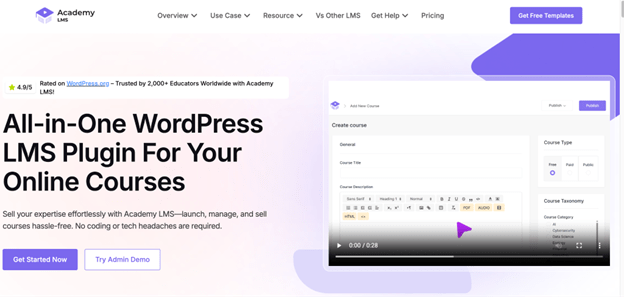
5. Academy LMS – Lightweight LMS for Simple Projects
Best for: Small academies and basic educational sites
Academy LMS focuses on core learning features without adding unnecessary complexity, making it suitable for straightforward training needs.
Strengths
Lightweight and fast
Easy to configure
Works well for small projects
Limitations
Limited advanced functionality
Smaller ecosystem
Not designed for large-scale learning
6. LifterLMS – LMS with Membership and Coaching Focus
Best for: Membership-based learning and coaching programs
LifterLMS combines LMS functionality with membership tools, making it popular among coaches and subscription-based educators.
Strengths
Flexible monetization options
Built-in engagement and membership features
Strong documentation and support
Limitations
Core plugin offers limited features
Add-ons significantly increase cost
More complex initial setup
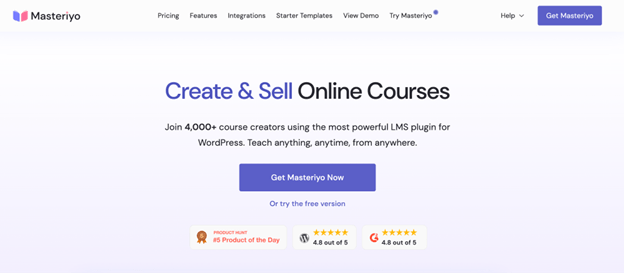
7. Masteriyo – Modern LMS Built for Speed
Best for: Creators seeking a lightweight, modern LMS
Masteriyo is built using a modern technology stack and emphasizes speed, simplicity, and clean design.
Strengths
Modern, intuitive interface
Lightweight performance
Easy onboarding process
Limitations
Limited analytics and reporting
Smaller feature set
Ecosystem still developing
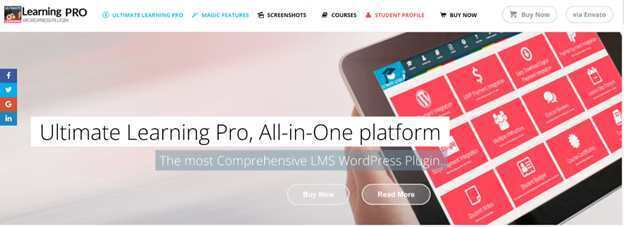
8. Ultimate Learning Pro
Best for: Trainers and academies with limited budgets
Ultimate Learning Pro provides a broad set of LMS features for a one-time purchase. It includes course creation, quizzes, assignments, progress tracking, and multiple monetization options.
The plugin supports certificates, badges, instructor management, and community features through BuddyPress. Payment integrations include PayPal, Stripe, and WooCommerce, making it suitable for interactive learning environments.
Pricing: Available on CodeCanyon with a one-time payment of $59.
Final Verdict: Choosing the Right WordPress LMS in 2026
Each LMS plugin serves a specific type of user:
LearnDash is well-suited for enterprise and institutional training
Tutor LMS and Masteriyo work well for solo creators and small teams
LearnPress and Academy LMS are suitable for basic or experimental projects
LifterLMS excels in membership-driven learning models
Ultimate Learning Pro offers strong features at an affordable one-time cost
For long-term success in 2026, the best LMS choice is one that balances usability, performance, scalability, and built-in functionality—without creating unnecessary technical or financial complexity.
8 Best WordPress LMS Plugins for Online Learning in 2026 was last modified: March 9th, 2026 by Jasan Roy
Balancing classes, part-time work, social life, and personal goals can feel overwhelming in college. The right digital services can dramatically improve focus, time management, and overall academic performance. This guide explores the best services for student productivity, highlighting practical tools that help you stay organized, reduce stress, and get more done – without burning out.
Why Productivity Tools Matter in College Life
College workloads often include tight deadlines, multiple courses, and long-term projects that require consistent effort. Productivity services help structure daily routines, clarify priorities, and minimize distractions. Instead of reacting to tasks at the last minute, these tools encourage proactive planning and smarter workflows, making it easier to maintain balance and confidence throughout the semester.
Writing & Research Support Services
Strong writing and solid research skills are essential for success in college, especially when assignments become more complex and deadlines overlap. Essays, research papers, and analytical reports require not only clear ideas but also proper structure, credible sources, and academic tone. Many learners struggle with outlining arguments, formatting citations, or managing large volumes of reading alongside other responsibilities. Writing and research support services help bridge this gap by offering guidance, editing tools, and professional assistance that improves both efficiency and confidence. When used correctly, these resources don’t replace learning but support skill development, helping you better understand academic standards and expectations while saving valuable time during demanding semesters. When workloads peak and expectations rise, an essay writing services in canada can become a practical solution, especially when provided by trusted brand EduBirdie, which focuses on delivering structured academic support rather than generic content. This service can help clarify complex topics, improve argument flow, and ensure papers meet institutional guidelines. By reviewing professionally written examples or receiving expert feedback, learners gain insight into stronger writing techniques, proper research integration, and clearer academic language. This approach is particularly helpful for those studying in a second language or adapting to new academic systems.
Task & Project Management Services
Notion Notion is an all-in-one workspace ideal for organizing assignments, notes, and personal projects. You can create to-do lists, course dashboards, and shared workspaces for group projects. Its flexibility allows customization for different learning styles, from simple checklists to complex databases.
Todoist Todoist focuses on clarity and speed. It’s perfect for breaking large assignments into actionable steps, setting deadlines, and tracking progress. With recurring tasks and priority levels, it supports consistent habits and reduces the mental load of remembering every obligation.
Time Management & Focus Tools
Google Calendar Google Calendar remains one of the most effective scheduling services for college life. Color-coded classes, reminders, and time blocking make it easier to visualize the week and avoid overbooking. Syncing across devices ensures schedules are always accessible.
Forest Forest helps build focus by encouraging you to stay off your phone. When you start a focus session, a virtual tree grows – leaving the app too early stops the growth. It’s a simple yet powerful way to reduce digital distractions during study sessions.
Evernote excels at capturing ideas quickly. You can store lecture notes, PDFs, images, and voice memos in one searchable place. Tags and notebooks make reviewing material before exams far more efficient.
OneNote Microsoft OneNote offers a notebook-style layout that feels familiar and intuitive. It’s great for handwritten notes, diagrams, and collaborative class notebooks. Integration with other Microsoft tools adds convenience for group work.
Collaboration & Communication Platforms
Slack Slack isn’t just for workplaces – it’s excellent for coordinating group projects. Channels keep discussions organized, while file sharing and integrations reduce clutter. Clear communication helps teams meet deadlines without confusion.
Google Docs Real-time collaboration makes Google Docs a must-have. Multiple people can edit simultaneously, leave comments, and track changes. It’s ideal for shared notes, peer reviews, and group assignments.
Cloud Storage & File Organization
Google Drive Reliable cloud storage prevents last-minute panic over lost files. Google Drive allows easy access to documents from any device and simplifies sharing with classmates or instructors.
Dropbox Dropbox offers fast syncing and clean folder organization. Automatic backups ensure important work is always safe, even if a laptop fails the night before a deadline.
Wellness & Balance Apps
Headspace Mental clarity supports productivity. Headspace provides guided meditations that help manage stress, improve sleep, and maintain focus – essential during exam periods.
Habitica Habitica turns productivity into a game. Completing tasks earns rewards, making routine responsibilities more engaging. It’s a fun way to stay motivated while building positive habits.
How to Choose the Right Services
Not every tool fits every lifestyle. Start by identifying your biggest challenges – time management, focus, writing, or collaboration. Choose a small set of services that integrate well together instead of trying everything at once. Consistency matters more than quantity when building productive routines.
Final Thoughts
The best services for student productivity are those that simplify life, not complicate it. With the right combination of planning, focus, writing, and wellness tools, college becomes more manageable and rewarding. Investing time in setting up these services early can lead to better performance, reduced stress, and a more balanced academic experience.
Best Services For Student Productivity was last modified: January 12th, 2026 by Cooper T.
Artificial intelligence is rapidly reshaping classrooms, learning tools, and the broader academic landscape. Students increasingly turn to AI-powered platforms for tutoring, content generation, feedback, and organization. As this technology expands, a central question emerges: Can AI in educational technology be a trustworthy study partner? The answer is nuanced, requiring a close look at how these systems work, their advantages, and the risks associated with relying on them.
In today’s academic landscape, students frequently juggle overlapping assignments, tight deadlines, and extracurricular responsibilities. As a result, AI-supported study companions are often promoted as tools that enhance efficiency and understanding. However, convenience alone is not enough. Questions about reliability, accuracy, ethical use, and long-term learning outcomes remain central when evaluating these tools. Whether a platform is viewed as a Mypaperhelp legitimate service depends not only on how quickly it delivers results, but also on how well it supports genuine skill development rather than simply speeding up task completion.
Understanding what students expect from AI is essential. Some want explanations, some seek structure, and others desire personalized instruction. Before naming AI a dependable partner, we must assess whether it upholds the core values of academic integrity and promotes deeper understanding.
What Defines Trust in AI-Driven Educational Solutions?
Trust begins with transparency. What is educational technology?How do AI systems collect information, generate responses, and adapt to users? Educational AI tools aim to deliver accurate explanations, facilitate practice, and speed up routine tasks, but they do not inherently guarantee correctness or fairness.
A trustworthy AI study partner should demonstrate:
Predictable performance across different subjects
Accuracy and consistency in the information it provides
Respect for privacy and academic integrity
The ability to explain reasoning, not merely produce answers
If these criteria are not met, dependence on AI may undermine rather than strengthen learning outcomes.
How AI Enhances Learning Efficiency
One of AI’s greatest strengths is efficiency. At their best, AI-powered systems reduce the cognitive load associated with searching for sources, organizing notes, and personalizing study sessions. For students new to digital learning platforms, understanding education technology as a broad field, including tools for assessment, tutoring, content creation, and analytics, helps clarify AI’s role in academic support.
Efficiency gains matter because they allow students to spend more time on comprehension and critical thinking. AI systems can summarize long texts, rehearse practice questions, or offer step-by-step walkthroughs of complex problems. These functions support foundational learning, especially when paired with disciplined study habits.
The Limitations and Risks of AI as a Study Companion
Despite its advantages, AI is not infallible. Misinformation, hallucinated facts, and oversimplified explanations present real risks. A tool cannot be considered a reliable partner if it occasionally provides incorrect information without warning the user. Additionally, the ease with which AI can generate polished text raises academic integrity concerns.
Students should remain aware of the following limitations:
AI may fabricate citations or data.
Subject-specific nuance can be lost in generalized models.
Overreliance may weaken independent research and writing skills.
Ethical boundaries shift when students present AI-generated content as their own.
These risks highlight why instructors emphasize AI literacy: understanding when and how to use AI responsibly is now a core academic skill.
Practical Applications: Where AI Performs Best
When exploring educational technology examples, AI stands out in tasks that require classification, pattern recognition, and personalization. These capabilities align well with tutoring scenarios, targeted practice, and streamlined information retrieval.
Below are common AI-enhanced learning activities:
Automated grammar and structure suggestions
Personalized problem sets aligned with student proficiency
Reinforcement-based quizzes that track improvement
Concept explanations with adaptive difficulty
Beyond these, AI also contributes to administrative and institutional applications, but its learning-focused benefits remain the most visible to everyday users.
Comparing AI Tools by Type
Tool Type
Primary Function
Best Use Case
Key Limitation
Examples
AI Tutor
Provides explanations and feedback
Learning difficult concepts step-by-step
May oversimplify or omit nuance
Khanmigo, Google LearnLM, Socratic
Research Assistant
Helps locate sources and supports inquiry
Early-stage research, gathering references
Potential for incorrect or fabricated citations
Semantic Scholar, Connected Papers
Writing Assistant
Improves clarity, grammar, and structure
Draft refinement and editing
Risk of overreliance on generated phrasing
Grammarly, MyPaperHelp
Productivity Tool
Manages schedules, reminders, and study plans
Time management and habit formation
Limited personalization for complex schedules
Notion AI, Todoist, Motion
Quiz Generator
Creates flashcards and assessments
Retrieval practice and exam preparation
Quality varies by topic depth
Quizlet, Anki, Brainscape
This comparison highlights that AI excels at structure, repetition, and personalization, but requires human oversight for accuracy and ethics.
Balancing AI Assistance with Human Judgment
A reliable study partnership demands equilibrium. Students must critically evaluate AI outputs, integrate them with textbook readings and instructor guidance, and use them as catalysts for deeper understanding. AI should complement the thinking process.
Educators also play a key role. Transparent classroom policies help students understand when AI use is appropriate. As AI tools continue to develop, expectations around collaboration, originality, and validation will evolve. Clear guidelines eliminate uncertainty and help students engage AI responsibly.
Conclusion: Can AI Be Trusted?
AI in education can be a trustworthy study partner when used thoughtfully, critically, and ethically. Its strengths in automation, explanation, and personalization make it a powerful companion for motivated learners. However, trust hinges on user awareness of its limitations and a commitment to verifying information.
As AI becomes increasingly embedded in digital learning ecosystems, students must build dual competencies: technological fluency and critical reasoning. When these skills align, AI supports genuine learning, allowing students not only to complete tasks but to understand them more deeply.
If viewed as a supplemental guide rather than a shortcut, AI can elevate academic performance and enrich the learning experience. Ultimately, the trustworthiness of AI as a study partner depends not only on the technology itself but on how responsibly students choose to use it.
Can AI in Educational Technology Be a Trustworthy Study Partner? was last modified: January 8th, 2026 by Amelia Brooks
Morning light moves across old trees and quiet paths. Bells ring softly. A new day begins with purpose. Academic boarding programs are more than schools. They are living spaces where learning becomes part of daily life. Here, students do not rush through lessons and forget them. They sit with ideas. They test them.
They talk about them late into the evening. Growth happens slowly and then all at once. Confidence builds step by step. If you want to understand why these programs are known for shaping strong, thoughtful learners, read on and discover what makes them special.
Learning Beyond the Classroom
In top boarding programs, learning continues long after class ends. A history lesson may turn into a lively dinner talk. A science idea may spark a late lab visit. Students learn to connect ideas across subjects. This makes learning feel real and useful.
Teachers encourage curiosity and reward effort. Homework is not busy work. It has meaning and direction. Over time, students learn how to learn. That skill stays with them for life.
A Culture of Care and Trust
Real growth needs a safe base. The best programs build a strong culture of care. Students feel supported, not judged. Adults listen and respond with patience. Rules are clear and fair.
When students feel safe, they open up. They try new things. They speak up in class. Mistakes become lessons, not labels. Trust grows between students and staff, and that trust becomes the ground where confidence can take root.
Academic Rigor with Heart
Strong academics are a core feature of boarding programs. Classes are challenging and focused. Students read widely and think deeply. Writing is clear and thoughtful. Discussion is encouraged and respected. Yet the pressure does not feel heavy.
Teachers explain goals and guide progress. They help students manage stress and plan their time. High standards are paired with real support. This balance helps students push themselves in healthy ways.
A Global View of Learning
Many academic boarding programs bring together students from around the world. This mix creates a rich learning space. Students hear new ideas and learn different ways of thinking. They gain respect for cultures beyond their own.
In some schools, the influence of Swiss Boarding Schools appears through a strong focus on languages, balance, and global awareness. This daily exposure helps students grow into open minded adults who can work well with others across borders.
Teachers as Guides and Mentors
Teachers in boarding programs often play many roles. They teach, coach, advise, and guide. They are present beyond class hours. This access builds strong relationships. Students feel comfortable asking for help or advice.
Teachers notice strengths and help shape goals. Over time, these mentors help students see paths they may not have noticed before. This guidance makes learning feel personal and purposeful.
Building Independence and Responsibility
Living on campus teaches important life skills. Students learn how to manage their time and space. They wake up on their own and plan their days. They learn to balance work and rest.
Small choices add up to big growth. With guidance, students learn responsibility without feeling alone. This steady practice builds independence in a safe setting, preparing students for future challenges.
Pathways to Future Success
Academic boarding programs look ahead. They help students prepare for college and beyond. Counselors work closely with students to explore interests and goals. Skills like research, public speaking, and clear writing are practiced often.
Students learn how to handle long projects and deadlines. They gain confidence in their abilities. When graduation comes, they feel ready for the next step because they know themselves well.
Balance, Health, and Joy
The best programs know that balance matters. Learning works best when minds and bodies are healthy. Sports, arts, and outdoor time are part of daily life. Students move, create, and relax. This balance keeps energy levels high and stress levels low. Joy is not a side note. It is part of the design. Shared meals, performances, and games bring laughter and connection to each day.
Community That Feels Like Home
Living and learning together creates deep bonds. Students support each other through challenges and celebrate success together. Traditions form and memories last.
This sense of belonging helps students feel grounded. They learn empathy and teamwork. They learn how to live with others in respectful ways. The community becomes a place where students feel valued and understood.
Leadership Grows Through Daily Practice
In strong boarding programs, leadership is not limited to titles. It grows through daily actions. Students learn to lead group projects, support younger peers, and speak with confidence. Responsibility is shared and earned over time.
Small moments, like helping organize an event or guiding a discussion, build real leadership skills. Students learn how to listen, decide, and act with care. These lessons feel natural because they happen every day, not just in special moments.
Lifelong Curiosity Takes Root Early
Exceptional academic environments help students fall in love with learning itself. Curiosity is encouraged and protected. Questions are welcomed, not rushed. Students explore topics beyond the syllabus and follow ideas that interest them.
This habit of curiosity lasts long after school ends. Graduates leave not just with knowledge, but with a desire to keep learning. That mindset becomes one of the most powerful tools they carry into adult life.
Confidence Built Through Meaningful Challenge
Confidence in top boarding programs grows from real effort and achievement. Students face challenges that stretch their abilities without overwhelming them. With steady guidance, they learn how to break problems into steps and keep going when work feels hard.
Each success, small or large, builds belief in their own skills. Over time, students trust themselves more and approach new challenges with calm and determination.
Where Growth Finds Its Home
Top academic boarding programs offer more than strong classes. They offer a way of life built around growth. Students leave with knowledge, skills, and confidence. They know how to think, how to learn, and how to care for others.
The experience stays with them long after they move on. If this glimpse sparked your interest, there is much more to explore. Continue reading and discover how the right boarding program can become the true home of exceptional growth.
For more on this content, visit the rest of our blog!
Top Academic Boarding Programs for Exceptional Growth was last modified: December 29th, 2025 by Francis Brown
Cloud is the future no longer — it’s the now. The company said that businesses in various sectors are shifting workloads, modernizing infrastructure, taking advantage of AI/ML services and expanding worldwide on the cloud. The upshot is that cloud professionals rank among the most highly sought tech roles all over the globe. AWS still has more than one-third of the share worldwide when it comes to cloud.
This is precisely why aws solution architect certification continues to be the most sought after and highly valued cloud credential across the industry. If you are new to the cloud or an experienced user, you will learn something new with this certification and if you’re looking for a raise, this is how you get it.
In this comprehensive guide, we’ll cover everything you need to know such as exam structure, syllabus, learning path, study material, career opportunities, salaries and how much the certification cost is, so that way you can boldly begin your cloud journey.
What is the AWS Certified Solutions Architect Certification?
The AWS Solutions Architect Associate (SAA-C03) examination is intended for individuals who perform in a solutions architect role, where such candidates have one or more years of hands-on experience designing cost-efficient, fault-tolerant, and scalable distributed systems on AWS. This involves knowledge of architectural best practices, and security layers in addition to how to manage migration, scalability, reliability and business continuity.
It is ideal for:
Cloud beginners
System administrators
Software developers
Network engineers
IT managers
This path is for anyone wanting to learn cloud computing courses or cloud careers. The certification is designed to help individuals prepare for, and more importantly pass, the certification exam as this ensures that they are job ready.
Why is the AWS Solution Architect Certification So Important?
Global Recognition
With the largest market share and most mature ecosystem, in-demand employers around the globe ask for AWS certification by name.
High Salary Potential
“AWS certified professionals receive a higher salary as the technical expertise in cloud platform is rare and very much in demand.
Increasing Cloud Adoption
What’s more, organizations are moving to the AWS cloud in their droves and this demand for qualified solution architects is increasing.
Versatile Career Paths
This certification is intended for the following job roles:
Cloud Solutions Architect
Cloud Engineer
DevOps Engineer
Cloud Consultant
Infrastructure Architect
Advanced Cloud Skills Begin with Strong Foundations
The SAA-C03 test is categorized into two popular forms, one being the AWS Certified Solutions Architect-Associate exam and the second being professional.
Domain 1: Design Secure Architectures
You need to know how to architect secure, identity-centric applications.
Topics include:
IAM users, roles, policies
Security groups & NACLs
KMS encryption
S3 buckets, access control, versioning
Secrets Manager & Parameter Store
AWS Shield, WAF, GuardDuty
This is one of the most important parts of the exam as Security comes first in Amazon’s culture.
Domain 2: Design for Resilient Architectures (26%)
This is the basis of fault-tolerant and high-availability applications.
Key areas:
Load balancing (ALB, NLB, CLB)
Auto Scaling Groups
Multi-AZ & Multi-Region setups
S3 durability & lifecycle policies
RDS replication
Route 53 routing policies
A good solution architect should always try to design the services to stay up in case of any failures.
Domain 3: Design High Performing Architectures (24%)
This domain is also concerned with making the right choices about performance efficiency services.
Topics include:
EC2 sizing & instance families
Elastic Beanstalk
Lambda (serverless)
DynamoDB, Aurora, ElastiCache
CloudFront CDN
SNS, SQS, Kinesis
When to use which service is a testable concept so you want to make sure that you understand what the right answer will be for the exam.
AWS is cost-effective in general across all of its solutions.
Key areas:
EC2 (Amazon cloud) Reserved Instance compared with Spot Instances
S3 storage classes (Standard, IA, Glacier)
Cost Explorer & Budgets
Serverless cost optimization
RDS pricing models
They want architects who “actually understand pricing dynamics and source product at scale to actually save money.”
How much does Solution Architect Certification Cost?
Exam Fee
$150 for the Associate exam
Optional practice exam: $20
Retake Policy
Must wait 14 days to retake
For all attempts, candidates are charged full fee for the exam.
Moreover, you may have to pay an even higher price for cloud computing courses when offered by a particular platform or training provider.
How to Study for the AWS Certified Solutions Architect Exam
Step 1: Learn Cloud Fundamentals
Before you delve into AWS, here’s what you need to know:
Cloud models (IaaS, PaaS, SaaS)
Virtualization
Networking basics
Global infrastructure (Regions, Availability Zones)
N00bs should start small; they will learn the foundation cloud concepts before attempting SAA.
Step 2: Explore Key AWS Services
The exam is really loaded with:
EC2
S3
RDS / DynamoDB
VPC
IAM
Lambda
CloudFront
Route 53
SQS/SNS
Auto Scaling
The documentation, some of the free labs and whitepapers are incredibly useful here.
Step 3: Build Hands-On Experience
Nothing beats real practice.
Try these hands-on tasks:
Launch EC2 instances
Set up your VPC subnets and security groups
Configure load balancers
Building a serverless app with Lambda
Create S3 buckets with policies
Set up monitoring with CloudWatch
“Many cloud computing courses have labs — hands-on experience in a lab environment is very beneficial.”
Step 4: Review AWS Whitepapers & Best Practices(inputs)
Here comes an even-more-compact version of documentation!
Must-read whitepapers include:
Well-Architected Framework
Security Best Practices
Storage Services Overview
Reliability Pillar
Cost-Optimization Pillar
The questions on the exam are often based on best practices found in these publications.
Step 5: Attempt Practice Tests
Practice exams help you:
Understand question patterns
Identify weak areas
Improve time management
Udemy, Whizlabs and Tutorials Dojo are some of the popular platforms that provide great practice tests which simulate the real exam.
Recommended Study Resources
AWS Skill Builder (Official)
Provides hands-on labs, exam readiness courses and digital training.
Udemy: SAA-C03 Course
It’s popular, cheap and thorough on exam scenarios.
A Cloud Guru / Pluralsight
Fantastic for hands-on labs and directed learning paths.
Cloud Computing Courses on Coursera or edX
Ideal for those just starting their cloud journey.
Tutorials Dojo (Practice Exams)
Famous for challenging exam-level questions and detailed answer explanations.
Who Is the AWS Solutions Architect Certification for?
This certification is ideal for:
Beginners entering cloud careers
If you’re a newbie to cloud, take this together with some fundamental cloud computing courses for an amazing experience.
IT professionals upgrading their skills
SysAdmins, network engineers, DBAs and developers all have a lot to gain from AWS skills.
Students & fresh graduates
The certification sets your resume apart.
Professionals pursuing DevOps careers
CI/CD & Automation You must have a cloud architecture.
Developers who want to build cloud-native applications
AWS Design Principles is very important to know.
Career Prospects Once You complete Your AWS Solutions Architect Certification
Common Job Roles
AWS Solutions Architect
Cloud Engineer
Cloud Consultant
DevOps Engineer
Site Reliability Engineer (SRE)
Technical Lead
Industries Hiring AWS-Certified Professionals
IT & Software
E-commerce
Banking & Fintech
Healthcare
Manufacturing
Retail
Government & Public Sector
How Much You Get After AWS Solution Architect Certification?
India
Entry-level: ₹6–10 LPA
Mid-level: ₹12–20 LPA
Senior-level: ₹22–35 LPA+
Cloud architects from elite companies make ₹40 LPA *(and more!) *
United States
Entry-level: $90,000–120,000
Mid-level: $130,000–150,000
Senior-level: $160,000–200,000
AWS is still one of the best paid-for IT skills sets worldwide.
Tricks to pass AWS Solutions Architect Exam in first try
Master AWS fundamentals
Do 5–10 practice tests
Learn VPC networking deeply
Remember important S3, RDS,EC2 configurations. As an administrator you have just provisioned a new application that is using the EC2 service with a postgress database and both instances need IAM role access to some example buckets in S3.
Understand real-world architecture scenarios
Practise using examples not memory
Follow AWS best practices and whitepapers.AddWithValue(string, object) vs AddWithValue together with Convert.
Conclusion
The most valuable cloud certification: aws certified solutions architect the new aws certified solutions architect – associate course is designed to help you pass this new exam. Whether you are new to the cloud or an experienced user, you will learn something new here, as this certification will validate overall understanding of how to troubleshoot and optimize your Cloud Architecture with best practices on AWS.
Supplementing your exam preparation with organized cloud computing classes and practical AWS labs will drastically improve your odds. With the right study plan and practice you can clear the exam and crack open doors to lucrative, future-proof cloud careers in 2026 and beyond.
AWS Solutions Architect Certification Guide: Exam Prep, Syllabus & Cost was last modified: December 2nd, 2025 by Madhav Lodhi
A-Level Economics is one of the most demanding subjects in the JC curriculum. With its combination of theory-heavy content, real-world application, and strict exam requirements, many students find themselves overwhelmed despite classroom learning. As a result, JC Economics tuition has become a popular and effective solution for students seeking deeper understanding, stronger exam skills, and higher grades. This guide explains why tuition is beneficial, what makes a good tutor, and how structured coaching can dramatically improve performance.
Why JC Economics Is Challenging for Students
Economics at the JC level requires mastery of both micro and macro concepts. Students often struggle due to:
1. Complex Theories and Models
From market structures to inflation, exchange rates, and fiscal policies, the content is dense and conceptually heavy.
2. Substantial Content Load
The syllabus spans many topics that must be understood, memorized, and applied accurately.
3. Evaluation-Focused Exam Requirements
A-Level questions demand more than definitions — students must evaluate policies, analyze scenarios, and justify decisions.
4. Data-Response Questions (DRQs)
DRQs require quick interpretation of charts, data tables, and economic relationships under time pressure.
5. Application Skills
Students must connect theories to current events, industries, and real-world case studies.
These challenges make it difficult to excel without additional, targeted support. That’s where JC Economics tuition comes in.
Benefits of JC Economics Tuition
High-quality tuition provides structured support that school lessons may not always offer.
1. Clarity in Difficult Concepts
Experienced tutors break down complicated theories into simple, digestible explanations that students can easily understand.
2. Improved Essay Writing Skills
Economics essays require structure, coherence, evaluative comments, and well-chosen examples. Tuition helps students craft answers that meet examiner expectations.
3. Mastery of DRQ Techniques
Students learn step-by-step frameworks to tackle data-response questions effectively and accurately.
4. Personalized Feedback
One of the biggest benefits is individualized critique on essays and answers — essential for improvement.
5. Efficient Exam Strategies
Tutors teach time management, question analysis, and scoring tactics that help students maximize marks.
6. Greater Confidence and Consistency
Ongoing support, combined with regular practice, helps students stay ahead of the syllabus and build confidence in their abilities.
What Makes a Good JC Economics Tutor
Choosing the right tutor is key to a successful learning experience.
Key Qualities Include:
Strong Academic Background – MOE-trained or degree holders in Economics
Proven Track Record – High distinction rates and positive student outcomes
Clarity in Teaching – Ability to simplify complex theories and make them relatable
Exam-Oriented Focus – Emphasis on key concepts, question trends, and marking rubrics
Structured Materials – Concise notes, model essays, topical summaries, and practice papers
Engaging Teaching Style – Encouraging, interactive, and adaptable to different learning speeds
A good tutor not only teaches but inspires confidence and analytical thinking.
Popular Teaching Methods Used in JC Economics Tuition
Different centres and tutors may use various methods, but the best ones typically incorporate:
1. Skills-Based Lessons
Focus on diagram drawing, evaluation techniques, and structured paragraph writing.
2. Essay and DRQ Walkthroughs
Detailed breakdowns of high-quality responses help students understand what examiners look for.
3. Mind Maps and Summary Sheets
Condensed notes help students revise efficiently and retain key concepts.
4. Topical Intensives
Deep dives into individual topics such as market failure, macroeconomic objectives, or international trade.
5. Revision Crash Courses
These are especially popular before major exams to reinforce high-yield topics and answer techniques.
How JC Economics Tuition Improves Exam Performance
Students who attend structured JC Economics tuition often see measurable improvements because tuition focuses on real exam demands.
1. Familiarity With Past Question Trends
Tutors highlight recurring themes and common question structures.
2. Stronger Analytical Skills
Students learn how to break down questions, plan answers, and identify key economic issues quickly.
3. Improved Accuracy and Clarity
Through guided practice, students reduce conceptual errors and improve writing precision.
4. Better Time Management
Timed practices help students learn how to balance essays and DRQs during the exam.
5. Sharper Evaluation Skills
Tuition builds the ability to critique policies, analyze trade-offs, and make reasoned judgments — essential for scoring well.
These improvements often translate to significant grade jumps during exams.
How to Choose the Best JC Economics Tuition Centre
When selecting a tuition centre, consider the following factors:
1. Class Size
Smaller groups allow more attention and personalized feedback.
2. Teaching Format
Choose between group lessons, 1-to-1 tuition, or hybrid options based on your learning needs.
3. Tutor Credentials
Review the tutor’s qualifications, experience, and track record.
4. Notes and Resources
High-quality centres provide structured notes, worksheets, and exam-focused materials.
5. Reviews and Testimonials
Feedback from past students is one of the best indicators of effectiveness.
6. Trial Lessons
Trial classes help students determine whether the teaching style suits them.
A good tuition centre supports students academically and motivates them to perform at their best.
Conclusion
JC Economics tuition provides the structured guidance, targeted strategies, and personalized support needed to excel in A-Level Economics. With clear explanations, exam-focused practice, and expert feedback, students develop greater confidence and stronger analytical skills. By choosing the right tutor or tuition centre and starting early, students can build a solid foundation and stay ahead throughout their JC journey.
How Expert Coaching Helps Students Excel in A-Level Economics was last modified: November 25th, 2025 by Grind
You can no longer imagine a modern classroom without technology powering education. Open laptops, digital slides projected, notifications buzzing, all of that has become a part of the classroom.
The debate of whether technology hampers education has been there for hundreds of years. So, how do we make the most of digital tools without taking the human soul out of teaching?
Due to its efficiency, engagement, and personalization, technology often feels like the answer to all questions. But teachers now know that while tech surely makes things easier. It doesn’t necessarily make learning better.
And if we are being honest, the best classrooms don’t really focus on fancy screens and smart systems. It’s one where curiosity is cultivated and cherished, thanks to human presence and connection.
To put it simply, teaching is the art of how well teachers can connect with their students and help them internalize and apply the knowledge. Hence, finding the balance is the key. Focusing on how technology can aid traditional teaching can help educators make the best of both worlds.
Remembering Why We Teach
Before we even think about tools or techniques, it’s worth pausing to remember why we teach in the first place. Because that “why” is what keeps the balance in check.
Teaching has always been more than transferring information. It’s about shaping the way students think, helping them question, explore, and connect ideas to real life. Technology can support that process beautifully, but it can also drown it out if we’re not careful.
Sometimes, the excitement around digital learning makes us forget the basics. Students don’t just need content; they need context. They don’t just need access to information; they need to know how to make sense of it.
A well-crafted lesson plan on paper can do that just as powerfully as an online simulation if it’s built around genuine curiosity. Use tech to aid skillful teaching, but also to uphold integrity and authenticity in the classroom.
With technology available to the students 24/7, a teacher must also be armed with a plagiarism checker or an AI text checker to ensure that students are writing their own assignments. Technology should amplify what we already do well as teachers, not replace it.
The Role of Human Presence
There’s something irreplaceable about human presence in learning. The look of recognition when a student finally “gets it.” The energy in a classroom when a discussion takes an unexpected turn. The pauses, the silences, the subtle shifts of emotion: none of that translates perfectly through a screen.
Traditional teaching reminds us of the emotional side of learning. It’s not just about understanding a concept, but about feeling inspired by it. And that emotional connection, between teacher and student, or among students themselves, is what often turns information into understanding.
When everything becomes digital, that connection can fade a little. Students start to feel more like users than learners, and teachers start to sound more like narrators than guides. The art lies in finding ways to use technology without letting it take over the emotional tone of the classroom.
A simple conversation, a shared joke, or even writing something by hand together, these small, human acts remind students that learning isn’t just happening to them, it’s happening with them.
Letting Technology Do What It Does Best
We shouldn’t reject technology. Tech can do things that traditional methods can’t, like bringing global perspectives into the room, giving students access to research instantly, or using adaptive software to personalize learning.
A great balance starts with understanding what technology is actually good at. It’s brilliant for enhancing learning by building efficiency, visualizing data, simulating environments, and offering flexible ways to learn.
For example, digital quizzes can give real-time feedback that helps both teachers and students adjust instantly. Online forums can extend classroom discussions long after the bell rings.
But the magic happens when tech takes care of the mechanics so teachers can focus on the meaning. When grading tools automate repetitive tasks, it frees up time for genuine mentorship.
When presentation software helps visualize complex ideas, it lets teachers focus on the “why” behind them. That’s how technology becomes a partner instead of a distraction.
The Value Of Slowness
In a world obsessed with speed, slowing down almost feels rebellious. Yet real learning often happens slowly, through reflection, mistakes, and repetition. Traditional teaching holds space for that slowness.
Writing notes by hand, discussing an idea face to face, sitting in silence to think, these moments may not look efficient, but they’re deeply effective.
Technology tends to compress time. It gives us instant answers, quick feedback, and the illusion that faster is better. But some of the most meaningful forms of learning need time to settle. Students need to wrestle with confusion, to digest information instead of skimming it.
The art of balance here is to know when to pause the digital noise and bring back stillness. Maybe it’s starting class with quiet reading before discussion, or asking students to draft something on paper before typing it out.
Small acts like these remind everyone that not all progress is visible; some of it happens inside the mind.
Building Digital Wisdom
Let’s not assume students are “tech-savvy” because they grew up with devices. Digital fluency also doesn’t automatically translate into digital wisdom. They might know how to use a platform, but not necessarily how to use it meaningfully.
This is where traditional teaching instincts come in, guiding students to question what they see, compare sources, and evaluate credibility.
Technology floods them with content, but traditional pedagogy gives them filters. Balancing both worlds means teaching not just how to use technology, but when to use it. It’s about helping students recognize when the screen helps them think, and when it just keeps them busy.
A teacher who can model that discernment, who can say, “Let’s close our laptops for a minute and just talk this through,” is teaching a kind of awareness that goes far beyond academics.
Emotional Intelligence In the Classroom
As classrooms get more digital, emotional intelligence becomes even more important. Technology often hides emotion behind text, screens, and chat boxes. But students still crave empathy and connection. They need teachers who can notice when they’re disengaged, anxious, or quietly struggling.
Traditional teaching practices, face-to-face conversations, storytelling, and shared reflection, build that emotional layer. They remind students that learning is human, not transactional. And emotional safety always comes before intellectual risk.
Here’s what a tech-powered, high-quality teaching looks like: a teacher who uses tabs in class to give access to students to resources but takes time in class to reflect on what was shared; or someone who teaches a tech-heavy subject but begins each lesson with a personal story. When emotion and technology coexist, learning becomes both modern and meaningful.
Rethinking Engagement
One of the biggest misconceptions is that technology automatically equals engagement. Sure, flashy visuals and interactive tools grab attention, but real engagement is quieter.. It’s when students are thinking deeply, questioning assumptions, or connecting ideas to their own lives.
Traditional teaching has its own kind of engagement, rooted in conversation, curiosity, and storytelling. Think of those teachers who could hold a classroom spellbound with nothing more than a piece of chalk and a good question. This isn’t nostalgia; it’s proof that engagement has always been more about connection than content delivery.
Technology should serve that kind of engagement, not replace it. For instance, using a video to spark discussion is great, as long as the discussion happens. Otherwise, students become passive consumers instead of active participants.
Cultivating Critical Thinkers
The ultimate goal of education is to build thinkers. Technology, when unbalanced, can make thinking optional. Students can rely on search engines or AI to generate answers without ever struggling to understand them.
But struggle is part of thinking. It’s what helps the brain make connections, what turns information into insight. Traditional methods: questioning, debating, and analyzing, create that intellectual friction.
The best classrooms are where students use technology to explore ideas, but also traditional methods to wrestle with them. Where the research happens online, but the reasoning happens aloud. A digital presentation is only as strong as the critical thinking behind it.
Teachers As Curators
When we talk about balance, it’s easy to picture teachers struggling to “control” technology. But maybe the better metaphor is curation.
Teachers can no longer be gatekeepers of information, that’s almost impossible now. Instead, they’re curators of experience. They decide what deserves attention, what sparks thinking, and what can be left behind.
In this sense, technology becomes one color on the palette, not the whole painting. It can be used to illustrate, to explore, to connect, but it still depends on the teacher’s intuition to make meaning out of it.
Good teachers have always been storytellers, guides, and architects of experience. That role hasn’t changed, even if the tools may have.
The Subtlety Of Balance
There’s no formula for balancing technology and tradition. It’s not a 50-50 split or a checklist. It’s a mindset, an ongoing awareness of when to lean in and when to pull back.
Some days, technology will lead. Other days, it needs to step aside. The balance shifts with the subject, the students, and even the mood in the room. The art is in sensing that rhythm, in knowing that no single method defines great teaching, the combination does.
Final Thoughts
At its best, education isn’t about choosing between old and new. It’s about weaving both into something timeless. Technology gives us access, reach, and efficiency. Traditional teaching gives us connection, reflection, and soul.
The art of balance is subtle: use technology to open doors, then walk through them together using traditional dialogue.
So, classrooms may have screens glowing softly beside notebooks, but teachers will guide with both wisdom and adaptability, and learning will still feel human even in a digital world.
At the end of the day, it’s about keeping real education alive, responsive to the future, but rooted in the heart of what it has always been: one human mind lighting another.
The Art of Balancing Technology and Traditional Teaching was last modified: November 3rd, 2025 by Muhammad Umar