Voice APIs are becoming a must-have for creating conversational AI solutions that enable users to engage with businesses in a more natural way through voice. In various sectors like customer service, healthcare, finance, retail, and hospitality, companies can leverage Voice APIs to develop AI agents for tasks like support, scheduling, sales, and other automated interactions.

Today’s Voice APIs offer much more than just basic calling.
They integrate features like:
- Speech-to-text
- Text-to-speech
- Real-time media streaming
- Call control
- WebRTC
- AI functionalities
This empowers developers to connect voice experiences with large language models (LLMs) and business systems, all while scaling across different channels and markets.
Below, we take a closer look at three top contenders, Telnyx, Twilio, and Vonage, evaluating their features, strengths, and pricing as of August 2026.
Top 3 Voice API Solutions At a Glance
| Voice APIs | Key Features | Pricing | Best for |
|---|---|---|---|
| Telnyx | Real-time media streaming Speech-to-text Text-to-speech Conversational AI commands Call control Browser/APP calling | Starts at $0.002 per minute | Teams wanting low-latency, carrier-owned infrastructure with full call control |
| Twilio | Interactive Voice Response Call tracking Elastic SIP Trunking Media streams Voice Insights Voice SDK | A pay-as-you-go model | Users needing a platform with wide language and SDK support |
| Vonage | Voice Connectors Voice Quality Engine WebRTC enabled Automatic speech recognition TTS | A pay-per-use model | Teams needing wide language coverage (120 languages) and flexible AI deployment options along the way |
1. Telnyx
Telnyx is a cloud communication and AI platform. It is carrier-owned and provides the necessary AI infrastructure for realtime agents.
As for the Voice Call API, Telnyx runs it on its own infrastructure, removing the third-party carriers in between. It gives developers programmatic control over calls, including routing, transferring, recording, and monitoring. Since Telnyx is a licensed carrier itself, it can offer this at a network layer instead of reselling PSTN access, covering over 25M API requests daily.
Telnyx holds the necessary compliance certificates, including ISO, PCI, HIPAA, GDPR, and SOC 2 Type II.
What Does Telnyx Offer?
- Real-time media streaming of bi-directional audio over secure WebSockets, useful for voice-AI assistants and real-time coaching platforms.
- Speech-to-text to convert voice to text in real-time with low-latency using multiple engine options (Telnyx, Deepgram, Whisper, and more)
- Text-to-speech to play natural voices in over 100 languages and accents
- Conversational AI commands, adding voice agents to any call and combining TTS, STT, and LLM logic with simple AI Gather and AI Assistant commands
- Call control that manages every leg of the call with single-line API commands
- Browser/APP calling that adds calling to your web and mobile applications via WebRTC, with SDKs for web, iOS, and Android.
What Are the Strengths?
- Owns its network end-to-end, keeping latency low
- Global coverage of over 130 countries with full PSTN control as a licensed carrier
- Usage-based pricing model
Pricing:
Voice API pricing starts at $0.002 per minute, with automatic volume discounts as usage scales.
2. Twilio
Twilio’s Voice API lets users build calling experiences that scale globally, connecting calls through a carrier network covering over 100 countries. Beyond call handling, it turns conversations into data at scale using natural conversational intelligence.
What Does Twilio Offer?
- Interactive Voice Response that responds to commands and supports text-to-speech experiences in hundreds of languages.
- Call tracking that links inbound calls to marketing campaigns to measure ROI and route leads correctly
- Elastic SIP Trunking to add global PSTN connectivity and usage scaling
- Interconnect, which is intended to protect your communications with private connections to the cloud
- Media streams for secure and real-time access to the phone call raw data
- Voice Insights for delivering real-time call quality data, spotting trends, and lifting answer rates
- Voice SDK to embed voice calling into iOS, Android, or JavaScript apps
What Are the Strengths?
- Wide SDK and language support
Pricing:
Twilio offers a pay-as-you-go model for its Voice API with a free trial available before committing to any of its paid plans.
3. Vonage
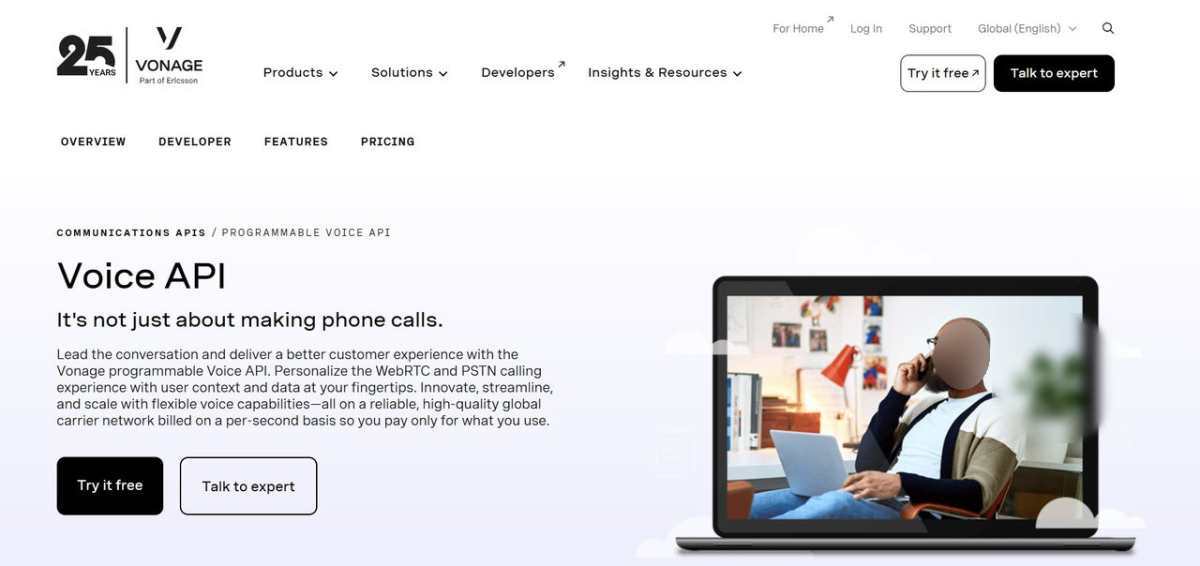
Vonage Voice API is a programmable voice tool for building calling experiences into apps. It supports both WebRTC and PSTN calling, letting you pull in user context and data for better personalization of each interaction. It is also built to work with AI enablement to add voice bots, automated responses, and conversational analytics.
What Does Vonage Offer?
- Voice Connectors to connect to partners in the Vonage network or third-party vendors in real time via WebSockets
- Voice Quality Engine that maintains low-latency, high-quality calls over Vonage’s carrier-grade network
- WebRTC enabled to support calling over both IP and PSTN with programmable voice features
- Automatic speech recognition to add self-service voice control in over 120 languages
- TTS that converts text into natural speech used for improving automatic menus and voice alerts
What Are the Strengths?
- Flexible AI deployment options
Pricing:
Vonage uses a pay-per-use model, where rates vary by country.
Closing Lines
As the features, strengths, and pricing offers differ across each solution, the best option for you depends on your unique needs, such as how much control you want over your infrastructure, your global reach, the AI features you require, and your budget.
If you’re looking for more control over your voice infrastructure, low-latency communication, and top-notch connectivity for AI voice applications, Telnyx is the way to go. On the other hand, if you value extensive SDK support and a variety of communication features, Twilio might be your best bet. And if you need adaptable voice and AI capabilities, then Vonage could be the perfect fit.