A year ago, I blogged that the rate of Video AI sophistication is moving so quickly that I’m changing my entire workflow every five months. Today I’m making clips that I could not even dream of in May 2026. All because of MiniMax H3.
For two weeks, I almost skipped over MiniMax H3. I saw the glowing promotions and figured – like LTX – it can’t be true. I’m a proper guy and I like to follow rules. There is a clear line buried in the license details. Section V.4 says,
You may not use, reproduce, modify, distribute, or display the MiniMax H3 Works or any of their Outputs or results outside the Applicable Territory.Section I.3 spells out what counts as the territory. Almost the whole globe, except for a handful of key regions.
United States. European Union. United Kingdom. South Korea. For anyone in those places, the standard license probably shuts people out. I saw that text. Locked doors. I’m not going to invest time in a tool I can’t use.
But I’m also a stubborn person. So I figured – what is the workaround? I found this application page people in this blocked group.
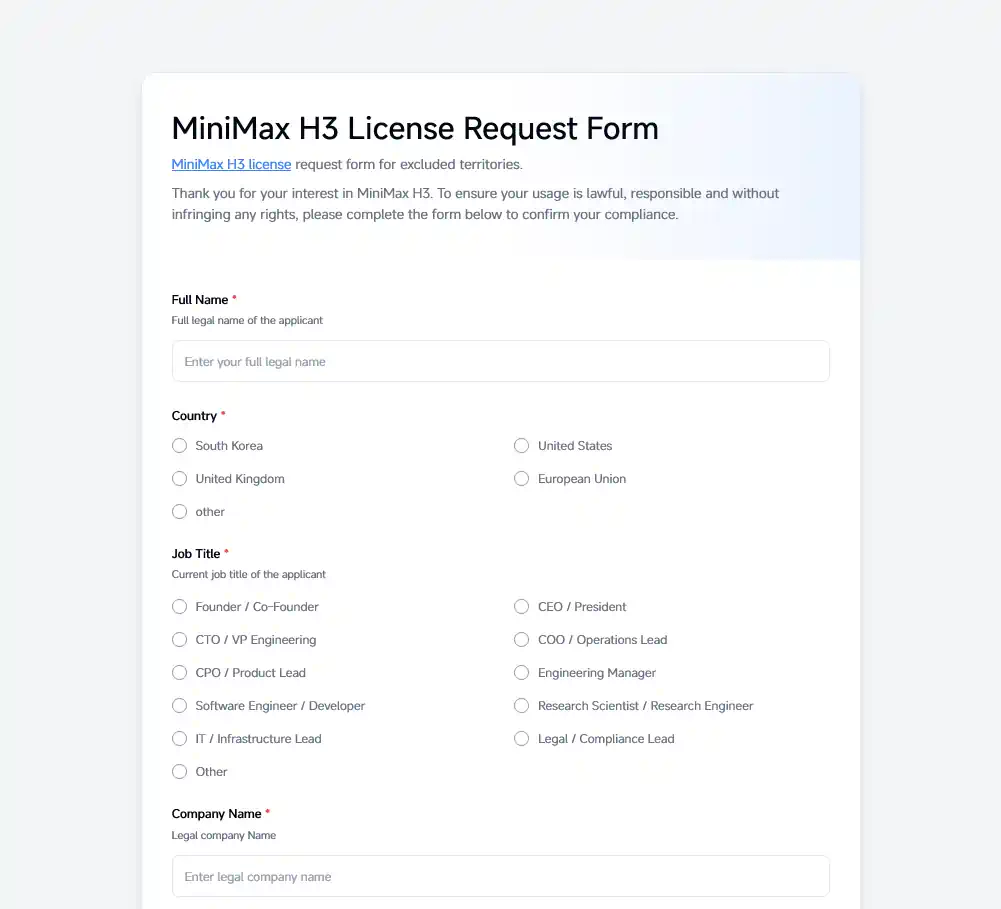
The form is brief. I filled it out. What the heck! Live dangerously!
My approval probably arrived in less than ten minutes.
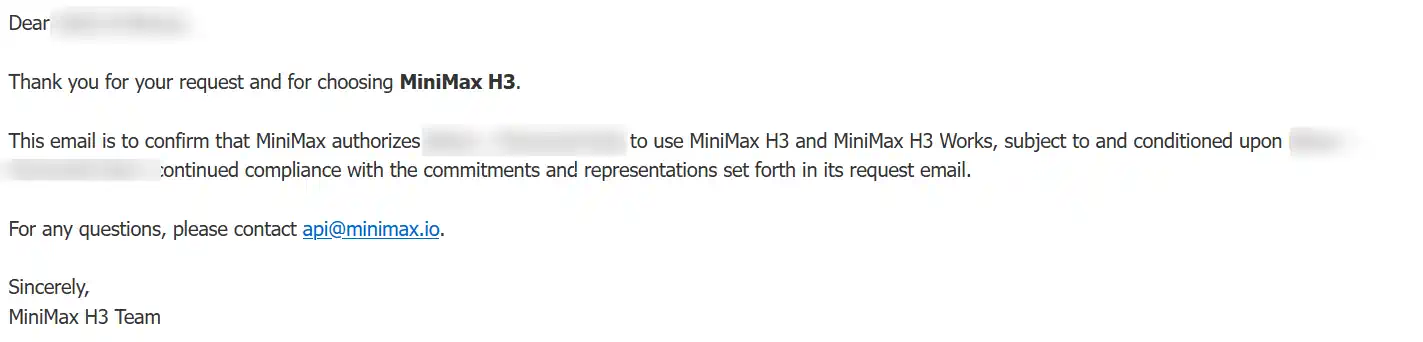
The time I sent this was about 4am Shanghai time. Unlikely that a human read my application. Either it auto-approved or was processed by AI. Or perhaps, this entire process was intended to get me to check the check boxes including the all-important indemnification box, which I did. I am happy to indemnify them for what I do. I do things proper. But it knocked my socks off to have a fully approved license in less time than you have spent reading this blog post.
Who MiniMax Is and What H3 Actually Does
MiniMax lives and grows in Shanghai. The story began late 2021. The company’s leaders started out at SenseTime. Their video tool for regular users carries the name Hailuo AI. Stock buyers may notice MiniMax in the Hong Kong market starting January 2026. The whole setup probably signals a major player with public backing and real scale.
H3 stands for the company’s third video release. Regular folks got access in the final days of July 2026. Hugging Face gained the open weights a few days after. The past month brought a steady wave of buzz. One incredible effect jumps out: H3 might turn both video frames and sound into reality at the exact same moment. The denoise action controls them both. Mouth movement and voice seem to stay in sync by design. Other open projects cannot match that yet.
Noisy debates erupted everywhere. DeepLearning.AI described the weights as open but tied down. Technology blogs everywhere carried stories about major regions losing access. That information probably reflects the real situation. Yet, most of those reports pause at the locked entrance. Few mention the way in might exist.
Why the License Looks Like a Wall
Open weights almost always limit what you can do with the model. MiniMax places boundaries on what comes out too. Go back to Section V.4. The license lists “Outputs or results” with the software itself. People may download the files in one allowed country. That does not mean users can show the video anywhere they like. A finished clip counts under the rule. That probably puts MiniMax in a stricter position than Llama or Qwen.
Two more rules might surprise many. Section IV.1 puts a line for big business. If yearly revenue reaches huge sums, separate written permission probably becomes necessary. Section IV.2 brings in a rule about names. Any commercial product built with MiniMax H3 must put the words “MiniMax H3” clearly on the user screen. Section VI.3 stands out with big legal words. You promise to step in and protect MiniMax if anyone else complains about how you use their technology. In my own words, if trouble comes later, you probably take the blame.
Trying to take in all the legal language in one go may feel heavy. The people at MiniMax have put out an official licensing question and answer page that might change everything. The team explains that the territory rule was never about shutting out some places. They describe it as a reply to the chaos of fast video laws. Then comes a softer message. The limit right now just means “not yet” rather than “never.” This might not sound like a slammed door. To me, it probably means I have to wait for new rules to become clear. It sounds like the Wan 2.6 license, or other “closed source” models.
The Web Form, and What Happened When I Used It
Some in the tech community have said people should try writing an email to MiniMax. I missed that step. Instead, I used a simple online form at platform.minimax.io/h3-license. That became my chosen path. If friends ask, I would probably suggest the web form too.
The online application comes short and simple. Only the basics appear. One question nearly stopped me. The company name box wanted an answer. Nowhere could I say I am just one person making my own YouTube music videos (my most popular video has 30 views). No field invited a description about personal side projects. So I typed something in. My application ended with just that.
Approval was in my inbox when I next looked. I want to pause before saying what that means. The quick response does not show any careful look by a person in Shanghai. In my mind, some bot or algorithm probably handles the first check. Some writers mention that nobody knows how long MiniMax might take in other cases. So please treat this as a single story, not a promise for all. My story is still real though. I followed the process. I got the green light.
From where I stand, the main reason for the form probably links to the promise about legal risk. You agree to shoulder the risk. MiniMax probably gives you the space to use their tool.
What I Believe I Can Do on YouTube
Let me spell out my take. Making H3 videos on my home hardware probably sits inside the rules. I could post results on a popular video site. I must put two important messages for viewers.
The first is an AI disclosure. This comes from Exhibit A, item 12 of the license. It bars public dissemination “without clearly and prominently disclosing that such information and/or content is machine-generated.” I read “prominently” as on screen. Not buried in a description box. So my card says the video is AI generated and the characters are fictional.
The second is attribution. Section IV.2 requires you to display “MiniMax H3.” I use “Powered by MiniMax H3.” It sits on the same card.
On YouTube, a unique law exists. The company demands creators highlight changed or artificial scenes when uploading. Creators find this step under the “Attributes” menu in Studio. The rule always applies, no matter the model’s contract details. Only a single on-screen notice sometimes checks all necessary boxes. synthetic content policy

What This Does Not Cover
My interest stayed very limited. I explored a situation using personal setup at home with ComfyUI. I did not examine any cloud agreements. Web platforms that let people pay to use H3 fall under separate contracts. The API conditions, too, might hold different needs. My exploration missed those routes.
Something else might need attention. MiniMax offers a different engine named H3 Max inside the API. Public code never included any release for that tool. The standard license never covers this case. No one should guess that one rule stretches to all versions.
At least today I feel secure. I feel that I can create videos and post them on my personal channel (not compensated) and maybe on other platforms that I post on. My experience is the opposite of my first impression. I made a very tentative knock on the door, and it flew open wide to welcome me.
A personal approval message sits safe in my legal folder. I will strive to post the correct warnings appear all my videos.