If you’ve been following the AI video space, you already know the news: OpenAI is winding down standalone access to Sora 2. The standalone web and app experiences were shut down on April 26, 2026, and the Sora 2 API is scheduled to be discontinued by September 2026. For creators who built their workflows around Sora’s photoreal output and synchronized audio, this leaves a real gap.
The good news? The AI video generator market has never been more competitive. From cinematic studios to social-first creative tools, today’s alternatives don’t just match what Sora 2 offered — many surpass it in specific dimensions like model variety, camera control, pricing flexibility, and workflow integration.
This guide compares 10 of the best Sora 2 alternative platforms in 2026, ranked not by a single “best” winner, but by the specific advantages each platform brings to the table. Whether you need cinematic realism, faceless content automation, multi-model access, or budget-friendly stylized clips, there’s a tool here built for your use case.
TL;DR — Quick Comparison Table
| Platform | Key Strength | Pricing (Entry) | Best For |
| DramaPixel | Multi-model access (Kling V3, Veo 3.1, Hailuo 2.3) under one subscription | $14.90/mo | Creators who want flexibility across top models |
| Runway | Industry-grade Gen-4.5 with Motion Brush & camera control | $12/mo | Professional filmmakers and agencies |
| Higgsfield | Cinematic camera control & viral preset library | Free + paid tiers | Social-first cinematic creators and marketers |
| Luma | Ray3 reasoning model with HDR & natural motion | $9.99/mo | Realism-focused storytellers |
| ImagineArt | All-in-one creative suite (image, video, voice, workflows) | $9/mo | Generalist creatives who want one workspace |
| Pika | Fun viral effects (Pikaswaps, Pikaffects, Pikaframes) | $8/mo | Social media creators making scroll-stopping clips |
| Invideo AI | Full prompt-to-finished-video automation with stock + voice | $17/mo | Marketers and faceless YouTubers |
| PixVerse | Stylized output (anime, clay, cinematic) on a budget | $8/mo | Budget-conscious stylized content creators |
| ClipTalk | Script-to-social-video with talking AI characters | Free + $19/mo | Faceless YouTube and TikTok at scale |
| Canva | AI video baked into the world’s most familiar design suite | Free + $12.99/mo | Designers and small businesses |
1. DramaPixel — Best for Multi-Model Flexibility
What Is DramaPixel?
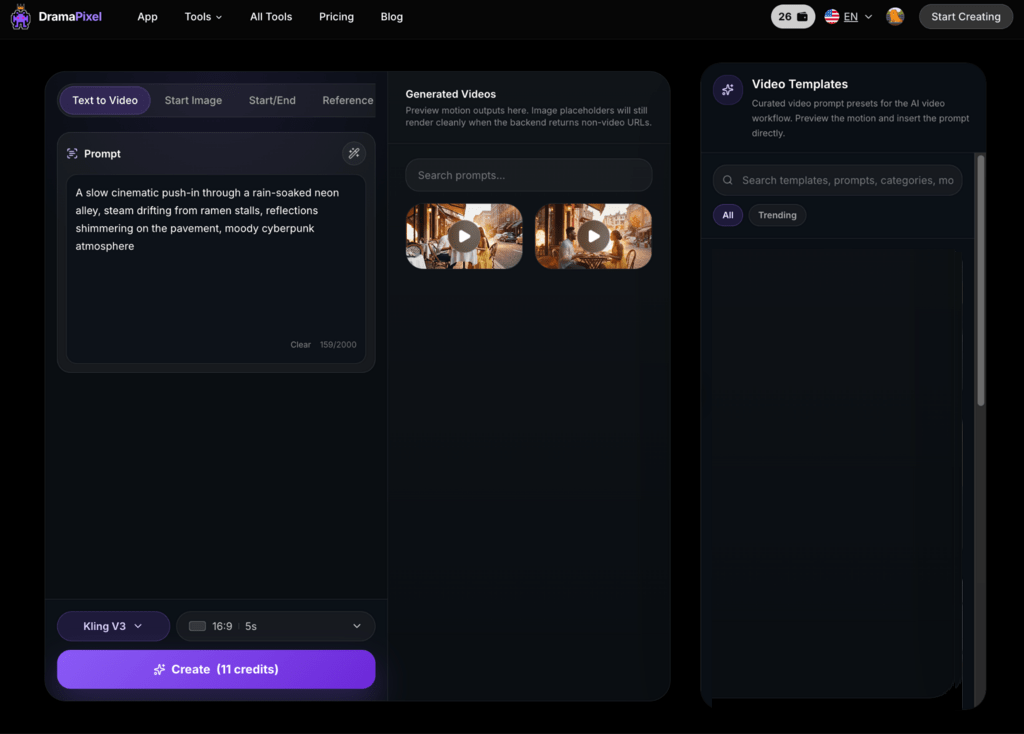
DramaPixel (dramapixel.ai) is a multi-model AI video generator platform that consolidates several leading generation engines under one affordable subscription. Rather than locking you into a single model, it gives you direct access to Kling V3, Veo 3.1 (Lite/Fast/Quality), and Hailuo 2.3 — letting you pick the right tool for each shot from a single dashboard.

Features
- Multi-model library: Kling V3 for reliable motion control, Veo 3.1 Quality for keyframe-optimized cinematic output, Hailuo 2.3 for first-frame controlled image-to-video at up to 1080p
- Three generation modes: Text-to-Video, Start Image, and Start/End Image keyframe control
- Aspect ratio options: 16:9, 9:16, 1:1 — covers landscape, vertical, and square in one click
- Duration control: 5s, 10s, and 15s clips
- Reference image and source video for character and style consistency
Pros & Cons
Pros:
- One subscription unlocks best-in-class models from Google, Kuaishou (Kling), and Minimax (Hailuo)
- Significantly cheaper than subscribing to each model separately
- Start/End frame control gives cinematic precision without complex software
- Covers every major aspect ratio and duration for cross-platform publishing
Cons:
- As a newer platform, the community and tutorial library are still growing
- New users may need time to learn each model’s particular strengths
Pricing
- Lite: $14.90/month — 300 credits/month
- Pro: $29.90/month — 600 credits/month
- Premium: $149.90/month — 3,200 credits/month
Annual billing is also available, and the per-credit value is notably strong given the breadth of models included.
Best For
Creators and marketers who want to access the best AI video models without juggling multiple subscriptions. DramaPixel is uniquely positioned for those who want the cinematic strengths of Veo 3.1, the motion reliability of Kling V3, and the image-to-video precision of Hailuo 2.3 — all in one place.
2. Runway — Best for Professional Filmmakers
What Is Runway?
Runway is one of the most established AI video generator platforms and is widely used by professional filmmakers, content studios, and creative agencies. Its Gen-4.5 model offers some of the most precise camera control, character consistency, and motion direction tools in the industry.
Features
- Gen-4 and Gen-4.5 video generation with advanced camera control
- Motion Brush for directing motion within specific areas of a frame
- Video-to-video transformation
- Lip sync and custom AI voice creation
- Act-Two character animation
- Professional editing timeline and 4K export on paid plans
- API access for teams and developers
Pros & Cons
Pros:
- Best-in-class motion control and directorial tools
- Strong for B-roll generation over existing footage
- A comprehensive creative suite — not just a clip generator
- Trusted by professional studios and agencies globally
Cons:
- Credit system is complex and credits don’t roll over
- On the Standard plan, a single 10-second Gen-4 clip can consume a large portion of monthly credits
- Adding team members requires paying full additional seats
- Steeper learning curve than consumer tools
Pricing
- Free: 125 one-time credits, watermarked
- Standard: $12/month (annual) — 625 credits/month
- Pro: $28/month (annual) — 2,250 credits, custom voices, 4K export
- Unlimited: $76/month (annual) — 2,250 credits + unlimited video in Explore Mode
- Enterprise: Custom pricing
Best For
Production studios, agencies, and filmmakers who need granular control over AI-generated footage and are willing to invest in mastering a more complex toolset.
3. Higgsfield — Best for Cinematic Camera Control & Viral Social Video
What Is Higgsfield?
Higgsfield AI is an AI video generator for creating cinematic videos and images, with a strong emphasis on camera-movement control, image-to-video workflows, and creator-friendly editing tools designed for social media creators, marketers, and filmmakers
. Its Cinema Studio feature simulates real optical physics, letting you choose virtual camera bodies, lens types, and focal lengths before generating.
Features
- Access to multiple leading AI video models in one workspace, including Seedance 2.0, Kling 3.0, Veo 3.1, Wan 2.7, Sora 2, and others — switch between models without leaving the platform and compare outputs side by side
- Cinema Studio 3.5 with directed camera language and aperture control
- Over 50 professional camera movements such as dynamic zooms, sweeping pans, and FPV drone shots to achieve Hollywood-style visuals without expensive equipment
- Motion Control for character actions up to 30 seconds
- Click-to-Ad: turn a product link into a finished ad
- Sora 2 Trends: viral preset templates
- Mobile-first Diffuse app
Pros & Cons
Pros:
- Unparalleled cinematic camera controls, high-quality fluid character motion with fewer artifacts, and an excellent mobile-first workflow for on-the-go creation
- A generative media platform that lets teams create short-form cinematic videos from a product link, image, or simple idea — generating roughly 4 million videos per day
- Wide library of viral presets and effects ideal for social campaigns
Cons:
- Still struggles with complex physical interactions and long multi-shot continuity
- The most powerful features are locked behind higher-tier plans, and the free version leaves a watermark
- Learning curve for advanced motion features
Pricing
- Basic: $9/month (billed yearly) — 3K credits/month, ~97 video generations
- Standard: $20/month — 8K credits/month, ~265 video generations, Seedance 2.0 access
- Ultimate: $34/month — 16K credits/month, ~530 video generations, all styles & models, unlimited Runway 4.5, Veo 3.1 Fast, Seedance 1.5 Pro
- Creator: $175/month — 100K credits/month, ~3.4K video generations, unlimited access to top models including Seedance 2 Fast and Kling 3.0 Pro
All paid plans include complimentary access to all GPT, Gemini, and Claude models.
Best For
Marketers, fashion teams, and short-form cinematic creators who want directorial camera control without traditional production overhead.
4. Luma — Best for Natural Cinematic Motion
What Is Luma?
Luma AI’s Dream Machine is known for producing some of the most fluid, cinematic-looking motion in the AI video category. Its Ray3 model introduced reasoning-based video generation — where the model understands cause and effect for more coherent scene progressions — along with native HDR output. Luma also integrates with Adobe Firefly, making it a natural fit for creators already in the Adobe ecosystem.
Features
- Text-to-video and image-to-video powered by Ray3 reasoning
- HDR/EXR export
- “Modify with Instructions” — edit videos using natural language
- Draft Mode for rapid concept testing
- Visual annotations and keyframe control
- Up to 10-second clips, extendable to ~30 seconds
- 1080p native, 4K upscaling available
Pros & Cons
Pros:
- Among the most natural-looking, physically plausible motion in the field
- The reasoning model produces more coherent, real-feeling scenes
- Fast generation times suit rapid iteration
- Solid value at the Standard tier
- Adobe Firefly integration extends professional workflows
Cons:
- Free and Lite plans are personal-use only with watermarks
- Clip length is limited compared to some competitors
- Quality can degrade on extended generations beyond 30 seconds
- Less suited for stylized or surreal output
Pricing
- Free: 30 generations/month, non-commercial
- Lite: $9.99/month — 70 generations
- Standard: $29.99/month — 150 generations, watermark-free, commercial use
- Plus: $64.99/month — 310 generations
- Pro: $99.99/month — 480 generations
- Premier: $499.99/month — 2,430 generations
Best For
Filmmakers, brand storytellers, and indie content creators who prioritize photoreal motion and smooth scene transitions.
5. ImagineArt — Best All-in-One Creative Suite
What Is ImagineArt?
ImagineArt (imagine.art) is a comprehensive AI creative platform that bundles image generation, video generation, voice tools, and workflow automation under a single roof.
It gives you access to multiple video generation models under one workspace
, making it a strong choice for creators who want to experiment across modalities without switching platforms.
Features
- Generate AI videos in seconds from text, images, or existing videos using Sora, Kling, Veo & Seedance, with no editing skills needed
- Edit image, reference, inpaint, upscale, lipsync, motion control, reframe, recolor, face swap, and more
- Workflow feature that allows you to work in node mode (similar to ComfyUI), plus the Chatly AI productivity agent
- AI avatars for tutorials and explainer videos
- Cinematic video generator with predefined effects, camera motions, and aspect-ratio control
- Browser-based plus iOS and Android apps
Pros & Cons
Pros:
- One credit pool unlocks dozens of image, video, audio, and editing tools
- Generations can be remarkably fast — sometimes around 30 seconds
- Strong for creators who blend image, video, and voice into cohesive projects
- Mobile and web parity
Cons:
- The credit system takes some getting used to
- Occasional inconsistency across the many models offered
- Best results require deliberate, well-structured prompts
Pricing
- Plus: $17/month (billed $200 yearly) — 75 credits/mo, 4 AI avatars, 20 GB storage, unlimited watermark-free exports
- Max: $85/month — 390 credits/mo, 16 AI avatars, 100 GB storage
- Generative: $170/month (Best Value) — 800 credits/mo, 40 AI avatars, 2 TB storage
- Elite: $900/month — 4,250 credits/mo, 200 AI avatars, 10 TB storage
All paid plans include access to Veo 3.1, Sora 2 & Kling 3, all AI workflows, and AI video trends.
Best For
Versatile creators, designers, and small teams who want a single creative OS for images, videos, voice, and end-to-end workflows.
6. Pika — Best for Fun, Viral Social Effects
What Is Pika?
Pika (pika.art) is one of the most playful AI video generators available today. Known for features like Pikaswaps (object swapping), Pikaffects (surreal effects), Pikaframes (start/end frame control), and Pikaformance (lip-sync from images), Pika 2.5 is a favorite among creators who want bold, scroll-stopping clips without a steep learning curve.
Features
- Text-to-video and image-to-video
- Pikaswaps, Pikaffects, Pikatwists, Pikadditions
- Pikaframes for start/end frame control
- Pikaformance for talking image and lip-sync
- PikaScenes for structured scene composition
- Turbo, Pro, and 2.5 model options
- Rollover credits on paid plans
Pros & Cons
Pros:
- Most beginner-friendly interface in the category
- Feature set tailored specifically for viral social content
- Fast generation
- Pro and Fancy plans include commercial rights and watermark-free exports
Cons:
- Standard plan credits run out fast for active creators
- Basic and Standard plans lack commercial rights
- Less suited for narrative or brand-controlled realism
- Credit costs on Pro-level effects can add up
Pricing
- Free: 80 credits/month, 480p, watermarked, no commercial use
- Standard: $8/month — 700 credits, watermark-free
- Pro: $28/month — 2,300 credits, commercial use, faster generation
- Fancy: $76/month — 6,000 credits, all models, fastest generation
Best For
Individual social media creators and lifestyle brands making content for TikTok, Reels, or Shorts who value creative effects and ease of use.
7. Invideo AI — Best for End-to-End Prompt-to-Video Automation
What Is Invideo AI?
Invideo AI is a browser-based AI video generator that turns your ideas into full videos — including ads, explainers, social media content, music videos, UGC-style ads, and essentially anything you can imagine
. The pitch: type a prompt and the agent assembles the script, voiceover, music, stock footage, and transitions for you.
Features
- AI Text-to-Video generator that turns prompts into full videos and clips — including scripts, scenes, voiceovers, music, transitions, and subtitles — powered by models like GPT-4.1, Sora 2, and Veo 3.1
- AI Movie Maker for full-length scripted videos
- AI Avatar Generator for UGC-style ads
- AI Voice Cloner that can clone your voice in seconds from a 30-second snippet
- AI Video Translator supporting 50+ languages
- Natural-language editing — change scenes, swap media, edit style with text commands
Pros & Cons
Pros:
- Fast, beginner-friendly AI tool that turns prompts into videos quickly
- Excellent for repurposing scripts, blog posts, or URLs into finished videos
- Massive built-in stock library and multilingual voice generation
- Holds a 4.6 out of 5 rating on Capterra and G2, and was named Product of the Month on Product Hunt
Cons:
- Fast for quick social drafts, but lacks creative control for serious brand work — best for quick TikTok/Reels drafts and simple explainers, not strict brand guidelines or conversion-focused ads
- Each prompt attempt consumes minutes, even for unsatisfactory results, and editing requires re-generation that uses additional minutes
- Reports of inconsistent visual matching between AI script and stock footage
Pricing
- Free: 2 AI video minutes/week, watermark included
- Plus: ~$25/mo (or ~$20/mo annually) — 50 AI minutes, 100GB storage, 95 iStock credits
- Max: ~$60/mo (or ~$48/mo annually) — 200 AI minutes, 400GB storage, 320 iStock credits
- Premium: ~$120/mo — higher limits for heavy users
Best For
Marketers, content agencies, and faceless YouTubers who need full prompt-to-finished-video automation rather than raw clip generation.
8. PixVerse — Best for Stylized Content on a Budget
What Is PixVerse?
PixVerse is a versatile, budget-friendly AI video generator that stands out for its strong stylistic range. Alongside realism, it offers anime, cinematic, clay, and 3D styles — giving creators a distinctive visual identity that other platforms struggle to match at this price point. Its daily-renewing credit system makes it practical for everyday creation.
Features
- Text-to-video and image-to-video
- Multiple style presets: Realistic, Anime, Clay, 3D, Cinematic
- Fusion and transition modes
- Audio and dialogue integration via prompt
- Fast rendering well-suited for daily use
- API access on Enterprise plan
Pros & Cons
Pros:
- Strongest budget option for stylized, visually distinctive content
- Daily-renewing credits (even on the free plan) make it practical for regular use
- Anime and cinematic styles are genuinely impressive at this price
- Low learning curve and quick render times
Cons:
- Realistic output doesn’t match premium tools like Runway or Luma
- Limited narrative or long-form capabilities
- Free plan has watermarks
- Less suited for production-grade cinematic work
Pricing
- Free: ~60 daily renewing credits, watermarked
- Standard: $8/month — 30 daily + 1,200 monthly credits
- Pro: $24/month — 30 daily + 6,000 monthly credits
- Premium: $48/month — 30 daily + 15,000 monthly credits
- Enterprise: $100/month — full API access
Best For
Anime fans, social content creators, and budget-conscious marketers who want stylized clips that punch above their price tag.
9. ClipTalk — Best for Faceless Channels & Script-to-Social Automation
What Is ClipTalk?
ClipTalk (cliptalk.pro) is purpose-built for short-form social content. It specializes in turning scripts, URLs, and text into fully produced videos — complete with AI voice-over, B-roll, auto-captions, and talking AI characters. It’s designed for the creator who wants to go from idea to published video without ever touching a timeline editor.
Features
- Script-to-video and URL-to-video conversion
- AI talking characters and voice cloning from a 30-second sample
- Auto-captions in 20+ languages
- AI-generated B-roll footage
- Silence and filler-word removal
- Natural-language video editing
- 48-language support
- Direct social media publishing
Pros & Cons
Pros:
- Extremely fast end-to-end production
- Voice cloning is a standout for faceless channels
- Strong for high-volume, repetitive content workflows
- No editing skills needed
- Auto-publishing saves multi-platform time
Cons:
- Not designed for cinematic or highly stylized output
- User reviews are mixed on quality consistency
- Free plan is very limited (1 minute)
- Less suitable for narrative or brand-led video work
Pricing
- Free: 1 minute of AI video, auto-captions in 20+ languages
- Starter: $19/month — 120 AI minutes, 15+ voices, 2 voice clones
- Pro: $60/month — 300 AI minutes, 30+ voices, 12 voice clones, priority rendering
Best For
Faceless YouTube and TikTok operators, content agencies, and marketers repurposing blog posts into video at scale.
10. Canva — Best for Designers & Small Businesses Who Already Use Canva
What Is Canva’s AI Video Generator?
Canva is the design platform that needs no introduction — and it has now folded AI video generation directly into the workflow that millions of marketers already use.
With Canva AI’s Create a Video Clip, you can turn text prompts into AI-generated videos in just one click and add cinematic visuals and synchronized audio — including dialogue and sound effects — into any project
.
Features
- Powered by Google’s Veo-3 — provide a text prompt and it generates a video up to eight seconds long, including audio that’s automatically synced with the video
AI Avatar generator that
- turns your photo or selfie into a talking head, or you can pick an available AI avatar and have it deliver your script in over 40 languages
- Magic Animate, Magic Switch (auto-resize across formats), background remover
- Massive template library for every social format
- Real-time team collaboration
Pros & Cons
Pros:
- Familiar — if you already use Canva for graphics, the video editor feels natural with the same interface, design philosophy, and asset library
- Even on the free plan, Canva does not add a watermark to your video exports — a significant advantage
- All-in-one workflow lets you design your thumbnail, create your video, and make matching social graphics all in one tool
- Massive template library is hard to beat for template-based social video
Cons:
- AI generation quality is basic compared to dedicated platforms — output looks like animated stock footage rather than genuine AI-generated content; Kling, Hailuo, and Runway produce significantly better AI video
- Limited video features: maximum 8-second clips, only 5 video generations per month on paid plans, and English-only prompts
- No public API for AI video generation
Pricing
- Canva Free: Includes basic AI tools and limited video credits
- Canva Pro: ~$12.99/month — 500 AI credits/month shared across AI features, full Magic Studio access
- Canva Teams: ~$100/user/year (3 user minimum) — collaboration, brand kit, IP indemnity
- Canva Enterprise: Custom pricing — centralized brand management, priority support
Best For
Social media managers, marketers, educators, and small business owners who already use Canva for design and want light AI video features without leaving their existing workflow.
Key Takeaways: How to Pick Your Sora 2 Replacement
With Sora 2 phasing out, the right replacement depends entirely on what you actually need to ship. Here’s a quick decision framework:
- You want flexibility across the best models without juggling subscriptions → DramaPixel. One plan, multiple top-tier engines (Kling V3, Veo 3.1, Hailuo 2.3), and meaningful keyframe control at consumer pricing.
- You’re producing professional client work that demands directorial control → Runway for industry-grade Motion Brush and camera tools, or Higgsfield for cinematic camera language and viral presets.
- You need photoreal motion that just looks “right” → Luma with the Ray3 reasoning model.
- You want one creative OS for image, video, voice, and workflows → ImagineArt.
- You’re chasing viral effects and fast social content → Pika for surreal effects, PixVerse for stylized aesthetics on a budget.
- You want to type a prompt and get a finished, publishable video → Invideo AI for end-to-end automation, or ClipTalk for faceless social-first pipelines.
- You already live inside Canva → Canva’s AI video features are the path of least resistance.
Conclusion
Sora 2’s discontinuation isn’t the end of an era — it’s a reminder that the AI video category has matured enough to offer specialized tools for every type of creator. There’s no single “best” Sora 2 alternative. There’s only the best alternative for you, depending on whether you value model breadth, cinematic control, automation, stylization, or workflow integration.
For most creators looking for the closest match to what made Sora 2 special — flexible access to multiple top-tier models, meaningful creative control, and pricing that doesn’t require an enterprise budget — DramaPixel is the most pragmatic starting point. By bundling Kling V3, Veo 3.1, and Hailuo 2.3 under a single affordable plan, it captures the multi-model power that Sora 2 users will miss most.
That said, if your work has a specific shape — cinematic camera language, viral social effects, faceless YouTube automation, or design-led marketing — one of the other nine tools on this list will serve you better. The smart approach is the same as always: start free, test against your real use cases, and commit only once you’ve seen the output that matches your actual workflow.
The best AI video generator in 2026 isn’t the one with the longest feature list. It’s the one you’ll actually use to ship.