Bad data is more expensive than most marketing teams realize. A list packed with invalid addresses doesn’t just push bounce rates up, it damages sender reputation in ways that can take months to repair. The best email verification tools in 2026 close that gap before a single campaign goes out. This roundup covers four of the most-used options, ranked by overall fit for marketers, developers, and teams verifying at scale.
Why Accuracy and Speed Matter in Email Verification
A verification tool that’s slow or imprecise creates its own problems. Slow bulk processing delays sends. Imprecise results (flagging valid addresses as risky, or worse, clearing invalid ones) push bounce rates back up the moment the next campaign runs. The best email verification tools handle both: they process lists fast enough to fit into a pre-send workflow and return results specific enough to act on without second-guessing every “risky” flag. Real-time API speed matters separately. If a tool can’t validate a signup address in under two seconds, it can’t protect a form at the moment of entry.
1. QuickEmailVerification
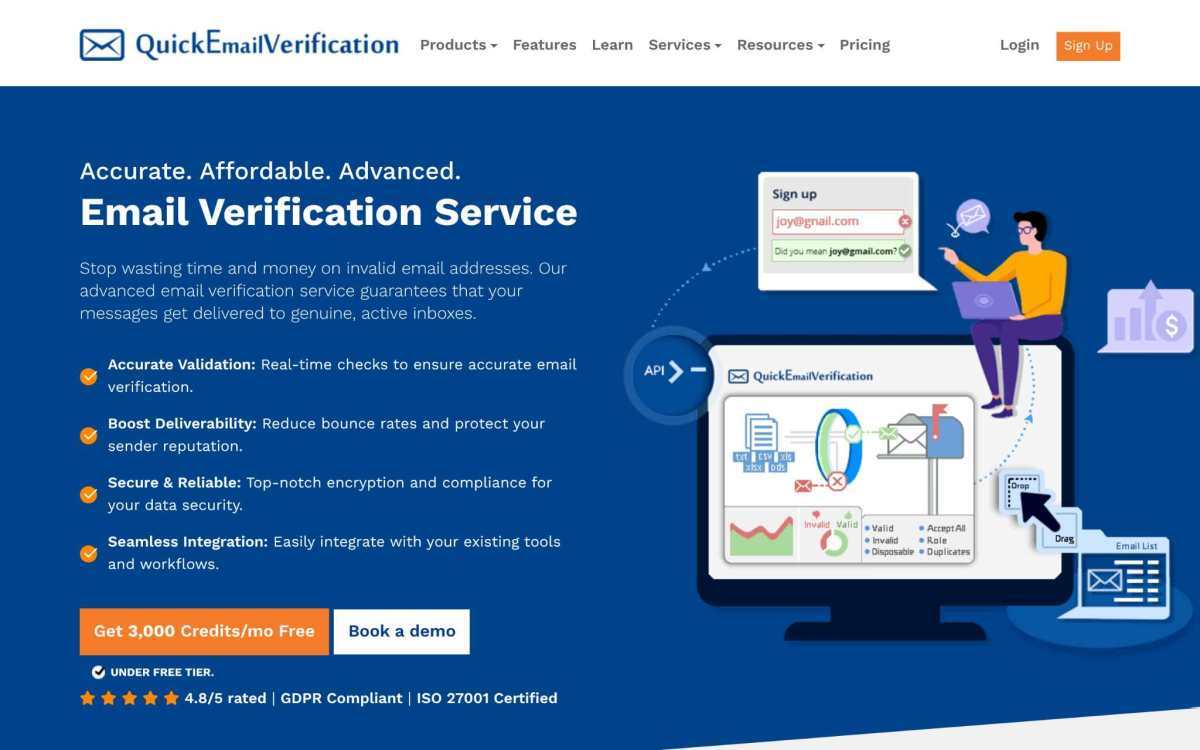
QuickEmailVerification is an email verification and list-cleaning platform, founded in 2014, built to reduce bounce rates and protect sender reputation for marketers, developers, and enterprises. It offers bulk list cleaning and a real-time REST API that returns results in under 1.2 seconds, fast enough to validate an address at form submission before it reaches a CRM or ESP.
The bulk verifier accepts TXT, CSV, XLS, XLSX, and ODS files and connects directly to 50+ platforms including Mailchimp, HubSpot, Salesforce, SendGrid, and Marketo. Each API check returns 15 data fields covering MX records, disposable status, role-based flags, and a typo-correction field that catches entries like “gnail.com” before they’re stored. A single safe_to_send flag filters disposable, role-based, and catch-all addresses beyond a plain valid/invalid split, and that’s what actually protects sender reputation at scale.
The company states it’s verified more than 30 billion emails for over 300,000 businesses, naming PwC, IBM, Salesforce, and Adobe as customers. It holds ISO 27001 certification and is GDPR, CCPA, and HIPAA compliant. Pay-as-you-go credits never expire, a free daily tier requires no credit card, and paid plans start at $4 for 500 credits. It rates 4.7 out of 5 on Capterra from 38 reviews and 4.6 out of 5 on G2 from 44 reviews.
2. Hunter
Hunter is an all-in-one email outreach platform founded in 2015 and headquartered in Wilmington, Delaware. Its Email Verifier sits inside a broader tool suite that also includes Domain Search, Email Finder, a leads database, and a full campaigns module with an AI writing assistant, making it a better fit for teams that want prospecting and verification in one place rather than a standalone list-hygiene tool.
The platform has over 4 million users, with Google, IBM, and Microsoft among its customers. Beyond the verifier, Hunter offers a Chrome extension, a Google Sheets add-on, and CRM integrations, plus a TechLookup feature that lists websites by the technology they run. API access and a data platform for bulk operations round out the developer-facing side.
The main consideration: because Hunter bundles verification inside a prospecting and outreach suite, teams that only need list cleaning may pay for features they won’t use. It’s best suited to sales and growth teams that run cold outreach campaigns end-to-end from a single interface.
3. BriteVerify
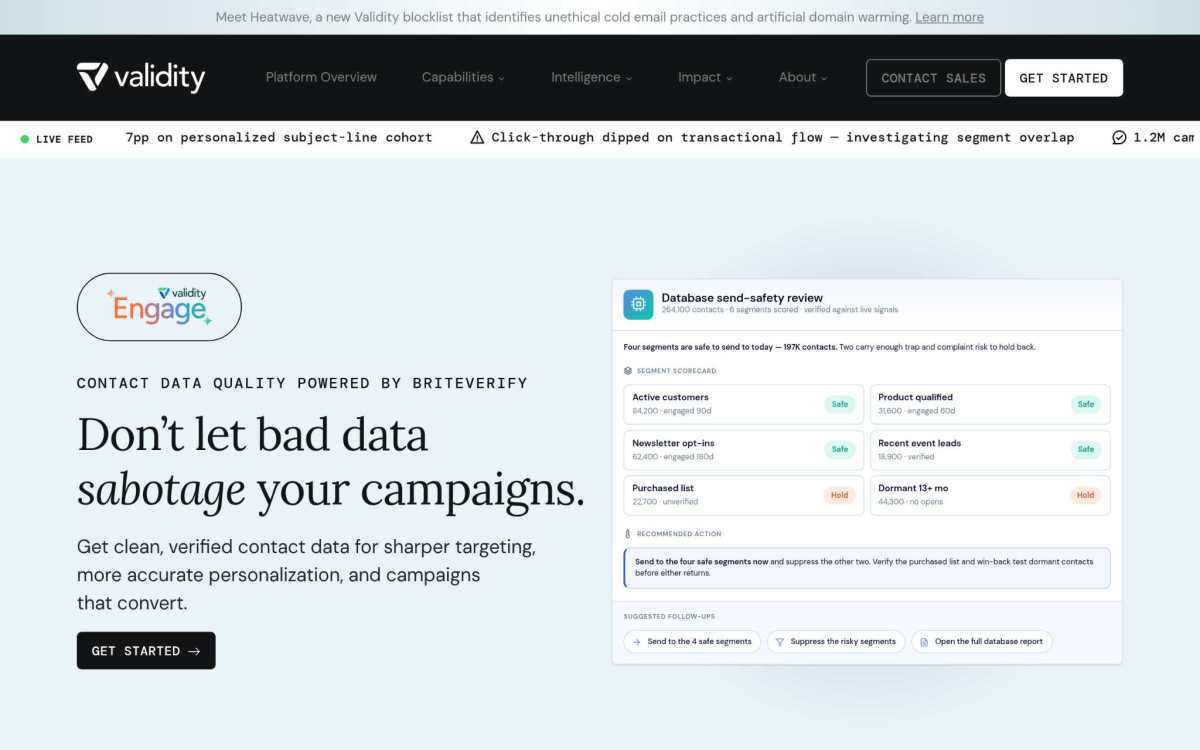
BriteVerify, founded in 2009 and headquartered in Charlotte, North Carolina, is now part of Validity’s product portfolio following its acquisition in June 2018. It describes itself as the industry’s longest-standing validation solution, and the scale backs that claim. Before the acquisition, BriteVerify processed 500 million email verifications per month, with Oracle, Mailchimp, Marketo, and Salesforce among its named clients.
The platform checks email addresses against syntax, domain, MX records, and mailbox existence. It also covers phone validation and physical address validation against USPS CASS-certified databases, which makes it a natural fit for organizations that need to clean more than just email data. Access comes through a web application, APIs, and native integrations. Every 24 hours, 1.5 million records move through the platform, and Validity’s customers took home multiple wins at the DMA Awards 2025 for email marketing effectiveness.
BriteVerify works best for compliance-conscious enterprise teams that need multi-channel data validation and want a provider with a long track record. Teams that only need email verification may find the broader Validity Engage stack more than they need.
4. Verifalia
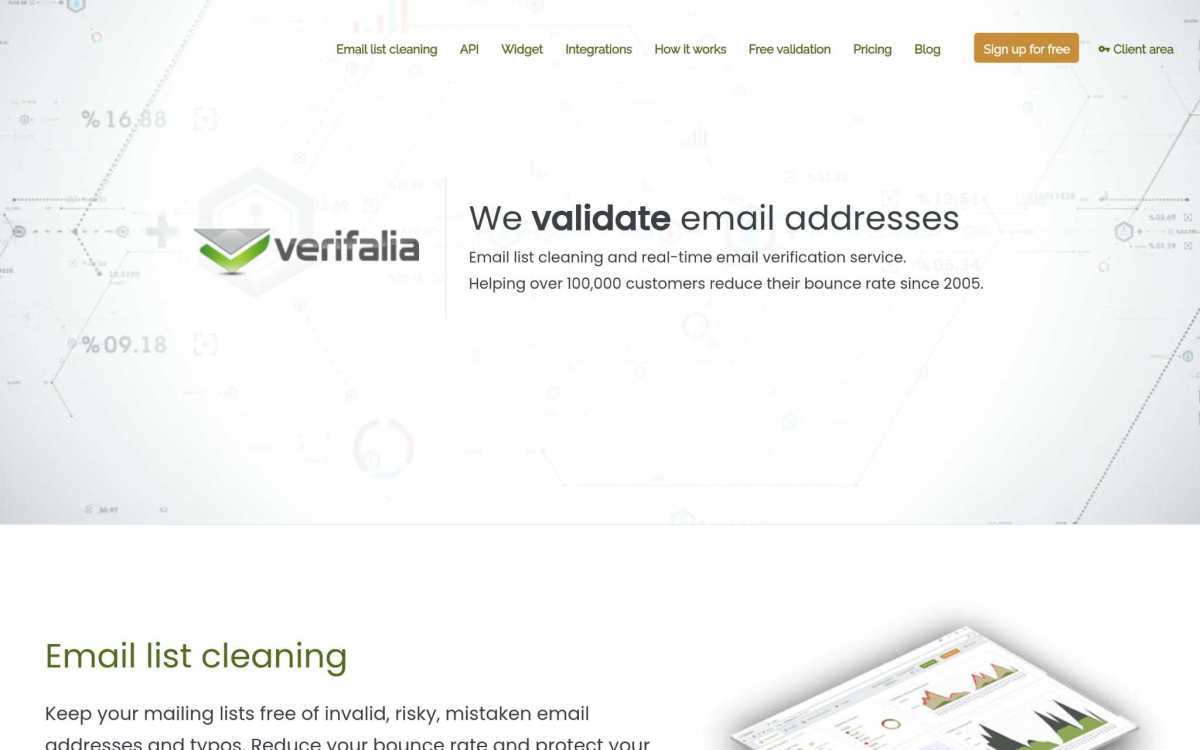
Verifalia is an email validation service developed by Cobisi Research, an Italian software company founded in 2005 and headquartered in Vigonza, Italy. The platform serves over 100,000 customers globally, with roughly 30% of those being Fortune and Global 500 organizations. Microsoft, Renault, Constellation Energy, and the American Psychiatric Association are listed among them. Cobisi Research is privately held and self-funded.
The platform’s verification achieves 99% accuracy, according to the company, detecting invalid, undeliverable, and risky addresses including spam traps, role accounts, catch-all servers, and disposable emails. Three distinct service quality levels give teams control over the thoroughness-versus-speed tradeoff on any given job. Services include bulk list cleaning, a real-time API, an embeddable JavaScript widget for web forms, and connections with over 6,000 applications through Zapier and Pipedream.
Verifalia’s depth of response codes and multi-quality-level approach makes it a strong pick for teams with strict data-quality requirements or complex validation workflows. The European origin is worth knowing for any compliance review, though the company operates a worldwide distribution network.
How to Choose the Right Verification Tool for Your Needs
The right tool depends on what a team actually does with email data. A developer adding real-time validation to a signup form needs a fast API with clear SDKs and consistent response times. A marketer cleaning a quarterly list once a month cares more about file format support, ESP integrations, and whether credits expire before they’re used. And a sales team running cold outreach campaigns will want prospecting and verification bundled together rather than a separate tool for each step.
Compliance requirements narrow the field further. Teams handling health or financial data should confirm HIPAA and SOC 2 status before committing. Volume matters too. Per-credit pricing at high volumes can be meaningfully different across providers, and that gap compounds quickly past the 100,000-email mark.
Bottom Line
The best email verification tools in 2026 fall into distinct categories: standalone list-hygiene platforms built for speed and scale, multi-channel data validators for enterprise compliance teams, and bundled outreach suites that pair prospecting with verification. Matching the tool to the actual workflow – bulk cleaning, real-time form validation, or end-to-end outreach – matters more than chasing a single “best” pick. Most providers offer a free tier, so testing against a real list segment before committing to a plan is straightforward.