AI music generation has moved far beyond experimentation. From indie creator tools to full-scale commercial apps, more developers are now integrating Suno-powered music generation directly into their products. But once you start comparing providers, the market gets confusing quickly.
Some platforms focus on ultra-low pricing, others emphasize uptime and scalability, while a few bundle Suno access into broader multimodal AI ecosystems. On paper, many of them look similar — until you compare pricing structures, rate limits, reliability, and how easy they are to integrate in production.

To make the comparison easier, we reviewed seven of the most widely used Suno API providers and compared them based on one major factor: overall cost-effectiveness.
This guide breaks down:
- Pricing models
- Music generation costs
- Developer experience
- Scalability
- Reliability
- Strengths and trade-offs of each provider
Whether you’re building an AI music startup, adding soundtrack generation to an app, or experimenting with creative workflows, this comparison should help you narrow down the right platform for your use case.
1. ApiPass
What is ApiPass?
ApiPass is an AI API marketplace designed for developers who want fast access to leading AI models without dealing with complicated infrastructure or expensive subscriptions. Its Suno API endpoints focus heavily on affordability, scalability, and simple deployment.
One of the platform’s biggest advantages is its pure pay-as-you-go model. There are no mandatory monthly plans, and unused credits never expire, which makes budgeting much easier for teams with fluctuating workloads.
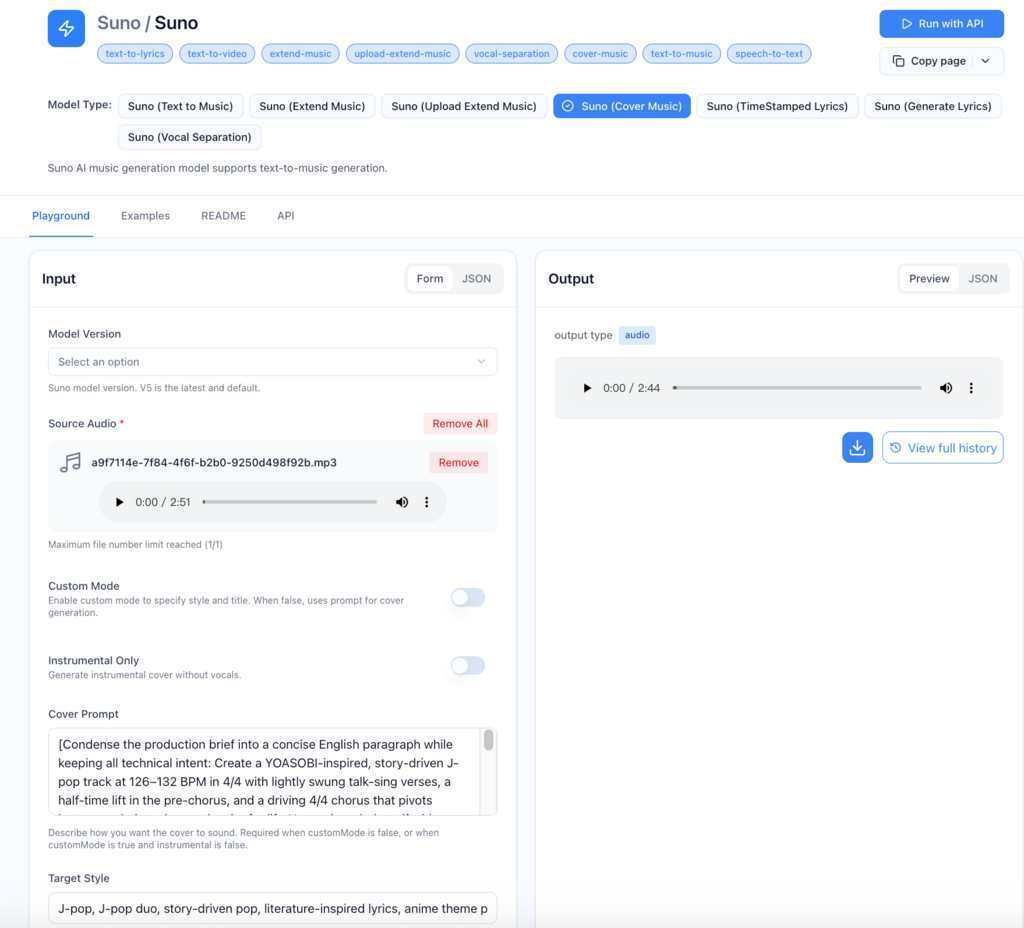
For developers building music generation features, ApiPass offers a lightweight integration experience with strong concurrency support and predictable pricing. Beyond standard text-to-music generation, APIPASS also provides a dedicated Suno Cover API, allowing developers to create AI-generated cover versions of songs through a simple API workflow. This is especially useful for music apps, remix tools, karaoke platforms, and creator-focused products that want to add interactive AI cover generation without building complex audio infrastructure from scratch.

Features
- Pay-as-you-go pricing with no subscriptions
- Credits never expire
- 20 requests per 10 seconds rate limit
- Single API key integration
- Support for music generation, extensions, covers, lyrics, and vocal separation
- Reliable uptime and production-friendly infrastructure
Pros and Cons
Pros
- Flexible pricing structure
- No wasted subscription fees
- Strong concurrency support
- Fast onboarding for developers
- Clear documentation
Cons
- Requires basic API integration knowledge
- Limited hands-on onboarding support for beginners
Price
Credit Packages
- $5 — 1,000 Credits
- $50 — 10,000 Credits
- $500 — 105,000 Credits (5% bonus)
- $1250 — 275,000 Credits (10% bonus)
Usage Costs
- Text to Music: 2.5 credits per run (~$0.014)
- Advanced Audio Tools: 2.5 credits per run
- Music extension
- Upload extension
- Cover generation
- Lyrics generation
- Vocal separation
2. aimlapi
What is aimlapi?
aimlapi provides access to hundreds of AI models through a unified API layer, including Suno music generation capabilities. The platform is built for teams that want to combine music generation with other multimodal AI features like image generation, chat models, and text processing.
Because everything is accessible through a single ecosystem, aimlapi works especially well for applications that need multiple AI capabilities in one stack.
Features
- Suno text-to-music generation
- Music extension support
- Lyrics generation tools
- Vocal separation features
- Multimodal AI ecosystem
- Stable handling of complex prompts
Pros and Cons
Pros
- Affordable per-run pricing
- Broad set of audio tools
- Useful for multimodal AI projects
- Easy centralized management
Cons
- Larger ecosystem creates a steeper learning curve
- Advanced audio customization may feel limited
Price
- Text to Music: 2.5 credits per run (~$0.014)
- Extend Music: 2.5 credits per run
- Upload / Cover / Lyrics / Vocal Separation: 2.5 credits per run
3. Replicate
What is Replicate?
Replicate is one of the most popular platforms for deploying and running AI models in the cloud. Instead of focusing only on Suno, it provides access to a massive library of open-source and community-built models, including music generation tools.
For developers who want infrastructure flexibility without managing GPUs directly, Replicate offers a clean middle ground between experimentation and production deployment.
Features
- Cloud-hosted AI model execution
- Automatic GPU provisioning
- Docker support for local testing
- Transparent compute-time billing
- Large community model ecosystem
Pros and Cons
Pros
- Highly transparent pricing
- No infrastructure management required
- Easy experimentation with multiple models
- Strong developer ecosystem
Cons
- Generation speed can vary significantly
- Community model quality is inconsistent
- Documentation quality depends on the model creator
Price
- Estimated Cost: ~$0.018 per run
- Average Value: Roughly 55 runs per $1
- Billing Model: Exact compute-time billing
Most generations complete in around 79 seconds on Nvidia T4 GPUs.
4. api.box
What is api.box?
api.box focuses on providing streamlined access to Suno AI music generation with an emphasis on speed and simplicity. The platform is designed for developers who want stable music generation APIs without unnecessary complexity.
Its infrastructure is optimized for low-latency requests and high-throughput workloads, making it suitable for production environments that need rapid audio generation.
Features
- Fast text-to-music generation
- Multiple Suno model support
- Vocal removal tools
- AI lyrics generation
- High-throughput streaming
- Simple developer integration
Pros and Cons
Pros
- Straightforward pricing
- Reliable performance
- Easy setup process
- Volume discount support
Cons
- Depends on upstream provider stability
- Limited UI tools for non-technical users
Price
Credit Packages
- $5 — 1,000 Credits
- $50 — 10,000 Credits
- $500 — 105,000 Credits (5% bonus)
- $1250 — 275,000 Credits (10% bonus)
5. Evolink
What is Evolink?
Evolink is built for production-grade AI workloads and places a strong emphasis on uptime and reliability. In addition to supporting Suno music models, the platform includes automatic fallback routing, which helps prevent downtime if one model endpoint becomes unavailable.
For teams running high-volume commercial applications, this reliability-first approach can be a major advantage.
Features
- Access to multiple Suno beta models
- Automatic fallback routing
- 99.9% uptime target
- Unified multimodal AI access
- Infrastructure designed for scale
Pros and Cons
Pros
- Excellent reliability
- Predictable pricing
- Access to newer Suno beta models
- Strong enterprise readiness
Cons
- Higher pricing for budget-sensitive indie projects
- Less granular billing flexibility
Price
Suno Model Pricing
- suno-v4-beta: $0.111/song
- suno-v4.5-beta: $0.111/song
- suno-v4.5all-beta: $0.111/song
- suno-v4.5plus-beta: $0.111/song
- suno-v5-beta: $0.111/song
Each generation consumes 8 credits.
6. Apiframe
What is Apiframe?
Apiframe is an all-in-one AI media generation platform that combines music, image, and video APIs into a single ecosystem. Rather than juggling multiple providers and billing systems, developers can manage everything from one interface.
The platform is particularly appealing for startups building multimodal AI products that require heavy media generation.
Features
- Unified AI media API platform
- Access to Suno and other leading models
- Prepaid billing system
- Unlimited RPM/TPM scaling
- Crypto payment support
- Priority human support
Pros and Cons
Pros
- Centralized billing and management
- Good fit for scaling startups
- Simplified infrastructure management
- Unlimited usage scaling
Cons
- Requires a $20 upfront payment
- May be excessive for small projects using only one endpoint
Price
- Pay-As-You-Go: $20 prepaid entry
- Enterprise: Custom pricing
7. sunoapi.org
What is sunoapi.org?
sunoapi.org is a dedicated Suno-focused platform offering commercial AI music generation through a traditional SaaS subscription model. Unlike usage-based providers, it relies on fixed monthly credit plans.
This approach works best for businesses with predictable generation volumes and recurring monthly workloads.
Features
- Dedicated Suno-only integration
- Webhook support
- Commercial-quality music generation
- Subscription-based pricing
- Full Suno feature access
Pros and Cons
Pros
- Predictable monthly costs
- Simple subscription structure
- Webhook support for async workflows
- Free testing tier available
Cons
- Unused credits may reduce overall value
- Less flexible for fluctuating workloads
- Higher scaling costs for smaller teams
Price
- Free: 20 credits
- Basic: $19/month — 1,000 credits
- Starter: $99/month — 5,500 credits
- Growth: $199/month — 12,000 credits
Key Takeaways
Pay-As-You-Go Models Usually Offer Better Flexibility
For most developers and startups, usage-based billing tends to provide better cost control. Platforms like ApiPass reduce the risk of paying for unused monthly credits and make scaling more predictable.
Advantages of Pay-As-You-Go
- No monthly commitments
- Better for fluctuating workloads
- Easier cost forecasting during early development
- Lower entry barrier for testing
Subscription Models Work Better for Predictable Usage
Subscription-based platforms can still make sense if your generation volume remains stable month after month.
Best Use Cases for Subscription Plans
- Established SaaS products
- Consistent enterprise workloads
- Teams with predictable generation demand
Always Check Credit Expiration Policies
One overlooked detail in AI API pricing is whether unused credits expire. Subscription services often reset credits monthly, which can reduce actual ROI if usage fluctuates.
Before committing to a provider, verify:
- Whether credits roll over
- Whether prepaid balances expire
- Whether unused capacity can be refunded
Test Audio Quality Before Scaling
Pricing alone does not determine value. Generation quality, consistency, and latency vary noticeably across providers.
Before upgrading to large plans:
- Test free tiers
- Benchmark latency
- Compare audio fidelity
- Validate concurrency behavior under load
Reliability Matters in Production
If you plan to run AI music generation inside a live product, infrastructure reliability becomes just as important as pricing.
Important factors to evaluate include:
- Uptime guarantees
- Rate limits
- Fallback routing
- Queue stability
- Regional latency
Conclusion
The Suno API ecosystem has matured quickly, and there are now strong options available for nearly every type of developer — from solo indie builders to enterprise production teams.
Some providers focus on aggressive pricing and flexibility, while others prioritize infrastructure reliability or multimodal AI integration. The best choice ultimately depends on your workload, scaling expectations, and how predictable your usage patterns are.
For most teams, starting with a pay-as-you-go provider is usually the safest approach. It keeps upfront costs low, allows for easier experimentation, and makes it simpler to benchmark generation quality before committing to larger spending.
As AI music generation continues evolving, factors like uptime, concurrency, latency, and audio fidelity will matter just as much as raw pricing. Taking the time to compare providers carefully now can save both engineering effort and operational costs later.