Drone technology in land surveying has redefined how spatial data is gathered, analyzed, and disseminated. It has opened up a new avenue that is faster, safer, and more accurate.
Today’s businesses and organizations need survey data that can be integrated into digital platforms seamlessly. As they move toward digital surveying methods, the use of drones has become the new standard.
This article presents the benefits of drone land surveying. We’ll explore the process of drone surveys and the shortcomings of conventional methods. We’ll also explore how Drone as a Service (DaaS) can be a game changer.
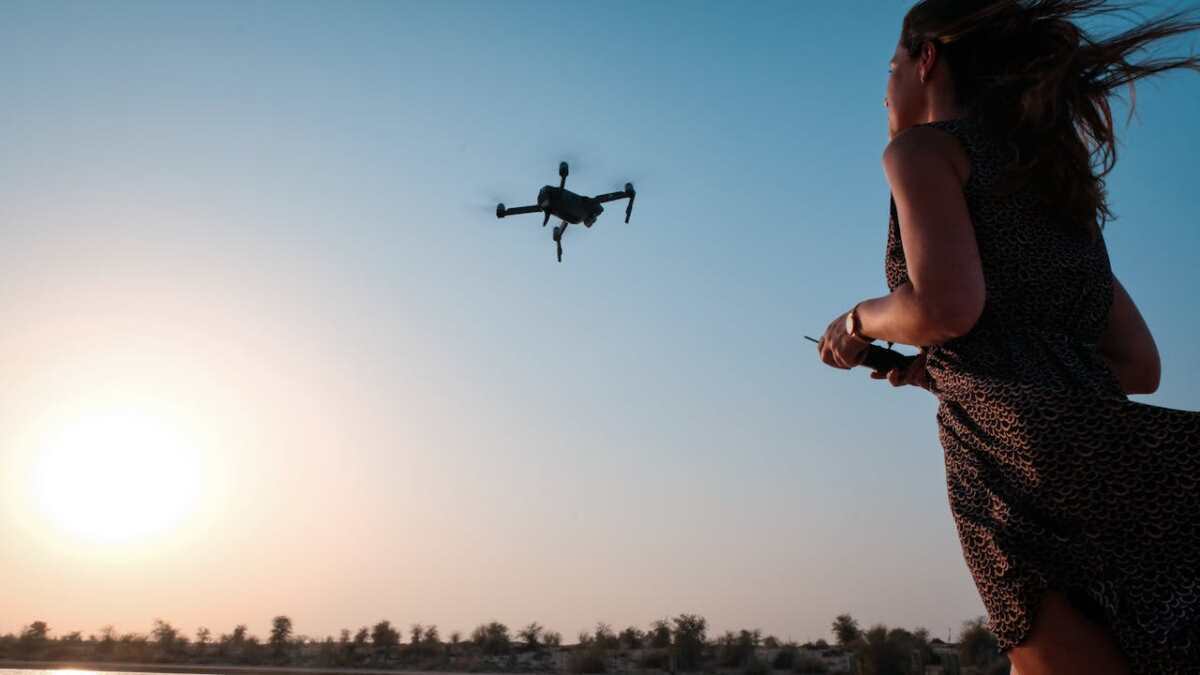
Understanding Drone Technology in Land Surveying
Drone technology in land surveying consists of the application of uncrewed aerial vehicles equipped with various sensors. These include high-resolution cameras, Light Detection and Ranging (LiDAR) systems, and Real-Time Kinematic (RTK) or Post-Processed Kinematic (PPK) positioning systems.
These surveys gather accurate spatial data during flights, replacing or adding to ground techniques by gathering thousands of points. The collected data is then fed straight into digital workflows.
Drone-based land surveys supplant or augment traditional ground-based techniques by rapidly collecting thousands of data points.
The digital land survey workflows directly involve these datasets. The result includes accurate orthomosaics, terrain models, and volumetric calculations.
Drone land surveying, in contrast to the traditional methods, goes over the entire surface continuously and does not leave any gaps on large or complex sites. That is why the reliability is improved in complex areas.
Why Drone Land Surveying Outperforms Traditional Methods
Speed That Supports Digital Workflows
One big reason drone land surveying beats traditional methods is the speed, which supports digital workflows.
Ground teams might take days for large areas, but a drone can do it in hours. It speeds up everything for engineers and planners, letting projects move without stops, even under tight deadlines.
Not all companies handle this well, though. Numerous companies provide drone services, but just a handful manage to streamline the entire process from beginning to end.
Ideally, a business would want a service that offers speedy installation and processing, reducing the time even further.
Survey-Grade Accuracy at Scale
Accuracy is another strong point, especially with RTK or PPK, getting measurements to centimeter-level for heights, distances, and volumes.
Drones still yield the same reliable results on different surfaces, while also handling vegetation or rough terrain efficiently.
In lengthy projects, this comes along with digital surveying accuracy. ZenaDrone’s advantage here is in managing precision standards, with protocols for each mission to meet professional needs.
Enhanced Safety for Survey Teams
Safety comes up a lot, too, since traditional surveying puts people near traffic or unstable ground.
Drones for surveying land, as well as data collection from aerial platforms, help minimize that danger by gathering aerial data. They can carry out surveys without the need for a constant ground presence.
As a result, survey teams can operate remotely while the drone is getting the data. This focus on safety reduces the risks and also safeguards onsite workers.
Cost Efficiency Through Service-Based Models
Purchasing drones comes with additional costs in the form of training and software. The ideal drone service emphasizes safety, which reduces liability and keeps workers safe.
On top of that, it should integrate services into digital land survey workflows seamlessly. Doing so eliminates the need for reworking, boosts productivity, and cuts down on long-term costs.
The Drone-as-a-Service model is a fantastic example of letting clients use the tech without ownership headaches. As a result, costs become manageable and scalable.
Deliverables That Enhance Decision-Making
The main benefit of drone-assisted surveys over traditional methods is that they produce better quality outcomes.
The typical result is as follows:
- Orthomosaic maps for site visualization with high accuracy
- Digital models of ground and height
- Abundant point cloud data
- Quantities of both cut and fill are calculated
- Contour maps for grading and drainage designs
The digital drone-surveying makes these instantly compatible with CAD, BIM, and GIS, thus the team’s cooperation is more efficient. ZenaDrone goes further by providing processed data that fits client systems, not just raw files.
Its strength resides in delivering actionable data rather than merely supplying unprocessed files. Processed outputs are also consistent with client systems and procedures.
Digital Land Survey Workflows Powered by Drones
In digital land survey workflows, drones power consistent processes. Modern methods rely on fast data flow from collection to analysis. The workflow includes planning, processing, analysis, and all matching project specs and accuracy.
Many competitors consider drone surveys as distinct activities. However, the best drone services integrate them into complete digital processes.
Doing so doesn’t just ensure that data is uniform and usable. It also does away with system incompatibility and the need for manual data exchange.
Industry Applications of Drone Survey Technology
Drone surveys have many uses across different industries. For instance, surveying in the construction sector aids in planning the site and monitoring the development of the project.
On top of that, the mining industry adopts it for the purpose of checking volumes. Through digital surveys, environmental groups follow up on the changes in land. Its adaptability makes it an indispensable tool in numerous industries.
Where Drone Services Often Fall Short
Drone land surveying companies often fail when they focus solely on the technology without integration among the different systems. When clients have to handle the processing, it can lead to more complexity and delays.
The best ones customize their service to fit the sector, with tailored flights and outputs for each project.
Ideally, a drone surveying business combines tech, operators, and workflows. This comprehensive approach offers an edge over competitors dependent on disjointed service provision.
As a result, clients get reliable results without extra costs, setting them apart from patchy services.
Regulatory and Operational Confidence
Regulations for airspace and data are a must for drone land surveys. However, these regulations can be challenging for internal teams to meet.
The best models offer full regulator compliance and mission planning as part of the deal. ZenaDrone’s Drone-as-a-Service model consists of compliance with the law and extensive mission planning. Clients do not face administrative challenges while being part of the judicial system.
Operational uniformity is the key, and that is why standardized procedures are used to secure results and data integrity over a prolonged period.
In the future, more automated solutions, AI, and sensors will significantly enhance drone surveys, leading to better digital land surveying.
The Future of Digital Surveying with Drones
Advances in drone technology, AI, and sensor technology have been bringing about steady advances in the abilities of drone surveys.
It is improvements like these that streamline digital land surveying processes.
Real-time data processing and internet integration will help to expedite delivery times. Streamlining of autonomous aviation systems makes it possible to cover an even wider area.
ZenaDrone always puts resources into these new ideas. Its service model keeps up with changes in technology, making sure that customers are always the first to know about new developments in the industry.
Conclusion
Drone tech is key in modern geospatial land surveying, faster, accurate, safer, and cheaper.
Integrated into digital procedures, it adds value across industries. ZenaDrone’s model streamlines with precise acquisition, processing, and integration.
ZenaDrone makes use of its innovative Drone-as-a-Service model to elevate these advantages.
On the one hand, the high-tech drone surveying technology, and on the other hand, the organized digital workflows, ZenaDrone not only reveals the best of the solutions but also facilitates the entire process.
We are currently involved in a project that comprises precise data collection, expert data handling, and total integration of the system.
Reach out to us at this very moment to discover the way ZenaDrone could transform your surveying with trustworthy and scalable digital surveying systems that utilize drones.