Finding the right influencer marketing platform can feel a bit like using a dating app. You swipe through endless options, each promising to be “the one,” only to realize three months into an annual contract that the relationship just isn’t working out.
Influencity is a solid player with over 200 million profiles and a functional IRM (Influencer Relationship Management) tool. However, as the industry heads toward a projected $32.55 billion valuation in 2025, many brands are finding they need more than just a database. Whether you need deeper e-commerce integrations, MENA-specific data, or enterprise-grade fraud detection, there is likely a better fit for your specific workflow.

Quick comparison: The best Influencity alternatives
Here’s a quick overview to help you compare these platforms at a glance:
| Tool | Key features | Best for | Pricing |
|---|---|---|---|
| Influencity | 200M+ profiles, IRM tool, 20+ filters, campaign boards, Shopify integration | Mid-sized brands wanting all-in-one campaign management | From $158/mo (annual) |
| MoonTech | 50K+ MENA influencers, AI matching, pay-per-sale model, cultural sensitivity, fintech wallet | E-commerce brands in MENA seeking performance-based campaigns | Performance-based (custom) |
| HypeAuditor | 219M+ profiles, 95.5% fraud detection, AQS scoring, 35+ metrics, white-label reports | Data-driven teams prioritizing authenticity verification | From $299/mo |
| Upfluence | 9M+ verified profiles, Amazon Attribution, Live Capture, affiliate tracking, bulk payments | E-commerce brands, especially Amazon sellers | From ~$478/mo (annual only) |
| Modash | 350M+ profiles, Shopify integration, auto content tracking, Stories capture, flexible billing | Shopify brands wanting largest database + transparent pricing | $199/mo (annual) or $299/mo (monthly) |
| CreatorIQ | 15M+ indexed profiles, Creator Graph, 190-country payments, enterprise analytics, compliance tools | Large enterprises running global campaigns | From $35,000/yr (annual only) |
What to look for in an Influencity alternative
Before diving into the specific tools, it is important to understand why marketers are moving away from “all-in-one” generalists toward specialized CRMs. When evaluating your next platform, consider these three pillars:
- E-commerce Connectivity: Does the tool connect to your specific stack? While Influencity focuses on Shopify, alternatives like Upfluence and CreatorIQ support WooCommerce, Magento, and Amazon.
- CRM Depth: Does the platform allow for in-app messaging, automated gifting, and payment processing? Influencity users often complain about having to use external email tools.
- Data Quality vs. Quantity: A database of 200 million is useless if 30% are bot accounts. Look for platforms that offer “Audience Quality Scores” or advanced fraud detection.
1. MoonTech
Best for: E-commerce brands in the MENA region seeking performance-based campaigns
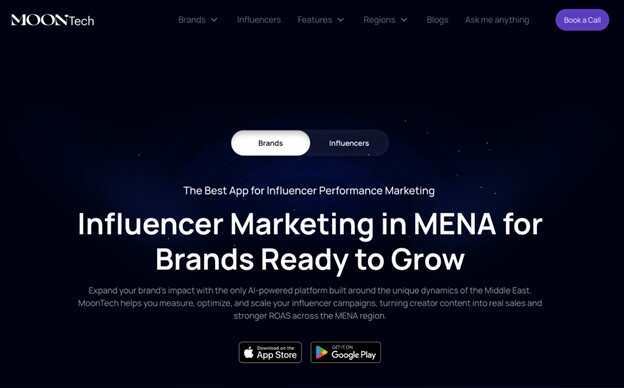
Founded in 2023 and headquartered in Dubai, MoonTech is the premier choice for brands targeting the Middle East and North Africa. Unlike global platforms that offer a “one-size-fits-all” approach, MoonTech is built with Arabic/English bilingual support and regional cultural nuances in mind.
Its standout feature is the performance-based pricing model. Rather than paying for “vanity metrics” like impressions, brands pay only for verified sales tracked through the platform.
Key features:
- Performance Tracking: Pay-per-sale model via coupon and affiliate tracking.
- Fintech Integration: Integrated wallet for seamless influencer payments.
- Regional Expertise: Specialized tools for Ramadan and Eid campaign planning.
- Bilingual AI: Matching algorithms optimized for Arabic and English content.
Pros:
- Zero wasted spend; you only pay for actual conversions.
- Superior database for Dubai, Riyadh, and Cairo markets.
- Includes dedicated mobile apps for both brands and creators.
Cons:
- Limited reach outside of the MENA region.
- Smaller total database (50k verified influencers) compared to global giants.
Pricing: Performance-based; custom quotes available via moontech.co.
2. HypeAuditor
Best for: Data-driven teams that prioritize fraud detection and audience authenticity
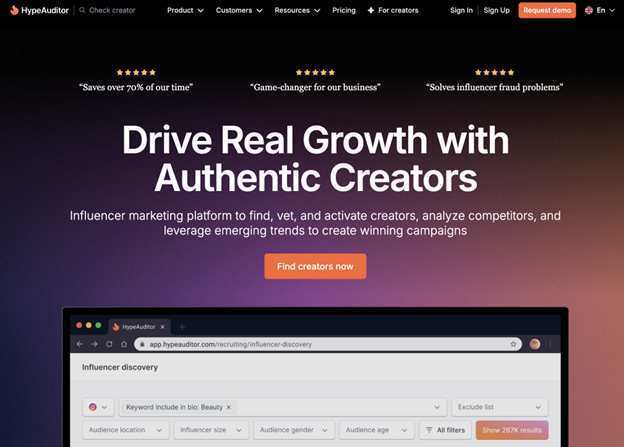
HypeAuditor began as a fraud detection tool, and that DNA remains its biggest strength. In an era where “engagement” can be bought, HypeAuditor uses AI to analyze 50+ behavioral patterns to identify fake followers with 95.5% accuracy.
Key features:
- Audience Quality Score (AQS): A proprietary metric that has become an industry standard for legitimacy.
- Advanced Discovery: Filters across 219M+ profiles on Instagram, TikTok, YouTube, Twitter/X, and Twitch.
- Competitor Analysis: Ability to track the influencer strategies of your direct competitors.
Pros:
- Most robust fraud detection on the market.
- Clean, professional interface (G2 rating of 4.6/5).
- Deep analytical reports (35+ metrics per profile).
Cons:
- No automatic Instagram Story monitoring.
- The $299/mo starting price is steep for small businesses.
Pricing: Starts at $299/month (billed annually).
3. Upfluence
Best for: E-commerce brands needing deep integrations, especially Amazon sellers
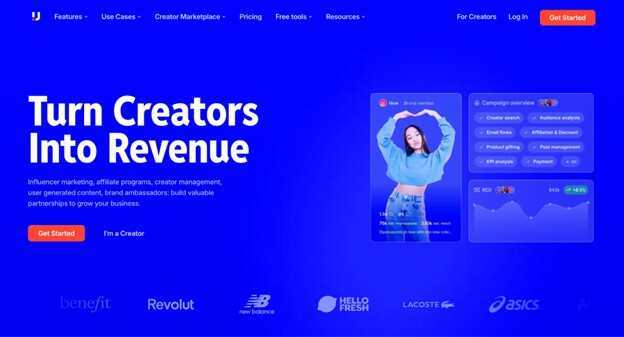
Upfluence is a powerhouse for e-commerce, offering the only major native Amazon Attribution integration. This allows Amazon sellers to track exactly which influencer drove a specific sale on the marketplace – a “holy grail” feature for many brands.
Key features:
- Live Capture: Identifies influential customers currently visiting your website to turn them into ambassadors.
- Full E-com Stack: Integrations for Shopify, WooCommerce, Magento, and BigCommerce.
- Workflow Automation: Handles everything from automated outreach to bulk payments.
Pros:
- Unrivaled for Amazon-specific influencer marketing.
- Includes “Social Listening” to track brand mentions.
- Proven ROI (e.g., Branded reported a 10x ROI using the platform).
Cons:
- Mandatory 12-month contracts (no monthly options).
- Steep learning curve for the advanced IRM features.
Pricing: Basic features from ~$478/month; full enterprise suite around $2,000/month.
4. Modash
Best for: Shopify brands wanting the largest creator database with flexible pricing
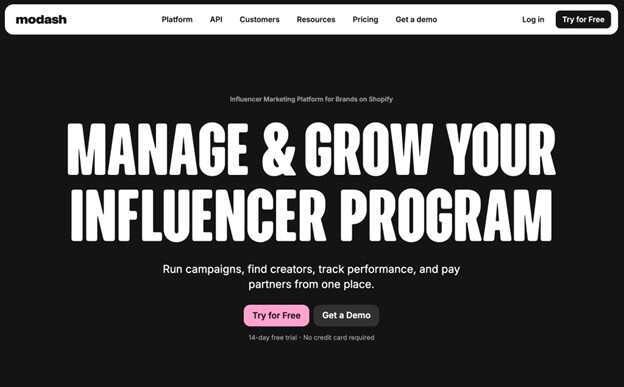
Modash boasts a database of 350 million+ profiles, making it nearly double the size of Influencity. It is specifically designed to help Shopify brands scale micro-influencer programs through automated product gifting and real-time revenue tracking.
Key features:
- Automated Content Collection: Captures every Story and post without requiring influencers to “sign in” to the platform.
- Shopify Gifting: Influencers can use self-selection links to pick the products they want.
- Ad Disclosure Alerts: Automatically flags content that misses required #ad tags.
Pros:
- Largest database in the industry.
- Offers monthly billing (rare in the influencer SaaS space).
- No “authentication” required from influencers to track content.
Cons:
- Does not support Twitch, LinkedIn, or Pinterest.
- IRM/CRM features are more basic than CreatorIQ.
Pricing: $199/month (billed annually) or $299/month (monthly).
5. CreatorIQ
Best for: Large enterprises running global campaigns with substantial budgets
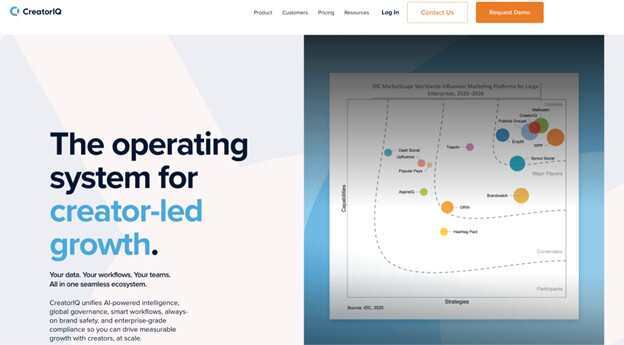
If you are managing a Fortune 500 budget, CreatorIQ is the “heavyweight” alternative. It is the platform of choice for Disney, Unilever, and Sephora. It focuses on the “Creator Graph,” an AI-driven infrastructure that handles high-complexity global compliance and payments.
Key features:
- Global Payments: Supports 120 currencies and 190 countries with built-in tax compliance.
- Google AI Imaging: Uses visual discovery to find influencers based on the content of their photos (e.g., “influencers who wear blue hats”).
- Enterprise Benchmarking: Compares your performance directly against competitors.
Pros:
- Elite-level analytics and reporting.
- Highest level of security and brand safety monitoring.
- Handles massive scale (thousands of influencers) without lag.
Cons:
- Extremely high price point (minimum $35k/year).
- No free trial or monthly options.
Pricing: Starts at $35,000/year; enterprise plans can exceed $200,000/year.
Final verdict: which Influencity alternative is right for you?
The “best” platform depends entirely on your regional focus and your tech stack:
- If you are in the MENA region: Choose MoonTech. Their pay-per-sale model and regional expertise are unmatched.
- If you sell on Amazon: Choose Upfluence. Their attribution tools are the most sophisticated for marketplace sellers.
- If you are a scaling Shopify brand: Choose Modash. It offers the biggest database and the most flexible monthly pricing.
- If you are a data-obsessed marketer: Choose HypeAuditor. Their fraud detection is the industry’s gold standard.
- If you are an enterprise giant: Choose CreatorIQ. It is the only platform built to handle global complexity at scale.
As the industry shifts toward long-term partnerships – with 47% of experts now prioritizing relationship depth over one-off transactions – choosing a platform that supports a true CRM workflow is a competitive necessity – so choose wisely.