The best SMTP API for developers in 2026 depends on what your stack needs: raw sending speed, strong deliverability, predictable pricing, or AWS-native integration. We compared five top SMTP API providers (Mailtrap, SendGrid, Postmark, Amazon SES, and Mailgun) across SDK quality, authentication workflow, webhook reliability, and real pricing as you scale.
| Provider | Primary focus | SDK languages | Starting price | G2 Rating |
| Mailtrap | High deliverability | Node.js, Ruby, PHP, Python, .NET, Elixir, Java | $15/month | 4.8/5 |
| SendGrid | Omnichannel Integration | Node.js, PHP, Python, Ruby, Java, Go, C# | $19.95/month | 4.0/5 |
| Postmark | Delivery speed | Node.js, PHP, Python, Ruby, .NET, Java, Go | $15/month | 4.6/5 |
| Amazon SES | AWS ecosystem | Full AWS SDK (all languages) | $0.10 / 1,000 emails | 4.3/5 |
| Mailgun | API routing | Node.js, Python, PHP, Ruby, Java, Go, C# | $15/month | 4.2/5 |
An SMTP API is a service that lets your application send email through a third-party infrastructure using either the SMTP protocol or a REST layer on top of it. Instead of running your own mail server, you get DNS authentication (SPF, DKIM, DMARC), IP reputation management, retry logic, bounce handling, and delivery analytics as part of the product. Picking one in 2026 comes down to how consistently your mail reaches the inbox, how cleanly your team can debug issues, and how predictable the cost looks as you scale.
Best for: Developer and product teams that want high deliverability and separate streams for transactional and bulk email.
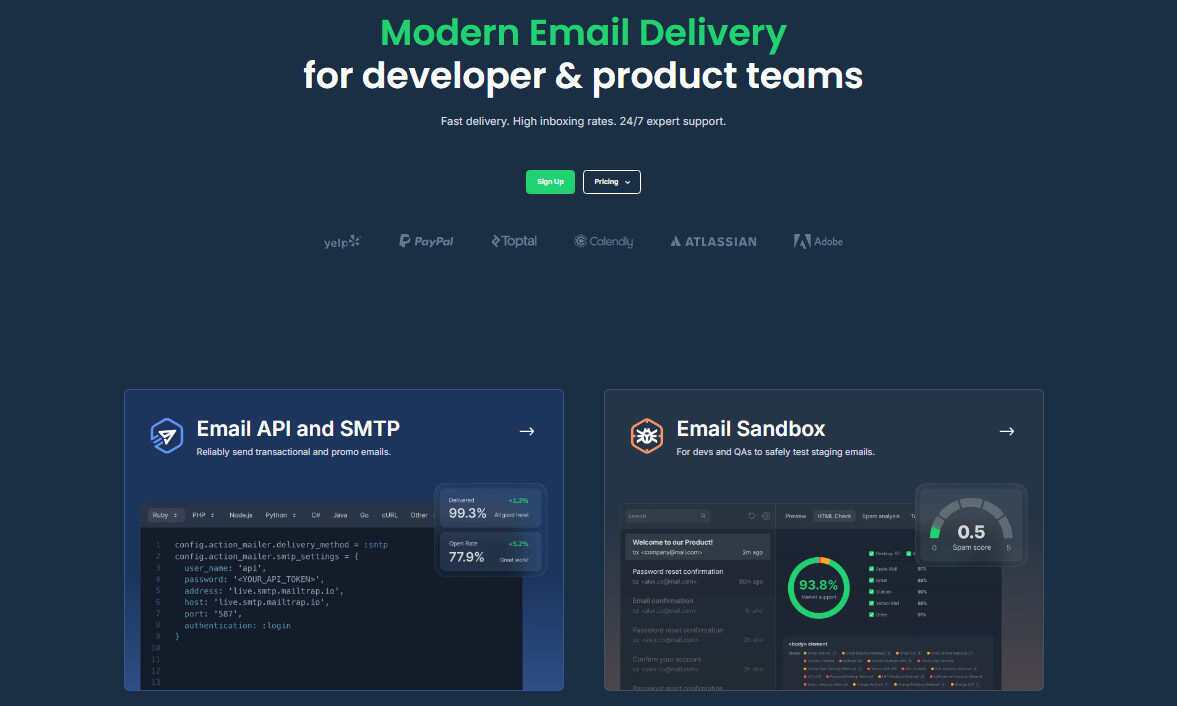
Mailtrap is an email delivery platform for developers and product teams that prioritizes high deliverability, with separate sending streams for transactional and marketing traffic. Mailtrap combines a REST API, SMTP relay, drill-down analytics, and automated authentication in one dashboard.
Both SMTP and REST API credentials are generated in one dashboard after domain verification. Setup to first send takes about 5 minutes. Authentication records are validated automatically, so you add the DNS records once and the provider confirms propagation on its side.
Official SDKs for Node.js, Ruby, PHP, Python, .NET, Elixir, and Java, plus 25+ framework snippets for Laravel, Symfony, Django, Rails, and Next.js. Native integrations with Vercel and Supabase, plus an MCP server that lets AI coding tools like Claude Code call Mailtrap as a direct “email skill.”
SPF, DKIM, and DMARC are configured automatically once you add the DNS records. DKIM keys rotate every four months on their own, which removes a common source of silent deliverability decay (stale keys that quietly stop validating months after setup). Dedicated IPs on the Business plan ship with automatic warmup, so you do not hand-schedule the 2 to 4 week ramp yourself.
Webhooks cover opens, clicks, bounces, spam complaints, and delivery events with 40 retries every 5 minutes. Email logs are retained for up to 30 days with drill-down reports by mailbox provider, domain, and stream. Analytics are included on every paid plan with no add-ons.
Free tier covers 4,000 emails per month. Paid plans start at $15/month for 10,000 emails. Business is $85/month for 100,000 emails with a dedicated IP and automatic warmup. Enterprise starts at $750/month for 1.5 million emails.
Best for: Enterprise teams already in the Twilio ecosystem that need broad platform coverage.
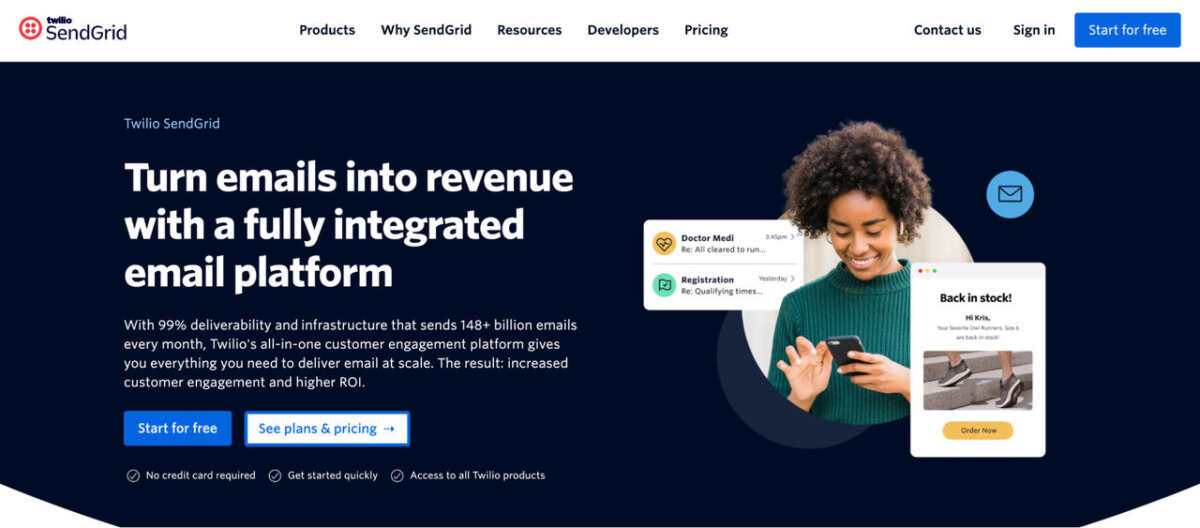
SendGrid is the longest-running SMTP API in this category, launched in 2009 and acquired by Twilio in 2019. The PHP SDK alone has more than 44 million installs on Packagist, and almost any framework has a community integration already written.
Standard SMTP relay and a REST v3 API. New accounts go through sender verification and domain authentication before production sending opens. The full setup typically runs 10 to 15 minutes plus DNS propagation time.
Official SDKs for Node.js, PHP, Python, Ruby, Java, Go, and C#. The PHP SDK is around 800 KB because it covers the entire platform (contacts, marketing campaigns, suppression lists, and mail sending) in one client. Server-side dynamic templates with Handlebars are a first-class feature for transactional messages with personalized content.
SPF, DKIM, and DMARC setup is manual via the domain authentication dashboard. There is no native separation of transactional and bulk streams, so teams approximate it with IP pools or subuser accounts, both of which require manual configuration. Dedicated IPs are available as a paid add-on.
Event webhooks retry for 24 hours after a failure. The free tier caps webhook endpoints at one, which most teams outgrow quickly. Activity logs are retained for 30 days on paid plans.
The free plan is 100 emails/day during a 60-day trial, then expires. Essentials starts at $19.95/month for 50,000 emails. Pro runs $89.95/month for 100,000 emails. Premier is custom.
Best for: Teams where inbox placement speed is the single most important requirement.
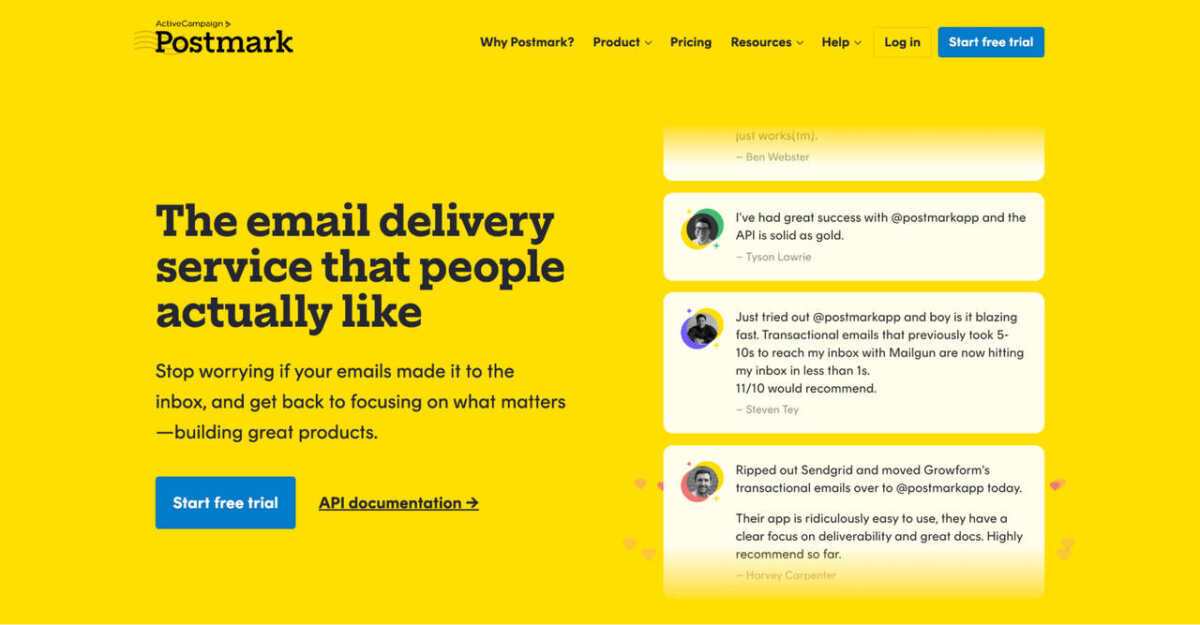
Postmark is an SMTP API focused on one outcome: getting transactional mail to the inbox fast. The platform runs a strict account review before enabling live sending and uses Message Streams to isolate transactional, broadcast, and inbound traffic.
SMTP server and a REST API. Once Postmark approves your account for live sending (usually within a business day), setup runs 5 to 10 minutes.
Official libraries for Node.js, PHP, Python, Ruby, .NET, Java, and Go. Message Streams is a first-class API concept: you pass a stream ID on each send and the provider routes transactional vs. broadcast without IP pool configuration on your side.
SPF, DKIM, and DMARC configuration happens during account setup. Message Streams keep transactional and broadcast reputation fully isolated without IP pool plumbing. Dedicated IPs ship with structured warmup, but only for accounts sending 300,000+ emails per month.
Activity logs are retained for 45 days, the longest in this comparison. Webhooks cover delivery, bounce, open, click, and spam complaint events, and every bounce is automatically processed, categorized, and suppressed.
Plans start at $15/month for 10,000 emails. 50,000 emails is $60.50/month. 125,000 emails costs $138/month. Dedicated IP adds $50 on top.
Best for: AWS-native teams sending at high volume who want the lowest per-email cost.
Amazon SES is the cheapest SMTP API on this list: $0.10 per 1,000 emails with no monthly minimum. The trade-off is that SES ships as raw infrastructure. You assemble the surrounding pieces (suppression logic, analytics, templating, production access approval) yourself using Lambda, SNS, and CloudWatch.
SMTP endpoint per AWS region and a REST API. Full setup runs 15 to 20 minutes for DNS authentication, IAM permissions, and CloudWatch metric configuration. New accounts start locked to verified addresses only, until AWS manually approves a production access request.
Full AWS SDK coverage for every language AWS supports: JavaScript, Python (boto3), Java, Go, Ruby, PHP, .NET, Rust, C++, and Kotlin. SMTP works with any mail library.
SPF, Easy DKIM, and DMARC support are included but require manual setup. There is no built-in bounce suppression logic. Delivery, bounce, and complaint events fire as SNS notifications, which you consume with Lambda or SQS and turn into your own suppression list.
Webhooks, logs, and debugging
No native webhooks. Events fire through SNS, so you build your own observability pipeline using Lambda, SQS, or CloudWatch. VDM surfaces reputation metrics, but only as a paid add-on.
$0.10 per 1,000 emails with no minimum. Free tier covers 3,000 emails/month for the first 12 months when sending from EC2 instances. Dedicated IPs are $24.95/month. Attachments and data transfer are billed separately at $0.12/GB.
Best for: Engineering teams that want email validation and fine-grained routing control.
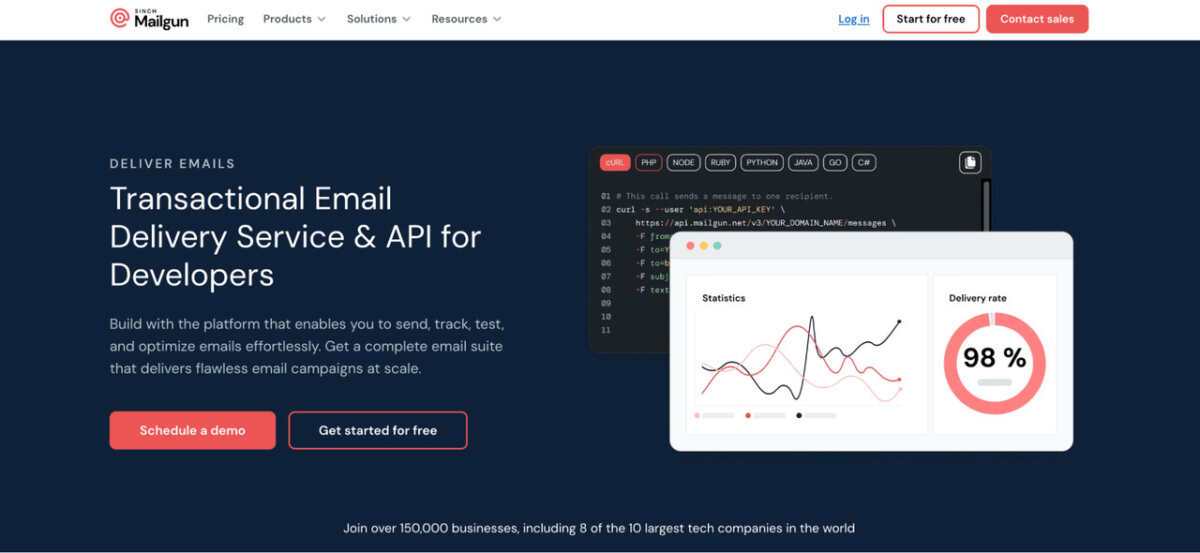
Mailgun is an API-first email service. The PHP SDK alone has over 1.3 million weekly Packagist installs, and the platform’s real differentiator is a built-in email validation API that checks addresses against DNS/MX records, disposable domain lists, and syntax rules before you send.
SMTP and REST API with domain-specific credentials. Setup runs 10 to 15 minutes: add DNS records, verify domain ownership, create domain-specific API keys. Multiple sending domains are the primary way to separate transactional and marketing traffic.
SDK and language support
Official SDKs for Node.js, Python, PHP, Ruby, Java, Go, and C#. The PHP SDK is ~200 KB and uses PSR-18 HTTP client abstraction. Batch sending accepts up to 1,000 recipients per API call with recipient variables for personalization.
SPF, DKIM, and DMARC are configured manually through DNS-based domain verification. The email validation API runs checks against DNS/MX records, disposable domain lists, and syntax rules before you send, which is a strong defense against the bounce spikes that damage sender reputation.
Webhooks, logs, and debugging
Webhooks retry for 8 hours on failure. Event logs are retained for up to 30 days depending on plan. Automatic bounce and spam complaint suppression is included on every plan.
Free tier: 100 emails/day. An entry tier is available at $15/month for 10,000 emails, with Foundation at $35/month for 50,000 emails. Scale begins at $90/month for 100,000+ emails. Overage runs around $1.80 per 1,000 emails, the highest of the providers here.
Start with how the provider treats deliverability. Mailtrap and Postmark isolate transactional and bulk traffic on separate streams by default, while SendGrid, Amazon SES, and Mailgun leave the work to you through IP pools, subuser accounts, or sending domain tricks. Pair this with authentication handling: Mailtrap configures SPF, DKIM, and DMARC automatically and rotates DKIM keys every month, while SendGrid, Amazon SES, and Mailgun all require manual setup and ongoing maintenance.
Then compare the real cost at your expected volume. Amazon SES is unbeatable at $0.10 per 1,000 when you have the AWS skill set to operate it. Mailtrap and Mailgun both start at $15/month, but Mailtrap’s 100K tier at $85 beats Mailgun’s $90 and includes the dedicated IP Mailgun charges $59 extra for. Postmark is the highest-priced at scale ($138/month for 125K) but bundles feature others split into add-ons.
The best SMTP API for developers in 2026 depends on which constraint is tightest: Mailtrap for high deliverability and stream separation without DIY configuration, SendGrid for enterprise ecosystem coverage, Postmark for quick delivery above all else, Amazon SES for AWS-native cost efficiency, and Mailgun for validation-heavy workflows. Configure SPF, DKIM, and DMARC before your first production send, and match the provider to how your team actually ships.
Live database synchronization is one of the most challenging engineering problems of current IT architecture.…
Taking family road trips or navigating daily city commutes requires frequent pit stops along busy…
As professionals take on new responsibilities, their current tools and setup may no longer be…
Managing an engineering team is a job. You have to balance a lot of things.…
Most small businesses leak customers between first contact and the sale. Here is where the…
A designer in New York opens the same project that a developer in another country…