College assignments punish fuzzy thinking. A small logic gap in statistics can tank a result, and a weak claim in a seminar paper can flatten your entire argument. That is why accuracy matters more at the university level than it did in high school.
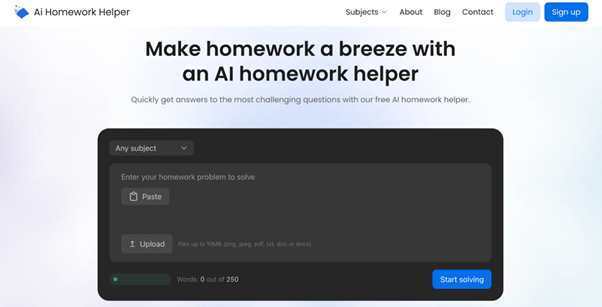
To see whether this tool can handle that pressure, I tested it on realistic college tasks across multiple subjects, not just easy examples. I also compared output quality across typed prompts, screenshots, and PDFs, because that is how students actually work during the semester. In the middle of that process, I kept returning to AI Homework Helper to check consistency under time pressure and mixed assignment formats.
The core question was simple: Is “free and fast” good enough for college rigor, or does it only work for basic homework checks?
College users are usually not looking for a magic button. They want speed, yes, but they also need accuracy, usable reasoning, and outputs they can verify against course standards. An AI homework generator becomes useful only when it supports real study behavior, not shortcut behavior.
At the university level, expectations are higher for a few reasons. First, assignments are often layered: method, interpretation, citations, formatting, and argument quality all matter at once. Second, instructors can spot shallow responses quickly. Third, students often use tools in high-stress windows, so unclear outputs can waste precious time.
Here is what most college students expect from a homework AI tool:
If a tool misses these basics, it may still look impressive in a demo, but it will not hold up during real coursework.
I approached testing as a student would during a heavy week. Instead of testing only one subject, I used mixed assignments that reflect common university workloads: quantitative tasks, concept-heavy science prompts, and open-ended humanities questions. The goal was to evaluate it as a homework checker for real study sessions.
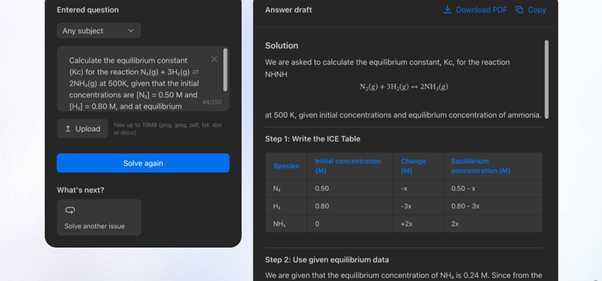
I tested three input paths: typed prompts, photo uploads, and PDFs. Then I evaluated each response for correctness, clarity, and practical usability. “Practical usability” means this: Could a student actually use the output to finish work faster while understanding what they are submitting?
I tracked whether responses preserved prompt details correctly, whether step logic stayed coherent, and whether results remained stable when the same task was rephrased. I also tested imperfect conditions on purpose, including mildly messy formatting and time pressure, because that reflects real student behavior better than ideal test cases.
The pattern was clear. Structured prompts produced better outcomes, and clean typed inputs were the most reliable. Image and PDF uploads were useful, but final quality depended heavily on how clearly symbols and text were captured before processing.
At the college level, the tool performs best when the assignment has a defined logic path. It is strongest when there is a clear question, a clear method, and a checkable outcome. In that context, it behaves like an AI helper for homework that can genuinely reduce friction.
Where it hits:
Minor misses:
These misses were usually manageable, but they matter in upper-level coursework where precision and voice carry grading weight.
The strongest results appeared in subjects where method clarity matters more than stylistic nuance. That includes many STEM tasks and other structured formats where each step can be validated.
It performed best in math-heavy coursework and problem-based science assignments where prompts were specific, and outcomes were checkable. It was also useful in foundational technical courses where students need quick confirmation on repeat-style exercises. In writing-heavy classes, its role was narrower but still useful for early outlining or idea direction before deeper drafting.
For deep humanities analysis, the tool is most useful at the early stage, where it helps you shape a clear starting direction and organize ideas faster. From there, you can elevate the final result with your own interpretation, stronger evidence choices, and academic voice. In literature, history, and theory-focused classes, it works well as a brainstorming partner that helps you move into drafting with more confidence.
In practical terms, the tool is most useful when you already know the course method and want to verify, speed up, or unblock progress. It is less useful when the assignment’s main challenge is originality of argument and subtle reasoning.
Yes, for most college students, it is absolutely worth using. AIHomeworkHelper.com is accurate on many structured assignments and especially strong when you need speed, clear step checks, and steady study momentum. It performs best in method-driven courses, where fast verification can save time and reduce avoidable mistakes.
The overall reliability is strong in STEM and technical coursework, and that alone makes it a valuable daily study companion. In humanities, it still adds value by helping you shape a starting draft, organize ideas, and move past blank-page stress faster.
The best part is how practical it feels in real student life. You can use it for quick clarification, confidence checks before submission, and faster progress when you get stuck.
Every growing business reaches a point where technology stops feeling like a helpful tool and…
Recurring revenue is the goal for most modern businesses — predictable cash flow, lower acquisition…
Modern companies are constantly searching for innovative ways to bring employees together, especially in remote…
Reliable knowledge management options are essential for many independent professionals. Selecting a platform that best…
The global procurement landscape in 2026 is undergoing a fundamental transformation, driven by the rapid…
Looking for ways to turn junk into cash? Everyone's got unused clutter gathering dust in…