Quantum computers are sprinting toward the day they shatter RSA and ECC. Attackers can hoard your encrypted data now and read it later, so the clock is already running.
Research shows enterprises need 12–15 years to swap out every vulnerable key. Fault-tolerant machines may arrive sooner, turning delay into a security gap.
Regulators echo the urgency: a joint CISA-NSA-NIST factsheet urges teams to inventory crypto and build a migration roadmap today.
We’ll guide you through four phased steps, ending with a checklist and tool picks—everything you need to stay ahead.
First, give the project a formal name.
Form a cross-functional Quantum-Readiness Team chaired by a senior executive who controls budget and removes roadblocks. The Canadian Cyber Centre calls this step “identify a dedicated migration lead” and insists each department include finance, procurement, and project-management voices, along with security engineers.
Executive sponsorship turns an academic threat into a budgeted priority and signals to vendors that quantum safety is mandatory.
Next, draft a short, living charter.
List deliverables: a roadmap draft in six months, quarterly progress briefs, and a full inventory by year-end. Clear deadlines keep momentum and make it simple for the board to track risk reduction.
Finish with an awareness sprint.
Brief senior leadership using plain-language stories: attackers already collect encrypted traffic, and quantum computers will let them read it later. That warning comes directly from CISA, NSA, and NIST in their 2023 fact sheet urging organizations to “begin preparing now.”
With governance anchored, we can discover exactly where our cryptography lives.
We can’t fix what we can’t see.
Launch an organization-wide hunt for every place public-key cryptography hides: servers, applications, IoT gateways, and even dusty backup tapes.
Start with the obvious. Pull certificate logs, scan network endpoints, and query your CMDB for libraries such as OpenSSL. These automated sweeps reveal quick wins like web servers running RSA-2048, VPN concentrators using classic Diffie-Hellman, and code-signing keys tucked into build pipelines.
Run client-side tests too.
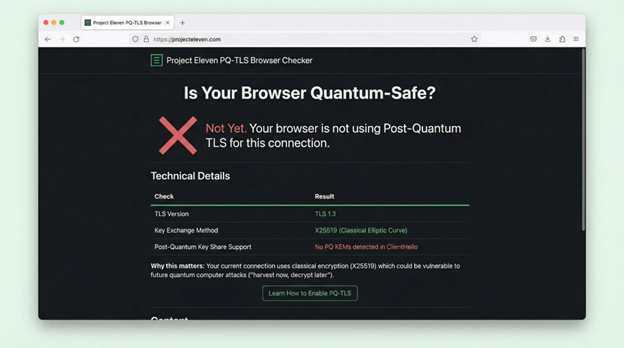
Project 11’s free PQ-TLS browser checker parses each endpoint’s TLS ClientHello and flags whether it advertises hybrid suites such as X25519-MLKEM768 or pure MLKEM variants, giving you an instant map of which workstations can join early pilots and which need patching.
Then dig deeper. The Canadian Cyber Centre warns that cryptography lurks in surprising corners: embedded firmware, remote-office printers, smart-factory sensors, and hard-coded API calls in legacy apps. Pair scanning tools with interviews. Ask system owners where encryption lives, which algorithms they rely on, and how long the protected data must stay secret.
Capture every finding in a living Cryptographic Bill of Materials. For each asset, record:
This single spreadsheet becomes our north star. At a glance, it shows which systems guard ten-year secrets behind soon-to-expire keys and which can be patched tomorrow with a quick library swap.
Perfection is not required on day one. The Cyber Centre notes that inventories mature iteratively; the key is to establish a repeatable discovery cadence and improve coverage each quarter. As new projects launch, make the CBOM part of change control so fresh cryptography never slips into the shadows.
With governance locked and the inventory underway, we know the size of the mountain. Next, we rank the risks and draft a plan to climb it.
An inventory is only a list until we score it.
Translate raw findings into a concise risk picture the board can grasp at a glance.
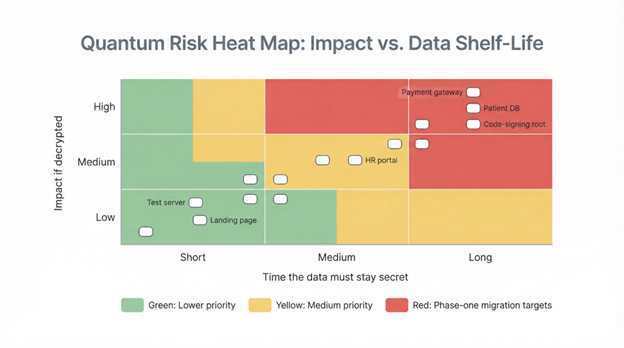
Mark each system with two factors: impact if decrypted and time the data must stay secret. A payroll API that protects tax IDs for seven years carries more weight than a scratch-pad test server cleared weekly. Public blockchains are no exception—on-chain signatures and keys persist indefinitely, and common quantum blockchain myths like “SHA-256 makes the ledger safe” overlook how a future cryptographically-relevant quantum computer could still forge ownership proofs. The MDPI timeline study matters here: large organizations face a 12-to-15-year replacement cycle, so anything valuable past 2030 sits in the danger zone.
Plot the scores on a heat map.
Red squares—long-lived, high-impact data behind classical keys—become phase-one targets. Yellow squares queue for later waves, while green items wait unless resources allow. Document every decision. If a legacy billing app will retire in two years, log an accepted risk with an expiry date rather than spending cycles on a short-lived fix.
Finally, add this risk profile to the enterprise risk register. That move elevates quantum exposure to the same governance channel as financial or operational threats and guarantees regular reviews and budget visibility.
With risks ranked and owners assigned, we have the clarity to design a phased migration plan in Phase 2.
With a crystal-clear inventory in hand, we turn numbers into action.
Our goal is simple: decide which systems move first, which follow, and which wait for retirement.
Start by mapping every entry in the CBOM against two axes: business impact and secrecy shelf-life. High impact means customer trust, revenue, or safety is on the line if data leaks. Shelf-life measures how long that data must stay unread. A marketing landing page has almost no shelf-life. Medical records? Decades.
Plot the results on a heat map.
The red corner, containing long shelf-life and high-impact data, shows the first movers of our migration. Typical residents include payment gateways, patient databases, code-signing roots, and cross-border VPNs. The Canadian government framework uses the same color-coded lens to ensure “systems protecting long-lived sensitive information are prioritized early.”
Next, fold in practical constraints. Vendor roadmap dates, hardware refresh cycles, and regulatory deadlines can shift the order. If an ERP provider promises a PQC patch in 2027, we may queue that system behind an in-house microservice we control today. The MDPI timeline study reminds us that resource bottlenecks—especially upgraded HSMs—can derail a logical plan if ignored.
Surface the scorecard to leadership. A one-page dashboard that shows “20 percent of high-risk systems scheduled for upgrade by Q4 next year” lets executives track progress and approve funding. It also locks quantum exposure into the enterprise risk register alongside supply-chain and compliance risks.
We now have a ranked list, assigned owners, and shared urgency. The next step is to sketch a phased roadmap that turns those priorities into calendar milestones.
Now we convert prioritized risks into a timeline everyone can support.
Picture four waves.
Wave 1 – Preparation (now through next fiscal year). Finish the crypto inventory, finalize the roadmap, and run proof-of-concept labs.
Wave 2 – Pilot & design (2024–2026). Stand up hybrid TLS on a staging site, patch a handful of internal services, and lock supplier contracts for PQC-ready hardware.
Wave 3 – high-priority rollout (2026–2030). Replace or wrap every red-zone system from our heat map: external portals, VPN head-ends, root CAs, and long-term archives.
Wave 4 – full adoption & decommission (2030–2035). Retire remaining classical keys, re-encrypt cold-storage data, and switch default cipher policies to pure post-quantum.
This cadence comes from government guidance that targets high-value systems first and expects all departments to reach quantum safety by 2035. It mirrors real-world refresh cycles, easing budget shocks by aligning with planned upgrades.
Each wave has clear exit criteria.
Wave 2 is complete only when hybrid certificates run in production and handshake performance is measured. Wave 3 closes when every critical service reports “no RSA/ECC in use” in monitoring dashboards.
Resource planning runs in parallel. The MDPI analysis warns that HSM capacity often triples once lattice-based keys arrive, so procurement for larger appliances lands in Wave 2 even if deployment waits for Wave 3. The roadmap pins those long-lead items early so finance can spread costs rather than absorbing them late.
Publish the roadmap as a living document. Quarterly reviews let us adjust for new NIST drafts, vendor delays, or breakthrough attacks. Momentum matters: graduate from one wave to the next without stalling in pilot limbo.
With milestones on the calendar, we are ready to integrate the plan into the broader enterprise risk-management framework.
When a plan lives in isolation, it falters.
We weave the post-quantum roadmap into the same governance machinery that tracks financial, operational, and compliance risks.
Begin with a familiar language. If your organization follows NIST 800-37, map each migration wave to the framework life-cycle:
This familiar model reassures auditors and shows budget committees that quantum work extends existing programs rather than creating a new silo.
Document residual risk formally. For systems waiting on a vendor patch, file a risk acceptance with an expiry date and compensating controls—for example, network isolation or symmetric-encryption overlays. This prevents forgotten tasks and keeps leadership accountable.
Maintain rhythm. Add quantum-readiness metrics to quarterly risk reviews: percentage of high-risk systems migrated, number of RSA certificates still live, and HSM capacity versus requirement. Show the same graph every quarter so progress, or lack of it, is obvious.
By anchoring the roadmap inside your enterprise risk framework, you turn quantum migration from a side project into core operational resilience. That alignment unlocks steady funding, executive attention, and the organizational muscle needed for the long haul.
Plans on paper satisfy auditors; working code convinces everyone else.
We start execution with small, low-risk pilots that let us feel the weight of post-quantum cryptography before touching critical systems.
Pick a friendly target, maybe a staging web server or an internal developer portal. Activate a hybrid TLS cipher that pairs classical RSA with the lattice-based Kyber key exchange. Modern builds of OpenSSL and Chrome already speak this dialect, so you will see success traffic on day one while legacy clients fall back to RSA.
Measure the results.
Track handshake time, CPU load, and certificate size. A bump of 5–10 ms in handshake latency is normal; anything larger flags a tuning task long before customers notice. Log every client that rejects the hybrid suite. That data becomes your compatibility heat map for broader rollout.
Share findings quickly. When leadership sees a live demo with packet captures proving quantum-safe key establishment, they move from abstract risk to visible progress. Engineers gain confidence, procurement learns which HSM firmware works, and the migration story shifts from “someday” to “already underway.”
Armed with real-world metrics, we can tackle production systems.
Pilots prove feasibility; now we swap parts in production.
Start with the trust backbone, your public key infrastructure. Patch internal certificate authorities so they can issue composite or Dilithium-signed certificates. Shorten certificate lifetimes to simplify future rotations and automate renewals through a certificate-lifecycle manager.
Next, address key custody. Post-quantum keys are larger than RSA keys, so firmware updates alone may not solve capacity limits. Plan for additional HSM slots or cloud-based key vaults before traffic spikes force an urgent purchase.
Move to network edge devices.
Activate hybrid cipher suites on web servers, API gateways, and VPN concentrators. Roll out in waves—customer-facing first, then internal systems—while monitoring handshake success and fallback rates. Announce end-of-life dates for pure RSA connections so partners have clear notice.
Applications come last because they need the most care. Refactor in-house code to call a crypto-agility wrapper instead of hard-coded algorithms. For immovable legacy apps, insert a proxy or service-mesh sidecar that handles post-quantum handshakes on their behalf.
Document every change in the CBOM. Each green check mark turns abstract progress into evidence for auditors and executives.
Not every system needs the same treatment.
Sort each one into three buckets:
Hybrid in place is the default. If a device or app can accept a firmware patch or library update, attach post-quantum algorithms while keeping classical ones for backward compatibility. Examples include web servers, email relays, and modern VPN gateways.
Replacement or re-architect comes next. Some legacy databases, mainframes, or bespoke appliances cannot learn new crypto tricks. When a patch costs more than a migration, schedule a clean swap, often tied to an existing refresh.
Isolate and tunnel is the last resort. For an IoT sensor fleet set for retirement in two years, route traffic through a quantum-safe gateway and segment the network. You reduce risk without spending capital on hardware you plan to discard.
Record the rationale. It prevents second-guessing when auditors ask why a billing system still speaks RSA in 2028 and keeps everyone aligned on priorities.
After every rollout, run three layers of testing—functional, security, and interoperability—and bake them into CI pipelines so checks happen automatically with each change.
Functional tests come first. Does the service start? Do clients of all ages connect and complete transactions? Any spike in error logs means we pause and fix before moving on.
Security tests dig deeper. Launch side-channel probes to confirm lattice-based operations do not leak timing clues, fuzz malformed keys to catch crash bugs, and verify certificates chain correctly back to the updated CA. Patch and retest until the service is clean.
Interoperability is the final gate. Build a client matrix that includes current browsers, legacy endpoints, and partner systems. Each must handshake successfully or fail gracefully. Share results with partners so no one is surprised by a sunset date for RSA.
Pass all three gates, and a system earns a green tick in the CBOM plus an entry in the audit log. Repeatable, evidence-backed testing turns broken-crypto headlines into someone else’s problem and shows auditors proof, not promises.
The migration never truly ends; it shifts from project to steady heartbeat.
First, treat the Cryptographic Bill of Materials as a living artifact, not a dusty spreadsheet. Automate weekly scans that flag any new RSA certificate, expired hybrid key, or shadow-IT service running vulnerable TLS. When a red entry appears, the risk dashboard lights up and an owner is paged.
Second, watch the research horizon. Subscribe to NIST and industry mailing lists so you know the day a newly standardized algorithm lands or an existing one shows cracks. Early notice lets us schedule patch windows before attackers craft an exploit.
Third, publish metrics that matter. Leadership cares about trends, not tables. A single chart showing “RSA exposure over time” protects the budget better than a fifty-page report. Celebrate downward slopes publicly to reinforce momentum.
Run a crypto-agility drill at least once a year. Swap the primary algorithm on a non-critical service within 48 hours to prove tooling works, staff know the playbook, and procurement can source keys fast.
When monitoring becomes muscle memory, quantum risk shrinks from headline threat to manageable line item.
Post-quantum work pays compound interest when we pause to collect it.
Hold an annual crypto health check. Gather lessons from recent rollouts: where hybrid handshakes lagged, which vendor patches arrived late, and who completed migration with zero downtime. Turn those stories into updated playbooks and share them across teams.
Rebalance cost and benefit. Early in the program, every hour felt like insurance. As quantum headlines grow louder and compliance deadlines approach, value flips: being demonstrably quantum-safe becomes a sales edge. Capture that advantage in RFP responses and security marketing.
Optimize performance. If Kyber-768 strains CPU on a busy microservice, a lighter hybrid suite may meet policy while keeping latency low. Tune algorithms, cache session tickets, or upgrade TLS offload cards to regain the overhead everyone feared.
Keep culture agile. Reward teams that flag outdated crypto before scanners do, celebrate quick pivots when NIST revises a draft, and treat algorithm swaps like routine patches. The goal is a security posture where changing ciphers feels as normal as rotating passwords.
Consistent refinement turns a one-time migration into a lasting advantage and prevents another scramble when the next cryptographic curveball appears.
Tick each item before the next board update:
Eight or more checks put you ahead of the pack. Fewer than five? Call a war room; quantum waits for no one.
We use RSA-4096 everywhere. Isn’t that large enough?
Size does not matter against a full-scale quantum computer; Shor’s algorithm breaks any RSA key in polynomial time. A quantum-resistant algorithm is the only safe public-key defense.
Can we wait until NIST finalizes every standard?
No. CISA, NSA, and NIST urge organizations to start now because inventory, governance, and pilot testing take years. When the remaining standards are published, you will want proven processes ready to accept them.
What about quantum key distribution?
QKD solves a niche transport problem with costly hardware and strict distance limits. Post-quantum cryptography works in software, scales globally, and covers signatures as well as key exchange, so it is the higher-impact first move for most enterprises.
Will post-quantum algorithms slow my apps?
Early pilots show a single-digit millisecond bump in TLS handshakes and negligible impact on bulk transfer. Session caching and TLS offload cards recover most of that overhead. Measure in your environment, but performance is rarely the blocker.
How do we prove to auditors that we are compliant?
Maintain an up-to-date CBOM, link every migration step to risk-register entries, and archive test evidence. Inventory, roadmap, and validation logs answer almost every audit question before it is asked.
The way people create and consume content online is changing rapidly, and artificial intelligence is…
During preparation for investments, audits, or certifications, attention to cybersecurity increases. Investors, auditors, and certification…
Logistics software development services enable companies to design and implement digital platforms that improve visibility,…
A new kind of financial literacy is becoming normal A productivity-focused professional might not think…
In the continually evolving world of digital marketing, brands are constantly seeking innovative ways to…
Always-on growth is what happens when your influencer and referral engine start behaving like a…