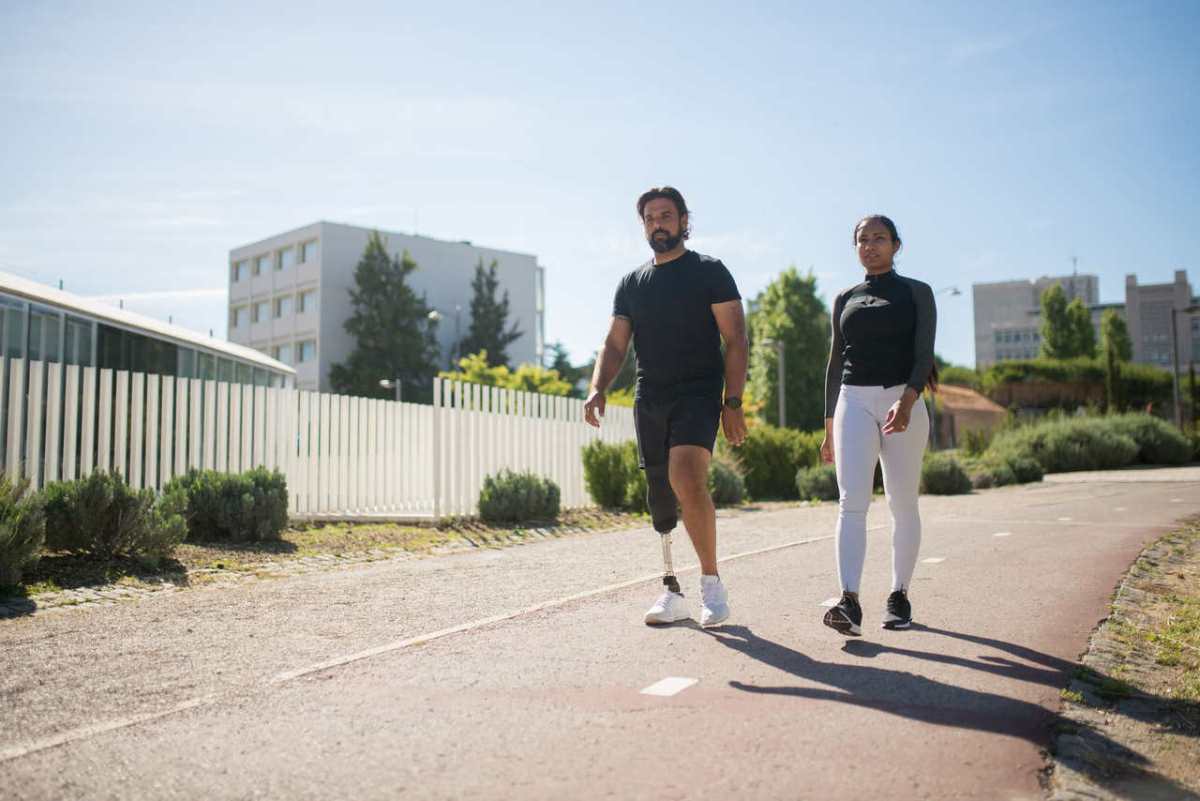
See how cameras turn walking footage into 3D movement data, what gait measurements mean, and why camera setup and repeatability affect the results. Continue reading
Picture a short clip of a friend walking across a room. You might notice a hurried pace or count their steps. Measuring how far each step reaches or how much a knee bends throughout a stride takes more than a casual look.
Markerless motion capture software estimates body positions from camera footage and builds a moving three-dimensional model. Multi-camera systems, for example, estimate 3D human pose from several synchronized views using deep learning. The result looks like an animated skeleton, but the measurements depend on how the footage was recorded and how the software interpreted it.
A single camera records where things appear in a flat image. Software can track a knee or ankle across those frames, but depth must be estimated. Multi-camera workflows film the same walk from several angles at once so the software can reconstruct depth.
Theia, for example, recommends a minimum of eight cameras for a capture space of roughly five by five metres with its own software, though that is not a rule every system follows. Its guide to measuring walking patterns in 3D walks through camera setup and the resulting outputs.
Calibration establishes how the cameras relate to one shared space. Synchronization aligns their recordings in time, so each view describes the same instant of movement. Combining views requires both: the software needs to know where the cameras are relative to one another and which images belong to the same moment.
Conventional marker-based motion capture attaches markers to the body and tracks those points. Markerless methods estimate body landmarks from the images instead. A trained neural network examines each frame and estimates where joints and other landmarks sit, producing a stick figure for each camera view. These positions become the inputs for reconstruction.
Triangulation combines a landmark’s positions across synchronized views to estimate a point in three-dimensional space. It uses the camera positions established during calibration. Repeating this process across landmarks and frames produces a set of moving points. Fitting a skeletal model to those points produces the animated figure used to describe walking, or gait, in 3D.
Other systems estimate 3D movement from a single phone video using learned models of human body shape and movement. That method relies on different assumptions. A one-camera result should not be assumed to match a multi-camera reconstruction.
The reconstructed model provides estimates of foot and joint positions over time. Analysis software can then use those estimates to calculate distances, timing, and joint movement.
Cadence is walking rate, counted in steps per minute. Step length measures the distance between contacts of opposite feet. Stride length measures the distance from one foot’s heel contact to the next heel contact of that same foot, as defined in the ARIC gait study. Walking speed combines distance with time, while stance time describes how long a foot stays on the ground during each cycle. These measurements describe the recorded walk; they do not carry a built-in good or bad label.
A three-dimensional model can describe how joint angles change throughout the walking cycle. These measurements capture bending and straightening, side-to-side movement, and rotation. Tracking angles over time shows how movement changes through a stride rather than at a single frozen pose.
| Measurement | What It Describes |
|---|---|
| Cadence | Steps per minute |
| Step length | Distance between contacts of opposite feet |
| Stride length | Distance between successive heel contacts of the same foot |
| Walking speed | Distance covered over time |
| Joint angles | Changes in joint position through bending, side-to-side movement, and rotation |
Cameras record movement rather than the pressure of a foot against the floor. Force plates, which are instrumented sections of floor, directly measure ground-reaction forces during contact, as the motion-capture company Qualisys explains. Video can be paired with this equipment, but the direct force reading comes from the plate.
Markerless tools commonly export pose data in formats such as .c3d, .fbx, and .json, and turning that data into a report or biomechanical analysis often happens in separate software. This means an exported movement model and a finished walking report are separate outputs.
Some tools process video locally rather than in the cloud. That describes where the analysis runs; it does not, by itself, establish how recordings are stored, who can access them, or whether the wider workflow meets a particular privacy requirement.
A polished animation can make uncertain measurements look convincing. This breakdown of how sensors and software make everyday devices smarter describes the same basic process: sensors collect information, and software interprets it. For a walking report, check the recording conditions, the supporting evidence, and the context of any comparison.
Camera position matters. A study by Jin, Childs, and Fujiyama in the Journal of Biomechanics Open examined how viewing geometry affects the validity of markerless video estimates of spatiotemporal gait parameters. Hidden body parts can also affect estimates. A 2025 validation of SPLYZA Motion, a single-camera system that derives 3D estimates from 2D video, notes that earlier research linked weaker agreement in some joint angles and gait phases to occlusion. These findings apply to the methods studied and should prompt questions about recording conditions, rather than become rules for every system.
Agreement asks how closely a system’s measurements match a reference measurement. Repeatability asks how consistent results are when measurements are repeated under comparable conditions. A person’s walking can also change between sessions, so a difference is not automatically a software error.
Weber and colleagues’ study in PLOS One reported that test-retest reliability of single-camera estimates varied by measurement and walking condition. Evidence supporting one measurement does not establish the reliability of every output, and a single accuracy percentage cannot describe the whole report.
When reading a walking report, ask:
Many markerless tools are built for research and sports use rather than diagnosis or treatment. Interpreting movement measurements for a person’s health requires a qualified professional and the relevant clinical context.
No. Markerless systems estimate body landmarks from video. Marker-based capture attaches markers to the body and tracks those points instead.
Some systems estimate a 3D model from a single video using learned assumptions about body shape and movement. The OpenCap Monocular preprint describes one such method. Its assumptions and supporting evidence differ from those of multi-camera reconstruction, so the approaches should not be treated as equivalent.
No. Step length is the distance between contacts of opposite feet. Stride length is the distance between successive heel contacts of the same foot.
No. Video pose capture estimates body movement. Directly measuring ground-reaction force requires force-measuring equipment such as a force plate. Model-derived force estimates are different from direct measurements.
Replacing legacy VDI with cloud desktops connects desktop architecture with identity controls, application testing, data…
The manufacturing industry is changing rapidly due to new technology. Companies are using modern tools…
Palace has become one of the most influential names in contemporary streetwear, combining skateboarding culture…
Kith has established itself as a recognizable name in modern fashion by combining streetwear influences…
Corteiz has become a recognized name in modern streetwear, known for bold branding, distinctive designs,…
East Providence, Rhode Island, sees steady traffic moving between residential neighborhoods, commercial corridors, and nearby…