Learn what the Amazon Account Health Rating measures, how the color coded page works, what counts as a violation, and how sellers can earn points back Continue reading
The Amazon Account Health Rating is a single number Amazon uses to summarize how well a seller account is performing. Instead of checking many separate reports, Amazon combines several signals into one score, often called an amazon account health score by sellers.
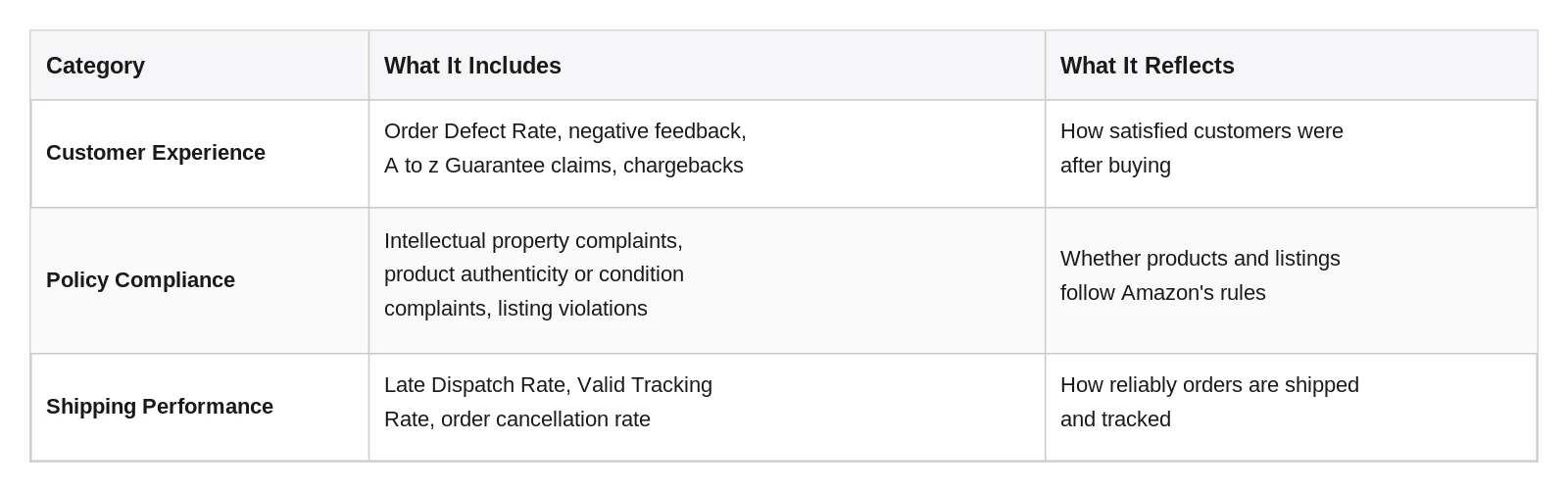
The score comes from three main areas. The table below shows a simple summary of each one.
Because the score blends these signals together, two sellers can share the same number for very different reasons, such as shipping delays for one and a policy issue for another.
This is one reason many sellers check sales numbers alongside account performance instead of looking at the score alone. Some sellers use analytics platforms such as My Real Profit to track daily sales clearly, which makes it easier to notice if a drop in orders lines up with a new account issue.
Amazon has used a scale from 0 to 1000 in the past, and many accounts now use a simpler 0 to 100 scale. The score also updates on a rolling basis, often looking at the past 30 or 60 days.
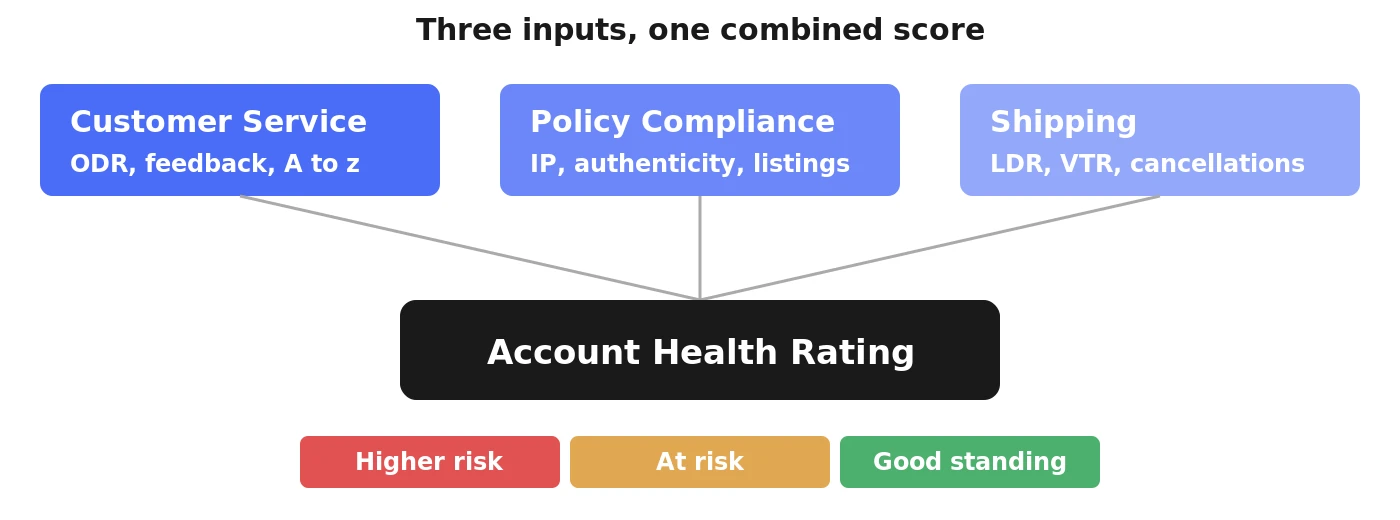
The Amazon Account Health Page uses color to make the current state of an account easy to understand at a glance. Green usually means performance sits within Amazon’s expected limits, with no urgent action needed.
Yellow or orange usually means one or more metrics are getting close to a limit, even if nothing has crossed the line yet. This is an early warning worth a closer look. Red usually means a metric has crossed its limit, and the account faces a higher risk of restrictions or, in serious cases, suspension.
Image: a simple gauge showing how the combined score moves through color zones, from higher risk to good standing. Suggested placement: right after this section.
A single yellow or red status rarely means the whole account is in danger at once. Checking the page weekly makes it easier to catch a slow shift from green toward yellow before it reaches red.
A good account health score is one where all three categories, customer experience, policy compliance, and shipping performance, sit comfortably within Amazon’s expected limits, with no single metric close to its threshold.
There is no single universal number that fits every seller. A high score, usually green, generally supports full access to selling features and a fair chance at the Buy Box. A middle score, often yellow, is a signal to review the account soon. A low score, usually red, carries real risk, including possible restrictions or suspension.
A useful habit is avoiding comparison with another seller’s score, since every account has a different mix of order volume and shipping methods. Watching your own trend over time is far more reliable than chasing a number seen elsewhere.
A violation is any specific event or repeated pattern that Amazon counts against one of the three categories above. Under customer experience, this can mean negative feedback, a successful A to z Guarantee claim, or a chargeback. Under policy compliance, it often comes from a specific complaint, such as an intellectual property issue or a product authenticity question. Amazon also factors these issues into your amazon performance rating, since repeated violations affect how the platform views account standing over time.
Under shipping performance, a violation usually means missing an expected shipping date, failing to provide valid tracking, or canceling an order before it ships.
Not every violation carries the same weight. A single late shipment rarely causes serious harm, while a repeated pattern or a confirmed policy issue has a much stronger effect. Some violations can be resolved with a clear explanation, while others simply need time to fade from the calculation.
Yes, in most cases a seller can recover a lower score over time. For metrics based on a rolling percentage, such as late shipments, recovery often happens naturally as older events fall outside the measurement window, usually between 30 and 60 days.
For policy related violations, recovery is less automatic and usually requires submitting an explanation showing what caused the problem and what steps were taken to prevent it from happening again.
Sellers who want to track this recovery process closely often pair it with their own sales records. Many sellers use an amazon profit dashboard to see daily order and profit numbers next to their account performance, which makes it easier to confirm that sales are stable while the score slowly improves.
A rough timeline for a shipping related issue is three to six weeks of consistent performance. Patience combined with steady daily work is almost always more effective than a rushed shortcut.
The Amazon Account Health Rating brings customer experience, policy compliance, and shipping performance into one combined number and one color coded status. Treating the score as a starting point, not a final verdict, and checking the three categories behind any change, helps a seller react calmly instead of guessing at every small shift.
What is a good Amazon Account Health Rating?
A good score generally means all three categories stay comfortably within Amazon’s expected limits at the same time. There is no single fixed number that applies to every seller.
Why did my Account Health Rating change color without any new orders?
Some metrics use a rolling time window, so older events can fall out of the calculation and change the color even without new activity.
Does a red status always mean my account will be suspended?
Not always. A red status signals higher risk within a specific category, but suspension usually follows a serious or repeated issue rather than a single isolated event.
How long does it take to recover a lower Account Health Rating?
This depends on the type of issue. Percentage based metrics can improve within a few weeks, while policy related violations usually need a clear explanation before they are resolved.
Can I compare my score directly to another seller’s?
It is not very useful in most cases, since every account has a different mix of order volume, product categories, and shipping methods.
A few of my Reels did well on Instagram. Good views, good saves. Then they…
A sales rep finishes a call, but the company record still has an empty industry…
A burst pipe at midnight or a flooded basement during a weekend storm creates a…
Clean contact data is something banks have to maintain, because anti-money laundering rules require them…
When a development team is small, releasing new software can feel simple. A few people…
Zoning, survey, PCA, Phase I. Here is the order that keeps a commercial deal moving…