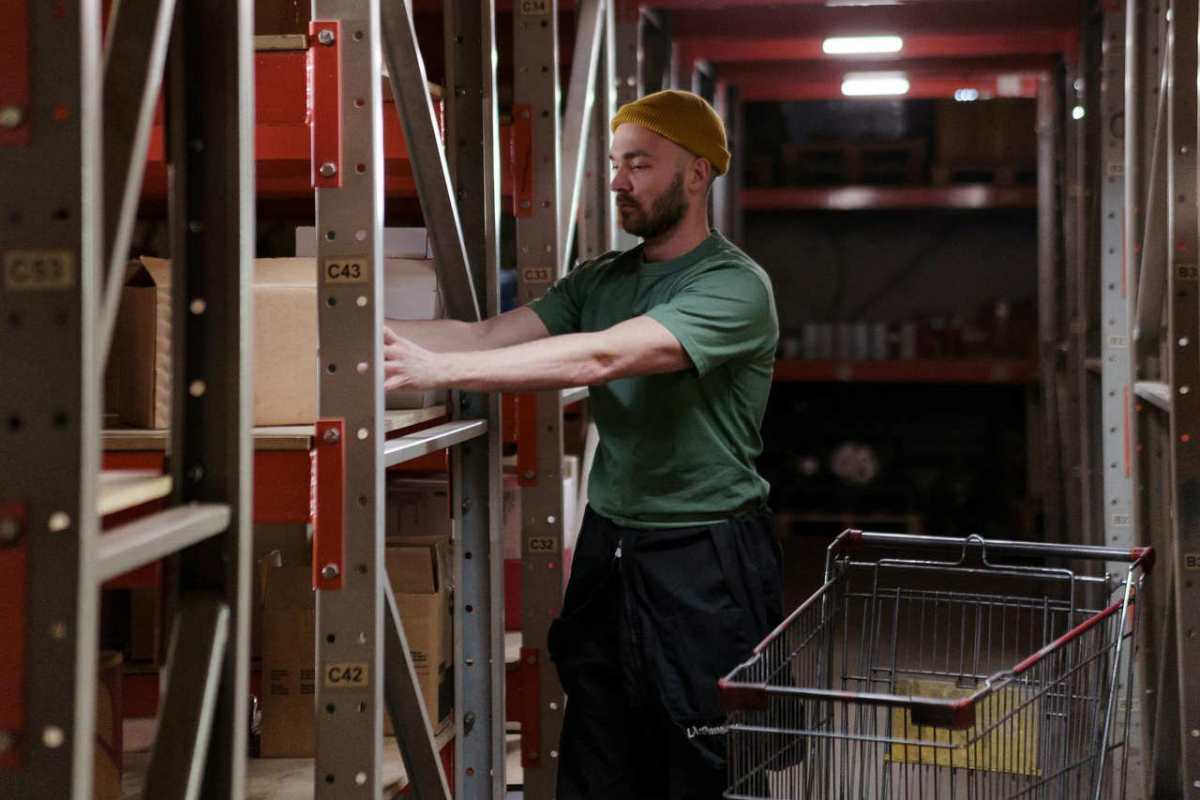
Review standard work quarterly, audit push forces monthly, retire damaged carts at once, and keep route signs at point of use. Just as important, ask workers what slows them down or feels unsafe, then adjust the equipment and flow before small problems become injuries. Continue reading
Peak season exposes weak warehouse flow fast. In a Melbourne third-party logistics site, forklifts clogged cross-aisles, pickers carried cartons between zones, and a near-miss at a busy intersection showed the layout was creating risk instead of controlling it.
The fix was simple. The site carved out pedestrian cart-pick zones, moved low- to mid-weight lines onto flat-deck carts, and kept forklifts in replenishment lanes. Travel got smoother, picks sped up, and people had fewer chances to cross the moving plant.
Flat-deck carts are not a small housekeeping item. Used well, they are a low-cost work health and safety control that cuts hazardous manual tasks and improves pick speed at the same time.
The biggest gains come from better force, better flow, and clear separation from forklifts.
A well-specified trolley replaces high-risk carrying with controlled pushing.
A flat-deck cart is a four-wheel unit with a rated capacity, task-matched castors, and handles that let staff move loads mechanically instead of lifting or carrying them.
That matters because body stress accounted for 34.5% of Australia’s serious workers’ compensation claims in 2023-24, and traumatic joint, ligament, and muscle or tendon injuries made up 36.4%. Claims lasting more than 13 weeks were only 21.9% of cases, but they consumed 74.8% of total compensation payments.
Order picking can represent up to 55% of total warehouse operating expense, so even small cart-pick gains can improve margins.
The best trolley programs improve safety, speed, and flexibility at once.
Trolleys reduce exposure to hazardous manual tasks by replacing carrying with pushing. The Model Code of Practice puts mechanical aids above training and personal protective equipment, so a trolley is a stronger control than a reminder poster. Label load limits clearly and test starting and rolling force on real routes.
Cart-first picking in pedestrian zones reduces travel friction and forklift conflict. Use 1.3-metre aisles, one-way flow, and short drop points to limit long pushes. WorkSafe Victoria reported 142 accepted claims from forklift incidents in 2022, so fewer crossings mean fewer high-severity risks.
Trolleys cost far less than conveyors or mobile robot systems, and you can redeploy them in hours. Teams can trial different decks, castors, or handles, then shift carts to new zones as demand changes. Fewer drops also mean fewer damaged goods.
Most trolley problems start with poor specification, not poor effort from staff.
Start with the floor. Larger wheel diameters and low-resistance bearings cut effort, hard tread suits smooth epoxy, and softer or semi-pneumatic tread handles rough transitions better. Two fixed plus two swivel castors give better tracking in long aisles, and route checks should flag any threshold or dock step where an access ramp will help a platform trolley roll safely.
Add foot or hand brakes for ramps and docks, use straps or gates for unstable items, and keep the heaviest stock low on the deck. WorkSafe Victoria suggests starting forces of about 17 to 21 kgf, or kilogram-force, and rolling force at or below 12 kgf for pushes over 3 metres. Slopes matter fast, and every 100 kilograms of laden trolley weight on a 1-in-20 slope adds about 5 kgf of push force.
If staff cross dock thresholds, kerbs, or vehicle entries, remove step-ups with a compliant access ramp. Then trial the trolley on the worst surface and steepest slope with the workers who will use it before a bulk buy.
Put trolleys where they replace the most carrying, awkward reaches, or forklift contact.
These areas usually pay back first.
If you want budget approval, measure the change before and after the pilot.
Do not rely on anecdotes. Baseline near-miss counts, musculoskeletal incident rate, push-force readings on worst-case routes, and lines per labour hour before the pilot starts. Use a calibrated force gauge, take at least three readings per route and slope, and average the results.
A 90-day pilot is usually enough. Pick one product family and one aisle, implement cart-first standard work and exclusion zones, and train staff on posture, braking, and sightlines. Use the first two weeks for force-testing and floor fixes, the next eight for live use, and the last two for analysis. Accept the change only if push forces fall, near-misses drop, and productivity improves without extra headcount.
A trolley helps only when the cart, load, route, and rules match the task.
Review standard work quarterly, audit push forces monthly, retire damaged carts at once, and keep route signs at point of use. Just as important, ask workers what slows them down or feels unsafe, then adjust the equipment and flow before small problems become injuries.
Meta description Software companies that sell in Europe often need a local entity. Here is…
A lead scanned at a trade show is only as good as the record behind…
A done-for-you cost segregation study spares landlords the classification work. See what the finished report…
Write down the priority order and put it somewhere visible. It takes an afternoon and…
Learn how to safely reset a tripped circuit breaker, spot the warning signs of a…
Three contractors, three wildly different bids. Here is what actually drives roof pricing in Seattle…