By connecting WhatsApp to a tool like Respond.io or HubSpot, you turn that noise into a structured pipeline. You stop guessing which leads are real. You stop losing phone numbers. Continue reading
You launch a campaign. The clicks roll in. Your phone buzzes every thirty seconds. It feels like success, but by Friday, you realize the truth: you spent the entire week chatting with people who have no budget, no authority, or no real interest in buying. Meanwhile, the three serious buyers who messaged you on Tuesday are still waiting for a reply. They bought from your competitor on Wednesday.
This is the “WhatsApp trap.” It feels productive because it’s loud and busy. But without a system to filter noise, you aren’t selling; you are just typing.
To fix this, you don’t need to type faster. You need a system that filters people for you. You need a tool that syncs WhatsApp with your customer database, qualifies leads while you sleep, and shows your sales team exactly who to call first.
Here is how the right tools turn WhatsApp from a chaotic chat app into a revenue engine, and five tools that do it best.
When you treat WhatsApp as a simple chat app, you rely on human memory and speed. This fails for three reasons:
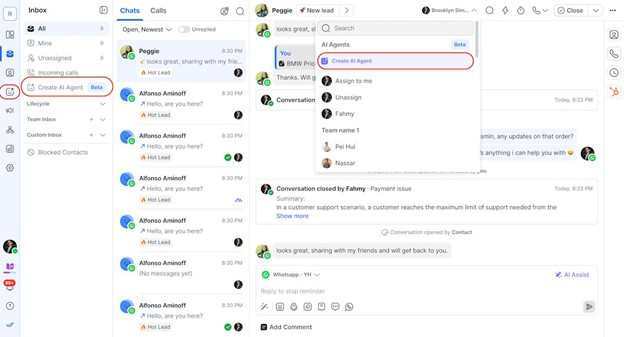
A WhatsApp CRM solves this by connecting the chat (where the customer is) with the data (where the business logic is). It allows you to set rules or use AI Agents to handle the flow. These agents reply to leads instantly, filter out spam, and qualify prospects. Then, they prioritize the serious buyers and automatically route them to the right salesperson.
We tested the market to find tools that don’t just “connect” WhatsApp but actively help you filter and convert leads.
Respond.io is a customer conversation management platform built for high-volume chat, email and call interactions across the customer lifecycle, with built-in CRM integrations, AI Agents and advanced reporting.
It is widely considered the best WhatsApp CRM for businesses that depend on WhatsApp or other instant messaging channels and require advanced AI-powered qualification, routing and automation, plus integrations with CRMs like Salesforce and HubSpot.
Respond.io has agentic AI Agents that can qualify leads, extract key details and hand conversations over to humans whenever necessary. Unlike rigid chatbots that rely on fixed rules, these agents understand intent and adapt to how customers naturally write, even with typos or incomplete sentences.
You can configure the AI Agent to run the qualification flow automatically. For example, when a new lead messages you, the AI Agent can filter out spam leads, then ask qualifying questions based on your setup, such as budget, product interest or purchase readiness, before determining the best next step.
Based on the customer’s replies, the system can automatically:
Respond.io AI Agents cut through inbox noise by identifying and routing serious buyers to your sales team immediately. Low-intent contacts stay out of the way, so reps spend their time where it matters.
Plus, with WhatsApp Business Calling, teams can switch from chat to call in one click – perfect for fast-moving or high-value deals that close better over the phone.
Best for: B2C businesses that rely on conversations to drive revenue across chat (including WhatsApp), email and voice calls and want a unified platform with advanced AI Agents, CRM integrations, customer lifecycle tracking and more.
HubSpot is the default brain for many B2B sales teams. Its native WhatsApp integration brings the chat directly into the customer’s timeline. If you live inside HubSpot, this integration makes WhatsApp feel like just another part of the contact record.
The power here lies in “Workflows.” You can trigger WhatsApp messages based on website behavior.
Imagine a prospect visits your pricing page three times in one week. HubSpot tracks this. You can set a rule: “If a contact visits the Pricing URL > 3 times, send a WhatsApp template: ‘Saw you checking our plans. Want a quick demo?'”
If they reply, the conversation logs automatically on their contact card. You can also use HubSpot’s lead scoring. If a lead chats on WhatsApp, their score goes up. If the score hits 50, the system creates a deal and assigns a task to a salesperson.
Context. When a salesperson replies to a WhatsApp message in HubSpot, they see the lead’s entire history: every email opened, every page visited, and every past purchase. They don’t ask “How can I help?”; they ask “Did you like the Enterprise plan you looked at yesterday?” That precision closes deals.
Best for: Marketing and sales teams who already run their lives through HubSpot.
Zoho offers a toolkit for everything, and its WhatsApp integration fits that mold. It is flexible, affordable, and deeply customizable.
You can connect it natively or use third-party extensions depending on your region and technical needs.
Zoho uses a feature called “Blueprints.” This forces your sales team to follow a process. You can design a Blueprint for WhatsApp leads that requires an agent to ask specific questions before moving the deal to the next stage.
For example, an agent cannot move a lead from “New” to “Qualified” until they tick a box confirming they received the client’s budget via WhatsApp. The system prompts the agent to ask the question if the field is empty.
Consistency. In many teams, top performers convert at 30% while juniors convert at 5%. Zoho’s structure ensures every lead on WhatsApp gets the same high-standard treatment. No lead gets dropped because an agent “forgot” to ask for the budget.
Best for: Small to medium businesses that need structure and affordability.
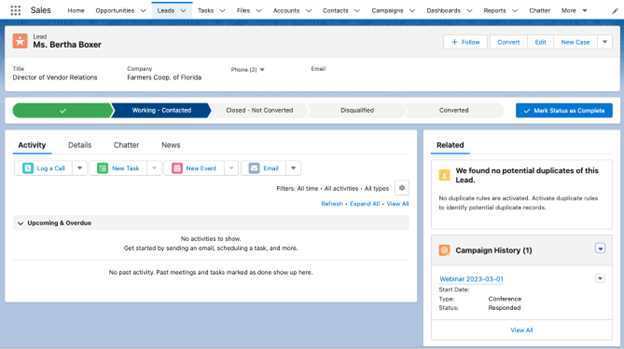
Salesforce is the heavy lifter. Its integration (via Digital Engagement or partners) is not for casual users. It is for enterprises where a lost lead costs thousands of dollars.
Salesforce combines WhatsApp with Einstein (their AI). It analyzes the sentiment of messages. If a lead sounds frustrated or urgent, the system flags it.
You can build complex “Flows.” For example: A lead messages via WhatsApp. Salesforce checks their phone number against your database.
Power. Salesforce allows for extreme personalization at scale. You can send a WhatsApp message that pulls data from five different fields: “Hi John, your renewal for [Product X] is coming up on [Date]. Since you used [Feature Y] heavily last month, we recommend upgrading to…” This level of detail proves you know your customer.
Best for: Large enterprises with complex sales cycles and distinct sales departments.
Kommo does not try to be an “everything store.” It focuses entirely on messenger-based sales.
If your business lives in chat, Kommo builds your entire sales process around it, treating every WhatsApp conversation as a deal in a pipeline rather than just a support ticket.
How it Improves Qualification The standout feature is the visual Salesbot. It is not just a greeter. It qualifies leads inside the chat and physically moves their deal card to the next stage in your pipeline.
You can build a logic path without code: When a lead messages via WhatsApp, the bot asks, “Are you looking for B2B or B2C services?”
Why it Converts
Visibility. Most tools show a chronological list of chats, which buries older (but valuable) conversations. Kommo shows a board of deals, similar to Trello. You see instantly which WhatsApp conversations are “New,” which are “In Progress,” and which are stalled. You prioritize by deal stage, not by who messaged last.
Best for: Small to medium businesses (SMBs) that want a visual, board-style view for their WhatsApp chats.
Simply buying these tools won’t fix your sales process. You need to apply the “Sync + Productivity” framework. This is a mental model for setting up your WhatsApp CRM.
Your first goal is to ensure that what happens in WhatsApp stays in the CRM.
Once data is syncing, you must stop your team from doing robot work.
Now that you have a qualified lead, you need to close them.
The difference between a chat app and a sales channel is data. WhatsApp without a CRM is just noise – a constant stream of notifications that distracts your team.
By connecting WhatsApp to a tool like Respond.io or HubSpot, you turn that noise into a structured pipeline. You stop guessing which leads are real. You stop losing phone numbers. You stop asking “What is your budget?” for the hundredth time. Instead, you start the conversation at the finish line, closing the deal because you already know who you are talking to and what they need.
A new client usually arrives with scattered details, rushed messages, and files saved across too…
In the current technological landscape, HIX.AI is pioneering a significant shift in how we perceive…
Cash flow data is easy to describe in broad terms and much harder to use…
The way people create and consume content online is changing rapidly, and artificial intelligence is…
During preparation for investments, audits, or certifications, attention to cybersecurity increases. Investors, auditors, and certification…
Logistics software development services enable companies to design and implement digital platforms that improve visibility,…